


收稿日期: 2025-06-09
修回日期: 2025-09-02
网络出版日期: 2026-10-16
基金资助
国家自然科学基金项目(42177424);国家自然科学基金项目(42522206);中国科学院“伙伴计划-未来网络伙伴专项”(052GJHZ2022024FN)
Advances and future directions in Paleolithic composite tool research
Received date: 2025-06-09
Revised date: 2025-09-02
Online published: 2026-10-16
旧石器时代的复合工具常被视为“行为现代性”过程的指征之一,标志着史前人类的工具制作出现重要创新。旧石器时代的复合工具可上溯至旧石器时代中期,并在旧石器时代晚期得到极大发展,其过程伴随着狩猎行为的普遍化和加工行为的高效化。此外,复合工具的设计与制造过程所需的多层思维和精细操作能力是反映制造者认知水平与体质发展的重要间接证据,相关的神经科学研究甚至指出复合工具与语言发展之间存在密切联系。目前,国际学术界在旧石器时代的复合工具研究中有较多尝试,而国内学界对此的讨论仍然较少。本文尝试梳理旧石器时代复合工具研究中的概念框架与研究方法,系统介绍持续更新的技术-类型分析、痕迹学分析和残留物分析等方法在复合工具识别中的应用。在此基础上,本文就复合工具的多维研究视角及其在人类演化中的意义展开深入讨论。
林乃如 , SANO Katsuhiro , 杨石霞 . 旧石器时代复合工具的研究进展与展望[J]. 人类学学报, 2026 , 45(05) : 991 -1006 . DOI: 10.16359/j.1000-3193/AAS.2025.0107
The manufacture of composite tools is often seen as a hallmark of cognitive sophistication, and played important role in the process of “behavioral modernity”. The emergence of composite tools can be traced back to the Middle Stone Age in Africa and the Middle Palaeolithic in Europe, with marked progress evident in later-stage lithic assemblages, culminating in the refinement of microlithic techniques. This technological innovation in tool production catalyzed the intensification of hunting practices and the systematization of resource-processing behaviors—adaptations likely rooted in selective pressures to optimize caloric returns and reduce energy expenditure. Distinct from monolithic tools—defined as implements crafted exclusively from stone—composite tools are engineered systems integrating multiple material components: (1) a lithic working element (e.g., blade, point), (2) an organic haft (wooden or bone shaft), and (3) adhesive / binder substances (e.g., plant resins, animal-derived glues). Therefore, the manufacture of composite tools requires the integration of diverse materials and involves multi-layered cognitive organization and fine motor skills. This techno-behavioral complexity positions composite toolmaking as a keystone innovation in hominin biocultural evolution, bridging material culture and emerging cognitive architectures. Notably, neurosciences analysis hypothesized a coevolutionary relationship between hafting technologies and the emergence of syntactic language, suggesting that the neural circuitry required for tool assembly may have scaffolded the development of recursive symbolic communication.
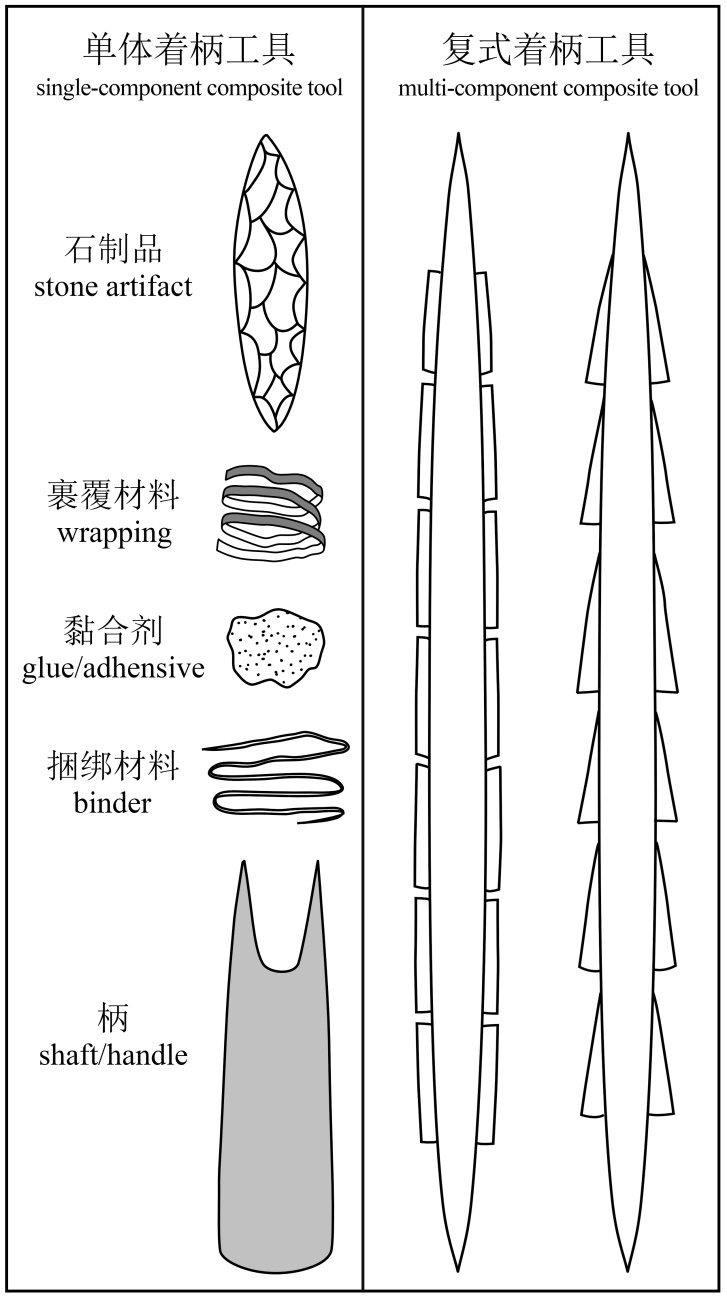
The composite tools can be classified into two principal categories: single-component composite tools (featuring a singular lithic element, such as hafted projectile points) and multi-component composite tools (integrating multiple lithic elements, exemplified by bone shafts inset with microlithic blades). Archaeological records from Africa demonstrate that single-component variants, notably hafted stone points, emerged as early as 500,000 years ago. In contrast, multi-component innovations—characterized by the strategic embedding of microliths or microblades into organic shafts—appear significantly later, with definitive examples dating to around 70,000 years ago. Although organic shaft and binder components are seldom preserved, the frequent analysis of adhesive and hafting traces provides verifiable evidence for composite tool identification. The emergence of composite tools represents not only a pivotal technological innovation in the Paleolithic Age but also a catalyst for advancing resource exploitation strategies and tool production systems. Despite their transformative role in human cultural evolution, the geographic distribution of documented composite tool assemblages remains heavily skewed, with robust evidence predominantly documented in Western Eurasia, Africa, and North America. By contrast, East Asian cases remain conspicuously underrepresented in global archaeological discourse. This disparity is particularly pronounced within Chinese archaeological research, where systematic investigations of composite tools have long remained understudied.
In this paper, we first establish a conceptual framework for composite tool analysis, addressing critical definitional challenges and proposing a functional classification system grounded in technological behavior. We then evaluate interdisciplinary methodological approaches for identifying composite tools, integrating techno-typological analysis, traceology, and residue analysis to reconstruct hafting techniques and material interactions. Through this synthesis, we further explore how composite tool studies can refine perspectives on human evolutionary trajectories. By reviewing these analytical frameworks, we highlighted the potential for composite tool studies to reveal previously unrecognized patterns in hominin adaptability and cultural dynamics in East Asia.
Key words: Composite tools; hafting; toolmaking ability; human evolution
| [1] | Kuhn SL, Shimelmitz R. From hafting to retooling: Miniaturization as tolerance control in paleolithic and neolithic blade production[J]. Journal of Archaeological Method and Theory, 2023, 30(2): 678-701 |
| [2] | McBrearty S, Brooks AS. The revolution that wasn’t: a new interpretation of the origin of modern human behavior[J]. Journal of human evolution, 2000, 39(5): 453-563 |
| [3] | Scerri EML, Will M. The revolution that still isn’t: The origins of behavioral complexity in Homo sapiens[J]. Journal of Human Evolution, 2023, 179: 103358 |
| [4] | Barham LS. From hand to handle: The first industrial revolution[M]. Oxford: Oxford University Press, 2013 |
| [5] | Iovita R, Sano K (Eds.). Multidisciplinary approaches to the study of Stone Age weaponry[M]. London: Springer, 2016 |
| [6] | Midoshima T. An Experimental Trace Study of Obsidian Lithics[M]. Tokyo: Doseisha, 2020 (in Japanese) |
| [7] | Langejans G, Aleo A, Fajardo S, et al. Archaeological adhesives[A/OL]. In: Aldenderfer M(Ed.). Oxford Research Encyclopedia of Anthropology[M/OL]. New York, NY: Oxford Academic, 2022. DOI: 10.1093/acrefore/9780190854584.013.198 |
| [8] | Bo?da E, Connan J, Dessort D, et al. Bitumen as a hafting material on Middle Palaeolithic artefacts[J]. Nature, 1996, 380(6572): 336-338 |
| [9] | Bo?da E, Bonilauri S, Connan J, et al. Middle Palaeolithic bitumen use at Umm el Tlel around 70 000 BP[J]. Antiquity, 2008, 82(318): 853-861 |
| [10] | Bo?da E, Bonilauri S, Connan J, et al. New evidence for significant use of bitumen in Middle Palaeolithic technical systems at Umm el Tlel (Syria) around 70,000 BP[J]. Paléorient, 2008, 34(2): 67-83 |
| [11] | Monnier GF, Hauck TC, Feinberg JM, et al. A multi-analytical methodology of lithic residue analysis applied to Paleolithic tools from Hummal, Syria[J]. Journal of Archaeological Science, 2013, 40(10): 3722-3739 |
| [12] | Serizawa C. Hafting method of microblades[A]. In: Serizawa C, Sutoh T (Eds.). The Araya site: report of the second and third term excavations, 1988-1989[C]. Sendai:Department of archaeology, graduate school of arts and letters, Tohoku University, and the Kawaguchi board of education, 2003, 84-88 (in Japanese) |
| [13] | Sano K. The emergence of complex hunting technology: innovation of Homo sapiens[A]. In: Nishiaki Y(Ed.). Homo sapiens and Archaic humans 3: shifting story in people and culture[M]. Tokyo: Rokuichi Shobo, 2015, 127-139 (in Japanese) |
| [14] | Zhang SQ, Doyon L, Zhang Y, et al. Innovation in bone technology and artefact types in the late Upper Palaeolithic of China: Insights from Shuidonggou Locality 12[J]. Journal of Archaeological Science, 2018, 93: 82-93 |
| [15] | Stordeur D. Manches et emmanchements préhistoriques: quelques propositions préliminaires[A]. In: Stordeur D (Ed.). La Main et l’Outil. Manches et emmanchements préhistoriques[C]. Lyon: Maison de l’Orient et de la Méditerranée, 1987, 11-34 |
| [16] | Tomasso S, Cnuts D, Mikdad A, et al. Changes in hafting practices during the Middle Stone Age at Ifri n’Ammar[J]. Quaternary International, 2020, 555: 21-32 |
| [17] | Slade AM. To haft and to hold: Evidence for the hafting of Clovis fluted points[J]. Journal of Lithic Studies, 2021, 8(3): 133-151 |
| [18] | Alperson-Afil N, Goren-Inbar N. Acheulian hafting: Proximal modification of small flint flakes at Gesher Benot Ya’aqov, Israel[J]. Quaternary International, 2016, 411: 34-43 |
| [19] | Pétillon JM, Bignon O, Bodu P, et al. Hard core and cutting edge: experimental manufacture and use of Magdalenian composite projectile tips[J]. Journal of Archaeological Science, 2011, 38(6): 1266-1283 |
| [20] | Wang FG, Yang SX, Ge JY, et al. Innovative ochre processing and tool use in China 40,000 years ago[J]. Nature, 2022, 603(7900): 284-289 |
| [21] | Rots V. Prehension and Hafting Traces on Flint Tools: A Methodology[M]. Leuven: Leuven University Press, 2010 |
| [22] | Odell GH, Odell-Vereecken F. Verifying the reliability of lithic use-wear assessments by ‘blind tests’: the low-power approach[J]. Journal of Field Archaeology, 1980, 7(1): 87-120 |
| [23] | Odell GH. The mechanics of use-breakage of stone tools: some testable hypotheses[J]. Journal of Field archaeology, 1981, 8(2): 197-209 |
| [24] | Odell GH. Prehistoric hafting and mobility in the North American Midcontinent: Examples from Illinois[J]. Journal of Anthropological Archaeology, 1994, 13(1): 51-73 |
| [25] | Keeley LH. Hafting and retooling: effects on the archaeological record[J]. American antiquity, 1982, 47(4): 798-809 |
| [26] | Stordeur D(Ed.). La Main et l’Outil. Manches et emmanchements préhistoriques[C]. Lyon: Maison de l’Orient et de la Méditerranée, 1987 |
| [27] | 杨石霞. 人类演化中的“行为现代性”与“现代人行为”探讨[J]. 人类学学报, 2025, 44(2): 181-192 |
| [28] | Sano K, Oba M. Backed point experiments for identifying mechanically-delivered armatures[J]. Journal of Archaeological Science, 2015, 63: 13-23 |
| [29] | Sano K, Denda Y, Oba M. Experiments in fracture patterns and impact velocity with replica hunting weapons from Japan[A]. In: Iovita R, Sano K (Eds.). Multidisciplinary approaches to the study of Stone Age weaponry[C]. Dordrecht: Springer, 2016, 29-46 |
| [30] | Groman-Yaroslavski I, Zaidner Y, Weinstein-Evron M. Complexity and sophistication of Early Middle Paleolithic flint tools revealed through use-wear analysis of tools from Misliya Cave, Mount Carmel, Israel[J]. Journal of Human Evolution, 2021, 154: 102955 |
| [31] | Coppe J, Taipale N, Rots V. Terminal ballistic analysis of impact fractures reveals the use of spearthrower 31 ky ago at Maisières-Canal, Belgium[J]. Scientific Reports, 2023, 13(1): 18305 |
| [32] | Kanomata Y, Sano K. The Takakurayama site: studies of the late paleolithic culture in the Mogami river basin, vol.3[M]. Sendai: Tohoku culture research room, graduate school of arts and letters, Tohoku University, 2016 (in Japanese) |
| [33] | Kanomata Y, Kumagai R. The Hakusan E and Hakusan B sites: studies of the late paleolithic culture in the Mogami river basin, vol.4[M]. Sendai: Tohoku culture research room, graduate school of arts and letters, Tohoku University. 2019, 101-106 (in Japanese) |
| [34] | Fischer A, Hansen PV, Rasmussen P. Macro and micro wear traces on lithic projectile points[J]. Journal of Danish Archaeology, 1984, 3: 19-46 |
| [35] | Sano K. Hunting evidence from stone artefacts from the Magdalenian cave site Bois Laiterie, Belgium: a fracture analysis[J]. Quart?r, 2009, 56: 67-86 |
| [36] | Sano K. Evidence for the use of the bow-and-arrow technology by the first modern humans in the Japanese islands[J]. Journal of Archaeological Science: Reports, 2016, 10: 130-141 |
| [37] | Lee GK, Sano K. Were tanged points mechanically delivered armatures? Functional and morphometric analyses of tanged points from an Upper Paleolithic site at Jingeuneul, Korea[J]. Archaeological and Anthropological Sciences, 2019, 11(6): 2453-2465 |
| [38] | 关莹, 高星. 旧石器时代残留物分析:回顾与展望[J]. 人类学学报, 2009, 28(4): 418-429 |
| [39] | Sano K, Omori T. Residue study and use-wear analysis on backed points[A]. In: Suzuki M, Ichikawa M (Eds.). Shimohara and Fujimi-cho sites 3: excavation of the Upper Palaeolithic site(1)[C]. Tokyo: Meiji University, 2016, 120-127 (in Japanese) |
| [40] | Mazza PPA, Martini F, Sala B, et al. A new Palaeolithic discovery: tar-hafted stone tools in a European Mid-Pleistocene bone-bearing bed[J]. Journal of Archaeological Science, 2006, 33(9): 1310-1318 |
| [41] | Schmidt P, Iovita R, Charrié-Duhaut A, et al. Ochre-based compound adhesives at the Mousterian type-site document complex cognition and high investment[J]. Science Advances, 2024, 10(8): eadl0822 |
| [42] | Pawlik AF, Thissen JP. Hafted armatures and multi-component tool design at the Micoquian site of Inden-Altdorf, Germany[J]. Journal of Archaeological Science, 2011, 38(7): 1699-1708 |
| [43] | Niekus MJT, Kozowyk PR, Langejans GH, et al. Middle Paleolithic complex technology and a Neandertal tar-backed tool from the Dutch North Sea[J]. Proceedings of the National Academy of Sciences, 2019, 116(44): 22081-22087 |
| [44] | Degano I, Soriano S, Villa P, et al. Hafting of Middle Paleolithic tools in Latium (central Italy): new data from Fossellone and Sant’Agostino caves[J]. PLoS ONE, 2019, 14(6): e0213473 |
| [45] | Sano K, Arrighi S, Stani C, et al. The earliest evidence for mechanically delivered projectile weapons in Europe[J]. Nature Ecology & Evolution, 2019, 3(10): 1409-1414 |
| [46] | Koller J, Baumer U, Mania D. High-tech in the middle Palaeolithic: Neandertal-manufactured pitch identified[J]. European Journal of Archaeology, 2001, 4(3): 385-397 |
| [47] | Picin A. Short-term occupations at the lakeshore: a technological reassessment of the open-air site K?nigsaue (Germany)[J]. Quart?r, 2016, 63: 7-32 |
| [48] | Carciumaru M, Ion RM, Ni?u EC, et al. New evidence of adhesive as hafting material on Middle and Upper Palaeolithic artefacts from Gura Cheii-Ra?nov Cave (Romania)[J]. Journal of Archaeological Science, 2012, 39(7): 1942-1950 |
| [49] | Dinnis R, Pawlik A, Gaillard C. Bladelet cores as weapon tips? Hafting residue identification and micro-wear analysis of three carinated burins from the late Aurignacian of Les Vachons, France[J]. Journal of Archaeological Science, 2009, 36(9): 1922-1934 |
| [50] | Hauck TC, Connan J, Charrié-Duhaut A, et al. Molecular evidence of bitumen in the Mousterian lithic assemblage of Hummal (Central Syria)[J]. Journal of Archaeological Science, 2013, 40(8): 3252-3262 |
| [51] | Gibson NE, Wadley L, Williamson BS. Microscopic residues as evidence of hafting on backed tools from the 60000 to 68000 year-old Howiesons Poort layers of Rose Cottage Cave, South Africa[J]. Southern African Humanities, 2004, 16(1): 1-11 |
| [52] | Wadley L. Ochre crayons or waste products? Replications compared with MSA ‘crayons’ from Sibudu Cave, South Africa[J]. Before Farming, 2005, 2005(3): 1-12 |
| [53] | Lombard M. The gripping nature of ochre: the association of ochre with Howiesons Poort adhesives and Later Stone Age mastics from South Africa[J]. Journal of Human Evolution, 2007, 53(4): 406-419 |
| [54] | Charrié-Duhaut A, Porraz G, Cartwright CR, et al. First molecular identification of a hafting adhesive in the late Howiesons Poort at Diepkloof Rock Shelter (Western Cape, South Africa)[J]. Journal of Archaeological Science, 2013, 40(9): 3506-3518 |
| [55] | Villa P, Soriano S, Tsanova T, et al. Border Cave and the beginning of the Later Stone Age in South Africa[J]. Proceedings of the National Academy of Sciences, 2012, 109(33): 13208-13213 |
| [56] | Zhang Y, Li S, Lotter MG, et al. First Evidence for Adhesive and Composite-tool Use During the Upper Palaeolithic in South China[J]. Lithic Technology, 2025, 51(2): 108-117 |
| [57] | Roebroeks W, Villa P. On the earliest evidence for habitual use of fire in Europe[J]. Proceedings of the National Academy of Sciences, 2011, 108(13): 5209-5214 |
| [58] | Hardy BL, Moncel MH, Kerfant C, et al. Direct evidence of Neanderthal fibre technology and its cognitive and behavioral implications[J]. Scientific Reports, 2020, 10(1): 4889 |
| [59] | Taipale N, Rots V. Functional perspectives on lithic standardization[J]. Lithic Technology, 2023, 48(4): 452-475 |
| [60] | Pargeter J, Shea JJ. Going big versus going small: Lithic miniaturization in hominin lithic technology[J]. Evolutionary Anthropology: Issues, News, and Reviews, 2019, 28(2): 72-85 |
| [61] | Rots V. Insights into early Middle Palaeolithic tool use and hafting in Western Europe. The functional analysis of level IIa of the early Middle Palaeolithic site of Biache-Saint-Vaast (France)[J]. Journal of Archaeological Science, 2013, 40(1): 497-506 |
| [62] | Sahle Y, Brooks AS. Assessment of complex projectiles in the early Late Pleistocene at Aduma, Ethiopia[J]. PLoS ONE, 2019, 14(5): e0216716 |
| [63] | Wilkins J, Schoville BJ, Brown KS, et al. Evidence for early hafted hunting technology[J]. Science, 2012, 338(6109): 942-946 |
| [64] | Lombard M. Quartz-tipped arrows older than 60 ka: further use-trace evidence from Sibudu, KwaZulu-Natal, South Africa[J]. Journal of Archaeological Science, 2011, 38(8): 1918-1930 |
| [65] | Lombard M. Re-considering the origins of Old World spearthrower-and-dart hunting[J]. Quaternary Science Reviews, 2022, 293: 107677 |
| [66] | Sano K. Development of hunting tools and the dispersal of Homo Sapiens: from Africa to Europe[A]. In: Harunari H(Ed.). What Changed History? Volume 1: Nature History and Paleolithic/Jomon Archaeology[M]. Tokyo: yuzankaku, 2023, 85-96 (in Japanese) |
| [67] | Moroni A, Boscato P, Ronchitelli A. What roots for the Uluzzian? Modern behaviour in Central-Southern Italy and hypotheses on AMH dispersal routes[J]. Quaternary International, 2013, 316: 27-44 |
| [68] | Yang SX, Zhang JF, Yue JP, et al. Initial Upper Palaeolithic material culture by 45,000 years ago at Shiyu in northern China[J]. Nature Ecology & Evolution, 2024, 8(3): 552-563 |
| [69] | Rots V, Van Peer P. Early evidence of complexity in lithic economy: core-axe production, hafting and use at Late Middle Pleistocene site 8-B-11, Sai Island (Sudan)[J]. Journal of Archaeological Science, 2006, 33(3): 360-371 |
| [70] | Rots V, Van Peer P, Vermeersch PM. Aspects of tool production, use, and hafting in Palaeolithic assemblages from Northeast Africa[J]. Journal of Human Evolution, 2011, 60(5): 637-664 |
| [71] | Rots V. Hafting and the interpretation of site function in the European Middle Palaeolithic[A]. In: Conard NJ, Delagnes A (Eds.). Settlement Dynamics of the Middle Palaeolithic and Middle Stone Age: Vol. IV[C]. Tübingen: Kerns Verlag, 2015, 383-410 |
| [72] | Rots V, Lentfer C, Schmid VC, et al. Pressure flaking to serrate bifacial points for the hunt during the MIS5 at Sibudu Cave (South Africa)[J]. PloS ONE, 2017, 12(4): e0175151 |
| [73] | Tomasso S, Rots V. What is the use of shaping a tang? Tool use and hafting of tanged tools in the Aterian of Northern Africa[J]. Archaeological and Anthropological Sciences, 2018, 10: 1389-1417 |
| [74] | Taipale N, Rots V. Every hunter needs a knife: Hafted butchering knives from Maisières-Canal and their effect on lithic assemblage characteristics[J]. Journal of Archaeological Science: Reports, 2021, 36: 102874 |
| [75] | Zipkin AM, Wagner M, McGrath K, et al. An experimental study of hafting adhesives and the implications for compound tool technology[J]. PloS ONE, 2014, 9(11): e112560 |
| [76] | Kozowyk PR, Soressi M, Pomstra D, et al. Experimental methods for the Palaeolithic dry distillation of birch bark: implications for the origin and development of Neandertal adhesive technology[J]. Scientific reports, 2017, 7(1): 8033 |
| [77] | Wadley L. Putting ochre to the test: replication studies of adhesives that may have been used for hafting tools in the Middle Stone Age[J]. Journal of Human Evolution, 2005, 49(5): 587-601 |
| [78] | Wynn T. Tools and the evolution of human intelligence[A]. In: Byrne RW, Whiten A (Eds.). Machiavellian intelligence: Social expertise and the evolution of intellect in monkeys, apes, and humans[C]. Oxford: Clarendon Press / Oxford University Press, 1988, 271-284 |
| [79] | Ambrose SH. Coevolution of composite-tool technology, constructive memory, and language: implications for the evolution of modern human behavior[J]. Current Anthropology, 2010, 51(S1): S135-S147 |
| [80] | Coolidge FL, Wynn T. Working memory, its executive functions, and the emergence of modern thinking[J]. Cambridge Archaeological Journal, 2005, 15(1): 5-26 |
| [81] | Stout D, Toth N, Schick K, et al. Neural correlates of Early Stone Age toolmaking: technology, language and cognition in human evolution[J]. Philosophical Transactions of the Royal Society B: Biological Sciences, 2008, 363(1499): 1939-1949 |
| [82] | Key A, Farr I, Hunter R, et al. Why invent the handle? Electromyography (EMG) and efficiency of use data investigating the prehistoric origin and selection of hafted stone knives[J]. Archaeological and Anthropological Sciences, 2021, 13: 162 |
| [83] | Coe D, Barham L, Gardiner J, et al. A biomechanical investigation of the efficiency hypothesis of hafted tool technology[J]. Journal of the Royal Society Interface, 2022, 19(188): 20210660 |
| [84] | Mika A, Lierenz J, Smith A, et al. Hafted technologies likely reduced stone tool-related selective pressures acting on the hominin hand[J]. Scientific Reports, 2023, 13(1): 15582 |
| [85] | Li H, Li ZY, Gao X, et al. Technological behavior of the early Late Pleistocene archaic humans at Lingjing (Xuchang, China)[J]. Archaeological and Anthropological Sciences, 2019, 11(7): 3477-3490 |
| [86] | Lin NR, Wang H, Huan FX, et al. Lithic miniaturization and hafted tools in early Late Pleistocene Salawusu, North China[J]. Journal of Archaeological Science: Reports, 2023, 48: 103831 |
| [87] | 张晓凌, 高星, 沈辰, 等. 虎头梁遗址尖状器功能的微痕研究[J]. 人类学学报, 2010, 29(4): 337-354 |
| [88] | 刘吉颖, 任海云, 杜水生. 山西下川遗址富益河圪梁地点上文化层燧石制品微痕研究[J]. 第四纪研究, 2025, 45(5): 1254-1262 |
| [89] | 丁伯涛. 吉林省和龙大洞遗址端刮器的实验考古学研究[D].硕士学位论文, 长春: 吉林大学, 2020 |
| [90] | Chen H, Wang Y, Chen C. Function and behaviour: use-wear evidence from Upper Paleolithic tools in southern Shanxi Province, North China[J]. Documenta Praehistorica, 2016, 43: 499-506 |
| [91] | Chen H, Hou YM, Yang ZM, et al. A preliminary study on human behavior and lithic function at the Wulanmulun site, Inner Mongolia, China[J]. Quaternary International, 2014, 347(1): 133-138 |
| [92] | Chen H, Lian H, Wang J, et al. Hafting wear on quartzite tools: An experimental case from the Wulanmulun Site, Inner Mongolia of north China[J]. Quaternary International, 2017, 427: 184-192 |
| [93] | 刘吉颖. 浙江紫金山遗址燧石制品的功能研究[D].硕士学位论文, 杭州: 浙江大学, 2017 |
| [94] | 徐哲, 张晓凌, 裴树文. 射击类带尖石制品使用微痕动态形成过程的实验研究[J]. 人类学学报, 2020, 39(2): 208-222 |
| [95] | 高星, 沈辰. 石器微痕分析的考古学实验研究[M]. 北京: 科学出版社, 2008, 145-175 |
| [96] | 余官玥, 仪明洁, 张晓凌, 等. 水洞沟地区白云岩细石叶的微痕实验研究[J]. 人类学学报, 2020, 39(2): 193-207 |
| [97] | 刘吉颖. 以色列Ohalo II遗址后旧石器时代小石叶组合的破损模式和情境埋藏研究[D].博士学位论文, 杭州: 浙江大学, 2022 |
| [98] | Liu JY, Nadel D, Chen H, et al. An experimental-based characterization of breakage patterns of prehistoric bladelets: The combined impact of knapping, exposure to fire and trampling[J]. Journal of Archaeological Science: Reports, 2024, 57: 104619 |
/
| 〈 |
|
〉 |
 京ICP证05002819号-3