Acta Anthropologica Sinica ›› 2024, Vol. 43 ›› Issue (03): 427-439.doi: 10.16359/j.1000-3193/AAS.2023.0043
• Research Articles • Previous Articles Next Articles
ZHAO Ruimin(
), LIU Kai, SUN Peng, ZHANG Zhongliang(
)
Received:2023-04-26
Revised:2023-07-23
Online:2024-06-15
Published:2024-06-04
CLC Number:
ZHAO Ruimin, LIU Kai, SUN Peng, ZHANG Zhongliang. Using fingerprint characteristics of a person’s thumb and forefinger to analyze his gender and age[J]. Acta Anthropologica Sinica, 2024, 43(03): 427-439.
Add to citation manager EndNote|Ris|BibTeX
URL: https://www.anthropol.ac.cn/EN/10.16359/j.1000-3193/AAS.2023.0043
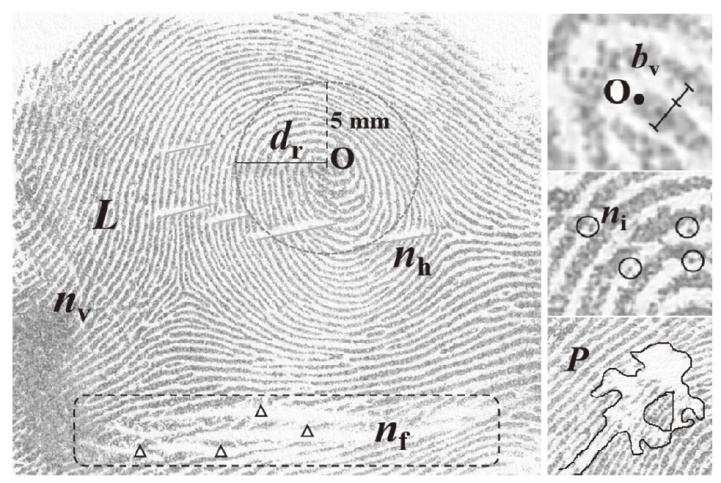
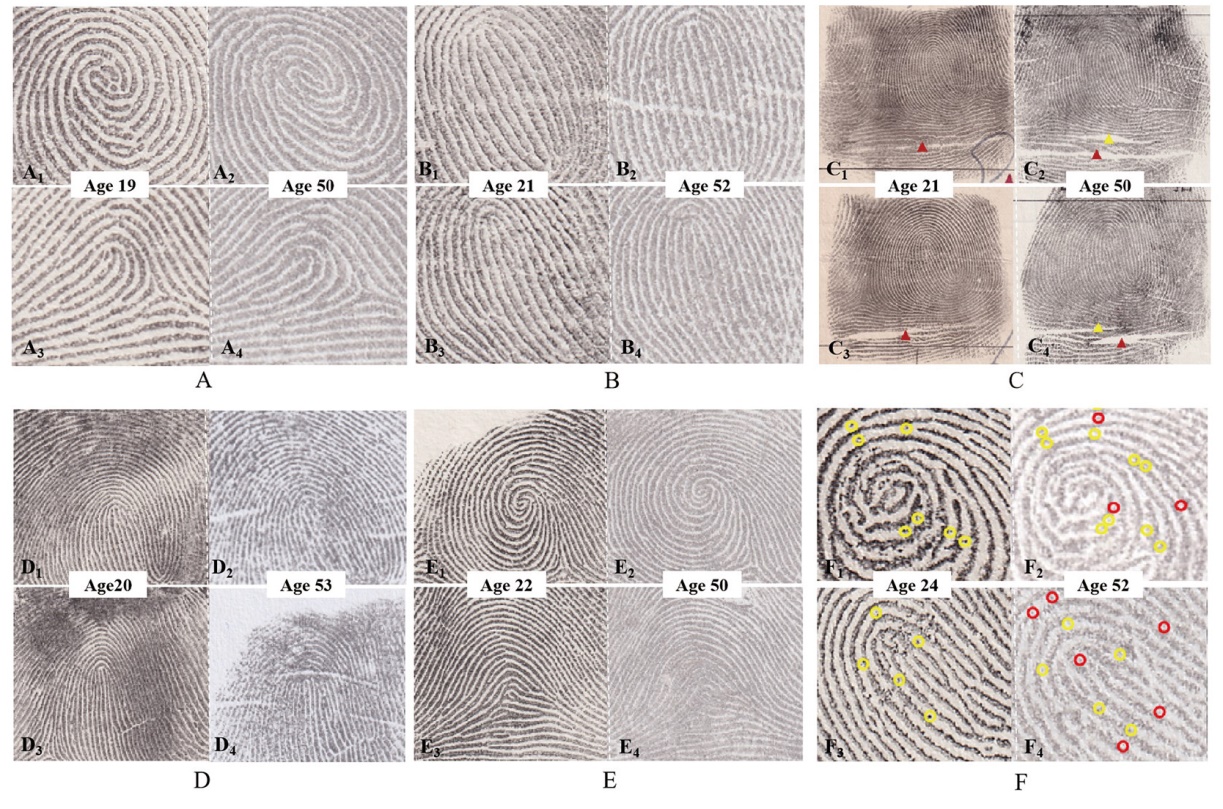
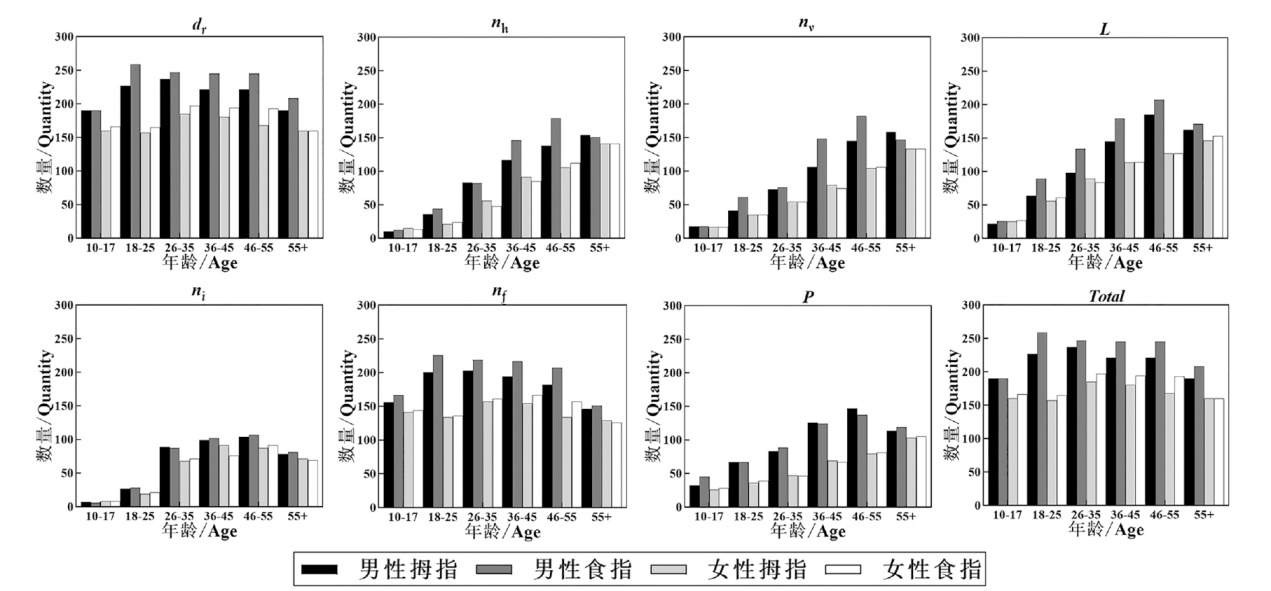
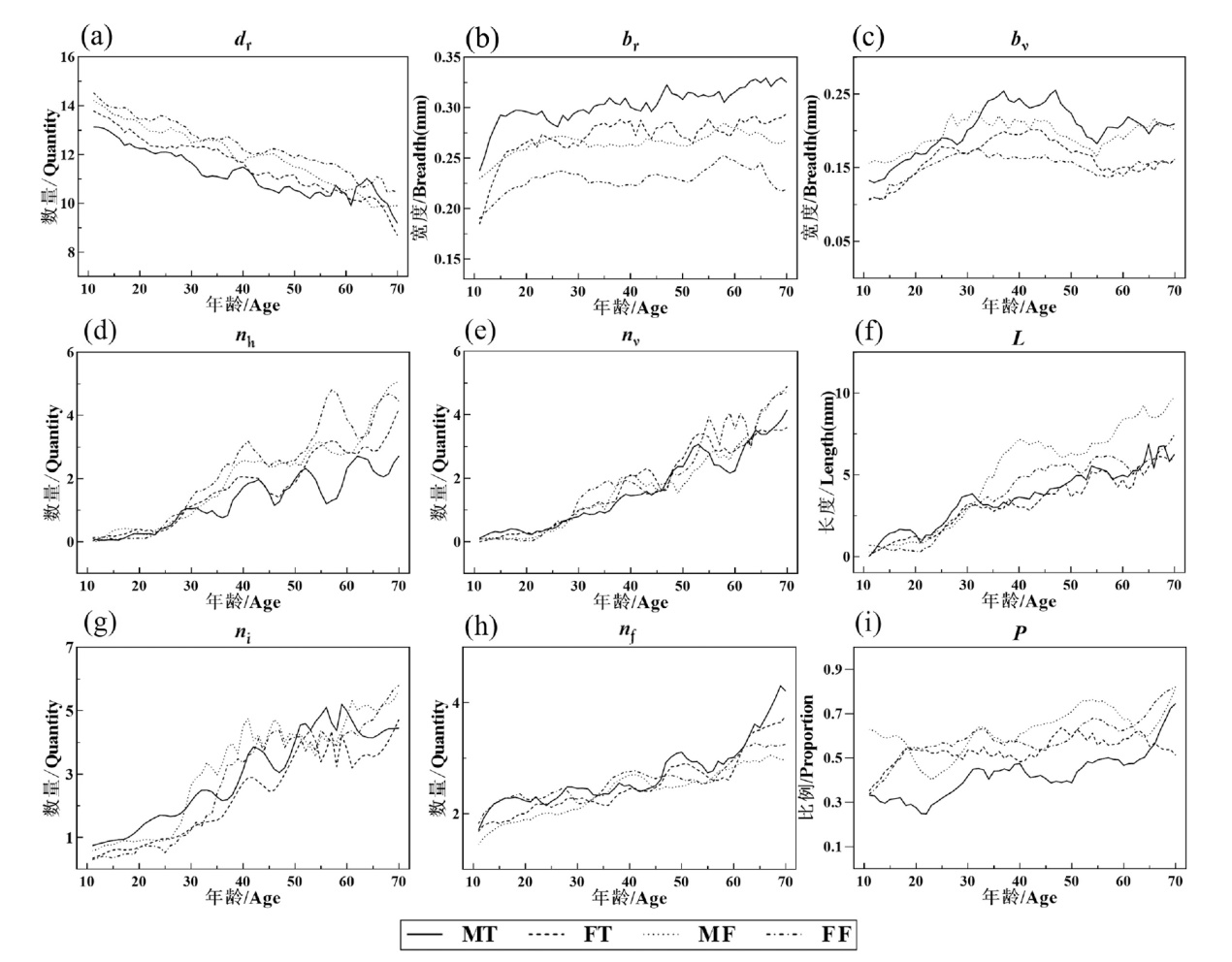
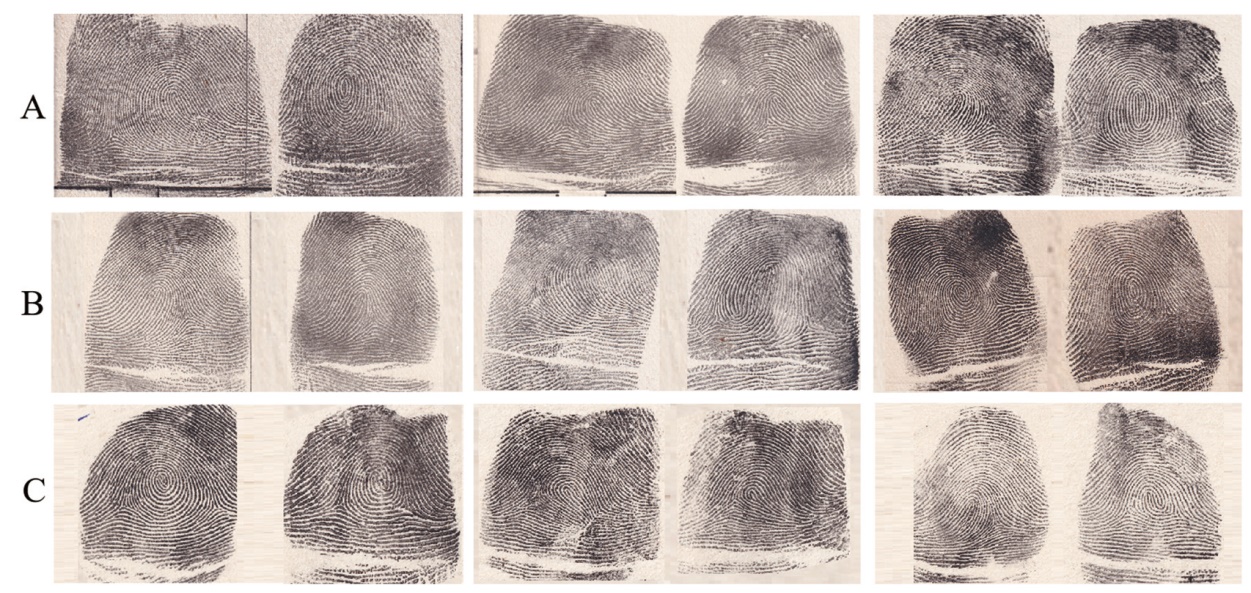
Fig.4 Patterns of thumb and forefinger fingerprint features with age in males and females correspond to the pattern of changes in dr, br, bv, nh, nv, L, ni, nf and P with age in the thumb and forefinger for males and females,and each feature value in the figure shows the median value of the data measured at each age, MT, FT, MF, FF stand for male thumb, female thumb, male index finger, and female index finger
| 方法Method→ 分组groups↓ | RAF | ADB | CTB | EXT | KNN | BPN | SVM | XGB | LGB | BYS |
|---|---|---|---|---|---|---|---|---|---|---|
| 1 | 0.949 | 0.951 | 0.954 | 0.941 | 0.938 | 0.907 | 0.550 | 0.942 | 0.948 | 0.910 |
| 2 | 0.951 | 0.954 | 0.956 | 0.950 | 0.946 | 0.909 | 0.583 | 0.949 | 0.955 | 0.901 |
| 3 | 0.956 | 0.955 | 0.955 | 0.949 | 0.944 | 0.911 | 0.648 | 0.950 | 0.961 | 0.915 |
| 4 | 0.958 | 0.954 | 0.957 | 0.956 | 0.949 | 0.924 | 0.642 | 0.957 | 0.959 | 0.912 |
| 5 | 0.958 | 0.954 | 0.962 | 0.955 | 0.953 | 0.923 | 0.557 | 0.953 | 0.964 | 0.921 |
| 6 | 0.963 | 0.960 | 0.962 | 0.957 | 0.951 | 0.928 | 0.751 | 0.961 | 0.964 | 0.914 |
| 7 | 0.959 | 0.963 | 0.966 | 0.964 | 0.957 | 0.929 | 0.547 | 0.961 | 0.966 | 0.930 |
| 8 | 0.964 | 0.959 | 0.971 | 0.964 | 0.953 | 0.925 | 0.710 | 0.962 | 0.967 | 0.916 |
| 9 | 0.975 | 0.967 | 0.971 | 0.963 | 0.954 | 0.929 | 0.706 | 0.957 | 0.973 | 0.924 |
Tab.1 F1 scores of different feature combinations based on 10 classification methods
| 方法Method→ 分组groups↓ | RAF | ADB | CTB | EXT | KNN | BPN | SVM | XGB | LGB | BYS |
|---|---|---|---|---|---|---|---|---|---|---|
| 1 | 0.949 | 0.951 | 0.954 | 0.941 | 0.938 | 0.907 | 0.550 | 0.942 | 0.948 | 0.910 |
| 2 | 0.951 | 0.954 | 0.956 | 0.950 | 0.946 | 0.909 | 0.583 | 0.949 | 0.955 | 0.901 |
| 3 | 0.956 | 0.955 | 0.955 | 0.949 | 0.944 | 0.911 | 0.648 | 0.950 | 0.961 | 0.915 |
| 4 | 0.958 | 0.954 | 0.957 | 0.956 | 0.949 | 0.924 | 0.642 | 0.957 | 0.959 | 0.912 |
| 5 | 0.958 | 0.954 | 0.962 | 0.955 | 0.953 | 0.923 | 0.557 | 0.953 | 0.964 | 0.921 |
| 6 | 0.963 | 0.960 | 0.962 | 0.957 | 0.951 | 0.928 | 0.751 | 0.961 | 0.964 | 0.914 |
| 7 | 0.959 | 0.963 | 0.966 | 0.964 | 0.957 | 0.929 | 0.547 | 0.961 | 0.966 | 0.930 |
| 8 | 0.964 | 0.959 | 0.971 | 0.964 | 0.953 | 0.925 | 0.710 | 0.962 | 0.967 | 0.916 |
| 9 | 0.975 | 0.967 | 0.971 | 0.963 | 0.954 | 0.929 | 0.706 | 0.957 | 0.973 | 0.924 |
| 特征Feature→ 方法 Method↓ | 拇指Thumb | 食指Forefinger | 拇指食指组合特征Thumb & Forefinger |
|---|---|---|---|
| RAF | 0.975 | 0.966 | 0.979 |
| ADB | 0.967 | 0.963 | 0.969 |
| CTB | 0.971 | 0.963 | 0.973 |
| EXT | 0.963 | 0.951 | 0.967 |
| KNN | 0.954 | 0.938 | 0.962 |
| BPN | 0.939 | 0.921 | 0.941 |
| SVM | 0.716 | 0.679 | 0.712 |
| XGB | 0.957 | 0.934 | 0.965 |
| LGB | 0.973 | 0.956 | 0.954 |
| BYS | 0.914 | 0.905 | 0.938 |
Tab.2 F1 scores of 3 types of features under 10 classification methods
| 特征Feature→ 方法 Method↓ | 拇指Thumb | 食指Forefinger | 拇指食指组合特征Thumb & Forefinger |
|---|---|---|---|
| RAF | 0.975 | 0.966 | 0.979 |
| ADB | 0.967 | 0.963 | 0.969 |
| CTB | 0.971 | 0.963 | 0.973 |
| EXT | 0.963 | 0.951 | 0.967 |
| KNN | 0.954 | 0.938 | 0.962 |
| BPN | 0.939 | 0.921 | 0.941 |
| SVM | 0.716 | 0.679 | 0.712 |
| XGB | 0.957 | 0.934 | 0.965 |
| LGB | 0.973 | 0.956 | 0.954 |
| BYS | 0.914 | 0.905 | 0.938 |
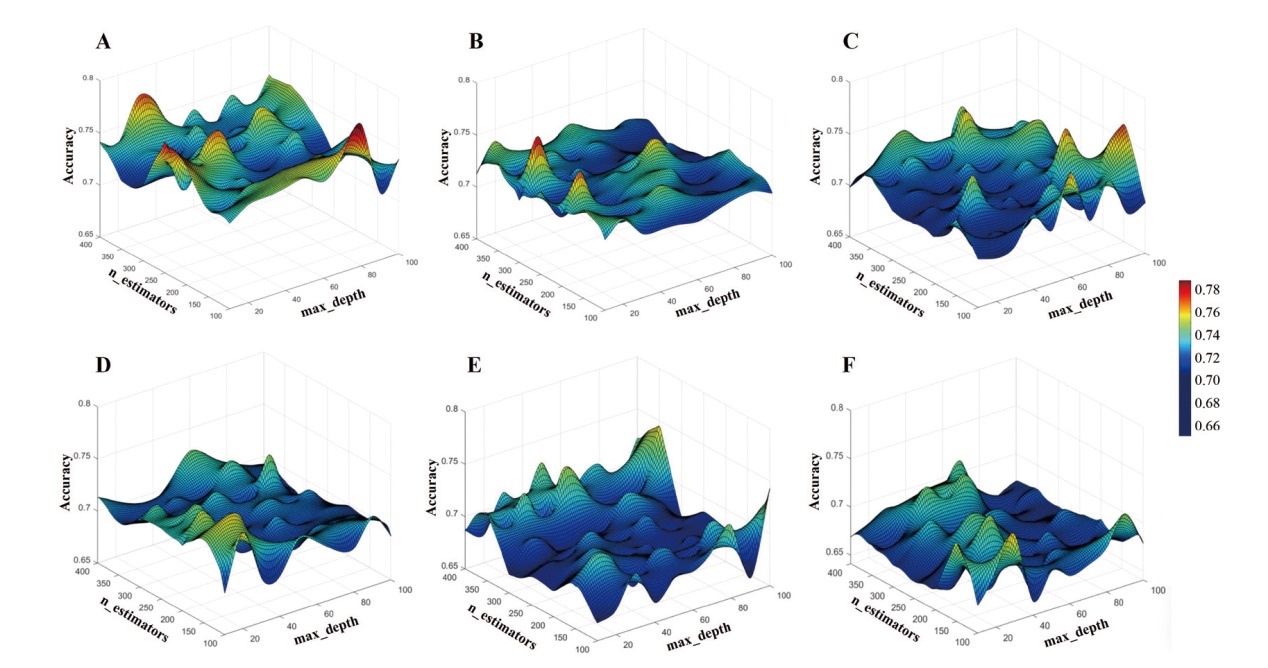
Fig.6 RAF method parameter tuning diagram the regression accuracy of the RAF method with the variation of parameters for 6 combinations of features from A to F
| 特征Feature→ | 男性Male | 女性Female | |||||
|---|---|---|---|---|---|---|---|
| 方法Method↓ | 拇指Thumb | 食指Forefinger | 拇指食指组合特征Thumb& Forefinger | 拇指Thumb | 食指Forefinger | 拇指食指组合特征Thumb& Forefinger | |
| RAF | 75.8% | 72.1% | 82.9% | 78.5% | 73.6% | 84.5% | |
| ADB | 75.2% | 72.3% | 86.7% | 77.1% | 74.5% | 85.3% | |
| EXT | 74.6% | 71.1% | 85.3% | 77.8% | 72.4% | 81.3% | |
| CTB | 71.3% | 69.2% | 81.6% | 75.7% | 70.9% | 81.1% | |
| KNN | 67.8% | 65.5% | 72.1% | 73.2% | 68.3% | 78.9% | |
| SVR | 59.6% | 53.7% | 68.4% | 73.4% | 70.6% | 80.8% | |
| LGB | 73.2% | 72.0% | 84.2% | 75.6% | 71.4% | 81.2% | |
| MLR | 68.5% | 67.3% | 75.2% | 71.3% | 69.3% | 80.5% | |
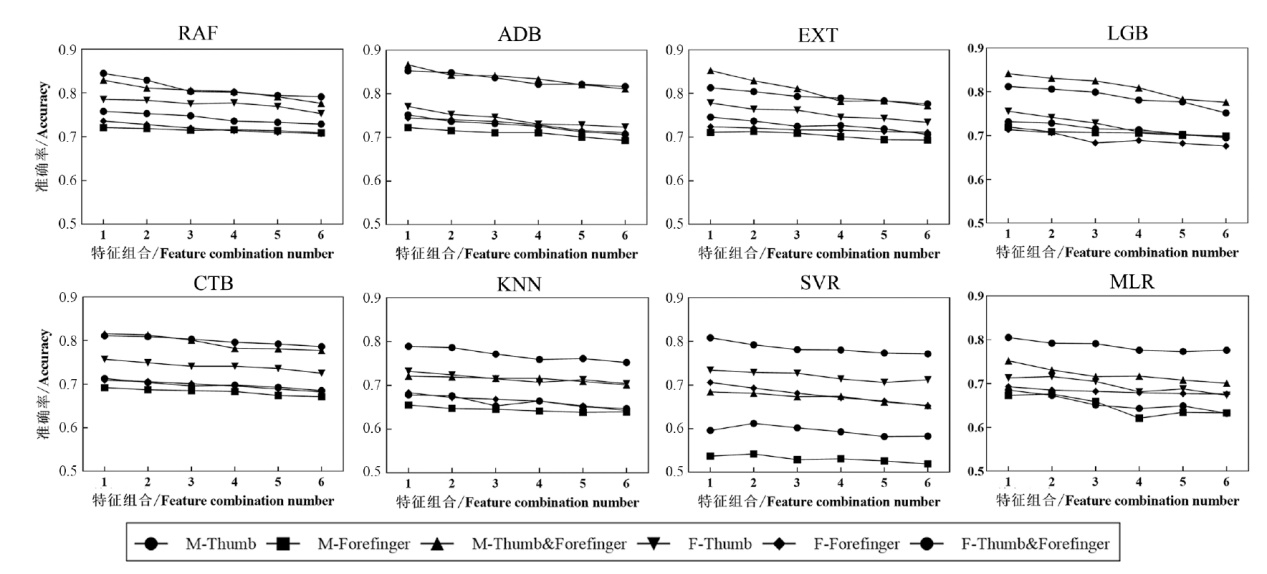
Tab. 3 Accuracy of RAF age regression without gender classification and after gender classification
| 特征Feature→ | 男性Male | 女性Female | |||||
|---|---|---|---|---|---|---|---|
| 方法Method↓ | 拇指Thumb | 食指Forefinger | 拇指食指组合特征Thumb& Forefinger | 拇指Thumb | 食指Forefinger | 拇指食指组合特征Thumb& Forefinger | |
| RAF | 75.8% | 72.1% | 82.9% | 78.5% | 73.6% | 84.5% | |
| ADB | 75.2% | 72.3% | 86.7% | 77.1% | 74.5% | 85.3% | |
| EXT | 74.6% | 71.1% | 85.3% | 77.8% | 72.4% | 81.3% | |
| CTB | 71.3% | 69.2% | 81.6% | 75.7% | 70.9% | 81.1% | |
| KNN | 67.8% | 65.5% | 72.1% | 73.2% | 68.3% | 78.9% | |
| SVR | 59.6% | 53.7% | 68.4% | 73.4% | 70.6% | 80.8% | |
| LGB | 73.2% | 72.0% | 84.2% | 75.6% | 71.4% | 81.2% | |
| MLR | 68.5% | 67.3% | 75.2% | 71.3% | 69.3% | 80.5% | |
| [1] | Champod C, Lennard CJ, Margot P, et al. Fingerprints and other ridge skin impressions[M]. La Paz: CRC Press, 2004 |
| [2] |
Monson KL, Roberts MA, Knorr KB, et al. The permanence of friction ridge skin and persistence of friction ridge skin and impressions: A comprehensive review and new results[J]. Forensic science international, 2019, 297: 111-131
doi: S0379-0738(19)30039-8 pmid: 30784948 |
| [3] | Gorka M, Thomas A, Bécue A. Chemical composition of the fingermark residue: Assessment of the intravariability over one year using MALDI-MSI[J]. Forensic Science International, 2022, 338: 111380 |
| [4] |
Mundorff AZ, Bartelink EJ, Murad TA. Sexual dimorphism in finger ridge breadth measurements: a tool for sex estimation from fingerprints[J]. Journal of forensic sciences, 2014, 59(4): 891-897
doi: 10.1111/1556-4029.12449 pmid: 24673752 |
| [5] |
Nayak VC, Rastogi P, Kanchan T, et al. Sex differences from fingerprint ridge density in Chinese and Malaysian population[J]. Forensic science international, 2010, 197(1-3): 67-69
doi: 10.1016/j.forsciint.2009.12.055 pmid: 20071110 |
| [6] | Sánchez-andrés A, Barea JA, Rivaldería N, et al. Impact of aging on fingerprint ridge density: Anthropometry and forensic implications in sex inference[J]. Science & justice, 2018, 58(5): 323-334 |
| [7] |
Kanchan T, Krishan K. Anthropometry of hand in sex determination of dismembered remains-A review of literature[J]. Journal of Forensic and Legal Medicine, 2011, 18(1): 14-17
doi: 10.1016/j.jflm.2010.11.013 pmid: 21216373 |
| [8] | Ceyhan EB, Saĝiroĝlu Ş, Tatoĝlu S, et al. Age estimation from fingerprints. Examination of the population in Turkey[A]. In: Wani M(Ed.). proceedings of the 2014 13th International Conference on Machine Learning and Applications[C]. Detroit: IEEE, 2014, 478-481 |
| [9] | 宋焕庭, 唐玮, 张丽梅, 等. 指纹与年龄相关性的量化分析[J]. 人类学学报, 2022, 41(6): 1047-1057 |
| [10] | Falohun A, Fenwa O, Ajala F. A fingerprint-based age and gender detector system using fingerprint pattern analysis[J]. International Journal of Computer Applications, 2016, 136(4): 0975-8887 |
| [11] | Jayakala G, Sudha L. Fingerprint analysis for age estimation using deep learning models (ResNet50 and VGG-16)[J]. International Journal of Health Sciences, 2022, 6(S3): 6781-6789 |
| [12] | Rivaldería N, Gutiérrez-Redomero E. Interpopulational differences in the frequency and distribution of delta types[J]. Forensic Science International, 2021, 322: 110749 |
| [13] |
Dao JRH, Kazin RA. Gender differences in skin: a review of the literature[J]. Gender medicine, 2007, 4(4): 308-328
doi: 10.1016/s1550-8579(07)80061-1 pmid: 18215723 |
| [14] |
Farage MA, Miller KW, Elsner P, et al. Characteristics of the aging skin[J]. Advances in wound care, 2013, 2(1): 5-10
doi: 10.1089/wound.2011.0356 pmid: 24527317 |
| [15] | Da Silva Carvalho D, De Alecrim MMV, De Sousa Júnior R T, et al. Outcome of sex determination from ulnar and radial ridge densities of Brazilians' fingerprints: applying an existing method to a new population[J]. Science & Justice, 2022, 62(2): 181-192 |
| [16] | Goutte C, Gaussier E. A Probabilistic Interpretation of Precision, Recall and F-Score, with Implication for Evaluation[A]. In: Losada (Ed.). Advances in Information Retrieval. ECIR 2005. Lecture Notes in Computer Science[C]. Heidelberg: Springer, 2005:345-359 |
| [17] | Patil A, Singh S. Prakash C(Ed.). Differential private random forest[A]. In: Prakash C(Ed.). proceedings of the 2014 International Conference on Advances in Computing, Communications and Informatics (ICACCI)[C]. Delhi: IEEE, 2014, 2623-2630 |
| [18] | Schapire RE. Explaining adaboost[J]. Empirical Inference: Festschrift in Honor of Vladimir N Vapnik, 2013, 37-52 |
| [19] | Prokhorenkova L, Gusev G, Vorobev A, et al. CatBoost: unbiased boosting with categorical features[J]. Advances in neural information processing systems, 2018, doi:10.48550/arXiv.1706.09516 |
| [20] | Geurts P, Ernst D, Wehenkel L. Extremely randomized trees[J]. Machine learning, 2006, 63: 3-42 |
| [21] | Peterson LE. K-nearest neighbor[J]. Scholarpedia, 2009, 4(2): 1883 |
| [22] | Buscema M. Back propagation neural networks[J]. Substance use & misuse, 1998, 33(2): 233-270 |
| [23] | Hearst MA, Dumais ST, Osuna E, et al. Support vector machines[J]. IEEE Intelligent Systems and their applications, 1998, 13(4): 18-28 |
| [24] | Chen T, Guestrin C. Xgboost: A scalable tree boosting system[J]. ACM, 2016. doi:10.1145/2939672.2939785 |
| [25] | Ke G, Meng Q, Finley T, et al. Lightgbm: A highly efficient gradient boosting decision tree[A]. In: Von Luxburg U(Ed.). Advances in neural information processing systems 30 (niP2017)[C]. Long Beach: Neural Information Processing Systems Foundation, 2017 |
| [26] | Rish I. An empirical study of the naive Bayes classifier[J]. Journal of Universal Computer Science, 2001, 1(2): 127 |
| [27] | Smola AJ, Schölkopf B. A tutorial on support vector regression[J]. Statistics and computing, 2004, 14: 199-222 |
| [28] | Eberly LE. Multiple linear regression[J]. Topics in Biostatistics, 2007, 165-187 |
| [29] | 陆宏, 霍正浩, 钟慧军, 等. 宁夏回、汉族指纹白线的研究[J]. 人类学学报, 2005, 24(1): 77-81 |

| [1] | YAO Li, LUO Zhen, GE Heng, MA Xiaoyun, LIN Zhehan. Determining gender based on the images of human barefoot footprints [J]. Acta Anthropologica Sinica, 2026, 45(02): 296-309. |
| [2] | ZHEN Wentian, ZHANG Haiguo, YANG Haitao, TAN Jingze, QIAO Hui, YUAN Ziyu, ZANG Jun, YAN Mingliang, WANG Jiucun. Dermatoglyphic phenome of the Mongolian people in Inner Mongolia [J]. Acta Anthropologica Sinica, 2026, 45(02): 310-321. |
| [3] | LI Yonglan, HAN Yuan, XI Luge, BAI Yun, ZHENG Lianbin. Physiological indicators of Northwest Ethnic Corridor populations and the impact of population evolution on physiological functions [J]. Acta Anthropologica Sinica, 2026, 45(01): 140-153. |
| [4] | WEI Yi. A brief review of theoretical approaches on Paleolithic personal ornaments [J]. Acta Anthropologica Sinica, 2026, 45(01): 187-198. |
| [5] | ZHENG Zhexuan, TAN Peiyang. Progress and reflections on paleolithic archaeology in Sichuan [J]. Acta Anthropologica Sinica, 2025, 44(06): 1094-1105. |
| [6] | ZHANG Weilin, YAN Maodu, ZAN Jinbo, MIAO Yunfa, SONG Xiangsuo, ZHANG Tao, XU Zunbo, Cairangdaoji , RUAN Qijun, LI Hao. Evolution of Cenozoic geomorphology in the Yuanmou hominin site area [J]. Acta Anthropologica Sinica, 2025, 44(06): 952-966. |
| [7] | HE Letian, XIE Guangmao, LIN Qiang, LI Dawei, WU Xiujie. Sex and age-at-death of the Yahuai Cave Man from the Late Pleistocene of Guangxi [J]. Acta Anthropologica Sinica, 2025, 44(03): 389-403. |
| [8] | YAO Yanyan, HUANG Shengmin, LIAO Wei, LI Jinyan, ZHANG Yijing, MO Jinyou, WANG Wei. A taphonomic study of early Pleistocene mammalian assemblages from the Chuifeng Cave site in South China [J]. Acta Anthropologica Sinica, 2025, 44(03): 514-528. |
| [9] | ZHI Yuan, DU Shuisheng, LIU Jiying. Exploitation of animal resource by humans during the Middle Stone Age in South Africa [J]. Acta Anthropologica Sinica, 2025, 44(02): 352-364. |
| [10] | LEI Shuai. Progress and perspectives of the isotope research of human tooth enamel [J]. Acta Anthropologica Sinica, 2025, 44(01): 165-180. |
| [11] | HUANG Yan, HU Yaowu. Research progress of investigating the ancient people’s diets by analyzing fatty acid in pottery [J]. Acta Anthropologica Sinica, 2024, 43(05): 865-880. |
| [12] | XU Guochang, ZHANG Peihua, CHEN Zhiguo, MA Changde, YE Songshan. Relationship between body fat and cognitive impairment in the elderly people in Nanyang, Henan Province [J]. Acta Anthropologica Sinica, 2024, 43(04): 629-637. |
| [13] | ZHANG Haiguo. Current situation and countermeasures of dermatoglyphic phenomics in China [J]. Acta Anthropologica Sinica, 2024, 43(04): 675-686. |
| [14] | ZENG Haoran, LIU Kangkang, LUO Yaping. Current status and prospects of the research on finger crease features [J]. Acta Anthropologica Sinica, 2024, 43(03): 518-528. |
| [15] | ZHAO Yunxiao, TONG Guang, TU Hua, ZHAO Hailong. Excavation report of the Shigou site C area in the Nihewan Basin, Hebei Province [J]. Acta Anthropologica Sinica, 2024, 43(01): 122-131. |
| Viewed | ||||||
|
Full text |
|
|||||
|
Abstract |
|
|||||