| [1] |
Hublin JJ, Ben-Ncer A, Bailey SE, et al. New fossils from Jebel Irhoud, Morocco and the pan-African origin of Homo sapiens[J]. Nature, 2017, 546(7657): 289-292
doi: 10.1038/nature22336
URL
|
| [2] |
Slon V, Mafessoni F, Vernot B, et al. The genome of the offspring of a Neanderthal mother and a Denisovan father[J]. Nature, 2018, 561(7721): 113-116
doi: 10.1038/s41586-018-0455-x
|
| [3] |
Chen F, Welker F, Shen CC, et al. A late middle Pleistocene Denisovan mandible from the Tibetan Plateau[J]. Nature, 2019, 569(7756): 409-412
doi: 10.1038/s41586-019-1139-x
|
| [4] |
Richter J. When did the Middle Paleolithic begin?[A]. In: Conard NJ, Richter J(Eds). Neanderthal lifeways, subsistence and technology: One hundred fifty years of Neanderthal study[M]. Dordrecht: Springer Netherlands, 2011: 7-14
|
| [5] |
Kuhn SL. Roots of the middle Paleolithic in Eurasia[J]. Current Anthropology, 2013, 54(S8): S255-S268
|
| [6] |
高星. 关于“中国旧石器时代中期”的探讨[J]. 人类学学报, 1999, 18(1): 1-15
|
| [7] |
Gao X, Norton CJ. A critique of the Chinese ‘Middle Palaeolithic’[J]. Antiquity, 2002, 76(292): 397-412
doi: 10.1017/S0003598X00090517
URL
|
| [8] |
Li H, Li Z, Gao X, et al. Technological behavior of the early Late Pleistocene archaic humans at Lingjing (Xuchang, China)[J]. Archaeological and Anthropological Sciences, 2019, 11: 3477-3490
doi: 10.1007/s12520-018-0759-7
|
| [9] |
Doyon L, Li Z, Li H, et al. Discovery of circa 115,000-year-old bone retouchers at Lingjing, Henan, China[J]. PLoS One, 2018, 13(3): e0194318
|
| [10] |
于建军, 王幼平, 何嘉宁, 等. 新疆吉木乃县通天洞遗址[J]. 考古, 2018, 7: 3-14
|
| [11] |
Li F, Kuhn SL, Chen F, et al. The easternmost middle paleolithic (Mousterian) from Jinsitai cave, north China[J]. Journal of Human Evolution, 2018, 114: 76-84
doi: S0047-2484(17)30303-2
pmid: 29447762
|
| [12] |
Hu Y, Marwick B, Zhang JF, et al. Late Middle Pleistocene Levallois stone-tool technology in southwest China[J]. Nature, 2019, 565(7737): 82-85
doi: 10.1038/s41586-018-0710-1
|
| [13] |
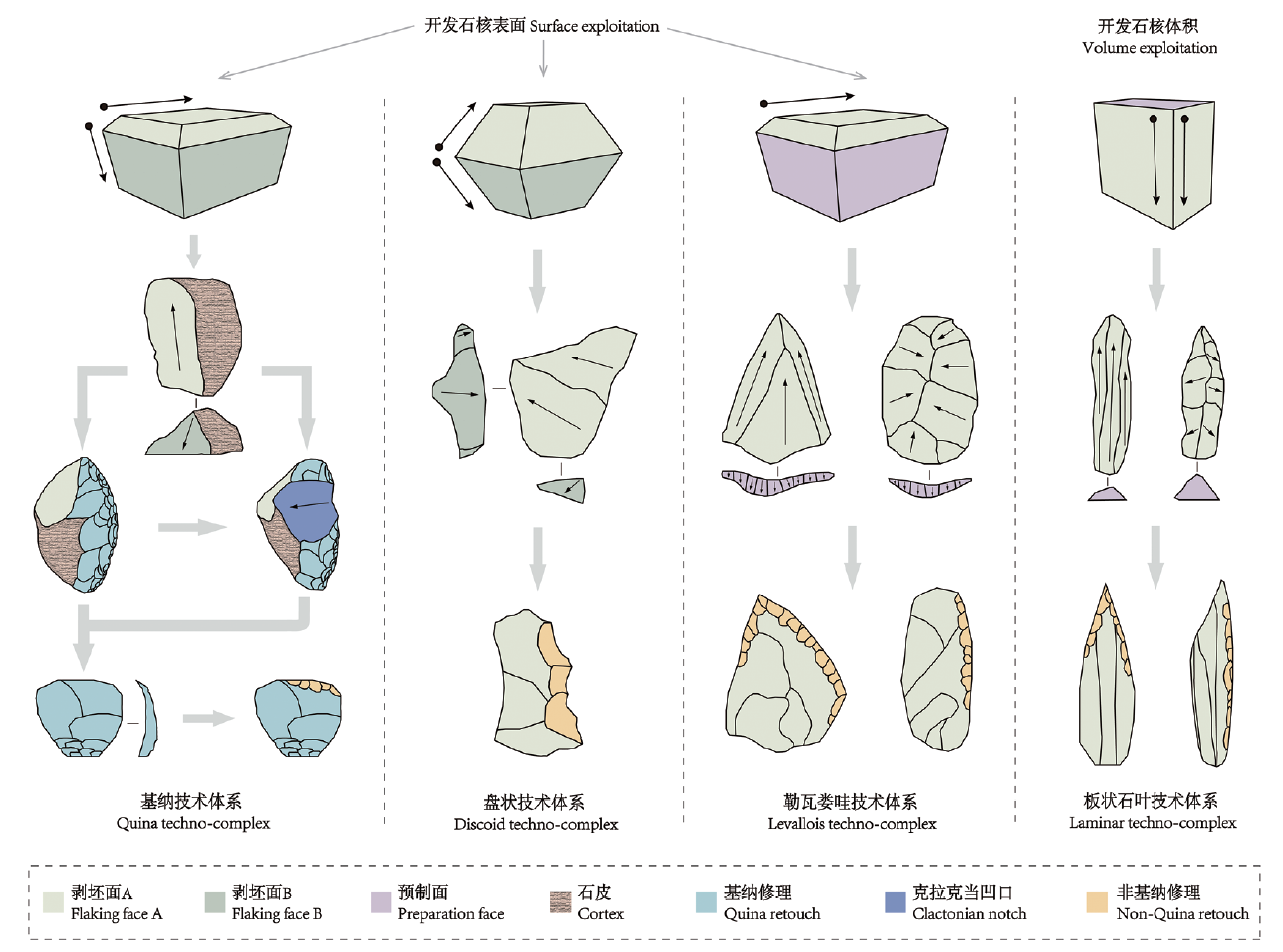
Li F, Li Y, Gao X, et al. A refutation of reported Levallois technology from Guanyindong Cave in south China[J]. National Science Review, 2019, 6(6): 1094-1096
doi: 10.1093/nsr/nwz115
URL
|
| [14] |
单明超, 娜仁高娃, 周兴启, 等. 内蒙古赤峰三龙洞发现距今5万年旧石器遗址[N]. 中国文物报,2017-10-20(008)
|
| [15] |
Wang F, Guo Y, Xian Q, et al. Luminescence chronology for the Paleolithic site of Xinmiaozhuang Locality 1 (XMZ1) in the Nihewan Basin, northern China, and its paleoenvironmental and archaeological implications[J]. Journal of Human Evolution, 2021, 157: 103033
doi: 10.1016/j.jhevol.2021.103033
URL
|
| [16] |
吉学平. 大河洞穴之魅:富源大河旧石器遗址揭秘[J]. 中国文化遗产, 2009, 6: 78-83
|
| [17] |
阮齐军, 刘建辉, 胡越, 等. 云南鹤庆天华洞旧石器遗址石制品研究[J]. 人类学学报, 2019, 38(2): 166-181
|
| [18] |
阮齐军, 周建威, 和金梅, 等. 云南鹤庆龙潭旧石器遗址2019—2020年度发掘简报[J]. 南方文物, 2021, 1: 105-118
|
| [19] |
陈宥成, 曲彤丽. 盘状石核相关问题探讨[J]. 考古, 2016, 2: 88-94
|
| [20] |
陈宥成, 曲彤丽. “勒瓦娄哇技术”源流管窥[J]. 考古, 2015, 2: 71-78
|
| [21] |
王潇玉, 高星. 勒瓦娄哇的剥片模式与技术组合[J]. 人类学学报, 2025, 44(1): 1-13
|
| [22] |
Jelinek AJ. Neandertal lithic industries at La Quina[M]. Tucson: University of Arizona Press, 2013
|
| [23] |
Bordes F, Bourgon M. Le complexe Moustérien: moustériens, levalloisien et tayacien[J]. Anthropologie, 1951, 55: 1-23
|
| [24] |
Turq A. Approche technologique et économique du faciès Moustérien de type Quina: étude préliminaire[J]. Bulletin de la Société préhistorique française, 1989, 86(8): 244-256
doi: 10.3406/bspf.1989.9390
URL
|
| [25] |
Turq A. Raw material and technological studies of the Quina Mousterian[A]. In: Dibble HL, Mellars P(Eds). The Middle Palaeolithic: Adaptation, Behavior, and Variability[C]. Philadelphia: University of Pennsylvania, 1992: 75-85
|
| [26] |
Bourguignon L. Le Moustérien de type Quina: nouvelle définition d’une technique[D]. PhD, Nanterre: Université de Paris X-Nanterre, 1997
|
| [27] |
Bourguignon L, Frère-Sautot MC, Ortega I. Apports de l’expérimentation et de l’analyse techno-morpho-fonctionnelle à la reconnaissance du processus d’aménagement de la retouche Quina[A]. In: Préhistoire et approche expérimentale[C]. Montagnac: Éditions Monique Mergoil, 2001, 35-66
|
| [28] |
Delpiano D, Zupancich A, Bertola S, et al. Flexibility within Quina lithic production systems and tool-use in Northern Italy: implications on Neanderthal behavior and ecology during early MIS 4[J]. Archaeological and Anthropological Sciences, 2022, 14(12): 219
doi: 10.1007/s12520-022-01684-2
|
| [29] |
Hiscock P, Turq A, Faivre JP, Bourguignon L. Quina procurement and tool production[A]. In: Adams B, Blades BS (Eds). Lithic Materials and Paleolithic Societies[C]. Wiley-Blackwell, 2009, 232-246
|
| [30] |
Delagnes A, Rendu W. Shifts in Neandertal mobility, technology and subsistence strategies in western France[J]. Journal of Archaeological Science, 2011, 38(8): 1771-1783
doi: 10.1016/j.jas.2011.04.007
URL
|
| [31] |
Bourguignon L, Faivre JP, Turq A. Ramification des chaînes opératoires: une spécificité du Moustérien[J]. Paléo, 2004, 16: 37-48
|
| [32] |
Lemorini C, Bourguignon L, Zupancich A, et al. A scraper's life history: Morpho-techno-functional and use-wear analysis of Quina and demi-Quina scrapers from Qesem Cave, Israel[J]. Quaternary International, 2016, 398: 86-93
doi: 10.1016/j.quaint.2015.05.013
URL
|
| [33] |
Peresani M, Bourguignon L, Delpiano D, et al. Quina on the edge. Insights from a Middle Palaeolithic lithic assemblage of Grotta di Fumane, Italy[J]. Journal of Archaeological Science: Reports, 2023, 49: 103998
doi: 10.1016/j.jasrep.2023.103998
URL
|
| [34] |
Agam A, Zupancich A. Interpreting the Quina and demi-Quina scrapers from Acheulo-Yabrudian Qesem Cave, Israel: Results of raw materials and functional analyses[J]. Journal of Human Evolution, 2020, 144: 102798
doi: 10.1016/j.jhevol.2020.102798
URL
|
| [35] |
Claud É, Soressi M, Jaubert J, et al. Étude tracéologique de l’outillage moustérien de type Quina de bonebed de Chez-Pinaud à Jonzac (Charente-Maritime)[J]. Gallia Préhistoire-Préhistoire de la France dans son contexte européen, 2012, 54: 3-32
|
| [36] |
Britton K, Grimes V, Niven L, et al. Strontium isotope evidence for migration in late Pleistocene Rangifer: Implications for Neanderthal hunting strategies at the Middle Palaeolithic site of Jonzac, France[J]. Journal of Human Evolution, 2011, 61(2): 176-185
doi: 10.1016/j.jhevol.2011.03.004
pmid: 21497882
|
| [37] |
Frouin M, Lahaye C, Valladas H, et al. Dating the middle Paleolithic deposits of La Quina Amont (Charente, France) using luminescence methods[J]. Journal of Human evolution, 2017, 109: 30-45
doi: 10.1016/j.jhevol.2017.05.002
URL
|
| [38] |
Bourguignon L, Djema H, Bertran P, et al. Le gisement Saalien de Petit-Bost (Neuvic, Dordogne) à l’origine du Moustérien d’Aquitaine?[A]. In: Jaubert J, Bordes J, Ortega I(Eds). Les Sociétés Du Paléolithique Dans Un Grand Sud-Ouest de La France: Nouveaux Gisements, Nouveaux Résultats, Nouvelles Méthodes[C]. Paris: Société préhistorique française, mémoire 47, 2006, 1: 41-55
|
| [39] |
Mihailović D, Kuhn SL, Bogićević K, et al. Connections between the Levant and the Balkans in the late Middle Pleistocene: archaeological findings from Velika and Mala Balanica Caves (Serbia)[J]. Journal of Human Evolution, 2022, 163: 103138
doi: 10.1016/j.jhevol.2021.103138
URL
|
| [40] |
Meignen L, Bar-Yosef O. Acheulo-Yabrudian and Early Middle Paleolithic at Hayonim Cave (Western Galilee, Israel): Continuity or break?[J]. Journal of Human Evolution, 2020, 139: 102733
doi: 10.1016/j.jhevol.2019.102733
URL
|
| [41] |
Falguères C, Richard M, Tombret O, et al. New ESR/U-series dates in Yabrudian and Amudian layers at Qesem Cave, Israel[J]. Quaternary International, 2016, 398: 6-12
doi: 10.1016/j.quaint.2015.02.006
URL
|
| [42] |
裴文中, 周明镇. 云南宜良发现之旧石器[J]. 古脊椎动物与古人类, 1961, 2: 139-142
|
| [43] |
邱中郎, 张银运, 胡绍锦. 昆明呈贡龙潭山第2地点的人化石和旧石器[J]. 人类学学报, 1985, 4(3): 233-241
|
| [44] |
Hu Y, Marwick B, Lu H, et al. Lithic technologies at Guanyindong cave, Southwest China: diversity and innovation during the Chinese Middle Palaeolithic[J]. Archaeological and Anthropological Sciences, 2024, 16(8): 119
doi: 10.1007/s12520-024-02022-4
|
| [45] |
肖培源, 阮齐军, 高玉, 等. 2022年云南宾川盆地旧石器遗址调查报告[J]. 人类学学报, 2024, 43(3): 448-457
|
| [46] |
Hu Y, Ruan QJ, Liu J, et al. Luminescence chronology and lithic technology of Tianhuadong Cave, an early Upper Pleistocene Paleolithic site in southwest China[J]. Quaternary Research, 2020, 94: 121-136
doi: 10.1017/qua.2019.67
URL
|
| [47] |
Ruan QJ, Li H, Xiao PY, et al. Quina lithic technology indicates diverse Late Pleistocene human dynamics in East Asia[J]. Proceedings of the National Academy of Sciences, 2025, 122(14): e2418029122
|
| [48] |
刘武, 吴秀杰. 中更新世晚期中国古人类化石的形态多样性及其演化意义[J]. 人类学学报, 2022, 41(4): 563-575
|
| [49] |
杨济达, 张志明, 沈泽昊, 等. 云南干热河谷植被与环境研究进展[J]. 生物多样性, 2016, 24(4): 462-474
doi: 10.17520/biods.2015251
|