

主管:中国科学院
主办:中国科学院古脊椎动物与古人类研究所
出版:科学出版社
主办:中国科学院古脊椎动物与古人类研究所
出版:科学出版社
人类学学报 ›› 2025, Vol. 44 ›› Issue (04): 700-714.doi: 10.16359/j.1000-3193/AAS.2024.0072cstr: 32091.14.j.1000-3193/AAS.2024.0072
刘玥1,2( ), 焦亚诺1,2, 卢泽基1,2, 胡贵兰1,2, 邵庆丰1,2()
收稿日期:2024-02-06
接受日期:2024-04-07
出版日期:2025-08-15
发布日期:2025-08-07
通讯作者:
邵庆丰
作者简介:刘玥,硕士研究生,从事旧石器考古遗址年代学研究。E-mail: 211302010@njnu.edu.cn
基金资助:
LIU Yue1,2(), JIAO Yanuo1,2, LU Zeji1,2, HU Guilan1,2, SHAO Qingfeng1,2()
Received:2024-02-06
Accepted:2024-04-07
Online:2025-08-15
Published:2025-08-07
Contact:
SHAO Qingfeng
摘要: 哺乳动物的骨骼和牙齿化石常见于考古和古人类遗址且铀含量较高,可用于铀系直接测年,但难题在于,化石是开放体系,不满足放射性同位素测年关于样品保持“封闭体系”的假设前提。为了获取化石内部铀浓度和铀钍同位素的空间分布数据,以解译铀吸附模式和铀系衰变不平衡的年代信息,本文发展了激光剥蚀原位分析铀钍同位素的方法,并详细描述了标准样品制备、仪器调谐、激光剥蚀、同位素测试和数据处理的相关流程。此外,本文利用激光剥蚀原位分析技术分析了许家窑人遗址的两颗马牙化石。结果表明出自上文化层的样品XJY-1929经历了铀早期吸附,其扩散模型的铀系年代为172.0±5.1 kaBP;而下文化层的样品XJY-3055经历了相对晚期吸附,其扩散模型的铀系年代为58.8±4.5 kaBP,显著小于地层的地质年代,这可能是由于该样品长期处于还原环境造成的结果。
中图分类号:
刘玥, 焦亚诺, 卢泽基, 胡贵兰, 邵庆丰. 激光剥蚀原位铀系法对化石年龄的测定[J]. 人类学学报, 2025, 44(04): 700-714.
LIU Yue, JIAO Yanuo, LU Zeji, HU Guilan, SHAO Qingfeng. U-series in situ dating of fossils by LA-MC-ICPMS[J]. Acta Anthropologica Sinica, 2025, 44(04): 700-714.
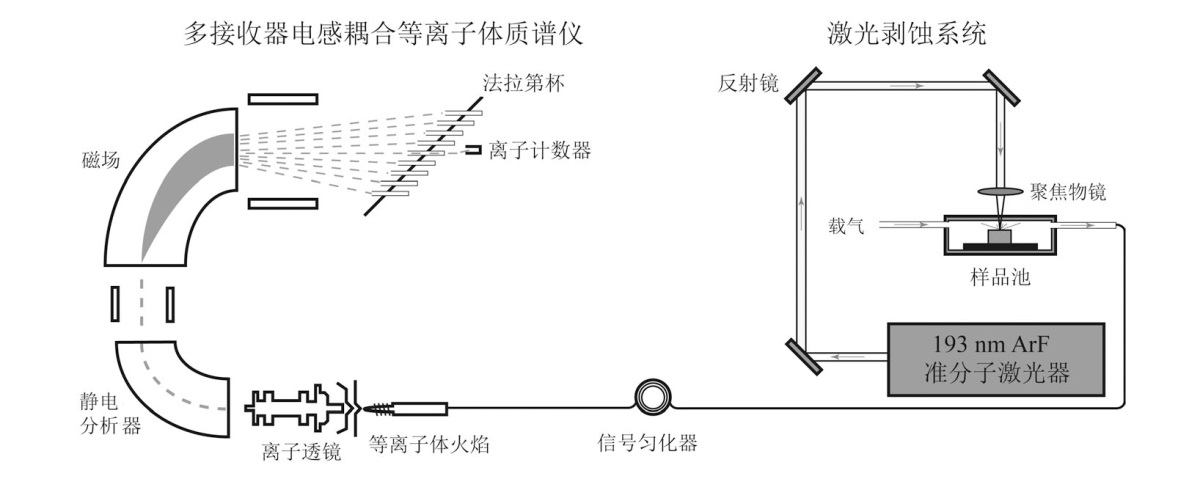
图1 LA系统与MC-ICPMS联用结构示意图 激光剥蚀系统(Laser Ablation system, LA)由激光发生器、光束传输系统、样品剥蚀池和观测系统组成:激光发生器用于产生高能激光,通过一系列透镜、反射镜构成的光路传输系统反射激光至聚焦物镜上对固体样品表面进行剥蚀,剥蚀融化得到的物质冷凝为气溶胶粒子,通过气路传输系统辅以高纯度氦气和氩气的混合气体将样品池中的气溶胶颗粒吹扫,经信号匀化器运输到ICP中。在到达等离子体火焰之前,加入少量氮气以提高信号灵敏度。气溶胶经高温等离子体火焰(~6000 K)分解和电离产生离子束,随后被提取到质谱仪中进行同位素组成分析。A laser ablation system, LA, consists of a laser source, laser beam path, sample pool, and sample observation system. The laser source is used to produce a laser of sufficient power. The output laser beam, is adjusted through a series of mirrors and/or prisms, to focus onto the sample surface to ablate sample. The sample aerosols generated by the laser ablation process are transported to the ICP by a mixture of Ar and He gases, and before reaching the plasma flame, a small quantity of N2 gas is added to enhance the sensitivity. The aerosols are dissociated and ionized by the high temperature of the plasma flame (~6000 K) to produce an ion beam, which is subsequently extracted for isotope analysis using a mass spectrometer.
Fig.1 Structure diagram of LA system combined with MC-ICPMS
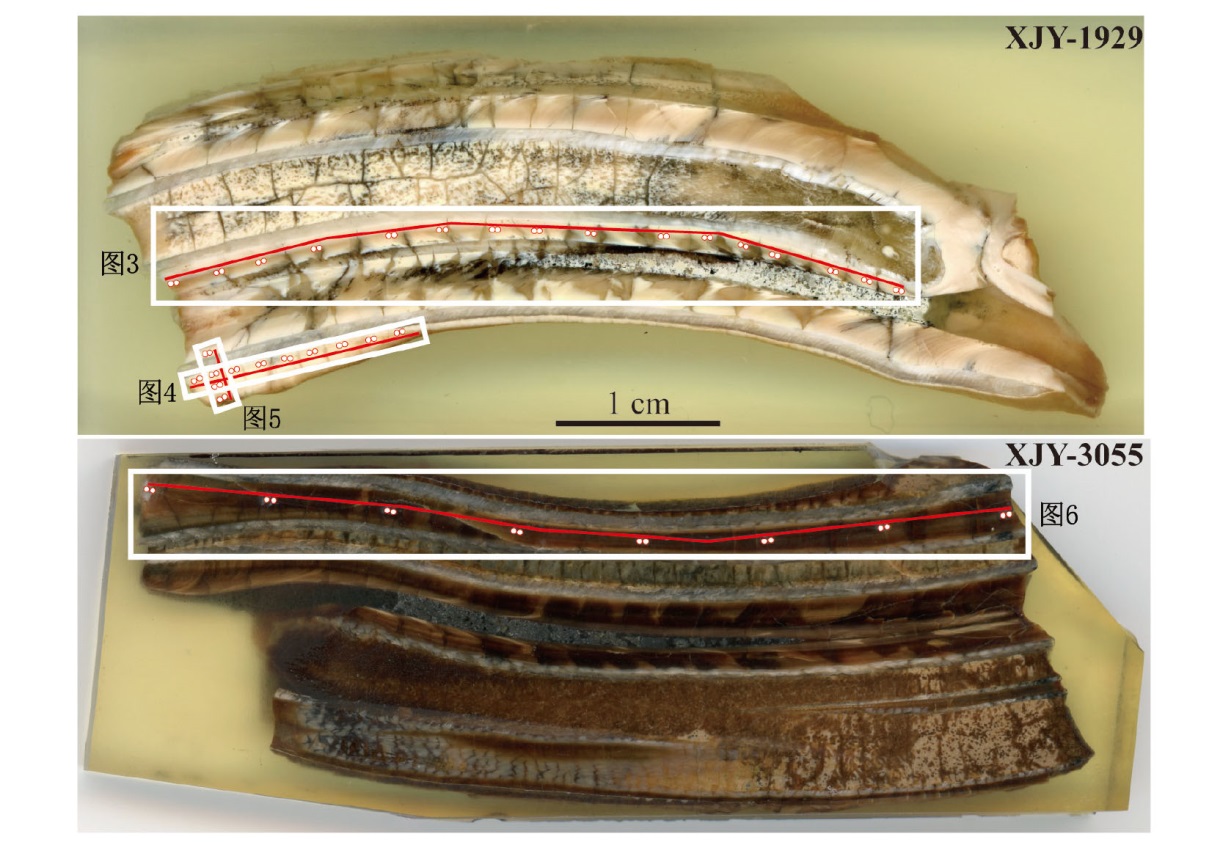
图2 许家窑人遗址的马牙化石样品XJY-1929和XJY-3055 矩形框表示用于LA-MC-ICPMS分析的区域,红色线段代表扫描路径,红色圈点代表激光剥蚀点。The rectangles indicate the area for LA-MC-ICPMS analyses, where the red lines represent the LA scan tracks, and the red circles are the LA spots.
Fig.2 Fossil teeth XJY-1929 and XJY-3055 from Xujiayao hominin site
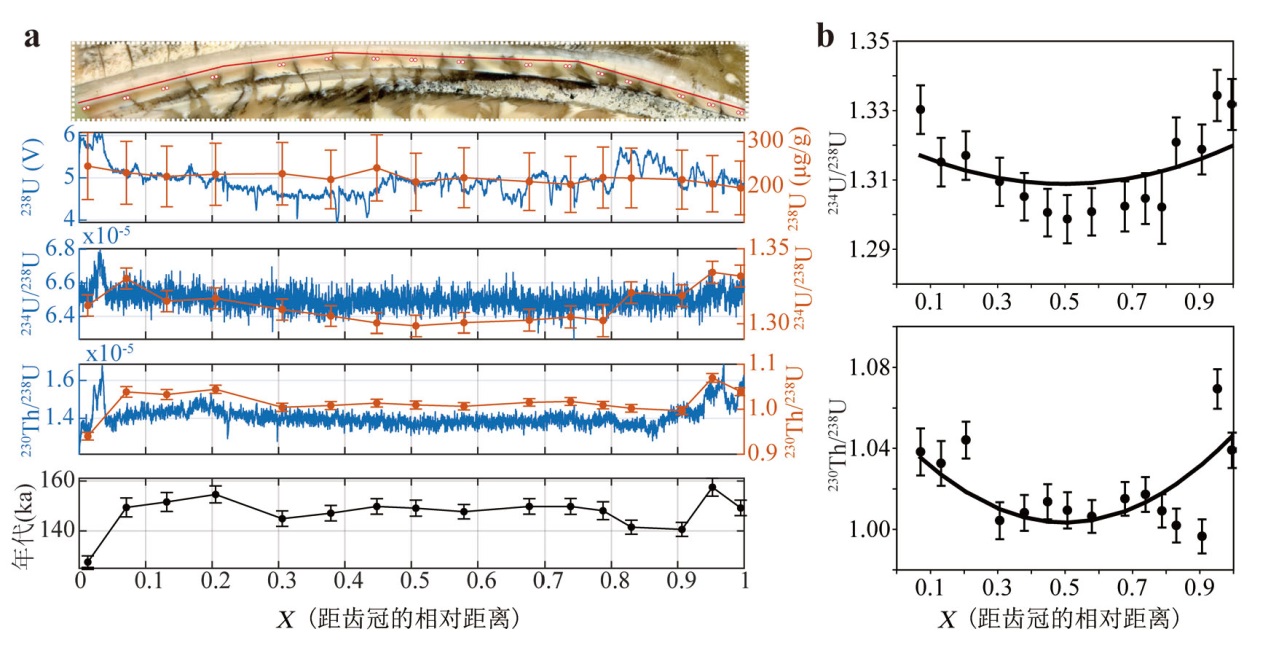
图3 XJY-1929牙本质的LA-MC-ICPMS铀系分析和DAD模拟 a.蓝线分别表示线扫描的238U信号强度(V),234U/238U原子比,230Th/238U原子比;红点代表点分析的铀含量(μg/g),234U/238U活度比,230Th/238U活度比;黑点为表观铀系年代。Blue curves represent, respectively, the 238U ion beam intensity (V), the 234U/238U and 230Th/238U atomic ratios, measured by raster scan; red points represent, respectively, the U-concentration (μg/g), 234U/238U and 230Th/238U activity ratios; black points are the apparent U-series ages; b.图上点为234U/238U和230Th/238U活度比的测量值,弧线为DAD模拟结果。Data points are the measured values of 234U/238U and 230Th/238U activity ratios and the curves are the results of DAD modeling.
Fig.3 LA-MC-ICPMS U-series analysis and DAD modeling of the sample XJY-1929 dentin
| 标本编号Sample ID | w(U) (μg/g) | 234U/238U | 230Th/238U | 230Th/232Th | 年代Age (kaBP) | (234U/238U)i |
|---|---|---|---|---|---|---|
| XJY1929-1 | 245.3±74.1 | 1.312±0.007 | 0.940±0.009 | >1000 | 127.5±2.5 | 1.447±0.011 |
| XJY1929-2 | 230.4±69.7 | 1.330±0.007 | 1.038±0.012 | >1000 | 149.4±3.8 | 1.503±0.012 |
| XJY1929-3 | 222.3±67.3 | 1.315±0.007 | 1.033±0.011 | >1000 | 151.6±3.8 | 1.483±0.012 |
| XJY1929-4 | 227.2±68.9 | 1.317±0.007 | 1.044±0.009 | >1000 | 154.6±3.4 | 1.490±0.012 |
| XJY1929-5 | 228.4±69.3 | 1.309±0.007 | 1.004±0.009 | >1000 | 144.9±3.1 | 1.466±0.011 |
| XJY1929-6 | 215.5±65.3 | 1.305±0.007 | 1.008±0.009 | >1000 | 147.1±3.1 | 1.462±0.011 |
| XJY1929-7 | 241.3±73.3 | 1.301±0.007 | 1.014±0.009 | >1000 | 149.8±3.1 | 1.459±0.011 |
| XJY1929-8 | 210.2±63.8 | 1.299±0.007 | 1.009±0.009 | >1000 | 149.1±3.2 | 1.455±0.011 |
| XJY1929-9 | 219.6±66.6 | 1.301±0.007 | 1.006±0.008 | >1000 | 147.7±2.9 | 1.456±0.011 |
| XJY1929-10 | 210.8±64.0 | 1.302±0.007 | 1.015±0.008 | >1000 | 149.8±3.1 | 1.461±0.012 |
| XJY1929-11 | 204.7±62.2 | 1.305±0.007 | 1.017±0.009 | >1000 | 149.8±3.2 | 1.465±0.012 |
| XJY1929-12 | 219.9±67.8 | 1.302±0.011 | 1.009±0.008 | >1000 | 148.1±3.6 | 1.459±0.017 |
| XJY1929-13 | 218.7±66.3 | 1.321±0.007 | 1.002±0.008 | >1000 | 141.5±2.8 | 1.478±0.011 |
| XJY1929-14 | 215.1±65.5 | 1.319±0.007 | 0.997±0.008 | >1000 | 140.6±2.8 | 1.474±0.011 |
| XJY1929-15 | 206.0±62.6 | 1.334±0.007 | 1.069±0.010 | >1000 | 157.5±3.6 | 1.521±0.013 |
| XJY1929-16 | 196.6±59.7 | 1.332±0.007 | 1.039±0.009 | >1000 | 149.2±3.1 | 1.505±0.012 |
| XJY1929-17 | 210.6±63.8 | 1.314±0.006 | 0.978±0.011 | >1000 | 136.6±3.2 | 1.462±0.010 |
| XJY1929-18 | 153.1±46.4 | 1.332±0.008 | 1.013±0.010 | >1000 | 141.9±3.1 | 1.496±0.012 |
| XJY1929-19 | 176.1±53.3 | 1.324±0.006 | 1.013±0.011 | >1000 | 143.7±3.3 | 1.486±0.011 |
| XJY1929-20 | 230.3±69.9 | 1.308±0.006 | 1.023±0.011 | >1000 | 150.7±3.6 | 1.471±0.011 |
| XJY1929-21 | 230.5±69.8 | 1.307±0.006 | 1.029±0.011 | >1000 | 152.7±3.7 | 1.472±0.011 |
| XJY1929-22 | 241.6±73.1 | 1.302±0.006 | 1.034±0.011 | >1000 | 155.6±3.8 | 1.469±0.011 |
| XJY1929-23 | 252.1±76.3 | 1.301±0.006 | 1.021±0.011 | >1000 | 152.0±3.7 | 1.462±0.011 |
| XJY1929-24 | 252.6±76.5 | 1.302±0.006 | 1.021±0.012 | >1000 | 151.7±3.8 | 1.463±0.011 |
| XJY1929-25 | 186.0±56.1 | 1.312±0.006 | 0.989±0.010 | >1000 | 140.3±3.1 | 1.463±0.010 |
| XJY1929-26 | 243.7±74.2 | 1.273±0.007 | 1.007±0.009 | >1000 | 155.3±3.6 | 1.424±0.012 |
| XJY1929-27 | 190.1±57.6 | 1.327±0.007 | 0.993±0.009 | >1000 | 137.8±2.8 | 1.482±0.012 |
| XJY1929-28 | 209.5±63.2 | 1.314±0.006 | 1.051±0.015 | >1000 | 157.5±5.0 | 1.490±0.012 |
| XJY3055-1 | 4.1±1.2 | 1.158±0.008 | 0.516±0.007 | 328 | 63.2±1.4 | 1.189±0.009 |
| XJY3055-2 | 2.0±0.6 | 1.138±0.011 | 0.488±0.012 | 645 | 60.1±2.1 | 1.163±0.013 |
| XJY3055-3 | 2.3±0.7 | 1.137±0.009 | 0.370±0.009 | 666 | 42.5±1.4 | 1.154±0.010 |
| XJY3055-4 | 1.7±0.5 | 1.147±0.010 | 0.368±0.012 | 772 | 41.7±1.7 | 1.165±0.011 |
| XJY3055-5 | 3.0±0.9 | 1.143±0.008 | 0.347±0.008 | 789 | 39.1±1.2 | 1.160±0.009 |
| XJY3055-6 | 2.0±0.6 | 1.140±0.009 | 0.420±0.011 | 898 | 49.5±1.6 | 1.162±0.010 |
| XJY3055-7 | 1.3±0.4 | 1.152±0.012 | 0.404±0.010 | 653 | 46.5±1.5 | 1.173±0.013 |
| XJY3055-8 | 13.1±3.9 | 1.154±0.006 | 0.425±0.007 | 222 | 49.5±1.0 | 1.177±0.007 |
表1 许家窑人遗址的马牙化石LA-MC-ICPMS铀系原位测年结果
Tab.1 LA-MC-ICPMS U-series in situ dating results for the fossil teeth from Xujiayao hominin site
| 标本编号Sample ID | w(U) (μg/g) | 234U/238U | 230Th/238U | 230Th/232Th | 年代Age (kaBP) | (234U/238U)i |
|---|---|---|---|---|---|---|
| XJY1929-1 | 245.3±74.1 | 1.312±0.007 | 0.940±0.009 | >1000 | 127.5±2.5 | 1.447±0.011 |
| XJY1929-2 | 230.4±69.7 | 1.330±0.007 | 1.038±0.012 | >1000 | 149.4±3.8 | 1.503±0.012 |
| XJY1929-3 | 222.3±67.3 | 1.315±0.007 | 1.033±0.011 | >1000 | 151.6±3.8 | 1.483±0.012 |
| XJY1929-4 | 227.2±68.9 | 1.317±0.007 | 1.044±0.009 | >1000 | 154.6±3.4 | 1.490±0.012 |
| XJY1929-5 | 228.4±69.3 | 1.309±0.007 | 1.004±0.009 | >1000 | 144.9±3.1 | 1.466±0.011 |
| XJY1929-6 | 215.5±65.3 | 1.305±0.007 | 1.008±0.009 | >1000 | 147.1±3.1 | 1.462±0.011 |
| XJY1929-7 | 241.3±73.3 | 1.301±0.007 | 1.014±0.009 | >1000 | 149.8±3.1 | 1.459±0.011 |
| XJY1929-8 | 210.2±63.8 | 1.299±0.007 | 1.009±0.009 | >1000 | 149.1±3.2 | 1.455±0.011 |
| XJY1929-9 | 219.6±66.6 | 1.301±0.007 | 1.006±0.008 | >1000 | 147.7±2.9 | 1.456±0.011 |
| XJY1929-10 | 210.8±64.0 | 1.302±0.007 | 1.015±0.008 | >1000 | 149.8±3.1 | 1.461±0.012 |
| XJY1929-11 | 204.7±62.2 | 1.305±0.007 | 1.017±0.009 | >1000 | 149.8±3.2 | 1.465±0.012 |
| XJY1929-12 | 219.9±67.8 | 1.302±0.011 | 1.009±0.008 | >1000 | 148.1±3.6 | 1.459±0.017 |
| XJY1929-13 | 218.7±66.3 | 1.321±0.007 | 1.002±0.008 | >1000 | 141.5±2.8 | 1.478±0.011 |
| XJY1929-14 | 215.1±65.5 | 1.319±0.007 | 0.997±0.008 | >1000 | 140.6±2.8 | 1.474±0.011 |
| XJY1929-15 | 206.0±62.6 | 1.334±0.007 | 1.069±0.010 | >1000 | 157.5±3.6 | 1.521±0.013 |
| XJY1929-16 | 196.6±59.7 | 1.332±0.007 | 1.039±0.009 | >1000 | 149.2±3.1 | 1.505±0.012 |
| XJY1929-17 | 210.6±63.8 | 1.314±0.006 | 0.978±0.011 | >1000 | 136.6±3.2 | 1.462±0.010 |
| XJY1929-18 | 153.1±46.4 | 1.332±0.008 | 1.013±0.010 | >1000 | 141.9±3.1 | 1.496±0.012 |
| XJY1929-19 | 176.1±53.3 | 1.324±0.006 | 1.013±0.011 | >1000 | 143.7±3.3 | 1.486±0.011 |
| XJY1929-20 | 230.3±69.9 | 1.308±0.006 | 1.023±0.011 | >1000 | 150.7±3.6 | 1.471±0.011 |
| XJY1929-21 | 230.5±69.8 | 1.307±0.006 | 1.029±0.011 | >1000 | 152.7±3.7 | 1.472±0.011 |
| XJY1929-22 | 241.6±73.1 | 1.302±0.006 | 1.034±0.011 | >1000 | 155.6±3.8 | 1.469±0.011 |
| XJY1929-23 | 252.1±76.3 | 1.301±0.006 | 1.021±0.011 | >1000 | 152.0±3.7 | 1.462±0.011 |
| XJY1929-24 | 252.6±76.5 | 1.302±0.006 | 1.021±0.012 | >1000 | 151.7±3.8 | 1.463±0.011 |
| XJY1929-25 | 186.0±56.1 | 1.312±0.006 | 0.989±0.010 | >1000 | 140.3±3.1 | 1.463±0.010 |
| XJY1929-26 | 243.7±74.2 | 1.273±0.007 | 1.007±0.009 | >1000 | 155.3±3.6 | 1.424±0.012 |
| XJY1929-27 | 190.1±57.6 | 1.327±0.007 | 0.993±0.009 | >1000 | 137.8±2.8 | 1.482±0.012 |
| XJY1929-28 | 209.5±63.2 | 1.314±0.006 | 1.051±0.015 | >1000 | 157.5±5.0 | 1.490±0.012 |
| XJY3055-1 | 4.1±1.2 | 1.158±0.008 | 0.516±0.007 | 328 | 63.2±1.4 | 1.189±0.009 |
| XJY3055-2 | 2.0±0.6 | 1.138±0.011 | 0.488±0.012 | 645 | 60.1±2.1 | 1.163±0.013 |
| XJY3055-3 | 2.3±0.7 | 1.137±0.009 | 0.370±0.009 | 666 | 42.5±1.4 | 1.154±0.010 |
| XJY3055-4 | 1.7±0.5 | 1.147±0.010 | 0.368±0.012 | 772 | 41.7±1.7 | 1.165±0.011 |
| XJY3055-5 | 3.0±0.9 | 1.143±0.008 | 0.347±0.008 | 789 | 39.1±1.2 | 1.160±0.009 |
| XJY3055-6 | 2.0±0.6 | 1.140±0.009 | 0.420±0.011 | 898 | 49.5±1.6 | 1.162±0.010 |
| XJY3055-7 | 1.3±0.4 | 1.152±0.012 | 0.404±0.010 | 653 | 46.5±1.5 | 1.173±0.013 |
| XJY3055-8 | 13.1±3.9 | 1.154±0.006 | 0.425±0.007 | 222 | 49.5±1.0 | 1.177±0.007 |
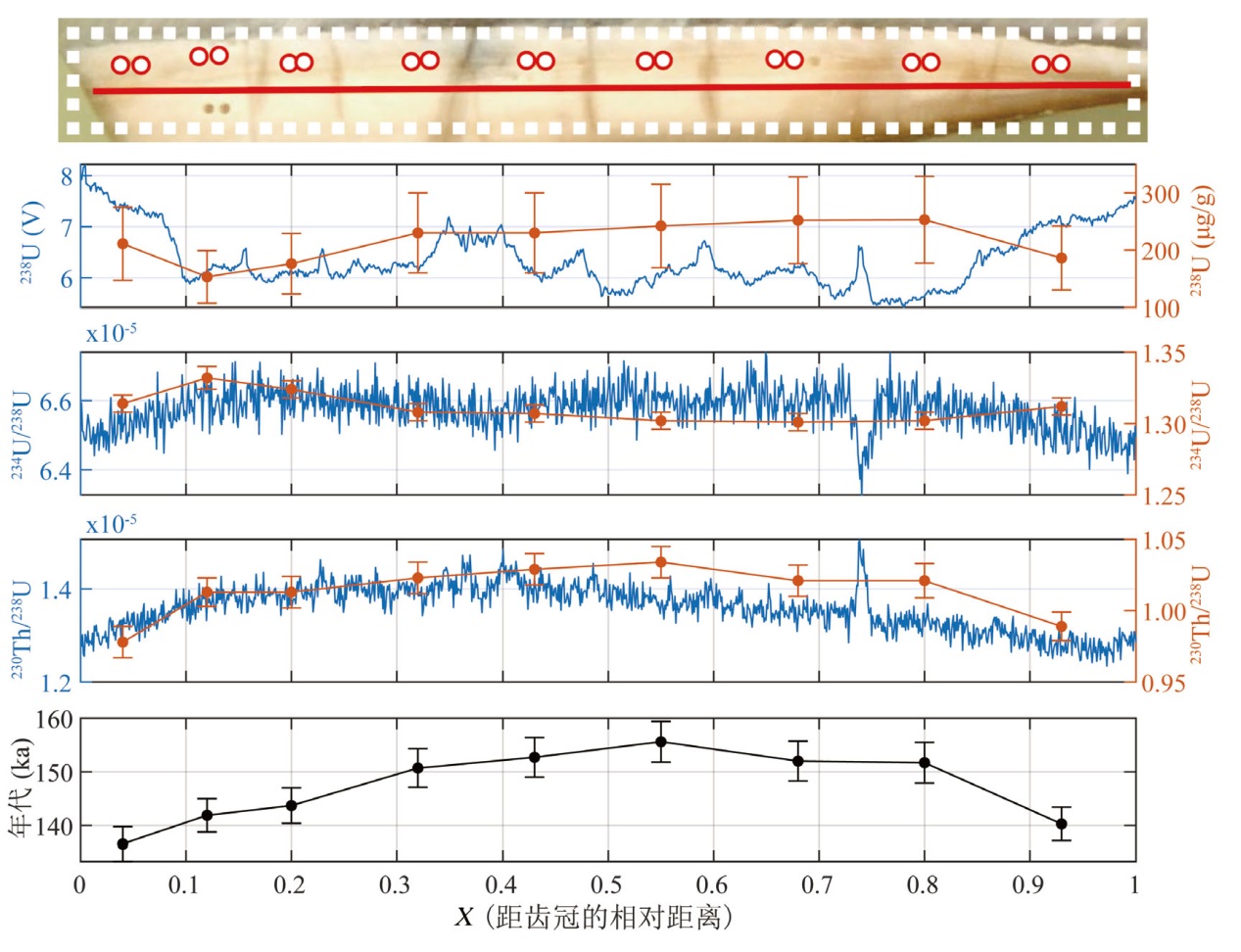
图4 XJY-1929牙骨质的LA-MC-ICPMS铀系分析 蓝线分别表示线扫描的238U信号强度(V),234U/238U原子比,230Th/238U原子比;红点代表点分析的铀含量(μg/g),234U/238U活度比,230Th/238U活度比;黑点为表观铀系年代(ka)。Blue curves represent, respectively, the 238U ion beam intensity (V), the 234U/238U and 230Th/238U atomic ratios, measured by raster scan; red points represent, respectively, the U-concentration (μg/g), 234U/238U and 230Th/238U activity ratios; black points are the apparent U-series ages.
Fig.4 LA-MC-ICPMS U- series analysis of the sample XJY-1929 cement
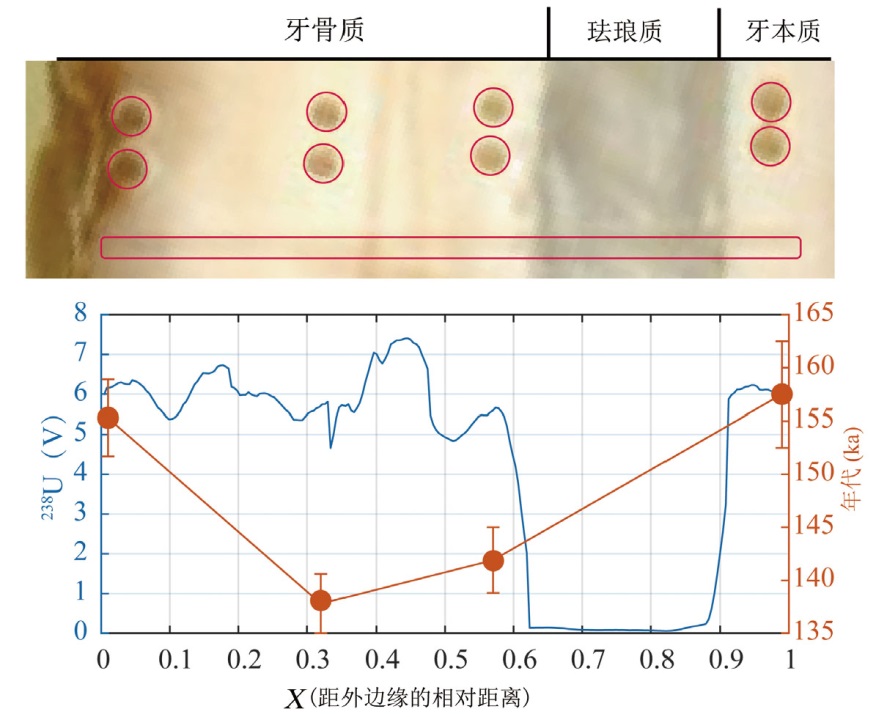
图5 XJY-1929牙骨质-珐琅质-牙本质的LA-MC-ICPMS铀系分析 蓝线表示线扫描的238U信号强度(V)Blue curves represent the 238U ion beam intensity (V);红点为表观铀系年代(ka) red points are the apparent U-series ages
Fig.5 LA-MC-ICPMS U-series analysis of XJY-1929 cementum-enamel-dentin
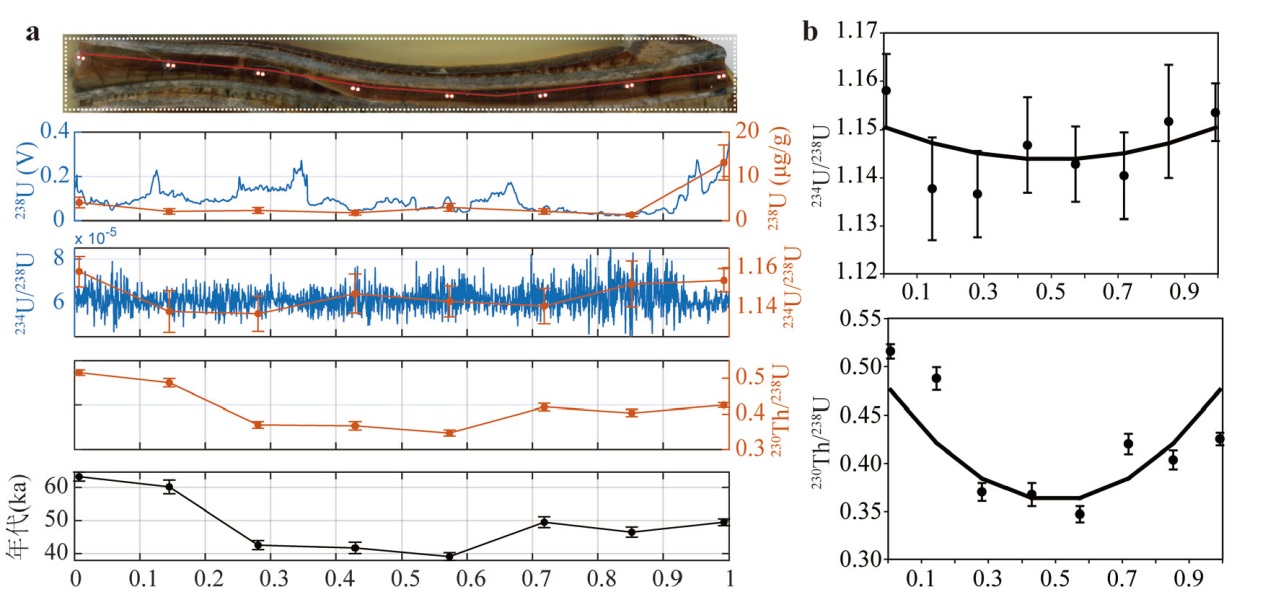
图6 XJY-3055牙本质的LA-MC-ICPMS铀系分析和DAD模拟 a.蓝线分别表示线扫描的238U信号强度(V)和234U/238U原子比;红点代表点分析的铀含量(μg/g),234U/238U活度比,230Th/238U活度比;黑点为表观铀系年代(ka)Blue curves represent, respectively, the 238U ion beam intensity (V), the 234U/238U atomic ratios, measured by raster scan; red points represent, respectively, the U-concentration (μg/g), 234U/238U and 230Th/238U activity ratios; black points are the apparent U-series ages。b.图上点为234U/238U和230Th/238U活度比的测量值,弧线为DAD模拟结果Data points are the measured values of 234U/238U and 230Th/238U activity ratios and the curves are the results of DAD modeling.
Fig.6 LA-MC-ICPMS U-series analysis and DAD modeling of the sample XJY-3055 dentin
| [1] | Edwards RL, Gallup CD, Cheng H. Uranium-series dating of marine and lacustrine carbonates[J]. Reviews in Mineralogy and Geochemistry, 2003, 52(1): 363-405 |
| [2] | Richards DA, Dorale JA. Uranium-series chronology and environmental applications of speleothems[J]. Reviews in Mineralogy and Geochemistry, 2003, 52(1): 407-460 |
| [3] | Schwarcz HP, Rink WJ. Dating methods for sediments of caves and rockshelters with examples from the Mediterranean region[J]. Geoarchaeology: An International Journal, 2001, 16(4): 355-371 |
| [4] | Pierre ES, Zhao J, Reed E. Expanding the utility of Uranium-series dating of speleothems for archaeological and palaeontological applications[J]. Journal of Archaeological Science, 2009, 36(7): 1416-1423 |
| [5] | Hoffmann DL, Pike AWG, García-Diez M, et al. Methods for U-series dating of CaCO3 crusts associated with Palaeolithic cave art and application to Iberian sites[J]. Quaternary Geochronology, 2016, 36: 104-119 |
| [6] | Szabo BJ, Malde HE, Irwin-Williams C. Dilemma posed by uranium-series dates on archaeologically significant bones from Valsequillo, Puebla, Mexico[J]. Earth and Planetary Science Letters, 1969, 6(4): 237-244 |
| [7] | Trueman CN, Tuross N. Trace elements in recent and fossil bone apatite[J]. Reviews in mineralogy and geochemistry, 2002, 48(1): 489-521 |
| [8] | Rae AM, Ivanovich M. Successful application of uranium series dating of fossil bone[J]. Applied geochemistry, 1986, 1(3): 419-426 |
| [9] | Ikeya M. A model of linear uranium accumulation for ESR age of Heidelberg (Mauer) and Tautavel bones[J]. Japanese Journal of Applied Physics, 1982, 21(11A): L690 |
| [10] | Szabo BJ, Rosholt JN. Uranium-series dating of Pleistocene molluscan shells from southern California-An open system model[J]. Journal of Geophysical Research, 1969, 74(12): 3253-3260 |
| [11] | 陈铁梅, 原思训, 高世君. 铀子系法测定骨化石年龄的可靠性研究及华北地区主要旧石器地点的铀子系年代序列[J]. 人类学学报, 1984, 3: 259-269 |
| [12] | 原思训, 陈铁梅, 高世君. 华南若干旧石器时代地点的铀系年代[J]. 人类学学报, 1986, 5(2): 179-190 |
| [13] | Chen TM, Yuan SX. Uranium-series dating of bones and teeth from Chinese palaeolithic sites[J]. Archaeometry, 1988, 30(1): 59-76 |
| [14] | Grün R, Schwarcz HP, Chadam J. ESR dating of tooth enamel: coupled correction for U-uptake and U-series disequilibrium[J]. Nuclear Tracks and Radiation Measurements, 1988, 14(1-2): 237-241 |
| [15] | Shao QF, Chadam J, Grün R, et al. The mathematical basis for the US-ESR dating method[J]. Quaternary Geochronology, 2015, 30: 1-8 |
| [16] | Millard AR, Hedges REM. A diffusion-adsorption model of uranium uptake by archaeological bone[J]. Geochimica et Cosmochimica Acta, 1996, 60(12): 2139-2152 |
| [17] | Pike AWG, Hedges REM. U-series dating of bone using the diffusion-adsorption model[J]. Geochimica et Cosmochimica Acta, 2002, 66(24): 4273-4286 |
| [18] | Sambridge M, Grün R, Eggins S. U-series dating of bone in an open system: the diffusion-adsorption-decay model[J]. Quaternary Geochronology, 2012, 9: 42-53 |
| [19] |
Aubert M, Pike AWG, Stringer C, et al. Confirmation of a late middle Pleistocene age for the Omo Kibish 1 cranium by direct uranium-series dating[J]. Journal of Human Evolution, 2012, 63(5): 704-710
doi: 10.1016/j.jhevol.2012.07.006 pmid: 22959819 |
| [20] | Holen SR, Deméré TA, Fisher DC, et al. A 130,000-year-old archaeological site in southern California, USA[J]. Nature, 2017, 544(7651): 479-483 |
| [21] | Westaway KE, Louys J, Awe RD, et al. An early modern human presence in Sumatra 73,000-63,000 years ago[J]. Nature, 2017, 548(7667): 322-325 |
| [22] | Grün R, Eggins S, Kinsley L, et al. Laser ablation U-series analysis of fossil bones and teeth[J]. Palaeogeography, Palaeoclimatology, Palaeoecology, 2014, 416: 150-167 |
| [23] | Shen CC, Wu CC, Cheng H, et al. High-precision and high-resolution carbonate 230Th dating by MC-ICP-MS with SEM protocols[J]. Geochimica et Cosmochimica Acta, 2012, 99: 71-86 |
| [24] | Cheng H, Edwards RL, Shen CC, et al. Improvements in 230Th dating, 230Th and 234U half-life values, and U-Th isotopic measurements by multi-collector inductively coupled plasma mass spectrometry[J]. Earth and Planetary Science Letters, 2013, 371: 82-91 |
| [25] | Stirling CH, Lee DC, Christensen JN, et al. High-precision in situ 238U-234U-230Th isotopic analysis using laser ablation multiple-collector ICPMS[J]. Geochimica et Cosmochimica Acta, 2000, 64(21): 3737-3750 |
| [26] | Drost K, Chew D, Petrus JA, et al. An image mapping approach to U-Pb LA-ICP-MS carbonate dating and applications to direct dating of carbonate sedimentation[J]. Geochemistry, Geophysics, Geosystems, 2018, 19(12): 4631-4648 |
| [27] |
Martin L, Galy A, Barbotin G, et al. Isotopic imaging using fsLA single-collector ICP-SFMS for direct U/Th dating of small archaeological carbonates[J]. Analytical Chemistry, 2022, 94(7): 3046-3055
doi: 10.1021/acs.analchem.1c02241 pmid: 35061344 |
| [28] | Spooner PT, Chen TY, Robinson LF, et al. Rapid uranium-series age screening of carbonates by laser ablation mass spectrometry[J]. Quaternary Geochronology, 2016, 31: 28-39 |
| [29] | Woodhead J, Petrus J. Exploring the advantages and limitations of in situ U-Pb carbonate geochronology using speleothems[J]. Geochronology, 2019, 1(1): 69-84 |
| [30] | Eggins S, Grün R, Pike AWG, et al. 238U, 232Th profiling and U-series isotope analysis of fossil teeth by laser ablation-ICPMS[J]. Quaternary Science Reviews, 2003, 22(10-13): 1373-1382 |
| [31] | Eggins S, Grün R, McCulloch MT, et al. In situ U-series dating by laser-ablation multi-collector ICPMS: new prospects for Quaternary geochronology[J]. Quaternary Science Reviews, 2005, 24(23-24): 2523-2538 |
| [32] | Grün R, Aubert M, Joannes-Boyau R, et al. High resolution analysis of uranium and thorium concentration as well as U-series isotope distributions in a Neanderthal tooth from Payre (Ardèche, France) using laser ablation ICP-MS[J]. Geochimica et Cosmochimica Acta, 2008, 72(21): 5278-5290 |
| [33] | Harvati K, Röding C, Bosman AM, et al. Apidima Cave fossils provide earliest evidence of Homo sapiens in Eurasia[J]. Nature, 2019, 571(7766): 500-504 |
| [34] | Grün R, Pike AWG, McDermott F, et al. Dating the skull from Broken Hill, Zambia, and its position in human evolution[J]. Nature, 2020, 580(7803): 372-375 |
| [35] | 涂湘林, 张红, 邓文峰, 等. RESOlution激光剥蚀系统在微量元素原位微区分析中的应用[J]. 地球化学, 2011, 1: 83-98 |
| [36] | Li FC, Hou ML, Luan RJ, et al. Optimization of analytical conditions for LA-ICP-MS and its application to zircon U-Pb dating[J]. Rock and Mineral Analysis, 2016, 35(1): 17-23 |
| [37] | Jackson SE, Günther D. The nature and sources of laser induced isotopic fractionation in laser ablation-multicollector-inductively coupled plasma-mass spectrometry[J]. Journal of Analytical Atomic Spectrometry, 2003, 18(3): 205-212 |
| [38] | Wiedenbeck M, Alle P, Corfu FY, et al. Three natural zircon standards for U-Th-Pb, Lu-Hf, trace element and REE analyses[J]. Geostandards newsletter, 1995, 19(1): 1-23 |
| [39] | Jackson SE, Pearson NJ, Griffin WL, et al. The application of laser ablation-inductively coupled plasma-mass spectrometry to in situ U-Pb zircon geochronology[J]. Chemical geology, 2004, 211(1-2): 47-69 |
| [40] | Jochum KP, Stoll B, Herwig K, et al. MPI-DING reference glasses for in situ microanalysis: New reference values for element concentrations and isotope ratios[J]. Geochemistry, Geophysics, Geosystems, 2006, 7(2) |
| [41] | Sláma J, Košler J, Condon DJ, et al. Plešovice zircon-a new natural reference material for U-Pb and Hf isotopic microanalysis[J]. Chemical Geology, 2008, 249(1-2): 1-35 |
| [42] | Li XH, Tang GQ, Gong B, et al. Qinghu zircon: A working reference for microbeam analysis of U-Pb age and Hf and O isotopes[J]. Chinese Science Bulletin, 2013, 58: 4647-4654 |
| [43] | Roberts NMW, Rasbury ET, Parrish RR, et al. A calcite reference material for LA-ICP-MS U-Pb geochronology[J]. Geochemistry, Geophysics, Geosystems, 2017, 18(7): 2807-2814 |
| [44] | Shao QF, Li CH, Huang MJ, et al. Interactive programs of MC-ICPMS data processing for 230Th/U geochronology[J]. Quaternary Geochronology, 2019, 51: 43-52 |
| [45] | 金曼谷, 焦亚诺, 刘玥, 等. MC-ICP-MS铀同位素的高精度法拉第杯静态分析[J]. 科学通报, 2022, 67(22): 11 |
| [46] | Bernal JP, Eggins SM, McCulloch MT. Accurate in situ 238U-234U-232Th-230Th analysis of silicate glasses and iron oxides by laser-ablation MC-ICP-MS[J]. Journal of Analytical Atomic Spectrometry, 2005, 20(11): 1240-1249 |
| [47] | 王法岗. 侯家窑遗址 2007-2012发掘地层的新认识[J]. 文物春秋, 2015, 6: 15-22 |
| [48] | 李曼玥, 张生瑞, 许清海, 等. 侯家窑遗址地层、年代与形成环境的新认识[J]. 古生物学报, 2016, 55(1): 122-135 |
| [49] | 李蕾, 黄华芳, 王健, 等. 泥河湾侯家窑遗址古河流及环境考古意义[J]. 沉积学报, 2016, 34(1): 111-119 |
| [50] | Grün R, Stringer C. Direct dating of human fossils and the ever-changing story of human evolution[J]. Quaternary Science Reviews, 2023, 322: 108379 |
| [51] | Shao QF, Ge JY, Ji Q, et al. Geochemical provenancing and direct dating of the Harbin archaic human cranium[J]. The Innovation, 2021, 2(3): 100131 |
| [52] |
Ge JY, Xing S, Grün R, et al, New Late Pleistocene age for the Homo sapiens skeleton from Liujiang southern China[J]. Nature Communications, 2024, 15: 3611
doi: 10.1038/s41467-024-47787-3 pmid: 38684677 |
| [53] | 陈铁梅, 原思训, 高世君, 等. 许家窑遗址哺乳动物化石的铀子系法年代测定[J]. 人类学学报, 1982, 1(1): 91-95 |
| [54] |
Ao H, Liu CR, Roberts AP, et al. An updated age for the Xujiayao hominin from the Nihewan Basin, North China: implications for Middle Pleistocene human evolution in East Asia[J]. Journal of Human Evolution, 2017, 106: 54-65
doi: S0047-2484(17)30034-9 pmid: 28434540 |
| [55] | Li Z, Xu Q, Zhang S, et al. Study on stratigraphic age, climate changes and environment background of Houjiayao Site in Nihewan Basin[J]. Quaternary international, 2014, 349: 42-48 |
| [56] | Mu H, Xu Q, Zhang S, et al. Pollen-based quantitative reconstruction of the paleoclimate during the formation process of Houjiayao Relic Site in Nihewan Basin of China[J]. Quaternary International, 2015, 374: 76-84 |
| [57] | Tu H, Shen GJ, Li HX, et al. 26Al/10Be burial dating of Xujiayao-Houjiayao site in Nihewan Basin, northern China[J]. PLoS One, 2014, 10(2): e0118315 |
| [58] | 王法岗, 李峰. “许家窑人”埋藏地层与时代探讨[J]. 人类学学报, 2020, 39(2): 161-172 |
| [1] | 王頠;田丰;莫进尤. 广西布兵盆地么会洞发现的巨猿牙齿化石[J]. 人类学学报, 2007, 26(04): 329-343. |
| 阅读次数 | ||||||
|
全文 |
|
|||||
|
摘要 |
|
|||||
 京ICP证05002819号-3