

主管:中国科学院
主办:中国科学院古脊椎动物与古人类研究所
出版:科学出版社
主办:中国科学院古脊椎动物与古人类研究所
出版:科学出版社
人类学学报 ›› 2025, Vol. 44 ›› Issue (03): 413-426.doi: 10.16359/j.1000-3193/AAS.2025.0040cstr: 32091.14.j.1000-3193/AAS.2025.0040
邓婉文( ), 谢颖
), 谢颖
收稿日期:2024-10-25
修回日期:2025-04-01
出版日期:2025-06-15
发布日期:2025-06-15
作者简介:邓婉文,助理教授,主要研究方向为旧石器时代考古。E-mail: wwdeng@xmu.edu.cn
基金资助:
DENG Wanwen(), XIE Ying
Received:2024-10-25
Revised:2025-04-01
Online:2025-06-15
Published:2025-06-15
摘要:
广西隆安娅怀洞遗址出土的文化遗物主要包括人类头骨与肢骨化石、大量石制品、骨制品及动植物化石等,地层堆积年代为43~14 kaBP cal;本文是对石制品的专项研究。石制品计7529件,原料包括石英砂岩、砂岩、玻璃陨石、石英、燧石等,基本为简单石核-石片技术产品。该遗址石器组合以刮削器为主,较小,整体表现为小型石制品组合特征,是近年来岭南地区旧石器时代晚期的重要考古发现之一。此类小型石制品还见于岭南、长江中下游、云贵高原乃至东南亚地区的同时期遗存中。综合比较结果显示,娅怀洞与华南及东南亚大陆地区所见小型石片石器遗存表现出相似的原料、技术与类型特点,体现了晚更新世晚期石制品小型化的全球趋势,而对燧石等优质原料的强化利用、简单石器作复合工具可能性的存在或与华南晚更新世现代人的扩散及其行为复杂化相关。
中图分类号:
邓婉文, 谢颖. 广西隆安娅怀洞遗址发现的小型石制品[J]. 人类学学报, 2025, 44(03): 413-426.
DENG Wanwen, XIE Ying. A study of the miniaturized stone artifacts from the Yahuai Cave site in Long’an, Guangxi[J]. Acta Anthropologica Sinica, 2025, 44(03): 413-426.
| 分区比例Percentage by zones→ 石料 Raw materials*↓ | A区 / Zone A | B区 / Zone B | C区 / Zone C | D区 / Zone D |
|---|---|---|---|---|
| 石英砂岩Quartz sandstone | 33.3% | 53.0% | 20.0% | 59.0% |
| 砂岩Sandstone | √ | √ | 5.2% | |
| 石英岩Quartzite | √ | √ | √ | |
| 硅质岩Siliceous rock | √ | 10.7% | √ | 7.0% |
| 燧石Flint | √ | √ | √ | √ |
| 石英Quartz | √ | 6.9% | 30.0% | 4.7% |
| 水晶Crystal | √ | √ | √ | |
| 玻璃陨石Tektite | √ | 6.9% | 38.2% | √ |
| 赭石Ochre | √ | √ | √ | 9.9% |
| 灰岩等其他石料Limestone and others | √ | √ | √ | √ |
| 合计数量Total number | n=93 | n=2324 | n=110 | n=5002 |
| 注:“*”—资料来源于参考文献[15] Data from the reference[15]. “√”—存在此类石料,但占比较低Indicates there exists a certain kind of raw material, but in quite low proportion. | ||||
表1 广西隆安娅怀洞遗址分区石制品原料构成
Tab.1 Constitution of lithic raw materials from the Yahuai Cave site in Long’an County, Guangxi, by excavation zones
| 分区比例Percentage by zones→ 石料 Raw materials*↓ | A区 / Zone A | B区 / Zone B | C区 / Zone C | D区 / Zone D |
|---|---|---|---|---|
| 石英砂岩Quartz sandstone | 33.3% | 53.0% | 20.0% | 59.0% |
| 砂岩Sandstone | √ | √ | 5.2% | |
| 石英岩Quartzite | √ | √ | √ | |
| 硅质岩Siliceous rock | √ | 10.7% | √ | 7.0% |
| 燧石Flint | √ | √ | √ | √ |
| 石英Quartz | √ | 6.9% | 30.0% | 4.7% |
| 水晶Crystal | √ | √ | √ | |
| 玻璃陨石Tektite | √ | 6.9% | 38.2% | √ |
| 赭石Ochre | √ | √ | √ | 9.9% |
| 灰岩等其他石料Limestone and others | √ | √ | √ | √ |
| 合计数量Total number | n=93 | n=2324 | n=110 | n=5002 |
| 注:“*”—资料来源于参考文献[15] Data from the reference[15]. “√”—存在此类石料,但占比较低Indicates there exists a certain kind of raw material, but in quite low proportion. | ||||
| 分区Zones→ | A区 / Zone A | B区 / Zone B | C区 / Zone C | D区 / Zone D | |||||||
|---|---|---|---|---|---|---|---|---|---|---|---|
| 石器类型Tool types↓ | 数量n | 占比% | 数量n | 占比% | 数量n | 占比% | 数量n | 占比% | |||
| 刮削器Scraper | 6 | 100% | 167 | 82.7% | 7 | 87.5% | 89 | 71.2% | |||
| 尖状器Point | 0 | 0 | 13 | 6.4% | 1 | 12.5% | 3 | 2.4% | |||
| 砍砸器Chopper | 0 | 0 | 21 | 10.4% | 0 | 0 | 31 | 24.8% | |||
表2 广西隆安娅怀洞遗址主要打制石器类型
Tab.2 Main lithic tool types from the Yahuai Cave site in Long’an County, Guangxi, by excavation zones
| 分区Zones→ | A区 / Zone A | B区 / Zone B | C区 / Zone C | D区 / Zone D | |||||||
|---|---|---|---|---|---|---|---|---|---|---|---|
| 石器类型Tool types↓ | 数量n | 占比% | 数量n | 占比% | 数量n | 占比% | 数量n | 占比% | |||
| 刮削器Scraper | 6 | 100% | 167 | 82.7% | 7 | 87.5% | 89 | 71.2% | |||
| 尖状器Point | 0 | 0 | 13 | 6.4% | 1 | 12.5% | 3 | 2.4% | |||
| 砍砸器Chopper | 0 | 0 | 21 | 10.4% | 0 | 0 | 31 | 24.8% | |||
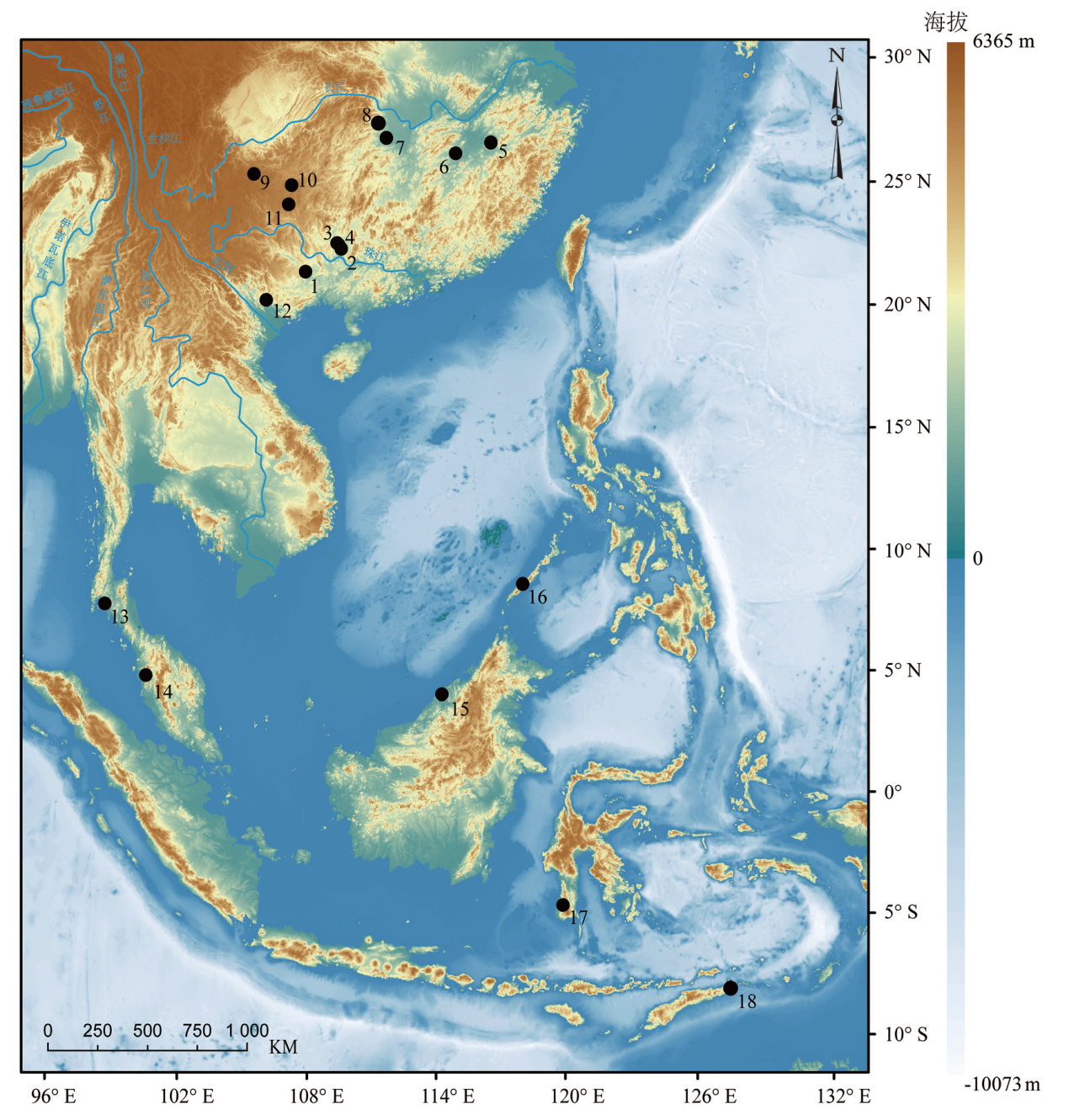
图1 本文讨论涉及的主要遗址点 1.广西隆安娅怀洞Yahuai Cave site in Long’an, Guangxi;2.广西柳州白莲洞Bailian Cave site in Liuzhou, Guangxi;3.广西柳州鲤鱼嘴Liyuzui rock shelter site in Liuzhou, Guangxi;4.广西柳州凤岩Fengyan Cave site in Liuzhou, Guangxi;5.江西万年仙人洞与吊桶环Xianrendong Cave and Diaotonghuan Cave sites in Wannian, Jiangxi;6.江西高安上湖Shanghu open-air site in Gao’an, Jiangxi;7.湖南澧县十里岗Shiligang open-air site in Lixian, Hunan;8.湖南石门燕耳洞Yaner Cave site in Shimen, Hunan;9.贵州毕节老鸦洞Laoya Cave site in Bijie, Guizhou;10.贵州开阳打儿窝Da’erwo rock shelter site in Kaiyang, Guizhou;11.贵州清水苑大洞Qingshuiyuan Dadong Cave site in Guizhou;12.越南太原Nguom岩厦遗址Nguom rock shelter site in Thai Nguyen, Vietnam;13.泰国甲米府Lang Rongrien洞穴遗址Lang Rogrien Cave site in Krabi, Thailand;14.马来西亚Niah洞穴遗址Niah Cave site in Borneo, Malaysia;15.马来西亚Kota Tampan遗址Kota Tampan open-air site in Perak, Malaysia;16.菲律宾Tabon洞穴遗址Tabon Cave site in Palawan, the Philippines;17.印度尼西亚Leang Burung 2号洞穴遗址Leang Burung 2 Cave site in Sulawesi, Indonesia;18.东帝汶Jerimalai岩厦与Lene Hara洞穴遗址Jerimalai rock shelter and Lene Hara Cave site in East Timor.
Fig.1 Main sites discussed in the text
| 分期Periods→ | 早期堆积 Early deposits | 中期堆积 Middle deposits | 晚期堆积 Late deposits | ||||||
|---|---|---|---|---|---|---|---|---|---|
| 遗址sites↓ | 石料 Raw materials* | 数量n | 占比Percentage | 数量n | 占比Percentage | 数量n | 占比Percentage | ||
| 仙人洞Xianrendong Cave | 燧石等优质原料 Fine-grained raw materials, e.g., flint nodule | 63 | 82.9% | 90 | 94.7% | 262 | 50.9% | ||
| 片岩等砾石原料 Coarse-grained raw materials, e.g., schist cobbles | 13 | 17.1% | 5 | 5.3% | 253 | 49.1% | |||
| 合计Total | 76 | 100.0% | 95 | 100.0% | 515 | 100.0% | |||
| 燧石等优质原料 Fine-grained raw materials, e.g., flint nodule† | 3 | 33.3% | 5 | 55.6% | 9 | 14.1% | |||
| 片岩等砾石原料 Coarse-grained raw materials, e.g., schist cobbles† | 6 | 66.7% | 4 | 44.4% | 55 | 85.9% | |||
| 合计 Total† | 9 | 100.0% | 9 | 100.0% | 64 | 100.0% | |||
| 吊桶环Diaotonghuan Cave | 燧石等优质原料 Fine-grained raw materials, e.g., flint nodule | 558 | 98.1% | 581 | 84.8% | 242 | 66.9% | ||
| 片岩等砾石原料 Coarse-grained raw materials, e.g., schist cobbles | 11 | 1.9% | 104 | 15.2% | 120 | 33.1% | |||
| 合计 Total | 569 | 100.0% | 685 | 100.0% | 362 | 100.0% | |||
| 燧石等优质原料 Fine-grained raw materials, e.g., flint nodule† | 86 | 96.6% | 53 | 51.0% | 24 | 28.6% | |||
| 片岩等砾石原料 Coarse-grained raw materials, e.g., schist cobbles† | 3 | 3.4% | 51 | 49.0% | 60 | 71.4% | |||
| 合计 Total† | 89 | 100.0% | 104 | 100.0% | 84 | 100.0% | |||
表3 江西万年仙人洞和吊桶环遗址早、中、晚期石制品整体原料构成
Tab.3 Differences in the constitution of lithic raw materials among early, middle and late deposits at the Xianrendong Cave and Diaotonghuan Cave sites in Wannian, Jiangxi
| 分期Periods→ | 早期堆积 Early deposits | 中期堆积 Middle deposits | 晚期堆积 Late deposits | ||||||
|---|---|---|---|---|---|---|---|---|---|
| 遗址sites↓ | 石料 Raw materials* | 数量n | 占比Percentage | 数量n | 占比Percentage | 数量n | 占比Percentage | ||
| 仙人洞Xianrendong Cave | 燧石等优质原料 Fine-grained raw materials, e.g., flint nodule | 63 | 82.9% | 90 | 94.7% | 262 | 50.9% | ||
| 片岩等砾石原料 Coarse-grained raw materials, e.g., schist cobbles | 13 | 17.1% | 5 | 5.3% | 253 | 49.1% | |||
| 合计Total | 76 | 100.0% | 95 | 100.0% | 515 | 100.0% | |||
| 燧石等优质原料 Fine-grained raw materials, e.g., flint nodule† | 3 | 33.3% | 5 | 55.6% | 9 | 14.1% | |||
| 片岩等砾石原料 Coarse-grained raw materials, e.g., schist cobbles† | 6 | 66.7% | 4 | 44.4% | 55 | 85.9% | |||
| 合计 Total† | 9 | 100.0% | 9 | 100.0% | 64 | 100.0% | |||
| 吊桶环Diaotonghuan Cave | 燧石等优质原料 Fine-grained raw materials, e.g., flint nodule | 558 | 98.1% | 581 | 84.8% | 242 | 66.9% | ||
| 片岩等砾石原料 Coarse-grained raw materials, e.g., schist cobbles | 11 | 1.9% | 104 | 15.2% | 120 | 33.1% | |||
| 合计 Total | 569 | 100.0% | 685 | 100.0% | 362 | 100.0% | |||
| 燧石等优质原料 Fine-grained raw materials, e.g., flint nodule† | 86 | 96.6% | 53 | 51.0% | 24 | 28.6% | |||
| 片岩等砾石原料 Coarse-grained raw materials, e.g., schist cobbles† | 3 | 3.4% | 51 | 49.0% | 60 | 71.4% | |||
| 合计 Total† | 89 | 100.0% | 104 | 100.0% | 84 | 100.0% | |||
| 地层Stratigraphy → | 单元Unit 10 | 单元Unit 9 | 单元Unit 8 | |||||
|---|---|---|---|---|---|---|---|---|
| 分类Category↓ | 数量n | 占比Percentage | 数量n | 占比Percentage | 数量n | 占比Percentage | ||
| 石片石器Flake tools | 3 | 25.0% | 11 | 55.0% | 9 | 69.2% | ||
| 石核石器Core tools | 7 | 58.3% | 2 | 10.0% | 1 | 7.7% | ||
| 石片Flakes | 2 | 16.7% | 2 | 10.0% | 2 | 15.4% | ||
| 石核Cores | 0 | 0.0% | 5 | 25.0% | 1 | 7.7% | ||
| 合计Total | 12 | 100% | 20 | 100% | 13 | 100% | ||
表4 泰国甲米府Lang Rongrien洞穴遗址早期地层石制品类别构成
Tab.4 Categories of lithic artefacts from Lower Levels at the Lang Rongrien site, Krabi, Thailand
| 地层Stratigraphy → | 单元Unit 10 | 单元Unit 9 | 单元Unit 8 | |||||
|---|---|---|---|---|---|---|---|---|
| 分类Category↓ | 数量n | 占比Percentage | 数量n | 占比Percentage | 数量n | 占比Percentage | ||
| 石片石器Flake tools | 3 | 25.0% | 11 | 55.0% | 9 | 69.2% | ||
| 石核石器Core tools | 7 | 58.3% | 2 | 10.0% | 1 | 7.7% | ||
| 石片Flakes | 2 | 16.7% | 2 | 10.0% | 2 | 15.4% | ||
| 石核Cores | 0 | 0.0% | 5 | 25.0% | 1 | 7.7% | ||
| 合计Total | 12 | 100% | 20 | 100% | 13 | 100% | ||
| [1] | 张森水. 管窥新中国旧石器考古学的重大发展[J]. 人类学学报, 1999, 18(3): 193-214 |
| [2] | Elston RG, Khun SL. Thinking Small: Global Perspectives on Microlithization[M]. Washington DC: American Anthropological Association, 2002 |
| [3] | 贾兰坡, 盖培, 尤玉柱. 山西峙峪旧石器时代遗址发掘报告[J]. 考古学报, 1972, 1: 39-58 |
| [4] | 张森水. 中国北方旧石器工业的区域渐进与文化交流[J]. 人类学学报, 1990, 9(4): 322-333 |
| [5] | 裴文中, 张森水. 中国猿人石器研究(中国古生物志,总号第168册,新丁种第12号)[M]. 北京: 科学出版社, 1985 |
| [6] | 王幼平. 华北晚更新世的石片石器[J]. 人类学学报, 2019, 38(4): 525-535 |
| [7] | 中国社会科学院考古研究所, 河北省文物研究所,阳原县文物管理所. 河北阳原县西白马营旧石器时代遗址2015年试掘简报[J]. 考古, 2019, 10: 3-14 |
| [8] | 周士航, 何湘栋, 徐静玥, 等. 蔚县盆地东沟遗址2017年度发掘简报[J]. 人类学学报, 2024, 43(1): 132-142 |
| [9] | Wang F, Yang S, Ge J, et al. Innovative ochre processing and tool use in China 40,000 years ago[J]. Nature, 2022, 603: 284-289 |
| [10] | Yang S, Zhang JF, Yue JP, et al. Initial Upper Palaeolithic material culture by 45,000 years ago at Shiyu in northern China[J]. Nature Ecology & Evolution, 2024, 8: 552-563 |
| [11] | Liu W, Martinon-torres M, Cai Y, et al. The earliest unequivocally modern humans in southern China[J]. Nature, 2015, 526: 696-699 |
| [12] | 刘武, 金昌柱, 吴新智. 广西崇左木榄山智人洞10万年前早期现代人化石的发现与研究[J]. 中国基础科学, 2011, 1: 11-14 |
| [13] | Bae CJ, Wang W, Zhao JX, et al. Modern human teeth from Late Pleistocene Luna Cave (Guangxi, China)[J]. Quaternary International, 2014, 354: 169-183 |
| [14] | 李浩. 探究早期现代人的南方扩散路线[J]. 人类学学报, 2022, 41(4): 630-648 |
| [15] | 谢光茂, 余明辉, 卢杰英. 广西隆安娅怀洞遗址发掘报告[J]. 人类学学报, 2025, 44(3): 365-388 |
| [16] | Toth N. The Stone Technologies of Early Hominids at Koobi Fora, Kenya: An Experimental Approach[D]. Berkeley: University of California, 1982 |
| [17] | 柳州白莲洞洞穴科学博物馆,北京自然博物馆,广西民族学院历史系. 广西柳州白莲洞石器时代洞穴遗址发掘报告[J]. 见:四川大学博物馆,中国古代铜鼓研究学会(编). 南方民族考古(第一辑)[C]. 成都: 四川大学出版社, 1987, 143-160 |
| [18] | 广西柳州白莲洞洞穴科学博物馆. 柳州白莲洞[M]. 北京: 科学出版社, 2009 |
| [19] | 中国社会科学院考古研究所华南一队, 广西文物保护与考古研究所, 柳州白莲洞洞穴科学博物馆, 等. 广西柳州市凤岩遗址2023年发掘简报[J]. 考古, 2025, 2: 3-18 |
| [20] | 柳州市博物馆,广西壮族自治区文物工作队. 柳州市大龙潭鲤鱼嘴新石器时代贝丘遗址[J]. 考古, 1983, 9: 769-774 |
| [21] | 湖南省文物考古研究所,澧县文化旅游广电体育局. 湖南澧县十里岗旧石器时代遗址发掘简报[J]. 考古与文物, 2020, 1: 3-13 |
| [22] | 湖南省文物考古研究所,石门县博物馆. 石门县燕儿洞旧石器遗址试掘[J]. 见:湖南省文物考古研究所(编). 湖南考古辑刊(第6辑)[C]. 长沙: 岳麓书社, 1994, 1-7 |
| [23] | 北京大学考古文博学院, 江西省文物考古研究所. 仙人洞与吊桶环[M]. 北京: 文物出版社, 2014 |
| [24] | 赵文杰, 李三灵, 李浩. 江西旧石器考古新发现与认识[J]. 南方文物, 2023, 6: 53-60 |
| [25] | 关莹, 蔡回阳, 王晓敏, 等. 贵州毕节老鸦洞遗址2013年发掘报告[J]. 人类学学报, 2015, 34(4): 461-477 |
| [26] | 贵州省文物考古研究所. 贵州开阳打儿窝岩厦遗址试掘简报[J]. 长江文明, 2013, 1: 1-19 |
| [27] | 张兴龙, 毕忠荣, 龙小平, 等. 贵州清水苑大洞遗址发掘简报[J]. 人类学学报, 2017, 36(4): 512-526 |
| [28] | Bui V. The Stone Age archaeology in Viet Nam: Achievements and general model[J]. In: Manguin PY. Southeast Asian Archaeology 1994: Proceedings of the 5th International Conference of the European Association of Southeast Asian Archaeologist, Paris, 24th-28th October 1994, Vol.1[C]. Hull: Centre for Southeast Asian Studies, University of Hull, 1994, 5-12 |
| [29] | Ha VT. The Late Pleistocene climate in Southeast Asia: New data from Vietnam[J]. Modern Quaternary Research in Southeast Asia, 1985, 9: 81-86 |
| [30] | Anderson DD. Lang Rongrien Rockshelter: A Pleistocene-Early Holocene Archaeological Site from Krabi, Southwestern Thailand[M]. Philadelphia: University Museum, University of Pennsylvania, 1990 |
| [31] | Majid Z. The West Mouth, Niah, in the Prehistory of Southeast Asia[J]. The Sarawak Museum Journal, 1982, XXXI(52, New Series): 1-200 |
| [32] | Majid Z, Tjia HD. Kota Tampan, Perak: The geological and archaeological evidence for a Late Pleistocene site[J]. Journal of the Malaysian Branch of the Royal Asiatic Society, 1988, 61-2(255): 123-134 |
| [33] | Fox RB. The Tabon Cave. Monograph of the National Museum No. 1[M]. Manila: National Museum Press, 1970 |
| [34] | Glover I. Leang Burung 2: An Upper Paleolithic rock shelter in south Sulawesi, Indonesia[J]. Modern Quaternary Research in Southeast Asia, 1981, 6: 1-38 |
| [35] | O'Connor S, Spriggs M, Veth P. Excavation at Lene Hara establishes occupation in East Timor at least 30 000-35 000 years[J]. Antiquity, 2002, 76: 45-50 |
| [36] | O'Connor S. New Evidence from East Timor contributes to our understanding of earliest modern human colonization east of the Sunda Shelf[J]. Antiquity, 2007, 81: 523-535 |
| [37] | 尹检顺. 澧水流域的“细小石器”及相关问题[J]. 湖南省博物馆馆刊, 2005, 2: 102-112 |
| [38] | 王幼平. 华南晚更新世晚期人类行为复杂化的个案—江西万年吊桶环遗址的发现[J]. 人类学学报, 2016, 35(3): 397-406 |
| [39] | Mijares AS. Human emergence and adaptation to an island environment in the Philippine Paleolithic[J]. In: Kaifu Y, Izuho M, Goebel T, et al (Eds.). Emergence and Diversity of Modern Human Behavior in Paleolithic Asia[C]. College Station: Texas A&M University Press, 2015, 171-181 |
| [40] | Pawlik AF. Detecting traits of modern behavior through microwear analysis: A case study from the Philippine Terminal Pleistocene[J]. In: Kaifu Y, Izuho M, Goebel T, et al (Eds.). Emergence and Diversity of Modern Human Behavior in Paleolithic Asia[C]. College Station: Texas A&M University Press, 2015, 182-198 |
| [41] | 王法岗, 杨石霞, 葛俊逸, 等. 泥河湾盆地下马碑遗址2013年发掘简报[J]. 人类学学报, 2024, 43(1): 143-156 |
| [42] | Bae CJ. Modern humans in Northeast Asia[J]. Nature Ecology & Evolution, 2024, 8: 368-369 |
| [43] | 王幼平. 更新世环境与中国南方旧石器文化发展[M]. 北京: 北京大学出版社,1997 |
| [44] | Wang YP. Late Pleistocene human migrations in China[J]. Current Anthropology, 2017, 58(S17): 504-513 |
| [45] | Heinreich H. Origin and consequences of cyclic ice rafting in the Northeast Atlantic ocean during the past 130,000 years[J]. Quaternary Research, 1988, 29: 142-152 |
| [46] | 张美良, 林玉石, 覃嘉铭, 等. 广西灌阳县观音阁响水洞的形成环境及1号石笋的古气候信息[J]. 地质地球化学, 2000, 1: 34-40 |
| [47] | 汪洪娇. 泥炭记录的黔西北51.91-37.96 ka BP古植被演化[D].硕士研究生毕业论文, 金华: 浙江师范大学, 2023 |
| [48] | 彭子成, 张兆峰, 蔡演军, 等. 贵州七星洞晚更新世晚期石笋的古气候环境记录[J]. 第四纪研究, 2002, 3: 273-282 |
| [49] |
Wang Y, Cheng H, Edwards RL, et al. A high-resolution absolute-dated Late Pleistocene monsoon record from Hulu Cave, China[J]. Science, 2001, 294(5550): 2345-2348
pmid: 11743199 |
| [1] | 郑喆轩, 谭培阳. 四川旧石器考古的进展与思考[J]. 人类学学报, 2025, 44(06): 1094-1105. |
| [2] | 谢光茂, 林强, 余明辉, 卢杰英. 广西隆安娅怀洞遗址发掘报告[J]. 人类学学报, 2025, 44(03): 365-388. |
| [3] | 贺乐天, 谢光茂, 林强, 李大伟, 吴秀杰. 广西更新世晚期娅怀洞人的性别与年龄[J]. 人类学学报, 2025, 44(03): 389-403. |
| [4] | 付永旭. 广西晚更新世小石片石器的来源[J]. 人类学学报, 2025, 44(03): 427-438. |
| [5] | 谢颖, 付琳. 广西隆安娅怀洞遗址出土的穿孔石器[J]. 人类学学报, 2025, 44(03): 439-450. |
| [6] | 郭云浩, 陈虹, 李大伟, 谢光茂, 薛理平. 广西娅怀洞遗址出土的玻璃陨石制品[J]. 人类学学报, 2025, 44(03): 451-465. |
| [7] | 李大伟, 周广超, 李凡, 崔景怡, 徐秀岚, 谢光茂, 贾真秀, 李浩. 广西娅怀洞遗址新发现赭石的初步研究[J]. 人类学学报, 2025, 44(03): 466-476. |
| [8] | 胡章华, 陈洪波, 谢莉, 王雨晴, 谢光茂. 广西娅怀洞遗址出土的蚌器[J]. 人类学学报, 2025, 44(03): 477-487. |
| [9] | 汪静怡, 赵志军, 谢光茂, 林强, 吴妍. 广西隆安娅怀洞遗址人类对植物的利用[J]. 人类学学报, 2025, 44(03): 488-498. |
| [10] | 李浩, 谢光茂, 李大伟, 李三灵, 肖培源, 陈清懿, 王雨晴, 贾真秀, 吴雁, 卢杰英. 广西娅怀洞遗址B区出土的旧石器[J]. 人类学学报, 2025, 44(03): 404-412. |
| [11] | 张亚盟, 吴秀杰. 中国晚更新世早期现代人内耳迷路的形态变异[J]. 人类学学报, 2024, 43(06): 1038-1047. |
| [12] | 胡晓纯, 高星. 贵州马鞍山遗址1986年出土石制品初步研究[J]. 人类学学报, 2022, 41(05): 788-803. |
| [13] | 马东东, 牛东伟, 裴树文, 李潇丽, 杨海勇, 王法岗. 蔚县盆地2017-2018年旧石器考古调查简报[J]. 人类学学报, 2021, 40(01): 128-136. |
| [14] | 李锋;高星. 东亚现代人来源的考古学思考:证据与解释[J]. 人类学学报, 2018, 37(02): 176-191. |
| [15] | 王幼平. 华南晚更新世晚期人类行为复杂化的个案——江西万年吊桶环遗址的发现[J]. 人类学学报, 2016, 35(03): 397-406. |
| 阅读次数 | ||||||
|
全文 |
|
|||||
|
摘要 |
|
|||||
 京ICP证05002819号-3