

主管:中国科学院
主办:中国科学院古脊椎动物与古人类研究所
出版:科学出版社
主办:中国科学院古脊椎动物与古人类研究所
出版:科学出版社
人类学学报 ›› 2026, Vol. 45 ›› Issue (02): 248-257.doi: 10.16359/j.1000-3193/AAS.2025.0116
易智星1,2( ), 仇若萱1, 王伟1, 廖卫1, 梁华3, 田淳1, 米尔阿迪力·吐尔逊江1, 张一景1, 姚艳燕1,2,4()
收稿日期:2025-06-20
修回日期:2025-10-13
出版日期:2026-04-15
发布日期:2026-04-17
通讯作者:
姚艳燕,副研究馆员,主要研究华南地区洞穴化石埋藏学、第四纪哺乳动物群。E-mail: yaoyanyan@amgx.org
作者简介:易智星,副研究员,主要从事古人类学研究。E-mail: yizhixing@sdu.edu.cn
基金资助:
YI Zhixing1,2(), QIU Ruoxuan1, WANG Wei1, LIAO Wei1, LIANG Hua3, TIAN Chun1, MIERADILI · Tuerxunjiang1, ZHANG Yijing1, YAO Yanyan1,2,4()
Received:2025-06-20
Revised:2025-10-13
Online:2026-04-15
Published:2026-04-17
摘要:
牙齿釉质厚度在灵长类系统演化和食性适应研究中具有重要指示意义。前人对大型猿类恒齿釉质厚度进行了较为系统的探讨,然而乳齿的釉质厚度研究相对匮乏。近期虽有研究报道了化石猩猩乳前臼齿的二维釉质厚度,但其三维釉质厚度特征仍有待阐明。本研究基于高精度显微CT数据,对广西更新世中晚期猩猩第四乳前臼齿的三维釉质厚度进行了定量分析,并与人类和现生猩猩进行了对比。统计分析结果显示,化石猩猩上颌三维釉质厚度显著大于下颌,这一发现与二维分析结果存在差异。此外,化石猩猩第四乳前臼齿的三维釉质厚度普遍小于人类,该发现与恒齿所揭示的规律基本一致。最后,更新世中晚期猩猩乳齿釉质可能厚于现生种,但该推论还需更多的现生猩猩数据加以佐证。本研究首次提供的数据有望为未来开展人科成员乳齿三维釉质厚度的对比研究奠定基础。
中图分类号:
易智星, 仇若萱, 王伟, 廖卫, 梁华, 田淳, 米尔阿迪力·吐尔逊江, 张一景, 姚艳燕. 更新世中晚期猩猩第四乳前臼齿的三维釉质厚度[J]. 人类学学报, 2026, 45(02): 248-257.
YI Zhixing, QIU Ruoxuan, WANG Wei, LIAO Wei, LIANG Hua, TIAN Chun, MIERADILI · Tuerxunjiang, ZHANG Yijing, YAO Yanyan. Three-dimensional enamel thickness of the fourth deciduous premolars in Middle-to-Late Pleistocene Pongo[J]. Acta Anthropologica Sinica, 2026, 45(02): 248-257.
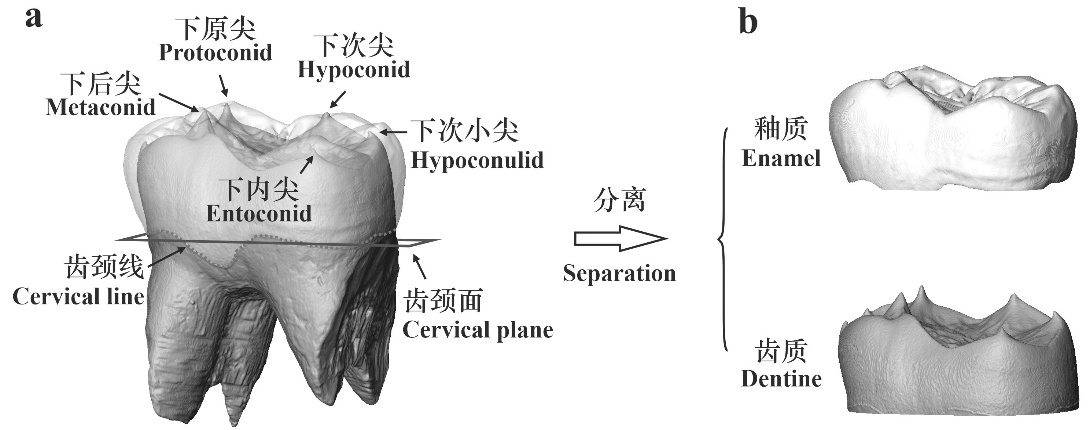
图1 分离牙冠的方法 a. 化石猩猩第四乳前臼齿的三维虚拟模型(SZPXRP3)/ 3D virtual model of the fossil Pongo deciduous fourth premolar (SZPXRP3);b.齿冠釉质和齿冠齿质/ Coronal enamel and coronal dentine
Fig.1 The method of crown separation
| 齿位Tooth | 数量n | 统计值Statistics | 釉质体积Ve (mm3) | EDJ面积SEDJ (mm2) | 齿质体积Vd (mm3) | 3DAET(mm) | 3DRET | 3DRED |
|---|---|---|---|---|---|---|---|---|
| dP4 | 7 | 平均值Mean | 119.77 | 192.55 | 274.64 | 0.62 | 9.74 | 7.62 |
| 最小值Min | 89.41 | 148.78 | 173.95 | 0.54 | 8.04 | 7.11 | ||
| 最大值Max | 138.79 | 219.88 | 332.17 | 0.78 | 12.92 | 8.35 | ||
| dP4 | 9 | 平均值Mean | 98.03 | 192.14 | 270.74 | 0.51 | 7.94 | 7.16 |
| 最小值Min | 74.80 | 137.45 | 148.80 | 0.44 | 6.54 | 6.68 | ||
| 最大值Max | 158.51 | 244.89 | 398.47 | 0.65 | 10.27 | 7.95 |
表1 更新世中晚期猩猩第四乳前臼齿三维釉质厚度平均值和分布范围
Tab.1 3D enamel thickness measurements of the fourth deciduous premolars in Middle-to-Late Pleistocene Pongo’s means and ranges
| 齿位Tooth | 数量n | 统计值Statistics | 釉质体积Ve (mm3) | EDJ面积SEDJ (mm2) | 齿质体积Vd (mm3) | 3DAET(mm) | 3DRET | 3DRED |
|---|---|---|---|---|---|---|---|---|
| dP4 | 7 | 平均值Mean | 119.77 | 192.55 | 274.64 | 0.62 | 9.74 | 7.62 |
| 最小值Min | 89.41 | 148.78 | 173.95 | 0.54 | 8.04 | 7.11 | ||
| 最大值Max | 138.79 | 219.88 | 332.17 | 0.78 | 12.92 | 8.35 | ||
| dP4 | 9 | 平均值Mean | 98.03 | 192.14 | 270.74 | 0.51 | 7.94 | 7.16 |
| 最小值Min | 74.80 | 137.45 | 148.80 | 0.44 | 6.54 | 6.68 | ||
| 最大值Max | 158.51 | 244.89 | 398.47 | 0.65 | 10.27 | 7.95 |
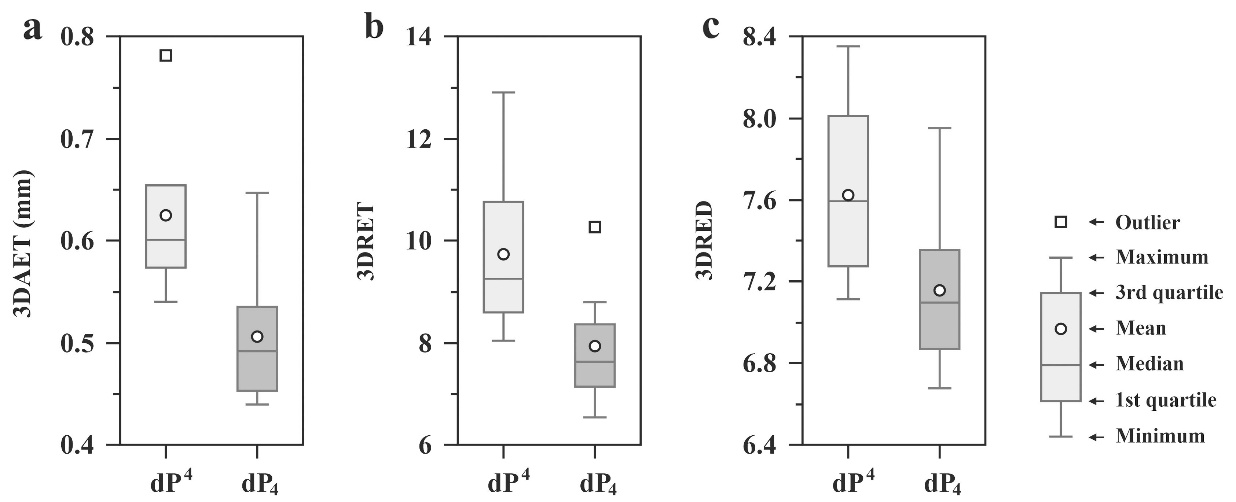
图2 更新世中晚期猩猩第四乳前臼齿上下颌三维釉质厚度箱线图 a. 上下颌第四乳前臼齿的3DAET对比/ Comparison of 3DAET between dP4 and dP4;b. 上下颌第四乳前臼齿的3DRET对比/ Comparison of 3DRET between dP4 and dP4;c. 上下颌第四乳前臼齿的3DRED对比/ Comparison of 3DRED between dP4 and dP4
Fig.2 Box-and-whisker plots comparing 3D enamel thickness between upper and lower fourth deciduous premolars in Middle-to-Late Pleistocene Pongo
| 检验结果Test results | 釉质体积Ve (mm3) | EDJ面积SEDJ (mm2) | 齿质体积Vd (mm3) | 3DAET(mm) | 3DRET | 3DRED |
|---|---|---|---|---|---|---|
| U | 52 | 33 | 36 | 57 | 53 | 51 |
| Z | 2.12 | 0.10 | 0.42 | 2.65 | 2.22 | 2.01 |
| p | 0.03 | 0.92 | 0.68 | 0.005 | 0.02 | 0.04 |
表2 更新世中晚期猩猩第四乳前臼齿上下颌之间釉质厚度测量值的曼-惠特尼U检验结果
Tab.2 The Mann-Whitney U test results of enamel thickness measurements between the maxillary and mandibular fourth deciduous premolars in Middle-to-Late Pleistocene Pongo
| 检验结果Test results | 釉质体积Ve (mm3) | EDJ面积SEDJ (mm2) | 齿质体积Vd (mm3) | 3DAET(mm) | 3DRET | 3DRED |
|---|---|---|---|---|---|---|
| U | 52 | 33 | 36 | 57 | 53 | 51 |
| Z | 2.12 | 0.10 | 0.42 | 2.65 | 2.22 | 2.01 |
| p | 0.03 | 0.92 | 0.68 | 0.005 | 0.02 | 0.04 |
| 齿位Tooth | 属种Taxon | 数量n | 3DAET (mm) | 3DRET | 厚度分类[ | |||||||
|---|---|---|---|---|---|---|---|---|---|---|---|---|
| 平均值Mean | 最小值Min | 最大值Max | 平均值Mean | 最小值Min | 最大值Max | |||||||
| dP4 | 化石猩猩Fossil Pongo | 7 | 0.62 | 0.54 | 0.78 | 9.74 | 8.04 | 12.92 | 薄Thin | |||
| 尼安德特人Neanderthals[ | 2 | 0.60 | 0.60 | 0.60 | 10.02 | 9.95 | 10.09 | 薄Thin | ||||
| 中更新世古人类Middle Pleistocene hominin[ | 1 | 0.75 | - | - | 11.71 | - | - | 偏薄Moderately thin | ||||
| 现代人Modern humans[ | 3 | 0.78 | 0.71 | 0.88 | 13.90 | 12.78 | 15.29 | 偏薄Moderately thin | ||||
| dP4 | 化石猩猩Fossil Pongo | 9 | 0.51 | 0.44 | 0.65 | 7.94 | 6.54 | 10.27 | 超薄Very thin | |||
| 现生猩猩Extant Pongo[ | 2 | 0.41 | 0.41 | 0.41 | 7.51 | 7.25 | 7.77 | 超薄Very thin | ||||
| 尼安德特人Neanderthals[ | 6 | 0.61 | 0.58 | 0.67 | 10.03 | 9.49 | 10.92 | 薄Thin | ||||
| 中更新世古人类 Middle Pleistocene hominin[ | 1 | 0.68 | - | - | 10.80 | - | - | 薄Thin | ||||
| 爪哇直立人Java Homo erectus[ | 1 | 0.81 | - | - | 13.46 | - | - | 偏薄Moderately thin | ||||
| 旧石器时代晚期人类Upper Paleolithic humans[ | 3 | 0.84 | 0.82 | 0.87 | 14.79 | 14.29 | 15.40 | 偏厚Moderately thick | ||||
| 现代人Modern humans[ | 18 | 0.82 | 0.70 | 0.95 | 14.80 | 12.99 | 17.27 | 偏厚Moderately thick | ||||
表3 三维釉质厚度结果对比
Tab.3 Comparison of 3D enamel thickness measurements
| 齿位Tooth | 属种Taxon | 数量n | 3DAET (mm) | 3DRET | 厚度分类[ | |||||||
|---|---|---|---|---|---|---|---|---|---|---|---|---|
| 平均值Mean | 最小值Min | 最大值Max | 平均值Mean | 最小值Min | 最大值Max | |||||||
| dP4 | 化石猩猩Fossil Pongo | 7 | 0.62 | 0.54 | 0.78 | 9.74 | 8.04 | 12.92 | 薄Thin | |||
| 尼安德特人Neanderthals[ | 2 | 0.60 | 0.60 | 0.60 | 10.02 | 9.95 | 10.09 | 薄Thin | ||||
| 中更新世古人类Middle Pleistocene hominin[ | 1 | 0.75 | - | - | 11.71 | - | - | 偏薄Moderately thin | ||||
| 现代人Modern humans[ | 3 | 0.78 | 0.71 | 0.88 | 13.90 | 12.78 | 15.29 | 偏薄Moderately thin | ||||
| dP4 | 化石猩猩Fossil Pongo | 9 | 0.51 | 0.44 | 0.65 | 7.94 | 6.54 | 10.27 | 超薄Very thin | |||
| 现生猩猩Extant Pongo[ | 2 | 0.41 | 0.41 | 0.41 | 7.51 | 7.25 | 7.77 | 超薄Very thin | ||||
| 尼安德特人Neanderthals[ | 6 | 0.61 | 0.58 | 0.67 | 10.03 | 9.49 | 10.92 | 薄Thin | ||||
| 中更新世古人类 Middle Pleistocene hominin[ | 1 | 0.68 | - | - | 10.80 | - | - | 薄Thin | ||||
| 爪哇直立人Java Homo erectus[ | 1 | 0.81 | - | - | 13.46 | - | - | 偏薄Moderately thin | ||||
| 旧石器时代晚期人类Upper Paleolithic humans[ | 3 | 0.84 | 0.82 | 0.87 | 14.79 | 14.29 | 15.40 | 偏厚Moderately thick | ||||
| 现代人Modern humans[ | 18 | 0.82 | 0.70 | 0.95 | 14.80 | 12.99 | 17.27 | 偏厚Moderately thick | ||||
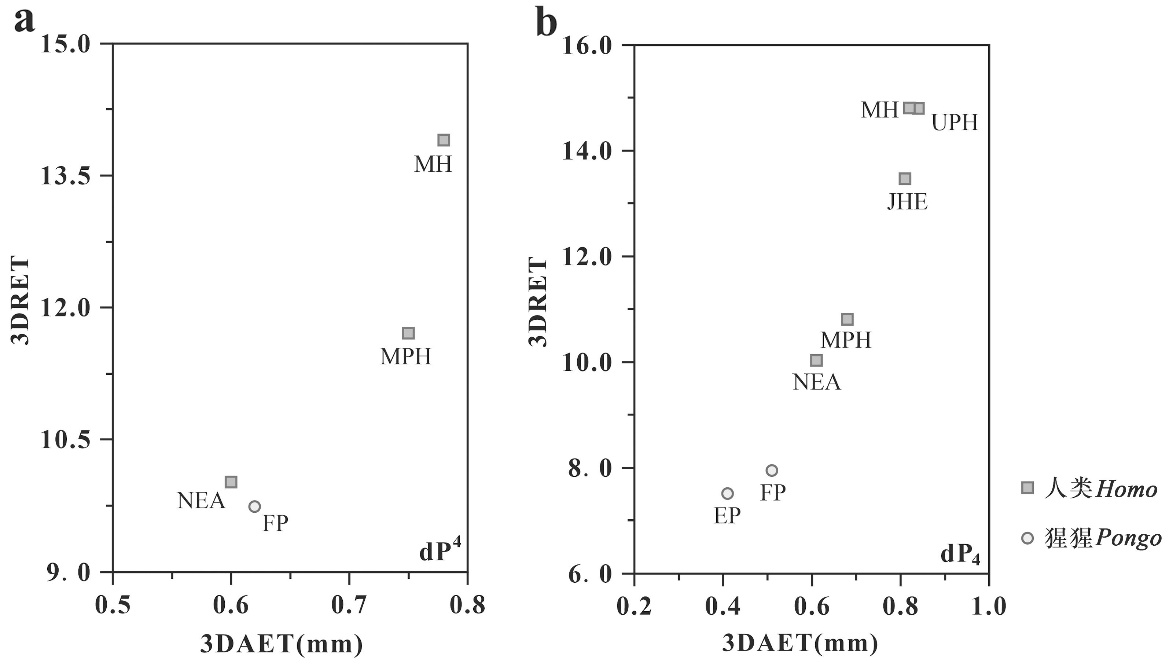
图3 更新世中晚期猩猩、人类和现生猩猩的三维平均釉质厚度和三维相对釉质厚度的平均值散点图 a. 上颌第四乳前臼齿3DAET和3DRET的平均值/ Mean 3DAET and mean 3DRET in dP4;b. 下颌第四乳前臼齿3DAET和3DRET的平均值/ Mean 3DAET and mean 3DRET in dP4。NEA,尼安德特人Neanderthals;FP,化石猩猩Fossil Pongo;MPH,中更新世古人类Middle Pleistocene hominin;MH,现代人Modern humans;EP,现生猩猩Extant Pongo;JHE,爪哇直立人Java Homo erectus;UPH,旧石器时代晚期人类Upper Paleolithic humans.
Fig.3 Scatter plots comparing mean 3DAET and mean 3DRET among Middle-to-Late Pleistocene Pongo, human taxa and extant Pongo
| [1] | Zhao LX, Wang CB, Jin CZ, et al. Fossil orangutan-like hominoid teeth from Late Pleistocene human site of Mulanshan cave in Chongzuo of Guangxi and implications on taxonomy and evolution of orangutan[J]. Chinese Science Bulletin, 2009, 54(21): 3924-3930 |
| [2] | Ibrahim YK, Tshen LT, Westaway KE, et al. First discovery of Pleistocene orangutan (Pongo sp.) fossils in Peninsular Malaysia: Biogeographic and paleoenvironmental implications[J]. Journal of Human Evolution, 2013, 65(6): 770-797 |
| [3] | Harrison T, Jin CZ, Zhang YQ, et al. Fossil Pongo from the Early Pleistocene Gigantopithecus fauna of Chongzuo, Guangxi, southern China[J]. Quaternary International, 2014, 354: 59-67 |
| [4] | Filoux A, Wattanapituksakul A, Lespes C, et al. A Pleistocene mammal assemblage containing Ailuropoda and Pongo from Tham Prakai Phet cave, Chaiyaphum Province, Thailand[J]. Geobios, 2015, 48(5): 341-349 |
| [5] | Liang H, Harrison T, Shao Q, et al. Middle Pleistocene Pongo from Ganxian Cave in southern China with implications for understanding dental size evolution in orangutans[J]. Journal of Human Evolution, 2023, 178: 103348 |
| [6] | Wang CB, Zhao LX, Jin CZ, et al. New discovery of Early Pleistocene orangutan fossils from Sanhe Cave in Chongzuo, Guangxi, southern China[J]. Quaternary International, 2014, 354: 68-74 |
| [7] | Bacon AM, Long VT. The first discovery of a complete skeleton of a fossil orang-utan in a cave of the Hoa Binh Province, Vietnam[J]. Journal of Human Evolution, 2001, 41(3): 227-241 |
| [8] | Tshen LT. Biogeographic distribution and metric dental variation of fossil and living orangutans (Pongo spp.)[J]. Primates, 2016, 57(1): 39-50 |
| [9] | Liao W, Harrison T, Yao YY, et al. Evidence for the latest fossil Pongo in southern China[J]. Journal of Human Evolution, 2022, 170: 103233 |
| [10] | Smith TM, Bacon AM, Demeter F, et al. Dental tissue proportions in fossil orangutans from mainland Asia and Indonesia[J]. Human Origins Research, 2011, 1: e1 |
| [11] | 廖卫. 中国南方猩猩化石的研究进展[J]. 人类学学报, 2024, 43(2): 199-213 |
| [12] | Harrison T, Zhang YQ, Yang LY, et al. Evolutionary trend in dental size in fossil orangutans from the Pleistocene of Chongzuo, Guangxi, southern China[J]. Journal of Human Evolution, 2021, 161: 103090 |
| [13] | 张立召, 赵凌霞. 巨猿牙齿釉质厚度及对食性适应与系统演化的意义[J]. 人类学学报, 2013, 32(3): 365-376 |
| [14] | Zanolli C, Dean C, Rook L, et al. Enamel thickness and enamel growth in Oreopithecus: Combining microtomographic and histological evidence[J]. Comptes Rendus Palevol, 2016, 15(1-2): 209-226 |
| [15] | Pan L, Ji XP, Liao W, et al. Premolar enamel thickness and distribution of a Miocene hominid Lufengpithecus hudienensis compared with Pleistocene and extant hominids[J]. Journal of Human Evolution, 2021, 157: 103030 |
| [16] | Zhang LZ, Du BP, Hu R, et al. Three-dimensional molar enamel thickness and distribution patterns in Late Miocene Lufengpithecus lufengensis from Shihuiba, Southwest China[J]. Anatomical Record-Advances in Integrative Anatomy and Evolutionary Biology, 2024, 1-11 |
| [17] | Smith TM, Olejniczak AJ, Zermeno JP, et al. Variation in enamel thickness within the genus Homo[J]. Journal of Human Evolution, 2012, 62(3): 395-411 |
| [18] | Skinner MM, Alemseged Z, Gaunitz C, et al. Enamel thickness trends in Plio-Pleistocene hominin mandibular molars[J]. Journal of Human Evolution, 2015, 85: 35-45 |
| [19] | 孙承凯, 孙小玲, 周蜜, 等. 山东新泰乌珠台人类牙齿的形态学特征[J]. 人类学学报, 2019, 38(3): 446-459 |
| [20] | Kono RT, Suwa G. Enamel distribution patterns of extant human and hominoid molars: Occlusal versus lateral enamel thickness[J]. Bulletin of the National Museum of Nature and Science, Series D, 2008, 34: 1-9 |
| [21] | Kato A, Tang N, Borries C, et al. Intra- and interspecific variation in macaque molar enamel thickness[J]. American Journal of Physical Anthropology, 2014, 155(3): 447-459 |
| [22] | Martin LB. The relationships of the later Miocene Hominoidea[D]. PhD Dissertation, London: University College London, 1983 |
| [23] | Kono RT. Molar enamel thickness and distribution patterns in extant great apes and humans: New insights based on a 3-dimensional whole crown perspective[J]. Anthropological Science, 2004, 112(2): 121-146 |
| [24] | Crevecoeur I, Bayle P, Rougier H, et al. The Spy VI child: A newly discovered Neandertal infant[J]. Journal of Human Evolution, 2010, 59(6): 641-656 |
| [25] | Toussaint M, Olejniczak AJ, El Zaatari S, et al. The Neandertal lower right deciduous second molar from Trou de l’Abime at Couvin, Belgium[J]. Journal of Human Evolution, 2010, 58(1): 56-67 |
| [26] | Fornai C, Benazzi S, Svoboda J, et al. Enamel thickness variation of deciduous first and second upper molars in modern humans and Neanderthals[J]. Journal of Human Evolution, 2014, 76: 83-91 |
| [27] | Arnaud J, Peretto C, Panetta D, et al. A reexamination of the Middle Paleolithic human remains from Riparo Tagliente, Italy[J]. Quaternary International, 2016, 425: 437-444 |
| [28] | Fabbri PF, Panetta D, Sarti L, et al. Middle paleolithic human deciduous incisor from Grotta del Cavallo, Italy[J]. American Journal of Physical Anthropology, 2016, 161(3): 506-512 |
| [29] | Becam G, Chevalier T. Neandertal features of the deciduous and permanent teeth from Portel-Ouest Cave (Ariege, France)[J]. American Journal of Physical Anthropology, 2019, 168(1): 45-69 |
| [30] | Garralda MD, Maureille B, Le Cabec A, et al. The Neanderthal teeth from Marillac (Charente, Southwestern France): Morphology, comparisons and paleobiology[J]. Journal of Human Evolution, 2020, 138: 102683 |
| [31] | Romandini M, Oxilia G, Bortolini E, et al. A late Neanderthal tooth from northeastern Italy[J]. Journal of Human Evolution, 2020, 147: 102867 |
| [32] | Oxilia G, Bortolini E, Marciani G, et al. Direct evidence that late Neanderthal occupation precedes a technological shift in southwestern Italy[J]. American Journal of Biological Anthropology, 2022, 179(1): 18-30 |
| [33] | Bayle P, Macchiarelli R, Trinkaus E, et al. Dental maturational sequence and dental tissue proportions in the early Upper Paleolithic child from Abrigo do Lagar Velho, Portugal[J]. Proceedings of the National Academy of Sciences of the United States of America, 2010, 107(4): 1338-1342 |
| [34] | Mahoney P. Testing functional and morphological interpretations of enamel thickness along the deciduous tooth row in human children[J]. American Journal of Physical Anthropology, 2013, 151(4): 518-525 |
| [35] | Zanolli C, Bayle P, Bondioli L, et al. Is the deciduous/permanent molar enamel thickness ratio a taxon-specific indicator in extant and extinct hominids?[J]. Comptes Rendus Palevol, 2017, 16(5-6): 702-714 |
| [36] | Zanolli C, Bondioli L, Mancini L, et al. Brief communication: Two human fossil deciduous molars from the Sangiran dome (Java, Indonesia): Outer and inner morphology[J]. American Journal of Physical Anthropology, 2012, 147(3): 472-481 |
| [37] | Zanolli C, Bayle P, Macchiarelli R. Tissue proportions and enamel thickness distribution in the early Middle Pleistocene human deciduous molars from Tighenif, Algeria[J]. Comptes Rendus Palevol, 2010, 9(6-7): 341-348 |
| [38] | Fornai C, Benazzi S, Gopher A, et al. The Qesem Cave hominin material (part 2): A morphometric analysis of dm2-QC2 deciduous lower second molar[J]. Quaternary International, 2016, 398: 175-189 |
| [39] | Garcia-Campos C, Modesto-Mata M, Martinon-Torres M, et al. Similarities and differences in the dental tissue proportions of the deciduous and permanent canines of Early and Middle Pleistocene human populations[J]. Journal of Anatomy, 2022, 240(2): 339-356 |
| [40] | Macchiarelli R, Mazurier A, Illerhaus B, et al. Ouranopithecus macedoniensis (Mammalia, Primates, Hominoidea): Virtual reconstruction and 3D analysis of a juvenile mandibular dentition (RPI-82 and RPI-83)[J]. Geodiversitas, 2009, 31(4): 851-863 |
| [41] | 胡荣, 赵凌霞. 广西化石猩猩牙齿釉质厚度研究[J]. 人类学学报, 2015, 34(3): 404-416 |
| [42] | Smith TM, Kupczik K, Machanda Z, et al. Enamel thickness in Bornean and Sumatran orangutan dentitions[J]. American Journal of Physical Anthropology, 2012, 147(3): 417-426 |
| [43] | Aiello LC, Montgomery C, Dean C. The natural history of deciduous tooth attrition in hominoids[J]. Journal of Human Evolution, 1991, 21(5): 397-412 |
| [44] | Zanolli C, Grine FE, Kullmer O, et al. The early Pleistocene deciduous hominid molar FS-72 from the Sangiran dome of Java, Indonesia: A taxonomic reappraisal based on its comparative endostructural characterization[J]. American Journal of Physical Anthropology, 2015, 157(4): 666-674 |
| [45] | Ortiz A, Schander-Triplett K, Bailey SE, et al. Enamel thickness variation in the deciduous dentition of extant large-bodied hominoids[J]. American Journal of Physical Anthropology, 2020, 173(3): 500-513 |
| [46] | Yi ZX, Zanolli C, Liao W, et al. Enamel thickness in the deciduous postcanine dentition of fossil and extant Pongo[J]. Journal of Human Evolution, 2024, 191: 103493 |
| [47] | Gantt DG, Harris EF, Rafter JA, et al. Distribution of enamel thickness on human deciduous molars[A]. In: Brook A(ed). Dental morphology[C]. Sheffield: Sheffield Academic Press, 2001, 167-190 |
| [48] | Zanolli C, Kullmer O, Kelley J, et al. Evidence for increased hominid diversity in the Early to Middle Pleistocene of Indonesia[J]. Nature Ecology & Evolution, 2019, 3(5): 755-764 |
| [49] | Molnar S. Human tooth wear, tooth function and cultural variability[J]. American Journal of Physical Anthropology, 1971, 34(2): 175-189 |
| [50] | Benazzi S, Panetta D, Fornai C, et al. Technical note: Guidelines for the digital computation of 2D and 3D enamel thickness in hominoid teeth[J]. American Journal of Physical Anthropology, 2014, 153(2): 305-313 |
| [51] | Yi ZX, Liao W, Zanolli C, et al. A robust alternative to assessing three-dimensional relative enamel thickness for the use in taxonomic assessment[J]. American Journal of Physical Anthropology, 2021, 174(3): 555-567 |
| [52] | Benazzi S, Fornai C, Bayle P, et al. Comparison of dental measurement systems for taxonomic assignment of Neanderthal and modern human lower second deciduous molars[J]. Journal of Human Evolution, 2011, 61(3): 320-326 |
| [53] | Olejniczak AJ, Smith TM, Feeney RNM, et al. Dental tissue proportions and enamel thickness in Neandertal and modern human molars[J]. Journal of Human Evolution, 2008, 55(1): 12-23 |
| [54] | Buti L, Le Cabec A, Panetta D, et al. 3D enamel thickness in Neandertal and modern human permanent canines[J]. Journal of Human Evolution, 2017, 113: 162-172 |
| [55] | Smith TM, Austin C, Hinde K, et al. Cyclical nursing patterns in wild orangutans[J]. Science Advances, 2017, 3(5): e1601517 |
| [56] | Bayle P, Braga J, Mazurier A, et al. Brief communication: High-resolution assessment of the dental developmental pattern and characterization of tooth tissue proportions in the late Upper Paleolithic child from La Madeleine, France[J]. American Journal of Physical Anthropology, 2009, 138(4): 493-498 |
| [1] | 孟紫阳, 杨雨薇, 廖卫, 王伟, 易智星. 鲁道古猿的三维釉质厚度和咬合力及其古食性指示意义[J]. 人类学学报, 2026, 45(02): 258-267. |
| [2] | 姚艳燕, 艾婉婷, 胡敏航, 付琼耀, 李国山, 钟洁美, 胡鹏程, 黄胜敏, 田淳, 梁华, 廖卫, 王伟, 易智星. 广西崇左岩利1号洞早-中更新世过渡期的巨猿化石[J]. 人类学学报, 2026, 45(02): 199-209. |
| [3] | 李三灵, 刘亚林, 赵文杰, 陈清懿, 李浩. 中国南方旧石器时代晚期石制品细小化现象初探[J]. 人类学学报, 2025, 44(06): 1034-1046. |
| [4] | 廖卫. 中国南方猩猩化石的研究进展[J]. 人类学学报, 2024, 43(02): 199-213. |
| [5] | 浣发祥, 杨石霞, 陈苇, 陈伟驹, 朱利东, 张玉修. 四川汉源富林遗址石制品再研究[J]. 人类学学报, 2023, 42(02): 177-190. |
| [6] | 王恬怡, 赵东月, 张明, 乔诗雨, 杨帆, 万杨, 杨若薇, 曹鹏, 刘峰, 付巧妹. 古DNA捕获新技术与中国南方早期人群遗传研究新格局[J]. 人类学学报, 2020, 39(04): 680-694. |
| [7] | Anne DAMBRICOURT MALASSé;ZHANG Pu;Patricia WILS. A new molar from the Middle Pleistocene hominid assemblage of Yanhuidong, Tongzi, South China[J]. 人类学学报, 2018, 37(01): 1-17. |
| [8] | 陈君;王頠;李大伟;廖卫. 广西田东中山遗址洞外岩厦出土动物骨骼的初步研究[J]. 人类学学报, 2017, 36(04): 527-536. |
| [9] | 胡荣;赵凌霞. 广西化石猩猩牙齿釉质厚度研究[J]. 人类学学报, 2015, 34(03): 404-416. |
| [10] | 陈少坤; 黄万波; 裴健; 贺存定; 秦利; 魏光飚; 冷静. 三峡地区最晚更新世的梅氏犀兼述中国南方更新世的犀牛化石[J]. 人类学学报, 2012, 31(04): 381-394. |
| [11] | 王翠斌; 赵凌霞; 金昌柱; 胡耀武; 王昌燧. 中国更新世猩猩类牙齿化石的测量研究及其分类学意义[J]. 人类学学报, 2009, 28(02): 192-200. |
| [12] | 金昌柱;郑家坚;王元;徐钦琦. 中国南方早更新世主要哺乳动物群层序对比和动物地理[J]. 人类学学报, 2008, 27(04): 304-317. |
| [13] | 吴伟鸿;王宏;谭惠忠;张镇洪. 香港深涌黄地峒遗址试掘简报[J]. 人类学学报, 2006, 25(01): 56-67. |
| 阅读次数 | ||||||
|
全文 |
|
|||||
|
摘要 |
|
|||||
 京ICP证05002819号-3