

主管:中国科学院
主办:中国科学院古脊椎动物与古人类研究所
出版:科学出版社
主办:中国科学院古脊椎动物与古人类研究所
出版:科学出版社
人类学学报 ›› 2026, Vol. 45 ›› Issue (03): 543-555.doi: 10.16359/j.1000-3193/AAS.2025.0050cstr: 32091.14.j.1000-3193/AAS.2025.0050
黄冰柔1,2( ), 牛东伟1,2,3, 裴树文4, 郭玉杰1,2()
收稿日期:2024-12-05
接受日期:2025-04-06
出版日期:2026-06-15
发布日期:2026-06-12
通讯作者:
郭玉杰,副教授,主要从事环境考古研究。E-mail: yjguo@hebtu.edu.cn
作者简介:黄冰柔,硕士研究生,主要从事环境考古研究。E-mail: 15876885896@163.com
基金资助:
HUANG Bingrou1,2(), NIU Dongwei1,2,3, PEI Shuwen4, GUO Yujie1,2()
Received:2024-12-05
Accepted:2025-04-06
Online:2026-06-15
Published:2026-06-12
摘要:
东沟遗址是蔚县盆地近期发现的一处重要的旧石器时代遗址,以往研究表明遗址的年代已超出放射性碳测年方法的上限。本文利用钾长石单片和单颗粒多步升温红外激发后红外激发光释光测年法(MET-pIRIR)对遗址剖面进行了测年研究,并结合贝叶斯模拟建立了遗址剖面的年代序列框架。结果表明,文化层的堆积年代在76~74 kaBP,对应深海氧同位素MIS-5a阶段的末期,文化上属于旧石器时代中期。东沟遗址为研究中国北方地区旧石器时代中期石器技术发展以及古人类生存策略选择等方面提供了新的考古材料与证据。
中图分类号:
黄冰柔, 牛东伟, 裴树文, 郭玉杰. 河北蔚县盆地东沟遗址的光释光年龄[J]. 人类学学报, 2026, 45(03): 543-555.
HUANG Bingrou, NIU Dongwei, PEI Shuwen, GUO Yujie. Luminescence dating of the Donggou site in the Yuxian Basin of Hebei[J]. Acta Anthropologica Sinica, 2026, 45(03): 543-555.
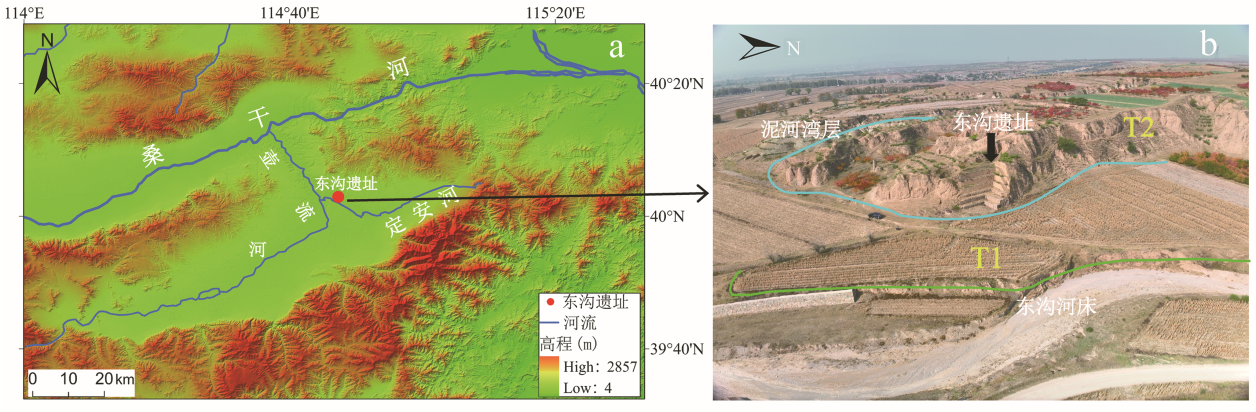
图1 东沟遗址地理位置图 a.东沟遗址位置Location of the Donggou site;b.地貌景观Landscape around the site
Fig.1 Geographical location of the Donggou site
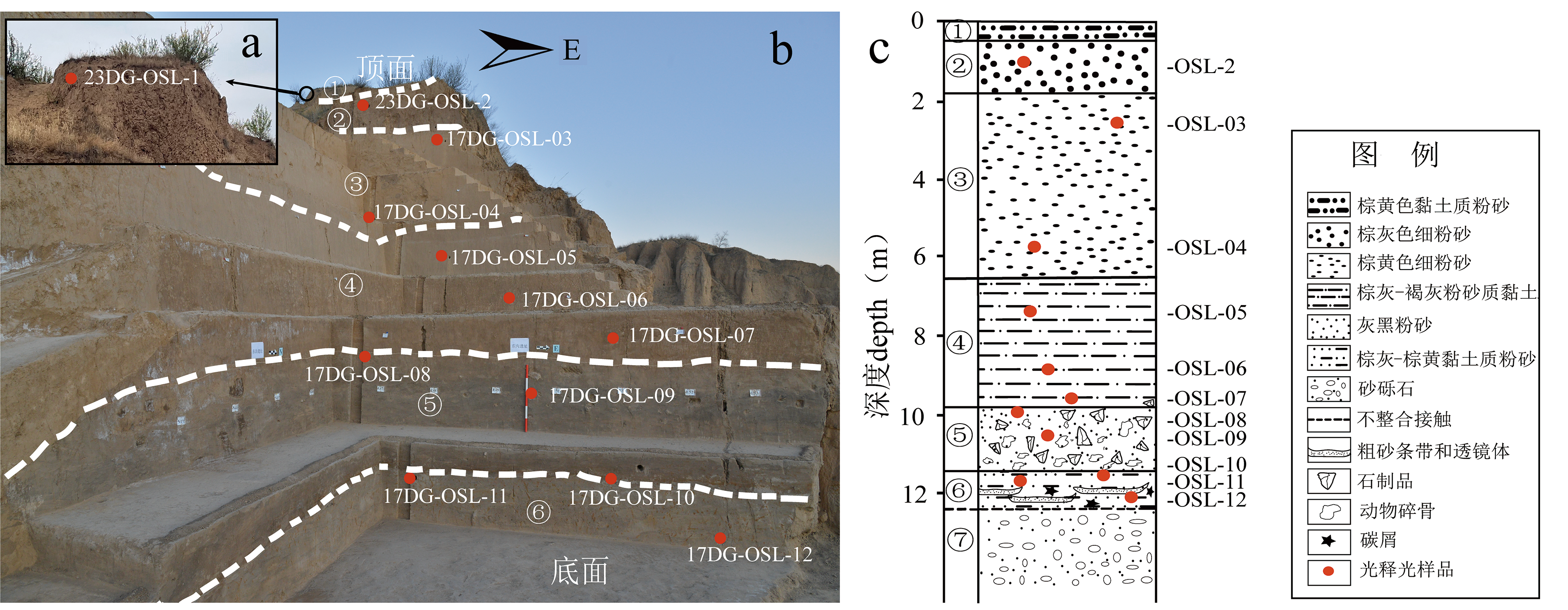
图2 东沟遗址剖面及光释光采样位置图 a、b.遗址光释光样品取样位置图Optically Stimulated Luminescence sample positions at the site;c.遗址地层堆积Stratigraphic section of the site。图b中的红白标尺为1 m / The red-and-white scale in Fig.2b represents 1 m
Fig.2 Stratigraphic profile and luminescence sampling locations of the Donggou site
| 样品Sample | 深度Depth (m) | 粒级Grain size (μm) | U (mg/kg) | Th (mg/kg) | K(%) | 外部剂量率External dose rate (Gy/ka) | 内部剂量率Internal dose rate (Gy/ka) | 总剂量率Total dose rate (Gy/ka) | 等效剂量 De(Gy) a | 实测年龄Age(ka) c | 模拟年龄Age(ka) d |
|---|---|---|---|---|---|---|---|---|---|---|---|
| 23DG-OSL-1 | 0.5 | 63-90 | 2.47±0.07 | 11.00±0.33 | 2.12%±0.11% | 3.36±0.11 | 0.32±0.05 | 3.67±0.12 | 5.3±0.9 | 1.4±0.2 | |
| 23DG-OSL-2 | 1 | 63-90 | 2.97±0.09 | 12.20±0.37 | 2.33%±0.12% | 3.70±0.12 | 0.32±0.05 | 4.02±0.13 | 293±7 | 72.8±2.9 | 70.7±4.0 |
| 17DG-OSL-03 | 2.6 | 90-150 | 2.85±0.09 | 10.61±0.32 | 2.27%±0.11% | 3.44±0.12 | 0.48±0.1 | 3.92±0.16 | 242±10 | 61.7±3.5 | |
| 17DG-OSL-04 | 5.7 | 90-150 | 2.42±0.07 | 9.92±0.30 | 2.28%±0.11% | 3.27±0.11 | 0.48±0.1 | 3.74±0.16 | 260±9 | 69.4±3.7 | 72.4±3.1 |
| 17DG-OSL-05 | 7.4 | 90-150 | 2.20±0.07 | 10.50±0.31 | 2.24%±0.11% | 3.20±0.11 | 0.48±0.1 | 3.68±0.15 | 280±10 | 76.2±4.1 | 72.9±2.9 |
| 17DG-OSL-06 | 8.8 | 90-150 | 2.27±0.07 | 11.39±0.34 | 2.27%±0.11% | 3.28±0.12 | 0.48±0.1 | 3.76±0.16 | 275±9 | 73.1±3.9 | 73.3±2.9 |
| 17DG-OSL-07 | 9.7 | 90-150 | 2.34±0.07 | 11.10±0.33 | 2.42%±0.12% | 3.41±0.12 | 0.48±0.1 | 3.88±0.16 | 279±11 | 71.9±4.1 | 73.6±3.1 |
| 17DG-OSL-08 | 9.9 | 90-150 | 2.29±0.07 | 11.50±0.34 | 2.35%±0.12% | 3.36±0.12 | 0.48±0.1 | 3.84±0.16 | 275±10 | 71.8±3.9 | 73.7±3.1 |
| 17DG-OSL-09 | 10.5 | 90-150 | 2.36±0.07 | 10.61±0.32 | 2.34%±0.12% | 3.30±0.12 | 0.48±0.1 | 3.78±0.16 | 287±10 | 75.9±4 | 74.5±3.7 |
| 17DG-OSL-09 b | 0.51±0.11 | 3.81±0.16 | 275±18 | 72.1±5.7 | 74.5±3.8 | ||||||
| 17DG-OSL-10 | 11.5 | 90-150 | 2.61±0.08 | 10.01±0.30 | 2.37%±0.12% | 3.34±0.12 | 0.48±0.1 | 3.82±0.16 | 373±16 | 97.6±5.9 | 101.7±9.5 |
| 17DG-OSL-11 | 11.6 | 90-150 | 2.26±0.07 | 9.90±0.30 | 2.32%±0.12% | 3.21±0.12 | 0.48±0.1 | 3.69±0.16 | 415±17 | 112.5±6.7 | 105±8.1 |
| 17DG-OSL-12 | 12.03 | 90-150 | 2.33±0.07 | 10.81±0.32 | 2.30%±0.12% | 3.27±0.12 | 0.48±0.1 | 3.74±0.16 | 436±21 | 116.5±7.5 | 119.4±14.0 |
表1 东沟遗址钾长石MET-pIRIR250℃年龄结果
Tab.1 The potassium feldspar MET-pIRIR250℃ age results from the Donggou site
| 样品Sample | 深度Depth (m) | 粒级Grain size (μm) | U (mg/kg) | Th (mg/kg) | K(%) | 外部剂量率External dose rate (Gy/ka) | 内部剂量率Internal dose rate (Gy/ka) | 总剂量率Total dose rate (Gy/ka) | 等效剂量 De(Gy) a | 实测年龄Age(ka) c | 模拟年龄Age(ka) d |
|---|---|---|---|---|---|---|---|---|---|---|---|
| 23DG-OSL-1 | 0.5 | 63-90 | 2.47±0.07 | 11.00±0.33 | 2.12%±0.11% | 3.36±0.11 | 0.32±0.05 | 3.67±0.12 | 5.3±0.9 | 1.4±0.2 | |
| 23DG-OSL-2 | 1 | 63-90 | 2.97±0.09 | 12.20±0.37 | 2.33%±0.12% | 3.70±0.12 | 0.32±0.05 | 4.02±0.13 | 293±7 | 72.8±2.9 | 70.7±4.0 |
| 17DG-OSL-03 | 2.6 | 90-150 | 2.85±0.09 | 10.61±0.32 | 2.27%±0.11% | 3.44±0.12 | 0.48±0.1 | 3.92±0.16 | 242±10 | 61.7±3.5 | |
| 17DG-OSL-04 | 5.7 | 90-150 | 2.42±0.07 | 9.92±0.30 | 2.28%±0.11% | 3.27±0.11 | 0.48±0.1 | 3.74±0.16 | 260±9 | 69.4±3.7 | 72.4±3.1 |
| 17DG-OSL-05 | 7.4 | 90-150 | 2.20±0.07 | 10.50±0.31 | 2.24%±0.11% | 3.20±0.11 | 0.48±0.1 | 3.68±0.15 | 280±10 | 76.2±4.1 | 72.9±2.9 |
| 17DG-OSL-06 | 8.8 | 90-150 | 2.27±0.07 | 11.39±0.34 | 2.27%±0.11% | 3.28±0.12 | 0.48±0.1 | 3.76±0.16 | 275±9 | 73.1±3.9 | 73.3±2.9 |
| 17DG-OSL-07 | 9.7 | 90-150 | 2.34±0.07 | 11.10±0.33 | 2.42%±0.12% | 3.41±0.12 | 0.48±0.1 | 3.88±0.16 | 279±11 | 71.9±4.1 | 73.6±3.1 |
| 17DG-OSL-08 | 9.9 | 90-150 | 2.29±0.07 | 11.50±0.34 | 2.35%±0.12% | 3.36±0.12 | 0.48±0.1 | 3.84±0.16 | 275±10 | 71.8±3.9 | 73.7±3.1 |
| 17DG-OSL-09 | 10.5 | 90-150 | 2.36±0.07 | 10.61±0.32 | 2.34%±0.12% | 3.30±0.12 | 0.48±0.1 | 3.78±0.16 | 287±10 | 75.9±4 | 74.5±3.7 |
| 17DG-OSL-09 b | 0.51±0.11 | 3.81±0.16 | 275±18 | 72.1±5.7 | 74.5±3.8 | ||||||
| 17DG-OSL-10 | 11.5 | 90-150 | 2.61±0.08 | 10.01±0.30 | 2.37%±0.12% | 3.34±0.12 | 0.48±0.1 | 3.82±0.16 | 373±16 | 97.6±5.9 | 101.7±9.5 |
| 17DG-OSL-11 | 11.6 | 90-150 | 2.26±0.07 | 9.90±0.30 | 2.32%±0.12% | 3.21±0.12 | 0.48±0.1 | 3.69±0.16 | 415±17 | 112.5±6.7 | 105±8.1 |
| 17DG-OSL-12 | 12.03 | 90-150 | 2.33±0.07 | 10.81±0.32 | 2.30%±0.12% | 3.27±0.12 | 0.48±0.1 | 3.74±0.16 | 436±21 | 116.5±7.5 | 119.4±14.0 |
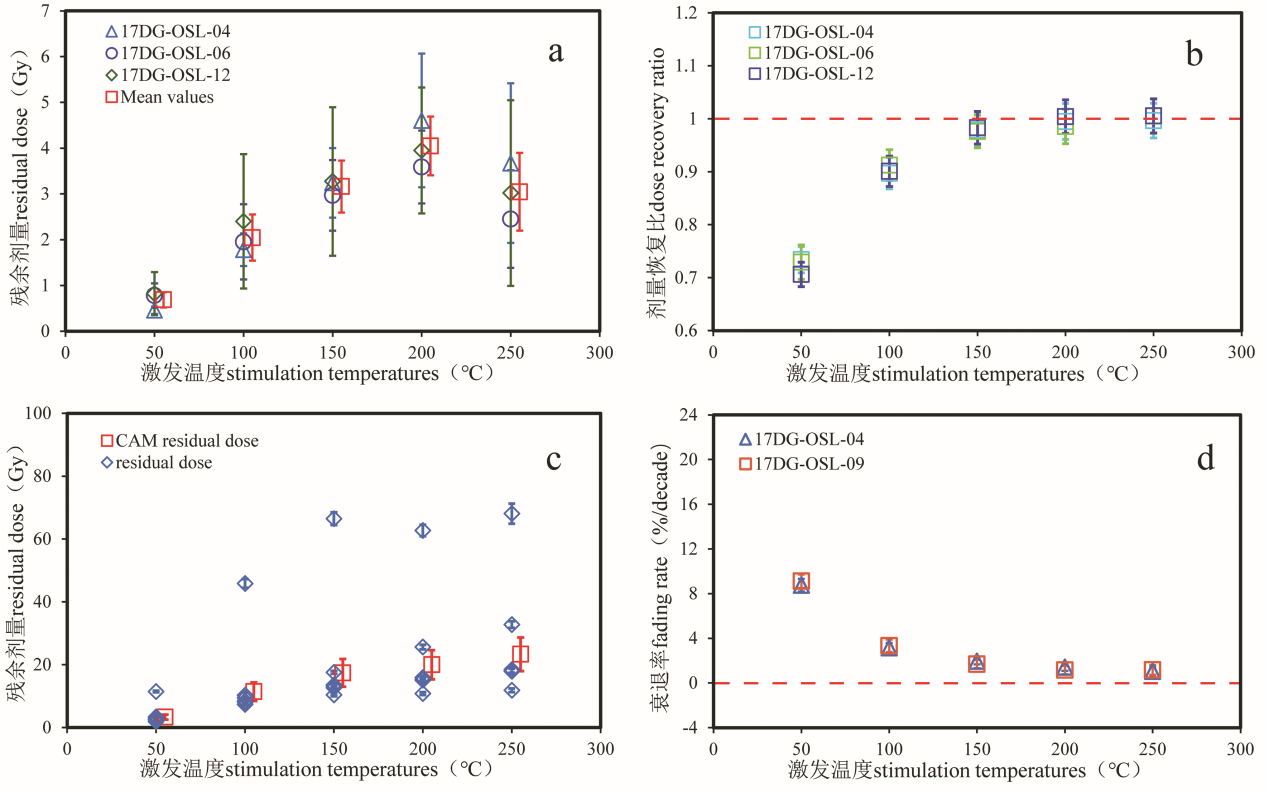
图3 东沟遗址样品检验实验结果 a.残余剂量实验结果Residual dose test result; b.剂量恢复实验结果Dose recovery test result; c.桑干河现代河漫滩样品自然残余剂量测试结果The natural residual dose for a modern floodplain sample from the Sanggan River; d.异常衰减率实验结果Fading test result。图中每个点的误差均为1σ / The vertical bars in each panel indicate the corresponding standard errors
Fig.3 Experimental results of sample testing from Donggou site
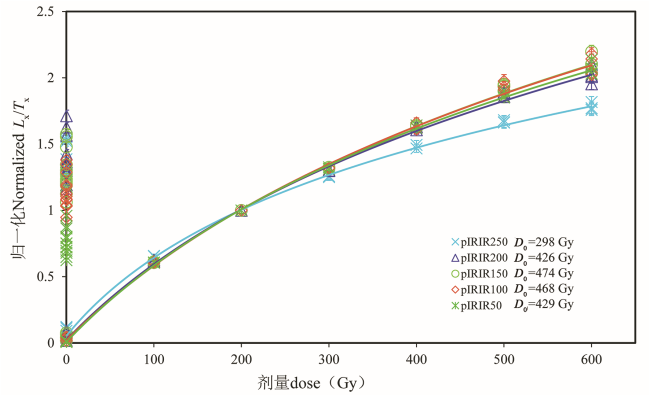
图4 钾长石MET-pIRIR 50~250 ℃标准生长曲线 图中每个点的误差均为1σ / The vertical bars in each panel indicate the corresponding standard errors.
Fig.4 Standard Growth Curve (SGC) of K-feldspar MET-pIRIR Signals (50~250°C)
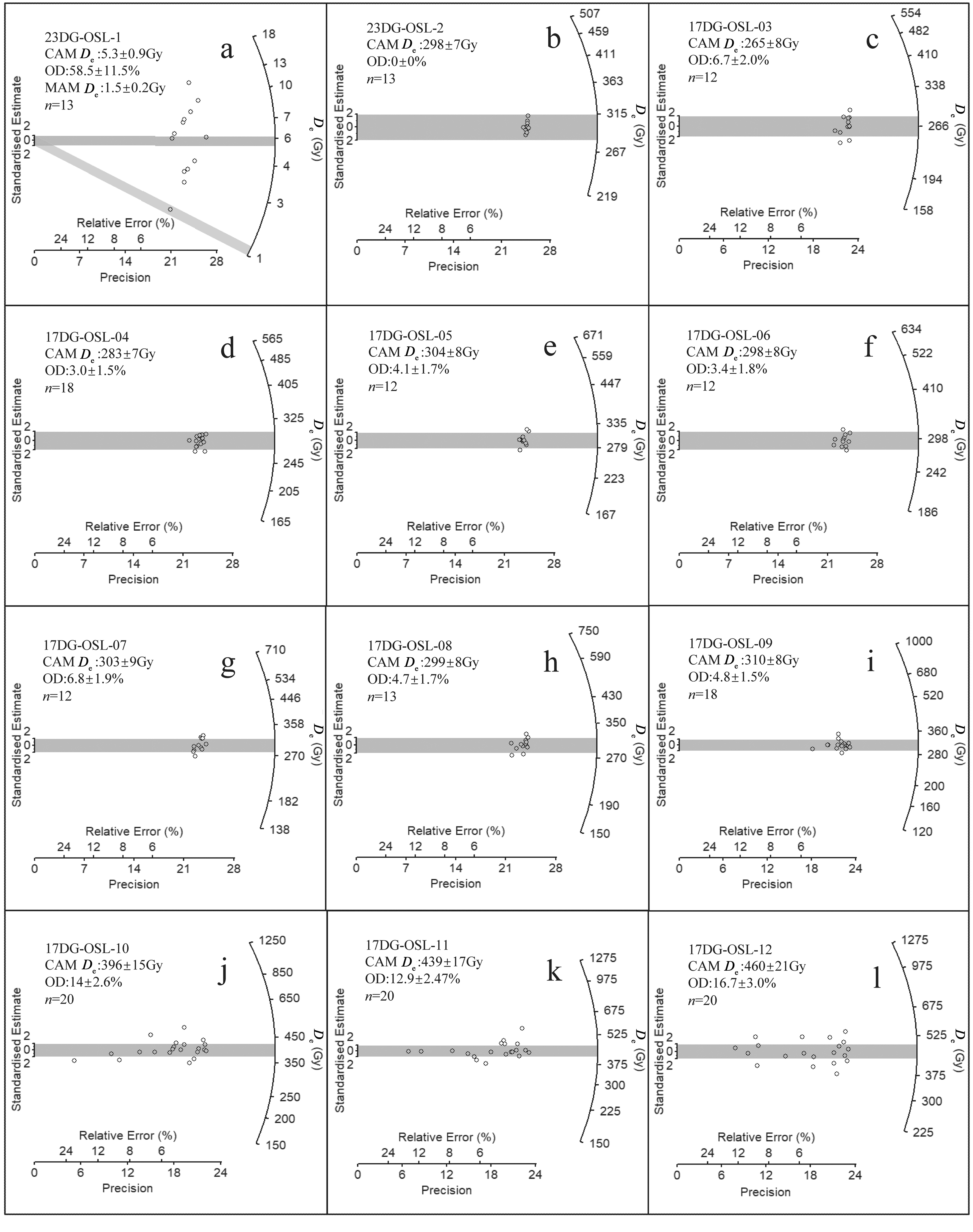
图5 东沟遗址钾长石单片MET-pIRIR250℃等效剂量雷达分布图 a-l. 23DG-OSL-1、23DG-OSL-2及17DG-OSL-03至17DG-OSL-12的钾长石单片MET-pIRIR250℃等效剂量雷达分布图/ Radial plots of single-aliquot MET-pIRIR250℃ De values for 23DG-OSL-1, 23DG-OSL-2 and 17DG-OSL-3 to 17DG-OSL-12。图中灰色阴影区代表样品的加权平均(CAM)De值,绿色阴影区为样品的最小年龄模型(MAM)De值/ The grey bands in each panel represent the CAM De values, while the green band represents the MAM De value
Fig.5 Radial plots of single-aliquot MET-pIRIR250℃ De values for the Donggou K-feldspar samples
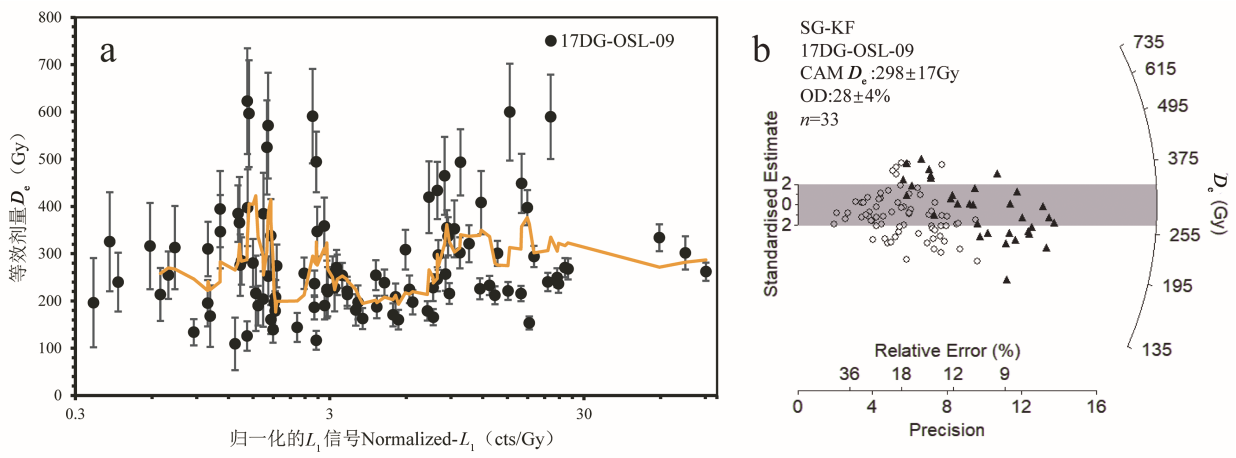
图6 样品17DG-OSL-09的单颗粒等效剂量实验结果 a. 单颗粒等效剂量与释光信号亮度对应关系,橙色曲线为每5个点的滑动平均值,每个点的误差均为1σ / Ranked individual De against their intrinsic brightness for all the accepted grains. The orange line is running means with a fixed subset size of 5 data points, the vertical bars in panel (a) indicate the corresponding standard errors。b. 等效剂量雷达分布图,样品最终CAM值(灰色阴影区)是基于最亮的30%的颗粒(即实心三角形)计算而来,空心圆圈代表剩余的70%较暗的颗粒 / Radial plot of single-grain De values. The grey band in panel (b) is centered on the CAM value based on the 30% brightest grains (solid triangles) for this sample, while the hollow circles indicate the remaining 70% dimmer grains.
Fig.6 Experimental results of single-grain equivalent dose for sample 17DG-OSL-09
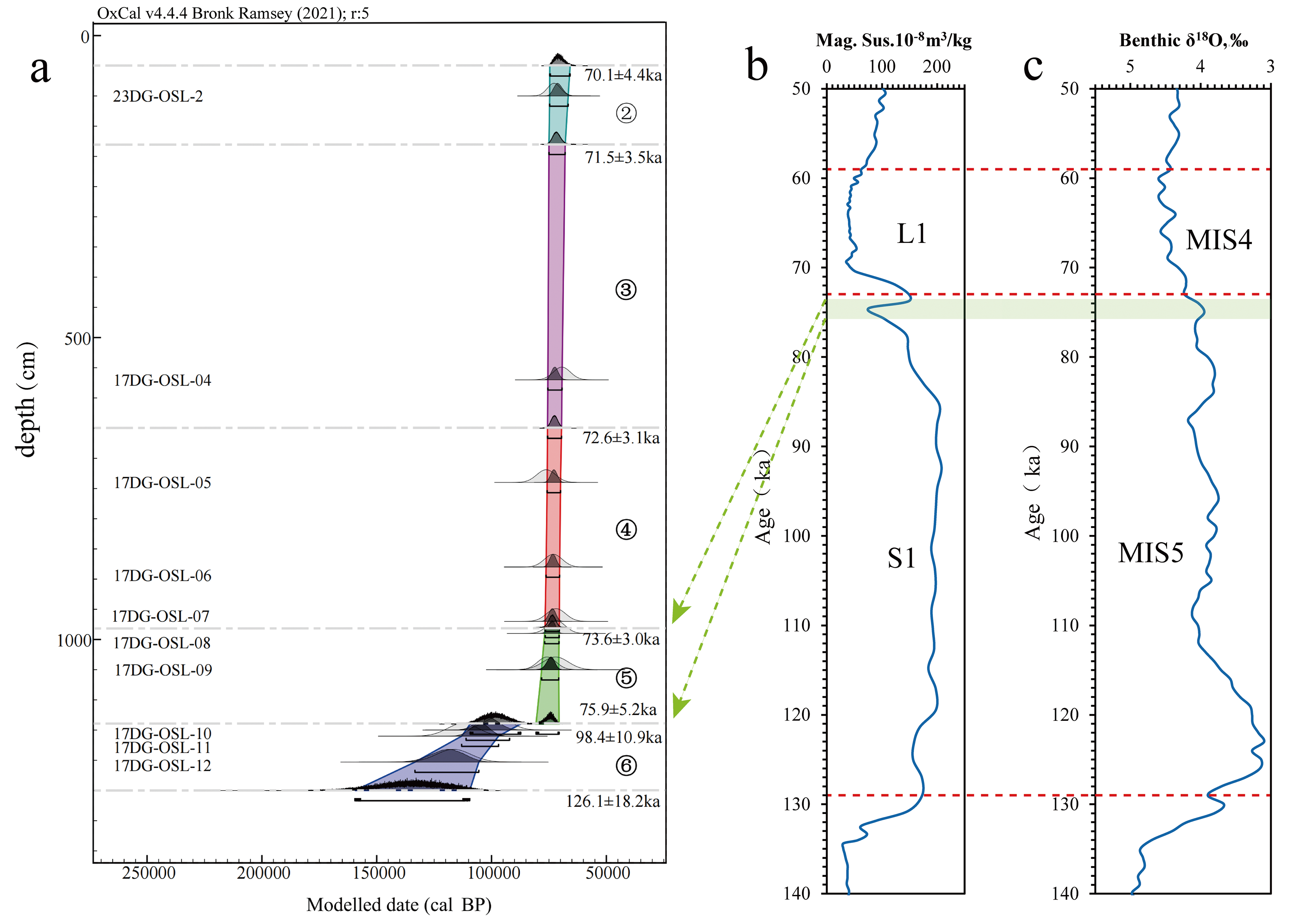
图7 东沟遗址光释光测年贝叶斯模拟结果 a. 贝叶斯年龄-深度模型 Bayesian age-depth model[38];b. 黄土磁化率曲线 Plotted against the magnetic susceptibility (Mag. Sus.) loess proxy curve from the Xifeng section[39];c. 深海氧同位素曲线Against globally distributed oxygen isotope record of marine benthos (Marine Isotope Stages)[40]。图a中年龄结果为贝叶斯模拟的各层开始和结束堆积的年龄/The age values in panel (a) represent Bayesian modeled estimates for the boundaries of each layer。图b和c中的黄土(L)、古土壤(S)以及氧同位素阶段的年龄界限引自[41] / The age boundaries of the loess-soil units and their corresponding Marine Isotope Stage are based on the reference [41]
Fig.7 Bayesian modeled OSL result for Donggou site
| [1] | 谢飞, 李珺, 刘连强. 泥河湾旧石器文化[M]. 石家庄: 花山文艺出版社, 2006, 1-2 |
| [2] |
Guo YJ, Li B, Zhang JF, et al. Luminescence ages for three ‘Middle Palaeolithic’sites in the Nihewan Basin, northern China, and their archaeological and palaeoenvironmental implications[J]. Quaternary Research, 2016, 85: 456-470
doi: 10.1016/j.yqres.2016.03.002 URL |
| [3] |
Wang FG, Yang SX, Ge JY, et al. Innovative ochre processing and tool use in China 40,000 years ago[J]. Nature, 2022, 603: 284-289
doi: 10.1038/s41586-022-04445-2 |
| [4] | 王法岗, 刘连强, 谢飞, 等. 蔚县盆地前上营遗址发现的旧石器[A].见:董为(主编).第十三届中国古脊椎动物学学术年会论文集[C].北京: 海洋出版社, 2012, 165-170 |
| [5] | 马东东, 牛东伟, 裴树文, 等. 蔚县盆地2017-2018年旧石器考古调查简报[J]. 人类学学报, 2021, 40(1): 128-136 |
| [6] | 裴树文, 马东东, 贾真秀, 等. 蔚县盆地吉家庄旧石器遗址发掘报告[J]. 人类学学报, 2018, 37(4): 510-528 |
| [7] | 周士航, 何湘栋, 徐静玥, 等. 蔚县盆地东沟遗址2017年度发掘简报[J]. 人类学学报, 2024, 43(1): 132-142 |
| [8] |
Huntley DJ, Godfre-Smith DI, Thewalt MLW. Optical dating of sediments[J]. Nature, 1985, 313: 105-107
doi: 10.1038/313105a0 |
| [9] |
Murry AS, Arnold LJ, Buylaert JP, et al. Optically stimulated luminescence dating using quartz[J]. Nature Reviews Methods Primers, 2021, 1: 72
doi: 10.1038/s43586-021-00068-5 |
| [10] | Li B, Li SH. Luminescence dating of K-feldspar from sedi-ments: A protocol without anomalous fading correction[J]. Quarternary Geochronology, 2011, 6: 468-479 |
| [11] |
Guo YJ, Li B, Zhang JF, et al. Luminescence-based chronologies for Palaeolithic sites in the Nihewan Basin, northern China: First tests using newly developed optical dating procedures for potassium feldspar grains[J]. Journal of Archaeological Science: Reports, 2015, 3: 31-40
doi: 10.1016/j.jasrep.2015.05.017 URL |
| [12] |
Guo YJ, Li B, Zhao HL. Comparison of single-aliquot and single-grain MET-pIRIR De results for potassium feldspar samples from the Nihewan Basin, northen China[J]. Quaternary Geochronology, 2020, 56: 101040
doi: 10.1016/j.quageo.2019.101040 URL |
| [13] |
Guo YJ, Xian Q, Lu C, et al. Redating the Zhuwobu Paleolithic site in the Huailai basin, North China, using the MET-pIRIR procedure on K-feldspars[J]. Frontiers in Earth Science, 2022, 10: 932834
doi: 10.3389/feart.2022.932834 URL |
| [14] |
Rui X, Li B, Guo YJ. Testing the upper limit of luminescence dating based on standardised growth curves for MET-pIRIR signals of K-feldspar grains from northern China[J]. Quaternary Geochronology, 2020a, 57: 101063
doi: 10.1016/j.quageo.2020.101063 URL |
| [15] |
Rui X, Li B, Guo YJ. The effect of residual signal on dose measurements using MET-pIRIR signals from K-feldspar[J]. Quaternary Geochronology, 2020b, 58: 101065
doi: 10.1016/j.quageo.2020.101065 URL |
| [16] | Lu Y, Sun XF, Zhao HL, et al. Luminescence dating of Youfangbei early late Pleistocene site, Nihewan Basin, North China[J]. Quaternary Geochronology, 2021, 104: 1-11 |
| [17] |
Wang FG, Guo YJ, Xian Q, et al. Luminescence chronology for the Paleolithic site of Xinmiaozhuang Locality 1 (XMZ1) in the Nihewan Basin, northern China, and its paleoenvironmental and archaeological implications[J]. Journal of Human Evolution, 2021, 157: 103033
doi: 10.1016/j.jhevol.2021.103033 URL |
| [18] |
Lei HR, Zhou ZY, Guo YJ, et al. Chronology of the Paleolithic site of Xibaimaying in the Nihewan Basin, North China, inferred from optical dating of fine-grained quartz[J]. Quaternary Geochronology, 2022, 72: 101363
doi: 10.1016/j.quageo.2022.101363 URL |
| [19] | Yang SX, Zhang JF, Yue JP, et al. Initial Upper Palaeolithic material culture by 45,000 years ago at Shiyu in northern China[J]. Nature Ecology & Evolution, 2024, 8: 552-563 |
| [20] | 徐静玥, 何湘栋, 牛东伟, 等. 泥河湾盆地蔚县东沟旧石器遗址的埋藏学[J]. 人类学学报, 2024, 43(6): 1075-1090 |
| [21] | Aitken MJ. An Introduction to Luminescence Dating[M]. Oxford University Press, 1998 |
| [22] |
Rui X, Guo YJ, Zhang JF, et al. Luminescence chronology of the Palaeolithic-Neolithic transition in the Yujiagou site at the Nihewan Basin, northern China[J]. Journal of Quaternary Science, 2019, 34: 125-137
doi: 10.1002/jqs.v34.2 URL |
| [23] |
Huntley DJ, Lamothe M. Ubiquity of anomalous fading in K-feldspars and the measurement and correction for it in optical dating[J]. Canadian Journal of Earth Sciences, 2001, 38: 1093-1106
doi: 10.1139/e01-013 URL |
| [24] |
Durcan J, King GE, Duller G. DARC: Dose Rate and Age Calculator for trapped charge dating[J]. Quaternary Geochronology, 2015, 28: 54-61
doi: 10.1016/j.quageo.2015.03.012 URL |
| [25] |
Bøtter-Jensen L, Bulur E, Duller GAT, et al. Advances in luminescence instrument systems[J]. Radiation Measurements, 2000, 32: 523-528
doi: 10.1016/S1350-4487(00)00039-1 URL |
| [26] |
Galbraith RF, Roberts RG, Laslett GM, et al. Optical dating of single and multiple grains of quartz from Jinmium rock shelter, northern Australia: Part I, experimental design and statistical models[J]. Archaeometry, 1999, 41: 339-364
doi: 10.1111/arch.1999.41.issue-2 URL |
| [27] |
Wallinga J, Murray AS, Wintle A. The single-aliquot regenerative-dose (SAR) protocol applied to coarse-grain feldspar[J]. Radiation Measurements, 2000, 32: 529-533
doi: 10.1016/S1350-4487(00)00091-3 URL |
| [28] |
Auclair M, Lamothe M, Huot S. Measurement of anomalous fading for feldspar IRSL using SAR[J]. Radiation Measurements, 2003, 37: 487-492
doi: 10.1016/S1350-4487(03)00018-0 URL |
| [29] |
Buylaert JP, Jain M, Murray AS, et al. A robust feldspar luminescence dating method for Middle and Late Pleistocene sediments[J]. Boreas, 2012, 41: 435-451
doi: 10.1111/bor.2012.41.issue-3 URL |
| [30] |
Nian XM, Li F, Chen FY, et al. Optically stimulated luminescence ages for human occupation during the penultimate glaciation in the western Loess Plateau of China[J]. Journal of Quaternary Science, 2016, 31: 928-935
doi: 10.1002/jqs.v31.8 URL |
| [31] |
E CY, Sohbati R, Murray AS, et al. Hebei loess section in the Anyemaqen Mountains, northeast Tibetan Plateau: A high-resolution luminescence chronology[J]. Boreas, 2018, 47: 1-14
doi: 10.1111/bor.2018.47.issue-1 URL |
| [32] |
Li B, Roberts RG, Jacobs Z, et al. Construction of a ‘global standardised growth curve’ (gSGC) for infrared stimulated luminescence dating of K-feldspar[J]. Quaternary Geochronology, 2015, 27: 119-130
doi: 10.1016/j.quageo.2015.02.010 URL |
| [33] |
Galbraith RF, Roberts RG. Statistical aspects of equivalent dose and error calculation and display in OSL dating: An overview and some recommendations[J]. Quaternary Geochronology, 2012, 11: 1-27
doi: 10.1016/j.quageo.2012.04.020 URL |
| [34] |
Fan T, Fan Y, Zhao H, et al. Investigations on the degree of bleaching of quartz OSL signals using modern aeolian dust from western Loess Plateau, China[J]. Geochronometria, 2013, 40(3): 165-176
doi: 10.2478/s13386-013-0112-y URL |
| [35] |
Jacobs Z, Duller GAT, Wintle AG. Interpretation of single grain De distributions and calculation of De[J]. Radiation Measurements, 2006, 41: 264-277
doi: 10.1016/j.radmeas.2005.07.027 URL |
| [36] |
Blegen N, Tryon Christian A, et al. Distal tephras of the eastern Lake Victoria basin, equatorial East Africa: correlations, chronology and a context for early modern humans[J]. Quaternary Science Reviews, 2015, 122: 89-111
doi: 10.1016/j.quascirev.2015.04.024 URL |
| [37] |
Long H, Zhao JR, Huang XL, et al. Single-grain K-feldspar luminescence dating of the late Quaternary rapid decline in the largest Lake over the Tibetan Plateau[J]. Quaternary Geochronology, 2024, 81: 101503
doi: 10.1016/j.quageo.2024.101503 URL |
| [38] | Ramsey CB. OxCal 4.4 Manual[DB/OL]. URL: https://c14.arch.ox.ac.uk/oxcalhelp/hlp_contents.html, 2021 |
| [39] | Lisiecki LE, Raymo ME. A Pliocene-Pleistocene stack of 57 globally distributed benthic δ18O records[J]. Paleoceanography, 2005, 20: PA1003 |
| [40] |
Guo ZT, Berger A, Yin Q, et al. Strong asymmetry of hemispheric climates during MIS 13 inferred from correlating China loess and Antarctica ice records[J]. Climate of the Past, 2009, 5: 21-31
doi: 10.5194/cp-5-21-2009 URL |
| [41] |
Yang SL, Ding ZL. A 249 kyr stack of eight loess grain size records from northern China documenting millennial-scale climate variability[J]. Geochemistry, Geophysics, Geosystems, 2014, 15: 798-814
doi: 10.1002/ggge.v15.3 URL |
| [42] | 任进成, 李锋, 王晓敏, 等. 河北阳原板井子旧石器时代遗址2015年发掘简报[J]. 考古, 2018, 11: 3-14+2 |
| [1] | 何湘栋, 梁越, 王春雪, 牛东伟, 杜雨薇. 蔚县盆地东沟遗址出土动物化石的初步研究[J]. 人类学学报, 2026, 45(03): 586-599. |
| [2] | 肖培源, 阮齐军, 李浩. 中国西南基纳型旧石器中期技术的发现与研究进展[J]. 人类学学报, 2025, 44(06): 1009-1018. |
| [3] | 胡越. 贵州观音洞遗址的石核剥片策略和修理技术[J]. 人类学学报, 2025, 44(06): 1019-1033. |
| [4] | 徐静玥, 何湘栋, 牛东伟, 李潇丽. 泥河湾盆地蔚县东沟旧石器遗址的埋藏过程[J]. 人类学学报, 2024, 43(06): 1075-1090. |
| [5] | 李浩, 肖培源, 彭培洺, 王雨晴, 陈清懿, Ikram QAYUM, 贾真秀, 阮齐军, 陈发虎. 西南丝绸之路上的旧石器文化与人群交流[J]. 人类学学报, 2024, 43(06): 979-992. |
| [6] | 肖培源, 阮齐军, 高玉, 贾真秀, 张明, 杨李靖, 刘建辉, 李三灵, 李浩. 2022年云南宾川盆地旧石器遗址调查报告[J]. 人类学学报, 2024, 43(03): 448-457. |
| [7] | 周士航, 何湘栋, 徐静玥, 李潇丽, 牛东伟. 蔚县盆地东沟遗址2017年度发掘简报[J]. 人类学学报, 2024, 43(01): 132-142. |
| [8] | 叶芷, 杜雨薇, 裴树文, 丁馨, 徐哲, 马东东. 蔚县盆地吉家庄旧石器遗址的形成过程[J]. 人类学学报, 2023, 42(01): 46-60. |
| [9] | 牛东伟, 闫晓蒙, 马东东, 徐哲, 裴树文. 蔚县盆地2019-2020年旧石器考古调查[J]. 人类学学报, 2022, 41(05): 936-944. |
| [10] | 慕占雄, 陈国科, 杜水生, 王辉. 甘肃环县楼房子遗址2018年发掘简报[J]. 人类学学报, 2022, 41(01): 121-134. |
| [11] | 袁文明, 夏宏茹, 兰会才, 王益人. 山西襄汾洞门遗址发掘简报[J]. 人类学学报, 2021, 40(06): 1072-1085. |
| [12] | 马东东, 牛东伟, 裴树文, 李潇丽, 杨海勇, 王法岗. 蔚县盆地2017-2018年旧石器考古调查简报[J]. 人类学学报, 2021, 40(01): 128-136. |
| [13] | 阮齐军, 刘建辉, 胡越, 李波, 杨长城, 罗兴荣. 云南鹤庆天华洞旧石器遗址石制品研究[J]. 人类学学报, 2019, 38(02): 166-181. |
| [14] | 裴树文;马东东;贾真秀;李潇丽;王晓敏;王法岗;杨海勇. 蔚县盆地吉家庄旧石器遗址发掘报告[J]. 人类学学报, 2018, 37(04): 510-528. |
| [15] | 武仙竹;王照魁. 重庆丰都瓦啄嘴遗址的小哺乳动物[J]. 人类学学报, 2018, 37(03): 452-466. |
| 阅读次数 | ||||||
|
全文 |
|
|||||
|
摘要 |
|
|||||
 京ICP证05002819号-3