

主管:中国科学院
主办:中国科学院古脊椎动物与古人类研究所
出版:科学出版社
主办:中国科学院古脊椎动物与古人类研究所
出版:科学出版社
人类学学报 ›› 2026, Vol. 45 ›› Issue (03): 586-599.doi: 10.16359/j.1000-3193/AAS.2026.0029cstr: 32091.14.j.1000-3193/AAS.2026.0029
何湘栋1( ), 梁越2,3, 王春雪1, 牛东伟2,3, 杜雨薇1()
收稿日期:2025-12-12
接受日期:2026-01-29
出版日期:2026-06-15
发布日期:2026-06-12
通讯作者:
杜雨薇,讲师,主要研究方向为旧石器时代动物考古学。E-mail: duyuwei@jlu.edu.cn
作者简介:何湘栋,博士研究生,研究方向为旧石器时代动物考古学。E-mail: Hexddd@163.com
基金资助:
HE Xiangdong1(), LIANG Yue2,3, WANG Chunxue1, NIU Dongwei2,3, DU Yuwei1()
Received:2025-12-12
Accepted:2026-01-29
Online:2026-06-15
Published:2026-06-12
摘要:
东沟遗址位于河北省张家口市蔚县,是广义泥河湾盆地南部的一处重要旷野遗址,前期研究已初步建立起遗址的文化面貌与年代框架。遗址2017年度出土石制品组合属于简单的石核石片技术,且遗物的多项指标显示遗址为近原地埋藏;进一步的光释光测年显示,遗址文化层年代为距今7.6万~7.4万年,对应于深海氧同位素MIS-5a阶段末期。本文以东沟遗址2017~2018年发掘出土的所有编号动物化石标本为研究对象。动物考古及埋藏学分析结果显示,东沟遗址出土动物化石以偶蹄类鹿科和牛科动物占绝大多数,其堆积与改造过程主要受到古人类活动影响,食肉类与啮齿类动物的作用极为有限。遗址应属于长期性居住营地,古人类在此开展了包括肢解、割肉、获取皮毛、敲骨取髓等一系列生存行为,并能根据环境特点采取相应的生存策略,展现出较强的环境适应能力。东沟遗址动物化石的研究为探讨MIS-5阶段古人类适应环境变迁的行为演化提供了新的证据。
中图分类号:
何湘栋, 梁越, 王春雪, 牛东伟, 杜雨薇. 蔚县盆地东沟遗址出土动物化石的初步研究[J]. 人类学学报, 2026, 45(03): 586-599.
HE Xiangdong, LIANG Yue, WANG Chunxue, NIU Dongwei, DU Yuwei. A preliminary study on the animal fossils from Donggou site in Yuxian Basin, North China[J]. Acta Anthropologica Sinica, 2026, 45(03): 586-599.
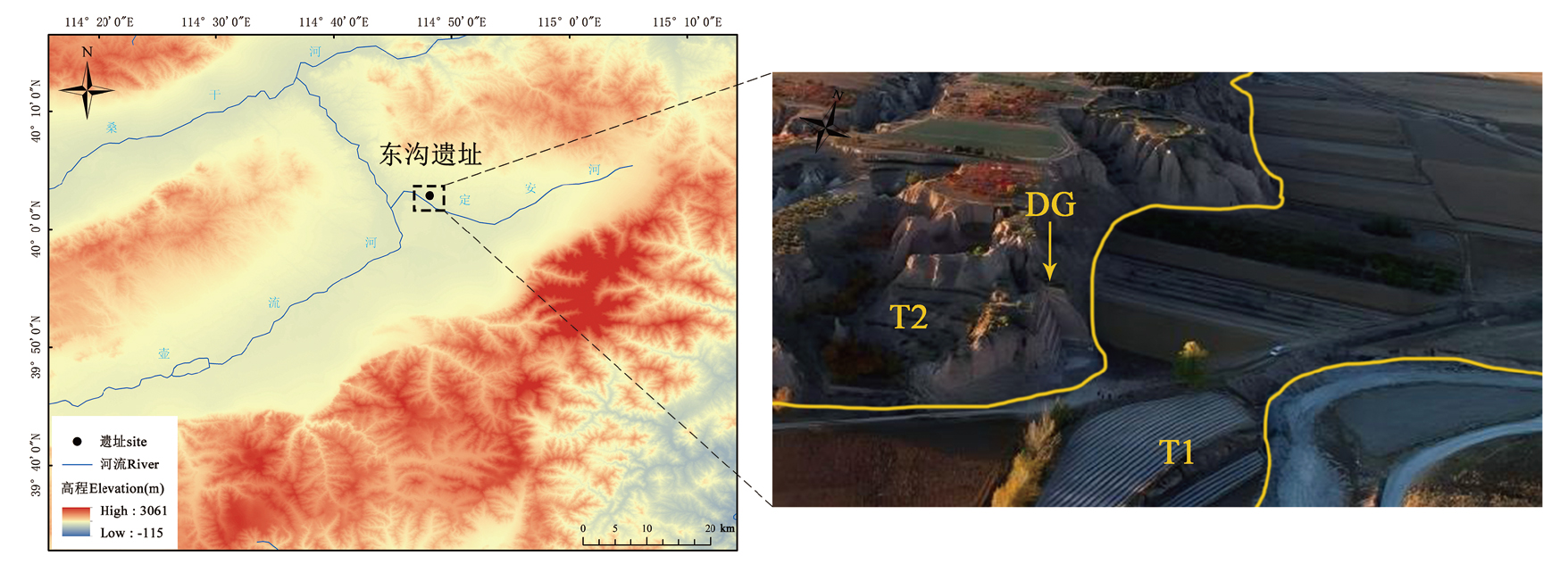
图1 东沟遗址地理位置图
Fig.1 Geographical location of the Donggou site
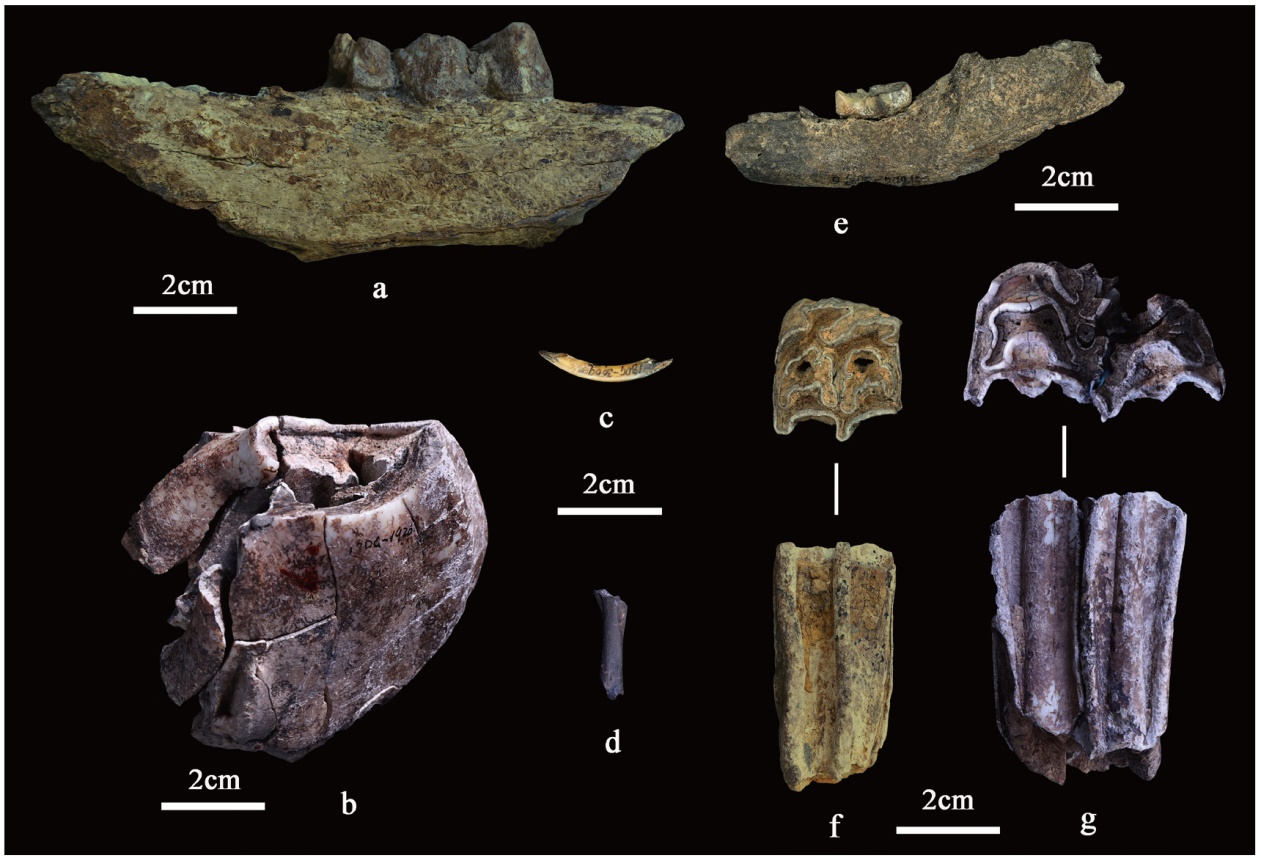
图2 东沟遗址出土的部分动物牙齿及骨骼 a.马鹿左侧下颌Left mandible of Cervus elaphus;b. 犀牛右上臼齿Right upper molar of Rhinocerotidae;c. 啮齿类门齿Incisor of Rodentia;d. 鸟肱骨Humerus of Aves;e. 狗獾左侧下颌Left mandible of Meles leucurus;f. 马右下臼齿Right lower molar of Equus sp.;g. 牛左上臼齿Left upper molar of Bovidae
Fig.2 Some faunal specimens from Donggou site
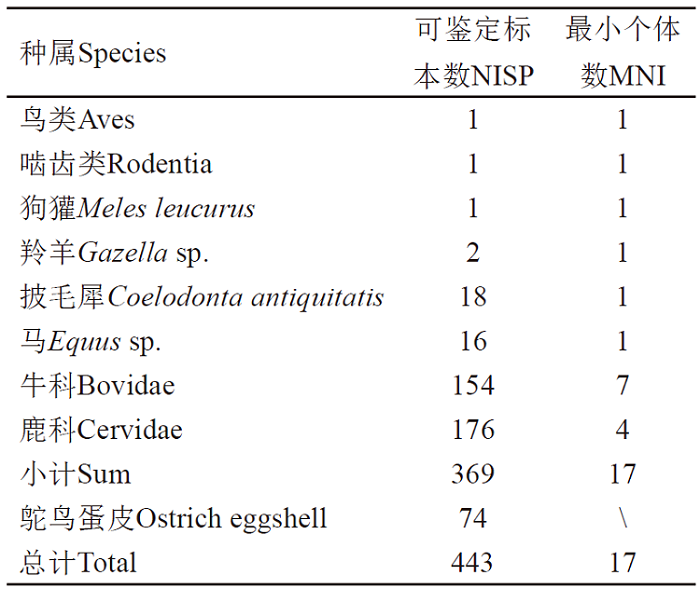 |
表1 东沟遗址出土动物种属的数量统计
Tab.1 Counts of animal species from Donggou site (n)
| |
| 种属Species→ 部位Element↓ | 鹿Cervus sp. | 牛Bovidae | 犀牛Rhinocerotidae | 马Equus sp. | |||||||||||
|---|---|---|---|---|---|---|---|---|---|---|---|---|---|---|---|
| MNE | MAU | MAU% | MNE | MAU | MAU% | MNE | MAU | MAU% | MNE | MAU | MAU% | ||||
| 下颌骨Mandible | 2.7 | 1.35 | 37.0% | 0 | 0 | 0 | 2 | 1 | 100.0% | 0 | 0 | 0 | |||
| 脊椎Vertebrae | 0.5 | 0.14 | 3.8% | 0.6 | 0.012 | 0.4% | 0 | 0 | 0 | 0 | 0 | 0 | |||
| 盆骨Pelvic | 0.5 | 0.25 | 6.8% | 1.8 | 0.9 | 26.5% | 0 | 0 | 0 | 0 | 0 | 0 | |||
| 肋骨Rib | 2 | 0.77 | 21.1% | 0.2 | 0.008 | 0.2% | 1.2 | 0.46 | 46.0% | 0 | 0 | 0 | |||
| 肩胛骨Scapula | 1 | 0.5 | 13.7% | 0.3 | 0.15 | 4.4% | 0.5 | 0.25 | 25.0% | 0 | 0 | 0 | |||
| 肱骨Humerus | 5 | 2.5 | 68.5% | 6.8 | 3.4 | 100.0% | 0.3 | 0.15 | 15.0% | 0 | 0 | 0 | |||
| 尺骨Ulna | 0 | 0 | 0 | 1 | 0.5 | 14.7% | 0 | 0 | 0 | 1 | 0.5 | 100.0% | |||
| 桡骨Radiu | 5 | 2.5 | 68.5% | 2.8 | 1.4 | 41.1% | 0 | 0 | 0 | 0.3 | 0.15 | 30.0% | |||
| 股骨Femur | 3.8 | 1.9 | 52.1% | 2.8 | 1.4 | 41.1% | 0.3 | 0.15 | 15.0% | 0.2 | 0.1 | 20.0% | |||
| 胫骨Tibia | 7.3 | 3.65 | 100.0% | 4.9 | 2.45 | 72.1% | 0 | 0 | 0 | 0.2 | 0.1 | 20.0% | |||
| 腕跗骨Carpal-Tarsal | 1.5 | 0.115 | 3.2% | 0 | 0 | 0 | 1.5 | 0.068 | 6.8% | 0 | 0 | 0 | |||
| 掌骨Metacarpal | 1.6 | 0.8 | 22.0% | 2.3 | 1.15 | 33.8% | 0 | 0 | 0 | 0.4 | 0.2 | 40.0% | |||
| 跖骨Metatarsal | 2.4 | 1.2 | 32.9% | 2.3 | 1.15 | 33.8% | 0 | 0 | 0 | 0.2 | 0.1 | 20.0% | |||
| 第一指/趾骨Proximal phalanx | 0 | 0 | 0 | 0.6 | 0.075 | 2.2% | 0 | 0 | 0 | 0 | 0 | 0 | |||
| 第二指/趾骨Mesial phalanx | 1 | 0.25 | 6.8% | 0 | 0 | 0 | 0 | 0 | 0 | 0 | 0 | 0 | |||
表2 东沟遗址出土鹿、牛、犀牛、马的骨骼单元分布
Tab.2 Bone element abundance of Cervus sp., Bovidae, Rhinocerotidae and Equus sp. from Donggou site (n)
| 种属Species→ 部位Element↓ | 鹿Cervus sp. | 牛Bovidae | 犀牛Rhinocerotidae | 马Equus sp. | |||||||||||
|---|---|---|---|---|---|---|---|---|---|---|---|---|---|---|---|
| MNE | MAU | MAU% | MNE | MAU | MAU% | MNE | MAU | MAU% | MNE | MAU | MAU% | ||||
| 下颌骨Mandible | 2.7 | 1.35 | 37.0% | 0 | 0 | 0 | 2 | 1 | 100.0% | 0 | 0 | 0 | |||
| 脊椎Vertebrae | 0.5 | 0.14 | 3.8% | 0.6 | 0.012 | 0.4% | 0 | 0 | 0 | 0 | 0 | 0 | |||
| 盆骨Pelvic | 0.5 | 0.25 | 6.8% | 1.8 | 0.9 | 26.5% | 0 | 0 | 0 | 0 | 0 | 0 | |||
| 肋骨Rib | 2 | 0.77 | 21.1% | 0.2 | 0.008 | 0.2% | 1.2 | 0.46 | 46.0% | 0 | 0 | 0 | |||
| 肩胛骨Scapula | 1 | 0.5 | 13.7% | 0.3 | 0.15 | 4.4% | 0.5 | 0.25 | 25.0% | 0 | 0 | 0 | |||
| 肱骨Humerus | 5 | 2.5 | 68.5% | 6.8 | 3.4 | 100.0% | 0.3 | 0.15 | 15.0% | 0 | 0 | 0 | |||
| 尺骨Ulna | 0 | 0 | 0 | 1 | 0.5 | 14.7% | 0 | 0 | 0 | 1 | 0.5 | 100.0% | |||
| 桡骨Radiu | 5 | 2.5 | 68.5% | 2.8 | 1.4 | 41.1% | 0 | 0 | 0 | 0.3 | 0.15 | 30.0% | |||
| 股骨Femur | 3.8 | 1.9 | 52.1% | 2.8 | 1.4 | 41.1% | 0.3 | 0.15 | 15.0% | 0.2 | 0.1 | 20.0% | |||
| 胫骨Tibia | 7.3 | 3.65 | 100.0% | 4.9 | 2.45 | 72.1% | 0 | 0 | 0 | 0.2 | 0.1 | 20.0% | |||
| 腕跗骨Carpal-Tarsal | 1.5 | 0.115 | 3.2% | 0 | 0 | 0 | 1.5 | 0.068 | 6.8% | 0 | 0 | 0 | |||
| 掌骨Metacarpal | 1.6 | 0.8 | 22.0% | 2.3 | 1.15 | 33.8% | 0 | 0 | 0 | 0.4 | 0.2 | 40.0% | |||
| 跖骨Metatarsal | 2.4 | 1.2 | 32.9% | 2.3 | 1.15 | 33.8% | 0 | 0 | 0 | 0.2 | 0.1 | 20.0% | |||
| 第一指/趾骨Proximal phalanx | 0 | 0 | 0 | 0.6 | 0.075 | 2.2% | 0 | 0 | 0 | 0 | 0 | 0 | |||
| 第二指/趾骨Mesial phalanx | 1 | 0.25 | 6.8% | 0 | 0 | 0 | 0 | 0 | 0 | 0 | 0 | 0 | |||
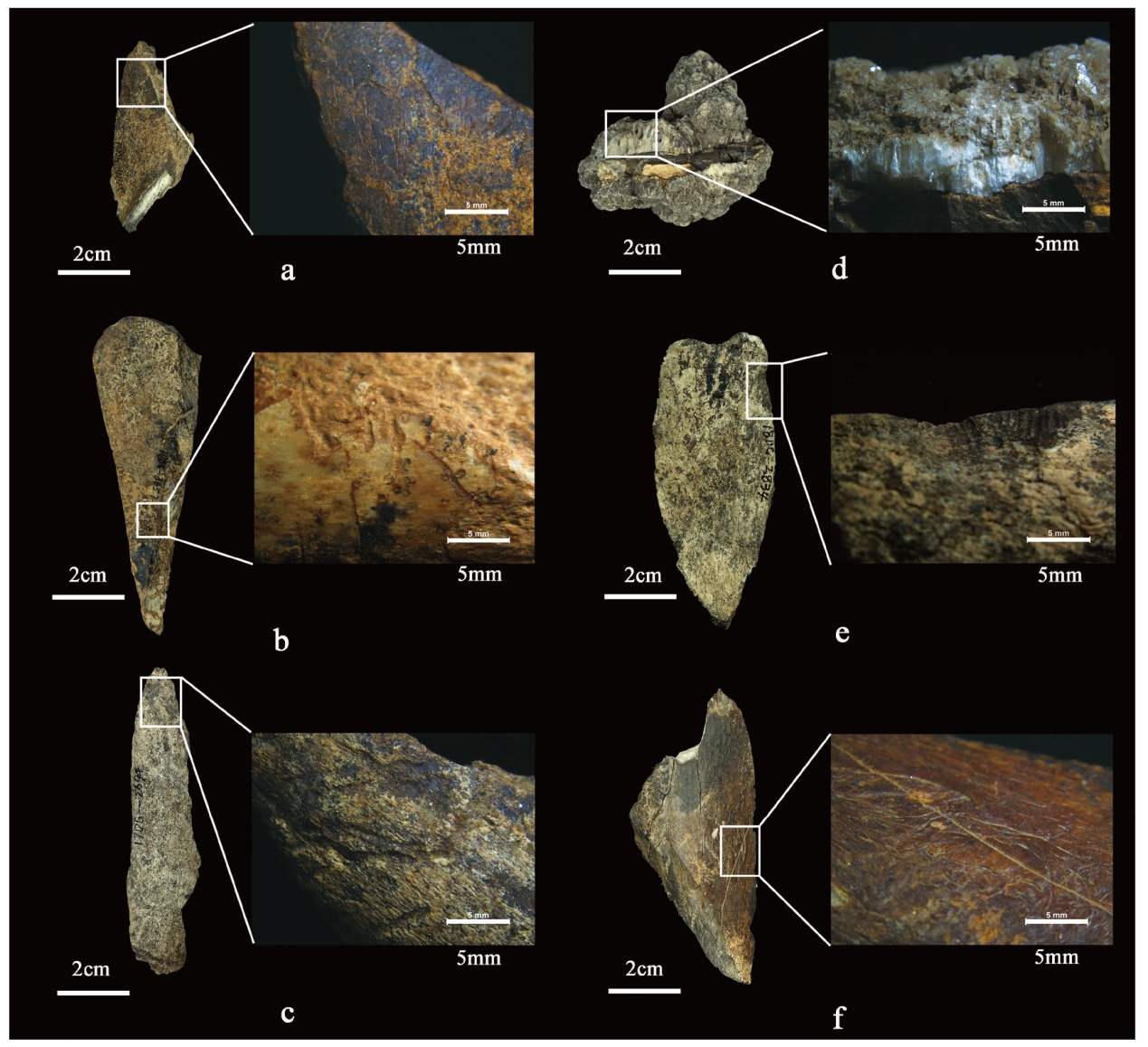
图3 东沟遗址出土动物骨骼表面的自然痕迹 a.水流磨蚀痕迹Water abration marks;b. 植物根系痕迹Root etching marks;c.食肉类动物啃咬痕迹Carnivore tooth marks;d.蒸发盐结晶Evaporated salt crystals;e.啮齿类动物啃咬痕迹Rodent tooth marks;f.踩踏痕迹Tramping mark
Fig.3 Bone surface natural modifications on animal bones from Donggou site
| 种属Species→ 部位Element↓ | 牛/马 Bovidae or Equus sp. | 鹿/羚羊 Cervus sp. or Gazella sp. | 总计 Total | ||
|---|---|---|---|---|---|
| 肢骨Limbs | 上部、中部肢骨 Upper/Middle limbs | 骨干 Diaphysis | 6 | 15 | 21 |
| (近)骨骺 Epiphysis/Metaphysis | 2 | 3 | 5 | ||
| 下部肢骨 Lower limbs | 骨干 Diaphysis | 1 | 3 | 4 | |
| (近)骨骺 Epiphysis/Metaphysis | 1 | 0 | 1 | ||
| 中轴骨Axial | 0 | 5 | 5 | ||
| 总计Total | 10 | 26 | 36 |
表3 切割痕迹的标本部位统计表
Tab.3 The number of specimens with cut marks (n)
| 种属Species→ 部位Element↓ | 牛/马 Bovidae or Equus sp. | 鹿/羚羊 Cervus sp. or Gazella sp. | 总计 Total | ||
|---|---|---|---|---|---|
| 肢骨Limbs | 上部、中部肢骨 Upper/Middle limbs | 骨干 Diaphysis | 6 | 15 | 21 |
| (近)骨骺 Epiphysis/Metaphysis | 2 | 3 | 5 | ||
| 下部肢骨 Lower limbs | 骨干 Diaphysis | 1 | 3 | 4 | |
| (近)骨骺 Epiphysis/Metaphysis | 1 | 0 | 1 | ||
| 中轴骨Axial | 0 | 5 | 5 | ||
| 总计Total | 10 | 26 | 36 |
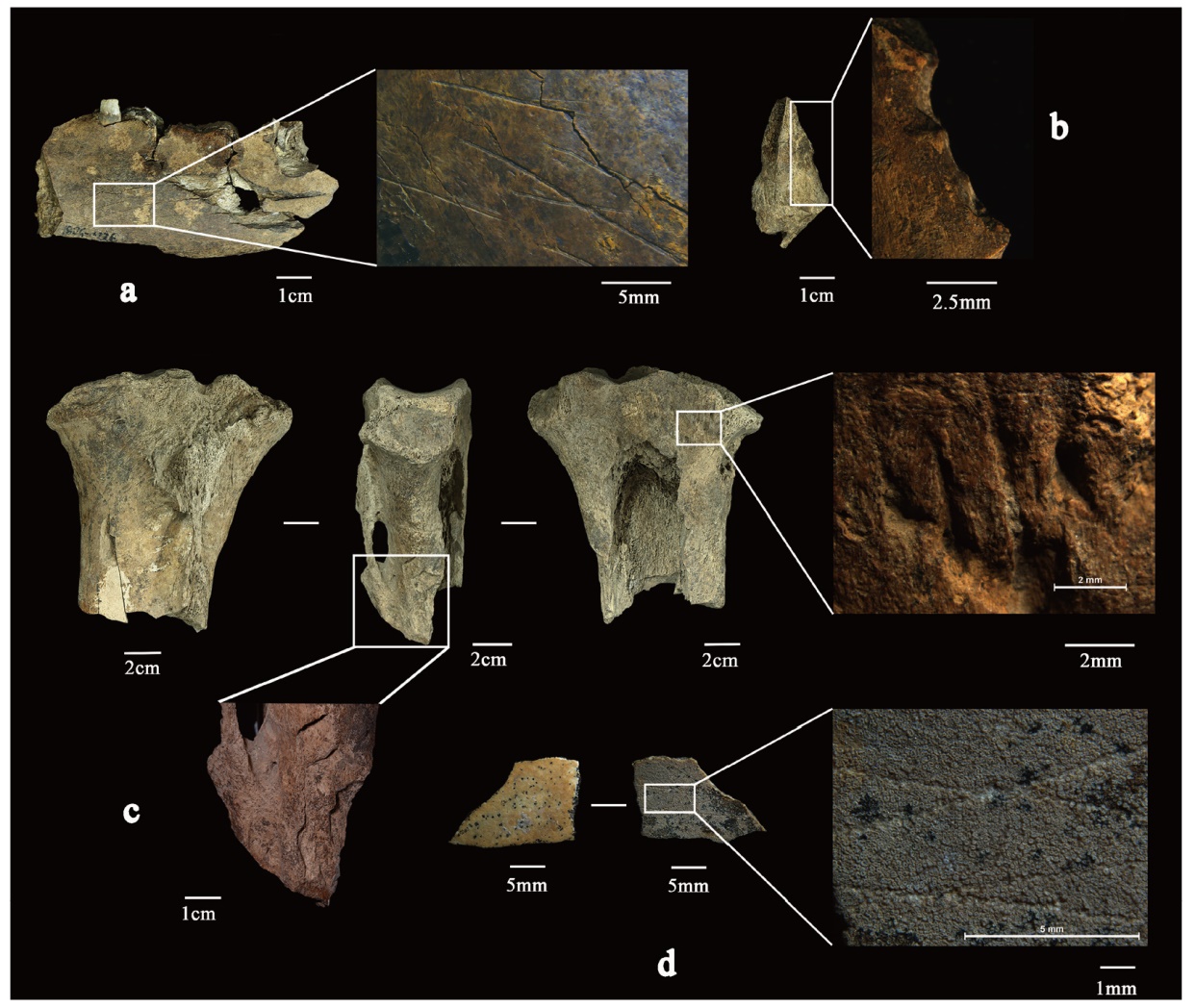
图4 东沟遗址出土动物骨骼表面的人工痕迹 a.切割痕迹Cut marks;b.敲砸痕迹Percussion notches;c.砍痕Chop marks(位于下方的放大图Magnified figure below);d. 鸵鸟蛋皮的切割痕迹Cut marks of ostrich eggshell
Fig.4 Bone surface artificial modifications on animal bones from Donggou site
| 种属Species→ 部位Element↓ | 牛/马 Bovidae or Equus sp. | 鹿/羚羊 Cervus sp. or Gazella sp. | 总计 Total | |
|---|---|---|---|---|
| 肢骨Limbs | 上部、中部肢骨 Upper/Middle limbs | 6 | 21 | 27 |
| 下部肢骨 Lower limbs | 2 | 3 | 5 | |
| 下颌骨Mandible | 0 | 3 | 3 | |
| 总计Total | 8 | 27 | 35 |
表4 敲砸痕迹的标本部位统计表
Tab.4 The number of specimens with percussion notches (n)
| 种属Species→ 部位Element↓ | 牛/马 Bovidae or Equus sp. | 鹿/羚羊 Cervus sp. or Gazella sp. | 总计 Total | |
|---|---|---|---|---|
| 肢骨Limbs | 上部、中部肢骨 Upper/Middle limbs | 6 | 21 | 27 |
| 下部肢骨 Lower limbs | 2 | 3 | 5 | |
| 下颌骨Mandible | 0 | 3 | 3 | |
| 总计Total | 8 | 27 | 35 |
| [1] |
Peterse F, Martínez-García A, Zhou B, et al. Molecular records of continental air temperature and monsoon precipitation variability in East Asia spanning the past 130,000 years[J]. Quaternary Science Reviews, 2014, 83: 76-82
doi: 10.1016/j.quascirev.2013.11.001 URL |
| [2] | 王伟. 华南地区现代人化石及其时代[J]. 人类学学报, 2024, 43(6): 934-950 |
| [3] | 裴树文, 王法岗, 牛东伟. 二十一世纪以来泥河湾盆地古人类活动的发现与研究进展[J]. 人类学学报, 2024, 43(6): 913-933 |
| [4] | 马东东, 牛东伟, 裴树文, 等. 蔚县盆地2017-2018年旧石器考古调查简报[J]. 人类学学报, 2021, 40(1): 128-136 |
| [5] | 牛东伟, 闫晓蒙, 马东东, 等. 蔚县盆地2019-2020年旧石器考古调查[J]. 人类学学报, 2022, 41(5): 936-944 |
| [6] | 牛东伟, 薛峰, 李鼎元, 等. 怀来盆地2014年度旧石器考古调查简报[J]. 人类学学报, 2018, 37(1): 79-87 |
| [7] | 李鼎元, 牛东伟, 李延豪. 怀来盆地2015年度旧石器考古调查发现的石制品[J]. 文物春秋, 2018, 2: 16-20 |
| [8] | 王天磊. 大同盆地2016-2018年旧石器考古调查发现与初步研究[D]. 硕士毕业论文, 太原: 山西大学, 2021 |
| [9] | 杨淼燃. 泥河湾盆地牛圈沟化石地点埋藏学研究[D]. 硕士毕业论文, 石家庄: 河北师范大学, 2021 |
| [10] | 杜雨薇, 张乐, 叶芷, 等. 蔚县盆地吉家庄旧石器遗址动物骨骼的埋藏学分析[J]. 人类学学报, 2023, 42(3): 359-372 |
| [11] | 王颖, 张乐, 杨石霞, 等. 山西峙峪遗址出土动物骨骼的埋藏学[J]. 人类学学报, 2025, 44(2): 255-269 |
| [12] | 王晓敏, 刘连强, 陈国鹏, 等. 泥河湾盆地马圈沟遗址哺乳动物破碎长骨反映的古人类行为[J]. 人类学学报, 2024, 43(1): 91-105 |
| [13] |
Wang XM, Xie F, Mei HJ, et al. Intensive exploitation of animal resources during Deglacial times in North China: a case study from the Yujiagou site[J]. Archaeological and Anthropological Sciences, 2019, 11(2): 4983-5000
doi: 10.1007/s12520-019-00852-1 |
| [14] | 王晓敏, 陈福友, 李锋, 等. 河北泥河湾板井子旧石器遗址2015年出土动物遗存初步研究[J]. 华夏考古, 2024, 2: 71-79 |
| [15] | 李冰, 杜天愉, 梅惠杰, 等. 泥河湾盆地油房遗址MIS 5阶段人类活动与气候、植被的关系[J]. 第四纪研究, 2024, 44(5): 1322-1337 |
| [16] | 周士航, 何湘栋, 徐静玥, 等. 蔚县盆地东沟遗址2017年度发掘简报[J]. 人类学学报, 2024, 43(1): 132-142 |
| [17] | 徐静玥, 何湘栋, 牛东伟, 等. 泥河湾盆地蔚县东沟旧石器遗址的埋藏过程[J]. 人类学学报, 2024, 43(6): 1075-1090 |
| [18] | 周士航. 蔚县盆地东沟遗址2017年度出土石制品研究[D]. 硕士毕业论文, 石家庄: 河北师范大学, 2024 |
| [19] |
Xu JY, Niu DW, Zhang SR, et al. Climate change and hominin behavioral adaptations during the Marine Isotope Stage 5 to 4 transition: a case study from Donggou site, Nihewan Basin, North China[J]. Quaternary Science Reviews, 2026, 373: 109714
doi: 10.1016/j.quascirev.2025.109714 URL |
| [20] | 黄冰柔, 牛东伟, 裴树文, 等. 河北蔚县盆地东沟遗址的光释光年龄[J]. 人类学学报, 2026, 45(3): 543-555 |
| [21] |
Rao ZG, Liu XK, Gao HH, et al. Evolving history of the East Asian summer monsoon intensity during the MIS5: inconsistent records from Chinese stalagmites and loess deposits[J]. Environmental Earth Sciences, 2015, 73: 3937-3950
doi: 10.1007/s12665-014-3681-z URL |
| [22] | 张月书, 李锋, 王晓敏, 等. 旧石器时代遗址发掘与记录方法讨论[J]. 人类学学报, 2021, 40(2): 181-193 |
| [23] | Lyman RL. Vertebrate Taphonomy[M]. Cambridge: Cambridge University Press, 1994 |
| [24] | 同号文, 张贝, 陈曦. 泥河湾盆地第四纪哺乳动物群概览及若干新认识[J]. 人类学学报, 2024, 43(1): 157-183 |
| [25] | 张乐, CJ Norton, 张双权, 等. 量化单元在马鞍山遗址动物骨骼研究中的运用[J]. 人类学学报, 2008, 1: 79-90 |
| [26] | Fernandez-Jalvo Y, Andrews P. Atlas of Taphonomic Identifications: 1001+ Images of Fossil and Recent Mammal Bone Modiffcation[M]. Dordrecht: Springer Netherlands, 2016 |
| [27] | 张双权. 旧石器遗址动物骨骼表面非人工痕迹研究及其考古学意义[J]. 第四纪研究, 2014, 34(1): 131-140 |
| [28] |
Behrensmeyer AK. Taphonomic and ecologic information from bone weathering[J]. Paleobiology, 1978, 4(2): 150-162
doi: 10.1017/S0094837300005820 URL |
| [29] |
Potts R, Shipman P. Cut marks made by stone tools on bones from Olduvai Gorge,Tanzania[J]. Nature, 1981, 291(5816): 577-580
doi: 10.1038/291577a0 |
| [30] |
Galán AB, Rodrínguez M, De Juana S, et al. A new experimental study on percussion marks and notches and their bearing on the interpretation of hammerstone-broken faunal assemblages[J]. Journal of Archaeological Science, 2009, 36(3): 776-784
doi: 10.1016/j.jas.2008.11.003 URL |
| [31] |
Vettese D, Blasco R, Cáceres I, et al. Towards an understanding of hominin marrow extraction strategies:a proposal for a percussion mark terminology[J]. Archaeological and Anthropological Sciences, 2020, 12: 48
doi: 10.1007/s12520-019-00972-8 |
| [32] |
Shipman P. Application of scanning electron microscopy to taphonomic problems[J]. Annals of the New York Academy of Sciences, 1981, 376(1): 357-385
doi: 10.1111/nyas.1981.376.issue-1 URL |
| [33] |
Okaluk TR, Greenfield HJ. Macroscopic Chop Mark Identification on Archaeological Bone: An Experimental Study of Chipped Stone, Ground Stone, Copper, and Bronze Axe Heads on Bone[J]. Quaternary, 2022, 5(1): 15
doi: 10.3390/quat5010015 URL |
| [34] |
Maté-González MÁ, Countenay LA, Aramendi J, et al. Application of geometric morphometrics to the analysis of cut mark morphology on different bones of differently sized animals. Does size really matter?[J]. Quaternary International, 2019, 517: 33-44
doi: 10.1016/j.quaint.2019.01.021 URL |
| [35] |
Selvaggio MM. Carnivore tooth marks and stone tool butchery marks on scavenged bones: archaeological implications Science Direct[J]. Journal of Human Evolution, 1994, 27(3): 215-228
doi: 10.1006/jhev.1994.1043 URL |
| [36] |
Villa P, Mahieu E. Breakage patterns of human long bones[J]. Journal of Human Evolution, 1991, 21(1): 27-48
doi: 10.1016/0047-2484(91)90034-S URL |
| [37] | 张双权, 李占扬, 张乐, 等. 河南灵井许昌人遗址大型食草类动物的骨骼单元分布[J]. 中国科学:地球科学, 2012, 42(5): 764-772 |
| [38] |
Douglass K, Bulathsinhala P, Feo TJ, et al. Modeling avian eggshell microstructure to predict ontogenetic age and reveal patterns of human-avifauna interaction[J]. Journal of Archaeological Science, 2021, 133: 105442
doi: 10.1016/j.jas.2021.105442 URL |
| [39] | 张乐. 旧石器时代古人类敲骨取髓行为的确认——以马鞍山遗址为例[J]. 第四纪研究, 2014, 34(1): 141-148 |
| [40] | Bar-Oz G, Adler DS. Taphonomic history of the Middle and Upper Palaeolithic faunal assemblage from Ortvale Klde, Georgian Republic[J]. Journal of Taphonomy, 2005, 3(4): 185-211 |
| [41] |
Pickering TR, Egeland CP. Experimental patterns of hammerstone percussion damage on bones: implications for inferences of carcass processing by humans[J]. Journal of Archaeological Science, 2006, 33(4): 459-469
doi: 10.1016/j.jas.2005.09.001 URL |
| [42] | 任进成, 王法岗, 李锋, 等. 泥河湾盆地板井子旧石器时代遗址的形成过程[J]. 人类学学报, 2021, 40(3): 378-392 |
| [43] | Bartram L, Kroll E, Bunn H. Variability in Camp Structure and Bone Food Refuse Patterning at Kua San Hunter-Gatherer Camps[A]. In: Kroll EM, Price TD(Eds.). The Interpretation of Archaeological Spatial Patterning[C]. Interdisciplinary Contributions to Archaeology, Boston: Springer, 1991, 77-148 |
| [44] | Marlowe FW. The Hadza Hunter-Gatherers of Tanzania[M]. California: University of Carlifornia Press, 2010 |
| [45] | 张乐, 王春雪, 张双权, 等. 马鞍山旧石器时代遗址古人类行为的动物考古学研究[J]. 中国科学:地球科学, 2009, 39(9): 1256-1265 |
| [46] |
Litov V, Marinelli F, Lemorini C, et al. Continuity and innovation in the Late Acheulian: Technological and functional analysis of scrapers from Jaljulia, Southern Levant (500-300 ka)[J]. Journal of Human Evolution, 2025, 205:103716
doi: 10.1016/j.jhevol.2025.103716 URL |
| [47] | Fairnell E. 101 ways to skin a fur-bearing animal:the implications for zooarchaeological interpretation[A]. In: Cunningham P, Heeb J, Paardekooper R(Eds.). Experiencing archaeology by experiment[C]. Oxbow: Oxford, 2008, 47-60 |
| [48] |
Pickering TR. Domínguez-Rodrigo M, Heaton JL, et al. Taphonomy of ungulate ribs and the consumption of meat and bone by 1.2- million-year-old hominins at Olduvai Gorge, Tanzania[J]. Journal of Archaeological Science, 2013, 40: 1295-1309
doi: 10.1016/j.jas.2012.09.025 URL |
| [49] |
Dart RA. Substitution of stone tools for bone tools at Makapansgat[J]. Nature, 1962, 196(4852): 314-316
doi: 10.1038/196314a0 |
| [50] | Blasco R, Rosell J, Arilla M, et al. Bone Marrow Storage and Delayed Consumption at Middle Pleistocene Qesem Cave, Israel (420 to 200 Ka)[J]. Science Advances, 2019, 5(10): 1-12 |
| [51] | Wang FG, Guo YJ, Xian Q, et al. Luminescence chronology for the Paleolithic site of Xinmiaozhuang Locality 1 (XMZ1) in the Nihewan Basin, northern China, and its paleoenvironmental and archaeological implications[J]. Journal of Human Evolution, 2021, 157: 1-15 |
| [52] | 王法岗, 孙永春. 泥河湾考古图典[M]. 石家庄: 河北美术出版社, 2023 |
| [53] |
Guo YJ, Li B, Zhang JF, et al. Luminescence ages for three‘Middle Palaeolithic’sites in the Nihewan Basin, northern China, and their archaeological and palaeoenvironmental implications[J]. Quaternary Research, 2016, 85(3): 456-470
doi: 10.1016/j.yqres.2016.03.002 URL |
| [1] | 黄冰柔, 牛东伟, 裴树文, 郭玉杰. 河北蔚县盆地东沟遗址的光释光年龄[J]. 人类学学报, 2026, 45(03): 543-555. |
| [2] | 杜雨薇, 耿帅杰, 徐静玥, 叶芷, 张乐, 马东东, 裴树文. 泥河湾盆地蔡家沟遗址A和B地点动物骨骼的埋藏学观察[J]. 人类学学报, 2026, 45(03): 570-585. |
| [3] | 侯沂杉, 张乐, 张双权. 显微CT技术和骨组织学观察在动物考古学研究中的应用[J]. 人类学学报, 2026, 45(02): 280-295. |
| [4] | 曹雨昕, 孙璐, 张乐, 张双权. 骨骼表面人类齿痕特征的实验研究[J]. 人类学学报, 2025, 44(02): 242-254. |
| [5] | 王颖, 张乐, 杨石霞, 张双权. 山西峙峪遗址出土动物骨骼的埋藏学[J]. 人类学学报, 2025, 44(02): 255-269. |
| [6] | 徐静玥, 何湘栋, 牛东伟, 李潇丽. 泥河湾盆地蔚县东沟旧石器遗址的埋藏过程[J]. 人类学学报, 2024, 43(06): 1075-1090. |
| [7] | 周士航, 何湘栋, 徐静玥, 李潇丽, 牛东伟. 蔚县盆地东沟遗址2017年度发掘简报[J]. 人类学学报, 2024, 43(01): 132-142. |
| [8] | 王晓敏, 刘连强, 陈国鹏, 李锋, 谢飞, 高星. 泥河湾盆地马圈沟遗址哺乳动物破碎长骨反映的古人类行为[J]. 人类学学报, 2024, 43(01): 91-105. |
| [9] | 杜雨薇, 张乐, 叶芷, 裴树文. 蔚县盆地吉家庄旧石器遗址动物骨骼的埋藏学分析[J]. 人类学学报, 2023, 42(03): 359-372. |
| [10] | 叶芷, 杜雨薇, 裴树文, 丁馨, 徐哲, 马东东. 蔚县盆地吉家庄旧石器遗址的形成过程[J]. 人类学学报, 2023, 42(01): 46-60. |
| [11] | 王晓敏, 王法岗, 陈福友, 李锋, 高星. 泥河湾盆地板井子晚更新世遗址古人类对动物资源的消费策略[J]. 人类学学报, 2022, 41(06): 1005-1016. |
| [12] | 牛东伟, 闫晓蒙, 马东东, 徐哲, 裴树文. 蔚县盆地2019-2020年旧石器考古调查[J]. 人类学学报, 2022, 41(05): 936-944. |
| [13] | 杜雨薇, 丁馨, 裴树文. 浅议古人类活动遗址的动物埋藏学研究方法[J]. 人类学学报, 2022, 41(03): 523-534. |
| [14] | 戴静雯, 张双权, 张乐. 史前人类对动物骨骼油脂的开发和利用[J]. 人类学学报, 2021, 40(03): 503-512. |
| [15] | 黄超, 张双权. X射线衍射技术在烧骨实验研究中的初步应用[J]. 人类学学报, 2021, 40(03): 513-525. |
| 阅读次数 | ||||||
|
全文 |
|
|||||
|
摘要 |
|
|||||
 京ICP证05002819号-3