

主管:中国科学院
主办:中国科学院古脊椎动物与古人类研究所
出版:科学出版社
主办:中国科学院古脊椎动物与古人类研究所
出版:科学出版社
人类学学报 ›› 2026, Vol. 45 ›› Issue (04): 709-720.doi: 10.16359/j.1000-3193/AAS.2025.0052cstr: 32091.14.j.1000-3193/AAS.2025.0052
朱思媚( ), 孙艺丹
收稿日期:2024-10-09
修回日期:2025-04-01
出版日期:2026-08-15
发布日期:2026-08-12
作者简介:朱思媚,讲师,主要研究方向为生物考古学。E-mail: zhusimei1992@foxmail.com
基金资助:
ZHU Simei(), SUN Yidan
Received:2024-10-09
Revised:2025-04-01
Online:2026-08-15
Published:2026-08-12
摘要:
对古代社会的哺乳断奶问题进行研究,有利于了解古代儿童的食物结构和喂养方式,揭示儿童营养状况及背后的文化动因。近年来,稳定同位素分析方法已成为复原古代母乳喂养与辅食摄入的有效工具,并可用于评估断奶年龄与辅食种类等。本文较为系统地梳理了国内外C、N稳定同位素在复原古代人类哺乳和断奶行为的研究进展,揭示了其在探讨古代人类的生存策略、生存压力、社会结构以及人类进化等考古学问题上极为重要的价值,为深入了解古代人类的生活方式和社会复杂化提供了关键线索。
中图分类号:
朱思媚, 孙艺丹. 稳定同位素分析在古代人类哺乳和断奶行为研究中的应用[J]. 人类学学报, 2026, 45(04): 709-720.
ZHU Simei, SUN Yidan. Application of stable isotope analysis in the study of ancient human breastfeeding and weaning behavior[J]. Acta Anthropologica Sinica, 2026, 45(04): 709-720.
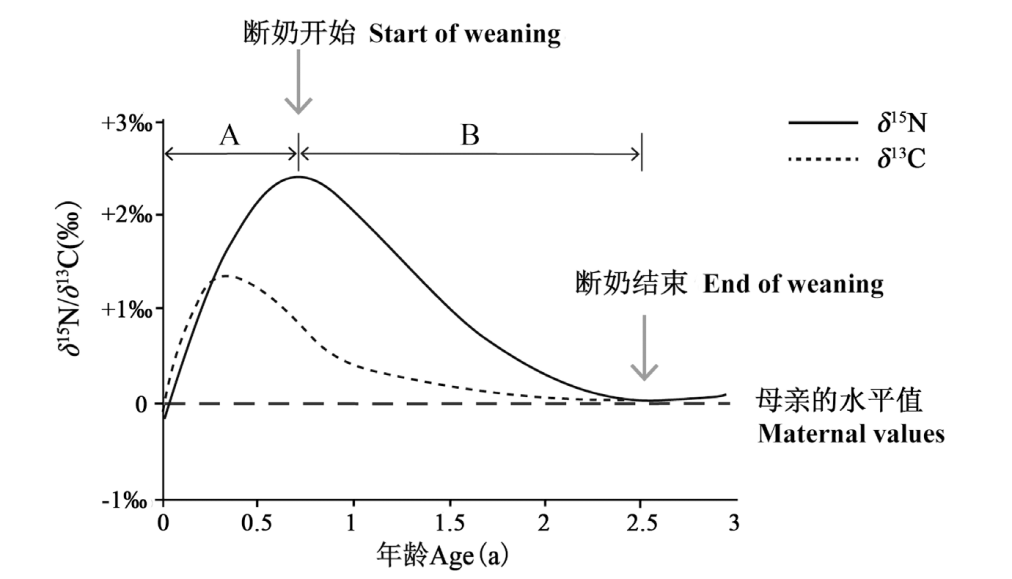
图1 母乳喂养和断奶期间婴儿δ13C和δ15N值的预期变化 A.纯母乳喂养Exclusive breastfeeding;B.引入辅食,母乳摄入量逐渐减少Introduction of complementary foods and gradual decrease in breast milk intake。本图改自文献[7] / This image is modified from reference [7]
Fig.1 Expected changes in δ13C and δ15N values in infants during breastfeeding and weaning
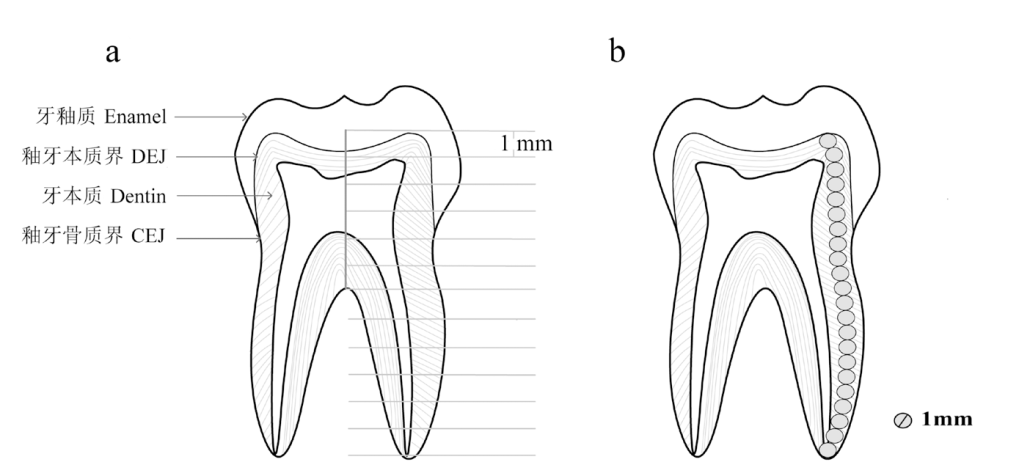
图2 两种不同的牙本质取样方法 a.牙本质序列切片方法Serial dentin sectioning method;b.牙本质微孔取样方法Dentin micropore sampling method。本图改自文献[24] / This image is modified from reference [24]
Fig.2 Two different methods of dentin sampling
| [1] |
Fernández-Crespo T, Czermak A, Lee-Thorp JA. Infant and childhood diet at the passage tomb of Alto de la Huesera (north-central Iberia) from bone collagen and sequential dentine isotope composition[J]. International Journal of Osteoarchaeology, 2018, 28(5): 542-551
doi: 10.1002/oa.v28.5 URL |
| [2] |
Wang TT, Wei D, Yi B, et al. Infancy, childhood, and puberty on the Silk Road revealed with isotopic analysis of incremental dentine[J]. Scientific Reports, 2022, 12(1): 19494
doi: 10.1038/s41598-022-24119-3 pmid: 36376478 |
| [3] | Fogel ML. Nitrogen isotope tracers of human lactation in modern and archaeological populations[J]. In: Annual Report of the Director of the Geophysical Laboratory, Washington: Carnegie Institution, 1989, 88: 111 |
| [4] | Katzenberg MA, Herring DA, Saunders SR. Weaning and infant mortality: evaluating the skeletal evidence[J]. American Journal of Physical Anthropology: The Official Publication of the American Association of Physical Anthropologists, 1996, 101(S23): 177-99 |
| [5] | 胡耀武. 稳定同位素生物考古学的概念、简史、原理和目标[J]. 人类学学报, 2021, 40(3): 526-534 |
| [6] | Fuller BT, Fuller JL, Harris DA, et al. Detection of breastfeeding and weaning in modern human infants with carbon and nitrogen stable isotope ratios[J]. American Journal of Physical Anthropology: The Official Publication of the American Association of Physical Anthropologists, 2006, 129(2): 279-293 |
| [7] |
King CL, Halcrow SE, Millard AR, et al. Let's talk about stress, baby! Infant-feeding practices and stress in the ancient Atacama desert, Northern Chile[J]. American Journal of Physical Anthropology, 2018, 166(1): 139-155
doi: 10.1002/ajpa.23411 pmid: 29355900 |
| [8] |
Chinique de Armas Y, Mavridou AM, Garcell Domínguez J, et al. Tracking breastfeeding and weaning practices in ancient populations by combining carbon, nitrogen and oxygen stable isotopes from multiple non-adult tissues[J]. PloS one, 2022, 17(2): e0262435
doi: 10.1371/journal.pone.0262435 URL |
| [9] | Fuller BT, Fuller JL, Sage NE, et al. Nitrogen balanceand δ15N: why you’re not what you eat during nutritional stress[J]. Rapid communicationsin Mass Spectrometry: An International Journal Devoted to the Rapid Dissemination of Up-to-the-Minute Research in Mass Spectrometry, 2005, 19(18): 2497-2506 |
| [10] | Dupras TL, Schwarcz HP, Fairgrieve SI. Infant feeding and weaning practices in Roman Egypt[J]. American Journal of Physical Anthropology: The Official Publication of the American Association of Physical Anthropologists, 2001, 115(3): 204-212 |
| [11] | Price, Douglas T. The chemistry of prehistoric human bone[M]. CUP Archive, 1989, 155-210 |
| [12] | Hedges REM, Clement JG, Thomas CDL, et al. Collagen turnover in the adult femoral mid-shaft: Modeled from anthropogenic radiocarbon tracer measurements[J]. American Journal of Physical Anthropology: The Official Publication of the American Association of Physical Anthropologists, 2007, 133(2): 808-816 |
| [13] | Choy K, Jeon OR, Fuller BT, et al. Isotopic evidence of dietary variations and weaning practices in the Gaya cemetery at Yeanri, Gimhae, South Korea[J]. American Journal of Physical Anthropology: The Official Publication of the American Association of Physical Anthropologists, 2010, 142(1): 74-84 |
| [14] |
Fuller BT, Richards MP, Mays SA. Stable carbon and nitrogen isotope variations in tooth dentine serial sections from Wharram Percy[J]. Journal of Archaeological Science, 2003, 30(12): 1673-1684
doi: 10.1016/S0305-4403(03)00073-6 URL |
| [15] |
Eerkens JW, Berget AG, Bartelink EJ. Estimating weaning and early childhood diet from serial micro-samples of dentin collagen[J]. Journal of Archaeological Science, 2011, 38(11): 3101-3111
doi: 10.1016/j.jas.2011.07.010 URL |
| [16] |
Wood JW, Milner GR, Harpending HC, et al. The osteological paradox: problems of inferring prehistoric health from skeletal samples [and comments and reply][J]. Current anthropology, 1992, 33(4): 343-370
doi: 10.1086/204084 URL |
| [17] |
Beaumont J. The whole tooth and nothing but the tooth: Or why temporal resolution of bone collagen may be unreliable[J]. Archaeometry, 2020, 62(3): 626-645
doi: 10.1111/arcm.12544 |
| [18] | 雷帅, 郭怡. 生物考古学视野下人类的牙齿与饮食[J]. 人类学学报, 2022, 41(3): 501-513 |
| [19] | Swindler DR. Primate dentition: an introduction to the teeth of non-human primates[M]. Cambridge University Press, 2002, 1-31 |
| [20] |
Beaumont J, Gledhill A, Lee-Thorp J, et al. Childhood diet: a closer examination of the evidence from dental tissues using stable isotope analysis of incremental human dentine[J]. Archaeometry, 2013, 55(2): 277-295
doi: 10.1111/arcm.2013.55.issue-2 URL |
| [21] |
Beaumont J, Montgomery J. Oral histories: a simple method of assigning chronological age to isotopic values from human dentine collagen[J]. Annals of Human Biology, 2015, 42(4): 407-414
pmid: 26225904 |
| [22] |
Czermak A, Schermelleh L, Lee-Thorp J. Imaging-assisted time-resolved dentine sampling to track weaning histories[J]. International Journal of Osteoarchaeology, 2018, 28(5): 535-541
doi: 10.1002/oa.v28.5 URL |
| [23] |
Brickley MB, Kahlon B, D'Ortenzio L. Using teeth as tools: Investigating the mother-infant dyad and developmental origins of health and disease hypothesis using vitamin D deficiency[J]. American journal of physical anthropology, 2020, 171(2): 342-353
doi: 10.1002/ajpa.23947 pmid: 31709512 |
| [24] |
Czermak A, Fernández-Crespo T, Ditchfield PW, et al. A guide for an anatomically sensitive dentine microsampling and age-alignment approach for human teeth isotopic sequences[J]. American Journal of Physical Anthropology, 2020, 173(4): 776-783
doi: 10.1002/ajpa.v173.4 URL |
| [25] |
Cheung C, Fernández-Crespo T, Mion L, et al. Micro-punches versus micro-slices for serial sampling of human dentine: Striking a balance between improved temporal resolution and measuring additional isotope systems[J]. Rapid Communications in Mass Spectrometry, 2022, 36(21): e9380
doi: 10.1002/rcm.v36.21 URL |
| [26] |
Ganiatsou E, Souleles A, Papageorgopoulou C. WEaning Age FiNder (WEAN): a tool for estimating weaning age from stable isotope ratios of dentinal collagen[J]. Archaeological and Anthropological Sciences, 2023, 15(4): 50
doi: 10.1007/s12520-023-01741-4 |
| [27] |
Dean MC, Liversidge HM, Elamin F. Combining radiographic and histological data for dental development to compare growth in the past and the present[J]. Annals of Human Biology, 2014, 41(4): 336-347
doi: 10.3109/03014460.2014.922614 pmid: 24932747 |
| [28] |
AlQahtani SJ, Hector MP, Liversidge HM. Brief communication: The London atlas of human tooth development and eruption[J]. American Journal of physical anthropology, 2010, 142(3): 481-490
doi: 10.1002/ajpa.21258 pmid: 20310064 |
| [29] |
Howcroft R, Eriksson G, Lidén K. Conformity in diversity? Isotopic investigations of infant feeding practices in two Iron Age populations from southern Öland, Sweden[J]. American Journal of Physical Anthropology, 2012, 149(2): 217-230
doi: 10.1002/ajpa.22113 pmid: 22826010 |
| [30] |
Burt NM, Garvie-Lok S. A new method of dentine microsampling of deciduous teeth for stable isotope ratio analysis[J]. Journal of Archaeological Science, 2013, 40(11): 3854-3864
doi: 10.1016/j.jas.2013.05.022 URL |
| [31] |
Fernández-Crespo T, Schulting RJ, Czermak A, et al. The “post-weanling’s conundrum”: exploring the impact of infant and child feeding practices on early mortality in the Bronze Age burial cave of Moro de Alins, north-eastern Iberia, through stable isotope analysis[J]. Archaeological and Anthropological Sciences, 2022, 14(10): 196
doi: 10.1007/s12520-022-01658-4 |
| [32] |
Lei S, Gu W, Wu Q, et al. Early childhood nurturing strategies in groups of the Yellow River's middle reaches from the late Yangshao culture (3500-2800 BCE): A stable isotope perspective[J]. International Journal of Osteoarchaeology, 2023, 33(5): 920-937
doi: 10.1002/oa.v33.5 URL |
| [33] |
Craig-Atkins E, Towers J, Beaumont J. The role of infant life histories in the construction of identities in death: An incremental isotope study of dietary and physiological status among children afforded differential burial[J]. American Journal of Physical Anthropology, 2018, 167(3): 644-655
doi: 10.1002/ajpa.23691 pmid: 30132793 |
| [34] |
Schmidt J, Kwok C, Keenleyside A. Infant feeding practices and childhood diet at Apollonia Pontica: Isotopic and dental evidence[J]. American journal of physical anthropology, 2016, 159(2): 284-299
doi: 10.1002/ajpa.22874 pmid: 26481114 |
| [35] |
Velte M, Czermak A, Grigat A, et al. Tracing early life histories from Roman times to the Medieval era: weaning practices and physiological stress[J]. Archaeological and Anthropological Sciences, 2023, 15(12): 190
doi: 10.1007/s12520-023-01882-6 |
| [36] |
Tsutaya T, Sawada J, Dodo Y, et al. Isotopic evidence of dietary variability in subadults at the Usu-moshiri site of the Epi-Jomon culture, Japan[J]. Journal of Archaeological Science, 2013, 40(11): 3914-3925
doi: 10.1016/j.jas.2013.05.015 URL |
| [37] |
Ventresca Miller A, Hanks BK, Judd M, et al. Weaning practices among pastoralists: New evidence of infant feeding patterns from Bronze Age Eurasia[J]. American Journal of Physical Anthropology, 2017, 162(3): 409-422
doi: 10.1002/ajpa.23126 pmid: 27796036 |
| [38] |
Goude G, Dori I, Sparacello VS, et al. Multi-proxy stable isotope analyses of dentine microsections reveal diachronic changes in life history adaptations, mobility, and tuberculosis-induced wasting in prehistoric Liguria (Finale Ligure, Italy, northwestern Mediterranean)[J]. International Journal of Paleopathology, 2020, 28: 99-111
doi: S1879-9817(19)30154-8 pmid: 32044292 |
| [39] |
Pezo-Lanfranco L, DeBlasis P, Eggers S. Weaning process and subadult diets in a monumental Brazilian shellmound[J]. Journal of Archaeological Science: Reports, 2018, 22: 452-469
doi: 10.1016/j.jasrep.2018.04.025 URL |
| [40] |
Dunne J, Rebay-Salisbury K, Salisbury RB, et al. Milk of ruminants in ceramic baby bottles from prehistoric child graves[J]. Nature, 2019, 574(7777): 246-248
doi: 10.1038/s41586-019-1572-x |
| [41] |
Haydock H, Clarke L, Craig-Atkins E, et al. Weaning at Anglo-Saxon raunds: Implications for changing breastfeeding practice in britain over two millennia[J]. American Journal of Physical Anthropology, 2013, 151(4): 604-612
doi: 10.1002/ajpa.22316 pmid: 23868173 |
| [42] |
Stantis C, Schutkowski H, Sołtysiak A. Reconstructing breastfeeding and weaning practices in the Bronze Age Near East using stable nitrogen isotopes[J]. American Journal of Physical Anthropology, 2020, 172(1): 58-69
doi: 10.1002/ajpa.23980 pmid: 31797366 |
| [43] |
Kennedy GE. From the ape’s dilemma to the weanling's dilemma: early weaning and its evolutionary context[J]. Journal of human evolution, 2005, 48(2): 123-145
pmid: 15701527 |
| [44] |
Tsutaya T, Mizushima N. Evolutionary biological perspectives on current social issues of breastfeeding and weaning[J]. American Journal of Biological Anthropology, 2023, 181: 81-93
doi: 10.1002/ajpa.v181.S76 URL |
| [45] | 【唐】孙思邈. 千金方[M]. 北京: 华夏出版社, 1993 |
| [46] |
Xia Y, Zhang J, Yu F, et al. Breastfeeding, weaning, and dietary practices during the Western Zhou dynasty (1122-771 BC) at Boyangcheng, Anhui Province, China[J]. American journal of physical anthropology, 2018, 165(2): 343-352
doi: 10.1002/ajpa.23358 pmid: 29131307 |
| [47] |
Miller MJ, Dong Y, Pechenkina K, et al. Raising girls and boys in early China: Stable isotope data reveal sex differences in weaning and childhood diets during the eastern Zhou era[J]. American Journal of Physical Anthropology, 2020, 172(4): 567-585
doi: 10.1002/ajpa.v172.4 URL |
| [48] |
Yi B, Liu X, Yuan H, et al. Dentin isotopic reconstruction of individual life histories reveals millet consumption during weaning and childhood at the Late Neolithic (4500 BP) Gaoshan site in southwestern China[J]. International Journal of Osteoarchaeology, 2018, 28(6): 636-644
doi: 10.1002/oa.v28.6 URL |
| [49] |
Cui MJ, Shang X, Ding Y, et al. Breatfeeding and weaning patterns among agro-pastoralists: New evidence of dentine isotopes in Northwest China during Bronze Age[J]. Journal of Archaeological Science: Reports, 2024, 56: 104523
doi: 10.1016/j.jasrep.2024.104523 URL |
| [50] |
Yi B, Zhang J, Cai B, et al. Osteobiography of a seventh-century potter at the Oupan kiln, China by osteological and multi-isotope approach[J]. Scientific reports, 2019, 9(1): 12475
doi: 10.1038/s41598-019-48936-1 pmid: 31462714 |
| [51] |
Yi B, Yuan HB, Wang TY, et al. Life history of a high-class noblewoman from the late Shu state in the Chengdu Plain during the Eastern Zhou period (770-221 BC): Childhood stresses and stable life[J]. International Journal of Osteoarchaeology, 2024, 34(1): e3282
doi: 10.1002/oa.v34.1 URL |
| [52] |
Lee CY, Lin KC, Chen J, et al. Dietary history of two human individuals at the Yingpanshan site, Sichuan Province, revealed by carbon and nitrogen isotope analysis of serial samples of dentinal collagen[J]. International Journal of Osteoarchaeology, 2020, 30(4): 565-574
doi: 10.1002/oa.v30.4 URL |
| [1] | 周立刚, 曹艳朋, 楚小龙, 孙蕾. 河南淅川下寨遗址人骨的C和N稳定同位素[J]. 人类学学报, 2024, 43(03): 405-414. |
| [2] | 雷帅, 郭怡. 生物考古学视野下人类的牙齿与饮食[J]. 人类学学报, 2022, 41(03): 501-513. |
| [3] | 王宁, 桑哲成, 刘效彬, 吴倩. 商代前期中原地区多品种农作物种植制度的初探:以河南新郑望京楼遗址为例[J]. 人类学学报, 2022, 41(01): 96-107. |
| [4] | 徐哲, 马姣, 裴树文. 哺乳动物牙釉质碳氧稳定同位素揭示早期人类演化与环境关系[J]. 人类学学报, 2021, 40(03): 454-468. |
| [5] | 周立刚, 韩朝会, 孙蕾, 呼国强. 河南淇县宋庄东周墓地人骨稳定同位素分析——东周贵族与殉人食谱初探[J]. 人类学学报, 2021, 40(01): 63-74. |
| [6] | 吴梦洋;葛威;陈兆善. 海洋性聚落先民的食物结构:昙石山遗址新石器时代晚期人骨的碳氮稳定同位素分析[J]. 人类学学报, 2016, 35(02): 246-256. |
| [7] | 郭怡; 胡耀武; 高强; 王昌燧; Michael P.Richards. 姜寨遗址先民食谱分析[J]. 人类学学报, 2011, 30(02): 149-157. |
| [8] | 张全超; Jacqueline T.ENG; 魏坚; 朱泓. 内蒙古察右前旗庙子沟遗址新石器时代人骨的稳定同位素分析[J]. 人类学学报, 2010, 29(03): 270-275. |
| [9] | 胡耀武; 李法军; 王昌燧; Michael P.Richards. 广东湛江鲤鱼墩遗址人骨的C、N稳定同位素分析:华南新石器时代先民生活方式初探[J]. 人类学学报, 2010, 29(03): 264-269. |
| [10] | 张雪莲; 仇士华; 钟建; 赵新平; 孙福喜; 程林泉; 郭永淇; 李新伟; 马萧林. 中原地区几处仰韶文化时期考古遗址的人类食物状况分析[J]. 人类学学报, 2010, 29(02): 197-207. |
| [11] | 张全超; 冯恩学; 朱泓. 俄罗斯远东地区特罗伊茨基靺鞨墓地人骨的稳定同位素分析[J]. 人类学学报, 2009, 28(03): 300-305. |
| [12] | 裴德明;胡耀武;杨益民;张全超;张国文;田建文;王昌燧. 山西乡宁内阳垣遗址先民食物结构分析[J]. 人类学学报, 2008, 27(04): 379-384. |
| 阅读次数 | ||||||
|
全文 |
|
|||||
|
摘要 |
|
|||||
 京ICP证05002819号-3