

主管:中国科学院
主办:中国科学院古脊椎动物与古人类研究所
出版:科学出版社
主办:中国科学院古脊椎动物与古人类研究所
出版:科学出版社
人类学学报 ›› 2026, Vol. 45 ›› Issue (05): 976-990.doi: 10.16359/j.1000-3193/AAS.2025.0115cstr: 32091.14.j.1000-3193/AAS.2025.0115
袁增箭1,2( ), 岑卉1,2, 李英华1,2,3,4()
收稿日期:2025-05-21
修回日期:2025-09-12
出版日期:2026-10-15
发布日期:2026-10-16
通讯作者:
李英华,教授,主要从事旧石器考古学研究。E-mail: lyhfrance2005@yahoo.fr
作者简介:袁增箭,博士研究生,研究方向为旧石器考古学。E-mail: yzj19890929@126.com
基金资助:
YUAN Zengjian1,2(), CEN Hui1,2, LI Yinghua1,2,3,4()
Received:2025-05-21
Revised:2025-09-12
Online:2026-10-15
Published:2026-10-16
摘要:
美洲大陆最早人类来源问题是多学科交叉研究的重要课题,在揭示现代人跨洲际迁徙和探索古人类环境适应生存策略方面具有重要意义。20世纪20年代,“克洛维斯第一模型”被提出并广泛应用于阐释美洲最早人类来源、迁徙时间和路径等问题。前克洛维斯遗址的存在使学者们不断探求更合理的解释模型,出现了“三波浪潮模型”等多种观点,随着前克洛维斯遗址的不断发现与古DNA技术的发展,更具整合普适性的“多次迁移假说”被提出,强调美洲最早人类约于末次冰盛期前后沿路桥通道和太平洋沿岸通道从东北亚迁至整个美洲,迁移是多发事件。研究方法从单一考古资料对比转变为运用古DNA、石器技术功能学、古环境等多方法综合研究,多学科数据整合的完整证据链将成为后续研究主要导向,为弄清美洲最早人类来源、演化和迁徙时间、路线、频次等问题提供多维度证据支撑。
中图分类号:
袁增箭, 岑卉, 李英华. 美洲大陆最早人类来源的研究进展[J]. 人类学学报, 2026, 45(05): 976-990.
YUAN Zengjian, CEN Hui, LI Yinghua. New advances in the study of the origin of the earliest humans on the American continent[J]. Acta Anthropologica Sinica, 2026, 45(05): 976-990.
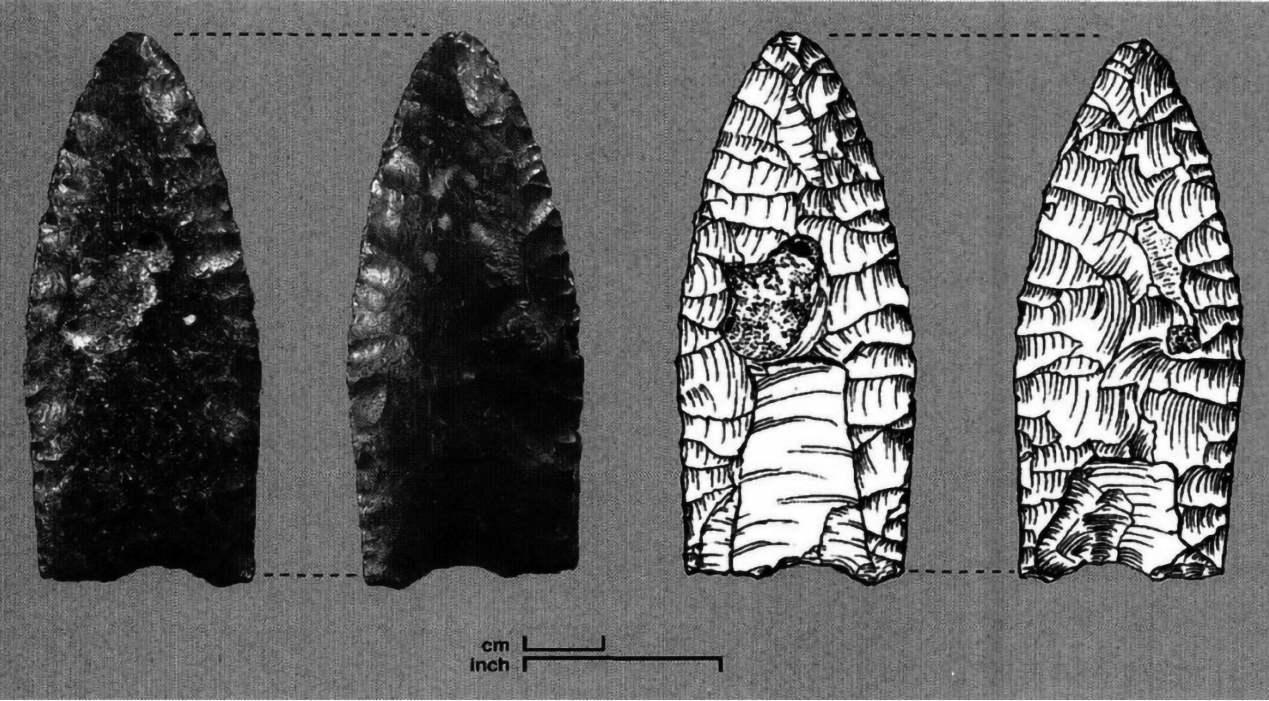
图1 克洛维斯尖状器[8]
Fig.1 Clovis Projectile Point
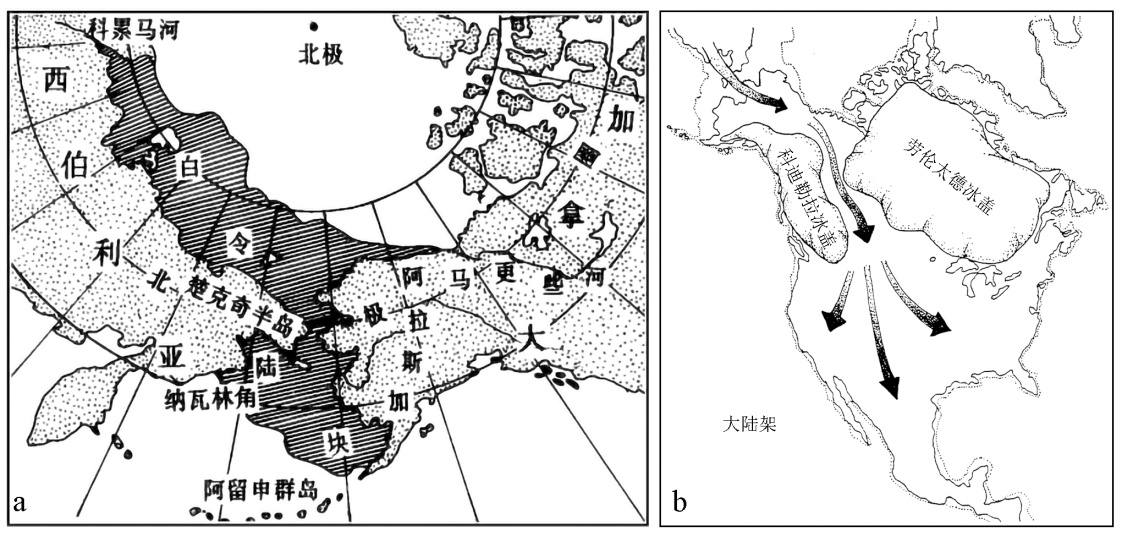
图2 白令陆桥(a)[20]和无冰走廊(b)[19]
Fig.2 Beringia (a) and the ice-free corridor (b)
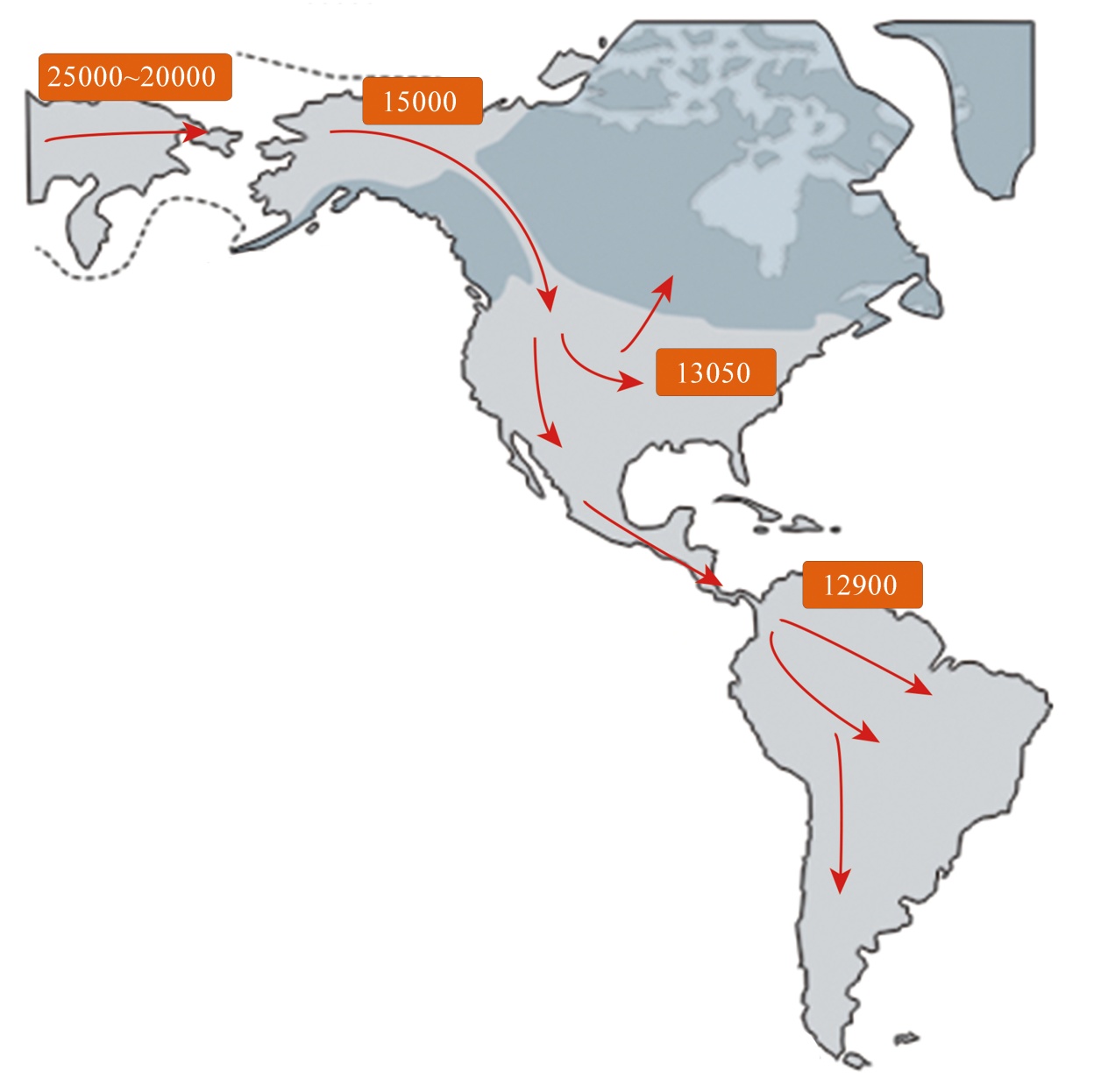
图3 “克洛维斯第一模型”的迁徙路线[30]
Fig.3 Routes of Clovis First
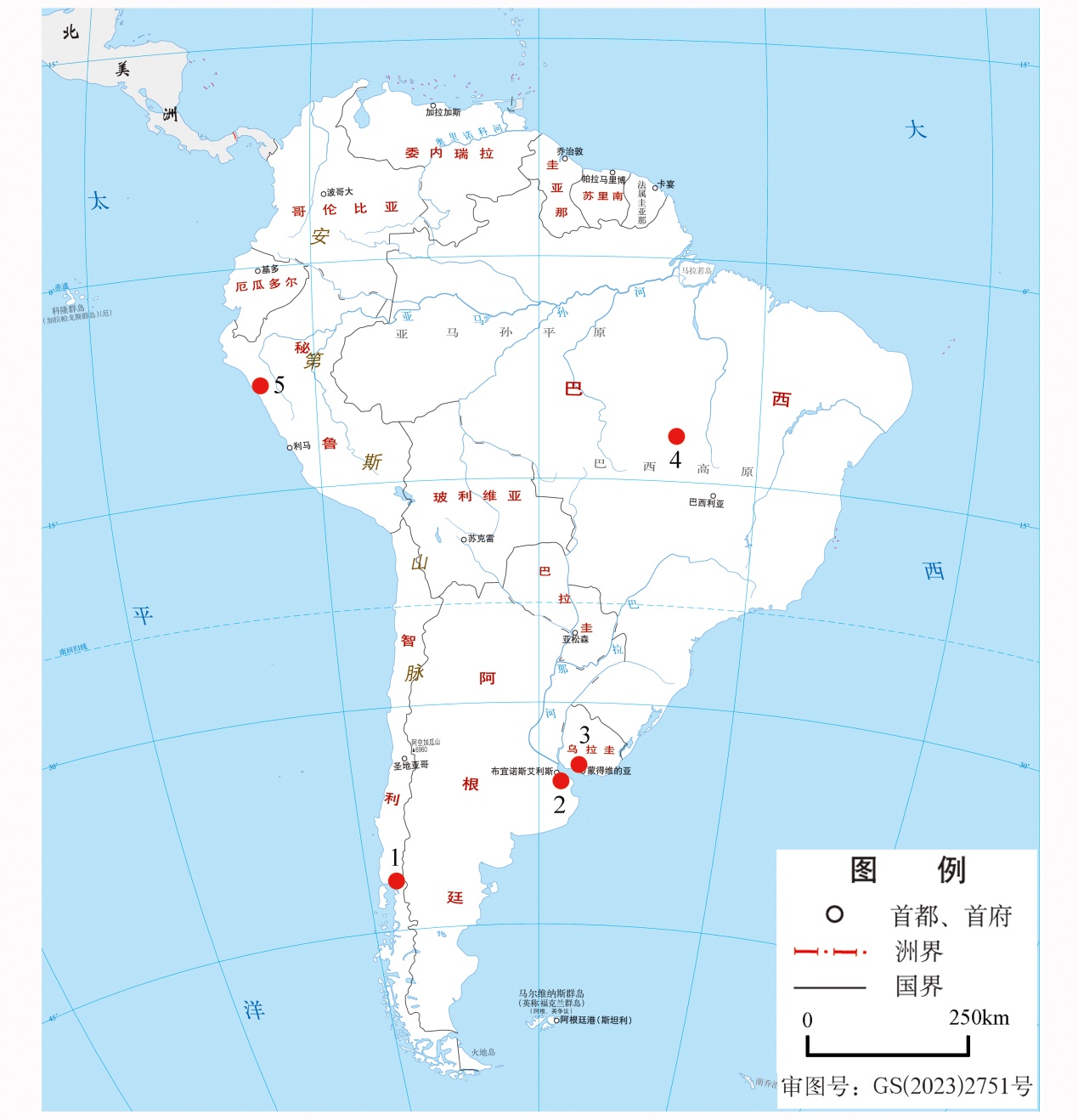
图4 南美洲部分前克洛维斯遗址 1.蒙特韦德遗址Monte Verde;2.萨尼翁·萨巴莱塔遗址Zanjón Zabaleta;3.维斯卡伊诺旱谷遗址Arroyo del Vizcaíno;4.莓尤洞穴遗址Toca do Sítio do Meio;5.普里塔神庙遗址Huaca Prieta
Fig.4 Some Pre-Clovis Sites of South America
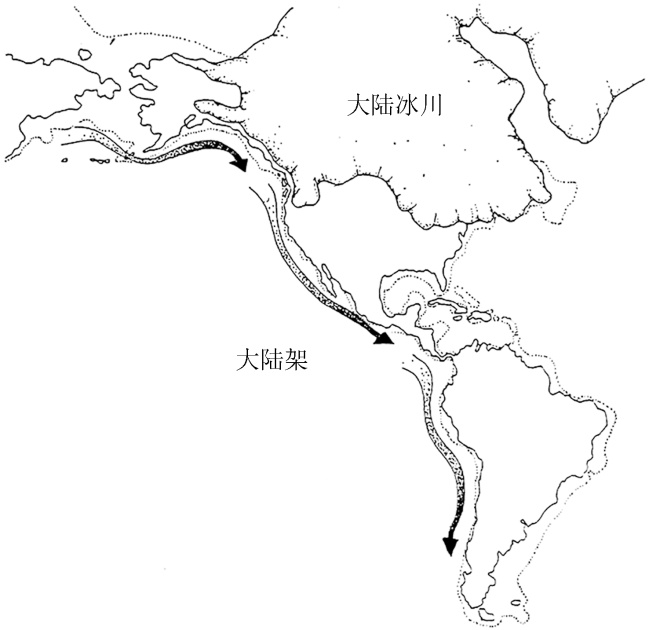
图5 太平洋沿岸迁徙假说迁徙路线[67]
Fig.5 Routes of Pacific Coastal Migration Hypothesis
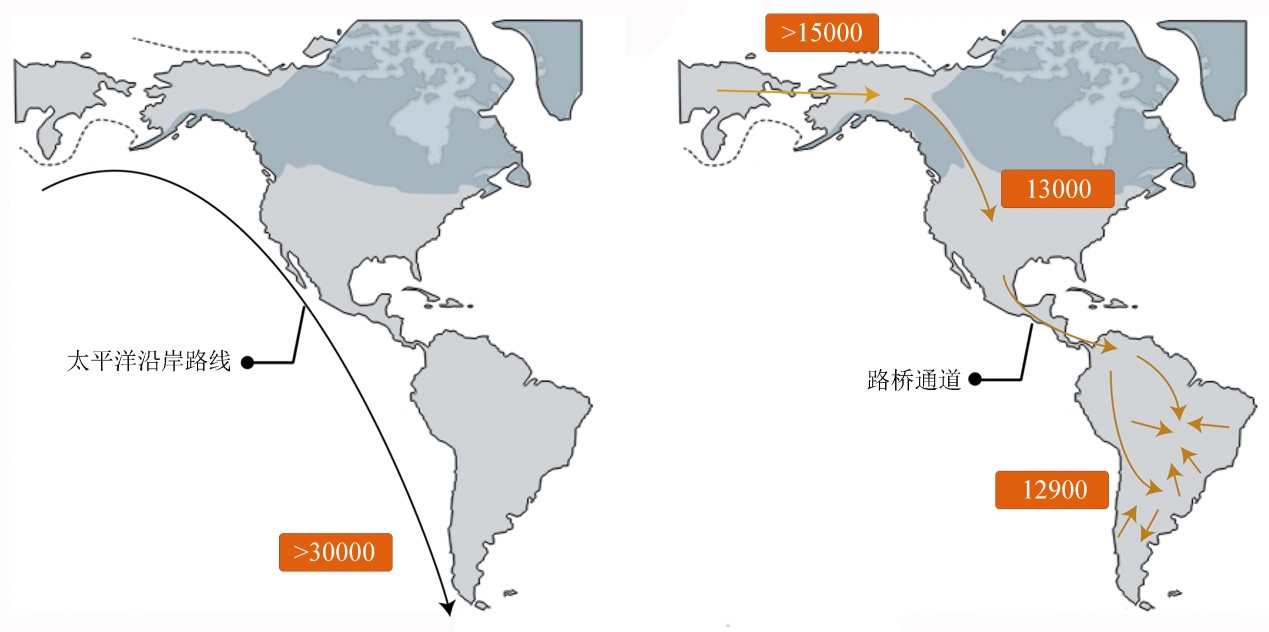
图6 美洲早期人类的多次迁移假说路线(改自[43])
Fig.6 Routes of Multiple Migration Hypothesis (Modified from [43])
| [1] | Jefferson T. Notes on the State of Virginia[M]. New York: Penguin USA, 1999, 103-104 |
| [2] |
Mazières S. Towards a reconciling model about the initial peopling of america[J]. Comptes Rendus Biologies, 2011, 334(7): 497-504
doi: 10.1016/j.crvi.2011.03.007 pmid: 21784359 |
| [3] |
Prokopec M. Dr. Aleš Hrdlička (1869–1943)[J]. International Journal of Anthropology, 1991, 6(3): 281-283
doi: 10.1007/BF02444956 URL |
| [4] | Howard EB. The occurrence of flints and extinct animals in pluvial deposits near Clovis, New Mexico[J]. Proceedings of the Academy of Natural Sciences of Philadelphia, 1935, 87: 299-303 |
| [5] | Figgins JD. A further contribution to the antiquity of man in America[J]. North dakota historical quarterly, 1933, 12(2): 4-8 |
| [6] |
Waters MR, Stafford TW Jr, Carlson DL. The Age of Clovis-13050-12750 cal yr B.P.[J]. Science Advances, 2020, 6(43): eaaz0455
doi: 10.1126/sciadv.aaz0455 URL |
| [7] |
Eiseley LC. Evidences of early occupation in Sandia cave, New Mexico, and other sites in the Sandia Manzano region[J]. American Antiquity, 1942, 7(4): 415-417
doi: 10.2307/275415 URL |
| [8] | Williams TJ, Collins MB, Rodrigues K, et al. Evidence of an early projectile point technology in North America at the Gault site, Texas, USA[J]. Science Advances, 2018, 4(7): eaar5954 |
| [9] |
Holliday VT, Haynes CV, Hofman JL, et al. Geoarchaeology and Geochronology of the Miami (Clovis) Site, Southern High Plains of Texas[J]. Quaternary Research, 1994, 41(2): 234-244
doi: 10.1006/qres.1994.1025 URL |
| [10] |
Waters MR, Stafford TW Jr. Redefining the age of Clovis: Implications for the peopling of the Americas[J]. Science, 2007, 315: 1122-1126
pmid: 17322060 |
| [11] |
Holliday VT, Huckell BB, Weber RH, et al. Geoarchaeology of the Mockingbird Gap (Clovis) Site, Jornada del Muerto, New Mexico[J]. Geoarchaeology: An International Journal, 2009, 24(3): 348-370
doi: 10.1002/gea.v24:3 URL |
| [12] |
Lahren L, Bonnichsen R. Bone foreshafts from a Clovis burial in southwestern Montana[J]. Science, 1974, 186: 147-150
pmid: 17744223 |
| [13] |
Haynes CV. Elephant-hunting in North America[J]. Scientific American, 1966, 214(6): 104-112
doi: 10.1038/scientificamerican0666-104 URL |
| [14] | Begley S, Murr A. The first Americans[J]. Newsweek, 1999, 26: 50-57 |
| [15] |
Schmitz PI. Prehistoric hunters and gatherers of Brazil[J]. Journal of World Prehistory, 1987, 1(1): 53-126
doi: 10.1007/BF00974817 URL |
| [16] |
Pearson GA. Bridging the Gap: An Updated Overview of Clovis across Middle America and its Techno-Cultural Relation with Fluted Point Assemblages from South America[J]. PaleoAmerica, 2017, 3: 203-230
doi: 10.1080/20555563.2017.1328953 URL |
| [17] | Blakey ML. Understanding racism in physical (biological) anthropology[J]. Critique of Anthropology, 2021, 2: 316-325 |
| [18] | Hrdlicka A. The origin and antiquity of the American Indian[A]. Annu Rep Smithson Inst Washington, 1923, 3: 481-494 |
| [19] |
Dixon EJ. Human colonization of the Americas: Timing, technology and process[J]. Quaternary Science Reviews, 2001, 20: 277-299
doi: 10.1016/S0277-3791(00)00116-5 URL |
| [20] | 吴持哲, 包翠华. 关于美洲印第安人起源的几个问题[J]. 内蒙古大学学报:哲学社会科学版, 1995, 1: 40-46 |
| [21] | 文韬. 试论与北美印第安人起源、迁徙有关的几个问题[J]. 北方文物, 1990, 4: 101-107 |
| [22] | Dyke AS. An outline of North American deglaciation with emphasis on central and northern Canada[A]. In: Ehlers J, Gibbard PL (Eds.). Quaternary Glaciations - Extent and Chronology: Vol. 2, Part II, North America[M]. Amsterdam: Elsevier, 2004: 373-424 |
| [23] | Holmes CE. The Beringian and transitional periods in Alaska: technology of the east Beringian tradition as viewed from swan point[A]. In: Ted Goebel (Ed.). From the Yenisei to the Yukon: Interpreting Lithic Assemblage Variability in Late Pleistocene/Early Holocene Beringia[C]. State of Texas: Texas A&M University Press, College Station, 2011, 179-191 |
| [24] |
Goebel T, Slobodin SB, Waters MR. New dates from ushki-1, kamchatka, confirm 13,000calbp age for earliest paleolithic occupation[J]. Journal of Archaeological Science, 2010, 37(10): 2640-2649
doi: 10.1016/j.jas.2010.05.024 URL |
| [25] |
Vachula RS. Alaskan Lake Sediment Records and Their Implications for the Beringian Standstill Hypothesis[J]. PaleoAmerica, 2020, 6(4): 303-307
doi: 10.1080/20555563.2020.1818171 URL |
| [26] |
Hoffecker JF, Elias SA, Potapova O. Arctic Beringia and Native American Origins[J]. PaleoAmerica, 2020, 6(2): 158-168
doi: 10.1080/20555563.2020.1725380 URL |
| [27] | de Azevedo S, Quinto-Sánchez M, Paschetta C, et al. The First Human Settlement Of The New World: a Closer Look At Craniofacial Variation And Evolution Of Early And Late Holocene Native American Groups[J]. Quaternary International, 2017, 431(B): 152-167 |
| [28] |
Lell JT, Sukernik RI, Starikovskaya YB, et al. The Dual Origin And Siberian Affinities Of Native American Y Chromosomes[J]. American Journal of Human Genetics, 2002, 70(1): 192-206
pmid: 11731934 |
| [29] |
Santos FR, Pandya A, Tyler-Smith C, et al. The Central Siberian Origin For Native American Y Chromosomes[J]. American Journal Of Human Genetics, 1999, 64: 619-628
pmid: 9973301 |
| [30] | Toledo MJ. Buenos Aires, Geoarchaeology of the Pleistocene-Holocene transition in the northeast Pampas (Buenos Aires, Argentina)[A]. In: Volume.1, An historical, stratigraphic, and taphonomic revision Perspectives on pre-LGM peopling[M]. Oxford: BAR Publishing, 2017, 1-35 |
| [31] |
Turner CG. Late Pleistocene And Holocene Population History Of East Asia Based On Dental Variation[J]. American Journal of Physical Anthropology, 1987, 73: 305-321
doi: 10.1002/ajpa.1330730304 pmid: 3303958 |
| [32] |
Neves WA, Prous A, González-José R, et al. Early Holocene Human Skeletal Remains From Santana Do Riacho, Brazil: Implications For The Settlement Of The New World[J]. Journal of Human Evolution, 2003, 45(1): 19-42
pmid: 12890443 |
| [33] |
Stone AC, Stoneking M. mtDNA Analysis of a Prehistoric Oneota Population: Implications For The Peopling of The New World[J]. The American Journal of Human Genetics, 1998, 62(5): 1153-1170
doi: 10.1086/301838 URL |
| [34] |
Oppenheimer S, Bradley B, Stanford D. Solutrean hypothesis: Genetics, the mammoth in the room[J]. World Archaeology, 2014, 46: 752-774
doi: 10.1080/00438243.2014.966273 URL |
| [35] |
Davis LG, Madsen DB, Becerra-Valdivia L, et al. Late Upper Paleolithic Occupation at Cooper’s Ferry, Idaho, USA, -16,000 Years Ago[J]. Science, 2019, 365: 891-897
doi: 10.1126/science.aax9830 URL |
| [36] | Raff JA, Bolnick DA. Does Mitochondrial Haplogroup X Indicate Ancient Trans-Atlantic Migration to the Americas? A critical re-evaluation[J]. Paleo America, 2015, 1(4): 297-304 |
| [37] |
Fiedel SJ, Potter BA, Morrow JE, et al. Pioneers from Northern Japan in Idaho 16,000 Years Ago? A Critical Evaluation of the Evidence from Cooper’s Ferry[J]. PaleoAmerica, 2021, 7(1): 28-42
doi: 10.1080/20555563.2020.1778416 URL |
| [38] | Raff J. Genetics: Ancient DNA Clarifies Population Histories of the Northeastern Margin of North America[J]. Current Biology, 2017, 27: 1108-1129 |
| [39] | Jennings JD. Prehistory of North America[M]. 2nd Edition, New York: McGraw-Hill, 1974, 76-87 |
| [40] |
Fiedel SJ. The Peopling of the New World: Present Evidence, New Theories, and Future Directions[J]. Journal of Archaeological Research, 2000, 8(1): 39-103
doi: 10.1023/A:1009400309773 |
| [41] | Graf KE, Ketron CV, Waters MR. Paleoamerican odyssey[C]. College Station: Texas A&M University Press, 2014 |
| [42] |
Dillehay TD, Ramirez C, Pino M, et al. Monte Verde: Seaweed, Food, Medicine, and the Peopling of South America[J]. Science, 2008, 320(5877): 784-786
doi: 10.1126/science.1156533 pmid: 18467586 |
| [43] | Boëda E, Pérez-Balarezo A. Il était une fois le peuplement des Amériques[J]. La Recherche, 2021, 568: 104-113 |
| [44] | Fariña RA, Tambusso PS, Varela L, et al. Arroyo del Vizcaíno, Uruguay: A Fossil-Rich 30-ka-old Megafaunal Locality with Cut-marked Bones[J]. Proceedings of the Royal Society B: Biological Sciences, 2014, 281(1774): 2013-2211 |
| [45] |
Guidon N. As Primeiras Ocupações Humanas Da Área Arqueológica De São Raimundo Nonato-Piauí[J]. Revista de Arqueologia, 1984, 2(1): 1-10
doi: 10.24885/sab.v2i1 URL |
| [46] |
Gómez Coutouly YA. Questioning the Anthropic Nature of Pedra Furada and the Piauí Sites[J]. PaleoAmerica, 2022, 8(1): 29-52
doi: 10.1080/20555563.2021.1943181 URL |
| [47] |
Boëda E, Clemente-Conte I, Fontugne M, et al. A New Late Pleistocene Archaeological Sequence In South America: The Vale Da Pedra Furada (Piauí, Brazil)[J]. Antiquity, 2014, 88: 927-955
doi: 10.1017/S0003598X00050845 URL |
| [48] | Boëda E, Rocca R, Da Costa A, et al. New Data on a Pleistocene Archaeological Sequence in South America: Toca do Sítio do Meio, Piauí, Brazil[J]. PaleoAmerica, 2016, 4(2): 286-302 |
| [49] |
Dillehay TD, Bonavia D, Goodbred SL, et al. A late Pleistocene human presence at Huaca Prieta, Peru, and early Pacific Coastal adaptations[J]. Quaternary Research, 2012, 77(3): 418-423
doi: 10.1016/j.yqres.2012.02.003 URL |
| [50] |
Dillehay TD, Bonavia D, Goodbred SL, et al. Chronology, mound-building, and environment at Huaca Prieta, Coastal Peru, from 13,700 to 4,000 years ago[J]. Antiquity, 2012, 86: 48-70
doi: 10.1017/S0003598X00062451 URL |
| [51] | Dillehay TD, Goodbred S, Pino M, et al. Simple technologies and diverse food strategies of the Late Pleistocene and Early Holocene at Huaca Prieta, Coastal Peru[J]. Science Advances, 2017, 3: e1602778 |
| [52] |
Ardelean CF, Becerra-Valdivia L, Pedersen MW, et al. Evidence of human occupation in Mexico around the Last Glacial Maximum[J]. Nature, 2020, 584: 87-92
doi: 10.1038/s41586-020-2509-0 |
| [53] |
Holen SR, Deméré TA, Fisher DC, et al. A 130,000-year-old archaeological site in southern California, USA[J]. Nature, 2017, 544(7651): 479-483
doi: 10.1038/nature22065 URL |
| [54] |
Bennett MR, Bustos D, Pigati JS, et al. Evidence of humans in north America during the last glacial maximum[J]. Science, 2021, 373(6562): 1528-1531
doi: 10.1126/science.abg7586 pmid: 34554787 |
| [55] |
Bourgeon L. Bluefish Cave II (Yukon Territory,Canada): Taphonomic Study of a Bone Assemblage[J]. PaleoAmerica, 2015, 1(1): 105-108
doi: 10.1179/2055556314Z.0000000001 URL |
| [56] |
Chatters JC, Potter BA, Prentiss AM, et al. Evaluating Claims of Early Human Occupation at Chiquihuite Cave, Mexico[J]. PaleoAmerica, 2022, 8(1): 1-16
doi: 10.1080/20555563.2021.1940441 URL |
| [57] |
Ardelean CF, Pedersen MW, Schwenninger JL, et al. Chiquihuite cave and america’s hidden limestone industries: a reply to chatters et al[J]. PaleoAmerica, 2021, 8(1): 17-28
doi: 10.1080/20555563.2021.1985063 URL |
| [58] |
Boëda E, Gruhn R, Vialou AV, et al. The Chiquihuite Cave, a Real Novelty? Observations about the Still-ignored South American Prehistory[J]. PaleoAmerica, 2021, 7(1): 1-7
doi: 10.1080/20555563.2020.1851500 URL |
| [59] |
Pitulko VV, Nikolsky PA, Girya EY, et al. The Yana RHS Site: Humans in the Arctic before the Last Glacial Maximum[J]. Science, 2004, 303(5654): 52-56
pmid: 14704419 |
| [60] |
Yu H, Spyrou MA, Karapetian M, et al. Paleolithic to Bronze Age Siberians Reveal Connections with First Americans and across Eurasia[J]. Cell, 2020, 181(6): 1232-1245
doi: S0092-8674(20)30502-X pmid: 32437661 |
| [61] |
Moreno-Mayar JV, Vinner L, de Barros Damgaard P, et al. Early Human Dispersals within the Americas[J]. Science, 2018, 362(6419): eaav2621
doi: 10.1126/science.aav2621 URL |
| [62] |
de Saint Pierre M. Antiquity of mtDNA lineage D1g from the southern cone of South America supports pre-Clovis migration[J]. Quaternary International, 2017, 444: 19-25
doi: 10.1016/j.quaint.2017.05.054 URL |
| [63] |
Rasmussen M, Anzick SL, Waters MR, et al. The Genome of a Late Pleistocene Human from a Clovis Burial Site in Western Montana[J]. Nature, 2014, 506(7487): 225-229
doi: 10.1038/nature13025 |
| [64] | Perri AR, Feuerborn TR, Frantz LA, et al. Dog Domestication and the Dual Dispersal of People and Dogs into the Americas[J]. PNAS, 2021, 118(6): 1-8 |
| [65] |
Fladmark KR. Routes: Alternate Migration Corridors for Early Man in North America[J]. American Antiquity, 1979, 44: 55-69
doi: 10.2307/279189 URL |
| [66] | Fladmark KR. Times and places: Environmental correlates of mid-to-late Wisconsinan human population expansion in North America[A]. In: Shutler R Jr (Ed.). Early Man in the New World[C]. Beverly Hills: Sage Publications, 1983, 13-42 |
| [67] | Davis LG, Madsen DB. The Coastal Migration Theory: Formulation and Testable Hypotheses[J]. Quaternary Science Reviews, 2020, 249: 1-13 |
| [68] | Clark J, Carlson AE, Reyes AV, et al. The age of the opening of the Ice-Free Corridor and implications for the peopling of the Americas[J]. Proceedings of the National Academy of Sciences. 2022, 119(14): e2118558119 |
| [69] |
Josenhans H, Fedje D, Pienitz R, et al. Early humans and rapidly changing Holocene sea levels in the Queen Charlotte Islands-Hecate Strait, British Columbia, Canada[J]. Science, 1997, 277: 71-74
doi: 10.1126/science.277.5322.71 URL |
| [70] |
Dickinson WR. Geological perspectives on the Monte Verde archeological site in Chile and pre-Clovis coastal migration in the Americas[J]. Quaternary Research, 2011, 76(2): 201-210
doi: 10.1016/j.yqres.2011.06.011 URL |
| [71] | 陈宥成, 袁广阔. 美洲最早人类文化的技术构成及其与旧大陆的关系[J]. 南方文物, 2017, 1: 203-209 |
| [72] | 李家添, 戴国华. 从考古学看美洲印第安人的起源[J]. 厦门大学学报(哲学社会科学版), 1984, 34(2): 91-96 |
| [73] |
Rothhammer F, Dillehay TD. The late pleistocene colonization of south america: an interdisciplinary perspective[J]. Annals of Human Genetics, 2009, 73(5): 540-549
doi: 10.1111/ahg.2009.73.issue-5 URL |
| [74] | Pérez-Balarezo A, González-Varas M, van Havre G, et al. Early prehistory of South America and population dynamics: Issues and hypotheses[J]. L’anthropologie, 2023, 127: 103139 |
| [75] |
Zhang X, Ji X, Li C, et al. A Late Pleistocene human genome from Southwest China[J]. Current Biology, 2022, 32(14): 3095-3109
doi: 10.1016/j.cub.2022.06.016 URL |
| [76] |
Yang MA, Gao X, Theunert C, et al. 40,000-Year-Old Individual from Asia Provides Insight into Early Population Structure in Eurasia[J]. Current Biology, 2017, 27(20): 3202-3208
doi: S0960-9822(17)31195-8 pmid: 29033327 |
| [1] | BAE Christopher J, 陈逸迎. 中国古人类学主要议题的探讨[J]. 人类学学报, 2026, 45(05): 815-838. |
| [2] | 郑喆轩, 谭培阳. 四川旧石器考古的进展与思考[J]. 人类学学报, 2025, 44(06): 1094-1105. |
| [3] | 刘武, 吴秀杰. 华龙洞古人类化石及其在人类演化上的意义[J]. 人类学学报, 2025, 44(05): 727-741. |
| [4] | 邓婉文, 谢颖. 广西隆安娅怀洞遗址发现的小型石制品[J]. 人类学学报, 2025, 44(03): 413-426. |
| [5] | 李浩, 谢光茂, 李大伟, 李三灵, 肖培源, 陈清懿, 王雨晴, 贾真秀, 吴雁, 卢杰英. 广西娅怀洞遗址B区出土的旧石器[J]. 人类学学报, 2025, 44(03): 404-412. |
| [6] | 杨石霞. 人类演化中的"行为现代性"与"现代人行为"探讨[J]. 人类学学报, 2025, 44(02): 181-192. |
| [7] | 支媛, 杜水生, 刘吉颖. 南非石器时代中期人类对动物资源的开发[J]. 人类学学报, 2025, 44(02): 352-364. |
| [8] | 宋光捷, 蔡大伟, 朱存世, 胡松梅, 周静, 任晓燕. 古DNA揭示中国西北地区史前人类对野生动物资源的利用[J]. 人类学学报, 2025, 44(01): 117-131. |
| [9] | 孙琦雅慧, 邢松. 广西通天岩洞穴遗址柳江人的多生齿[J]. 人类学学报, 2024, 43(06): 1027-1037. |
| [10] | 张亚盟, 吴秀杰. 中国晚更新世早期现代人内耳迷路的形态变异[J]. 人类学学报, 2024, 43(06): 1038-1047. |
| [11] | 王伟. 华南地区现代人化石及其时代[J]. 人类学学报, 2024, 43(06): 934-950. |
| [12] | 李锋. 早期现代人向东亚扩散北方路线的研究进展与展望[J]. 人类学学报, 2024, 43(06): 951-966. |
| [13] | 李浩, 肖培源, 彭培洺, 王雨晴, 陈清懿, Ikram QAYUM, 贾真秀, 阮齐军, 陈发虎. 西南丝绸之路上的旧石器文化与人群交流[J]. 人类学学报, 2024, 43(06): 979-992. |
| [14] | 王法岗, 杨石霞, 葛俊逸, 岳健平, 赵克良, Andreu Ollé, 李文艳, 杨海勇, 刘连强, 关莹, 谢飞, Francesco d’Errico, Michael Petraglia, 邓成龙. 泥河湾盆地下马碑遗址2013年发掘简报[J]. 人类学学报, 2024, 43(01): 143-156. |
| [15] | 张明, 平婉菁, YANG Melinda Anna, 付巧妹. 古基因组揭示史前欧亚大陆现代人复杂遗传历史[J]. 人类学学报, 2023, 42(03): 412-421. |
| 阅读次数 | ||||||
|
全文 |
|
|||||
|
摘要 |
|
|||||
 京ICP证05002819号-3
