


激光剥蚀原位铀系法对化石年龄的测定
收稿日期: 2024-02-06
录用日期: 2024-04-07
网络出版日期: 2025-08-07
基金资助
国家重点研发计划(2020YFC1521500)
U-series in situ dating of fossils by LA-MC-ICPMS
Received date: 2024-02-06
Accepted date: 2024-04-07
Online published: 2025-08-07
刘玥 , 焦亚诺 , 卢泽基 , 胡贵兰 , 邵庆丰 . 激光剥蚀原位铀系法对化石年龄的测定[J]. 人类学学报, 2025 , 44(04) : 700 -714 . DOI: 10.16359/j.1000-3193/AAS.2024.0072
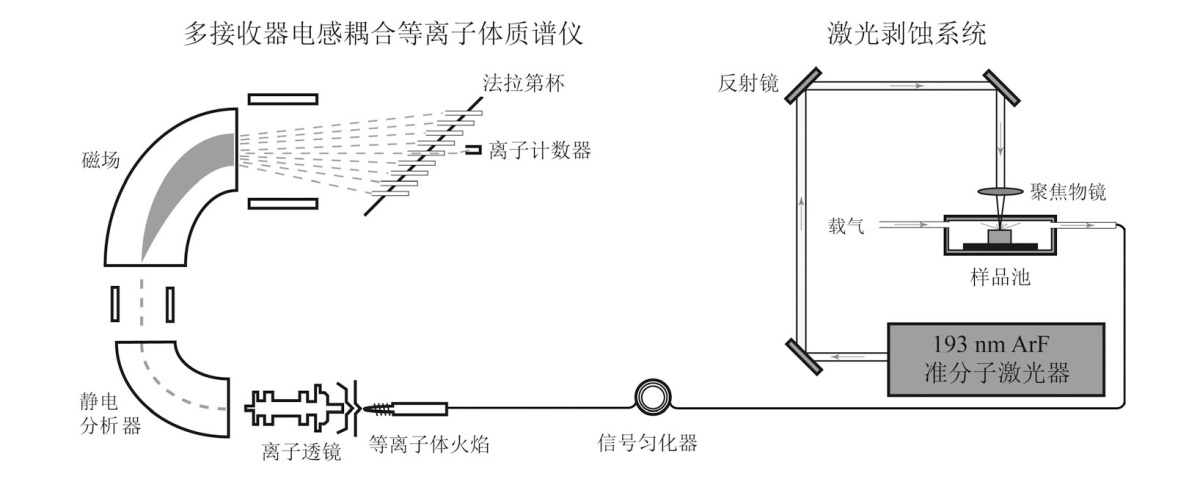
U-series dating of fossil bones and teeth is based on the fact that U is incorporated into the fossils during their burial and subsequently decays to the daughter nuclides towards equilibrium. However, it has been long-known that the diagenetic phenomenon of uranium uptake influences the reliability of U-series dating of fossils. Over the past two decades, significant advances have been made in the technology of U and Th isotopic analyses. Today, it is able to achieve ɛ-precision of U-Th isotopic ratios using the state of art of Multi-Collector Inductively Coupled Plasma Mass Spectrometer (MC-ICPMS) and to achieve micrometer scale of spatial resolution with Laser Ablation-ICPMS (but with lower precision). It seems most timely to further develop U-series dating method for fossils using the high-precision and high-resolution analytical techniques. We therefore developed a LA-MC-ICPMS method for U-series in situ dating of fossil samples from Paleolithic and/or paleoanthropological sites. We described the details of our method, including standard preparation, LA-MC-ICPMS calibration, laser ablation, U-Th isotopic measurements and data treatment. Using the newly established method, we analyzed two mammalian fossil teeth from the Xujiayao hominin site, in Nihewan Basin. The sample XJY-1929, from the Upper Culture Layer, displayed U-shaped distribution of U-content, 234U/238U and 230Th/238U activity ratios, indicating an early uptake process, and yielded a DAD model age of 172.0±5.1 kaBP, representing a minimum age of this fossil. The sample XJY-3055, from the Lower Culture Layer, however, showed apparently lower U-content, 234U/238U and 230Th/238U activity ratios, with a DAD model age of 58.8±4.5 kaBP, which is much younger than the geologic age of the layer. This sample probably experienced a later U-uptake, caused by the redox conditions in the Lower Culture Layer.
| [1] | Edwards RL, Gallup CD, Cheng H. Uranium-series dating of marine and lacustrine carbonates[J]. Reviews in Mineralogy and Geochemistry, 2003, 52(1): 363-405 |
| [2] | Richards DA, Dorale JA. Uranium-series chronology and environmental applications of speleothems[J]. Reviews in Mineralogy and Geochemistry, 2003, 52(1): 407-460 |
| [3] | Schwarcz HP, Rink WJ. Dating methods for sediments of caves and rockshelters with examples from the Mediterranean region[J]. Geoarchaeology: An International Journal, 2001, 16(4): 355-371 |
| [4] | Pierre ES, Zhao J, Reed E. Expanding the utility of Uranium-series dating of speleothems for archaeological and palaeontological applications[J]. Journal of Archaeological Science, 2009, 36(7): 1416-1423 |
| [5] | Hoffmann DL, Pike AWG, García-Diez M, et al. Methods for U-series dating of CaCO3 crusts associated with Palaeolithic cave art and application to Iberian sites[J]. Quaternary Geochronology, 2016, 36: 104-119 |
| [6] | Szabo BJ, Malde HE, Irwin-Williams C. Dilemma posed by uranium-series dates on archaeologically significant bones from Valsequillo, Puebla, Mexico[J]. Earth and Planetary Science Letters, 1969, 6(4): 237-244 |
| [7] | Trueman CN, Tuross N. Trace elements in recent and fossil bone apatite[J]. Reviews in mineralogy and geochemistry, 2002, 48(1): 489-521 |
| [8] | Rae AM, Ivanovich M. Successful application of uranium series dating of fossil bone[J]. Applied geochemistry, 1986, 1(3): 419-426 |
| [9] | Ikeya M. A model of linear uranium accumulation for ESR age of Heidelberg (Mauer) and Tautavel bones[J]. Japanese Journal of Applied Physics, 1982, 21(11A): L690 |
| [10] | Szabo BJ, Rosholt JN. Uranium-series dating of Pleistocene molluscan shells from southern California-An open system model[J]. Journal of Geophysical Research, 1969, 74(12): 3253-3260 |
| [11] | 陈铁梅, 原思训, 高世君. 铀子系法测定骨化石年龄的可靠性研究及华北地区主要旧石器地点的铀子系年代序列[J]. 人类学学报, 1984, 3: 259-269 |
| [12] | 原思训, 陈铁梅, 高世君. 华南若干旧石器时代地点的铀系年代[J]. 人类学学报, 1986, 5(2): 179-190 |
| [13] | Chen TM, Yuan SX. Uranium-series dating of bones and teeth from Chinese palaeolithic sites[J]. Archaeometry, 1988, 30(1): 59-76 |
| [14] | Grün R, Schwarcz HP, Chadam J. ESR dating of tooth enamel: coupled correction for U-uptake and U-series disequilibrium[J]. Nuclear Tracks and Radiation Measurements, 1988, 14(1-2): 237-241 |
| [15] | Shao QF, Chadam J, Grün R, et al. The mathematical basis for the US-ESR dating method[J]. Quaternary Geochronology, 2015, 30: 1-8 |
| [16] | Millard AR, Hedges REM. A diffusion-adsorption model of uranium uptake by archaeological bone[J]. Geochimica et Cosmochimica Acta, 1996, 60(12): 2139-2152 |
| [17] | Pike AWG, Hedges REM. U-series dating of bone using the diffusion-adsorption model[J]. Geochimica et Cosmochimica Acta, 2002, 66(24): 4273-4286 |
| [18] | Sambridge M, Grün R, Eggins S. U-series dating of bone in an open system: the diffusion-adsorption-decay model[J]. Quaternary Geochronology, 2012, 9: 42-53 |
| [19] | Aubert M, Pike AWG, Stringer C, et al. Confirmation of a late middle Pleistocene age for the Omo Kibish 1 cranium by direct uranium-series dating[J]. Journal of Human Evolution, 2012, 63(5): 704-710 |
| [20] | Holen SR, Deméré TA, Fisher DC, et al. A 130,000-year-old archaeological site in southern California, USA[J]. Nature, 2017, 544(7651): 479-483 |
| [21] | Westaway KE, Louys J, Awe RD, et al. An early modern human presence in Sumatra 73,000-63,000 years ago[J]. Nature, 2017, 548(7667): 322-325 |
| [22] | Grün R, Eggins S, Kinsley L, et al. Laser ablation U-series analysis of fossil bones and teeth[J]. Palaeogeography, Palaeoclimatology, Palaeoecology, 2014, 416: 150-167 |
| [23] | Shen CC, Wu CC, Cheng H, et al. High-precision and high-resolution carbonate 230Th dating by MC-ICP-MS with SEM protocols[J]. Geochimica et Cosmochimica Acta, 2012, 99: 71-86 |
| [24] | Cheng H, Edwards RL, Shen CC, et al. Improvements in 230Th dating, 230Th and 234U half-life values, and U-Th isotopic measurements by multi-collector inductively coupled plasma mass spectrometry[J]. Earth and Planetary Science Letters, 2013, 371: 82-91 |
| [25] | Stirling CH, Lee DC, Christensen JN, et al. High-precision in situ 238U-234U-230Th isotopic analysis using laser ablation multiple-collector ICPMS[J]. Geochimica et Cosmochimica Acta, 2000, 64(21): 3737-3750 |
| [26] | Drost K, Chew D, Petrus JA, et al. An image mapping approach to U-Pb LA-ICP-MS carbonate dating and applications to direct dating of carbonate sedimentation[J]. Geochemistry, Geophysics, Geosystems, 2018, 19(12): 4631-4648 |
| [27] | Martin L, Galy A, Barbotin G, et al. Isotopic imaging using fsLA single-collector ICP-SFMS for direct U/Th dating of small archaeological carbonates[J]. Analytical Chemistry, 2022, 94(7): 3046-3055 |
| [28] | Spooner PT, Chen TY, Robinson LF, et al. Rapid uranium-series age screening of carbonates by laser ablation mass spectrometry[J]. Quaternary Geochronology, 2016, 31: 28-39 |
| [29] | Woodhead J, Petrus J. Exploring the advantages and limitations of in situ U-Pb carbonate geochronology using speleothems[J]. Geochronology, 2019, 1(1): 69-84 |
| [30] | Eggins S, Grün R, Pike AWG, et al. 238U, 232Th profiling and U-series isotope analysis of fossil teeth by laser ablation-ICPMS[J]. Quaternary Science Reviews, 2003, 22(10-13): 1373-1382 |
| [31] | Eggins S, Grün R, McCulloch MT, et al. In situ U-series dating by laser-ablation multi-collector ICPMS: new prospects for Quaternary geochronology[J]. Quaternary Science Reviews, 2005, 24(23-24): 2523-2538 |
| [32] | Grün R, Aubert M, Joannes-Boyau R, et al. High resolution analysis of uranium and thorium concentration as well as U-series isotope distributions in a Neanderthal tooth from Payre (Ardèche, France) using laser ablation ICP-MS[J]. Geochimica et Cosmochimica Acta, 2008, 72(21): 5278-5290 |
| [33] | Harvati K, R?ding C, Bosman AM, et al. Apidima Cave fossils provide earliest evidence of Homo sapiens in Eurasia[J]. Nature, 2019, 571(7766): 500-504 |
| [34] | Grün R, Pike AWG, McDermott F, et al. Dating the skull from Broken Hill, Zambia, and its position in human evolution[J]. Nature, 2020, 580(7803): 372-375 |
| [35] | 涂湘林, 张红, 邓文峰, 等. RESOlution激光剥蚀系统在微量元素原位微区分析中的应用[J]. 地球化学, 2011, 1: 83-98 |
| [36] | Li FC, Hou ML, Luan RJ, et al. Optimization of analytical conditions for LA-ICP-MS and its application to zircon U-Pb dating[J]. Rock and Mineral Analysis, 2016, 35(1): 17-23 |
| [37] | Jackson SE, Günther D. The nature and sources of laser induced isotopic fractionation in laser ablation-multicollector-inductively coupled plasma-mass spectrometry[J]. Journal of Analytical Atomic Spectrometry, 2003, 18(3): 205-212 |
| [38] | Wiedenbeck M, Alle P, Corfu FY, et al. Three natural zircon standards for U-Th-Pb, Lu-Hf, trace element and REE analyses[J]. Geostandards newsletter, 1995, 19(1): 1-23 |
| [39] | Jackson SE, Pearson NJ, Griffin WL, et al. The application of laser ablation-inductively coupled plasma-mass spectrometry to in situ U-Pb zircon geochronology[J]. Chemical geology, 2004, 211(1-2): 47-69 |
| [40] | Jochum KP, Stoll B, Herwig K, et al. MPI-DING reference glasses for in situ microanalysis: New reference values for element concentrations and isotope ratios[J]. Geochemistry, Geophysics, Geosystems, 2006, 7(2) |
| [41] | Sláma J, Ko?ler J, Condon DJ, et al. Ple?ovice zircon-a new natural reference material for U-Pb and Hf isotopic microanalysis[J]. Chemical Geology, 2008, 249(1-2): 1-35 |
| [42] | Li XH, Tang GQ, Gong B, et al. Qinghu zircon: A working reference for microbeam analysis of U-Pb age and Hf and O isotopes[J]. Chinese Science Bulletin, 2013, 58: 4647-4654 |
| [43] | Roberts NMW, Rasbury ET, Parrish RR, et al. A calcite reference material for LA-ICP-MS U-Pb geochronology[J]. Geochemistry, Geophysics, Geosystems, 2017, 18(7): 2807-2814 |
| [44] | Shao QF, Li CH, Huang MJ, et al. Interactive programs of MC-ICPMS data processing for 230Th/U geochronology[J]. Quaternary Geochronology, 2019, 51: 43-52 |
| [45] | 金曼谷, 焦亚诺, 刘玥, 等. MC-ICP-MS铀同位素的高精度法拉第杯静态分析[J]. 科学通报, 2022, 67(22): 11 |
| [46] | Bernal JP, Eggins SM, McCulloch MT. Accurate in situ 238U-234U-232Th-230Th analysis of silicate glasses and iron oxides by laser-ablation MC-ICP-MS[J]. Journal of Analytical Atomic Spectrometry, 2005, 20(11): 1240-1249 |
| [47] | 王法岗. 侯家窑遗址 2007-2012发掘地层的新认识[J]. 文物春秋, 2015, 6: 15-22 |
| [48] | 李曼玥, 张生瑞, 许清海, 等. 侯家窑遗址地层、年代与形成环境的新认识[J]. 古生物学报, 2016, 55(1): 122-135 |
| [49] | 李蕾, 黄华芳, 王健, 等. 泥河湾侯家窑遗址古河流及环境考古意义[J]. 沉积学报, 2016, 34(1): 111-119 |
| [50] | Grün R, Stringer C. Direct dating of human fossils and the ever-changing story of human evolution[J]. Quaternary Science Reviews, 2023, 322: 108379 |
| [51] | Shao QF, Ge JY, Ji Q, et al. Geochemical provenancing and direct dating of the Harbin archaic human cranium[J]. The Innovation, 2021, 2(3): 100131 |
| [52] | Ge JY, Xing S, Grün R, et al, New Late Pleistocene age for the Homo sapiens skeleton from Liujiang southern China[J]. Nature Communications, 2024, 15: 3611 |
| [53] | 陈铁梅, 原思训, 高世君, 等. 许家窑遗址哺乳动物化石的铀子系法年代测定[J]. 人类学学报, 1982, 1(1): 91-95 |
| [54] | Ao H, Liu CR, Roberts AP, et al. An updated age for the Xujiayao hominin from the Nihewan Basin, North China: implications for Middle Pleistocene human evolution in East Asia[J]. Journal of Human Evolution, 2017, 106: 54-65 |
| [55] | Li Z, Xu Q, Zhang S, et al. Study on stratigraphic age, climate changes and environment background of Houjiayao Site in Nihewan Basin[J]. Quaternary international, 2014, 349: 42-48 |
| [56] | Mu H, Xu Q, Zhang S, et al. Pollen-based quantitative reconstruction of the paleoclimate during the formation process of Houjiayao Relic Site in Nihewan Basin of China[J]. Quaternary International, 2015, 374: 76-84 |
| [57] | Tu H, Shen GJ, Li HX, et al. 26Al/10Be burial dating of Xujiayao-Houjiayao site in Nihewan Basin, northern China[J]. PLoS One, 2014, 10(2): e0118315 |
| [58] | 王法岗, 李峰. “许家窑人”埋藏地层与时代探讨[J]. 人类学学报, 2020, 39(2): 161-172 |
/
| 〈 |
|
〉 |
 京ICP证05002819号-3