


板井子遗址第2地点2023~2024年发掘报告
收稿日期: 2026-02-27
录用日期: 2026-04-25
网络出版日期: 2026-06-12
基金资助
国家重点研发计划(2023YFF0905700);国家自然科学基金(42372010);全国考古人才振兴计划(2025-191)
Preliminary report on the 2023-2024 excavation of Banjingzi Locality 2 in Nihewan Basin, North China
Received date: 2026-02-27
Accepted date: 2026-04-25
Online published: 2026-06-12
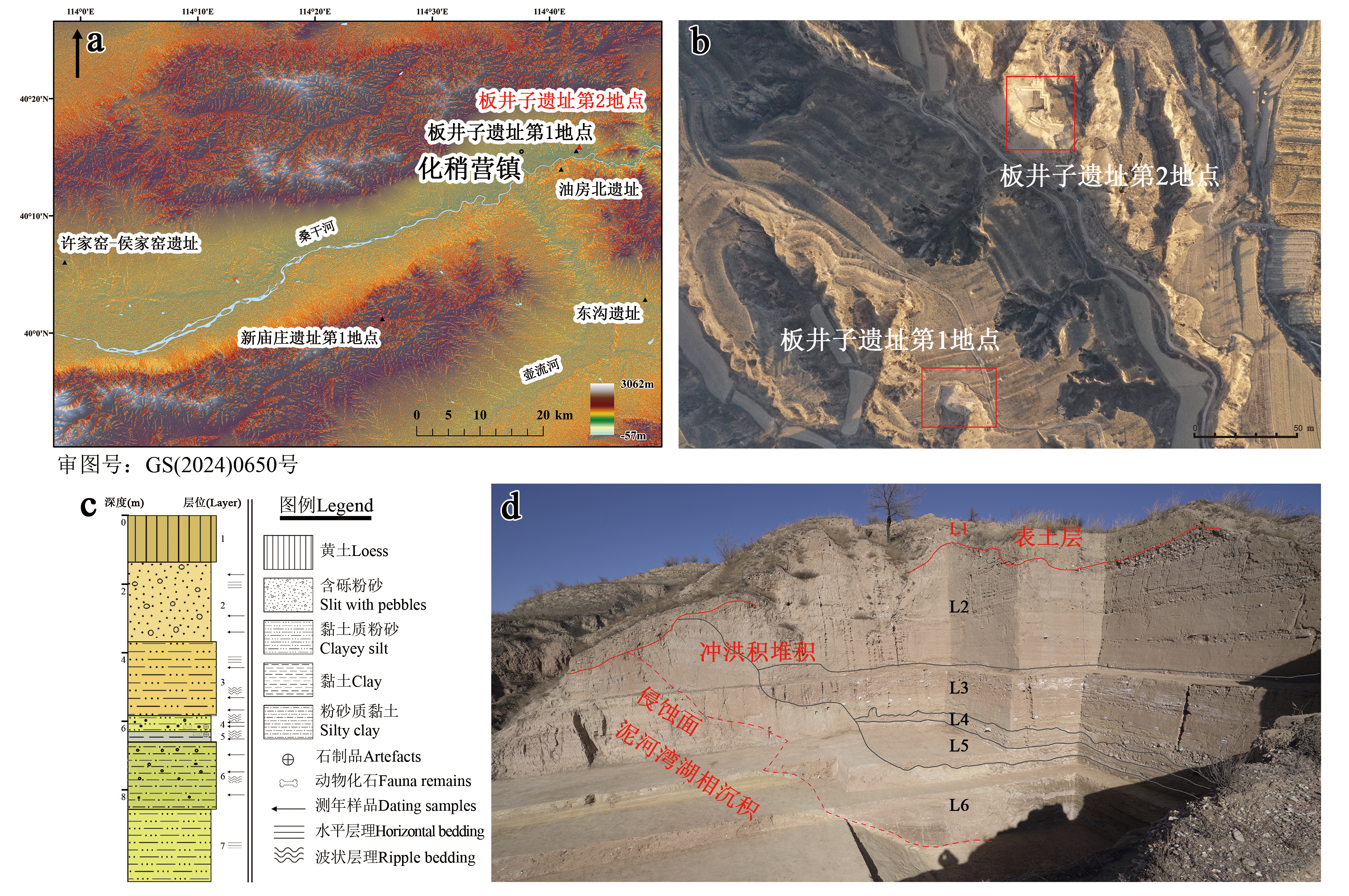
板井子遗址第2地点地处泥河湾盆地东缘,2023~2024年度的发掘揭露了该遗址完整的地层与文化序列,共出土编号遗物2008件,初步测年结果表明遗址文化层形成于距今112~86 ka,属于晚更新世早期。遗址文化堆积形成于泥河湾大湖消亡和桑干河形成之间,遗物埋藏于一套上覆于泥河湾层的冲洪积物中。石制品以燧石为主要原料,体现出明确的选择性;剥片以锤击法为主,石核剥片具有较强的计划性,多采用单向陡钝单面剥片;石器以刮削器和锯齿刃器为主,多以完整石片为毛坯正向修理。动物化石包含普氏野马、蒙古野驴和披毛犀等,反映了半干旱草原或荒漠环境。板井子遗址第1、第2地点石制品组合的相似程度较高,均体现出对A类燧石的策略性选择和较远距离的定向获取,石器技术亦体现出一定的计划性和复杂性。本次发掘为研究泥河湾盆地晚更新世早期的石器技术演变、古人类生存适应策略以及重建古人类行为背景提供了重要的实物资料。
沈柯 , 李锋 , 王晓敏 , 王法岗 , 郭北姮 , 高星 . 板井子遗址第2地点2023~2024年发掘报告[J]. 人类学学报, 2026 , 45(03) : 462 -477 . DOI: 10.16359/j.1000-3193/AAS.2026.0040
Banjingzi Locality 2, located in the Yangjiagou valley on the eastern margin of the Nihewan Basin, North China, is a crucial archaeological site for understanding the cultural stage and the behavioral strategies of early Late Pleistocene hominins. To further investigate its rich cultural deposits, a new round of systematic archaeological excavation was conducted by the Institute of Vertebrate Paleontology and Paleoanthropology and the Hebei Provincial Institute of Cultural Relics and Archaeology from 2023 to 2024. The excavation covered a maximum area of 200 square meters and exposed a stratigraphic profile exceeding 10 meters in depth, which is divided into seven layers. The primary cultural remains were discovered within a fluvial “cut-and-fill” sequence overlying Nihewan beds. This specific depositional environment indicates that the hominin occupation happened after the decline of the ancient Nihewan lake but early than the formation of the stable Sanggan River terrace system. 15 Optically Stimulated Luminescence (OSL) samples were systematically collected from the east profile of the site to receive a precise chronological framework, which dated between 86~112 ka.
During the excavation, a total of 2008 specimens were unearthed, including 1745 lithic artifacts and 263 faunal remains from Layer 4 and Layer 5. The lithic assemblages from both cultural layers shows high similarity. Hominins showed clear selectivity in raw material procurement, with Chert A dominating the assemblage (71.46%), followed by vein quartz and Chert B. Cherts were likely collected from the Zhoujiashan area near the Youfang site, 3.6 kilometers away. This shows a well-planned resource exploitation strategy. Technological analysis reveals that the core reduction strategy was based on direct hard-hammer percussion. The core assemblage indicates a high percentage of single and double platform cores, and a smaller ratio of discoids. Hominins frequently selected blanks without cortex, using former fracture planes as striking platforms. The flaking process was organized and planned to a certain extent. The whole flakes are morphologically standardized, mostly exhibiting triangular or lenticular cross-sections with flat or slightly curved ventral surfaces, shows good control over inner platform angles and exterior platform angles.
The retouched pieces are mainly scrapers and denticulates, with very few notches. Tools were primarily made on complete flakes. And using single-edged, direct retouch method on the flat ventral surfaces. The retouching scars are typically single-layered and scalar. The faunal remain assemblage includes Equus przewalskii, Equus hemionus, Coelodonta antiquitatis, Cervus elaphus, and Bos primigenius. The composition of this fauna shows a cold- and drought-adapted feature, suggesting that the hominins at Banjingzi Locality 2 occupied a semi-arid steppe or desert environment during the early Late Pleistocene.
Key words: Nihewan Basin; Banjingzi site; early Late Pleistocene; lithic technology
| [1] | 谢飞, 李珺, 刘连强. 泥河湾旧石器文化[M]. 石家庄: 花山文艺出版社, 2006 |
| [2] | 王法岗. 泥河湾盆地板井子遗址调查研究[J]. 文物春秋, 2017, 4: 21-29 |
| [3] | 任进成, 李锋, 王晓敏, 等. 河北阳原县板井子旧石器时代遗址2015年发掘简报[J]. 考古, 2018, 11: 3-14 |
| [4] | 任进成. 泥河湾盆地板井子旧石器时代遗址形成过程与石器技术研究[D]. 博士研究生毕业论文, 北京: 中国科学院大学, 2019 |
| [5] | Ren JC, Li F, Chen FY, et al. Lithic technology at Banjingzi Locality 1: Implications for the Middle Paleolithic in northern China[J]. Journal of Archaeological Science Reports, 2025, 65: 105193 |
| [6] | 沈柯, 李锋. 夯实基础勇攀前沿——第三届旧石器考古高级培训研修班结业[N]. 中国文物报公众号,2023-10-17 |
| [7] | 石金鸣. 板井子石工业探析[J]. 山西大学学报(哲学社会科学版), 1992, 4: 15-18 |
| [8] | 石金鸣, 谢飞. 河北阳原板井子旧石器时代遗址1988年发掘报告[A].见: 河北省考古文集(五)[C].北京: 科学出版社, 2014 |
| [9] | 李锋, 陈福友, 赵海龙, 等. 试论“水平层”与旧石器时代遗址考古发掘方法[J]. 考古, 2019, 1: 85-95+2 |
| [10] | 张月书, 李锋, 王晓敏, 等. 旧石器时代遗址发掘与记录方法讨论[J]. 人类学学报, 2021, 40(2): 181-193 |
| [11] | 赵海龙, 周天路, 马冲, 等. 河北泥河湾盆地东缘石器原料的开发与利用[J]. 人类学学报, 2026, 45(1): 34-45 |
| [12] | 杜水生. 泥河湾盆地旧石器中晚期石制品原料初步分析[J]. 人类学学报, 2003, 22(2): 121-130 |
| [13] | Gao X, Norton CJ. A critique of the Chinese “Middle Palaeolithic”[J]. Antiquity, 2002, 76(292): 397-412 |
| [14] | Odell G. Lithic Analysis[M]. New York: Kluwer Academic/Plenum, 2004, 74 |
| [15] | 王晓敏, 陈福友, 李锋, 等. 河北泥河湾板井子旧石器遗址2015年出土动物遗存初步研究[J]. 华夏考古, 2024, 2: 71-79 |
| [16] | 韩诣深. 中国“旧石器时代中期”问题讨论:发展时期区域性石器技术演进视角的分析[J]. 文博, 2023, 6: 31-40 |
| [17] | 高星. 关于“中国旧石器时代中期”的探讨[J]. 人类学学报, 1999, 18(1): 1-15 |
| [18] | 张森水. 中国北方旧石器工业的区域渐进与文化交流[J]. 人类学学报, 1990, 9(4): 322-334 |
| [19] | 张森水. 我国北方旧石器时代中期文化初探[J]. 史前研究, 1985, 1: 8-16+73 |
| [20] | 李锋. 中国发现的莫斯特遗存及旧石器时代中期的再思考[J]. 考古, 2024, 4: 69-81 |
| [21] | 李浩. 中国旧石器时代早、中期石器技术多样性研究的新进展[J]. 人类学学报, 2018, 37(4): 602-612 |
| [22] | 陈宥成, 曲彤丽. 盘状石核相关问题探讨[J]. 考古, 2016, 2: 88-94 |
| [23] | 高星. 周口店第15地点剥片技术研究[J]. 人类学学报, 2000, 19(3): 199-215 |
| [24] | Li H, Li ZY, Gao X, et al. Technological Behavior of the Early Late Pleistocene Archaic Humans at Lingjing (Xuchang, China)[J], Archaeological and Anthropological Sciences, 2019, 11: 3477-3490 |
| [25] | 裴树文, 王法岗, 牛东伟. 二十一世纪以来泥河湾盆地古人类活动的发现与研究进展[J]. 人类学学报, 2024, 43(6): 913-933 |
| [26] | 吴秀杰. 中更新世晚期许家窑人化石的研究进展[J]. 人类学学报, 2024, 43(1): 5-18 |
| [27] | 刘武, 邢松, 吴秀杰. 中更新世晚期以来中国古人类化石形态特征的多样性[J]. 中国科学:地球科学, 2016, 46(7): 906-917 |
| [28] | 李锋. 克拉克的“技术模式”与中国旧石器技术演化研究[J]. 考古, 2017, 9: 73-81 |
/
| 〈 |
|
〉 |
 京ICP证05002819号-3