| [1] |
XIE Ying, FU Lin.
Perforated stone tools from the Yahuai Cave site in Long’an, Guangxi
[J]. Acta Anthropologica Sinica, 2025, 44(03): 439-450.
|
| [2] |
HU Zhanghua, CHEN Hongbo, XIE Li, WANG Yuqing, XIE Guangmao.
Shell tools excavated from the Yahuai Cave site in Guangxi
[J]. Acta Anthropologica Sinica, 2025, 44(03): 477-487.
|
| [3] |
LIU Jiying, REN Haiyun, DU Shuisheng.
Use-wear analysis of chert artifacts from the Fuyihegeliang Locality of Xiachuan site, Shanxi
[J]. Acta Anthropologica Sinica, 2025, 44(02): 201-209.
|
| [4] |
WANG Ying, ZHANG Yue, YANG Shixia, ZHANG Shuangquan.
Taphonomy of the animal remains from the Shiyu site, Shanxi
[J]. Acta Anthropologica Sinica, 2025, 44(02): 255-269.
|
| [5] |
CAI Xinyi, DU Shuisheng.
Core flaking technology of the Shuijingbei locality of Xiachuan site in Shanxi
[J]. Acta Anthropologica Sinica, 2025, 44(01): 14-26.
|
| [6] |
ZHANG Yue, ZHANG Shuangquan.
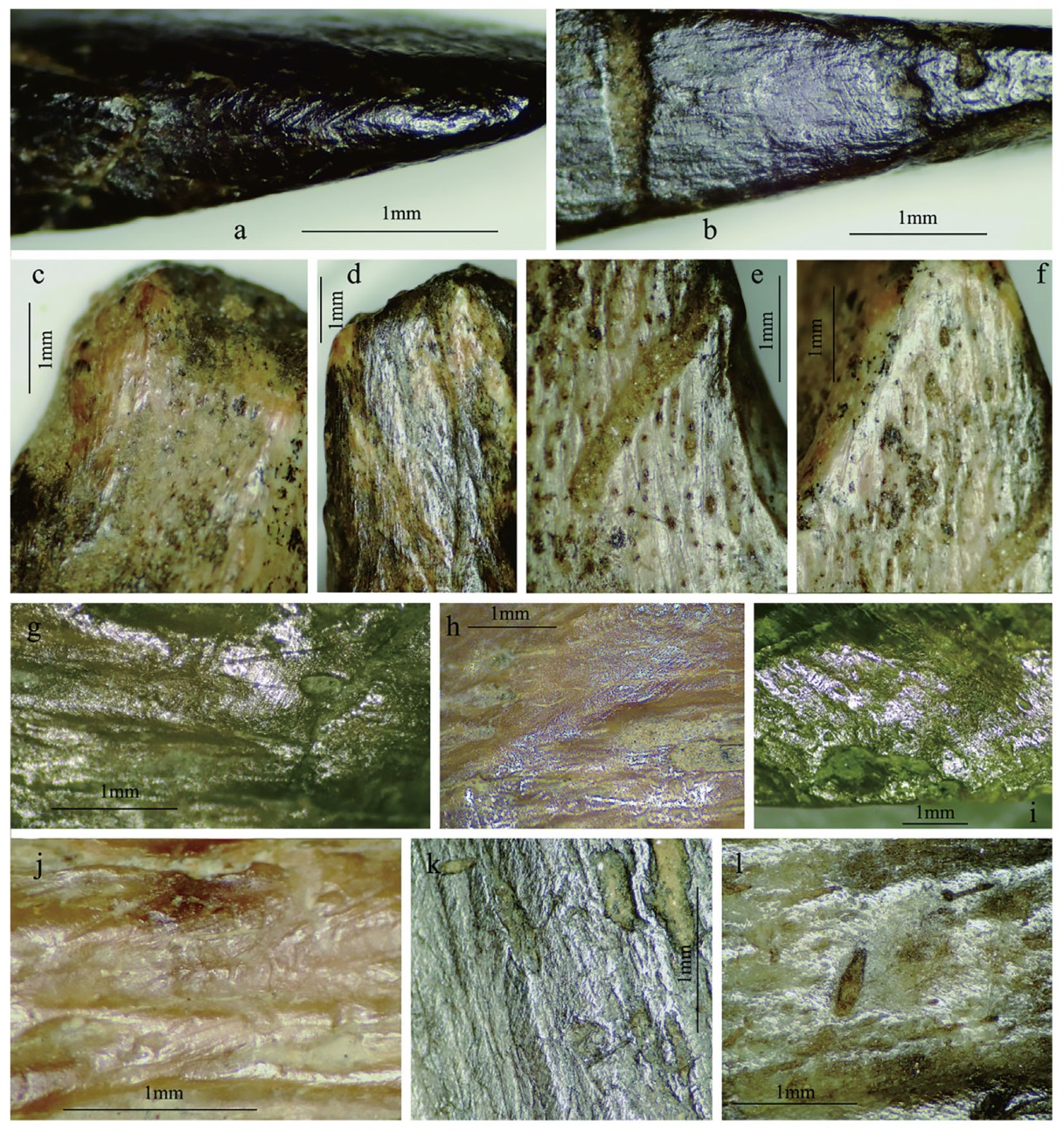
Bone artifacts unearthed from the Chuandong cave site in Puding of Guizhou in 1981
[J]. Acta Anthropologica Sinica, 2024, 43(06): 1048-1063.
|
| [7] |
LI Hao, XIAO Peiyuan, PENG Peiming, WANG Yuqing, CHEN Qingyi, Ikram QAYUM, JIA Zhenxiu, RUAN Qijun, CHEN Fahu.
Paleolithic culture and human interactions on the Southwest Silk Road
[J]. Acta Anthropologica Sinica, 2024, 43(06): 979-992.
|
| [8] |
Evgeny P RYBIN, Arina M KHATSENOVICH.
Selenga River human dispersal path in Initial Upper Paleolithic
[J]. Acta Anthropologica Sinica, 2024, 43(05): 780-796.
|
| [9] |
GAO Huangwen, LIU Yingjie, LU Chengqiu, SUN Xuefeng, HUANG Xuchu, XU Jingyue.
A preliminary report of the 2021 excavation at the Baobaoling site in Yunyang, Hubei
[J]. Acta Anthropologica Sinica, 2024, 43(05): 828-838.
|
| [10] |
HAN Fang, LI Jiyuan, QIAO Hong, XU Hailun, HE Honglin, GAO Xuan, LYU Hongliang, DU Zhanwei, CAI Linhai, ZHEN Qiang, MA Wenling.
New discoveries of microblade sites in the Qinghai Lake region
[J]. Acta Anthropologica Sinica, 2024, 43(05): 839-852.
|
| [11] |
CHENG Nan, XIA Wenting, YANG Qing, JI Xueping, ZI Xing, FAN Bin, ZOU Zining, YU Tong, ZHANG Yu, SHI Lin, ZHANG Wuqi, ZHENG Hongbo.
Stone artifacts, age and environment of the Sanhe Cave locality in Weishan, Yunnan
[J]. Acta Anthropologica Sinica, 2024, 43(03): 392-404.
|
| [12] |
Hiroyuki SATO, Kazuki MORISAKI.
On the beginning of the Japanese Upper Paleolithic: A review of recent archaeological and anthropological evidence
[J]. Acta Anthropologica Sinica, 2024, 43(03): 470-487.
|
| [13] |
WANG Hua, LI Zhanyang, Thijs van KOLFSCHOTEN.
Comparison of bone artifacts from the Schöningen site in Germany and the Lingjing site in China
[J]. Acta Anthropologica Sinica, 2024, 43(02): 214-232.
|
| [14] |
ZHOU Shihang, HE Xiangdong, XU Jingyue, LI Xiaoli, NIU Dongwei.
2017 Excavation of the Donggou Paleolithic site in the Yuxian Basin
[J]. Acta Anthropologica Sinica, 2024, 43(01): 132-142.
|
| [15] |
ZHOU Zhenyu, WANG Fagang, GUAN Ying.
Stone artifacts unearthed in 1985 and 1986 from the Xibaimaying site of the Nihewan Basin, Hebei Province
[J]. Acta Anthropologica Sinica, 2024, 43(01): 55-66.
|