

主管:中国科学院
主办:中国科学院古脊椎动物与古人类研究所
出版:科学出版社
主办:中国科学院古脊椎动物与古人类研究所
出版:科学出版社
人类学学报 ›› 2025, Vol. 44 ›› Issue (04): 674-687.doi: 10.16359/j.1000-3193/AAS.2024.0088cstr: 32091.14.j.1000-3193/AAS.2024.0088
郭远哲1( ), 赵凌霞2, 仪明洁3, 张立召2, 张乐4, 张双权2,5()
收稿日期:2023-11-27
接受日期:2024-06-06
出版日期:2025-08-15
发布日期:2025-08-07
通讯作者:
张双权
作者简介:郭远哲,博士研究生,主要研究方向为旧石器时代动物考古学和埋藏学。E-mail: pierreku@163.com
基金资助:
GUO Yuanzhe1(), ZHAO Lingxia2, YI Mingjie3, ZHANG Lizhao2, ZHANG Yue4, ZHANG Shuangquan2,5()
Received:2023-11-27
Accepted:2024-06-06
Online:2025-08-15
Published:2025-08-07
Contact:
ZHANG Shuangquan
摘要:
贵州韦家洞遗址位于毕节市东北的一个山间盆地中。初步测年结果显示其年代大致处于末次盛冰期末期。本文基于遗址出土的动物牙齿材料,以齿冠高度为主要判断依据,结合牙齿磨蚀程度确定了大型鹿科动物个体的死亡年龄,并以改进三角图的形式反映其死亡年龄分布特点。结果显示,大型鹿科动物在韦家洞遗址动物群占据绝对优势,且其呈现壮年居优型的死亡年龄模式,这与其他古人类遗址、食肉类巢穴以及现生种群中同一类动物的死亡年龄模式有着较为明显的差别。这一研究表明,韦家洞遗址的古人类主要以大型鹿科动物为其狩猎对象,并且选择性地猎杀了居群中体型较大、肉量较多的成年个体;这一专业化的狩猎策略应是韦家洞古人类应对末次盛冰期相对干冷气候条件的一种有效方式。
中图分类号:
郭远哲, 赵凌霞, 仪明洁, 张立召, 张乐, 张双权. 贵州韦家洞遗址大型鹿科动物的死亡年龄[J]. 人类学学报, 2025, 44(04): 674-687.
GUO Yuanzhe, ZHAO Lingxia, YI Mingjie, ZHANG Lizhao, ZHANG Yue, ZHANG Shuangquan. Death age of large cervidae from the Weijiadong site in Guizhou Province[J]. Acta Anthropologica Sinica, 2025, 44(04): 674-687.
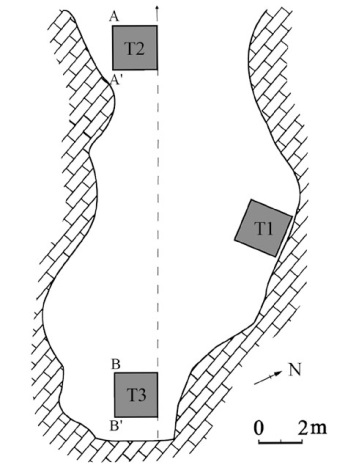
图1 韦家洞遗址洞穴平面图 A-A′ 和 B-B′ 分别为 T2、T3 南侧剖面 / A-A′ and B-B′ are the southern stratigraphic section of T2 and T3 respectively(修改自文献[1])
Fig.1 Plan view of the Weijiadong site
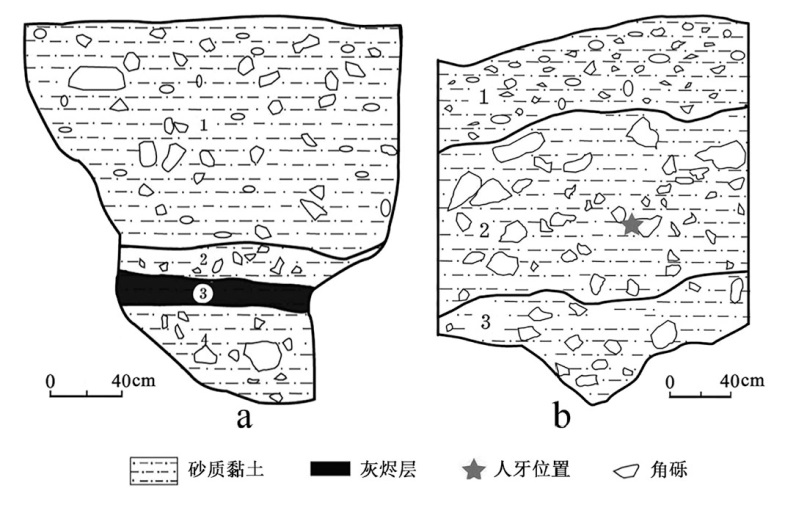
图2 韦家洞遗址T2、T3剖面 a. 韦家洞遗址T3南侧剖面B-B′ / southern section of T3 B-B′;b. T2南侧剖面A-A′/ southern section of T2 A-A′(修改自文献[1])
Fig.2 Stratigraphic section of T2 and T3 of the Weijiadong site
| 动物种属Taxon | NISP | MNI |
|---|---|---|
| 大型鹿科Large Cervidae | 639 | 38 |
| 水牛Bubalus bubalis | 11 | 3 |
| 野猪Sus sp. | 10 | 3 |
| 马Equus sp. | 3 | 1 |
| 小型牛科Small Bovidae | 20 | 3 |
| 猪獾Arctonyx collaris | 1 | 1 |
| 熊Ursus sp. | 1 | 1 |
表1 韦家洞遗址动物群种属构成
Tab.1 Taxonomic composition of faunal assemblages in Weijiadong site
| 动物种属Taxon | NISP | MNI |
|---|---|---|
| 大型鹿科Large Cervidae | 639 | 38 |
| 水牛Bubalus bubalis | 11 | 3 |
| 野猪Sus sp. | 10 | 3 |
| 马Equus sp. | 3 | 1 |
| 小型牛科Small Bovidae | 20 | 3 |
| 猪獾Arctonyx collaris | 1 | 1 |
| 熊Ursus sp. | 1 | 1 |
| 上牙Upper (n=361) | DP2-DP3 | DP4 | P2-P4 | M1-M2 | M3 | NISP | |
|---|---|---|---|---|---|---|---|
| 左侧Left | 1 | 3 | 30 | 105 | 32 | 171 | |
| 右侧Right | 3 | 5 | 23 | 129 | 30 | 190 | |
| 下牙Lower (n=329) | i-c | dp2-dp3 | dp4 | p2-p4 | m1-m2 | m3 | NISP |
| 左侧Left | 22 | 0 | 0 | 33 | 81 | 29 | 165 |
| 右侧Right | 16 | 1 | 2 | 25 | 84 | 36 | 164 |
表2 韦家洞遗址大型鹿科牙数量
Tab.2 Teeth preservation of Large Cervidae in the Weijiadong site(n)
| 上牙Upper (n=361) | DP2-DP3 | DP4 | P2-P4 | M1-M2 | M3 | NISP | |
|---|---|---|---|---|---|---|---|
| 左侧Left | 1 | 3 | 30 | 105 | 32 | 171 | |
| 右侧Right | 3 | 5 | 23 | 129 | 30 | 190 | |
| 下牙Lower (n=329) | i-c | dp2-dp3 | dp4 | p2-p4 | m1-m2 | m3 | NISP |
| 左侧Left | 22 | 0 | 0 | 33 | 81 | 29 | 165 |
| 右侧Right | 16 | 1 | 2 | 25 | 84 | 36 | 164 |
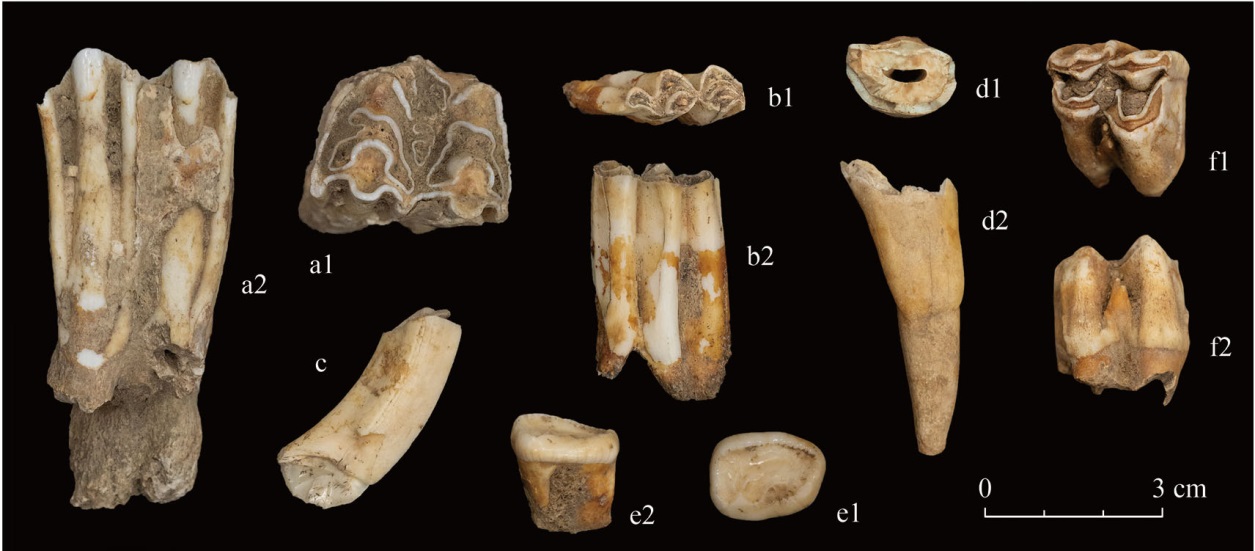
图3 韦家洞遗址出土部分动物牙齿化石 a1.牛上臼齿嚼面 Occlusal view of the upper molar of Bubalus bubalis; a2.牛上臼齿颊面 Buccal view of the upper molar of Bubalus bubalis; b1.小型牛科左下第三臼齿嚼面 Occlusal view of the right m3 of small Bovidae; b2.小型牛科左下第三臼齿颊面 Buccal view of the right m3 of small Bovidae; c.猪犬齿 the canine of Sus sp.; d1.马门齿嚼面(断裂)Occlusal view of the incisor of Equus sp. (broken) ; d2.马门齿颊面 Buccal view of the incisor of Equus sp.; e1.熊臼齿嚼面 Occlusal view of the molar of Ursus sp.; e2.熊臼齿颊面 Buccal view of the molar of Ursus sp.; f1. 大型鹿科右上第三臼齿嚼面 Occlusal view of the right M3 of Large Cervidaer; f2. 大型鹿科右上第三臼齿舌面 Lingual view of the right M3 of Large Cervidae
Fig.3 Some faunal specimens from Weijiadong site
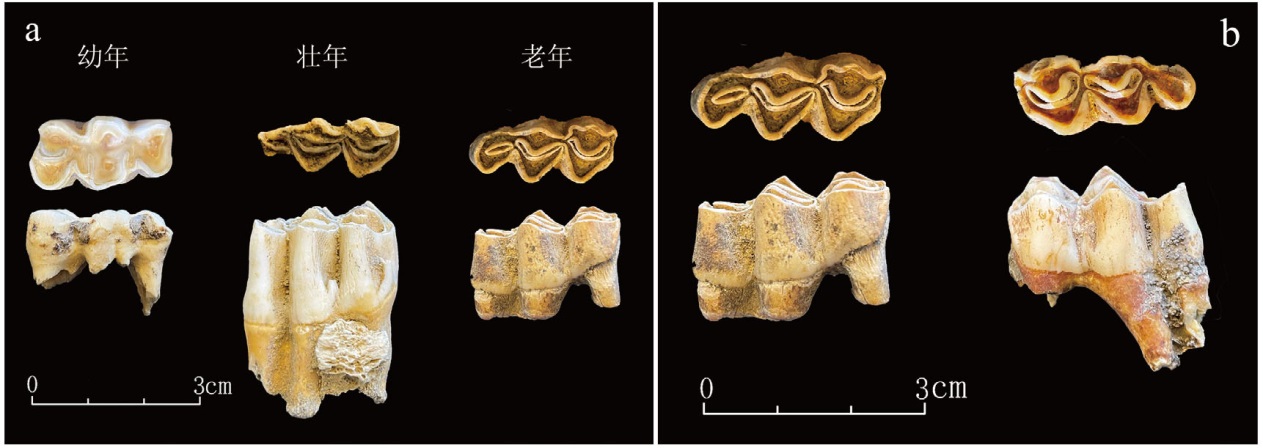
图4 不同年龄阶段和位置大型鹿科动物牙齿标本 a.幼年、壮年和老年牙齿齿冠及磨耗Tooth crown height and wear of juvenile, prime and old individuals;b.左右侧老年标本对比Comparison of old teeth specimens between left and right
Fig.4 Teeth Specimens of Large Cervidae in different age stages
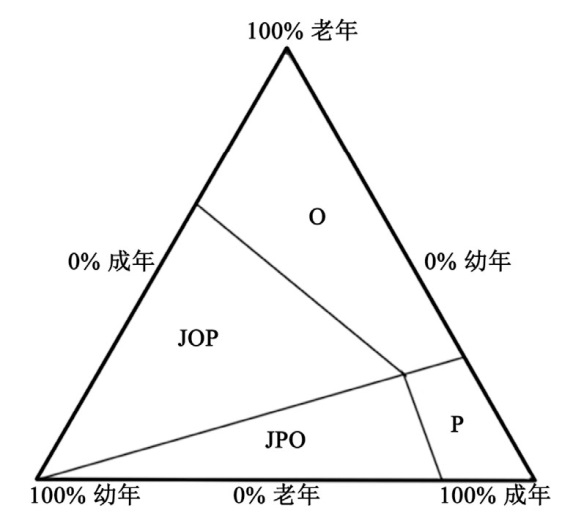
图5 死亡年龄结构三角图
Fig.5 Mortality profile zones of ternary diagrams
| 遗址名称Site | 遗址性质Ag | 年龄Age (a) | 个体总数Total | |||
|---|---|---|---|---|---|---|
| 幼年Juv | 亚成年Sub | 壮年Prime | 老年Old | |||
| 韦家洞Weijiadong | A | 0 | 2 | 18 | 5 | 25 |
| 马鞍山上层Ma’anshan upper | A | 5 | 8 | 4 | 17 | |
| 老鸦洞Laoyadong L2 | A | 10 | 38 | 7 | 55 | |
| 老鸦洞Laoyadong L3 | A | 35 | 59 | 12 | 106 | |
| 老鸦洞Laoyadong L4 | A | 21 | 44 | 14 | 79 | |
| Duoi U’Oi | A(?) | 3 | 3 | 19 | 0 | 25 |
| Tam Hang | H | 7 | 1 | 6 | 1 | 15 |
| Sibrambang | H | 3 | 2 | 8 | 2 | 15 |
| Boh Dambang | H | 5 | 4 | 0 | 9 | |
表3 韦家洞与其他遗址大型鹿科动物死亡年龄的对比
Tab.3 Mortality distribution of Large Cervidae from different assemblages of Weijiadong and other sites
| 遗址名称Site | 遗址性质Ag | 年龄Age (a) | 个体总数Total | |||
|---|---|---|---|---|---|---|
| 幼年Juv | 亚成年Sub | 壮年Prime | 老年Old | |||
| 韦家洞Weijiadong | A | 0 | 2 | 18 | 5 | 25 |
| 马鞍山上层Ma’anshan upper | A | 5 | 8 | 4 | 17 | |
| 老鸦洞Laoyadong L2 | A | 10 | 38 | 7 | 55 | |
| 老鸦洞Laoyadong L3 | A | 35 | 59 | 12 | 106 | |
| 老鸦洞Laoyadong L4 | A | 21 | 44 | 14 | 79 | |
| Duoi U’Oi | A(?) | 3 | 3 | 19 | 0 | 25 |
| Tam Hang | H | 7 | 1 | 6 | 1 | 15 |
| Sibrambang | H | 3 | 2 | 8 | 2 | 15 |
| Boh Dambang | H | 5 | 4 | 0 | 9 | |
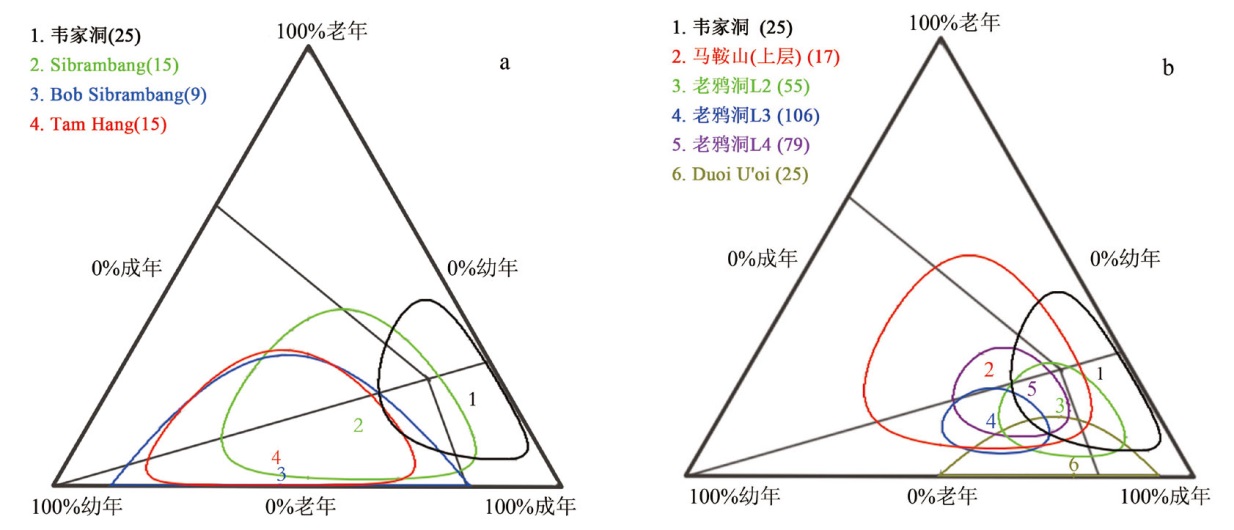
图6 韦家洞与非人类因素主导遗址年龄(a)、古人类遗址年龄(b)结构对比
Fig.6 Mortality profile of Weijiadong and other sites formed by non-human factors(a), human behaviours(b)
| [1] | 郭林, 赵凌霞, 郑远文, 等. 贵州毕节韦家洞古人类遗址年代测定及人牙的形态学意义[J]. 人类学学报, 2021, 40(6): 931-942 |
| [2] | Guo L, Zhang L, Du B, et al. A Newly Discovered Late Pleistocene Lower Third Premolar and the High Frequency Occurrence of Tomes’ Root in the Human Fossil Record from China[J]. Bulletin of the International Association for Paleodontology, 2019, 13(2): 31-40 |
| [3] | 朱婧琳. 贵州毕节韦家洞遗址出土动物骨骼的痕迹研究[D]. 学士学位论文, 北京: 中央民族大学, 2022 |
| [4] | Brain C. The Hunters or the Hunted? An introduction to African Cave taphonomy[M]. Chicago: Chicago Press, 1981 |
| [5] | Fernandez P, Guadelli JL, Fosse P. Applying dynamics and comparing life tables for Pleistocene Equidae in anthropic (Bau de l’Aubesier, Combe-Grenal) and carnivore (Fouvent) contexts with modern feral horse populations (Akagera, Pryor Mountain)[J]. Journal of Archaeological Science, 2006, 33(2): 176-184 |
| [6] | 栗静舒, 张双权, 高星, 等. 许家窑遗址马科动物的死亡年龄[J]. 人类学学报, 2017, 36(1): 62-73 |
| [7] | Hillson S. Teeth (2nd edition)[M]. New York: Cambridge University Press, 2005 |
| [8] | 张乐, 王春雪, 张双权, 等. 马鞍山遗址动物群的死亡年龄研究[J]. 人类学学报, 2009, 28(3): 306-318 |
| [9] | 栗静舒, 张双权. 垩质年轮法在旧石器时代动物考古学中的应用[J]. 人类学学报, 2014, 33(2): 177-186 |
| [10] |
Watter K, Thomas E, White N, et al. Aging Sambar (Rusa unicolor) Using Cementum Annuli and Eruption and Wear: Implications for Predicting Populations[J]. Wildlife Society Bulletin, 2021, 45(3): 383-389
doi: 10.1002/wsb.1216 |
| [11] | 李青, 同号文. 周口店田园洞梅花鹿年龄结构分析[J]. 人类学学报, 2008, 2: 143-152 |
| [12] | Wang X, Guan Y, Cai H, et al. Diet breadth and mortality patterns from Laoya Cave: A primary profile of MIS 3/2 hunting strategies in the Yunnan-Guizhou Plateau, southwest China[J]. Science China Earth Sciences, 2016, 59(8): 1642-1651 |
| [13] | Brown WAB, Chapman NG. The dentition of red deer (Cervus elaphus): a scoring scheme to assess age from wear of the permanent molariform teeth[J]. Journal of Zoology, 1991, 224(4): 519-536 |
| [14] | Klein RG, Wolf C, Freeman LG, et al. The use of dental crown heights for constructing age profiles of red deer and similar species in archaeological samples[J]. Journal of Archaeological Science, 1981, 8(1): 1-31 |
| [15] | Zhang B, Chen X, Tong HW. Tooth remains of Late Pleistocene moschid and cervid (Artiodactyla, Mammalia) from Yangjiawan and Fuyan Caves of southern China[J]. Quaternary International, 2018, 490: 21-32 |
| [16] | 陈少坤, 庞丽波, 吴雁, 等. 重庆巫山玉米洞遗址中-晚更新世鹿科动物化石[J]. 古生物学报, 2023, 62(1): 134-146 |
| [17] | Bacon AM, Westaway K, Antoine PO, et al. Late Pleistocene mammalian assemblages of Southeast Asia: New dating, mortality profiles and evolution of the predator-prey relationships in an environmental context[J]. Palaeogeography, Palaeoclimatology, Palaeoecology, 2015, 422: 101-127 |
| [18] | Stiner MC. The use of mortality patterns in archaeological studies of hominid predatory adaptations[J]. Journal of Anthropological Archaeology, 1990, 9(4): 305-351 |
| [19] | Bunn HT, Pickering TR. Methodological recommendations for ungulate mortality analyses in paleoanthropology[J]. Quaternary Research, 2010, 74(3): 388-394 |
| [20] | Semiadi G, Muir PD, Barry TN. General biology of sambar deer (Cervus unicolor) in captivity[J]. New Zealand Journal of Agricultural Research, 1994, 37(1): 79-85 |
| [21] | Leslie DM Jr. Rusa unicolor (Artiodactyla: Cervidae)[J]. Mammalian Species, 2011, 43(871): 1-30 |
| [22] |
Dahlan I, Dawend J. Growth and reproductive performance of sambar deer in Sabal Forest Reserve of Sarawak, Malaysia[J]. Tropical Animal Health and Production, 2013, 45(7): 1469-1476
doi: 10.1007/s11250-013-0383-6 pmid: 23475732 |
| [23] | 王华, 王炜林, 胡松梅. 仰韶时代人类狩猎梅花鹿的策略:以铜川瓦窑沟遗址为案例[J]. 人类学学报, 2014, 33(1): 90-100 |
| [24] | Miura S, Tokida K. Management strategy of sika dede based on sensitive analysis[A]. In: In: McCullough DR, Takatsuki S, Kaji K(Eds.). Sika Deer: Biology and Management of Native and Introduced Populations[C]. Tokyo, Berlin, Heidelberg and New York: Springer, 2009 |
| [25] | Discamps E, Costamagno S. Improving mortality profile analysis in zooarchaeology: a revised zoning for ternary diagrams[J]. Journal of Archaeological Science, 2015, 58: 62-76 |
| [26] | Saladié P, Rodríguez-Hidalgo A, Marín J, et al. The top of the Gran Dolina (Atapuerca, Spain) sequence: A zooarchaeological and occupational perspective[J]. Quaternary Science Reviews, 2018, 195: 48-71 |
| [27] | Bacon AM, Demeter F, Duringer P, et al. The Late Pleistocene Duoi U’Oi cave in northern Vietnam: palaeontology, sedimentology, taphonomy and palaeoenvironments[J]. Quaternary Science Reviews, 2008, 27(15): 1627-1654 |
| [28] | Bacon AM, Duringer P, Antoine PO, et al. The Middle Pleistocene mammalian fauna from Tam Hang karstic deposit, northern Laos: New data and evolutionary hypothesis[J]. Quaternary International, 2011, 245(2): 315-332 |
| [29] | Bacon AM, Duringer P, Westaway K, et al. Testing the savannah corridor hypothesis during MIS2: The Boh Dambang hyena site in southern Cambodia[J]. Quaternary International, 2018, 464: 417-439 |
| [30] | Karanth KU, Sunquist ME. Prey Selection by Tiger, Leopard and Dhole in Tropical Forests[J]. Journal of Animal Ecology, 1995, 64(4): 439-450 |
| [31] | Biswas S, Sankar K. Prey abundance and food habit of tigers (Panthera tigris tigris) in Pench National Park, Madhya Pradesh, India[J]. Journal of Zoology, 2002, 256(3): 411-420 |
| [32] | Weaver TD, Boyko RH, Steele TE. Cross-platform program for likelihood-based statistical comparisons of mortality profiles on a triangular graph[J]. Journal of Archaeological Science, 2011, 38(9): 2420-2423 |
| [33] | Steele TE, Weaver TD. The Modified Triangular Graph: A Refined Method for Comparing Mortality Profiles in Archaeological Samples[J]. Journal of Archaeological Science, 2002, 29(3): 317-322 |
| [34] | 张乐, 王春雪, 张双权, 等. 马鞍山旧石器时代遗址古人类行为的动物考古学研究[J]. 中国科学(D辑:地球科学), 2009, 39(9): 1256-1265 |
| [35] | 张双权, 李占扬, 张乐, 等. 河南灵井许昌人遗址大型食草类动物死亡年龄分析及东亚现代人类行为的早期出现[J]. 科学通报, 2009, 54(19): 2857-2863 |
| [36] | 曲彤丽, 顾万发, 汪松枝, 等. 郑州地区晚更新世中期人类的生计方式——老奶奶庙遗址动物遗存研究[J]. 人类学学报, 2018, 37(1): 70-78 |
| [37] | Duringer P, Bacon AM, Sayavongkhamdy T, et al. Karst development, breccias history, and mammalian assemblages in Southeast Asia: A brief review[J]. Comptes Rendus Palevol, 2012, 11(2): 133-157 |
| [38] | 贾兰坡, 盖培, 尤玉桂. 山西峙峪旧石器时代遗址发掘报告[J]. 考古学报, 1972, 1: 39-58+135-136 |
| [39] | 王晓敏, 王法岗, 陈福友, 等. 泥河湾盆地板井子晚更新世遗址古人类对动物资源的消费策略[J]. 人类学学报, 2022, 41(6): 1005-1016 |
| [40] | Mellars P. The Impact of Climatic Changes on the Demography of Late Neandertal and Early Anatomically Modern Populations in Europe[A]. In: Akazawa T, Aoki K, Bar-Yosef O. Neandertals and Modern Humans in Western Asia[C]. Boston, MA: Springer US, 1998, 493-507 |
| [41] | Enloe JG. Acquisition and processing of reindeer in the Paris Basin[A]. In: Costamagno S, Laroulandie V. Mode de vie au Magdalénien: les apports de l’archéozoologie[C]. Oxford: BAR International Series, 2003, 1144: 23-31 |
| [42] | Mellars P. Reindeer specialization in the early Upper Palaeolithic: the evidence from south west France[J]. Journal of Archaeological Science, 2004, 31(5): 613-617 |
| [43] | Mellars P. Major Issues in the Emergence of Modern Humans[J]. Current Anthropology, 1989, 30(3): 349-385 |
| [44] | Grayson DK, Delpech F. Specialized Early Upper Palaeolithic Hunters in Southwestern France?[J]. Journal of Archaeological Science, 2002, 29(12): 1439-1449 |
| [45] | Grayson DK, Delpech F. Ungulates and the Middle-to-Upper Paleolithic transition at Grotte XVI (Dordogne, France)[J]. Journal of Archaeological Science, 2003, 30(12): 1633-1648 |
| [46] | Boyle K. The zooarchaeology of complexity and specialization during the Upper Palaeolithic in Western Europe: changing diversity and evenness[A]. In: Alanarella U, Riaaetto M, Russ H, et al. The Oxford Handbook of Zooarchaeology[C]. Oxford University Press, 2017, 39-51 |
| [47] | Discamps E, Jaubert J, Bachellerie F. Human choices and environmental constraints: deciphering the variability of large game procurement from Mousterian to Aurignacian times (MIS 5-3) in southwestern France[J]. Quaternary Science Reviews, 2011, 30(19-20): 2755-2775 |
| [48] |
赵增友, 石胜强, 袁智郴, 等. 黔西高原末次冰期晚期古植被及西南季风演变[J]. 古地理学报, 2019, 21(6): 1013-1024
doi: 10.7605/gdlxb.2019.06.069 |
| [49] | 覃嘉铭, 袁道先, 程海, 等. 贵州都匀七星洞石笋剖面晚更新世高分辨率的气候地层学[J]. 第四纪研究, 2004, 3: 318-324 |
| [50] |
Wang W, Potts R, Baoyin Y, et al. Sequence of mammalian fossils, including hominoid teeth, from the Bubing Basin caves, South China[J]. Journal of Human Evolution, 2007, 52(4): 370-379
pmid: 17198721 |
| [51] |
Daujeard C, Vettese D, Britton K, et al. Neanderthal selective hunting of reindeer? The case study of Abri du Maras (south-eastern France)[J]. Archaeological and Anthropological Sciences, 2019, 11(3): 985-1011
doi: 10.1007/s12520-017-0580-8 |
| [52] | Costamagno S, Liliane M, Cédric B, et al. Les Pradelles (Marillac-le-Franc, France): A mousterian reindeer hunting camp?[J]. Journal of Anthropological Archaeology, 2006, 25(4): 466-484 |
| [53] | Soulier MC, Mallye JB. Hominid subsistence strategies in the South-West of France: A new look at the early Upper Palaeolithic faunal material from Roc-de-Combe (Lot, France)[J]. Quaternary International, 2012, 252: 99-108 |
| [54] | Niven L. A Diachronic Evaluation of Neanderthal Cervid Exploitation and Site Use at Pech de l’Azé IV, France[A]. In: Clark J, Speth J. Zooarchaeology and Modern Human Origins[A]. Springer, 2013: 151-161 |
| [55] | Rendu W, Costamagno S, Meignen L, et al. Monospecific faunal spectra in Mousterian contexts: Implications for social behavior[J]. Quaternary International, 2012, 247: 50-58 |
| [56] | 盛和林. 中国鹿类动物[M]. 上海: 华东师范大学出版社, 1992 |
| [57] | Speth JD. Thoughts about hunting: Some things we know and some things we don’t know[J]. Quaternary International, 2013, 297: 176-185 |
| [58] | Bunn HT, Gurtov AN. Prey mortality profiles indicate that Early Pleistocene Homo at Olduvai was an ambush predator[J]. Quaternary International, 2014, 322-323: 44-53 |
| [1] | 姚艳燕, 黄胜敏, 廖卫, 李金燕, 张一景, 莫进尤, 王伟. 广西吹风洞早更新世动物群的埋藏学[J]. 人类学学报, 2025, 44(03): 514-528. |
| [2] | 贺乐天, 谢光茂, 林强, 李大伟, 吴秀杰. 广西更新世晚期娅怀洞人的性别与年龄[J]. 人类学学报, 2025, 44(03): 389-403. |
| [3] | 赵克良, 姜海涛, 王元, 同号文, 张雅平, 葛俊逸, 周新郢, 金昌柱, 李小强. 中国真猛犸象和披毛犀化石14C年代研究新进展[J]. 人类学学报, 2022, 41(03): 551-562. |
| [4] | 鲁可. 中国的骨针及其对晚更新世人类扩散的指示意义[J]. 人类学学报, 2019, 38(03): 362-372. |
| [5] | 曲彤丽;顾万发;汪松枝;陈宥成;王幼平. 郑州地区晚更新世中期人类的生计方式——老奶奶庙遗址动物遗存研究[J]. 人类学学报, 2018, 37(01): 70-78. |
| [6] | 栗静舒;张双权;高星;Henry T.Bunn. 许家窑遗址马科动物的死亡年龄[J]. 人类学学报, 2017, 36(01): 62-73. |
| [7] | 任进成;周静;李锋;陈福友;高星. 甘肃石峡口旧石器遗址第1地点发掘报告[J]. 人类学学报, 2017, 36(01): 1-16. |
| [8] | 严亚玲;金昌柱;朱敏;刘毅弘;刘进余. 广西扶绥岩亮洞早更新世独角犀年龄结构的分析[J]. 人类学学报, 2014, 33(04): 534-544. |
| [9] | 栗静舒;张双权. 垩质年轮法在旧石器时代动物考古学中的应用[J]. 人类学学报, 2014, 33(02): 177-186. |
| [10] | 宋先杰; 于世永. 海岱地区大汶口文化时期人口死亡年龄的统计分布特征[J]. 人类学学报, 2012, 31(03): 259-268. |
| [11] | 张东菊; 陈发虎; 吉笃学; L Barton; PJ Brantingham; 王辉. 甘肃苏苗塬头地点石制品特征与古环境分析[J]. 人类学学报, 2011, 30(03): 289-298. |
| [12] | 李占扬; 张双权; 张乐; 高星. 河南灵井许昌人遗址普通马(Equus caballus)化石居群的死亡年龄曲线[J]. 人类学学报, 2011, 30(01): 45-54. |
| [13] | 张乐; 王春雪; 张双权; 高星. 马鞍山遗址动物群的死亡年龄研究[J]. 人类学学报, 2009, 28(03): 306-318. |
| [14] | 李青;同号文. 周口店田园洞梅花鹿年龄结构分析[J]. 人类学学报, 2008, 27(02): 141-150. |
| [15] | Christopher J.NORTON;张双权;张乐;高星. 上/更新世动物群中人类与食肉动物“印记”的识别[J]. 人类学学报, 2007, 26(02): 183-192. |
| 阅读次数 | ||||||
|
全文 |
|
|||||
|
摘要 |
|
|||||
 京ICP证05002819号-3