

主管:中国科学院
主办:中国科学院古脊椎动物与古人类研究所
出版:科学出版社
主办:中国科学院古脊椎动物与古人类研究所
出版:科学出版社
人类学学报 ›› 2026, Vol. 45 ›› Issue (01): 59-73.doi: 10.16359/j.1000-3193/AAS.2025.0012cstr: 32091.14.j.1000-3193/AAS.2025.0012
周立刚1( ), 武志江2, 孙蕾2, 杜月3, 韩炜炜4, 吴晓桐3()
收稿日期:2024-06-25
接受日期:2024-09-29
出版日期:2026-02-15
发布日期:2026-02-13
通讯作者:
吴晓桐,讲师,主要研究方向为锶同位素考古。E-mail: wuxiaotong2022@ruc.edu.cn
作者简介:周立刚,教授,主要研究方向为战国秦汉考古、稳定同位素考古。E-mail: leag3210@126.com
基金资助:
ZHOU Ligang1(), WU Zhijiang2, SUN Lei2, DU Yue3, HAN Weiwei4, WU Xiaotong3()
Received:2024-06-25
Accepted:2024-09-29
Online:2026-02-15
Published:2026-02-13
摘要:
为了研究仰韶晚期灰坑葬人群的来源及相互关系,本文对河南省渑池县笃忠遗址4个灰坑中15具人骨个体开展了多种同位素分析。碳氮同位素分析结果表明,笃忠遗址绝大部分个体以粟为主粮,多名个体从幼年到成年的食谱特征经历了不同趋势的变化。锶氧同位素分析结果显示,绝大部分男性个体幼年都不在本地生活,其来源地可能在遗址东部的平原地区或者更东部的近海地区,这与颅骨形态特征和拔牙习俗所反映的文化因素来源方向是吻合的。多人合葬的单位同时包括有本地个体和异地迁入个体;同单位所葬的外地迁入个体中,有一部分具有相同的食谱特征和迁徙轨迹,暗示他们之间存在某种密切关系,可能同属于某种性质的社会组织单元。本研究结果为研究仰韶晚期灰坑葬性质及中原与东部地区文化交流等问题提供了重要线索,同时也充分体现了多种同位素综合分析方法在史前考古研究中的价值。
中图分类号:
周立刚, 武志江, 孙蕾, 杜月, 韩炜炜, 吴晓桐. 河南渑池笃忠遗址灰坑葬人群的来源[J]. 人类学学报, 2026, 45(01): 59-73.
ZHOU Ligang, WU Zhijiang, SUN Lei, DU Yue, HAN Weiwei, WU Xiaotong. Origin of the ash-pit burial people at the Duzhong site in Mianchi, Henan[J]. Acta Anthropologica Sinica, 2026, 45(01): 59-73.
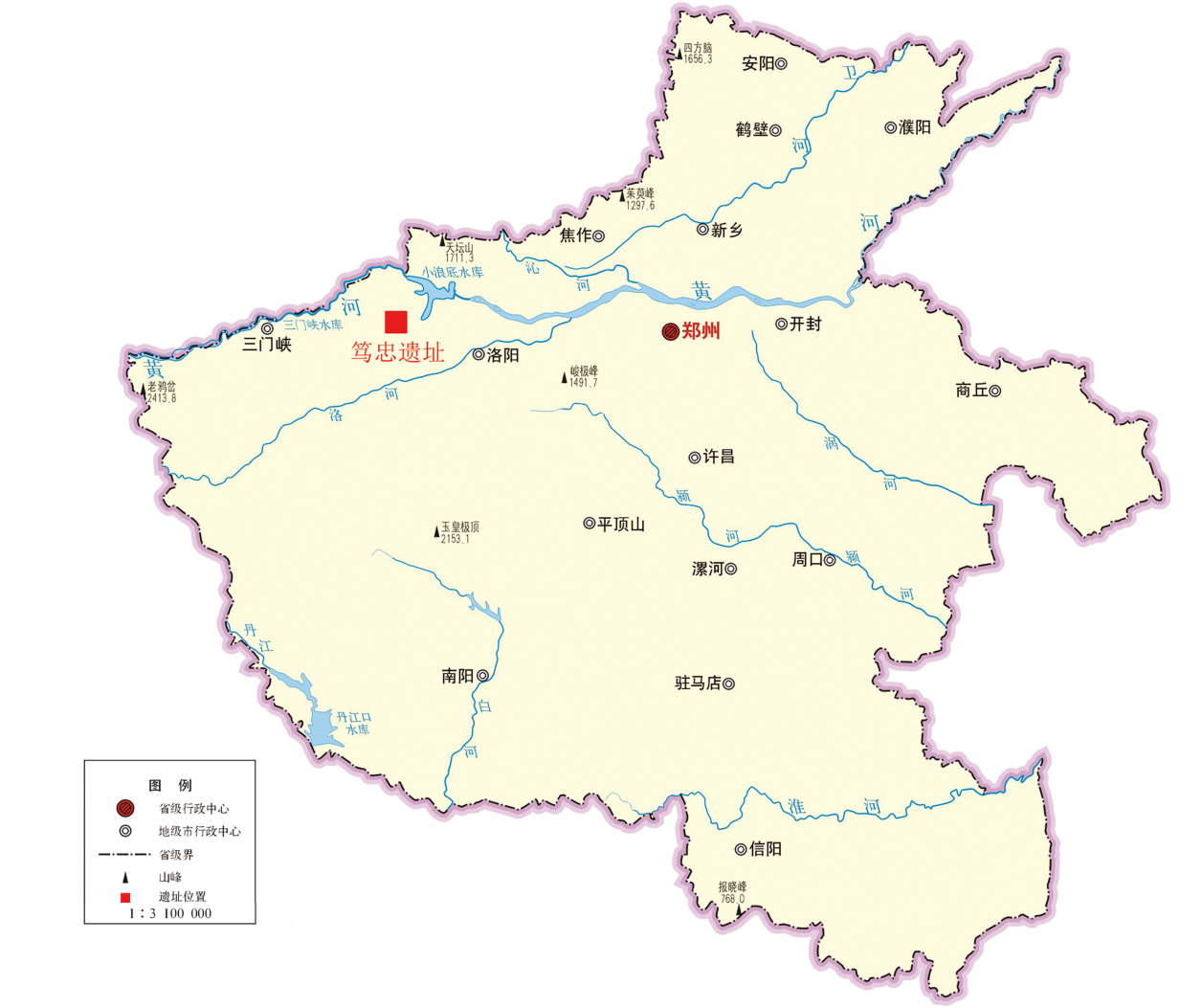
图1 笃忠遗址在河南省的位置(审图号:GS(2019)3333号)
Fig.1 Location of the Duzhong site in Henan Province
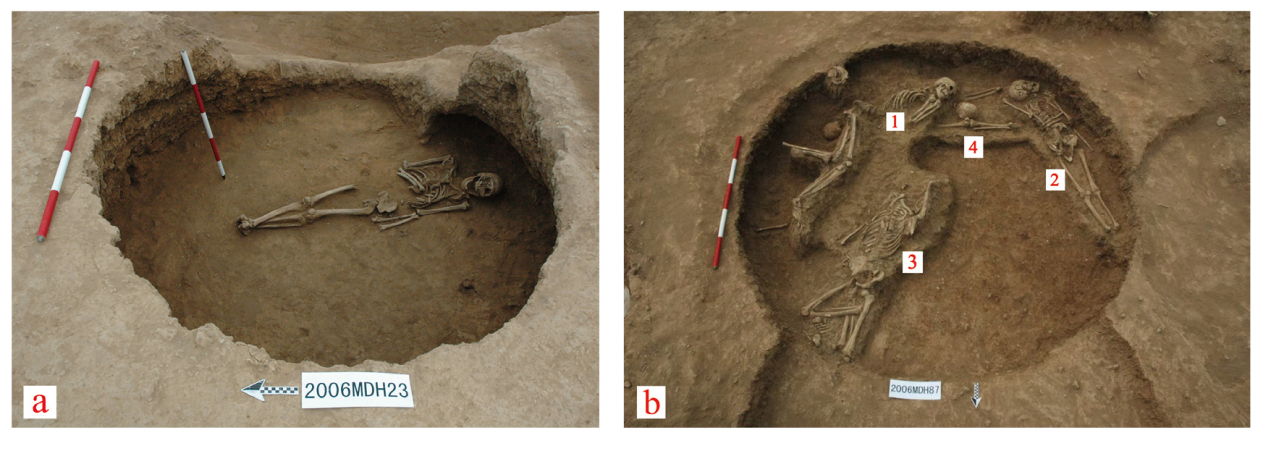
图2 笃忠遗址灰坑葬 图上数字1~4指的是灰坑内人骨编号The numbers 1 to 4 refer to the human skeletons in the ash pit a. H23;b. H87。
Fig.2 Pit burials of Duzhong site
| 个体编号Number | 性别Sex | 年龄Age(y) | 样品部位Sample | δ13C | δ15N | C | N | C:N | 产出比例 Collagen yield |
|---|---|---|---|---|---|---|---|---|---|
| MDH23 | 男 | 20± | 犬齿 | -14.0‰ | 10.2‰ | 43.1% | 15.4% | 3.3 | 7.4% |
| 肋骨 | -16.0‰ | 9.8‰ | 45.2% | 16.3% | 3.2 | 14.4% | |||
| MDH69-1 | 男 | <18 | 门齿 | -6.6‰ | 9.8‰ | 43.2% | 15.6% | 3.2 | 8.7% |
| 肋骨 | -10.3‰ | 9.6‰ | 42.7% | 15.5% | 3.2 | 5.1% | |||
| MDH69-2 | 女 | 40~45 | 门齿 | -7.2‰ | 8.9‰ | 43.4% | 15.6% | 3.2 | 5.1% |
| 肋骨 | -7.4‰ | 8.0‰ | 43.0% | 15.5% | 3.2 | 6.1% | |||
| MDH69-3 | 女 | 40± | 门齿 | -7.7‰ | 8.6‰ | 42.7% | 15.3% | 3.2 | 8.0% |
| 肋骨 | -7.0‰ | 9.0‰ | 44.7% | 16.1% | 3.2 | 16.4% | |||
| MDH69-4 | 男 | 20± | 门齿 | -8.1‰ | 9.5‰ | 43.3% | 15.6% | 3.2 | 9.4% |
| 肋骨 | -7.1‰ | 10.1‰ | 42.8% | 15.4% | 3.3 | 5.2% | |||
| MDH69-5 | 男 | 40~45 | 门齿 | -7.7‰ | 9.4‰ | 43.2% | 15.6% | 3.2 | 9.8% |
| 肋骨 | -7.4‰ | 8.8‰ | 42.3% | 15.3% | 3.2 | 6.6% | |||
| MDH69-6 | 男 | 35~40 | 肋骨 | -7.0‰ | 9.1‰ | 43.1% | 15.5% | 3.2 | 5.3% |
| MDH82-1 | 男 | 18± | 臼齿 | -7.4‰ | 9.6‰ | 42.9% | 15.5% | 3.2 | 6.8% |
| 肋骨 | -10.1‰ | 9.5‰ | 43.3% | 15.6% | 3.2 | 5.6% | |||
| MDH82-2 | 男 | 20± | 门齿 | -6.6‰ | 7.0‰ | 42.7% | 15.4% | 3.2 | 4.7% |
| 肋骨 | -8.4‰ | 7.3‰ | 43.4% | 15.6% | 3.2 | 4.8% | |||
| MDH82-3 | 男 | 20± | 掌骨 | -7.2‰ | 7.6‰ | 43.1% | 15.5% | 3.2 | 6.1% |
| MDH82-4 | 女 | 35± | 肋骨 | -7.9‰ | 8.3‰ | 42.5% | 15.2% | 3.2 | 7.7% |
| MDH87-1 | 男 | 35± | 门齿 | -6.5‰ | 11.1‰ | 42.4% | 15.4% | 3.2 | 10.2% |
| 掌骨 | -7.2‰ | 8.1‰ | 43.9% | 15.8% | 3.2 | 8.7% | |||
| MDH87-2 | 男 | 25± | 门齿 | -6.5‰ | 9.1‰ | 43.6% | 15.7% | 3.2 | 9.3% |
| 肋骨 | -7.0‰ | 8.3‰ | 41.5% | 15.2% | 3.2 | 4.6% | |||
| MDH87-3 | 男 | 25~30 | 肋骨 | -15.5‰ | 10.3‰ | 43.1% | 15.5% | 3.2 | 4.5% |
| MDH87-4 | 男 | 18± | 肋骨 | -7.5‰ | 8.4‰ | 43.0% | 15.6% | 3.2 | 5.2% |
表1 笃忠遗址人骨和牙齿碳氮稳定同位素数据
Tab.1 Stable carbon and nitrogen isotope values for Duzhong human bones and teeth
| 个体编号Number | 性别Sex | 年龄Age(y) | 样品部位Sample | δ13C | δ15N | C | N | C:N | 产出比例 Collagen yield |
|---|---|---|---|---|---|---|---|---|---|
| MDH23 | 男 | 20± | 犬齿 | -14.0‰ | 10.2‰ | 43.1% | 15.4% | 3.3 | 7.4% |
| 肋骨 | -16.0‰ | 9.8‰ | 45.2% | 16.3% | 3.2 | 14.4% | |||
| MDH69-1 | 男 | <18 | 门齿 | -6.6‰ | 9.8‰ | 43.2% | 15.6% | 3.2 | 8.7% |
| 肋骨 | -10.3‰ | 9.6‰ | 42.7% | 15.5% | 3.2 | 5.1% | |||
| MDH69-2 | 女 | 40~45 | 门齿 | -7.2‰ | 8.9‰ | 43.4% | 15.6% | 3.2 | 5.1% |
| 肋骨 | -7.4‰ | 8.0‰ | 43.0% | 15.5% | 3.2 | 6.1% | |||
| MDH69-3 | 女 | 40± | 门齿 | -7.7‰ | 8.6‰ | 42.7% | 15.3% | 3.2 | 8.0% |
| 肋骨 | -7.0‰ | 9.0‰ | 44.7% | 16.1% | 3.2 | 16.4% | |||
| MDH69-4 | 男 | 20± | 门齿 | -8.1‰ | 9.5‰ | 43.3% | 15.6% | 3.2 | 9.4% |
| 肋骨 | -7.1‰ | 10.1‰ | 42.8% | 15.4% | 3.3 | 5.2% | |||
| MDH69-5 | 男 | 40~45 | 门齿 | -7.7‰ | 9.4‰ | 43.2% | 15.6% | 3.2 | 9.8% |
| 肋骨 | -7.4‰ | 8.8‰ | 42.3% | 15.3% | 3.2 | 6.6% | |||
| MDH69-6 | 男 | 35~40 | 肋骨 | -7.0‰ | 9.1‰ | 43.1% | 15.5% | 3.2 | 5.3% |
| MDH82-1 | 男 | 18± | 臼齿 | -7.4‰ | 9.6‰ | 42.9% | 15.5% | 3.2 | 6.8% |
| 肋骨 | -10.1‰ | 9.5‰ | 43.3% | 15.6% | 3.2 | 5.6% | |||
| MDH82-2 | 男 | 20± | 门齿 | -6.6‰ | 7.0‰ | 42.7% | 15.4% | 3.2 | 4.7% |
| 肋骨 | -8.4‰ | 7.3‰ | 43.4% | 15.6% | 3.2 | 4.8% | |||
| MDH82-3 | 男 | 20± | 掌骨 | -7.2‰ | 7.6‰ | 43.1% | 15.5% | 3.2 | 6.1% |
| MDH82-4 | 女 | 35± | 肋骨 | -7.9‰ | 8.3‰ | 42.5% | 15.2% | 3.2 | 7.7% |
| MDH87-1 | 男 | 35± | 门齿 | -6.5‰ | 11.1‰ | 42.4% | 15.4% | 3.2 | 10.2% |
| 掌骨 | -7.2‰ | 8.1‰ | 43.9% | 15.8% | 3.2 | 8.7% | |||
| MDH87-2 | 男 | 25± | 门齿 | -6.5‰ | 9.1‰ | 43.6% | 15.7% | 3.2 | 9.3% |
| 肋骨 | -7.0‰ | 8.3‰ | 41.5% | 15.2% | 3.2 | 4.6% | |||
| MDH87-3 | 男 | 25~30 | 肋骨 | -15.5‰ | 10.3‰ | 43.1% | 15.5% | 3.2 | 4.5% |
| MDH87-4 | 男 | 18± | 肋骨 | -7.5‰ | 8.4‰ | 43.0% | 15.6% | 3.2 | 5.2% |
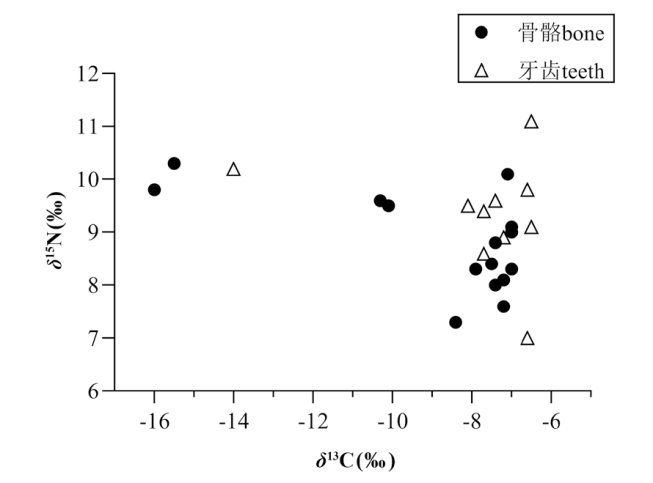
图3 笃忠遗址人骨和牙齿碳氮同位素值分布
Fig.3 Distribution of carbon and nitrogen isotope values for Duzhong individuals
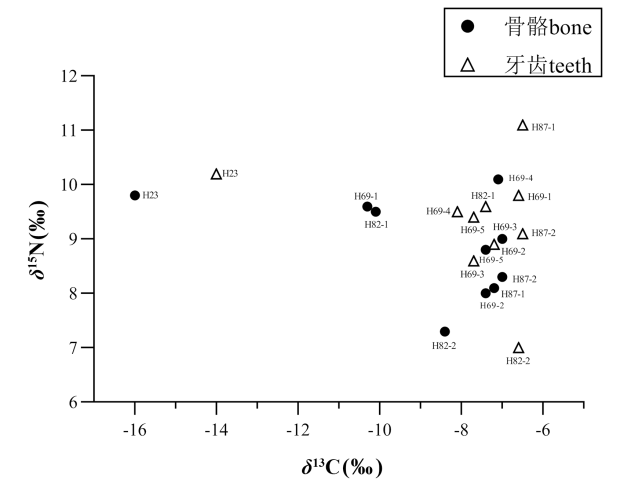
图4 笃忠遗址个体牙齿与骨骼碳氮同位素对比
Fig.4 Comparison of carbon and nitrogen isotope values between tooth and bone samples from Duzhong individuals
| 个体编号Number | 样品种类Sample | 87Sr/86Sr | SE | δ18O VPDB |
|---|---|---|---|---|
| MDH23 | 犬齿 | 0.71208 | 0.000010 | -3.1‰ |
| 肋骨 | 0.71205 | 0.000010 | -6.8‰ | |
| MDH69-1 | 齿冠 | 0.71308 | 0.000009 | -8.3‰ |
| 肋骨 | 0.71214 | 0.000009 | -7.9‰ | |
| MDH69-3 | 门齿 | 0.71194 | 0.000010 | -8.0‰ |
| 肋骨 | 0.71208 | 0.000009 | -8.4‰ | |
| MDH69-4 | 肋骨 | 0.71212 | 0.000010 | -7.5‰ |
| 门齿 | 0.71140 | 0.000009 | -5.1‰ | |
| MDH69-5 | 门齿 | 0.71152 | 0.000010 | -5.5‰ |
| 肋骨 | 0.71203 | 0.000008 | -7.7‰ | |
| MDH69-6 | 臼齿 | 0.71141 | 0.000010 | -5.6‰ |
| 肋骨 | 0.71211 | 0.000008 | -8.2‰ | |
| MDH82-1 | 齿冠 | 0.71203 | 0.000009 | -9.1‰ |
| MDH82-2 | 肋骨 | 0.71213 | 0.000009 | -7.6‰ |
| 门齿 | 0.71148 | 0.000011 | -5.0‰ | |
| MDH87-1 | 门齿 | 0.71172 | 0.000011 | -8.4‰ |
| 掌骨 | 0.71207 | 0.000008 | -7.9‰ | |
| MDH87-2 | 门齿 | 0.71259 | 0.000010 | -5.2‰ |
| 肋骨 | 0.71215 | 0.000009 | -8.6‰ |
表2 笃忠遗址人骨和牙齿锶氧同位素数据
Tab.2 Strontium and oxygen isotope values for Duzhong human bones and teeth
| 个体编号Number | 样品种类Sample | 87Sr/86Sr | SE | δ18O VPDB |
|---|---|---|---|---|
| MDH23 | 犬齿 | 0.71208 | 0.000010 | -3.1‰ |
| 肋骨 | 0.71205 | 0.000010 | -6.8‰ | |
| MDH69-1 | 齿冠 | 0.71308 | 0.000009 | -8.3‰ |
| 肋骨 | 0.71214 | 0.000009 | -7.9‰ | |
| MDH69-3 | 门齿 | 0.71194 | 0.000010 | -8.0‰ |
| 肋骨 | 0.71208 | 0.000009 | -8.4‰ | |
| MDH69-4 | 肋骨 | 0.71212 | 0.000010 | -7.5‰ |
| 门齿 | 0.71140 | 0.000009 | -5.1‰ | |
| MDH69-5 | 门齿 | 0.71152 | 0.000010 | -5.5‰ |
| 肋骨 | 0.71203 | 0.000008 | -7.7‰ | |
| MDH69-6 | 臼齿 | 0.71141 | 0.000010 | -5.6‰ |
| 肋骨 | 0.71211 | 0.000008 | -8.2‰ | |
| MDH82-1 | 齿冠 | 0.71203 | 0.000009 | -9.1‰ |
| MDH82-2 | 肋骨 | 0.71213 | 0.000009 | -7.6‰ |
| 门齿 | 0.71148 | 0.000011 | -5.0‰ | |
| MDH87-1 | 门齿 | 0.71172 | 0.000011 | -8.4‰ |
| 掌骨 | 0.71207 | 0.000008 | -7.9‰ | |
| MDH87-2 | 门齿 | 0.71259 | 0.000010 | -5.2‰ |
| 肋骨 | 0.71215 | 0.000009 | -8.6‰ |
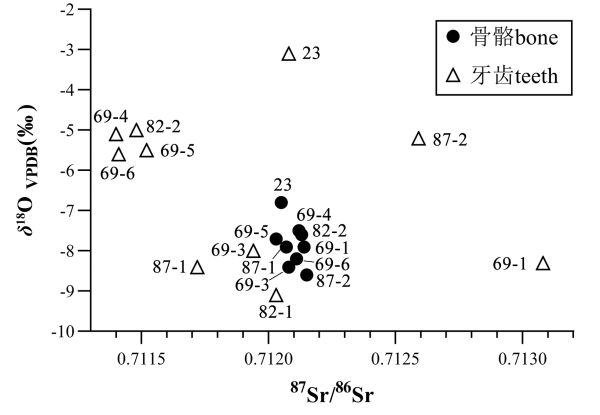
图5 笃忠遗址人骨和牙齿锶氧同位素分布
Fig.5 Distribution of strontium and oxygen isotope values for Duzhong individuals
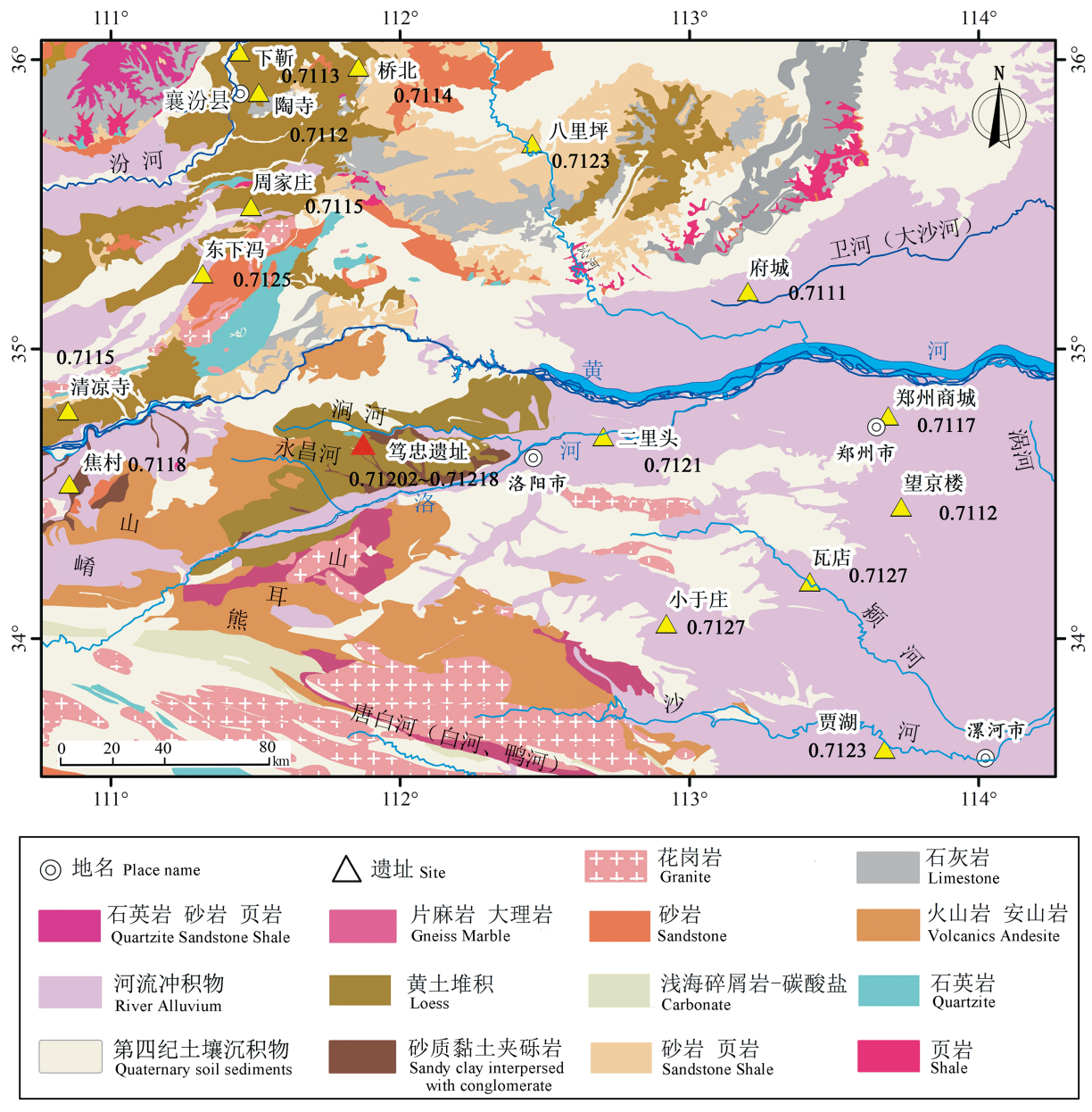
图6 笃忠遗址及周边地区地质图和生物锶同位素分布
Fig.6 Geographic map and distribution of bio-available strontium isotope values in and around Duzhong site
| 编号Number | 性别Sex | 年龄Age(y) | 食谱变化Change of diet | 迁徙Migrate | 来源Source |
|---|---|---|---|---|---|
| H69-3 | 女female | 40± | 否No | 否No | 本地local |
| H87-1 | 男male | 35± | 是Yes | 否No | 本地local |
| H82-1 | 男male | 18± | 是Yes | 否No | 本地local |
| H23 | 男male | 20± | 是Yes | 是Yes | 东部近海地区east areas close to the sea |
| H69-1 | 男male | 18 | 是Yes | 是Yes | 东部平原plains in the east |
| H82-2 | 男male | 20± | 是Yes | 是Yes | 东部近海地区east areas close to the sea |
| H87-2 | 男male | 25± | 否No | 是Yes | 遗址东部平原地区plains in the east |
| H69-4 | 男male | 20± | 否No | 是Yes | 东部近海地区east areas close to the sea |
| H69-5 | 男male | 40-45 | 否No | 是Yes | 东部近海地区east areas close to the sea |
表3 笃忠先民食谱特征与迁徙活动对比分析
Tab.3 Comparison of dietary features and migration of Duzhong individuals
| 编号Number | 性别Sex | 年龄Age(y) | 食谱变化Change of diet | 迁徙Migrate | 来源Source |
|---|---|---|---|---|---|
| H69-3 | 女female | 40± | 否No | 否No | 本地local |
| H87-1 | 男male | 35± | 是Yes | 否No | 本地local |
| H82-1 | 男male | 18± | 是Yes | 否No | 本地local |
| H23 | 男male | 20± | 是Yes | 是Yes | 东部近海地区east areas close to the sea |
| H69-1 | 男male | 18 | 是Yes | 是Yes | 东部平原plains in the east |
| H82-2 | 男male | 20± | 是Yes | 是Yes | 东部近海地区east areas close to the sea |
| H87-2 | 男male | 25± | 否No | 是Yes | 遗址东部平原地区plains in the east |
| H69-4 | 男male | 20± | 否No | 是Yes | 东部近海地区east areas close to the sea |
| H69-5 | 男male | 40-45 | 否No | 是Yes | 东部近海地区east areas close to the sea |
| [1] | 李小龙. 仰韶文化灰坑葬相关问题探讨[J]. 文博, 2015, 6: 31-37 |
| [2] | 李永强. 中国史前居址葬俗刍议[J]. 中原文物, 2017, 6: 39-44 |
| [3] | 武志江, 杨玉华, 鲁红卫, 等. 河南渑池笃忠遗址2006年发掘简报[J]. 华夏考古, 2010, 3: 3-18 |
| [4] | 孙蕾, 武志江. 渑池笃忠遗址仰韶文化晚期人骨研究[J]. 华夏考古, 2010, 3: 100-109 |
| [5] | 孙蕾. 河南渑池笃忠遗址仰韶晚期出土的人骨骨病研究[J]. 人类学学报, 2011, 30(1): 55-63 |
| [6] |
Hu YW. Thirty-four years of stable isotopic analyses of ancient skeletons in china: an overview, progress and prospects[J]. Archaeometry, 2018, 60(1): 144-156
doi: 10.1111/arcm.v60.1 URL |
| [7] | Lee-Thorp JA. On isotopes and old bones[J]. Archaeometry, 2008, 6: 925-950 |
| [8] | 蔡莲珍, 仇士华. 碳十三测定和古代食谱研究[J]. 考古, 1984, 10: 949-955 |
| [9] | 张雪莲. 应用古人骨的元素、同位素分析研究其食物结构[J]. 人类学学报, 2003, 1: 75-84 |
| [10] | 张雪莲. 碳十三和氮十五分析与古代人类食物结构研究及其新进展[J]. 考古, 2006, 7: 50-56 |
| [11] |
Ericson JE. Strontium isotope characterization in the study of prehistoric human ecology[J]. Journal of Human Evolution, 1985, 14(5): 503-514
doi: 10.1016/S0047-2484(85)80029-4 URL |
| [12] |
Bentley RA. Strontium isotopes from the earth to the archaeological skeleton: a review[J]. Journal of Archaeological Method and Theory, 2006, 13(3): 135-187
doi: 10.1007/s10816-006-9009-x URL |
| [13] |
Britton K, Grimes V, Dau J, et al. Reconstructing faunal migrations using intra-tooth sampling and strontium and oxygen isotope analyses: a case study of modern caribou (Rangifer tarandus granti)[J]. Journal of Archaeological Science, 2009, 36(5): 1163-1172
doi: 10.1016/j.jas.2009.01.003 URL |
| [14] | 尹若春, 张居中. 锶同位素分析技术在考古学中的应用研究[J]. 东南文化, 2007, 1: 55-60 |
| [15] | 张兴香. 多种同位素方法应用于云南青铜时代人骨材料研究[D]. 博士学位论文, 合肥: 中国科学技术大学, 2015 |
| [16] |
Wang XY, Tang ZH. The first large-scale bioavailable Sr isotope map of China and its implication for provenance studies[J]. Earth-Science Reviews, 2020, 210: 103353
doi: 10.1016/j.earscirev.2020.103353 URL |
| [17] | 吴晓桐, 张兴香. 关于锶同位素考古研究的几个问题[J]. 人类学学报, 2022, 41(3): 535-550 |
| [18] | Price TD, Burton JH. An Introduction to Archaeological Chemistry[M]. New York: Springer New York, 2011, 91-92 |
| [19] |
Liu JR, Song XF, Yuan GF, et al. Characteristics of δ18O in precipitation over Eastern Monsoon China and the water vapor sources[J]. Chinese Science Bulletin, 2010, 55: 200-211
doi: 10.1007/s11434-009-0202-7 URL |
| [20] | 吴晓桐. 龙山时期黄河流域的人群迁移与资源流通[D]. 博士学位论文, 合肥: 中国科学技术大学, 2018 |
| [21] |
Dupras TL, Schwarcz HP. Strangers in a Strange Land: Stable Isotope Evidence for Human Migration in the Dakhleh Oasis, Egypt[J]. Journal of Archaeological Science, 2001, 28(11): 1199-1208
doi: 10.1006/jasc.2001.0640 URL |
| [22] | Lightfoot E, O’Connell TC. On the Use of Biomineral Oxygen Isotope Data to Identify Human Migrants in the Archaeological Record: Intra-Sample Variation, Statistical Methods and Geographical Considerations[J]. PLOS One, 2016, 11(4): e0153850 |
| [23] | Sealy J, Johnson M, Richards M, et al. Comparison of two methods of extracting bone collagen for stable carbon and nitrogen isotope analysis: comparing whole bone demineralization with gelatinization and ultrafiltration[J]. Journal of Archaeological Science, 2014 (47): 64-69 |
| [24] |
DeNiro MJ. Postmortem preservation and alteration of in vivo bone collagen isotope ratios in relation to palaeodietary reconstruction[J]. Nature, 1985, 317(6040): 806-809
doi: 10.1038/317806a0 |
| [25] |
Ambrose SH. Preparation and characterization of bone and tooth collagen for isotopic analysis[J]. Journal of archaeological science, 1990, 17(4): 431-451
doi: 10.1016/0305-4403(90)90007-R URL |
| [26] |
Price TD, Blitz J, Burton J, et al. Diagenesis in prehistoric bone: Problems and solutions[J]. Journal of Archaeological Science, 1992, 19(5): 513-529
doi: 10.1016/0305-4403(92)90026-Y URL |
| [27] |
Kohn MJ, Schoeninger MJ, Barker WW. Altered states: effects of diagenesis on fossil tooth chemistry[J]. Geochimica et Cosmochimica Acta, 1999, 63(18): 2737-2747
doi: 10.1016/S0016-7037(99)00208-2 URL |
| [28] | 张雪莲, 仇士华, 钟建, 等. 中原地区几处仰韶文化时期考古遗址的人类食物状况分析[J]. 人类学学报, 2010, 29(2): 197-207 |
| [29] | 周立刚, 曹艳朋, 楚小龙, 等. 河南淅川下寨遗址人骨的C和N稳定同位素[J]. 人类学学报, 2024, 43(3): 405-414 |
| [30] | 杨凡. 中原地区仰韶文化中晚期的农业与社会[D]. 博士学位论文, 济南: 山东大学, 2021 |
| [31] |
Shoda S, Nasu H, Yamazaki K, et al. Dry or Wet? Evaluating the Initial Rice Cultivation Environment on the Korean Peninsula[J]. Agronomy, 2021, 11(5): 929
doi: 10.3390/agronomy11050929 URL |
| [32] | 杜凯闯, 王文静, 吴克宁, 等. 河南仰韶村遗址原始农业活动研究[J]. 土壤, 2018, 50(4): 832-840 |
| [33] |
Fuller BT, Fuller JL, Harris DA, et al. Detection of Breastfeeding and Weaning in Modern Human Infants with Carbon and Nitrogen Stable Isotope Ratios[J]. American Journal of Physical Anthropology, 2006, 129(2): 279-293
pmid: 16261548 |
| [34] | 马丽芳. 中国地质图集[M]. 北京: 地质出版社, 2002, 230-231 |
| [35] |
Bentley AR, Price TD, Stephan E. Determining the 'local' 87Sr/86Sr range for archaeological skeletons: A case study from Neolithic Europe[J]. Journal of Archaeological Science, 2004, 31(4):365-375
doi: 10.1016/j.jas.2003.09.003 URL |
| [36] | 赵春燕, 李志鹏, 袁靖, 等. 二里头遗址出土动物来源初探:根据牙釉质的锶同位素比值分析[J]. 考古, 2011, 7: 68-75 |
| [37] | 赵春燕, 方燕明. 禹州瓦店遗址出土部分人类牙釉质的锶同位素比值分析[J]. 华夏考古, 2014, 3: 123-127 |
| [38] | 尹若春, 张居中, 杨晓勇. 贾湖史前人类迁移行为的初步研究:锶同位素分析技术在考古学中的运用[J]. 第四纪研究, 2008, 1: 50-57 |
| [39] |
Wu XT, Guo ZY, He N, et al. Intermarriage and ancient polity alliances: isotopic evidence of cross-regional female exogamy during the Longshan period (2500-1900 BC)[J]. Antiquity, 2024, 98(397): 48-65
doi: 10.15184/aqy.2023.173 URL |
| [40] |
Fang F, Liao JW, Zeng XM, et al. The Truth of Unusual Deaths under Military Expansion: Evidence from the Stable Isotopes of a Human Skull Ditch in the Capital City of the Early Shang Dynasty[J]. Genes, 2022, 13(11): 2077
doi: 10.3390/genes13112077 URL |
| [41] | 赵春燕. 嵩山地区二里头文化时期牛和羊来源蠡测:以二里头遗址与望京楼遗址为例[J]. 华夏考古, 2018, 6: 77-84 |
| [42] |
Lanehart RE, Tykot RH, Underhill AP, et al. Dietary adaptation during the Longshan period in China: stable isotope analyses at Liangchengzhen (southeastern Shandong)[J]. Journal of Archaeological Science, 2011, 38(9): 2171-2181
doi: 10.1016/j.jas.2011.03.011 URL |
| [43] | 杨玉璋, 程至杰, 李为亚, 等. 淮河上、中游地区史前稻-旱混作农业模式的形成、发展与区域差异[J]. 中国科学:地球科学, 2016, 46(8): 1037-1050 |
| [44] | 栾丰实. 太昊和少昊传说的考古学研究[J]. 中国史研究, 2000, 2: 3-18 |
| [45] | 赵永生, 张晓雯, 董文斌, 等. 海岱地区史前居民的拔牙习俗[J]. 人类学学报, 2022, 41(5): 837-847 |
| [46] | 王峰威. 新石器时代居民的拔牙习俗:以大汶口文化、马家浜文化和屈家岭文化为例[J]. 濮阳职业技术学院学报, 2016, 29(5): 18-22 |
| [47] | 韩康信, 潘其风. 我国拔牙风俗的源流及其意义[J]. 考古, 1981, 1: 64-76 |
| [48] | 张海, 赵晓军. 仰韶与龙山之间:公元前3千纪前半叶中原社会的变革[J]. 中原文物, 2021, 6: 68-81 |
| [49] | 靳松安. 河洛与海岱地区考古学文化的交流与融合[M]. 北京: 科学出版社, 2006, 152-156 |
| [1] | 周立刚, 曹艳朋, 楚小龙, 孙蕾. 河南淅川下寨遗址人骨的C和N稳定同位素[J]. 人类学学报, 2024, 43(03): 405-414. |
| [2] | 贺乐天, 王永强, 魏文斌. 新疆哈密拉甫却克墓地人的颅面部测量学特征[J]. 人类学学报, 2022, 41(06): 1017-1027. |
| [3] | 吴晓桐, 张兴香. 关于锶同位素考古研究的几个问题[J]. 人类学学报, 2022, 41(03): 535-550. |
| [4] | 雷帅, 郭怡. 生物考古学视野下人类的牙齿与饮食[J]. 人类学学报, 2022, 41(03): 501-513. |
| [5] | 王宁, 桑哲成, 刘效彬, 吴倩. 商代前期中原地区多品种农作物种植制度的初探:以河南新郑望京楼遗址为例[J]. 人类学学报, 2022, 41(01): 96-107. |
| [6] | 徐哲, 马姣, 裴树文. 哺乳动物牙釉质碳氧稳定同位素揭示早期人类演化与环境关系[J]. 人类学学报, 2021, 40(03): 454-468. |
| [7] | 周立刚, 韩朝会, 孙蕾, 呼国强. 河南淇县宋庄东周墓地人骨稳定同位素分析——东周贵族与殉人食谱初探[J]. 人类学学报, 2021, 40(01): 63-74. |
| [8] | 吴梦洋;葛威;陈兆善. 海洋性聚落先民的食物结构:昙石山遗址新石器时代晚期人骨的碳氮稳定同位素分析[J]. 人类学学报, 2016, 35(02): 246-256. |
| [9] | 高星; 王惠民; 关莹. 水洞沟旧石器考古研究的新进展与新认识[J]. 人类学学报, 2013, 32(02): 121-132. |
| [10] | 郭怡; 胡耀武; 高强; 王昌燧; Michael P.Richards. 姜寨遗址先民食谱分析[J]. 人类学学报, 2011, 30(02): 149-157. |
| [11] | 孙蕾. 河南渑池笃忠遗址仰韶晚期出土的人骨骨病研究[J]. 人类学学报, 2011, 30(01): 55-63. |
| [12] | 张全超; Jacqueline T.ENG; 魏坚; 朱泓. 内蒙古察右前旗庙子沟遗址新石器时代人骨的稳定同位素分析[J]. 人类学学报, 2010, 29(03): 270-275. |
| [13] | 胡耀武; 李法军; 王昌燧; Michael P.Richards. 广东湛江鲤鱼墩遗址人骨的C、N稳定同位素分析:华南新石器时代先民生活方式初探[J]. 人类学学报, 2010, 29(03): 264-269. |
| [14] | 张雪莲; 仇士华; 钟建; 赵新平; 孙福喜; 程林泉; 郭永淇; 李新伟; 马萧林. 中原地区几处仰韶文化时期考古遗址的人类食物状况分析[J]. 人类学学报, 2010, 29(02): 197-207. |
| [15] | 张全超; 冯恩学; 朱泓. 俄罗斯远东地区特罗伊茨基靺鞨墓地人骨的稳定同位素分析[J]. 人类学学报, 2009, 28(03): 300-305. |
| 阅读次数 | ||||||
|
全文 |
|
|||||
|
摘要 |
|
|||||
 京ICP证05002819号-3