

主管:中国科学院
主办:中国科学院古脊椎动物与古人类研究所
出版:科学出版社
主办:中国科学院古脊椎动物与古人类研究所
出版:科学出版社
人类学学报 ›› 2026, Vol. 45 ›› Issue (05): 896-911.doi: 10.16359/j.1000-3193/AAS.2025.0054cstr: 32091.14.j.1000-3193/AAS.2025.0054
侯侃1,2( ), 李树云3, 徐楠4, 李君1
收稿日期:2024-11-26
修回日期:2025-02-27
出版日期:2026-10-15
发布日期:2026-10-16
作者简介:侯侃,副教授,主要从事人类骨骼考古学研究。E-mail: houkan@live.cn
基金资助:
HOU Kan1,2(), LI Shuyun3, XU Nan4, LI Jun1
Received:2024-11-26
Revised:2025-02-27
Online:2026-10-15
Published:2026-10-16
摘要:
本文通过对山西大同恒源路北魏墓地出土的人类颅骨进行形态学分析,探讨了墓地内个体颅骨形态的变异性及欧罗巴人种因素的存在。首先,结合主成分分析和生物距离分析评估组内颅骨形态的变异度,结果显示男性个体的变异度较低,而女性的变异度相对较高,暗示其来源的多样性。其次,采用判别分析方法与Howells数据库中的世界各地人群进行对比,初步判定部分个体可能具有欧罗巴人种的特征。再次,进一步鉴定出M35、M13-2等个体具有欧罗巴人种因素,且两性中的这些个体分别与欧罗巴人种的地中海东支类型和中亚两河类型较为接近。最后,通过生物距离构建无根邻接树,判断这些具有欧罗巴因素的个体与中国代表性古代人群的关系,推测这些欧罗巴人种因素可能与当时的文化交流、战争移民以及胡人迁居有关。本文不仅为北魏时期平城居民来源提供了新的证据,还验证了多元统计分析及机器学习算法在人种鉴定中的有效性,并且讨论了人种鉴定的意义。
中图分类号:
侯侃, 李树云, 徐楠, 李君. 山西大同恒源路墓地人类颅骨的形态变异[J]. 人类学学报, 2026, 45(05): 896-911.
HOU Kan, LI Shuyun, XU Nan, LI Jun. Morphology variability of human crania from the Hengyuan Road Cemetery, Datong of Shanxi[J]. Acta Anthropologica Sinica, 2026, 45(05): 896-911.
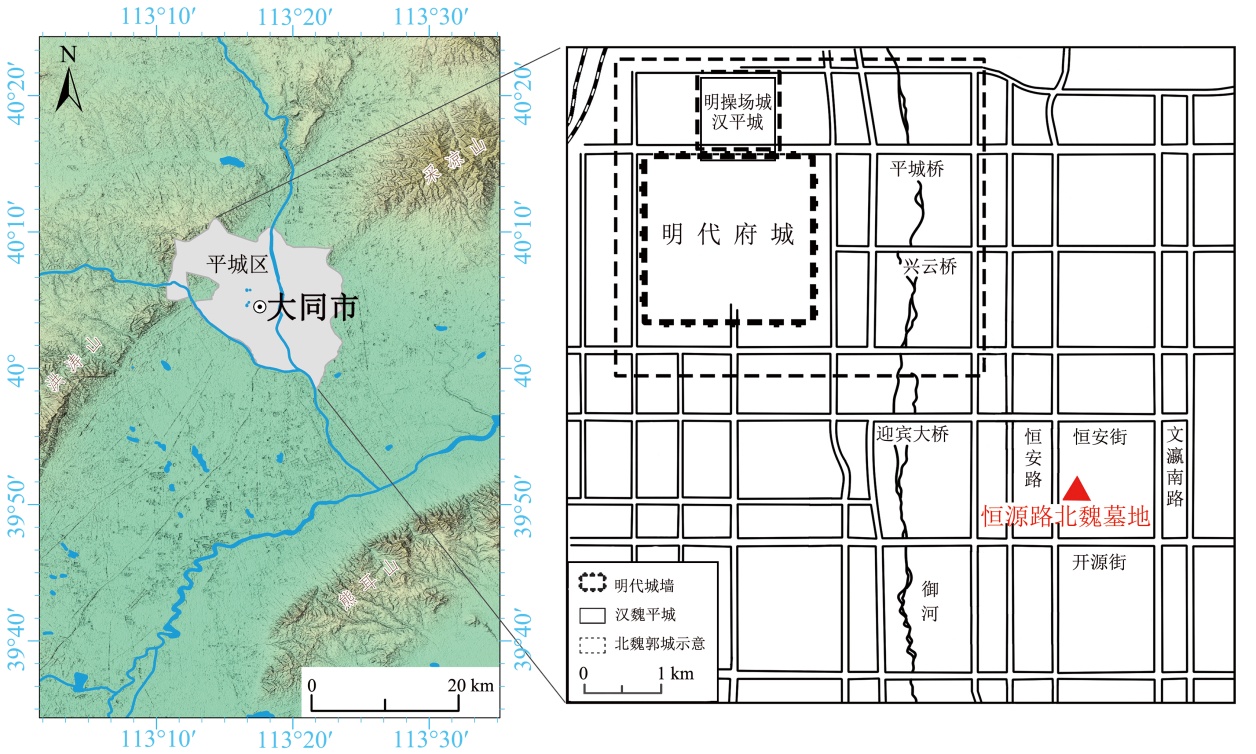
图1 大同恒源路北魏墓地位置示意图 左图浅灰色区域为大同市平城区 the light grey area (left) denotes Pingcheng District, Datong。 右图修改自文献[12]/ the right image modified from [12]。
Fig.1 Location of the Northern Wei Dynasty Cemetery at Hengyuan Road, Datong
| 对比组Sample | 姜家梁Jiangjialiang | 磨沟Mogou | 后套木嘎Houtaomuga | 殷墟中小墓Yinxu | 榆次聂店Yuci Niedian | 榆次明清Yuci Mingqing | 大同恒源路Datong | 组内dm /Intragroup dm |
|---|---|---|---|---|---|---|---|---|
| 姜家梁Jiangjialiang | 0 | 3.9293 | 5.187 | 4.0993 | 5.7018 | 4.6301 | 3.8717 | 4.0983 |
| 磨沟Mogou | 3.9293 | 0 | 4.517 | 3.5566 | 5.2921 | 4.2027 | 3.3502 | 3.4387 |
| 后套木嘎Houtaomuga | 5.187 | 4.517 | 0 | 4.2661 | 6.6111 | 5.998 | 4.052 | 3.586 |
| 殷墟中小墓Yinxu | 4.0993 | 3.5566 | 4.2661 | 0 | 4.9255 | 4.8751 | 3.0456 | 3.3029 |
| 榆次聂店Yuci Niedian | 5.7018 | 5.2921 | 6.6111 | 4.9255 | 0 | 5.8655 | 4.7042 | 4.047 |
| 榆次明清Yuci Mingqing | 4.6301 | 4.2027 | 5.998 | 4.8751 | 5.8655 | 0 | 4.6563 | 3.6979 |
| 大同恒源路Datong | 3.8717 | 3.3502 | 4.052 | 3.0456 | 4.7042 | 4.6563 | 0 | 2.8717 |
表1 男性各组间dm及组内dm
Tab.1 Intergroup dm and intragroup dm of male samples
| 对比组Sample | 姜家梁Jiangjialiang | 磨沟Mogou | 后套木嘎Houtaomuga | 殷墟中小墓Yinxu | 榆次聂店Yuci Niedian | 榆次明清Yuci Mingqing | 大同恒源路Datong | 组内dm /Intragroup dm |
|---|---|---|---|---|---|---|---|---|
| 姜家梁Jiangjialiang | 0 | 3.9293 | 5.187 | 4.0993 | 5.7018 | 4.6301 | 3.8717 | 4.0983 |
| 磨沟Mogou | 3.9293 | 0 | 4.517 | 3.5566 | 5.2921 | 4.2027 | 3.3502 | 3.4387 |
| 后套木嘎Houtaomuga | 5.187 | 4.517 | 0 | 4.2661 | 6.6111 | 5.998 | 4.052 | 3.586 |
| 殷墟中小墓Yinxu | 4.0993 | 3.5566 | 4.2661 | 0 | 4.9255 | 4.8751 | 3.0456 | 3.3029 |
| 榆次聂店Yuci Niedian | 5.7018 | 5.2921 | 6.6111 | 4.9255 | 0 | 5.8655 | 4.7042 | 4.047 |
| 榆次明清Yuci Mingqing | 4.6301 | 4.2027 | 5.998 | 4.8751 | 5.8655 | 0 | 4.6563 | 3.6979 |
| 大同恒源路Datong | 3.8717 | 3.3502 | 4.052 | 3.0456 | 4.7042 | 4.6563 | 0 | 2.8717 |
| 对比组Sample | 姜家梁Jiangjialiang | 磨沟Mogou | 后套木嘎Houtaomuga | 殷墟中小墓Yinxu | 榆次聂店Yuci Niedian | 榆次明清Yuci Mingqing | 大同恒源路Datong | 组内dm /Intragroup dm |
|---|---|---|---|---|---|---|---|---|
| 姜家梁Jiangjialiang | 0 | 4.1843 | 4.5346 | 3.7969 | 3.3798 | 3.9455 | 4.1772 | 3.6456 |
| 磨沟Mogou | 4.1843 | 0 | 4.5784 | 4.0442 | 3.9395 | 4.594 | 4.1104 | 4.0042 |
| 后套木嘎Houtaomuga | 4.5346 | 4.5784 | 0 | 3.7967 | 4.3645 | 5.6951 | 4.7537 | 2.8526 |
| 殷墟中小墓Yinxu | 3.7969 | 4.0442 | 3.7967 | 0 | 3.3118 | 4.6224 | 3.9454 | 3.3956 |
| 榆次聂店Yuci Niedian | 3.3798 | 3.9395 | 4.3645 | 3.3118 | 0 | 3.8852 | 3.7216 | 2.9324 |
| 榆次明清Yuci Mingqing | 3.9455 | 4.594 | 5.6951 | 4.6224 | 3.8852 | 0 | 4.7277 | 3.7197 |
| 大同恒源路Datong | 4.1772 | 4.1104 | 4.7537 | 3.9454 | 3.7216 | 4.7277 | 0 | 3.8949 |
表2 女性各组间dm及组内dm
Tab.2 Intergroup dm and intragroup dm of female samples
| 对比组Sample | 姜家梁Jiangjialiang | 磨沟Mogou | 后套木嘎Houtaomuga | 殷墟中小墓Yinxu | 榆次聂店Yuci Niedian | 榆次明清Yuci Mingqing | 大同恒源路Datong | 组内dm /Intragroup dm |
|---|---|---|---|---|---|---|---|---|
| 姜家梁Jiangjialiang | 0 | 4.1843 | 4.5346 | 3.7969 | 3.3798 | 3.9455 | 4.1772 | 3.6456 |
| 磨沟Mogou | 4.1843 | 0 | 4.5784 | 4.0442 | 3.9395 | 4.594 | 4.1104 | 4.0042 |
| 后套木嘎Houtaomuga | 4.5346 | 4.5784 | 0 | 3.7967 | 4.3645 | 5.6951 | 4.7537 | 2.8526 |
| 殷墟中小墓Yinxu | 3.7969 | 4.0442 | 3.7967 | 0 | 3.3118 | 4.6224 | 3.9454 | 3.3956 |
| 榆次聂店Yuci Niedian | 3.3798 | 3.9395 | 4.3645 | 3.3118 | 0 | 3.8852 | 3.7216 | 2.9324 |
| 榆次明清Yuci Mingqing | 3.9455 | 4.594 | 5.6951 | 4.6224 | 3.8852 | 0 | 4.7277 | 3.7197 |
| 大同恒源路Datong | 4.1772 | 4.1104 | 4.7537 | 3.9454 | 3.7216 | 4.7277 | 0 | 3.8949 |
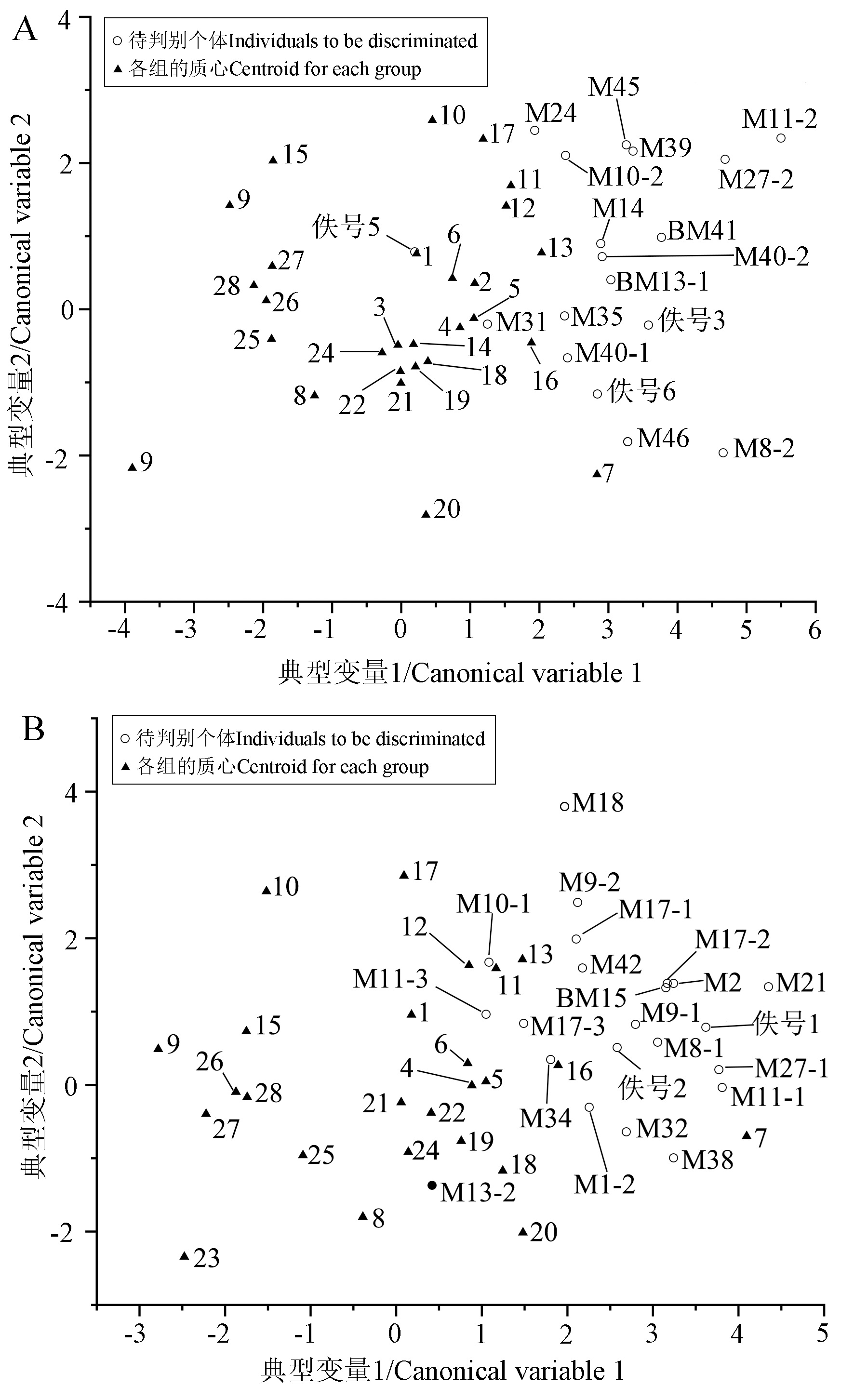
图2 恒源路组男性(A)、女性(B)与Howells数据库群体质心的散点图 恒源路男性个体:BM13-1、BM41、M8-2、M10-2、M11-2、M13-1、M14、M24、M27-2、M35、M40-1、M45、M46、佚号3、佚号5、佚号6。恒源路女性个体:BM15、M1-2、M2、M8-1、M9-1、M9-2、M10-1、M11-1、M11-3、M13-2、M17-1、M17-2、M17-3、M21、M27-1、M32、M34、M38、M42、佚号1、佚号2。 东亚群体:1. Ainu; 2. Anyang; 3. Atayal; 4. Hainan; 5. N Japan; 6. S Japan。北亚群体:7. Buriat。印度洋群体:8. Andaman; 澳大利亚群体:9. Australi。太平洋岛屿群体:10. Easter I; 11. Guam; 12. Mokapu; 13. Moriori; 14. Phillipi; 15. Tolai。美洲群体:16. Arikara; 17. Eskimo; 18. Peru; 19. Santa Cr.。欧洲群体:20. Berg; 21. Norse; 22. Zalavar。非洲群体:23. Bushman; 24. Egypt; 25. Dogon; 26. Tasmania; 27. Teita; 28. Zulu
Fig.2 Scatterplot of Hengyuan Road male (A), female (B) vs. the centroids of the groups in Howells’ database
| 标本specimen | Ancestrees-AnF | Ancestrees-ToF | Fordisc-FDB | Fordisc-Howells | ||||||||||||||
|---|---|---|---|---|---|---|---|---|---|---|---|---|---|---|---|---|---|---|
| 判断结果 | 概率 | n | 鉴定结果 | 概率 | n | 判断结果 | 概率 | n | 全部对比组 all groups | 欧亚对比组European and Asian groups | n | |||||||
| 判断结果 | 概率 | 判断结果 | 概率 | |||||||||||||||
| M10-2 | Northern Asia & Arctic | 36.04% | 5 | Polynesia | 53.91% | 5 | B* | 52.3% | 4 | ESK* | 35.8% | NOR* | 46.9% | 5 | ||||
| North America | 12.40% | Southwestern Europe | 46.09% | W* | 16.9% | EAS* | 23.0% | ZAL* | 13.0% | |||||||||
| Northern & Central Europe | 11.82% | A* | 11.8% | NOR* | 9.5% | SJA* | 10.2% | |||||||||||
| M35 | Northern Asia & Arctic | 30.57% | 21 | Polynesia | 64.45% | 21 | H* | 36.9% | 21 | EGY* | 34.9% | ZAL* | 31.2% | 26 | ||||
| North America | 24.71% | East Asia | 35.55% | J* | 25.1% | MOR* | 29.5% | SJA* | 26.7% | |||||||||
| Polynesia | 14.16% | CH* | 20.4% | SJA* | 8.6% | NOR* | 16.2% | |||||||||||
| M39 | Northern Asia & Arctic | 23.83% | 5 | Northern & Central Europe | 54.69% | 5 | GT* | 41.5% | 5 | ATA* | 16.3% | ATA* | 35.6% | 5 | ||||
| South America | 21.48% | South America | 45.31% | H* | 22.9% | ANY* | 14.3% | ANY* | 30.1% | |||||||||
| North America | 19.34% | J* | 12.9% | ESK* | 14.0% | HAI* | 18.3% | |||||||||||
| M45 | Northeast Africa | 19.34% | 5 | East Asia | 72.27% | 5 | B* | 45.0% | 5 | EAS* | 31.4% | ANY* | 32.3% | 5 | ||||
| Polynesia | 12.30% | Sub-Saharan Africa | 27.73% | W* | 20.6% | ESK* | 14.3% | SJA* | 23.2% | |||||||||
| Southwestern Europe | 11.91% | CH* | 15.7% | ZUL* | 10.5% | AIN* | 16.8% | |||||||||||
| M13-2 | Northern & Central Europe | 22.85% | 20 | Northern & Central Europe | 77.73% | 20 | J** | 56.7% | 20 | EGY** | 62.6% | ZAL** | 41.6% | 25 | ||||
| Northeast Africa | 20.51% | Sub-Saharan Africa | 22.27% | W** | 25.1% | NJA** | 7.9% | NJA** | 26.5% | |||||||||
| Sub-Saharan Africa | 16.60% | H** | 15.2% | ATA** | 7.6% | ATA** | 15.4% | |||||||||||
| M11-1 | Polynesia | 21.29% | 20 | East Asia | 92.19% | 20 | H** | 68.2% | 20 | GUA** | 72.0% | HAI** | 48.0% | 25 | ||||
| North America | 19.63% | North America | 7.81% | J** | 17.0% | HAI** | 11.9% | NJA** | 31.4% | |||||||||
| Southeast Asia | 18.75% | A** | 14.7% | NJA** | 5.5% | SJA** | 12.9% | |||||||||||
| M18 | Polynesia | 22.07% | 6 | East Asia | 64.45% | 6 | W** | 39.9% | 6 | ESK** | 33.0% | AIN** | 70.9% | 8 | ||||
| Southeast Asia | 14.65% | Northeast Africa | 35.55% | B** | 37.1% | EAS** | 21.6% | SJA** | 16.8% | |||||||||
| Northern Asia & Arctic | 14.26% | J** | 10.1% | AIN** | 19.2% | NJA** | 7.9% | |||||||||||
| M2 | Northern & Central Europe | 17.38% | 8 | Northern Asia & Arctic | 72.66% | 8 | H** | 40.8% | 8 | GUA** | 19.8% | HAI** | 21.0% | 12 | ||||
| North America | 16.31% | Polynesia | 27.34% | J** | 37.5% | ARI** | 11.8% | SJA** | 19.7% | |||||||||
| South America | 11.23% | A** | 17.1% | ESK** | 8.7% | NJA** | 18.8% | |||||||||||
| M42 | East Asia | 16.02% | 6 | Northern & Central Europe | 60.16% | 6 | A** | 46.5% | 7 | ESK** | 26.1% | AIN** | 38.5% | 7 | ||||
| Southwestern Europe | 15.23% | Polynesia | 39.84% | W** | 17.4% | MOR** | 17.0% | NOR** | 19.1% | |||||||||
| Polynesia | 13.96% | H** | 13.3% | AIN** | 12.8% | ZAL** | 17.9% | |||||||||||
表3 两种种族鉴定方法的部分结果
Tab.3 The partial results of ancestry estimation by two methods
| 标本specimen | Ancestrees-AnF | Ancestrees-ToF | Fordisc-FDB | Fordisc-Howells | ||||||||||||||
|---|---|---|---|---|---|---|---|---|---|---|---|---|---|---|---|---|---|---|
| 判断结果 | 概率 | n | 鉴定结果 | 概率 | n | 判断结果 | 概率 | n | 全部对比组 all groups | 欧亚对比组European and Asian groups | n | |||||||
| 判断结果 | 概率 | 判断结果 | 概率 | |||||||||||||||
| M10-2 | Northern Asia & Arctic | 36.04% | 5 | Polynesia | 53.91% | 5 | B* | 52.3% | 4 | ESK* | 35.8% | NOR* | 46.9% | 5 | ||||
| North America | 12.40% | Southwestern Europe | 46.09% | W* | 16.9% | EAS* | 23.0% | ZAL* | 13.0% | |||||||||
| Northern & Central Europe | 11.82% | A* | 11.8% | NOR* | 9.5% | SJA* | 10.2% | |||||||||||
| M35 | Northern Asia & Arctic | 30.57% | 21 | Polynesia | 64.45% | 21 | H* | 36.9% | 21 | EGY* | 34.9% | ZAL* | 31.2% | 26 | ||||
| North America | 24.71% | East Asia | 35.55% | J* | 25.1% | MOR* | 29.5% | SJA* | 26.7% | |||||||||
| Polynesia | 14.16% | CH* | 20.4% | SJA* | 8.6% | NOR* | 16.2% | |||||||||||
| M39 | Northern Asia & Arctic | 23.83% | 5 | Northern & Central Europe | 54.69% | 5 | GT* | 41.5% | 5 | ATA* | 16.3% | ATA* | 35.6% | 5 | ||||
| South America | 21.48% | South America | 45.31% | H* | 22.9% | ANY* | 14.3% | ANY* | 30.1% | |||||||||
| North America | 19.34% | J* | 12.9% | ESK* | 14.0% | HAI* | 18.3% | |||||||||||
| M45 | Northeast Africa | 19.34% | 5 | East Asia | 72.27% | 5 | B* | 45.0% | 5 | EAS* | 31.4% | ANY* | 32.3% | 5 | ||||
| Polynesia | 12.30% | Sub-Saharan Africa | 27.73% | W* | 20.6% | ESK* | 14.3% | SJA* | 23.2% | |||||||||
| Southwestern Europe | 11.91% | CH* | 15.7% | ZUL* | 10.5% | AIN* | 16.8% | |||||||||||
| M13-2 | Northern & Central Europe | 22.85% | 20 | Northern & Central Europe | 77.73% | 20 | J** | 56.7% | 20 | EGY** | 62.6% | ZAL** | 41.6% | 25 | ||||
| Northeast Africa | 20.51% | Sub-Saharan Africa | 22.27% | W** | 25.1% | NJA** | 7.9% | NJA** | 26.5% | |||||||||
| Sub-Saharan Africa | 16.60% | H** | 15.2% | ATA** | 7.6% | ATA** | 15.4% | |||||||||||
| M11-1 | Polynesia | 21.29% | 20 | East Asia | 92.19% | 20 | H** | 68.2% | 20 | GUA** | 72.0% | HAI** | 48.0% | 25 | ||||
| North America | 19.63% | North America | 7.81% | J** | 17.0% | HAI** | 11.9% | NJA** | 31.4% | |||||||||
| Southeast Asia | 18.75% | A** | 14.7% | NJA** | 5.5% | SJA** | 12.9% | |||||||||||
| M18 | Polynesia | 22.07% | 6 | East Asia | 64.45% | 6 | W** | 39.9% | 6 | ESK** | 33.0% | AIN** | 70.9% | 8 | ||||
| Southeast Asia | 14.65% | Northeast Africa | 35.55% | B** | 37.1% | EAS** | 21.6% | SJA** | 16.8% | |||||||||
| Northern Asia & Arctic | 14.26% | J** | 10.1% | AIN** | 19.2% | NJA** | 7.9% | |||||||||||
| M2 | Northern & Central Europe | 17.38% | 8 | Northern Asia & Arctic | 72.66% | 8 | H** | 40.8% | 8 | GUA** | 19.8% | HAI** | 21.0% | 12 | ||||
| North America | 16.31% | Polynesia | 27.34% | J** | 37.5% | ARI** | 11.8% | SJA** | 19.7% | |||||||||
| South America | 11.23% | A** | 17.1% | ESK** | 8.7% | NJA** | 18.8% | |||||||||||
| M42 | East Asia | 16.02% | 6 | Northern & Central Europe | 60.16% | 6 | A** | 46.5% | 7 | ESK** | 26.1% | AIN** | 38.5% | 7 | ||||
| Southwestern Europe | 15.23% | Polynesia | 39.84% | W** | 17.4% | MOR** | 17.0% | NOR** | 19.1% | |||||||||
| Polynesia | 13.96% | H** | 13.3% | AIN** | 12.8% | ZAL** | 17.9% | |||||||||||
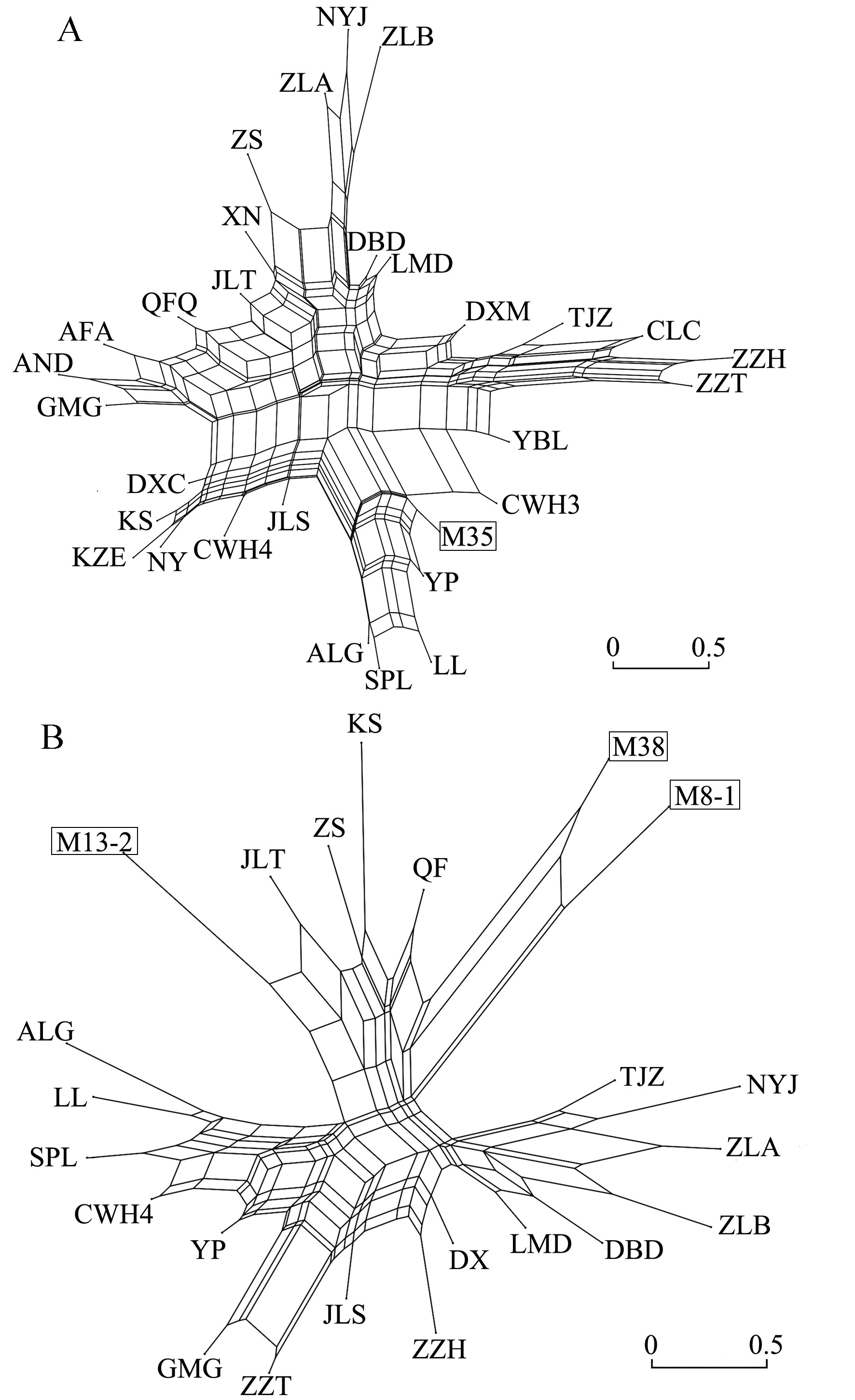
图3 男性(A)、女性(B)对比组的网状邻接图 图中字母代号所指对比组分别为:米努辛斯克盆地阿凡纳羡沃组,AFA;米努辛斯克盆地安德罗诺沃组,AND;古墓沟组,GMG;大同东信广场有三组,其中男性C组代号为DXC,M组代号为DXM,女性组代号为DX;喀什晋唐组,KS;克孜尔组,KZE;尼雅组,NY;察吾乎四号墓地组,CWH4;九龙山-南垣组,JLS;阿拉沟Ⅰ组,ALG;山普拉组,SPL;楼兰城郊组,LL;营盘组,YP;察吾乎三号墓地组,CWH3;焉不拉克C组,YBL;郑州唐墓组,ZZT;郑州汉墓组,ZZH;宁夏中卫常乐C组,CLC;西宁陶家寨组,TJZ;三燕喇嘛洞组,LMD;神木大保当组,DBD;扎赉诺尔A组,ZLA;扎赉诺尔B组,ZLB;南杨家营子组,NYJ;昭苏组,ZS;蒙古匈奴合并组,XN;吉林台组,JLT;恰甫其海组,QFQ。图中方框内是大同恒源路组的个体编号the boxed characters in the image are the individual numbers of Datong Hengyuan Road Group。
Fig.3 Neighbor-joining network diagram of the male (A) and female (B) samples
| [1] |
Devor EJ. Transmission of human craniofacial dimensions[J]. Journal of Craniofacial Genetics and Developmental Biology, 1987, 7(2): 95-106
pmid: 3624421 |
| [2] | Pearson K. Craniological notes: homogeneity and heterogeneity in collections of crania[J]. Biometrika, 1903, 2(3): 345-347 |
| [3] | Howells WW. Some uses of the standard deviation in anthropometry[J]. Human Biology, 1936, 8(4): 592-600 |
| [4] |
Hefner JT. Cranial nonmetric variation and estimating ancestry[J]. Journal of Forensic Sciences, 2009, 54(5): 985-995
doi: 10.1111/jfo.2009.54.issue-5 URL |
| [5] |
Plemons AM, Hefner JT. Ancestry estimation using macromorphoscopic traits[J]. Academic Forensic Pathology, 2016, 6(3): 400-412
doi: 10.23907/2016.041 pmid: 31239915 |
| [6] | Hefner JT, Emanovsky PD, Byrd J, et al. The value of experience, education, and methods in ancestry prediction[A]. In: Proceedings of the 59th Annual Meeting of the American Academy of Forensic Sciences[C]. Colorado Springs, CO: American Academy of Forensic Sciences, 2007: H64 |
| [7] |
Nakhaeizadeh S, Dror IE, Morgan RM. Cognitive bias in forensic anthropology: visual assessment of skeletal remains is susceptible to confirmation bias[J]. Science and Justice, 2014, 54(3): 208-214
doi: 10.1016/j.scijus.2013.11.003 URL |
| [8] |
Dunn RR, Spiros MC, Kamnikar KR, et al. Ancestry estimation in forensic anthropology: A review[J]. Wiley Interdisciplinary Reviews: Forensic Science, 2020, 2(4): e1369
doi: 10.1002/wfs2.v2.4 URL |
| [9] |
Flouri DE, Alifragki A, Gómez García-Donas J, et al. Ancestry estimation: advances and limitations in forensic applications[J]. Research and Reports in Forensic Medical Science, 2022, 12: 13-24
doi: 10.2147/RRFMS.S272224 URL |
| [10] |
Cunha E, Ubelaker DH. Evaluation of ancestry from human skeletal remains: a concise review[J]. Forensic Sciences Research, 2020, 5(2): 89-97
doi: 10.1080/20961790.2019.1697060 pmid: 32939424 |
| [11] | Ousley SD. Forensic classification and biodistance in the 21st century: the rise of learning machines[A]. In: Pilloud MA, Hefner JT (Eds). Biological distance analysis: Forensic and bioarchaeological perspectives[M]. London: Elsevier Inc, 2016, 197-212 |
| [12] | 曹臣明. 平城附近鲜卑及北魏墓葬分布规律考[J]. 文物, 2016(5): 61-69 |
| [13] | 徐楠. 大同二中南校区墓地出土人骨研究[D]. 硕士学位论文, 太原: 山西大学, 2023 |
| [14] | 邵象清. 人体测量手册[M]. 上海: 上海辞书出版社, 1985, 34-44 |
| [15] | White TD, Folkens PA. The Human Bone Manual[M]. Burlington: Academic Press, 2005, 406-419 |
| [16] | Evteev AA, Staroverov NE, Potrakhov NN. Analytical techniques and software for the study of intragroup metric variation using principal component analysis[J]. Bulletins et mémoires de la Société d’Anthropologie de Paris, 2021, 33(1): 87-97 |
| [17] |
Howells WW. Howells' craniometric data on the internet[J]. American Journal of Physical Anthropology, 1996, 101(3): 441-442
pmid: 8922187 |
| [18] | Howells WW. Skull Shapes and the Map[M]. Cambridge: Peabody Museum of Archaeology and Ethnology, Harvard University, 1989, 89-119 |
| [19] |
Navega D, Coelho C, Vicente R, et al. AncesTrees: ancestry estimation with randomized decision trees[J]. International journal of legal medicine, 2015, 129(5): 1145-1153
doi: 10.1007/s00414-014-1050-9 pmid: 25053239 |
| [20] | Ousley SD, Jantz RL. Fordisc 3 and statistical methods for estimating sex and ancestry[A]. In: Dirkmaat DC(Ed.). A companion to forensic anthropology[M]. London: Wiley-Blackwell, 2012, 311-329 |
| [21] | Jantz RL, Ousley SD. Introduction to Fordisc 3 and human variation statistics[A]. In: Langley NR, Tersigni-Tarrant MT(Eds). Forensic Anthropology: A Comprehensive Introduction (2nd edition)[M]. Boca Raton, FL: CRC Press, 2017, 255-270 |
| [22] |
Darroch JN, Mosimann JE. Canonical and principal components of shape[J]. Biometrika, 1985, 72(2): 241-252
doi: 10.1093/biomet/72.2.241 URL |
| [23] |
Huson DH, Bryant D. Application of phylogenetic networks in evolutionary studies[J]. Molecular biology and evolution, 2006, 23(2): 254-267
doi: 10.1093/molbev/msj030 pmid: 16221896 |
| [24] | Howells WW. Cranial Variation in Man[M]. Papers of the Peabody Museum of Archaeology and Ethnology, Harvard University, Vol. 67. Cambridge: Peabody Museum of Archaeology and Ethnology, Harvard University, 1973, 170-187 |
| [25] |
Pang J, Dong Y, Turner C, et al. Analysis of data consistency identifies measurement abnormality in Howells' craniometric test data set[J]. American Journal of Biological Anthropology, 2022, 179(4): 687-692
doi: 10.1002/ajpa.v179.4 URL |
| [26] | Howells WW. Skull Shapes and the Map[M]. Cambridge: Peabody Museum of Archaeology and Ethnology, Harvard University, 1989, 45-70 |
| [27] |
Littlefield A, Lieberman L, Reynolds LT, et al. Redefining race: the potential demise of a concept in physical anthropology [and comments and reply][J]. Current Anthropology, 1982, 23(6): 641-655
doi: 10.1086/202915 URL |
| [28] | Armelagos G, Goodman AH. Race, racism, and anthropology[A]. In: Goodman AH, Leatherman TL(Eds). Building a New Biocultural Synthesis: Political-Economic Perspectives on Human Biology[M]. Ann Arbor: University of Michigan Press, 1998, 359-378 |
| [29] |
Fuentes A, Ackermann RR, Athreya S, et al. AAPA statement on race and racism[J]. American Journal of Physical Anthropology, 2019, 169(3): 400-402
doi: 10.1002/ajpa.23882 pmid: 31199004 |
| [30] |
Sauer NJ. Forensic anthropology and the concept of race: if races don't exist, why are forensic anthropologists so good at identifying them?[J]. Social Science & Medicine, 1992, 34(2): 107-111
doi: 10.1016/0277-9536(92)90086-6 URL |
| [31] |
Ousley S, Jantz R, Freid D. Understanding race and human variation: why forensic anthropologists are good at identifying race[J]. American Journal of Physical Anthropology, 2009, 139(1): 68-76
doi: 10.1002/ajpa.21006 pmid: 19226647 |
| [32] | Ousley S, Jantz RL, Hefner JT. From Blumenbach to Howells: the slow, painful emergence of theory through forensic race estimation[A]. In: Boyd CC, Boyd DC (Eds). Forensic Anthropology: Theoretical Framework and Scientific Basis[M]. New York: John Wiley & Sons, 2018, 67-97 |
| [33] |
Bamshad M, Wooding S, Salisbury BA, et al. Deconstructing the relationship between genetics and race[J]. Nature reviews genetics, 2004, 5(8): 598-609
doi: 10.1038/nrg1401 pmid: 15266342 |
| [34] |
Ross AH, Williams SE. Ancestry studies in forensic anthropology: back on the frontier of racism[J]. Biology, 2021, 10(7): 602
doi: 10.3390/biology10070602 URL |
| [35] | 希安·琼斯. 族属的考古:构建古今的身份[M].译者:陈淳,沈辛成. 上海: 上海古籍出版社, 2017 |
| [36] | 梁云, 白劲松. 中国古代北方民族史·拓跋鲜卑卷[M]. 北京: 科学出版社, 2021, 22-33 |
| [37] | 韩康信. 塞、乌孙、匈奴和突厥之种族人类学特征[J]. 西域研究, 1992, 2: 3-23 |
| [38] | 朱泓. 人种学上的匈奴、鲜卑与契丹[J]. 北方文物, 1994(2): 7-13 |
| [39] | 杨军. 鲜卑人中白种人来源考[J]. 辽宁师范大学学报(社会科学版), 2007, 30(6): 108-111 |
| [40] | 陈琳国. 中古北方民族史探[M]. 北京: 商务印书馆, 2010, 445-467 |
| [41] | 路遇, 滕泽之. 中国人口通史(上)[M]. 北京: 中国社会科学出版社, 2015, 240-255 |
| [42] | 李凭. 北魏平城时代(第四版)[M]. 上海: 上海古籍出版社, 2023, 8 |
| [43] | 葛剑雄. 中国移民史·第二卷·先秦至魏晋南北朝时期[M]. 上海: 复旦大学出版社, 2022, 478-518 |
| [44] | 马永. 北魏平城时期族际通婚研究[J]. 云冈研究, 2022(6): 75-80 |
| [45] | 张庆捷. 民族汇聚与文明互动——北朝社会的考古学观察[M]. 北京: 商务印书馆, 2015, 349-368 |
| [46] | 王银田. 丝绸之路与北魏平城[J]. 暨南学报(哲学社会科学版), 2014, 36(1): 139-150 |
| [47] | 尚永琪. 北朝胡人与佛教的传播[J]. 吉林大学社会科学学报, 2006(2): 135-142 |
| [48] | 刘宁. 新疆地区古代居民的人种结构研究:以楼兰、乌孙、车师、回鹘为例[D].硕士学位论文, 长春: 吉林大学, 2010 |
| [49] | 韩康信. 中国境内考古发现的西方人种成分[A].见:韩康信.韩康信人类学文选韩康信人类学文选[M]. 北京: 科学出版社, 2017, 59-84 |
| [50] | 张银运, 吴秀杰, 刘武. 中国西北地区古代人群头骨的欧洲人种特征[J]. 人类学学报, 2013, 32(3): 274-279 |
| [1] | 周亚威, 王煜, 侯晓刚, 李树云. 山西大同金茂园遗址人群颅骨的形态学[J]. 人类学学报, 2024, 43(02): 233-246. |
| [2] | 侯亮亮;古顺芳;张昕煜;戴玲玲;武夏;张国文;郭怡. 农业区游牧民族饮食文化的滞后性——基于大同东信广场北魏墓群人骨的稳定同位素研究[J]. 人类学学报, 2017, 36(03): 359-369. |
| [3] | 张振标. 中国古代人类强直性脊椎炎的骨骼例证[J]. 人类学学报, 1995, 14(02): 110-194. |
| [4] | 张振标. 中国古代人类遗骸的骨折病例[J]. 人类学学报, 1993, 12(04): 319-326. |
| [5] | 张振标. 长阳青铜时代与大同北魏朝代人类牙齿的形态变异[J]. 人类学学报, 1993, 12(02): 103-112. |
| 阅读次数 | ||||||
|
全文 |
|
|||||
|
摘要 |
|
|||||
 京ICP证05002819号-3
