

主管:中国科学院
主办:中国科学院古脊椎动物与古人类研究所
出版:科学出版社
主办:中国科学院古脊椎动物与古人类研究所
出版:科学出版社
人类学学报 ›› 2025, Vol. 44 ›› Issue (03): 514-528.doi: 10.16359/j.1000-3193/AAS.2025.0033cstr: 32091.14.j.1000-3193/AAS.2025.0033
姚艳燕1,2,3( ), 黄胜敏3, 廖卫1, 李金燕4, 张一景1, 莫进尤5, 王伟1()
收稿日期:2024-12-19
修回日期:2025-03-11
出版日期:2025-06-15
发布日期:2025-06-15
通讯作者:
王伟,教授,主要从事史前考古及相关研究。E-mail: 作者简介:姚艳燕,副研究馆员,主要研究华南地区洞穴化石埋藏学、第四纪哺乳动物群。E-mail: yaoyanyan@amgx.org
基金资助:
YAO Yanyan1,2,3(), HUANG Shengmin3, LIAO Wei1, LI Jinyan4, ZHANG Yijing1, MO Jinyou5, WANG Wei1()
Received:2024-12-19
Revised:2025-03-11
Online:2025-06-15
Published:2025-06-15
摘要:
长期以来,我们对华南地区洞穴化石的来源、埋藏过程及其性质知之甚少,限制了对该区域不同时期动物群埋藏学的深入了解。本研究对广西布兵盆地早更新世吹风洞遗址(约1.9 MaBP)出土的近千枚哺乳动物牙齿和碎骨化石的埋藏学特征进行了详细分析,通过对优势种群的牙齿磨耗程度鉴定死亡年龄,根据种群死亡年龄的分布分析其死亡原因。结果显示,犀牛的死亡模式为磨耗型,偏向于自然死亡的模式;鹿类动物和猪属动物的死亡模式为壮年居优型,这些死亡类型极有可能是不同食肉动物对不同体型猎物的选择以及自然死亡等多种因素叠加造成的结果。从吹风洞化石的表面痕迹发现,碎骨表面存在食肉动物的咬痕和大量豪猪咬痕,以及牙齿化石不同程度的风化和磨圆痕迹,表明食肉动物和豪猪的搬运是吹风洞遗址化石积累的主要原因。吹风洞遗址动物群的埋藏学研究为探索华南地区第四纪洞穴化石堆积的来源、沉积过程及其形成机制提供了科学依据。
中图分类号:
姚艳燕, 黄胜敏, 廖卫, 李金燕, 张一景, 莫进尤, 王伟. 广西吹风洞早更新世动物群的埋藏学[J]. 人类学学报, 2025, 44(03): 514-528.
YAO Yanyan, HUANG Shengmin, LIAO Wei, LI Jinyan, ZHANG Yijing, MO Jinyou, WANG Wei. A taphonomic study of early Pleistocene mammalian assemblages from the Chuifeng Cave site in South China[J]. Acta Anthropologica Sinica, 2025, 44(03): 514-528.
| 种属Species | 磨耗Worn | P2 | P3 | P4 | M1 | M2 | M3 | p2 | p3 | p4 | m1 | m2 | m3 |
|---|---|---|---|---|---|---|---|---|---|---|---|---|---|
| 赤麂Muntiacus muntjak | W0 | b1R | |||||||||||
| W1 | b2R, b1L | b1R, b2L | b1R | b1R | b1L, b2R | b3L | b1R, b2L | b1L | b1L | a2L, b2L, a1R, b2R | b1R, b2L | ||
| W2 | c2R, c1l | c1R, c2L | b1R | c5L, c2R | c2L | c1R, b1L, c1L | c1L | b1L | c2L,c1R | c2R, c1L | |||
| W3 | d2L | d2R | d2R | c2R | d1L, d3R | d2R | c2L, c1R | d1R | |||||
| 水鹿Cervus unicolor | W0 | b1R | a1L | b1R | a2R | b1R | |||||||
| W1 | b5L, b2R | b1L, b1R | b1R | b2R | b1L | a1L, b3L, a1R | b2L, b1R | ||||||
| W2 | c1L, c1R | c1L, c1R | b1L, c2L, b3R | c3L, c1R | c1R | b1L, c1R | c3R | c2R | |||||
| W3 | d1L, d2R | d1L | c3L, c3R | d1R | d1R | d1L | c1L, c1R | d2L | |||||
| 云南水鹿Cervus yunnanensis | W0 | ||||||||||||
| W1 | b1L, b2R | b3L, b2R | b1L, b2R | b1L | b1L, b3R | b4L | |||||||
| W2 | c1R | c2L, c1R | c1R | c3L, c2R | b2R | c2L, b3R | c1L, c1R | c1L | |||||
| W3 | d1L, d1R | d1L, d2R | c2L, c2R | d2L, d1R | d1R | c1R | d2R | ||||||
| 凤歧鹿Cervus fenqii | W0 | b1R | |||||||||||
| W1 | b1R | b1L, b1R | b1R | b5L, b4R | b1L, b1R | b3L | b1L, b2R | b1R | b2R | b1R | |||
| W2 | c1L, c1R | c1L | c1R | c1L, c1R | c3L | ||||||||
| W3 | d1R | d2L | c1L, c1R, d1R | c3L, c2R | |||||||||
| 裴氏猪 Sus peii | W0 | b1L, b2R | c2L, c3R | b1R | c4L,c1R | ||||||||
| W1 | c4L, c1R | c2L, c1R, d2L, d1R | b1R | c5L, c2R | c2L, c6R, d1R | ||||||||
| W2 | c1L, c1R | c1R, d5L, d1R | d3L, d1R | c4L,c7R | d2L,d1R | d1L | |||||||
| W3 | d1L, d1R | d1R | d1R | ||||||||||
| 犀牛恒齿Permanent teeth of Rhino | W0 | b1R | |||||||||||
| W1 | b1R | b1L | |||||||||||
| W2 | b1R | b1L | c1L | c1R | c2R | c1L, d1R | |||||||
| W3 | c1L | c1L, c1R | d2R |
表1 吹风洞优势种属牙齿磨耗等级统计表(1)
Tab.1 Statistical table of tooth wear grade for dominant species from the Chuifeng Cave (1)
| 种属Species | 磨耗Worn | P2 | P3 | P4 | M1 | M2 | M3 | p2 | p3 | p4 | m1 | m2 | m3 |
|---|---|---|---|---|---|---|---|---|---|---|---|---|---|
| 赤麂Muntiacus muntjak | W0 | b1R | |||||||||||
| W1 | b2R, b1L | b1R, b2L | b1R | b1R | b1L, b2R | b3L | b1R, b2L | b1L | b1L | a2L, b2L, a1R, b2R | b1R, b2L | ||
| W2 | c2R, c1l | c1R, c2L | b1R | c5L, c2R | c2L | c1R, b1L, c1L | c1L | b1L | c2L,c1R | c2R, c1L | |||
| W3 | d2L | d2R | d2R | c2R | d1L, d3R | d2R | c2L, c1R | d1R | |||||
| 水鹿Cervus unicolor | W0 | b1R | a1L | b1R | a2R | b1R | |||||||
| W1 | b5L, b2R | b1L, b1R | b1R | b2R | b1L | a1L, b3L, a1R | b2L, b1R | ||||||
| W2 | c1L, c1R | c1L, c1R | b1L, c2L, b3R | c3L, c1R | c1R | b1L, c1R | c3R | c2R | |||||
| W3 | d1L, d2R | d1L | c3L, c3R | d1R | d1R | d1L | c1L, c1R | d2L | |||||
| 云南水鹿Cervus yunnanensis | W0 | ||||||||||||
| W1 | b1L, b2R | b3L, b2R | b1L, b2R | b1L | b1L, b3R | b4L | |||||||
| W2 | c1R | c2L, c1R | c1R | c3L, c2R | b2R | c2L, b3R | c1L, c1R | c1L | |||||
| W3 | d1L, d1R | d1L, d2R | c2L, c2R | d2L, d1R | d1R | c1R | d2R | ||||||
| 凤歧鹿Cervus fenqii | W0 | b1R | |||||||||||
| W1 | b1R | b1L, b1R | b1R | b5L, b4R | b1L, b1R | b3L | b1L, b2R | b1R | b2R | b1R | |||
| W2 | c1L, c1R | c1L | c1R | c1L, c1R | c3L | ||||||||
| W3 | d1R | d2L | c1L, c1R, d1R | c3L, c2R | |||||||||
| 裴氏猪 Sus peii | W0 | b1L, b2R | c2L, c3R | b1R | c4L,c1R | ||||||||
| W1 | c4L, c1R | c2L, c1R, d2L, d1R | b1R | c5L, c2R | c2L, c6R, d1R | ||||||||
| W2 | c1L, c1R | c1R, d5L, d1R | d3L, d1R | c4L,c7R | d2L,d1R | d1L | |||||||
| W3 | d1L, d1R | d1R | d1R | ||||||||||
| 犀牛恒齿Permanent teeth of Rhino | W0 | b1R | |||||||||||
| W1 | b1R | b1L | |||||||||||
| W2 | b1R | b1L | c1L | c1R | c2R | c1L, d1R | |||||||
| W3 | c1L | c1L, c1R | d2R |
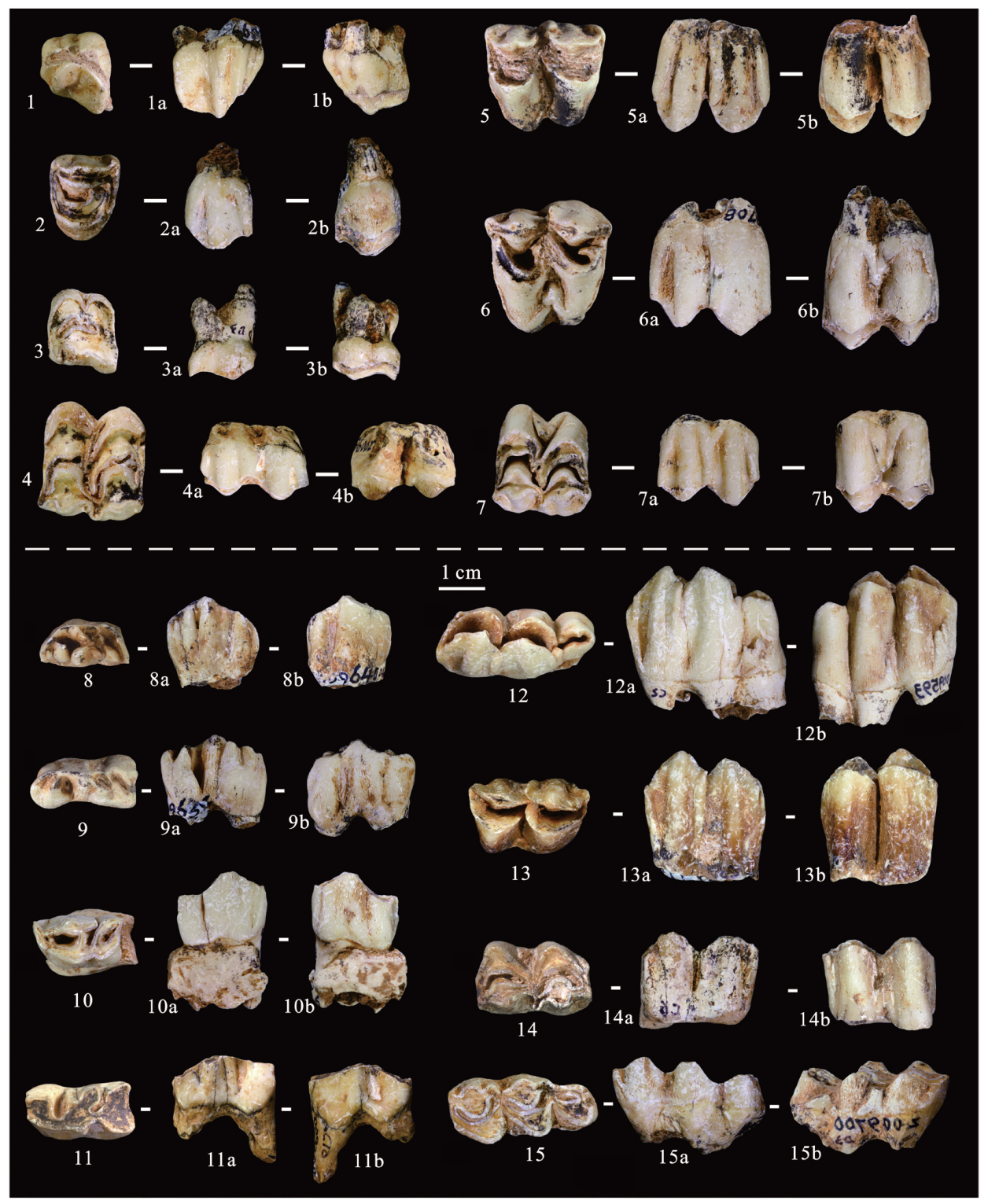
图1 吹风洞水鹿牙齿化石磨耗等级 上颌齿maxillary teeth:1.未磨耗unworn,NO.009767,RP2;2.中度磨耗medium wear,NO.009730,LP4;3.重度磨耗heavy wear,NO.009660,RP3;4.重度磨耗heavy wear,NO.009685,RM1;5.未磨耗unworn,NO.009758,LM2;6.轻度磨耗light wear,NO.009708,LM3;7.中度磨耗medium wear,NO.009721,RM1。1a~7a.唇侧labial side;1b~7b.舌侧lingual side。 下颌齿mandibular teeth:8.未磨耗unworn,NO.009640,rp4;9.轻度磨耗light wear,NO.009652,rp3;10.中度磨耗medium wear,NO.009612,lp4;11.重度磨耗heavy wear,NO.009702,lp3;12.未磨耗unworn,009593,rm3;13.轻度磨耗light wear,NO.009797,lm2;14.中度磨耗medium wear,NO.009602,rm2;15.重度磨耗heavy wear,NO.009700,lm3。8a~15a.舌侧lingual side;8b~15b.唇侧labial side。
Fig.1 Wear grade of mandibular tooth fossils of Cervus unicolor in the Chuifeng Cave
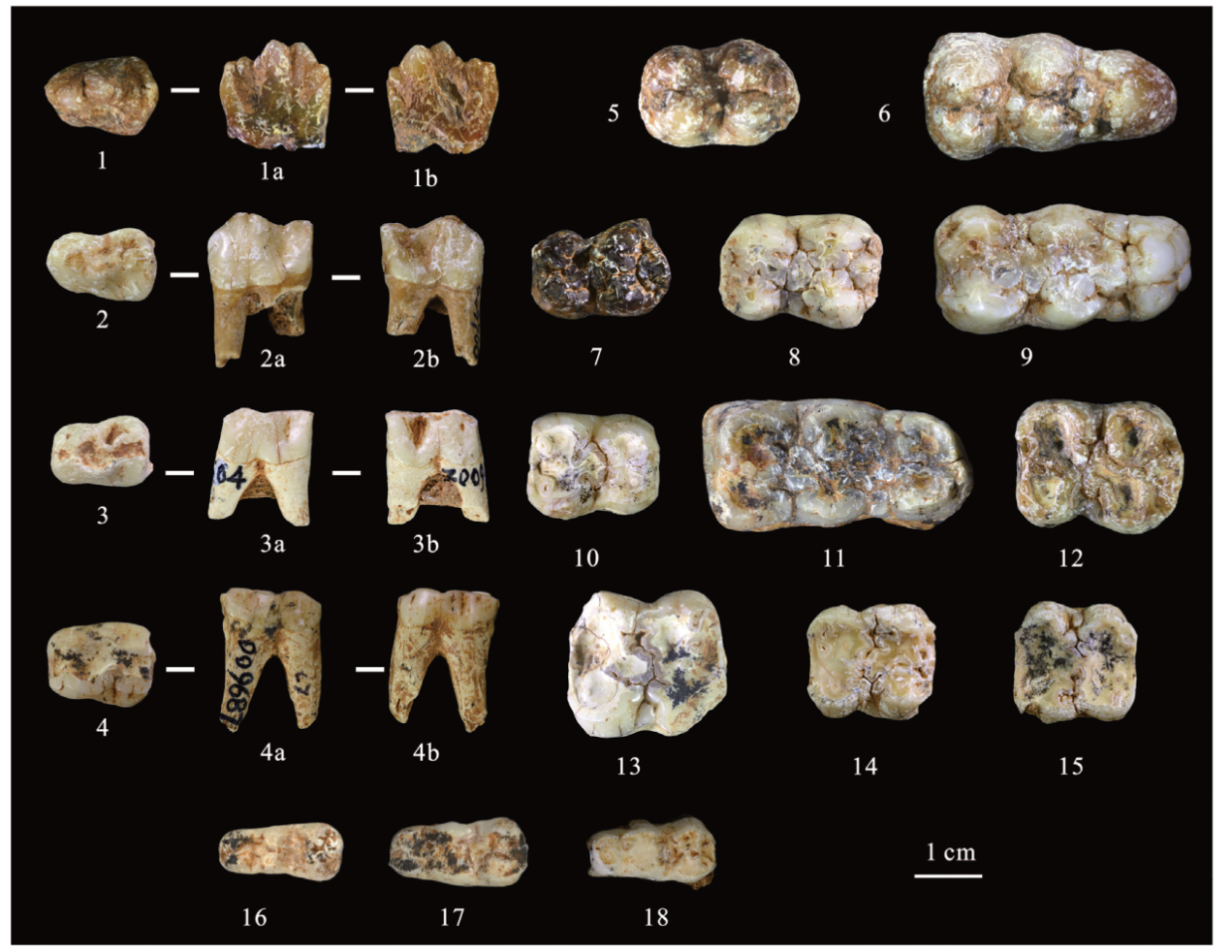
图2 吹风洞裴氏猪牙齿化石磨耗等级 1.未磨耗unworn,NO.009573,lp4;2.轻度磨耗light wear,NO.009706,rp4;3.中度磨耗medium wear,NO.009504,rp4;4.重度磨耗heavy wear,NO.009687,lp4;5.未磨耗unworn,NO.009390,rm2;6.未磨耗unworn,NO.009434,lm3;7.轻度磨耗,NO.009351,rm1;8.轻度磨耗,NO.009414,lm2;9.轻度磨耗light wear,NO.009332,rm3;10.中度磨耗medium wear,NO.009346,rm1;11.中度磨耗medium wear,NO.009470,lm3;12.中度磨耗medium wear,NO.009420,lm2;13.重度磨耗heavy wear,NO.009340,RM2;14.重度磨耗heavy wear,NO.009406,RM1;15.重度磨耗heavy wear,NO.009394,LM1;16.轻度磨耗light wear,NO.CF111,ldp4;17.中度磨耗medium wear,NO.CF113,rdp4;18.中-重度磨耗medium/heavy wear,NO.CF112,rdp4。1a~4a. 舌侧lingual side;1b~4b. 唇侧labial side。
Fig.2 Wear grade of tooth fossils of Sus peii in the Chuifeng Cave
| 种属Species | 磨耗Worn | DP2 | DP3 | dp1 | dp2 | dp3 | dp4 |
|---|---|---|---|---|---|---|---|
| 犀牛乳齿 Deciduous teeth of Rhinoceros fusuiensis | W0 | a1R, a1L | a2L | ||||
| W1 | a1R | a1R | a1R, a1L | a1R | a1L | ||
| W2 | b1L | ||||||
| W3 | b1R | b1R |
表2 吹风洞优势种属牙齿磨耗等级统计表(2)
Tab.2 Statistical table of tooth wear grade for dominant species from the Chuifeng Cave (2)
| 种属Species | 磨耗Worn | DP2 | DP3 | dp1 | dp2 | dp3 | dp4 |
|---|---|---|---|---|---|---|---|
| 犀牛乳齿 Deciduous teeth of Rhinoceros fusuiensis | W0 | a1R, a1L | a2L | ||||
| W1 | a1R | a1R | a1R, a1L | a1R | a1L | ||
| W2 | b1L | ||||||
| W3 | b1R | b1R |
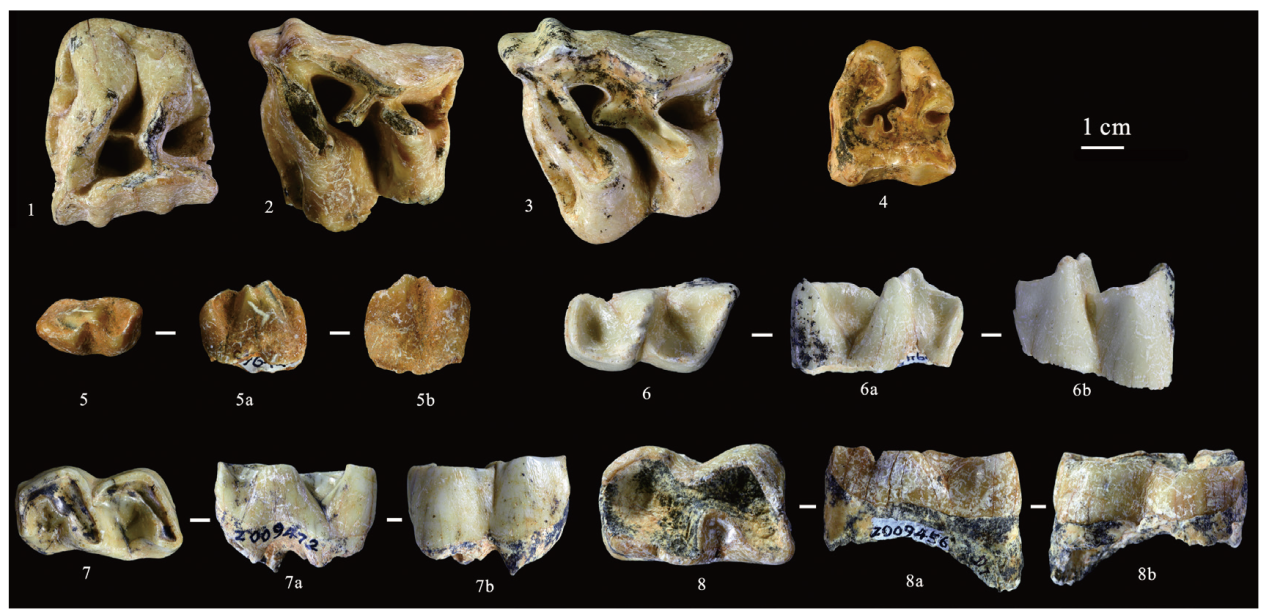
图3 吹风洞犀牛牙齿化石磨耗等级 1.未磨耗unworn,NO.009476,RP4;2.轻度磨耗light wear,NO.009445,LM2;3.中度磨耗medium wear,NO.009457,LM2;4.中-重度磨耗medium/heavy wear,NO.009468,RDP3;5.未磨耗unworn,NO.009642,ldp2;6.轻度磨耗light wear,NO.009454,ldp4;7.中度磨耗medium wear,NO.009472,rp4;8.重度磨耗heavy wear,NO.009456,rm1。5a~8a. 舌侧lingual side;5b~8b. 唇侧labial side
Fig.3 Wear grade of tooth fossils of Rhinoceros fusuiensis in the Chuifeng Cave
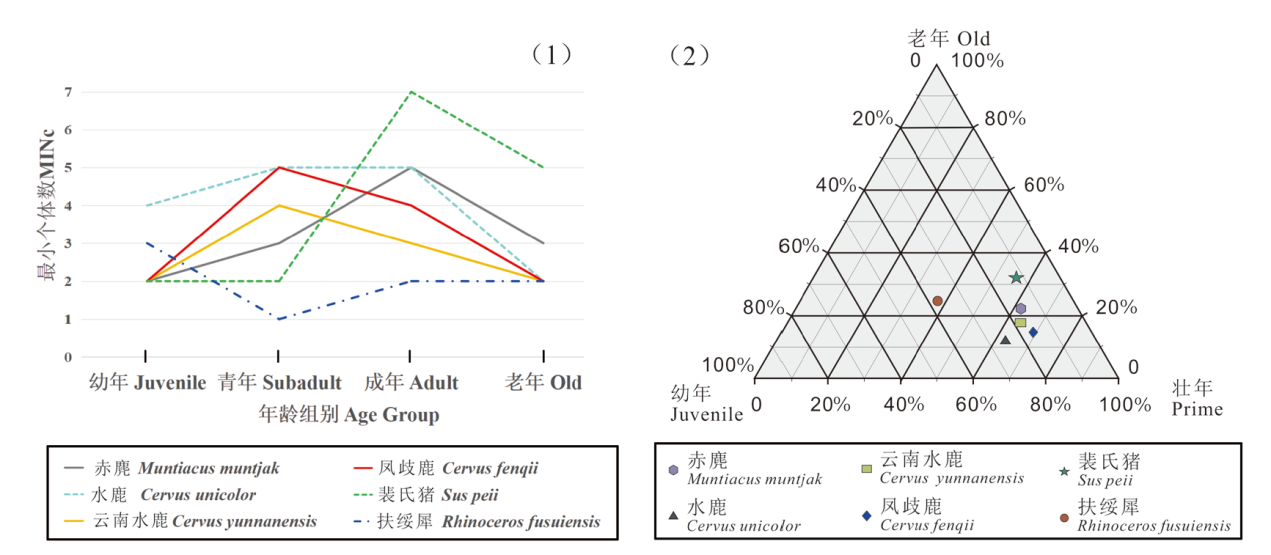
图4 吹风洞优势种属死亡年龄结构图 1.死亡年龄结构折线图(四个年龄组)Line graph of age structure of deaths (four age groups);2. 死亡年龄结构三元坐标图(三个年龄组)Ternary coordinate chart of age structure of deaths (three age groups)。
Fig.4 Age structure graph of dominant species in the Chuifeng Cave
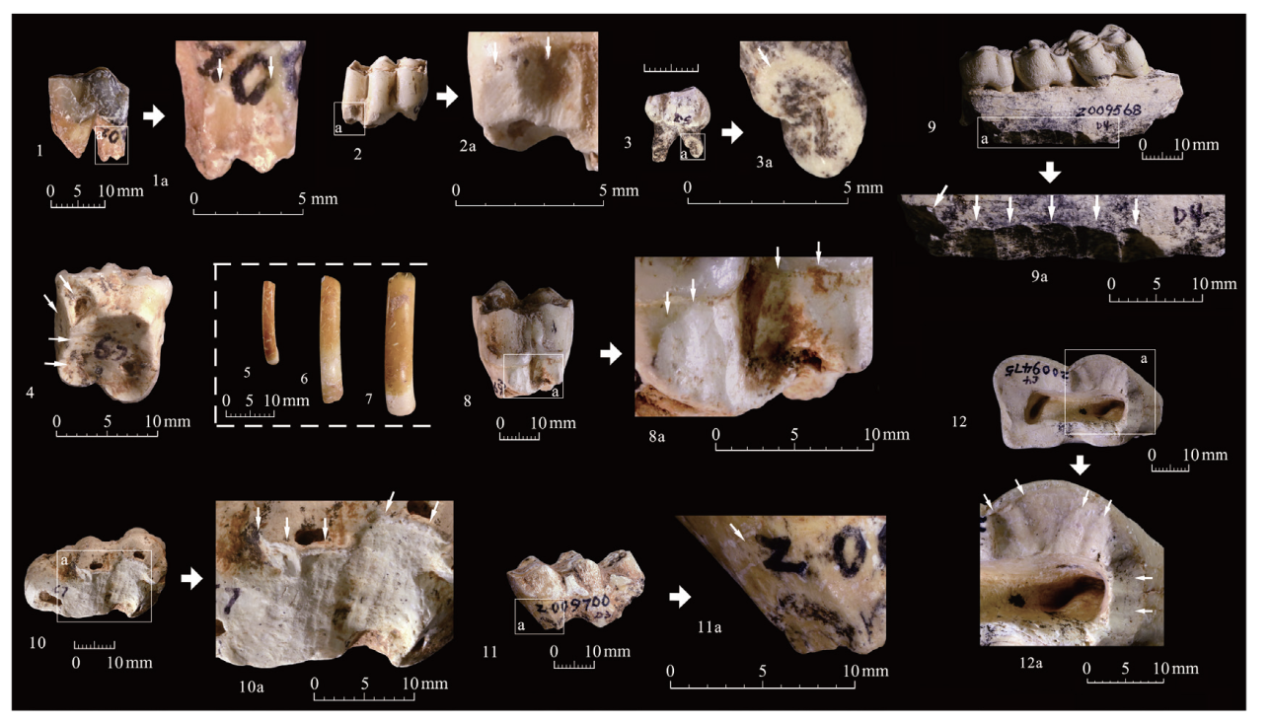
图5 豪猪的啃咬痕迹 1. 009334,裴氏猪Sus peii,rp4;2. CF90,赤麂Muntiacus muntjak,rm3;3. CF22,赤麂Muntiacus muntjak,lp2;4. CF57,赤麂Muntiacus muntjak,LM2;5. CF176,帚尾豪猪Atherurus sp.,RI1;6. CF167,华南豪猪Hystrix Subcristata,RI1;7. CF158,硕豪猪Hystrix magna,RI1;8. 009693,水鹿Cervus unicolor,LM2;9. 009568,凤歧鹿Cervus fenqii,lp3,lp4,lm1;10. 009372,裴氏猪Sus peii,LM3;11. 009700,水鹿Cervus unicolor,lm3;12. 009475,扶绥犀Rhinoceros fusuiensis,rm3
Fig.5 Gnaw marks of the Hystrix sp.
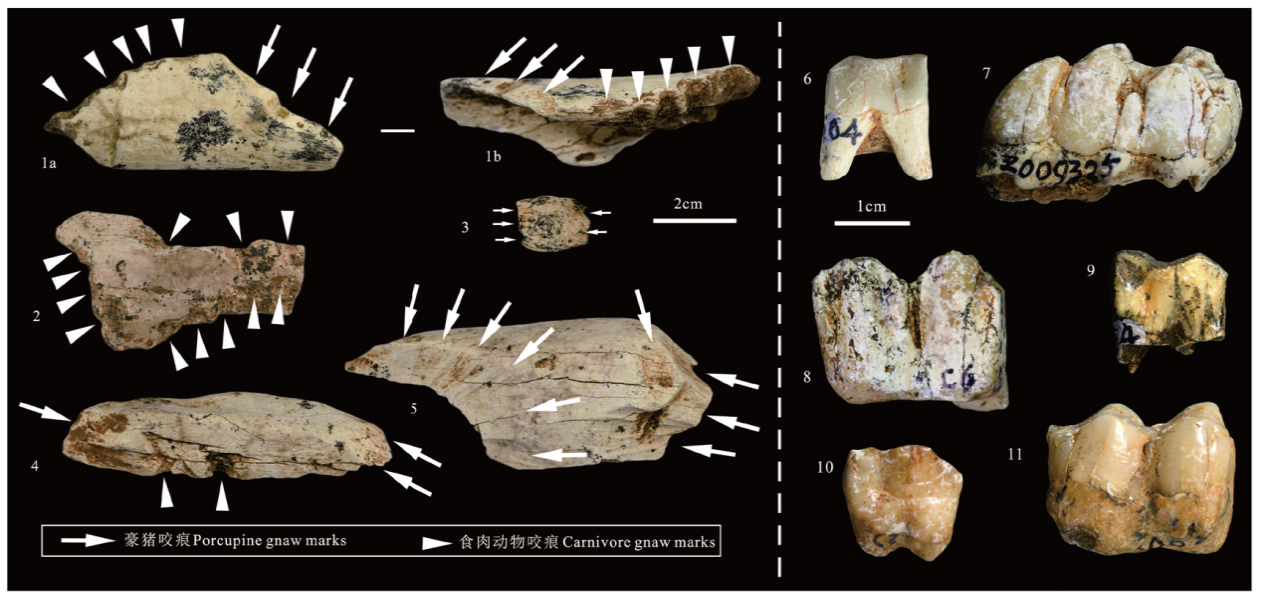
图6 吹风洞化石表面痕迹分类 1a~1b, 4.豪猪咬痕与食肉动物咬痕porcupine and carnivore gnaw marks;2.食肉动物咬痕carnivore gnaw marks;3, 5.豪猪咬痕porcupine gnaw marks;6.轻度风化light weathering,009504,裴氏猪Sus peii,RP4;7.中度风化medium weathering,009325,裴氏猪Sus peii,RM3; 8.重度风化heavy weathering,009602,水鹿Cervus unicolor,rm2;9.轻度磨圆light rounding,009754,裴氏猪Sus peii,lp4; 10.中度磨圆medium rounding,CF346,裴氏猪Sus peii,lp4;11.重度磨圆heavy rounding,009331,裴氏猪Sus peii,rm2
Fig.6 Classification of fossil surface traces from the Chuifeng Cave
| [1] | Bacon AM, Duringer P, Antoine PO, et al. The Middle Pleistocene mammalian fauna from Tam Hang karstic deposit, northern Laos: New data and evolutionary hypothesis[J]. Quaternary International, 2011, 245: 315-332 |
| [2] | Duringer P, Bacon AM, Sayavongkhamdy T, et al. Karst development, breccias history, and mammalian assemblages in Southeast Asia: A brief review[J]. Science Direct, 2012, 11: 133-157 |
| [3] | Fan YB, Shao QF, Bacon AM, et al. Late Pleistocene large-bodied mammalian fauna from Mocun cave in south China: Palaeontological, chronological and biogeographical implications[J]. Quaternary Science Reviews, 2022, 294: 107741 |
| [4] | Liang H, Liao W, Shao QF, et al. New discovery of a late Middle Pleistocene mammalian fauna in Ganxian Cave, Southern China[J]. Historical Biology, 2022, 1-18 |
| [5] | Liao W, Harrison T, Yao YY, et al. Evidence for the latest fossil Pongo in southern China[J]. Journal of Human Evolution, 2022, 170: 103233 |
| [6] | Vu T L, Vos JD, Ciochon RL. The fossil mammal fauna of the Lang Trang caves, Vietnam, compared with Southeast Asian fossil and recent mammal faunas: the geographical implications[J]. Bulletin of the Indo-Pacific Prehistory Association, 1996, 14: 100-109 |
| [7] | Wang W, Liao W, Li DW, et al. Early Pleistocene large-mammal fauna associated with Gigantopithecus at Mohui Cave, Bubing Basin, South China[J]. Quaternary International, 2014, 354: 122-130 |
| [8] | Yao YY, Fan YB, Bae CJ, et al. Early Mid-Pleistocene mammal fauna from Yanlidong Cave, South China[J]. Historical biology, 2023, 1-18 |
| [9] | Christopher J.B, Wang W, Zhao JX, et al. Modern human teeth from Late Pleistocene Luna Cave (Guangxi, China)[J]. Quaternary International, 2014, 354: 169-183 |
| [10] | Liao W, Xing S, Li DW, et al. Mosaic dental morphology in a terminal Pleistocene hominin from Dushan Cave in southern China[J]. Scientific Reports, 2019, 9(1): 1-14 |
| [11] | Yao YY, Liao W, Christopher J.B, et al. New discovery of Late Pleistocene modern human teeth from Chongzuo, Guangxi, southern China[J]. Quaternary International, 2020, 563: 5-12 |
| [12] | 金昌柱, 潘文石, 张颖奇, 等. 广西崇左江州木榄山智人洞古人类遗址及其地质时代[J]. 科学通报, 2009, 54(19): 2848-2856 |
| [13] | 王頠, Potts R, 侯亚梅, 等. 广西布兵盆地么会洞新发现的早更新世人类化石[J]. 科学通报, 2005, 17: 85-89 |
| [14] | Tong HW, Zhang SQ, Chen FY, et al. Rongements sélectifs des os par les porcs-épics et autres rongeurs: cas de la grotte Tianyuan, un site avec des restes humains fossiles récemment découvert près de Zhoukoudian (Choukoutien)[J]. L'Anthropologie, 2008, 112(3): 353-369 |
| [15] | Tong HW. Age Profiles of Rhino Fauna from the Middle Pleistocene Nanjing Man Site, South China -Explained by the Rhino Specimens of Living Species[J]. International Journal of Osteoarchaeology, 2001, 11: 231-237 |
| [16] | Schepartz LA, Stoutamire S, Bekken DA. Stegodon orientalis from Panxian Dadong, a Middle Pleistocene archaeological site in Guizhou, South China: taphonomy, population structure and evidence for human interactions[J]. Quaternary International, 2005, (126-128): 271-282 |
| [17] | Schepartz LA, Miller-Antonio S. Taphonomy, Life History, and Human Exploitation of Rhinoceros sinensis at the Middle Pleistocene Site of Panxian Dadong, Guizhou, China[J]. International Journal of Osteoarchaeology, 2010, 20: 253-268 |
| [18] | 李占扬, 张双权. 灵井遗址动物群埋藏学研究方法与思路[J]. 中原文物, 2008, 5: 26-32 |
| [19] | 张双权, 李占扬, 张乐, 等. 河南灵井许昌人遗址大型食草类动物死亡年龄分析及东亚现代人类行为的早期出现[J]. 科学通报, 2009, 54(19): 2857-2863 |
| [20] | 陈曦, 同号文. 泥河湾山神庙嘴化石点直隶狼埋藏学研究[J]. 人类学学报, 2015, 34(4): 553-564 |
| [21] | 陈君, 王頠, 李大伟, 等. 广西田东中山遗址洞外岩厦出土动物骨骼的初步研究[J]. 人类学学报, 2017, 36(4): 527-536 |
| [22] | Bacon AM, Westaway K, Antoine PO, et al. Late Pleistocene mammalian assemblages of Southeast Asia: New dating,mortality profiles and evolution of the predator-prey relationships in an environmental context[J]. Palaeogeography, Palaeoclimatology, Palaeoecology, 2015, 422: 101-127 |
| [23] |
Wang W. New discoveries of Gigantopithecus blacki teeth from Chuifeng Cave in the Bubing Basin, Guangxi, south China[J]. Journal of Human Evolution, 2009, 57(3): 229-240
doi: 10.1016/j.jhevol.2009.05.004 pmid: 19656551 |
| [24] |
Wang W, Potts R, Yuan BY, et al. Sequence of mammalian fossils, including hominoid teeth, from the Bubing Basin caves, South China[J]. Journal of Human Evolution, 2007, 52(4): 370-379
pmid: 17198721 |
| [25] | Shao QF, Wang W, Deng CL, et al. ESR, U-series and paleomagnetic dating ofGigantopithecus fauna from Chuifeng Cave, Guangxi, southern China[J]. Quaternary Research, 2014, 82(1): 270-280 |
| [26] | Welker F, Ramos-Madrigal J, Kuhlwilm M, et al. Enamel proteome shows that Gigantopithecus was an early diverging pongine[J]. Nature, 2019, 576(7786): 262-265 |
| [27] | Zhang YQ, Westaway KE, Haberle S, et al. The demise of the giant ape Gigantopithecus blacki[J]. Nature, 2024, 625: 535-539 |
| [28] | 李大伟, 王伟, 胡超涌, 等. 广西更新世早期吹风洞的古环境——来自巨猿动物群牙釉质C、O同位素的证据[J]. 第四纪研究, 2021, 41(5): 1357-1365 |
| [29] | Liao W, Liang H, Li JY, et al. Early Pleistocene large-mammal assemblage associated with Gigantopithecus at Chuifeng Cave Bubing Basin South China[J]. Historical Biology, 2023, 3: 1-18 |
| [30] | Brown WAB. The dentition of red deer (Cervus elaphus): a scoring scheme to assess age from wear of the permanent molariform teeth[J]. The Zoological Society of London, 1991, 224: 519-536 |
| [31] | 张明海, 许庆翔, 路秉信, 等. 马鹿臼齿磨损率与年龄关系的研究[J]. 兽类学报, 2000, 20(4): 250-257 |
| [32] | Smith H. Age estimation of the White rhinoceros Ceratotherium simum[J]. Journal of Zoology, 1986, 210: 355-379 |
| [33] | Stiner MC. The Use of Mortality Patterns in Archaeological Studies of Hominid Predatory Adaptations[J]. Journal of Anthropological Archaeology, 1990, 9: 305-351 |
| [34] | 李青, 同号文. 周口店田园洞梅花鹿年龄结构分析[J]. 人类学学报, 2008, 27(2): 141-150 |
| [35] | Rolett BV, Chiu MY. Age Estimation of Prehistoric Pigs (Sus scrofa) by Molar Eruption and Attrition[J]. Journal of Archaeological Science, 1994, 21: 377-386 |
| [36] | Wilson B, Grigson C, Payne S. Ageing and sexing animal bones from archaeological sites[M]. England: BAR British Series, 1982 |
| [37] | 严亚玲, 金昌柱, 朱敏, 等. 广西扶绥岩亮洞早更新世独角犀年龄结构的分析[J]. 人类学学报, 2014, 33(4): 534-544 |
| [38] | Voorhies M. Taphonomy and population dynamics of an early Pliocene vertebrate fauna, Knox County, Nebraska[J]. Contributions to geology Special paper, 1969, 1-69 |
| [39] | 张双权, Christopher JN, 张乐. 考古动物群中的偏移现象——埋藏学的视角[J]. 人类学学报, 2007, 4: 379-388 |
| [40] | Behrensmeyer AK. Taphonomic and ecologic information from bone weathering[J]. Paleobiology, 1978, 4(2): 150-162 |
| [41] | 刘金毅. 繁昌人字洞与硕鬣狗漫谈[J]. 化石, 2018, 4: 26-32 |
| [42] | Brank CK. The hunters or the hunted? An introduction to African cave taphonomy[M]. Chicago: University of Chicago Press, 1981 |
| [43] | 曲彤丽. 旧石器时代埋藏学[M]. 北京: 北京大学出版社, 2022 |
| [44] | 王頠. 广西田东么会洞早更新世人猿超科化石及其在早期人类演化研究上的意义[D]. 博士研究生毕业论文, 武汉: 中国地质大学, 2005 |
| [45] | Steele TE, Weaver TD. The Modified Triangular Graph: A Refined Method for Comparing Mortality Profiles in Archaeological Samples[J]. Journal of Archaeological Science, 2002, 29(3): 317-322 |
| [46] | Lemine G. Morlan RE. Spiral fractures on limb bones: which ones are artificial?[M]. In: MacEachern A(eds). Carnivores, Human Scavengers and Predators: A Question of Bone Technology[M]. Calgary: The Archaeological Association of The University of Calgary, 1983 |
| [47] | Munson PJ. Age-correlated differential destruction of bones and its effect on archaeological mortality profiles of domestic sheep and goats[J]. Journal of Archaeological Science, 2000, 27: 391-407 |
| [48] | Kahlke RD, Gaudzinski S. The blessing of a great flood: differentiation of mortality patterns in the large mammal record of the Lower Pleistocene fluvial site of Untermassfeld (Germany) and its relevance for the interpretation of faunal assemblages from archaeological sites[J]. Journal of Archaeological Science, 2005, 32: 1202-1222 |
| [49] | Bacon AM, Demeter F, Duringe P, et al. The Late Pleistocene Duoi U’Oi cave in northern Vietnam: palaeontology, sedimentology, taphonomy and palaeoenvironments[J]. Quaternary Science Reviews, 2008, 27(15): 1627-1654 |
| [50] | 武仙竹, 李禹阶, 裴树文, 等. 湖北郧西白龙洞遗址骨化石表面痕迹研究[J]. 第四纪研究, 2008, 6: 1023-1033 |
| [1] | 姚艳燕, 艾婉婷, 胡敏航, 付琼耀, 李国山, 钟洁美, 胡鹏程, 黄胜敏, 田淳, 梁华, 廖卫, 王伟, 易智星. 广西崇左岩利1号洞早-中更新世过渡期的巨猿化石[J]. 人类学学报, 2026, 45(02): 199-209. |
| [2] | 刘博轩, 刘驷统, 金泽田, 邓国栋, 吴秀杰. 从大额牛牙齿看华龙洞人的狩猎行为[J]. 人类学学报, 2025, 44(05): 862-873. |
| [3] | 胡海虔, 黄万波, 魏光飚, 代辉, 熊璨, 何树兴, 姜涛. 重庆武隆早更新世地层中发现巨猿化石[J]. 人类学学报, 2024, 43(05): 701-711. |
| [4] | 王伟. 利用古蛋白技术分析巨猿演化地位的评述[J]. 人类学学报, 2020, 39(04): 717-726. |
| [5] | 同号文;吴秀杰;董哲;盛锦朝;金泽田;裴树文;刘武. 安徽东至华龙洞古人类遗址哺乳动物化石的初步研究[J]. 人类学学报, 2018, 37(02): 284-305. |
| [6] | 赵凌霞;张立召;杜抱朴;年小美;郑远文;张忠文;王翠斌;王新金;蔡回阳. 贵州毕节发现古人类化石与哺乳动物群[J]. 人类学学报, 2016, 35(01): 24-35. |
| [7] | 严亚玲;金昌柱;朱敏;刘毅弘;刘进余. 广西扶绥岩亮洞早更新世独角犀年龄结构的分析[J]. 人类学学报, 2014, 33(04): 534-544. |
| [8] | 董为; 傅仁义; 冯兴无; 张双权. 辽宁朝阳龙城马山洞哺乳动物群的性质及时代探讨[J]. 人类学学报, 2009, 28(01): 95-109. |
| [9] | 徐钦琦; 金昌柱; 郑龙亭; 刘武; 董为; 刘金毅; 孙承凯; 吕锦燕. 关于金盆洞遗址的古地理古气候古生态问题[J]. 人类学学报, 2009, 28(01): 26-31. |
| [10] | 张乐;Christopher J.Norton;张双权;高星. 量化单元在马鞍山遗址动物骨骼研究中的运用[J]. 人类学学报, 2008, 27(01): 79-90. |
| [11] | 李占扬;董为. 河南许昌灵井旧石器遗址哺乳动物群的性质及时代探讨[J]. 人类学学报, 2007, 26(04): 345-360. |
| [12] | 徐钦琦,尤玉柱. 华北四个古人类遗址的哺乳动物群及其与深海沉积物的对比[J]. 人类学学报, 1982, 1(02): 180-190. |
| [13] | 徐钦琦,欧阳涟. 北京人时代的气侯[J]. 人类学学报, 1982, 1(01): 80-90. |
| 阅读次数 | ||||||
|
全文 |
|
|||||
|
摘要 |
|
|||||
 京ICP证05002819号-3