

主管:中国科学院
主办:中国科学院古脊椎动物与古人类研究所
出版:科学出版社
主办:中国科学院古脊椎动物与古人类研究所
出版:科学出版社
人类学学报 ›› 2026, Vol. 45 ›› Issue (01): 1-17.doi: 10.16359/j.1000-3193/AAS.2026.0002cstr: 32091.14.j.1000-3193/AAS.2026.0002
• 特邀文章 • 下一篇
侯侃1,2( )
)
收稿日期:2025-07-07
接受日期:2025-10-30
出版日期:2026-02-15
发布日期:2026-02-13
作者简介:侯侃,副教授,主要从事人类骨骼考古学研究。E-mail: houkan@live.cn
基金资助:
HOU Kan1,2()
Received:2025-07-07
Accepted:2025-10-30
Online:2026-02-15
Published:2026-02-13
摘要:
古人口学是以考古出土人骨为核心材料,研究古代人口结构、动态及其社会背景的新兴学科。本文回顾了国内外古人口学的发展历程,探讨了理论与方法的发展,分析了古人口学研究中存在的问题,并展望了未来的发展趋势。国外古人口学始于20世纪30年代,历经了从简单的人口结构统计到生命表方法的应用,再到基于贝叶斯定理的年龄估计方法的改进和更多复杂的人口学模型的应用等阶段。国内古人口学研究始于20世纪80年代,理论和方法的起点较高,90年代研究范式逐渐形成,2010年以来重视方法革新。文章总结了古人口学对年龄估计方法的改进和人口学模型的应用与改进等方法和技术的新进展,讨论了古人口学中的理论问题,包括均变论、人骨样本的代表性问题、骨学悖论、因死亡人口与总人口不同而产生的概念误用以及新石器时代人口转型理论等。目前,国内古人口学发展仍较薄弱,未来需加强方法论创新、深化多学科合作,立足中国材料提出自主理论,推动学科的本土化发展。
中图分类号:
侯侃. 国内外古人口学研究进展述评[J]. 人类学学报, 2026, 45(01): 1-17.
HOU Kan. Review of the domestic and international progress in paleodemography[J]. Acta Anthropologica Sinica, 2026, 45(01): 1-17.
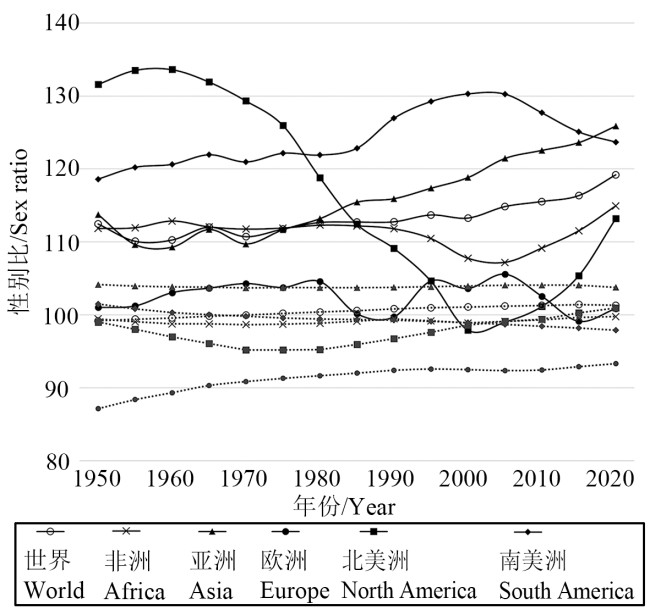
图1 1950~2022年世界各洲死亡人口性别比和总人口性别比 图中实线所示为死亡人口性别比,虚线所示为总人口性别比
Fig.1 Sex ratio of deaths and sex ratio of the total population of each continent worldwide from 1950 to 2022 The solid line represents the sex ratio of deaths, and the dashed line represents the sex ratio of the total population
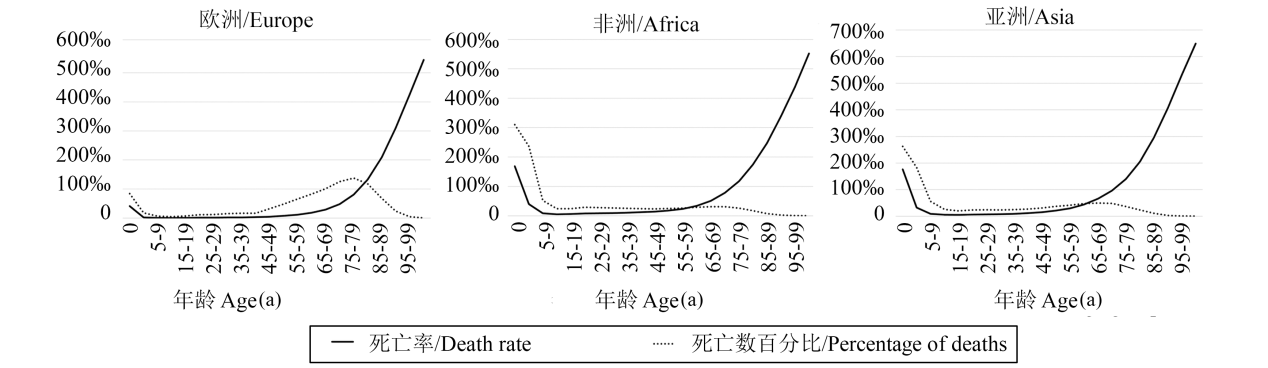
图2 1960年欧洲、非洲和亚洲的分年龄死亡率和死亡数占比
Fig.2 Age-specific mortality rates and percentage of deaths in Europe, Africa, and Asia in 1960
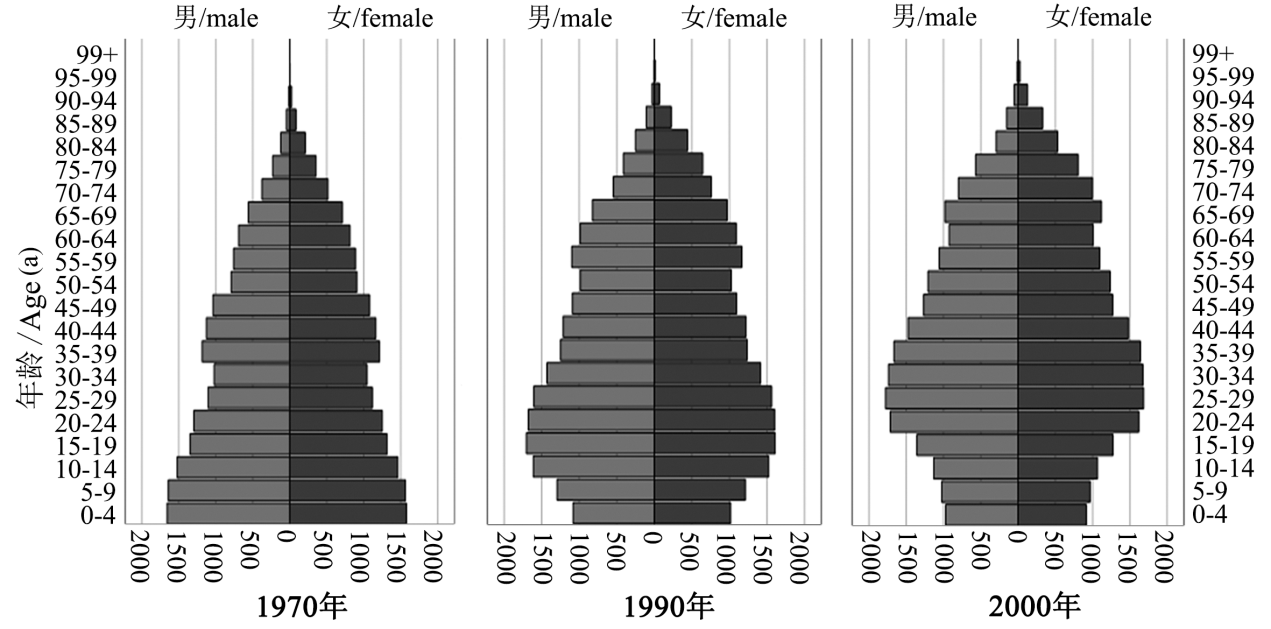
图3 西班牙人口金字塔示例图
Fig.3 Examples of Spain’s population pyramid
| [1] |
Konigsberg LW, Frankenberg SR. Estimation of age structure in anthropological demography[J]. American Journal of Physical Anthropology, 1992, 89(2): 235-256
pmid: 1443096 |
| [2] |
Buikstra JE, Konigsberg LW. Paleodemography: critiques and controversies[J]. American Anthropologist, 1985, 87(2): 316-333
doi: 10.1525/aa.1985.87.2.02a00050 URL |
| [3] | Hoppa RD, Vaupel JW.The Rostock Manifesto for paleodemography: the way from stage to age[A]. In: Hoppa RD, Vaupel JW. Paleodemography: Age Distributions from Skeletal Samples[C]. Cambridge: Cambridge University Press, 2008, 1-8 |
| [4] | Boldsen JL, Milner GR, Konigsberg LW, Wood JW.Transition analysis: a new method for estimating age from skeletons[A]. In: Hoppa RD, Vaupel JW. Paleodemography: Age Distributions from Skeletal Samples[C]. Cambridge: Cambridge University Press, 2008, 73-106 |
| [5] |
Sattenspiel L, Harpending H. Stable populations and skeletal age[J]. American Antiquity, 1983, 48(3): 489-498
doi: 10.2307/280557 URL |
| [6] |
Johansson SR, Horowitz S. Estimating mortality in skeletal populations: influence of the growth rate on the interpretation of levels and trends during the transition to agriculture[J]. American Journal of Physical Anthropology, 1986, 71(2): 233-250
pmid: 3541647 |
| [7] |
Milner GR, Humpf DA, Harpending HC. Pattern matching of age-at-death distributions in paleodemographic analysis[J]. American Journal of Physical Anthropology, 1989, 80(1): 49-58
pmid: 2801905 |
| [8] |
Gage TB. Mathematical hazard models of mortality: an alternative to model life tables[J]. American Journal of Physical Anthropology, 1988, 76(4): 429-441
pmid: 3218669 |
| [9] |
Gage TB. Bio-mathematical approaches to the study of human variation in mortality[J]. American Journal of Physical Anthropology, 1989, 32(S10): 185-214
doi: 10.1002/(ISSN)1096-8644 URL |
| [10] | Konigsberg LW, Frankenberg SR. Paleodemography:“Not quite dead”[J]. Evolutionary Anthropology: Issues, News, and Reviews, 1994, 3(3): 92-105 |
| [11] |
Wood JW, Milner GR, Harpending HC, et al. The osteological paradox: problems of inferring prehistoric health from skeletal samples [and comments and reply][J]. Current Anthropology, 1992, 33(4): 343-370
doi: 10.1086/204084 URL |
| [12] | 陈靓, 薛新明. 山西芮城清凉寺新石器时代墓地人口构成研究[J]. 西北大学学报(哲学社会科学版), 2010, 40(6): 37-40 |
| [13] | 朱泓, 肖晓鸣. 后套木嘎遗址汉书二期文化居民人口学研究[J]. 边疆考古研究, 2013, 2: 299-306 |
| [14] | 王建华, 曹静. 蒙城尉迟寺遗址单人墓人口自然结构及相关问题研究[J]. 东方考古, 2013, 1: 409-417 |
| [15] | 王建华, 曹静. 大溪遗址单人墓葬人口自然结构及相关问题研究[J]. 东方考古, 2014, 1: 274-283 |
| [16] |
Konigsberg LW, Herrmann NP, Wescott DJ, et al. Estimation and evidence in forensic anthropology: age-at-death[J]. Journal of Forensic Sciences, 2008, 53(3): 541-557
doi: 10.1111/j.1556-4029.2008.00710.x pmid: 18471197 |
| [17] |
Getz SM. The use of transition analysis in skeletal age estimation[J]. Wiley Interdisciplinary Reviews: Forensic Science, 2020, 2(6): e1378
doi: 10.1002/wfs2.v2.6 URL |
| [18] |
Milner GR, Boldsen JL. Transition analysis: A validation study with known-age modern American skeletons[J]. American journal of physical anthropology, 2012, 148(1): 98-110
doi: 10.1002/ajpa.22047 pmid: 22419394 |
| [19] |
Fojas CL, Kim J, Minsky-Rowland JD, et al. Testing inter-observer reliability of the transition analysis aging method on the William M. bass forensic skeletal collection[J]. American Journal of Physical Anthropology, 2018, 165(1): 183-193
doi: 10.1002/ajpa.23342 pmid: 29072307 |
| [20] |
Kim J, Algee-Hewitt BFB. Age-at-death patterns and transition analysis trends for three Asian populations: Implications for [paleo] demography[J]. American Journal of Biological Anthropology, 2022, 177(2): 207-222
doi: 10.1002/ajpa.v177.2 URL |
| [21] | Hagelthorn C L, Alblas A, Greyling L. The accuracy of the Transition Analysis of aging on a heterogenic South African population[J]. Forensic Science International, 2019, 297(370): e1-e5 |
| [22] | Simon AM, Hubbe M. Reliability of reconstructed population survivorship from transition analysis age estimation[J]. International Journal of Osteoarchaeology, 2024, 34(5): e3344 |
| [23] |
Bullock M, Márquez L, Hernández P, et al. Paleodemographic age-at-death distributions of two Mexican skeletal collections: A comparison of transition analysis and traditional aging methods[J]. American Journal of Physical Anthropology, 2013, 152(1): 67-78
doi: 10.1002/ajpa.22329 pmid: 24037796 |
| [24] | Getz SM. Improved skeletal age-at-death estimation and its impact on archaeological analyses[D]. State College: The Pennsylvania State University, 2017 |
| [25] | Fritz S. Establishing the paleodemography of S: t Nicolai High Medieval cemetery-An evaluation study of the Transition Analysis 3 method[D]. Lund: Lund University, 2021 |
| [26] | Getz SM, Galimany JG. Evaluation of the transition analysis 3 (TA3)(Beta Ver. 0.8.0) age-estimation program using two international samples [Poster][C]. 74th Annual Scientific Conference of the American Academy of Forensic Sciences, Seattle, WA, 2022 |
| [27] |
Bolster AL, JeanLouis HJ, Gregoricka LA, et al. Estimating adult age categories in commingled skeletons with Transition Analysis 3[J]. American Journal of Biological Anthropology, 2024, 183(2): e24890
doi: 10.1002/ajpa.v183.2 URL |
| [28] |
Bocquet-Appel JP, Masset C. Paleodemography: expectancy and false hope[J]. American Journal of Physical Anthropology, 1996, 99(4): 571-583
pmid: 8779339 |
| [29] |
Aykroyd RG, Lucy D, Pollard AM, Roberts CA. Nasty, brutish, but not necessarily short: a reconsideration of the statistical methods used to calculate age at death from adult human skeletal and dental age indicators[J]. American antiquity, 1999, 64(1): 55-70
doi: 10.2307/2694345 URL |
| [30] |
Caussinus H, Courgeau D, Mandelbaum J. Estimating age without measuring it: A new method in paleodemography[J]. Population, 2010, 65(1): 117-144
doi: 10.3917/popu.1001.0117 URL |
| [31] |
Séguy I, Caussinus H, Courgeau D, et al. Estimating the age structure of a buried adult population: A new statistical approach applied to archaeological digs in France[J]. American Journal of Physical Anthropology, 2013, 150(2): 170-183
doi: 10.1002/ajpa.22187 pmid: 23184626 |
| [32] |
Łukasik S, Bijak J, Krenz-Niedbała M, et al. Paleodemographic analysis of age at death for a population of Black Sea Scythians: An exploration by using Bayesian methods[J]. American Journal of Physical Anthropology, 2021, 174(4): 595-613
doi: 10.1002/ajpa.24211 pmid: 33382089 |
| [33] |
Sasaki T, Kondo O. An informative prior probability distribution of the gompertz parameters for bayesian approaches in paleodemography[J]. American Journal of physical anthropology, 2016, 159(3): 523-533
doi: 10.1002/ajpa.22891 pmid: 26537028 |
| [34] |
Nagaoka T, Sawada J, Hirata K. Did the Jomon people have a short lifespan? Evidence from the adult age-at-death estimation based on the auricular surface of the ilium[J]. Anthropological Science, 2008, 116(2): 161-169
doi: 10.1537/ase.070724 URL |
| [35] |
Nagaoka T, Hirata K. Demographic structure of skeletal populations in historic Japan: a new estimation of adult age-at-death distributions based on the auricular surface of the ilium[J]. Journal of Archaeological Science, 2008, 35(5): 1370-1377
doi: 10.1016/j.jas.2007.10.002 URL |
| [36] |
Nagaoka T, Ishida H, Hirata K. Paleodemography of the early modern human skeletons from Kumejima (Okinawa, Japan)[J]. Quaternary International, 2016, 405: 222-232
doi: 10.1016/j.quaint.2014.11.015 URL |
| [37] |
Nagaoka T, Abe M, Shimatani K. Estimation of mortality profiles from non-adult human skeletons in Edo-period Japan[J]. Anthropological Science, 2012, 120(2): 115-128
doi: 10.1537/ase.1107312 URL |
| [38] | Müller HG, Love B, Hoppa RD. Semiparametric method for estimating paleodemographic profiles from age indicator data[J]. American Journal of Physical Anthropology, 2002, 117(1): 1-14 |
| [39] |
Roksandic M, Armstrong SD. Using the life history model to set the stage (s) of growth and senescence in bioarchaeology and paleodemography[J]. American Journal of Physical Anthropology, 2011, 145(3): 337-347
doi: 10.1002/ajpa.21508 pmid: 21469078 |
| [40] |
Gage TB. Demographic estimation from anthropological data: New methods[J]. Current Anthropology. 1985, 26(5):644-647
doi: 10.1086/203353 URL |
| [41] | Wood JW, Holman DJ, Weiss KM, et al. Hazards models for human population biology[J]. American Journal of Physical Anthropology, 1992, 35(S15): 43-87 |
| [42] | Wood JW, Holman DJ, O Connor KA, et al.Mortality models for paleodemography[A]. In: Hoppa RD, Vaupel JW(eds.). Paleodemography: Age Distribution from Skeletal Samples[C]. Cambridge: Cambridge University Press, 2002: 129-168 |
| [43] |
Konigsberg LW, Frankenberg SR. Deconstructing death in paleodemography[J]. American Journal of Physical Anthropology, 2002, 117(4): 297-309
pmid: 11920365 |
| [44] |
Eshed V, Gopher A, Gage TB, et al. Has the transition to agriculture reshaped the demographic structure of prehistoric populations? New evidence from the Levant[J]. American Journal of Physical Anthropology, 2004, 124(4): 315-329
pmid: 15252860 |
| [45] |
DeWitte SN. Age patterns of mortality during the Black Death in London, AD 1349-1350[J]. Journal of Archaeological Science, 2010, 37(12): 3394-3400
pmid: 21572598 |
| [46] |
Kelmelis KS, Price MH, Wood J. The effect of leprotic infection on the risk of death in medieval rural Denmark[J]. American Journal of Physical Anthropology, 2017, 164(4): 763-775
doi: 10.1002/ajpa.23314 pmid: 28940226 |
| [47] |
Yaussy SL. The intersectional effects of sex and socioeconomic status on risk of mortality in industrializing England[J]. American Journal of Biological Anthropology, 2024, 185(3): e25022
doi: 10.1002/ajpa.v185.3 URL |
| [48] |
Betsinger TK, DeWitte S. Trends in mortality and biological stress in a medieval polish urban population[J]. International Journal of Paleopathology, 2017, 19: 24-36
doi: S1879-9817(17)30123-7 pmid: 29198397 |
| [49] | Luy MA, Wittwer-Backofen U.The Halley band for paleodemographic mortality analysis[A]. In: Hawks J, Bocquet-Appel JP (eds). Recent Advances in Palaeodemography: Data, Techniques, Patterns[C]. Dordrecht: Springer Netherlands, 2008: 119-141 |
| [50] |
Moser D, Pichler SL, Santos AL, et al. The uncertain death. Estimating mortality structure by random sampling[J]. International Journal of Osteoarchaeology, 2025, 35(1): e3363
doi: 10.1002/oa.v35.1 URL |
| [51] | Bocquet JP, Masset C. Estimateurs en paléodémographie[J]. L’homme, 1977, 1: 65-90 |
| [52] |
Buikstra JE, Konigsberg LW, Bullington J. Fertility and the development of agriculture in the prehistoric Midwest[J]. American Antiquity, 1986, 51(3): 528-546
doi: 10.2307/281750 URL |
| [53] |
Paine RR, Harpending HC. Assessing the reliability of paleodemographic fertility estimators using simulated skeletal distributions[J]. American Journal of Physical Anthropology, 1996, 101(2): 151-159
pmid: 8893082 |
| [54] |
Bocquet-Appel JP. Paleoanthropological traces of a Neolithic demographic transition[J]. Current anthropology, 2002, 43(4): 637-650
doi: 10.1086/342429 URL |
| [55] |
Robbins G. Don’t throw out the baby with the bathwater: Estimating fertility from subadult skeletons[J]. International Journal of Osteoarchaeology, 2011, 21(6): 717-722
doi: 10.1002/oa.v21.6 URL |
| [56] |
McFadden C, Oxenham MF. The D0-14/D ratio: A new paleodemographic index and equation for estimating total fertility rates[J]. American Journal of Physical Anthropology, 2018, 165(3): 471-479
doi: 10.1002/ajpa.23365 pmid: 29159821 |
| [57] |
McFadden C, Muir B, Oxenham MF. Determinants of infant mortality and representation in bioarchaeological samples: A review[J]. American Journal of Biological Anthropology, 2022, 177(2): 196-206
doi: 10.1002/ajpa.v177.2 URL |
| [58] |
McFadden C, Oxenham MF. The impacts of underenumeration and age estimation error on the D0-14/D ratio and palaeodemographic measures[J]. Journal of Archaeological Science: Reports, 2019, 23: 57-61
doi: 10.1016/j.jasrep.2018.10.033 URL |
| [59] |
McFadden C, Oxenham MF. Rate of natural population increase as a paleodemographic measure of growth[J]. Journal of Archaeological Science: Reports, 2018, 19: 352-356
doi: 10.1016/j.jasrep.2018.03.012 URL |
| [60] |
Taylor BR, Oxenham MF, McFadden C. Estimating fertility using adults: A method for under-enumerated pre-adult skeletal samples[J]. American Journal of Biological Anthropology, 2023, 181(2): 262-270
doi: 10.1002/ajpa.v181.2 URL |
| [61] |
McFadden C, Oxenham MF. The paleodemographic measure of maternal mortality and a multifaceted approach to maternal health[J]. Current Anthropology, 2019, 60(1): 141-146
doi: 10.1086/701476 |
| [62] | Duering A. From individuals to settlement patterns. Bridging the gap between the living and the dead in early medieval populations using an agent-based demographic model[D]. Oxford: University of Oxford, 2017 |
| [63] |
Duering A, Wahl J. A massacred village community? Agent-based modelling sheds new light on the demography of the Neolithic mass grave of Talheim[J]. Anthropologischer Anzeiger, 2014, 71(4): 447-468
doi: 10.1127/anthranz/2014/0450 pmid: 25774830 |
| [64] |
Fernández-Crespo T, Schulting RJ, Ordoño J, et al. New radiocarbon dating and demographic insights into San Juan ante Portam Latinam, a possible Late Neolithic war grave in North-Central Iberia[J]. American Journal of Physical Anthropology, 2018, 166(3): 760-771
doi: 10.1002/ajpa.23465 pmid: 29543322 |
| [65] | Chamberlain AT. Demography in Archaeology[M]. Cambridge: Cambridge University Press, 2006, 10 |
| [66] | Hoppa RD. Modeling the effects of selection bias on palaeodemographic analyses[J]. Homo, 1999, 50(3): 228-243 |
| [67] |
Bello SM, Thomann A, Signoli M, et al. Age and sex bias in the reconstruction of past population structures[J]. American Journal of Physical Anthropology, 2006, 129(1): 24-38
pmid: 16161146 |
| [68] | Jackes M.Representativeness and bias in archaeological skeletal samples[A]. In: Agarwal SC, Glencross BA(eds). Social Bioarchaeology[C]. Hoboken: Wiley-Blackwell, 2011, 107-146 |
| [69] |
Taylor BR, Oxenham MF. A Method for Detecting Bias in Human Archaeological Cemetery Samples[J]. International journal of osteoarchaeology, 2025, 35(1): e3379
doi: 10.1002/oa.v35.1 URL |
| [70] |
Wilson JJ. Paradox and promise: Research on the role of recent advances in paleodemography and paleoepidemiology to the study of “health” in Precolumbian societies[J]. American Journal of Physical Anthropology, 2014, 155(2): 268-280
doi: 10.1002/ajpa.v155.2 URL |
| [71] |
Morrone A, Zorzato L. The Song of the Science Mermaid: A Philosophical Trilogue on the Osteological Paradox[J]. Acta Baltica Historiae et Philosophiae Scientiarum, 2021, 9(1): 27-50
doi: 10.11590/abhps URL |
| [72] | 马瀛通. 数理统计分析人口学[M]. 北京: 中国人口出版社, 2010, 105-111 |
| [73] | 郭未. 人口学[M]. 北京: 社会科学文献出版社, 2018, 90-91 |
| [74] |
Hoppa RD, Saunders SR. The MAD legacy: how meaningful is mean age-at-death in skeletal samples[J]. Human evolution, 1998, 13: 1-14
doi: 10.1007/BF02439363 URL |
| [75] |
Bocquet-Appel JP. When the world’s population took off: the springboard of the Neolithic Demographic Transition[J]. Science, 2011, 333(6042): 560-561
doi: 10.1126/science.1208880 pmid: 21798934 |
| [76] | Bocquet-Appel JP, Bar-Yosef Oeds. The Neolithic demographic transition and its consequences[M]. Berlin: Springer Science & Business Media, 2008, 1-12 |
| [77] |
Shennan S, Sear R. Archaeology, demography and life history theory together can help us explain past and present population patterns[J]. Philosophical Transactions of the Royal Society B, 2021, 376(1816): 20190711
doi: 10.1098/rstb.2019.0711 URL |
| [78] | Dubouloz J, Moussa R, Berger JF.Between paleodemographic estimators and “LBK” colonization in Central-Western Europe (c. 5550-4950 BCE): A tribute to the theoretical and methodological trajectory of Jean-Pierre Bocquet-Appel in the study of the first farmers of the “Old World”[A]. In: Degioanni A, Herrscher E, Naji S(eds). Journey of a Committed Paleodemographer-Farewell to Jean-Pierre Bocquet-Appel[C]. Aix-en-Provence: Presses universitaires de Provence, 2021, 95-112 |
| [79] |
Li J, Bocquet-Appel JP. Detection of the Agricultural Demographic Transition in China[J]. Journal of Archaeological Science: Reports, 2024, 55: 104498
doi: 10.1016/j.jasrep.2024.104498 URL |
| [1] | 李欣, 姜帅, 黄婷, 钟华, 温有锋. 内蒙古与新疆达斡尔族头面部特征比较[J]. 人类学学报, 2024, 43(04): 586-596. |
| [2] | 侯侃. 生命表法在古人口学中的应用误区[J]. 人类学学报, 2023, 42(05): 687-700. |
| [3] | 侯侃. 过渡分析在先秦时期人骨年龄估计中的应用[J]. 人类学学报, 2022, 41(03): 439-449. |
| [4] | 赵东月, 刘昊鹏, 杨磊. 沣西新城曹家寨清代墓地古人口学初步研究[J]. 人类学学报, 2022, 41(01): 11-22. |
| [5] | 侯侃, 林留根, 甘恢元, 闫龙, 朱晓汀. 江苏兴化蒋庄遗址良渚文化墓地的古人口学[J]. 人类学学报, 2021, 40(02): 239-248. |
| [6] | 李楠. “区域模型生命表”在古人口学研究中的应用[J]. 人类学学报, 2019, 38(01): 98-106. |
| [7] | 杨诗雨;张全超. 《古病理学指南》评介[J]. 人类学学报, 2018, 37(04): 667-668. |
| [8] | 张全超;张雯欣. 《生物考古学:通过骨骼解读人类行为(第二版)》评介[J]. 人类学学报, 2017, 36(01): 143-144. |
| [9] | 张雯欣;张全超. 《人类进化和生物考古视角下的牙齿生长发育》评介[J]. 人类学学报, 2016, 35(04): 633-634. |
| [10] | 赵永生;曾雯;王辉;毛瑞林;朱泓. 磨沟墓地古代居民头骨的形态学分析[J]. 人类学学报, 2016, 35(02): 181-197. |
| [11] | 曾雯;潘其风;赵永生;朱泓. 纱帽山滇文化墓地颅骨的人类学特征[J]. 人类学学报, 2014, 33(02): 187-197. |
| [12] | 任光祥; 余跃生; 杨胜文; 郭光武; 韦亚丽; 林先燕; 李钟艳. 贵州土家族体质人类学研究[J]. 人类学学报, 2012, 31(03): 289-298. |
| [13] | 张建波; 巫新华; 李黎明; 金力; 李辉; 谭婧泽. 新疆于田流水墓地青铜时代人类颅骨的非连续性特征研究[J]. 人类学学报, 2011, 30(04): 379-404. |
| [14] | 陈尧峰; 张海国; 沈建甫. 台湾太鲁阁(Truku)族群肤纹学研究[J]. 人类学学报, 2011, 30(03): 334-342. |
| [15] | 聂晨霞; 张海国; 车德才; 马红莲; 赵双; 盖东征; 裴陆田; 王燕莎; 张联珠; 武斌. 山西上党地区汉族肤纹研究[J]. 人类学学报, 2011, 30(01): 91-101. |
| 阅读次数 | ||||||
|
全文 |
|
|||||
|
摘要 |
|
|||||
 京ICP证05002819号-3