

主管:中国科学院
主办:中国科学院古脊椎动物与古人类研究所
出版:科学出版社
主办:中国科学院古脊椎动物与古人类研究所
出版:科学出版社
人类学学报 ›› 2026, Vol. 45 ›› Issue (01): 116-127.doi: 10.16359/j.1000-3193/AAS.2025.0029cstr: 32091.14.j.1000-3193/AAS.2025.0029
吕风仪( ), 周亚威()
收稿日期:2024-11-13
接受日期:2025-01-15
出版日期:2026-02-15
发布日期:2026-02-13
通讯作者:
周亚威,博士,教授,主要从事人类骨骼考古学研究。E-mail: zhouyawei469@163.com
作者简介:吕风仪,博士研究生,主要从事人类骨骼考古学研究。E-mail: 1206458499@qq.com
基金资助:
LYU Fengyi(), ZHOU Yawei()
Received:2024-11-13
Accepted:2025-01-15
Online:2026-02-15
Published:2026-02-13
摘要:
为探讨全新世人群鼻骨区域的变异性以及与鼻部形态的关系,本文采集了中原地区10个遗址的286例人骨的鼻骨形态特征数据,分别进行T检验、单向方差分析和Pearson相关性检验等。结果发现,中原地区人群鼻骨整体属中窄型,鼻根点略有凹陷,鼻骨鼻翼微隆起、形成小曲线;与其他时期相比,明清时期鼻骨类型更窄、鼻骨高和鼻骨高比例指数更大、最小鼻骨宽最小;男性较女性的鼻骨尺寸变异更为显著。大量数据分析显示,中原地区古代人群的鼻骨高与鼻高呈正相关性,且鼻骨高比例指数在不同时期变异范围相对稳定,而最小鼻骨宽与鼻宽多数情况下不具有统计学意义上的相关性,鼻骨宽指数在不同时期离散度高且不具有规律性。
中图分类号:
吕风仪, 周亚威. 中原地区古代人群的鼻骨形态[J]. 人类学学报, 2026, 45(01): 116-127.
LYU Fengyi, ZHOU Yawei. Nasal bone morphology of ancient populations in the Central Plains region[J]. Acta Anthropologica Sinica, 2026, 45(01): 116-127.
| 时期Period | 遗址名称Site name | 男性Male | 女性Female | 未知Unknown | 总计Total | 文献Reference |
|---|---|---|---|---|---|---|
| 仰韶 Yangshao | 双槐树遗址SHU | 5 | 3 | 2 | 10 | |
| 孙庄遗址SUN | 3 | 6 | 1 | 10 | ||
| 汪沟遗址WAN | 29 | 14 | 0 | 43 | ||
| 东周 Dongzhou | 北沈家桥遗址BEI | 38 | 12 | 0 | 50 | |
| 后李遗址HOU | 10 | 6 | 0 | 16 | ||
| 两醇遗址LIA | 10 | 4 | 0 | 14 | [ | |
| 西汉 Xihan | 乙烯生活区YIL | 20 | 20 | 0 | 40 | [ |
| 乙烯墓地YIC | 25 | 15 | 0 | 40 | [ | |
| 明清 Mingqing | 三门峡职业技术学院墓地SAN | 18 | 28 | 0 | 46 | |
| 西霞院水利枢纽XIA | 5 | 12 | 0 | 17 | ||
| 总计Total | 163 | 120 | 3 | 286 | ||
表1 遗址的个体统计表
Tab.1 Individual statistical table of the site (n=286)
| 时期Period | 遗址名称Site name | 男性Male | 女性Female | 未知Unknown | 总计Total | 文献Reference |
|---|---|---|---|---|---|---|
| 仰韶 Yangshao | 双槐树遗址SHU | 5 | 3 | 2 | 10 | |
| 孙庄遗址SUN | 3 | 6 | 1 | 10 | ||
| 汪沟遗址WAN | 29 | 14 | 0 | 43 | ||
| 东周 Dongzhou | 北沈家桥遗址BEI | 38 | 12 | 0 | 50 | |
| 后李遗址HOU | 10 | 6 | 0 | 16 | ||
| 两醇遗址LIA | 10 | 4 | 0 | 14 | [ | |
| 西汉 Xihan | 乙烯生活区YIL | 20 | 20 | 0 | 40 | [ |
| 乙烯墓地YIC | 25 | 15 | 0 | 40 | [ | |
| 明清 Mingqing | 三门峡职业技术学院墓地SAN | 18 | 28 | 0 | 46 | |
| 西霞院水利枢纽XIA | 5 | 12 | 0 | 17 | ||
| 总计Total | 163 | 120 | 3 | 286 | ||
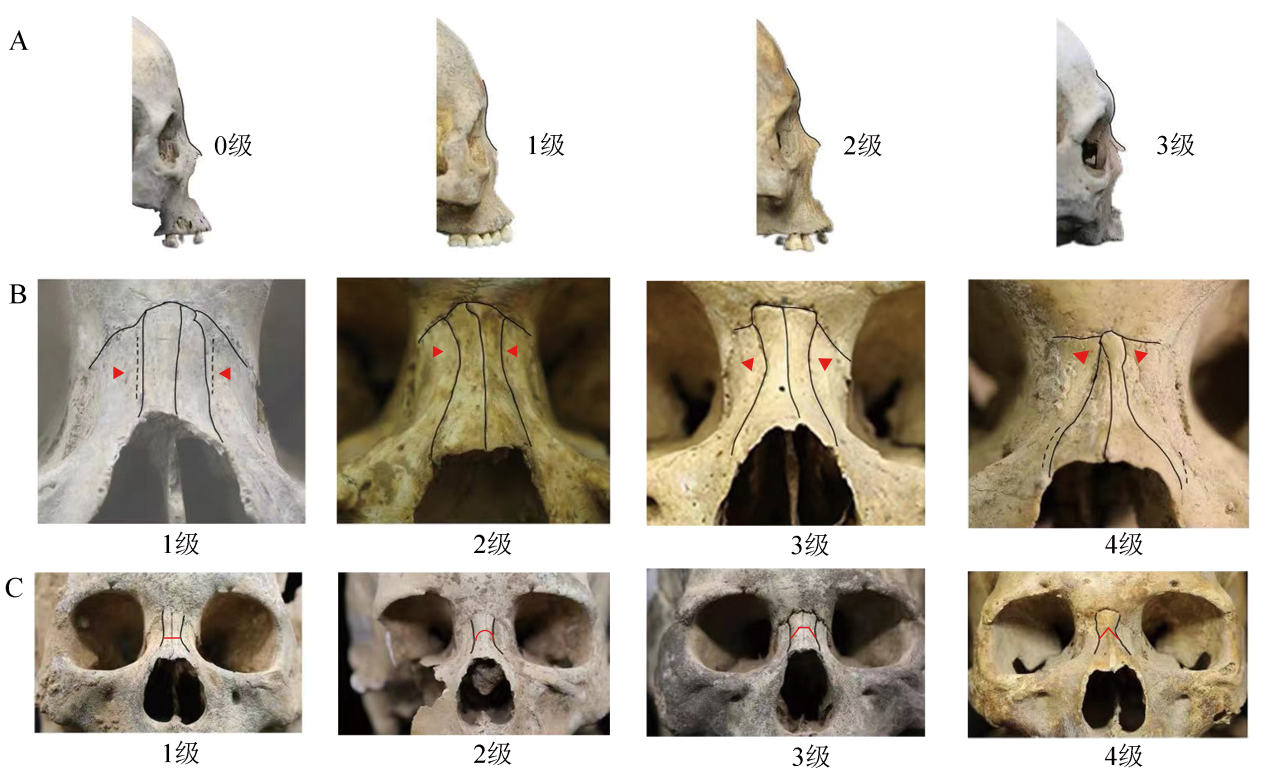
图1 中原地区古代人群鼻部区域形态变异 A.鼻根点凹陷程度nasion depression;B.鼻骨类型types of nasal bones;C.鼻骨水平起伏程度nasal saddle / contour
Fig.1 Morphological variation in the nasal region of ancient populations in the Central Plains
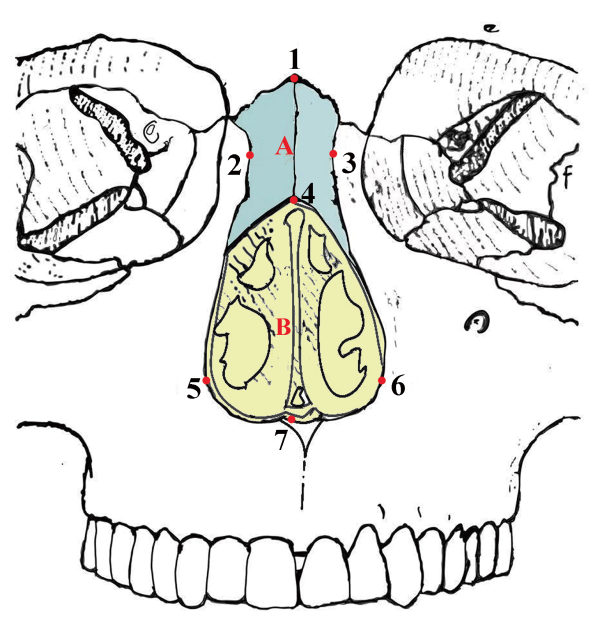
图2 鼻部解剖区域及测量特征 A.鼻骨区域nasal bone region;B.梨状孔区域piriform foramen area;A+B.鼻部区域nasal region。连接1-4点:鼻骨高height of nasal bone;连接4-7点:梨状孔高height of nose hole;连接1-7点鼻高nasal height;连接2-3点:最小鼻宽simoticchord;连接5-6点:鼻宽nose width
Fig.2 Anatomical area of the nose and its measurement characteristics
| 时期Period | 遗址名称Site name | 性别Sex | 鼻骨类型 Types of nasal bones | 鼻根点凹陷 Nasion depression | 鼻骨轮廓 Nasion bone contour | ||||||||||||
|---|---|---|---|---|---|---|---|---|---|---|---|---|---|---|---|---|---|
| 1级 | 2级 | 3级 | 4级 | 0级 | 1级 | 2级 | 3级 | 4级 | 1级 | 2级 | 3级 | 4级 | |||||
| 仰韶Yangshao | 双槐树遗址SHU | 男Male | 0 | 2 | 1 | 2 | 1 | 3 | 1 | 0 | 0 | 4 | 1 | 0 | 0 | ||
| 女Female | 1 | 2 | 0 | 0 | 1 | 2 | 0 | 0 | 0 | 3 | 0 | 0 | 0 | ||||
| 未知Unknown | 1 | 0 | 1 | 1 | 1 | 2 | 1 | 0 | 0 | 2 | 1 | 0 | 0 | ||||
| 总计Total | 2 | 4 | 2 | 3 | 3 | 7 | 1 | 0 | 0 | 9 | 2 | 0 | 0 | ||||
| 孙庄遗址SUN | 男Male | 2 | 2 | 0 | 0 | 2 | 1 | 2 | 0 | 0 | 1 | 2 | 0 | 0 | |||
| 女Female | 2 | 2 | 2 | 1 | 2 | 4 | 0 | 1 | 0 | 5 | 2 | 0 | 0 | ||||
| 未知Unknown | 0 | 1 | 0 | 0 | 0 | 0 | 1 | 0 | 0 | 0 | 0 | 1 | 0 | ||||
| 总计Total | 4 | 5 | 2 | 1 | 4 | 5 | 3 | 1 | 0 | 6 | 4 | 1 | 0 | ||||
| 汪沟遗址WAN | 男Male | 4 | 11 | 3 | 9 | 2 | 15 | 1 | 4 | 0 | 8 | 8 | 5 | 2 | |||
| 女Female | 5 | 3 | 3 | 2 | 8 | 6 | 0 | 0 | 0 | 10 | 2 | 2 | 0 | ||||
| 总计Total | 9 | 14 | 6 | 11 | 10 | 21 | 1 | 4 | 0 | 18 | 10 | 7 | 2 | ||||
| 汇总Total | 男Male | 6 | 15 | 4 | 11 | 5 | 19 | 4 | 4 | 0 | 13 | 11 | 5 | 2 | |||
| 女Female | 8 | 7 | 5 | 3 | 11 | 12 | 0 | 0 | 0 | 19 | 5 | 3 | 0 | ||||
| 总计Total | 14 | 22 | 9 | 14 | 16 | 21 | 4 | 4 | 0 | 32 | 16 | 8 | 2 | ||||
| 东周Dongzhou | 北沈家桥遗址BEI | 男Male | 8 | 18 | 15 | 9 | 10 | 13 | 20 | 9 | 0 | 9 | 18 | 3 | 3 | ||
| 女Female | 4 | 8 | 2 | 0 | 7 | 7 | 2 | 0 | 0 | 9 | 4 | 0 | 1 | ||||
| 总计Total | 12 | 26 | 17 | 9 | 17 | 20 | 22 | 9 | 0 | 18 | 22 | 3 | 4 | ||||
| 西汉Xihan | 乙烯生活区YIL | 男Male | 0 | 2 | 5 | 5 | 0 | 3 | 7 | 0 | 0 | ||||||
| 女Female | 1 | 2 | 0 | 0 | 1 | 2 | 0 | 0 | 0 | ||||||||
| 总计Total | 1 | 4 | 5 | 5 | 1 | 5 | 7 | 0 | 0 | ||||||||
| 明清Mingqing | 西霞院水利枢纽XIA | 男Male | 0 | 3 | 4 | 1 | 0 | 3 | 3 | 3 | 0 | 5 | 5 | 0 | 0 | ||
| 女Female | 1 | 5 | 0 | 1 | 1 | 4 | 1 | 1 | 0 | 3 | 4 | 0 | 0 | ||||
| 总计Total | 1 | 8 | 4 | 2 | 1 | 7 | 4 | 4 | 0 | 8 | 9 | 0 | 0 | ||||
| 三门峡职业技术学院墓地SAN | 男Male | 0 | 11 | 8 | 0 | 5 | 9 | 3 | 0 | 0 | 8 | 7 | 0 | 4 | |||
| 女Female | 9 | 21 | 4 | 0 | 9 | 16 | 7 | 0 | 0 | 14 | 7 | 3 | 4 | ||||
| 总计Total | 9 | 32 | 12 | 0 | 14 | 25 | 10 | 0 | 0 | 22 | 14 | 3 | 4 | ||||
| 汇总Total | 男Male | 0 | 14 | 12 | 1 | 5 | 12 | 6 | 3 | 0 | 13 | 12 | 0 | 4 | |||
| 女Female | 10 | 26 | 4 | 1 | 10 | 20 | 8 | 1 | 0 | 17 | 11 | 3 | 0 | ||||
| 总计Total | 10 | 40 | 16 | 2 | 15 | 32 | 14 | 4 | 0 | 30 | 23 | 3 | 4 | ||||
| 男性 Male | 14 | 49 | 36 | 26 | 20 | 37 | 37 | 16 | 0 | 44 | 52 | 13 | 11 | ||||
| 女性 Female | 23 | 43 | 11 | 4 | 29 | 41 | 10 | 1 | 0 | 61 | 24 | 8 | 5 | ||||
| 共计 Total | 37 | 92 | 47 | 30 | 49 | 78 | 47 | 17 | 0 | 105 | 76 | 21 | 16 | ||||
表2 鼻骨形态特征类型数量统计表
Tab.2 Statistical table of morphological characteristics of nasal bone types (n=286)
| 时期Period | 遗址名称Site name | 性别Sex | 鼻骨类型 Types of nasal bones | 鼻根点凹陷 Nasion depression | 鼻骨轮廓 Nasion bone contour | ||||||||||||
|---|---|---|---|---|---|---|---|---|---|---|---|---|---|---|---|---|---|
| 1级 | 2级 | 3级 | 4级 | 0级 | 1级 | 2级 | 3级 | 4级 | 1级 | 2级 | 3级 | 4级 | |||||
| 仰韶Yangshao | 双槐树遗址SHU | 男Male | 0 | 2 | 1 | 2 | 1 | 3 | 1 | 0 | 0 | 4 | 1 | 0 | 0 | ||
| 女Female | 1 | 2 | 0 | 0 | 1 | 2 | 0 | 0 | 0 | 3 | 0 | 0 | 0 | ||||
| 未知Unknown | 1 | 0 | 1 | 1 | 1 | 2 | 1 | 0 | 0 | 2 | 1 | 0 | 0 | ||||
| 总计Total | 2 | 4 | 2 | 3 | 3 | 7 | 1 | 0 | 0 | 9 | 2 | 0 | 0 | ||||
| 孙庄遗址SUN | 男Male | 2 | 2 | 0 | 0 | 2 | 1 | 2 | 0 | 0 | 1 | 2 | 0 | 0 | |||
| 女Female | 2 | 2 | 2 | 1 | 2 | 4 | 0 | 1 | 0 | 5 | 2 | 0 | 0 | ||||
| 未知Unknown | 0 | 1 | 0 | 0 | 0 | 0 | 1 | 0 | 0 | 0 | 0 | 1 | 0 | ||||
| 总计Total | 4 | 5 | 2 | 1 | 4 | 5 | 3 | 1 | 0 | 6 | 4 | 1 | 0 | ||||
| 汪沟遗址WAN | 男Male | 4 | 11 | 3 | 9 | 2 | 15 | 1 | 4 | 0 | 8 | 8 | 5 | 2 | |||
| 女Female | 5 | 3 | 3 | 2 | 8 | 6 | 0 | 0 | 0 | 10 | 2 | 2 | 0 | ||||
| 总计Total | 9 | 14 | 6 | 11 | 10 | 21 | 1 | 4 | 0 | 18 | 10 | 7 | 2 | ||||
| 汇总Total | 男Male | 6 | 15 | 4 | 11 | 5 | 19 | 4 | 4 | 0 | 13 | 11 | 5 | 2 | |||
| 女Female | 8 | 7 | 5 | 3 | 11 | 12 | 0 | 0 | 0 | 19 | 5 | 3 | 0 | ||||
| 总计Total | 14 | 22 | 9 | 14 | 16 | 21 | 4 | 4 | 0 | 32 | 16 | 8 | 2 | ||||
| 东周Dongzhou | 北沈家桥遗址BEI | 男Male | 8 | 18 | 15 | 9 | 10 | 13 | 20 | 9 | 0 | 9 | 18 | 3 | 3 | ||
| 女Female | 4 | 8 | 2 | 0 | 7 | 7 | 2 | 0 | 0 | 9 | 4 | 0 | 1 | ||||
| 总计Total | 12 | 26 | 17 | 9 | 17 | 20 | 22 | 9 | 0 | 18 | 22 | 3 | 4 | ||||
| 西汉Xihan | 乙烯生活区YIL | 男Male | 0 | 2 | 5 | 5 | 0 | 3 | 7 | 0 | 0 | ||||||
| 女Female | 1 | 2 | 0 | 0 | 1 | 2 | 0 | 0 | 0 | ||||||||
| 总计Total | 1 | 4 | 5 | 5 | 1 | 5 | 7 | 0 | 0 | ||||||||
| 明清Mingqing | 西霞院水利枢纽XIA | 男Male | 0 | 3 | 4 | 1 | 0 | 3 | 3 | 3 | 0 | 5 | 5 | 0 | 0 | ||
| 女Female | 1 | 5 | 0 | 1 | 1 | 4 | 1 | 1 | 0 | 3 | 4 | 0 | 0 | ||||
| 总计Total | 1 | 8 | 4 | 2 | 1 | 7 | 4 | 4 | 0 | 8 | 9 | 0 | 0 | ||||
| 三门峡职业技术学院墓地SAN | 男Male | 0 | 11 | 8 | 0 | 5 | 9 | 3 | 0 | 0 | 8 | 7 | 0 | 4 | |||
| 女Female | 9 | 21 | 4 | 0 | 9 | 16 | 7 | 0 | 0 | 14 | 7 | 3 | 4 | ||||
| 总计Total | 9 | 32 | 12 | 0 | 14 | 25 | 10 | 0 | 0 | 22 | 14 | 3 | 4 | ||||
| 汇总Total | 男Male | 0 | 14 | 12 | 1 | 5 | 12 | 6 | 3 | 0 | 13 | 12 | 0 | 4 | |||
| 女Female | 10 | 26 | 4 | 1 | 10 | 20 | 8 | 1 | 0 | 17 | 11 | 3 | 0 | ||||
| 总计Total | 10 | 40 | 16 | 2 | 15 | 32 | 14 | 4 | 0 | 30 | 23 | 3 | 4 | ||||
| 男性 Male | 14 | 49 | 36 | 26 | 20 | 37 | 37 | 16 | 0 | 44 | 52 | 13 | 11 | ||||
| 女性 Female | 23 | 43 | 11 | 4 | 29 | 41 | 10 | 1 | 0 | 61 | 24 | 8 | 5 | ||||
| 共计 Total | 37 | 92 | 47 | 30 | 49 | 78 | 47 | 17 | 0 | 105 | 76 | 21 | 16 | ||||
| 测量项目Measurement items | 鼻骨高hb | 鼻高hn | 梨状孔ho | 鼻宽 bn | 最小鼻宽bs | 梨状孔指数 ho/bn | 鼻骨高比例指数 hb/hn | 鼻指数 bn/hn | 鼻骨宽指数bs/bn | ||
|---|---|---|---|---|---|---|---|---|---|---|---|
| 仰韶Yangshao | 平均值±标准差($\bar{X} \pm \sigma$) | 男M(n=37) | 23.6±3.4 | 53.4±2.3 | 32.9±2.8 | 26.5±1.8 | 7.5±2.3 | 80.6±8.5 | 43.9±5.5 | 49.6±3.8 | 27.9±8.4 |
| 女F(n=23) | 22.3±2.1 | 49.2±3.1 | 28±2.5 | 26.4±1.3 | 7.4±1.5 | 94.7±7.6 | 46.2±3.2 | 53.8±4.1 | 29.0±6.5 | ||
| T | 1.3 | 5.5** | 5.3** | 0.2 | 0.4 | -5.1** | -1.4 | -4.0** | 0.6 | ||
| 两性对比sex comparisons | ↑ | ↑ | ↓ | ↓ | |||||||
| 东周Dongzhou | 平均值±标准差($\bar{X} \pm \sigma$) | 男M(n=58) | 23.7±3.3 | 53.5±2.9 | 33.2±2.5 | 26.9±1.7 | 7.6±2.7 | 81.5±7.1 | 43.9±4.7 | 50.6±4 | 28.3±10 |
| 女F(n=22) | 22.1±2.4 | 49.4±2.3 | 28.9±2.9 | 25.7±1.4 | 7.4±1.7 | 88.6±6.5 | 44.6±3.9 | 51.±3.2 | 28.0±6.3 | ||
| T | 1.5 | 5.9** | 4.9** | 3.2** | 4.4* | -3.0** | -1.2 | -1.4 | 3.4 | ||
| 两性对比sex comparisons | ↑ | ↑ | ↑ | ↑ | ↓ | ||||||
| 西汉Xihan | 平均值±标准差($\bar{X} \pm \sigma$) | 男M(n=45) | 22±2.9 | 52.6±8 | 32.1±2.2 | 26.4±2.3 | 7.6±2.7 | 80.8±7.8 | 41.7±4.6 | 49.5±4.9 | 28.3±10.9 |
| 女F(n=35) | 23.4±3.6 | 49.4±2.3 | 27.9±3 | 26.3±1.7 | 7.4±1.7 | 94.8±13 | 47.1±6.9 | 53.4±4.5 | 28.0±6.3 | ||
| T | -1.2 | 2.3* | 4.5** | 0.2 | 4.4* | -3.6** | -2.5* | -3.6** | 3.4 | ||
| 两性对比sex comparisons | ↑ | ↑ | ↑ | ↓ | ↓ | ↓ | |||||
| 明清 Mingqing | 平均值±标准差($\bar{X} \pm \sigma$) | 男M(n=28) | 25.5±2.4 | 54.1±2.9 | 31.3±3.1 | 25.6±2 | 6.1±2.3 | 83.8±10.7 | 47.3±3.7 | 47.5±4.7 | 23.9±10.7 |
| 女F(n=35) | 25.2±2.8 | 51.2±3.7 | 29.4±3.7 | 25.8±2.5 | 5.6±2.1 | 87.6±13.6 | 49.3±4.4 | 50.7±6.1 | 21.3±10.3 | ||
| T | 0.4 | 3.4** | 1.8 | -0.4 | 1.3 | -1 | -1.6 | -2.2** | 0.4 | ||
| 两性对比sex comparisons | ↑ | ↓ | |||||||||
| 时代间显著性对比 Between-age | 男性Fmale | 4.1** | 0.7 | 2.8* | 2.9* | 3.2* | 0.7 | 4.4** | 3.2* | 2.1 | |
| d>c | b>d | b>d | a>d | d>c | b>d | ||||||
| 女性Ffemale | 4.1* | 3.3* | 0.8 | 0.9 | 5.5** | 1.8 | 2.4 | 2.7 | 4.9** | ||
| d>a, b | a, b, c>d | a, b, c>d | |||||||||
| 整体Ftotal | 6.1** | 1.5 | 2.8 | 2.4 | 7.1** | 0.9 | 6.2** | 2.6 | 7.0** | ||
| d>a, b, c | a, b, c>d | d>a, b, c | a, b, c>d | ||||||||
表3 鼻骨测量性状的性别差异比较
Tab.3 Comparison of sex difference in nasal bone traits
| 测量项目Measurement items | 鼻骨高hb | 鼻高hn | 梨状孔ho | 鼻宽 bn | 最小鼻宽bs | 梨状孔指数 ho/bn | 鼻骨高比例指数 hb/hn | 鼻指数 bn/hn | 鼻骨宽指数bs/bn | ||
|---|---|---|---|---|---|---|---|---|---|---|---|
| 仰韶Yangshao | 平均值±标准差($\bar{X} \pm \sigma$) | 男M(n=37) | 23.6±3.4 | 53.4±2.3 | 32.9±2.8 | 26.5±1.8 | 7.5±2.3 | 80.6±8.5 | 43.9±5.5 | 49.6±3.8 | 27.9±8.4 |
| 女F(n=23) | 22.3±2.1 | 49.2±3.1 | 28±2.5 | 26.4±1.3 | 7.4±1.5 | 94.7±7.6 | 46.2±3.2 | 53.8±4.1 | 29.0±6.5 | ||
| T | 1.3 | 5.5** | 5.3** | 0.2 | 0.4 | -5.1** | -1.4 | -4.0** | 0.6 | ||
| 两性对比sex comparisons | ↑ | ↑ | ↓ | ↓ | |||||||
| 东周Dongzhou | 平均值±标准差($\bar{X} \pm \sigma$) | 男M(n=58) | 23.7±3.3 | 53.5±2.9 | 33.2±2.5 | 26.9±1.7 | 7.6±2.7 | 81.5±7.1 | 43.9±4.7 | 50.6±4 | 28.3±10 |
| 女F(n=22) | 22.1±2.4 | 49.4±2.3 | 28.9±2.9 | 25.7±1.4 | 7.4±1.7 | 88.6±6.5 | 44.6±3.9 | 51.±3.2 | 28.0±6.3 | ||
| T | 1.5 | 5.9** | 4.9** | 3.2** | 4.4* | -3.0** | -1.2 | -1.4 | 3.4 | ||
| 两性对比sex comparisons | ↑ | ↑ | ↑ | ↑ | ↓ | ||||||
| 西汉Xihan | 平均值±标准差($\bar{X} \pm \sigma$) | 男M(n=45) | 22±2.9 | 52.6±8 | 32.1±2.2 | 26.4±2.3 | 7.6±2.7 | 80.8±7.8 | 41.7±4.6 | 49.5±4.9 | 28.3±10.9 |
| 女F(n=35) | 23.4±3.6 | 49.4±2.3 | 27.9±3 | 26.3±1.7 | 7.4±1.7 | 94.8±13 | 47.1±6.9 | 53.4±4.5 | 28.0±6.3 | ||
| T | -1.2 | 2.3* | 4.5** | 0.2 | 4.4* | -3.6** | -2.5* | -3.6** | 3.4 | ||
| 两性对比sex comparisons | ↑ | ↑ | ↑ | ↓ | ↓ | ↓ | |||||
| 明清 Mingqing | 平均值±标准差($\bar{X} \pm \sigma$) | 男M(n=28) | 25.5±2.4 | 54.1±2.9 | 31.3±3.1 | 25.6±2 | 6.1±2.3 | 83.8±10.7 | 47.3±3.7 | 47.5±4.7 | 23.9±10.7 |
| 女F(n=35) | 25.2±2.8 | 51.2±3.7 | 29.4±3.7 | 25.8±2.5 | 5.6±2.1 | 87.6±13.6 | 49.3±4.4 | 50.7±6.1 | 21.3±10.3 | ||
| T | 0.4 | 3.4** | 1.8 | -0.4 | 1.3 | -1 | -1.6 | -2.2** | 0.4 | ||
| 两性对比sex comparisons | ↑ | ↓ | |||||||||
| 时代间显著性对比 Between-age | 男性Fmale | 4.1** | 0.7 | 2.8* | 2.9* | 3.2* | 0.7 | 4.4** | 3.2* | 2.1 | |
| d>c | b>d | b>d | a>d | d>c | b>d | ||||||
| 女性Ffemale | 4.1* | 3.3* | 0.8 | 0.9 | 5.5** | 1.8 | 2.4 | 2.7 | 4.9** | ||
| d>a, b | a, b, c>d | a, b, c>d | |||||||||
| 整体Ftotal | 6.1** | 1.5 | 2.8 | 2.4 | 7.1** | 0.9 | 6.2** | 2.6 | 7.0** | ||
| d>a, b, c | a, b, c>d | d>a, b, c | a, b, c>d | ||||||||
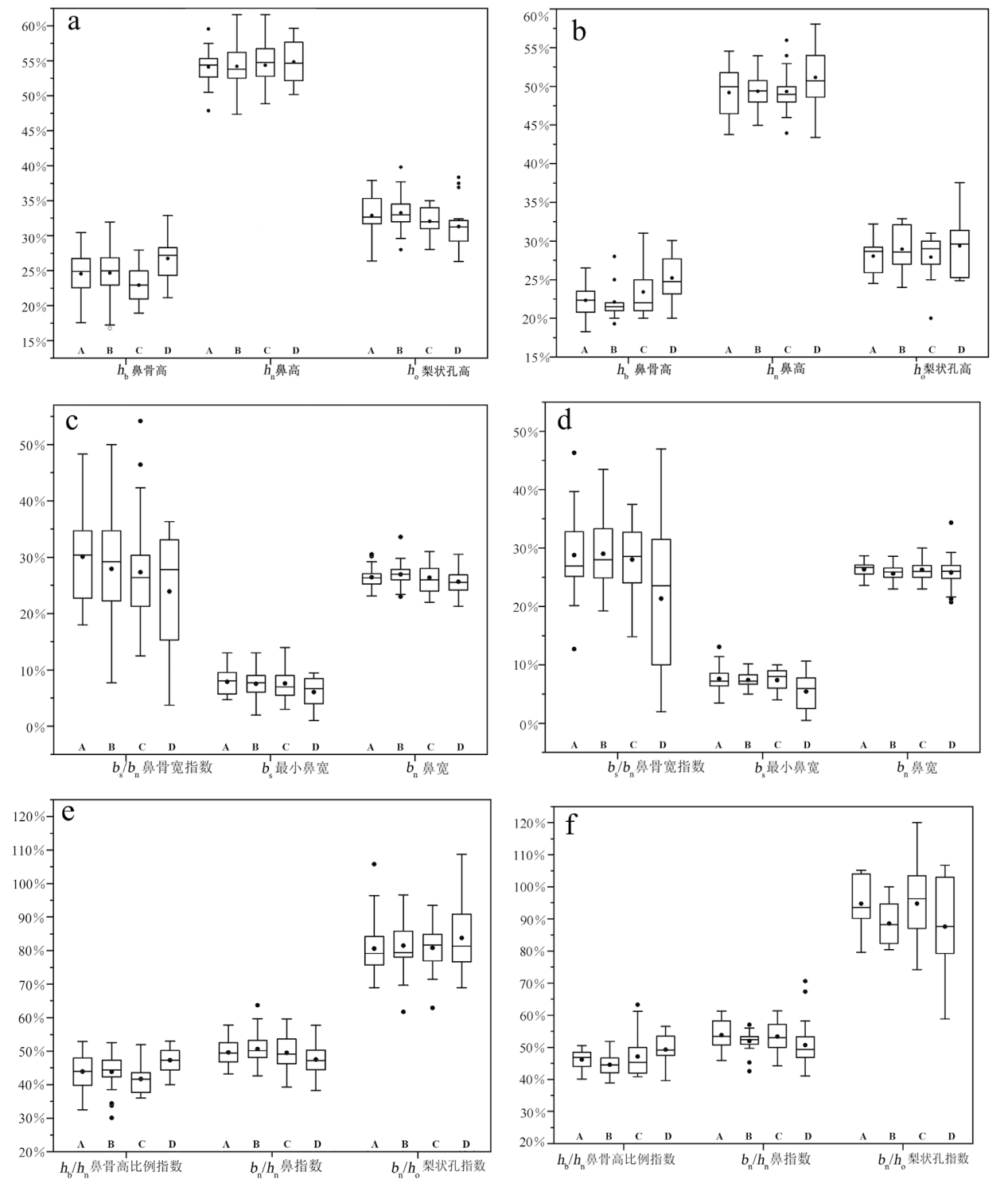
图3 不同时期的鼻部线性数值、指数分布图 A.仰韶Yangshao;B.东周Eastern Zhou;C.西汉Western Han;D.明清Ming and Qing; a.男性鼻骨高、鼻高和梨状孔高的分布Distribution of nasal bone height, nasal height and piriform foramen height in males;b.女性鼻骨高、鼻高和梨状孔高的分布Distribution of nasal bone height, nasal height and piriform foramen height in females;c.男性鼻骨宽指数、最小鼻宽和鼻宽的分布Distribution of nasal bone width index, minimum nasal width and nasal width in males;d.女性鼻骨宽指数、最小鼻宽和鼻宽的分布Distribution of nasal bone width index, minimum nasal width and nasal width in females;e.男性鼻骨高比例指数、鼻指数和梨状孔指数的分布Distribution of nasal bone high proportion index, nasal index, and piriform foramen index in males;f.女性鼻骨高比例指数、鼻指数和梨状孔指数的分布Distribution of nasal bone high proportion index, nasal index, and piriform foramen index in females.
Fig.3 Linear numerical and exponential distribution of the nose in different periods
| 时期 period | 性别Sex | 鼻高hb | 鼻宽hn | 鼻骨高比例指数hb/hn | 鼻指数bn/hn | 最小鼻宽bs | 鼻骨宽指数bs/bn |
|---|---|---|---|---|---|---|---|
| 仰韶Yangshao | 男Male | 14.21 | 4.26 | 12.24 | 7.48 | 30.7 | 30.1 |
| 女Female | 9.35 | 6.21 | 6.94 | 7.55 | 20.3 | 22.4 | |
| 东周Dongzhou | 男Male | 13.95 | 5.43 | 10.67 | 7.95 | 35.5 | 35.3 |
| 女Female | 10.95 | 4.69 | 8.79 | 6.16 | 23.0 | 22.5 | |
| 西汉Xihan | 男Male | 13.06 | 5.86 | 10.70 | 9.79 | 35.5 | 38.5 |
| 女Female | 15.31 | 4.71 | 14.33 | 8.45 | 22.9 | 22.5 | |
| 明清Mingqing | 男Male | 10.66 | 5.39 | 7.91 | 9.95 | 37.7 | 44.7 |
| 女Female | 11.23 | 7.26 | 8.96 | 12.11 | 35.7 | 40.4 |
表4 鼻部测量项目在四个时期的变异系数
Tab.4 Coefficient of variation of nasal measurement items over four periods
| 时期 period | 性别Sex | 鼻高hb | 鼻宽hn | 鼻骨高比例指数hb/hn | 鼻指数bn/hn | 最小鼻宽bs | 鼻骨宽指数bs/bn |
|---|---|---|---|---|---|---|---|
| 仰韶Yangshao | 男Male | 14.21 | 4.26 | 12.24 | 7.48 | 30.7 | 30.1 |
| 女Female | 9.35 | 6.21 | 6.94 | 7.55 | 20.3 | 22.4 | |
| 东周Dongzhou | 男Male | 13.95 | 5.43 | 10.67 | 7.95 | 35.5 | 35.3 |
| 女Female | 10.95 | 4.69 | 8.79 | 6.16 | 23.0 | 22.5 | |
| 西汉Xihan | 男Male | 13.06 | 5.86 | 10.70 | 9.79 | 35.5 | 38.5 |
| 女Female | 15.31 | 4.71 | 14.33 | 8.45 | 22.9 | 22.5 | |
| 明清Mingqing | 男Male | 10.66 | 5.39 | 7.91 | 9.95 | 37.7 | 44.7 |
| 女Female | 11.23 | 7.26 | 8.96 | 12.11 | 35.7 | 40.4 |
| [1] |
Cho EO, Cowgill LW, Middleton KM, et al. The influence of climate and population structure on East Asian skeletal morphology[J]. Journal of Human Evolution, 2022, 173: 103268
doi: 10.1016/j.jhevol.2022.103268 URL |
| [2] |
Zhang M, Wu S, Du S, et al. Genetic variants underlying differences in facial morphology in East Asian and European populations[J]. Nat Genet, 2022, 54(4): 403-411
doi: 10.1038/s41588-022-01038-7 pmid: 35393595 |
| [3] |
Tran CNH, Schroeder L. Common evolutionary patterns in the human nasal region across a worldwide sample[J]. Am J Phys Anthropol, 2021, 176(3): 422-433
doi: 10.1002/ajpa.24378 pmid: 34331455 |
| [4] | 李海军, 姚雪纯, 翁敏洁, 等. 人类鼻形态研究概述[J]. 人类学学报, 2024, 43(4): 687-700 |
| [5] |
Maddux SD, Butaric LN, Yokley TR, et al. Ecogeographic variation across morphofunctional units of the human nose[J]. American Journal of Physical Anthropology, 2017, 162(1): 103-119
doi: 10.1002/ajpa.23100 pmid: 27670377 |
| [6] | 刘武, 何嘉宁, 严毅, 等. 现代人群颅骨梨状孔区域的形态变异[J]. 人类学学报, 2023, 42(4): 445-457 |
| [7] | 翟桂英, 任甫. 基于欧几里德几何距离矩阵的成人梨状孔性别差异分析[J]. 解剖学杂志, 2015, 38(4): 465-468 |
| [8] | 高星, 彭菲, 付巧妹, 李锋. 中国地区现代人起源问题研究进展[J]. 中国科学:地球科学, 2018, 48(1): 30-41 |
| [9] | 刘武, 吴秀杰, 邢松. 现代人的出现与扩散:中国的化石证据[J]. 人类学学报, 2016, 35(2): 161-171 |
| [10] | 高星, 张晓凌, 杨东亚, 等. 现代中国人起源与人类演化的区域性多样化模式[J]. 中国科学:地球科学, 2010, 40(9): 1287-1300 |
| [11] | 张银运, 刘武. 再论南京直立人的高耸鼻梁和气候适应[J]. 人类学学报, 2010, 29: 150-158 |
| [12] | 何嘉宁, 赵朝洪, 郁金城, 等. 北京东胡林遗址人骨的体质演化与生物文化适应[J]. 考古, 2020, 7: 90-98 |
| [13] | 朱泓, 曹嘉懿. 中国旧新石器过渡阶段人群的体质人类学观察[R]. 旧新石器过渡学术研讨会, 2024, 11: 38-43 |
| [14] | Butaric LN, Klocke RP. Nasal variation in relation to high-altitude adaptations among Tibetans and Andeans[J]. American Journal of Human Biology, 2018, 30: 1-14 |
| [15] |
Tran CNH, Schroeder L. Common evolutionary patterns in the human nasal region across a worldwide sample[J]. American Journal of Physical Anthropology, 2021, 176: 422-433
doi: 10.1002/ajpa.24378 pmid: 34331455 |
| [16] | 山东省文物考古研究所, 土井浜遗址人类学博物馆. 探索渡来系弥生人大陆区域的源流(山东省合作研究报告)[M]. 山口县: アリフク印刷株式会, 2000, 150-184 |
| [17] | Martin R. Lehrbuch der Anthropologie in systematischer Darstellung, mit besonderer Berücksichtigung der anthropologischen Methoden für Studierende.Ärzte und Forschungsreisende[M]. Iéna: Fische, 1914, 620-650 |
| [18] | Joseph T. Hefner and Kandus C. Linde. Atlas of Human Cranial Macromorphoscopic Traits[M]. London: AcademicPress, 2018, 125-138 |
| [19] | 邵象清. 人体测量手册[M]. 上海: 上海辞书出版社, 1985, 116-137 |
| [20] | Lahr MM. Evolution of modern human diversity: a study in cranial variation[M]. Cambridge,Cambridge University Press, 1996, 342-343 |
| [21] | Joseph T, Kandus C. Atlas of Human Cranial Macromorphoscopic Traits[J]. Elsevier Science: Elsevier Science and Technology, 2018, 105-117 |
| [22] | 吴汝康, 吴新智, 张振标. 人体测量方法[M]. 北京: 科学出版社, 1984, 25-45 |
| [23] |
Zhang M, Wu S, Du S, et al. Genetic variants underlying differences in facial morphology in East Asian and European populations[J]. Nat Genet, 2022, 54: 403-411
doi: 10.1038/s41588-022-01038-7 pmid: 35393595 |
| [24] | 王一如. 沟湾遗址新石器时代人骨研究[D]. 硕士学位毕业论文, 长春: 吉林大学, 2015, 13-14 |
| [25] | 孙蕾, 李彦桢, 武志江. 河南郑州站马屯遗址仰韶晚期人骨的颅面形态[J]. 人类学学报, 2023, 42(3): 331-341 |
| [26] | 孙蕾. 河南渑池笃忠遗址龙山文化早期人骨研究[D]. 硕士学位毕业论文, 长春: 吉林大学, 2008, 4-10 |
| [27] | 周亚威, 刘明明, 冯春艳, 等. 徐堡遗址龙山文化居民颅骨的形态学研究[J]. 人类学学报, 2018, 37(1): 18-28 |
| [28] | 孙蕾, 张小虎, 朱泓. 河南尉氏新庄遗址二里头人骨种系初探[J]. 文物春秋, 2017, 5: 18-26 |
| [29] | 孙蕾, 朱泓, 楚小龙, 等. 郑州地区汉唐宋墓葬人骨种系研究:以荥阳薛村遗址和新郑多处遗址为例[J]. 华夏考古, 2015, 3: 105-115+167-168 |
| [30] | 原海兵. 殷墟中小墓人骨的综合研究[D]. 硕士学位毕业论文, 长春: 吉林大学, 2010, 115-124 |
| [31] | 孙蕾, 梁法伟. 河南荥阳小胡村墓地晚商至战国人骨研究[J]. 黄河·黄土·黄种人, 2018, 8: 31-36 |
| [32] | 付巧妹. 中国现代人起源与传播的古DNA观察[R]. 旧新石器过渡学术研讨会, 2024, 11: 33-37 |
| [33] | Sahin-Yilmaz A, Pinto JM, et al. Familial aggregation of nasal conditioning capacity[J]. J Appl Physiol, 2007, 3: 78-81 |
| [34] |
Weiner JS. Nose Shape and Climate[J]. Am J Phys Anthropol, 1954, 12: 615-618
pmid: 14350081 |
| [35] | 邱旭梅, 达瓦卓玛. 浅谈地形与气候的关系[J]. 科技创新与应用, 2015, 22: 163 |
| [36] | 杨凡. 中原地区仰韶文化中晚期的农业与社会[D]. 硕士学位毕业论文, 济南: 山东大学, 2021, 42-45 |
| [37] | 陈雪香, 郭林, 郝颖. 东周秦汉时期齐都临淄的环境、农业与工匠生活:以阚家寨遗址动植物遗存为核心[J]. 南方文物, 2021, 2: 162-167 |
| [38] | 竺可桢. 中国近五千年来气候变迁的初步研究[J]. 气象科技资料, 1973, S1: 2-23 |
| [39] | 戴凯之. 竹谱[M]. 北京: 中国书店, 第1版, 2014, 1 |
| [40] | 葛全胜, 郑景云, 郝志新, 等. 过去2000年中国气候变化的若干重要特征[J]. 中国科学:地球科学, 2012, 42(6): 934-942 |
| [41] | Savell KR, Auerbach BM, Roseman CC. Constraint, natural selection, and the evolution of human body form[J]. Proc. Natl. Acad. Sci., USA, 2016: 113 |
| [42] | 李紫君, 魏偏偏, 孙畅. 汉族人群鼻部观察类形态特征的比较分析[J]. 解剖学报, 2020, 24 |
| [43] | 宋楠, 余庆雄, 张天宇. 功能性鼻整形的解剖学进展[J]. 中国耳鼻咽喉颅底外科杂志, 2024, 30(2): 65-71 |
| [44] | 吴新智, 尚虹. 南京直立人的高鼻梁是由于对寒冷气候的适应吗?[J]. 人类学学报, 2007, 4: 289-294 |
| [45] | Dunsworth HM. Dunsworth. Expanding the evolutionary explanations for sex differences in the human skeleton[J]. Evol. Anthropol, 2020, 108-116 |
| [46] |
Stock JT. Hunter-gatherer postcranial robusticity relative to patterns of mobility, climatic adaptation, and selection for tissue economy[J]. Am. J. Phys. Anthropol, 2006, 131: 194-204
doi: 10.1002/ajpa.20398 pmid: 16596600 |
| [47] |
Waxenbaum EB, Feiler ME. Influence of climatic stress on nonmetric sexually dimorphic features of the skull and pelvis[J]. Am J Hum Biol, 2021, 33(6): e23559
doi: 10.1002/ajhb.v33.6 URL |
| [48] |
Hopkins SR, Harms CA. Gender and pulmonary gas exchange during exercise[J]. Exerc Sport Sci Rev, 2004, 32(2): 50-56
pmid: 15064648 |
| [49] | Auerbach BM. Human skeletal variation in the New World during the Holocene: Effects of climate and subsistence across geography and time-Part I[D]. Ph.D. Dissertation, Baltimore: The John Hopkins University, 2007, 1-138 |
| [50] | Franciscus RG, Long JC. Variation in human nasal height and breadth[J]. Am J Phys Anthropol, 1991, 85: 4 |
| [1] | 王宁, 桑哲成, 刘效彬, 吴倩. 商代前期中原地区多品种农作物种植制度的初探:以河南新郑望京楼遗址为例[J]. 人类学学报, 2022, 41(01): 96-107. |
| [2] | 周亚威;程嫄倩. “东亚现代人起源与早期中原文明研讨会”在郑州大学召开[J]. 人类学学报, 2018, 37(03): 498-498. |
| [3] | 张雪莲; 仇士华; 钟建; 赵新平; 孙福喜; 程林泉; 郭永淇; 李新伟; 马萧林. 中原地区几处仰韶文化时期考古遗址的人类食物状况分析[J]. 人类学学报, 2010, 29(02): 197-207. |
| 阅读次数 | ||||||
|
全文 |
|
|||||
|
摘要 |
|
|||||
 京ICP证05002819号-3