

主管:中国科学院
主办:中国科学院古脊椎动物与古人类研究所
出版:科学出版社
主办:中国科学院古脊椎动物与古人类研究所
出版:科学出版社
人类学学报 ›› 2026, Vol. 45 ›› Issue (05): 965-975.doi: 10.16359/j.1000-3193/AAS.2026.0014cstr: 32091.14.j.1000-3193/AAS.2026.0014
王呈祥1,2,3( ), 陈胜前4
收稿日期:2022-03-17
修回日期:2022-09-08
出版日期:2026-10-15
发布日期:2026-10-16
作者简介:王呈祥,博士研究生,主要从事旧石器时代考古学。E-mail: wangchengxiang@ivpp.ac.cn
基金资助:
WANG Chengxiang1,2,3(), CHEN Shengqian4
Received:2022-03-17
Revised:2022-09-08
Online:2026-10-15
Published:2026-10-16
摘要:
压制剥片技术与石叶类遗存(石叶、小石叶、细石叶)的关系,对于探讨文化传播、环境适应等考古议题具有重要的意义。而当前常用的压制石叶类遗存判别标准的可靠性尚未被检视,因此本文分析了复制实验用于石叶类遗存生产方式判别研究的合理性与效用,并比较了四组经典的石叶类遗存复制实验结果。研究表明,不同实验结论存在差异,当前的压制遗存判别标准并不具有普适性,若需判断特定遗存的生产方式,则有必要展开专门的复制实验。而为了更好地模拟考古学情境以改进复制实验,本文讨论了复制实验中压杆、夹持工具等工具对实验结论的影响,并指出可从遗址所处自然条件、微痕所反映的固定方式等方面尝试复原压制剥片过程中的技术细节。
中图分类号:
王呈祥, 陈胜前. 压制剥片技术的实验研究回顾[J]. 人类学学报, 2026, 45(05): 965-975.
WANG Chengxiang, CHEN Shengqian. Review of experimental research on pressure flaking technology[J]. Acta Anthropologica Sinica, 2026, 45(05): 965-975.
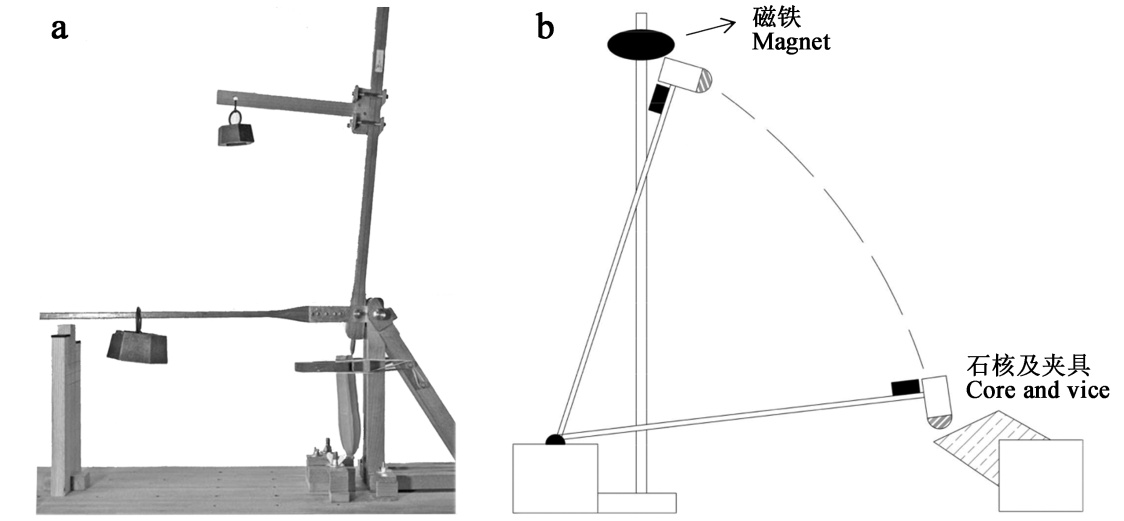
图1 Kelterborn (a)、Pelcin (b)控制变量实验使用中的实验装置[20,21]
Fig.1 The device used in Kelterborn’s (a), Pelcin’s (b) controlled experiments
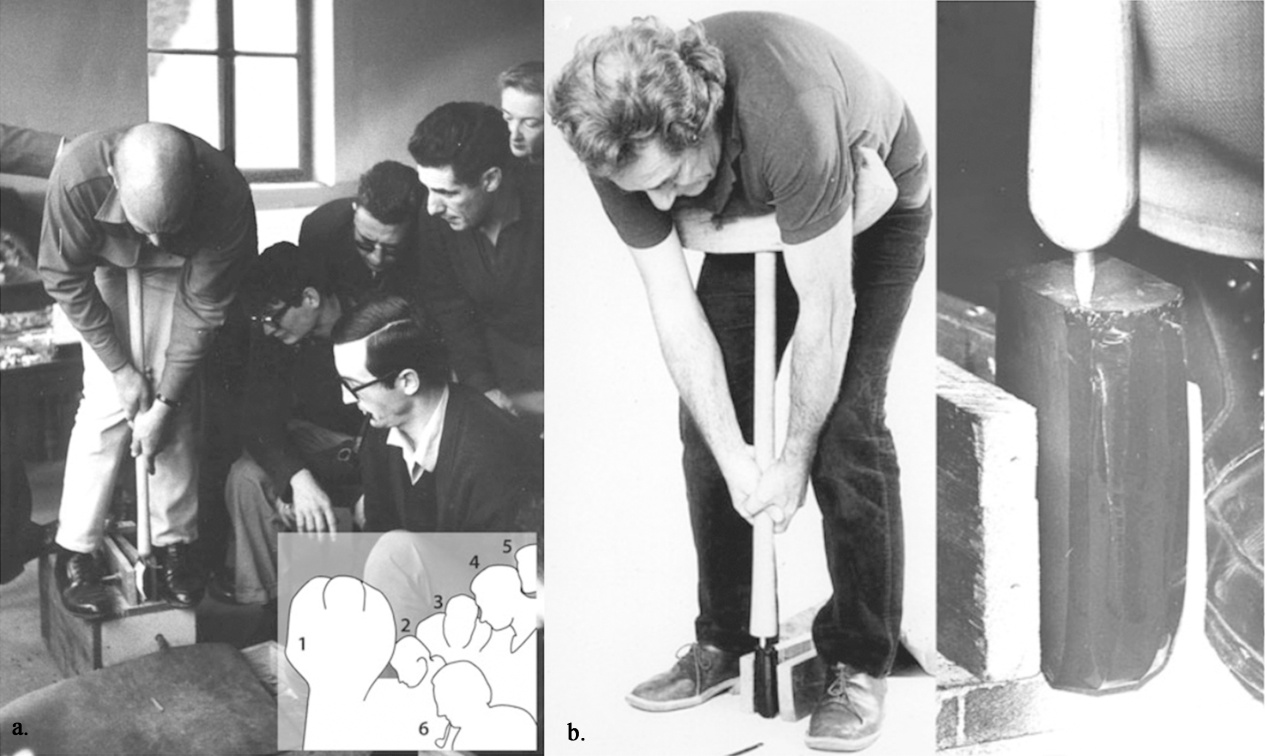
图2 Tixier的压制石叶实验演示 a. Crabtree在Les Eyzies会议上演示压制石叶(人物4为Tixier)Crabtree manufactures blades by pressure flaking at the Les Eyzies Conference (figure 4 is Tixier);b. Tixier在压制石叶(左)与石核部分特写(右)(修改自参考文献[26])Tixier manufactures blades by pressure flaking (left) and the close-up view of the core (right) (modified from reference [26])
Fig.2 Tixier exhibiting blade pressure flaking
| 编号No. | 方法Technique | 主要目的Main purpose | 关键发现Major findings |
|---|---|---|---|
| 1 | 硬锤法Hard hammer percussion | 验证硬锤法生产石叶的可行性 | 硬锤法可生产石叶 |
| 2 | 软锤法Soft hammer percussion | 验证软锤(鹿角)法生产石叶的可行性 | 软锤法可生产石叶;产品宽度变异大;台面边缘常见破碎痕迹 |
| 3 | 硬锤法Hard hammer percussion | 获取统计分析样本 | 生产了125件石叶;宽度无集中趋势 |
| 4 | 软锤法Soft hammer percussion | 验证软锤法生产大石叶的可行性 | 软锤法可生产大型石叶 |
| 5 | 间接法Indirect percussion | 验证鹿角冲子和石锤组合生产石叶类产品的可行性 | 间接法可以生产大型、规整的石叶,宽度集中于21~25 mm |
| 6 | 间接法Indirect percussion | 最大化细石叶产量 | 仅有38%产品是细石叶,且产品断裂率高 |
| 7 | 压制法Pressure flaking | 验证装置固定石核和鹿角压杆生产细石叶的可行性 | 高达84%产品为细石叶,产品尺寸集中 |
| 8 | 压制法Pressure flaking | 验证手持石核和鹿角压杆生产细石叶的可行性 | 高达85%产品为细石叶 |
| 9 | 硬锤法Hard hammer percussion | 验证熟练工匠硬锤法生产细石叶可行性 | 高达77%产品为细石叶,但多数台面破损 |
表1 Sollberger与Patterson所进行的实验
Tab.1 Nine experiments conducted by Sollberger and Patterson
| 编号No. | 方法Technique | 主要目的Main purpose | 关键发现Major findings |
|---|---|---|---|
| 1 | 硬锤法Hard hammer percussion | 验证硬锤法生产石叶的可行性 | 硬锤法可生产石叶 |
| 2 | 软锤法Soft hammer percussion | 验证软锤(鹿角)法生产石叶的可行性 | 软锤法可生产石叶;产品宽度变异大;台面边缘常见破碎痕迹 |
| 3 | 硬锤法Hard hammer percussion | 获取统计分析样本 | 生产了125件石叶;宽度无集中趋势 |
| 4 | 软锤法Soft hammer percussion | 验证软锤法生产大石叶的可行性 | 软锤法可生产大型石叶 |
| 5 | 间接法Indirect percussion | 验证鹿角冲子和石锤组合生产石叶类产品的可行性 | 间接法可以生产大型、规整的石叶,宽度集中于21~25 mm |
| 6 | 间接法Indirect percussion | 最大化细石叶产量 | 仅有38%产品是细石叶,且产品断裂率高 |
| 7 | 压制法Pressure flaking | 验证装置固定石核和鹿角压杆生产细石叶的可行性 | 高达84%产品为细石叶,产品尺寸集中 |
| 8 | 压制法Pressure flaking | 验证手持石核和鹿角压杆生产细石叶的可行性 | 高达85%产品为细石叶 |
| 9 | 硬锤法Hard hammer percussion | 验证熟练工匠硬锤法生产细石叶可行性 | 高达77%产品为细石叶,但多数台面破损 |
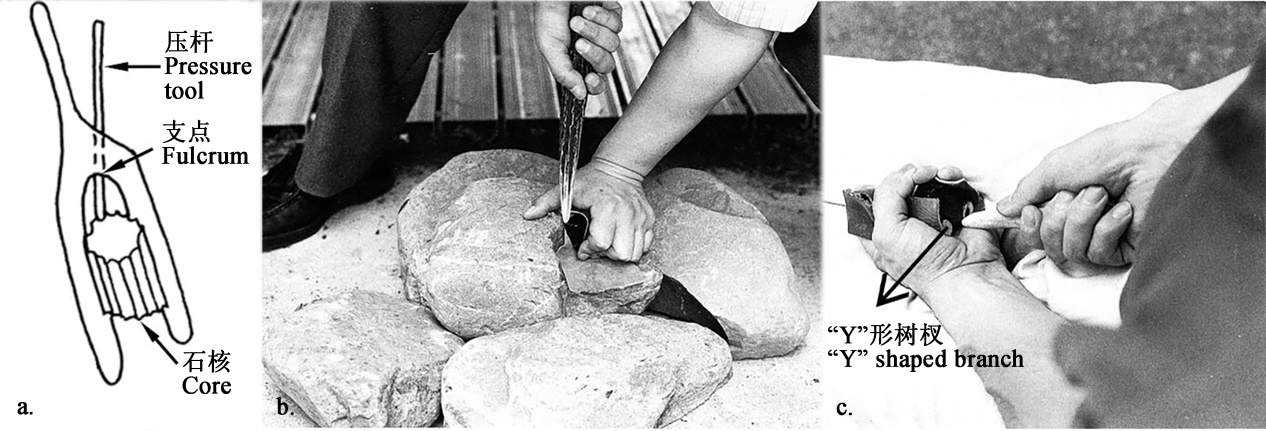
图3 Sollberger与Patterson设计的压制工具(a)[29],Ohnuma展示两种细石叶的压制方式 (b, c)[31]
Fig.3 Pressure tool designed by Sollberger and Patterson (a)[29]; Ohnuma demonstrates two ways of detaching micro-blades by pressure (b, c)[31]
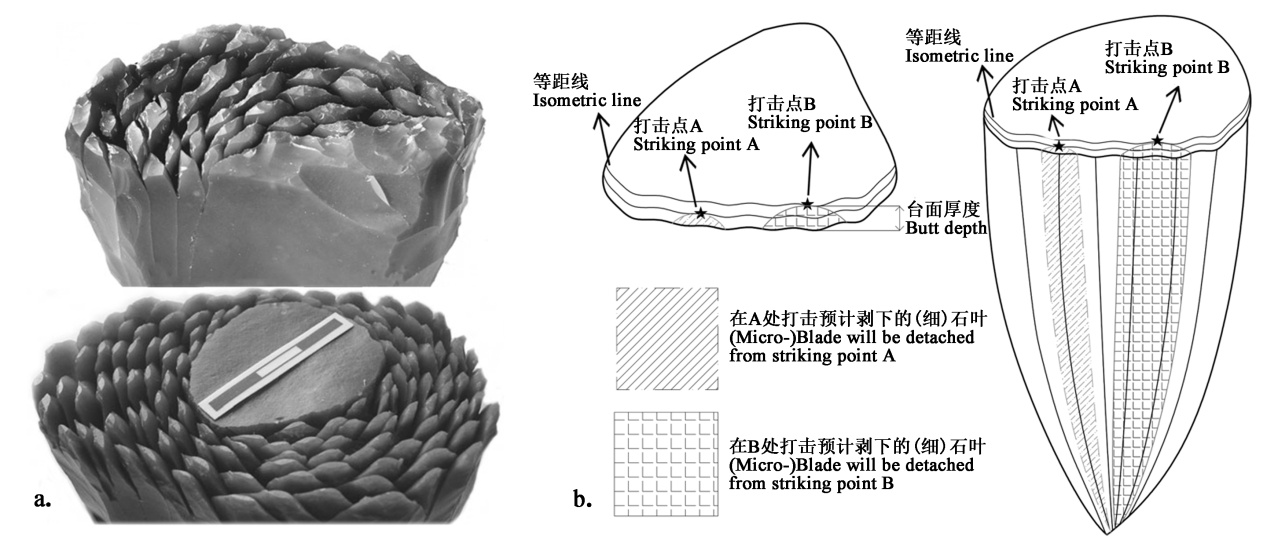
图4 石叶类产品的台面特征及其与产品尺寸的关系 a.(细)石叶石核剥片面形态稳定性示意(修改自参考文献[40])The stability of (micro-)blade core surface morphology (modified from reference [40]);b.台面厚度的增减,导致(细)石叶宽度的增减Increases and decreases in platform thickness result in increases and decreases in (micro-)blade’s width
Fig.4 Platform characteristics and their impacts on laminar production
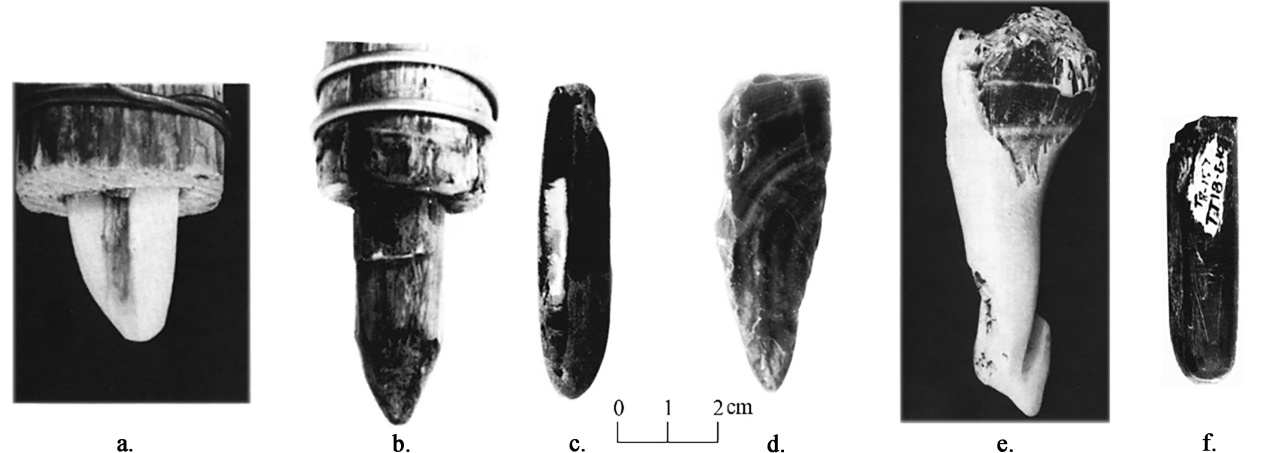
图5 Clark在实验中试验的压头 a.牛骨cow bone;b.阔变豆木granadillo;c.黑曜石obsidian;d.燧石chert;e.贝类甲壳shell;f.考古发现疑似石质压头possible stone bit excavated in Mexico。(修改自参考文献[44]) (modified from reference [44])
Fig.5 Bits tested in Clark’s experiments
| [1] | 陈淳, 张萌. 细石叶工业研究的回顾与再思考[J]. 人类学学报, 2018, 37(4): 577-589 |
| [2] | 李锋. 石叶概念探讨[J]. 人类学学报, 2012, 31(1): 41-50 |
| [3] | 加藤真二. 中国的石叶技术[J]. 人类学学报, 2006, 25(4): 343-351 |
| [4] |
Desrosiers PM. Palaeoeskimo lithic technology: Constraints and adaptation[J]. Lithic Technology, 2007, 32(1): 17-38
doi: 10.1080/01977261.2007.11721041 URL |
| [5] | Inizan ML, Lechevallier M, Plumet P. A technological marker of the penetration into North America: Pressure microblade debitage, its origin in the Paleolithic of North Asia and its diffusion[J]. Pittsburgh: Material Research Society, 1992, 661-681 |
| [6] | Desrosiers PM. Breaking stones without striking them[A]. In: Desrosiers PM(Ed). The Emergence of Pressure Blade Making: From Origin to Modern Experimentation[C]. New York: Springer, 2012, 3-9 |
| [7] |
Gómez Coutouly YA. The emergence of pressure knapping microblade technology in northeast Asia[J]. Radiocarbon, 2018, 60(3): 1-35
doi: 10.1017/RDC.2017.96 URL |
| [8] |
Keates SG, Postnov AV, Kuzmin YV. Towards the origin of microblade technology in Northeastern Asia[J]. Vestnik of Saint Petersburg University. History, 2019, 64(2): 390-414
doi: 10.21638/11701/spbu02.2019.203 URL |
| [9] | Brunet F. The technique of pressure knapping in Central Asia: innovation or diffusion[A]. In: Desrosiers PM(Ed.). The Emergence of Pressure Blade Making: From Origin to Modern Experimentation[C]. New York: Springer, 2012, 307-328 |
| [10] | Madsen B. Late Palaeolithic cultures of south Scandinavia: tools, traditions and technology[A]. In: Larsson L(Ed.). The Earliest Settlement of Scandinavia and Its Relationship with Neighbouring Areas[C]. Stockholm: Almqvist & Wiksell, 1996, 61-73 |
| [11] | 陈胜前. 考古推理的结构[J]. 考古, 2007, 10: 42-51 |
| [12] |
Jennings TA, Smallwood AM, Pevny CD. Reviewing the role of experimentation in reconstructing Paleoamerican lithic technologies[J]. PaleoAmerica, 2021, 7(1): 53-67
doi: 10.1080/20555563.2020.1848269 URL |
| [13] |
Gifford-Gonzalez D. Bones are not enough: Analogues, knowledge, and interpretive strategies in zooarchaeology[J]. Journal of Anthropological Archaeology, 1991, 10(3): 215-254
doi: 10.1016/0278-4165(91)90014-O URL |
| [14] |
Cameron D. Uniformitarianism and prehistoric archaeology[J]. Australian Archaeology, 1993, 36(1): 42-49
doi: 10.1080/03122417.1993.11681481 URL |
| [15] |
Johnson LL. A history of flint-knapping experimentation, 1838-1976 (and comments and reply)[J]. Current Anthropology, 1978, 19(2): 337-372
doi: 10.1086/202078 URL |
| [16] | Nami HG. Reflections on experimental archaeology and lithic technology: Issues on actualistic stone tools analysis and interpretation[A]. In: Nami HG(Ed). Experiments and Interpretation of Traditional Technologies: Essays in Honor of Errett Callahan[C]. Buenos Aires: Ediciones de Arqueología Contemporánea, 2010, 91-168 |
| [17] | 何华青, 吴彤. 实验的可重复性研究——新实验主义与科学知识社会学比较[J]. 自然辩证法通讯, 2008, 4: 42-48 |
| [18] |
Shea JJ. Stone tool analysis and human origins research: Some advice from uncle Screwtape[J]. Evolutionary Anthropology, 2011, 20(2): 48-53
doi: 10.1002/evan.20290 pmid: 22034103 |
| [19] |
Thomas DH. Points on points - A reply to Flenniken and Raymond[J]. American Antiquity, 1986, 51(3): 619-627
doi: 10.2307/281758 URL |
| [20] | Kelterborn P. Measurable flintknapping[A]. In: Hirth K(Ed.). Mesoamerican Lithic Technology: Experimentation and Interpretation[C]. Salt Lake City: University of Utah Press, 2002, 120-131 |
| [21] | Pelcin AW. Controlled Experiments in the Production of Flake Attributes[D]. PhD thesis, Philadelphia: University of Pennsylvania, 1996 |
| [22] | Faulkner A. Mechanical Principles of Flintworking[D]. PhD thesis, Pullman: Washington State University, 1974 |
| [23] |
Eren MI, Lycett SJ, Patten RJ, et al. Test, model, and method validation: The role of experimental stone artifact replication in hypothesis-driven archaeology[J]. Ethnoarchaeology, 2016, 8(2): 103-136
doi: 10.1080/19442890.2016.1213972 URL |
| [24] | Campbell DT, Stanley JC. Experimental and Quasi-Experimental designs for research[M]. Belmont: Wadsworth Publishing, 1963, 4-6 |
| [25] |
Speth JD. Mechanical basis of percussion flaking[J]. American Antiquity, 1972, 37(1): 34-60
doi: 10.2307/278884 URL |
| [26] | Inizan ML. Pressure débitage in the old world: Forerunners, researchers, geopolitics-Handing on the baton[A]. In: Desrosiers PM(Ed). The Emergence of Pressure Blade Making: From Origin to Modern Experimentation[C]. New York: Springer, 2012, 11-42 |
| [27] | Clark JE. Stoneworkers’ approaches to replicating prismatic blades[A]. In: Desrosiers PM(Ed.). The Emergence of Pressure Blade Making: From Origin to Modern Experimentation[C]. New York: Springer, 2012, 43-135 |
| [28] | Texier PJ. Un débitage expérimental de silex par pression pectorale à la béquille[J]. Bulletin de la Société préhistorique française, 1984, 25-27 |
| [29] |
Sollberger JB, Patterson LW. Prismatic blade replication[J]. American Antiquity, 1976, 41(4): 517-531
doi: 10.2307/279021 URL |
| [30] | Flenniken JJ. The paleolithic Dyuktai pressure blade technique of Siberia[J]. Arctic Anthropology, 1987, 24(2): 117-132 |
| [31] | Ohnuma K. Experimental studies in the determination of manners of micro-blade detachment[J]. Al-Rafidan, 1993, 14: 153-181 |
| [32] | Crabtree DE. An introduction to flintworking[M]. Pocatello: Idaho State University Museum, 1972 |
| [33] | Inizan ML, Reduron-Ballinger M, Roche H, et al. Technology and terminology of knapped stone: Followed by a multilingual vocabulary Arabic, English, French, German, Greek, Italian, Portuguese, Spanish[M]. Nanterre: CREP, 1999, 30-32 |
| [34] | Newcomer MH. “Punch technique” and Upper Paleolithic blades[A]. In: Swanson E(Ed.). Lithic Technology: Making and Using Stone Tools[C]. Paris: Mouton Publishers, 1975, 97-102 |
| [35] | Cotterell B, Kamminga J. The mechanics of flaking[A]. In: Hayden B(Ed). Lithic use-wear analysis[C]. New York: Academic Press, 1979, 97-112 |
| [36] |
Cotterell B, Kamminga J. The formation of flakes[J]. American antiquity, 1987, 52(4): 675-708
doi: 10.2307/281378 URL |
| [37] | Baker T. Digital Crabtree: computer simulation of Folsom fluting[A]. In: Clark JE, Collins MB(Eds). Folsom Technology and Lifeways (Lithic Technology, Special Publication)[C]. Tulsa: Department of Anthropology, University of Tulsa, 2002, 209-226 |
| [38] |
Dibble HL, Pelcin AW. The effect of hammer mass and velocity on flake mass[J]. Journal of Archaeological Science, 1995, 22(3): 429-439
doi: 10.1006/jasc.1995.0042 URL |
| [39] |
Pelcin AW. The effect of core surface morphology on flake attributes: Evidence from a controlled experiment[J]. Journal of Archaeological Science, 1997, 24(8): 749-756
doi: 10.1006/jasc.1996.0156 URL |
| [40] | Pelegrin J. New Experimental observations for the characterization of pressure blade production techniques [A]. In: Desrosiers PM(Ed). The Emergence of Pressure Blade Making: From Origin to Modern Experimentation[C]. New York: Springer, 2012, 465-500 |
| [41] |
Outram AK. Introduction to experimental archaeology[J]. World Archaeology, 2008, 40(1): 1-6
doi: 10.1080/00438240801889456 URL |
| [42] |
Tabarev AV. Paleolithic wedge-shaped microcores and experiments with pocket devices[J]. Lithic Technology, 1997, 22(2): 139-149
doi: 10.1080/01977261.1997.11754539 URL |
| [43] |
Wobst HM. The archaeo-ethnology of hunter-gatherers or the tyranny of the ethnographic record in archaeology[J]. American antiquity, 1978, 43(2): 303-309
doi: 10.2307/279256 URL |
| [44] |
Clark JE. Platforms, bits, punches and vises: A potpourri of Mesoamerican blade technology[J]. Lithic Technology, 1985, 14(1): 1-15
doi: 10.1080/01977261.1985.11754496 URL |
| [45] |
Healan DM, Kerley JM. Edge damage induced by core immobilization in prismatic blade manufacture[J]. Lithic Technology, 1984, 13(1): 1-10
doi: 10.1080/01977261.1984.11720842 URL |
| [46] |
Lin SC, Rezek Z, Dibble HL, et al. Experimental design and experimental inference in stone artifact archaeology[J]. Journal of Archaeological Method and Theory, 2018, 25(3): 663-688
doi: 10.1007/s10816-017-9351-1 |
| [47] |
Shott MJ, Trail BW. Exploring new approaches to lithic analysis: Laser scanning and geometric morphometrics[J]. Lithic Technology, 2010, 35(2): 195-220
doi: 10.1080/01977261.2010.11721090 URL |
| [48] |
González-José R, Charlin J. Relative importance of modularity and other morphological attributes on different types of lithic point weapons: Assessing functional variations[J]. PLoS ONE, 2012, 7(10): e48009
doi: 10.1371/journal.pone.0048009 URL |
| [49] |
Hutchings WK. Quantification of fracture propagation velocity employing a sample of Clovis channel flakes[J]. Journal of Archaeological Science, 1999, 26: 1437-1447
doi: 10.1006/jasc.1999.0416 URL |
| [50] |
Takakura J. Towards improved identification of obsidian microblade and microblade-like debitage knapping techniques: A case study from the Last Glacial Maximum assemblage of Kawanishi-C in Hokkaido, Northern Japan[J]. Quaternary International, 2021, 596: 65-78
doi: 10.1016/j.quaint.2021.04.003 URL |
| [1] | 仝广, 李锋, 高星. 泥河湾盆地二道梁遗址船形石核的剥片模拟实验[J]. 人类学学报, 2026, 45(01): 46-58. |
| [2] | 唐依梦, 刘扬, 侯亚梅. 乌兰木伦遗址非完整骨骼成因的实验考古学[J]. 人类学学报, 2025, 44(01): 42-54. |
| [3] | 李尧, 陈虹, 徐廷. 黑曜岩实验打制品使用后的痕迹特征[J]. 人类学学报, 2024, 43(05): 727-743. |
| [4] | 仝广, 李锋, 赵海龙, 闫晓蒙, 高星. 泥河湾盆地火山角砾岩原料的热处理实验[J]. 人类学学报, 2024, 43(01): 81-90. |
| [5] | 叶灿阳, 陈胜前, 赵潮, 胡晓农, 郭明建, 包青川. 冀蒙交界裕民文化锛状器的制作技术[J]. 人类学学报, 2023, 42(03): 317-330. |
| [6] | 张钰哲, 仝广, 张月书, 胡晓纯, 李锋. 石制品技术分析的盲测实验[J]. 人类学学报, 2022, 41(06): 994-1004. |
| [7] | 卢立群, 董兵, 陈胜前. 中国旧石器时代石球的实验研究[J]. 人类学学报, 2021, 40(04): 587-599. |
| [8] | 黄超, 张双权. X射线衍射技术在烧骨实验研究中的初步应用[J]. 人类学学报, 2021, 40(03): 513-525. |
| [9] | 崔启龙;张居中;杨玉璋;孙亚男. 河南舞阳贾湖遗址出土石器的微痕分析[J]. 人类学学报, 2017, 36(04): 478-498. |
| [10] | 翟少冬. 陶寺遗址石制品复制实验与磨制工艺[J]. 人类学学报, 2015, 34(02): 192-201. |
| [11] | 周振宇; 关莹; 高星. 旧石器时代石制品热处理研究:回顾与展望[J]. 人类学学报, 2013, 32(01): 19-30. |
| [12] | 陈慧; 陈胜前. 湖北郧县余嘴2号地点砍砸器的实验研究[J]. 人类学学报, 2012, 31(01): 1-10. |
| 阅读次数 | ||||||
|
全文 |
|
|||||
|
摘要 |
|
|||||
 京ICP证05002819号-3
