

主管:中国科学院
主办:中国科学院古脊椎动物与古人类研究所
出版:科学出版社
主办:中国科学院古脊椎动物与古人类研究所
出版:科学出版社
人类学学报 ›› 2026, Vol. 45 ›› Issue (02): 387-402.doi: 10.16359/j.1000-3193/AAS.2025.0007
• 综述 • 上一篇
魏屹( )
)
收稿日期:2024-05-28
修回日期:2024-08-14
出版日期:2026-04-15
发布日期:2026-04-17
作者简介:魏屹,副研究员,主要从事旧石器时代考古学研究。E-mail: veahweiyi@outlook.com
基金资助:
WEI Yi()
Received:2024-05-28
Revised:2024-08-14
Online:2026-04-15
Published:2026-04-17
摘要:
旧石器时代装饰品通常使用海洋贝壳、兽骨、兽牙、岩石矿物、化石和鸵鸟蛋皮等原料制成,但在时间和地域上存在着差异和共性。本文梳理了旧石器时代各类装饰品原料在不同地区和不同阶段的利用情况,在此基础上对旧石器时代装饰品的原料选择进行初步分析和总结,并对中国北方晚更新世时期的装饰品原料利用情况展开阐释。本文认为,客观因素固然是人类遴选原料的重要考量依据,但对于早期装饰品这类非实用性物品而言,文化传统可能是影响其原料选择的最重要因素。
中图分类号:
魏屹. 旧石器时代装饰品原料浅析[J]. 人类学学报, 2026, 45(02): 387-402.
WEI Yi. A brief analysis on raw material used for Paleolithic personal ornaments[J]. Acta Anthropologica Sinica, 2026, 45(02): 387-402.
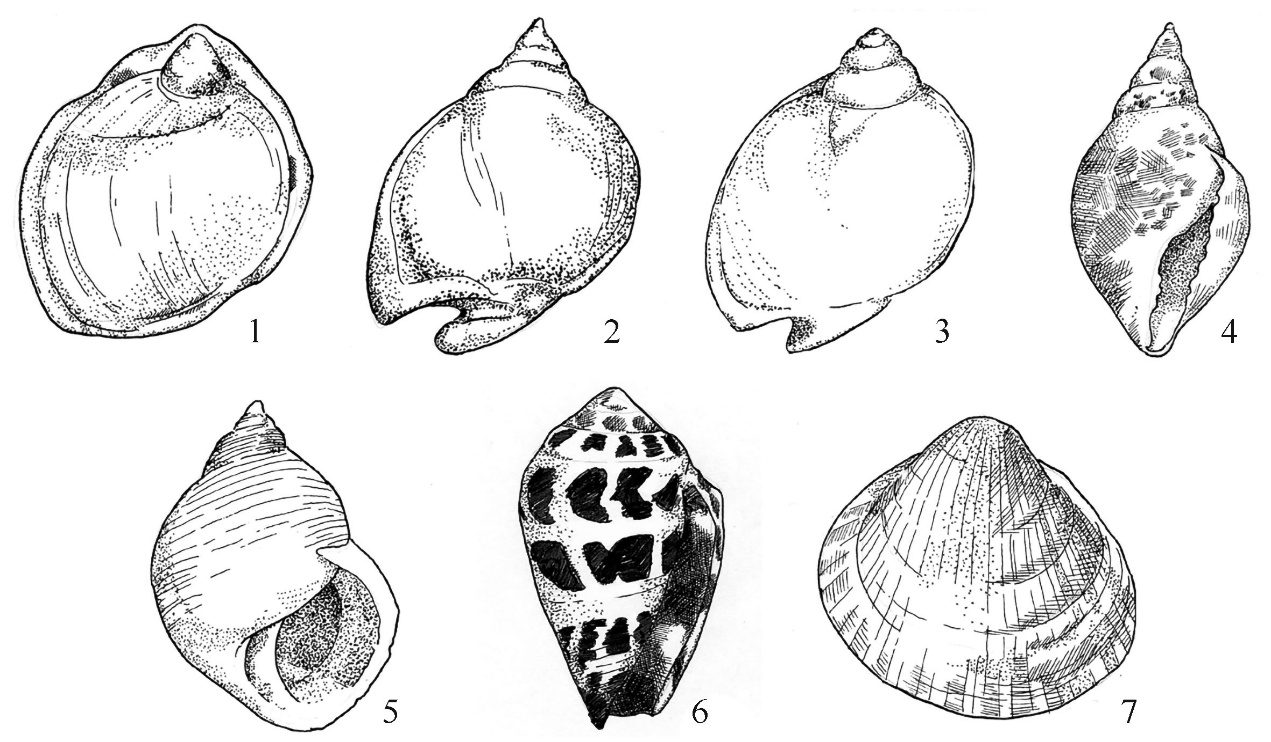
图1 旧石器时代最早用作装饰品的贝壳类型 1. Nassarius kraussianus; 2. Tritia gibbosula; 3. Tritia circumcinctus; 4. Columbella rustica; 5. Afrolittorina Africana; 6. Conus ebraeus; 7. Glycymeris nummaria。改绘自文献[3] / modified after reference[3]
Fig.1 Shell species used as the earliest Paleolithic personal ornaments
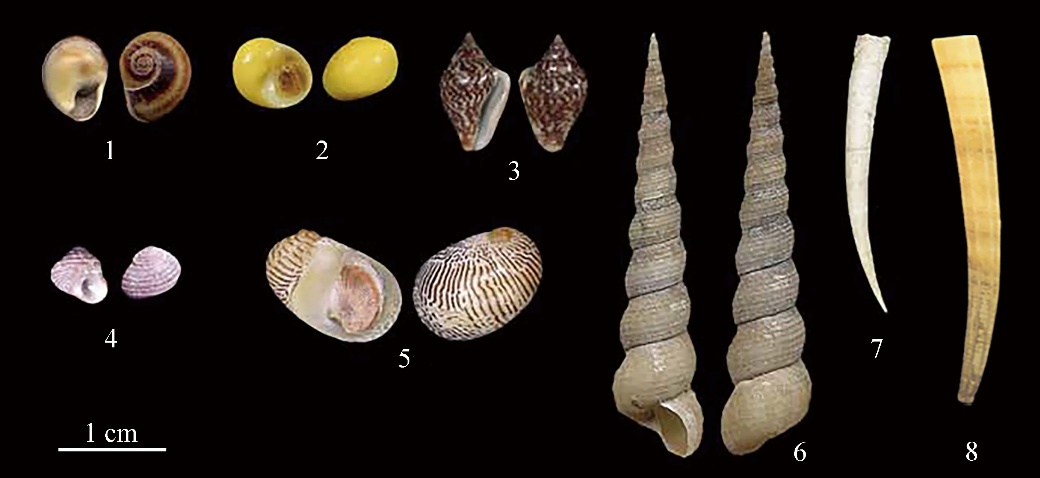
图2 旧石器时代晚期常用作装饰品原料的贝壳类型 1. Cyclope sp.; 2. Littorina obtusata; 3. Columbella sp.; 4. Homalopoma sanguineum; 5. Theodoxus sp.; 6. Turritella sp.; 7. Dentalium sp.; 8. Antalis sp.。改绘自文献[49] / modified after reference[49]
Fig.2 Commonly used shell species as raw materials for Upper Paleolithic personal ornaments
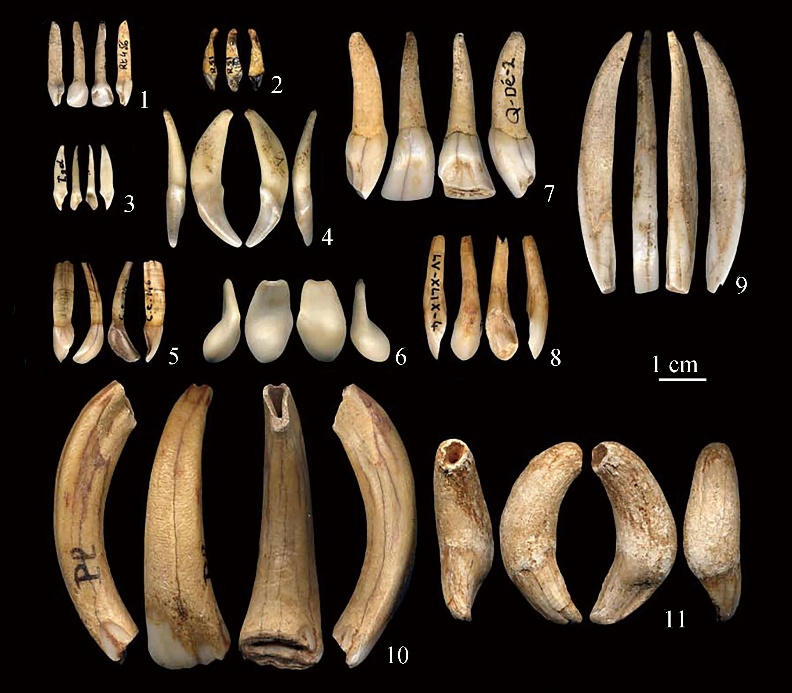
图3 旧石器时代常用作装饰品原料的兽牙类型 1.驯鹿门齿reindeer incisor;2.驯鹿犬齿reindeer canine;3.狐狸门齿fox incisor;4.狐狸犬齿fox canine;5.马鹿门齿red deer incisor;6.马鹿犬齿red deer canine;7.牛科门齿bovid incisor;8.山羊门齿ibex incisor;9.野猪门齿wild boar incisor;10.马门齿horse incisor;11.马犬齿horse canine。改绘自文献[49] / modified after reference[49]
Fig.3 Commonly used animal teeth as raw materials for Paleolithic personal ornaments
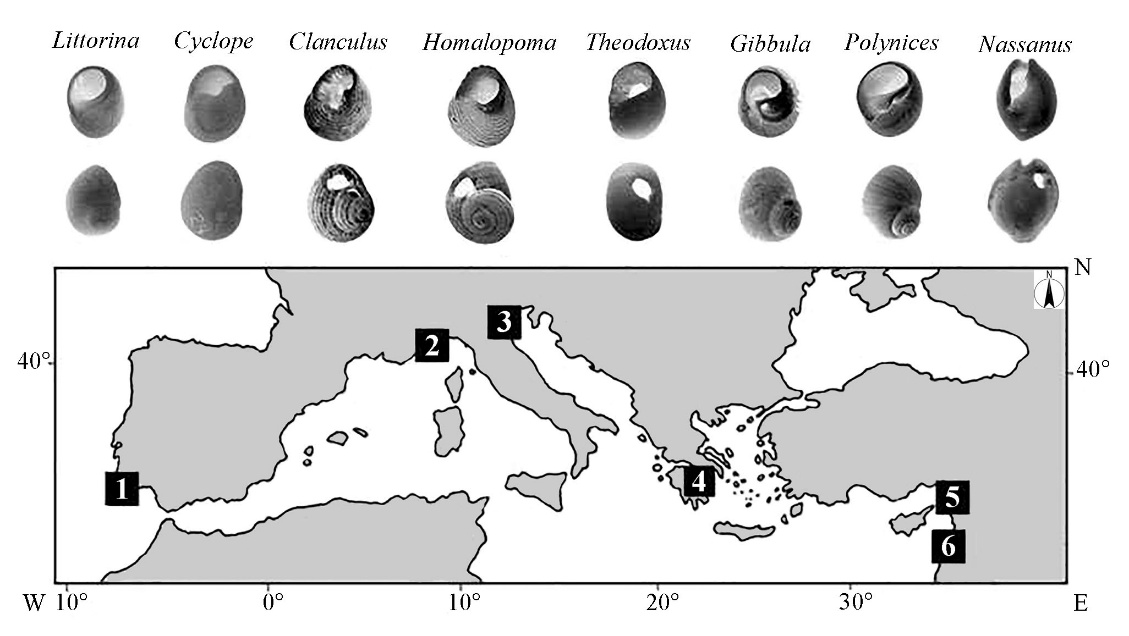
图4 欧洲南部和黎凡特地区旧石器时代晚期常见的贝壳种类及出土遗址 1. 葡萄牙Vale Boi遗址 (Vale Boi site, Portugal);2. 意大利Riparo Mochi遗址 (Riparo Mochi site, Italy);3. 意大利Riparo Fumane遗址 (Riparo Fumane site, Italy);4. 希腊Franchthi Cave、Kephalari Cave、Klissoura Cave 1遗址 (Franchthi Cave, Kephalari Cave and Klissoura Cave 1, Greece);5. 黎凡特Üçağızlı Cave I遗址 (Üçağızlı Cave I, Levant);6. 黎凡特Skhul、Qafzeh Cave遗址 (Skhul、Qafzeh Cave, Levant)。改绘自文献[106] / modified after reference[106]
Fig.4 Commonly used shell species as personal ornaments during Upper Paleolithic in southern Europe and the Levant

图5 Riparo Mochi 遗址出土的不同原料制作的篮状装饰品 1. Nassarius贝壳 Nassarius shell;2. Cyclope贝壳 Cyclope shell;3. 仿马鹿犬齿的兽骨串珠 carved bone bead carved into the form of a red deer canine;4-6. 马鹿犬齿red deer canine;7-8. 滑石串珠 carved soapstone bead。改绘自文献[106] / modified after reference[106]
Fig.5 Basket-shaped ornaments from Riparo Mochi made from distinct raw materials
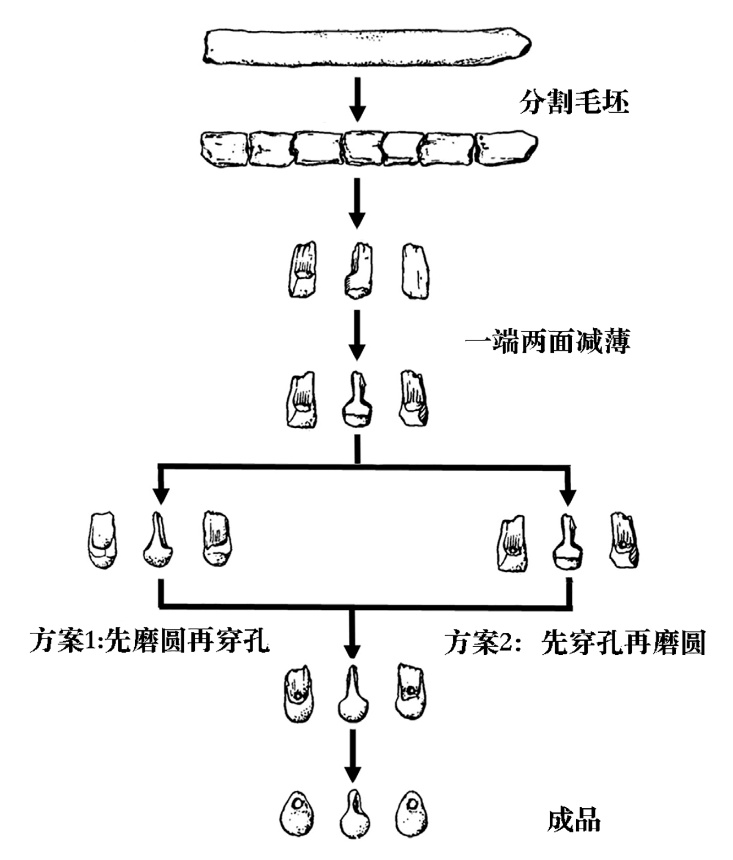
图6 以象牙为原料制作篮状串珠的标准化生产流程示意图 改绘自文献[107] / modified after reference[107]
Fig.6 Standardized production sequence for basket-shaped beads made from ivory
| [1] | Bar-Yosef Mayer DE, Groman-Yaroslavski I, Bar-Yosef O, et al. On holes and strings: Earliest displays of human adornment in the Middle Palaeolithic[J]. PLoS ONE, 2020, 15(7): e0234924 |
| [2] | Jerardino A, Marean CW. Shellfish gathering, marine palaeoecology and modern human behavior: Perspectives from cave PP13b, Pinnacle Point, South Africa[J]. Journal of Human Evolution, 2010, 59(3-4): 412-424 |
| [3] | Steele TE, Álvarez-Fernández E, Hallett-Desguez E. A Review of Shells as Personal Ornamentation during the African Middle Stone Age[J]. PaleoAnthropology, 2019: 24-51 |
| [4] | Sehasseh EM, Fernandez P, Kuhn S, et al. Early Middle Stone Age personal ornaments from Bizmoune Cave, Essaouira, Morocco[J]. Science Advances, 2021, 7(39): eabi8620 |
| [5] | Vanhaeren M, d’Errico F, Stringer C, et al. Middle Paleolithic Shell Beads in Israel and Algeria[J]. Science, 2006, 312: 1785-1788 |
| [6] | Bouzouggar A, Barton RNE, Vanhaeren M, et al. 82,000-year-old shell beads from North Africa and implications for the origins of modern human behavior[J]. Proceedings of the National Academy of Sciences, 2007, 104: 9964-9969 |
| [7] | d’Errico F, Vanhaeren M, Barton N, et al. Additional evidence on the use of personal ornaments in the Middle Paleolithic of North Africa[J]. Proceedings of the National Academy of Sciences, 2009, 106: 16051-16056 |
| [8] | El Hajraoui MA, Oudouche H, Nespoulet R. Partie 3-Grotte d’El Mnasra:Chapitre XXVI. Étude des coquilles perforées découvertes à Témara[A]. In: El Hajraoui MA, Nespoulet R, Debénath A, et al(Eds). Préhistoire de la Région de Rabat-Témara. Villes et Sites Archéologiques du Maro[C]. Royaume du Maroc, Ministère de la Culture, Institut National des Sciences de l’Archéologie et du Patrimoine, Rabat, Morocco, 2012, 191-199 |
| [9] | Kuhn SL, Stiner MC, Reese DS, et al. Ornaments of the earliest Upper Paleolithic: new insights from the Levant[J]. Proceedings of the National Academy of Sciences of the United States of America, 2001, 98: 7641-7646 |
| [10] | Bosch MD, Wesselingh FP, Mannino MA. The Ksâr ‘Akil (Lebanon) mollusc assemblage: zooarchaeological and taphonomic investigations[J]. Quaternary International, 2015, 390: 85-101 |
| [11] | Stiner MC, Kuhn SL, Gulec E. Early upper paleolithic shell beads at Üçağızlı Cave I (Turkey): technology and the socioeconomic context of ornament life-histories[J]. Journal of Human Evolution, 2013, 64(5): 380-398 |
| [12] | ar-Yosef Mayer DE. Shell Beads of the Middle and Upper Palaeolithic: A Review of the Earliest Records[A]. In: Mãrgãrit M, Boronean A(Eds). Beauty and the Eye of the Beholder: Personal Adornments Across the Millennia[C]. Cetatea de scaun: Târgovişte, 2020, 11-25 |
| [13] | d'Errico F, Henshilwood C, Vanhaeren M, et al. Nassarius kraussianus shell beads from Blombos Cave: evidence for symbolic behaviour in the Middle Stone Age[J]. Journal of Human Evolution, 2005, 48(1): 3-24 |
| [14] | d'Errico F, Backwell LR, Villa P, et al. Early evidence of San material culture represented by organic artifacts from Border Cave, South Africa[J]. Proceedings of the National Academy of Sciences, 2012, 109: 13214-13219 |
| [15] | Vanhaeren M, d’Errico F, van Niekerk KL, et al. Thinking strings: additional evidence for personal ornament use in the Middle Stone Age at Blombos Cave, South Africa[J]. Journal of Human Evolution, 2013, 64: 500-517 |
| [16] | Vanhaeren M, Wadley L, d’Errico F. Variability in Middle Stone Age Symbolic Traditions: The Marine Shell Beads from Sibudu Cave, South Africa[J]. Journal of Archaeological Science: Reports, 2019, 27: 101893 |
| [17] | d’Errico F, Vanhaeren M, Wadley L. Possible shell beads from the Middle Stone Age layers of Sibudu Cave, South Africa[J]. Journal of Archaeological Science, 2008, 35: 2675-2685 |
| [18] | d’Errico F, Backwell L. Earliest evidence of personal ornaments associated with burial: the Conus shells from Border Cave[J]. Journal of Archaeological Science, 2016, 93: 91-108 |
| [19] | Bar-Yosef Mayer DE, Vandermeersch B, Bar-Yosef O. Shells and ochre in Middle Paleolithic Qafzeh Cave, Israel: indications for modern behavior[J]. Journal of Human Evolution, 2009, 56: 307-314 |
| [20] | Taborin Y. La mer et les premiers hommes modernes[A]. In: Vandermeersch B(Ed). Échanges et diffusion dans la préhistroire méditerranéenne[C]. Paris: Editions du comité des travaux historiques et scientifiques, 2003, 113-122 |
| [21] | Zilhão J, Angelucci DE, Badal-García E, et al. Symbolic use of marine shells and mineral pigments by Iberian Neandertals[J]. Proceedings of the National Academy of Sciences of the United States of America, 2010, 107(3): 1023-1028 |
| [22] | White R. Technological and Social Dimensions of "Aurignacian-Age" Body Ornaments across Europe[A]. In: Knecht H, Pike-Tay A, White R(Eds). Before Lascaux. The Complex Record of the Early Upper Palaeolithic[C]. Boca Ratón, Florida: CRC Press, 1993, 227-299 |
| [23] | Álvarez Fernández E, Jöris O. Personal ornaments in the early Upper Paleolithic of Western Eurasia: An evaluation of the record[J]. Eurasian Prehistory, 2007, 5(2): 31-44 |
| [24] | Perlès C. Cultural implications of uniformity in ornament assemblages: Paleolithic and Mesolithic ornaments from Franchthi cave, Greece[J]. PaleoAnthropology, 2019, 196-207 |
| [25] | Balme J, O'Connor S. Traditions and change in scaphopod shell beads in Northern Australia from the Pleistocene to the recent past[A]. In: Bar-Yosef Mayer DE, Choyke A, Bonsall C(Eds). Not just for show: The archaeology of beads, beadwork, and personal ornaments[C]. Oxford: Oxbow books, 2017, 7-18 |
| [26] | Balme J, Morse K. Shell beads and social behaviour in Pleistocene Australia[J]. Antiquity, 2006, 80(310): 799-811 |
| [27] | Langley MC, Clarkson C, Ulm S. Symbolic expression in Pleistocene Sahul, Sunda, and Wallacea[J]. Quaternary Science Reviews, 2019, 221: 1-22 |
| [28] | Langley MC, O'Connor S, Piotto E. 42,000-year-old worked and pigment- stained Nautilus shell from Jerimalai (Timor-Leste): evidence for an early coastal adaptation in ISEA[J]. Journal of Human Evolution, 2016, 97: 1-16 |
| [29] | Langley MC, Amano N, Wedage O, et al. Bows and arrows and complex symbolic displays 48,000 years ago in the South Asian tropics[J]. Science Advances, 2020, 6(24): eaba3831 |
| [30] | Langley MC, Kealy S, O'Connor S. Sequins from the sea: Nautilus shell bead technology at Makpan, Alor Island, Indonesia[J]. Antiquity, 2023, 97(394): 810-828 |
| [31] | Sali S. The Upper Palaeolithic and Mesolithic Cultures of Maharashtra[M]. Pune: Deccan College Postgraduate Research Institute, 1989 |
| [32] | Wei Y, d’Errico F, Vanhaeren M, et al. An Early Instance of Upper Palaeolithic Personal Ornamentation from China: The Freshwater Shell Bead from Shuidonggou 2[J]. PLoS ONE, 2016, 11(5): e0155847 |
| [33] | Pei WC. The Upper Cave Industry of Choukoutien[M]. Palaeontologia Sinica 120. Peking:Geological Survey of China, 1939 |
| [34] | 宋艳花, 石金鸣. 山西吉县柿子滩旧石器时代遗址出土装饰品研究[J]. 考古, 2013, 8: 46-57 |
| [35] | 盖培, 卫奇. 虎头梁旧石器时代晚期遗址的发现[J]. 古脊椎动物学报, 1977, 15(4): 287-302 |
| [36] | Fujita M, Yamasaki S, Katagiri C, et al. Advanced maritime adaptation in the western Pacific coastal region extends back to 35,000-30,000 years before present[J]. Proceedings of the National Academy of Sciences, 2016, 113(40): 11184-11189 |
| [37] | Shunkov MV, Fedorchenko AY, Kozlikin MB. Early Upper Paleolithic objects of bone from the South Chamber of Denisova cave (collection of 2017)[A]. In: Derevianko AP, Molodin VI, Shunkov MV(Eds). Problems of Archaeology, Ethnography and Anthropology in Siberia and Neighboring Territories, 23[C]. Novosibirsk: Institute of Archaeology and Ethnography SB RAS Publ, 2017, 259-262 |
| [38] | Shunkov MV, Fedorchenko AY, Kozlikin MB, et al. Initial Upper Palaeolithic ornaments and formal bone tools from the East Chamber of Denisova Cave in the Russian Altai[J]. Quaternary International, 2020, 559: 47-67 |
| [39] | Derevianko AP, Rybin EP. The earliest representations of symbolic behavior by Paleolithic humans in the Altai Mountains[J]. Archaeology, Ethnography and Anthropology of Eurasia, 2003, 4, 27-50 |
| [40] | Lbova L. Personal ornaments as markers of social behavior, technological development and cultural phenomena in the Siberian early upper Paleolithic[J]. Quaternary International, 2021, 573: 4-13 |
| [41] | Pitulko VV, Pavlova EY, Nikolskiy PA, et al. The oldest art of the Eurasian Arctic: personal ornaments and symbolic objects from Yana RHS, Arctic Siberia[J]. Antiquity, 2012, 86(333): 642-659 |
| [42] | Tejero JM, Bar-Oz G, Bar-Yosef O, et al. New insights into the Upper Palaeolithic of the Caucasus through the study of personal ornaments. Teeth and bones pendants from Satsurblia and Dzudzuana caves (Imereti, Georgia)[J]. PLoS ONE, 2021, 16(11): e0258974 |
| [43] | Tejero JM, Rabinovich R, Yeshurun R, et al. Personal ornaments from Hayonim and Manot caves (Israel) hint at symbolic ties between the Levantine and the European Aurignacian[J]. Journal of Human Evolution, 2021, 160: 102870 |
| [44] | 黄慰文, 傅仁义. 小孤山——辽宁海城史前洞穴遗址综合研究[M]. 北京: 科学出版社, 2009 |
| [45] | 袁家荣. 湖南旧石器时代文化与玉蟾岩遗址[M]. 长沙: 岳麓书社, 2013 |
| [46] | Leavesley MG. A shark-tooth ornament from Pleistocene Sahul[J]. Antiquity, 2007, 81: 308-315 |
| [47] | Brumm A, Langley MC, Moore MW, et al. Early human symbolic behavior in the Late Pleistocene of Wallacea[J]. Proceedings of the National Academy of Sciences, 2017, 114(16): 4105-4110 |
| [48] | Taborin Y. Langage Sans Parole. La Parure Aux Temps Préhistoriques[M]. Paris: La Maison Des Roches, 2004 |
| [49] | Vanhaeren M, d'Errico F. Aurignacian Ethno-linguistic Geography of Europe Revealed by Personal Ornaments[J]. Journal of Archaeological Science, 2006, 33(8): 1105-1128 |
| [50] | Álvarez Fernández E. Magdalenian Personal Ornaments on the Move: a Review of the Current Evidence in Central Europe[J]. Zephyrus, 2009, LXIII: 45-59 |
| [51] | Álvarez-Fernández E. Los objetos de adorno-colgantes del paleolítico superior y del Mesolítico en la cornisa cantábrica y en el valle del ebro: una visión Europea[D]. Spain: Universidad de Salamanca, 2006 |
| [52] | Romandini M, Peresani M, Laroulandie V, et al. Convergent evidence of eagle talons used by late Neanderthals in Europe: A further assessment on symbolism[J]. PLoS ONE, 2014, 9(7): e101278 |
| [53] | Radovčić D, Sršen AO, Radovčić J, et al. Evidence for Neandertal jewelry: Modified white-tailed eagle claws at Krapina[J]. PLoS ONE, 2015, 10(3): e0119802 |
| [54] | Radovčić D, Birarada G, Sršen AO, et al. Surface analysis of an eagle talon from Krapina[J]. Scientific Reports, 2020, 10(1): 6329 |
| [55] | Rodríguez-Hidalgo A, Morales JI, Cebrià A, et al. The Châtelperronian Neanderthals of Cova Foradada (Calafell, Spain) used imperial eagle phalanges for symbolic purposes[J]. Science Advances, 2019, 5(11): eaax1984 |
| [56] | Clarkson C, Petraglia M, Korisettar R, et al. The oldest and longest enduring microlithic sequence in India: 35000 years of modern human occupation and change at the Jwalapuram Locality 9 rockshelter[J]. Antiquity, 2015, 83(320): 326-348 |
| [57] | Langley MC, O'Connor S, Aplin K. A >46,000-year-old kangaroo bone implement from Carpenter's Gap 1 (Kimberley, northwest Australia)[J]. Quaternary Science Reviews, 2016, 154: 199-213 |
| [58] | Dortch C. Australia's oldest known ornaments[J]. Antiquity, 1979, 53(207): 39-43 |
| [59] | White R. Toward a Contextual Understanding of the Earliest Body Ornaments[A]. In: Trinkhaus E(Ed). The Emergence of Modern Humans: Biocultural Adaptations in the Later Pleistocene[C]. Cambridge: Cambridge University Press, 1989, 211-231 |
| [60] | White R. A social and technological View of Aurignacian and Castelperronian Personal Ornaments in SW Europe[A]. In: Cabrera Valdés V(Ed). El origen del Hombre Moderno en el Suroeste de Europa[C]. Madrid: UNED, 1993, 327-357 |
| [61] | Sáenz de Buruaga A. Colgantes y otras manifestaciones artísticas de los niveles del Paleolítico superior inicial de la Cueva de Gatzarria (Zuberoa, País Vasco)[J]. Veleia, 1989, 6: 21-48 |
| [62] | Shunkov MV, Fedorchenko AY, Kozlikin MB, et al. Bone tools and ornaments from the Early Upper Paleolithic deposits in the Main Chamber of Denisova cave:2016 collection[A]. In: Derevianko AP, Molodin VI, Shunkov MV(Eds). Problems of Archaeology, Ethnography and Anthropology in Siberia and Neighboring Territories, 22[C]. Novosibirsk: Institute of Archaeology and Ethnography SB RAS Publ., 2016, 221-224 |
| [63] | Shunkov MV, Fedorchenko AY, Kozlikin MB. Early Upper Paleolithic ivory bracelet from Denisova cave[A]. In: Derevianko AP, Molodin VI, Shunkov MV(Eds). Problems of Archaeology, Ethnography and Anthropology in Siberia and Neighboring Territories, 23[C]. Novosibirsk: Institute of Archaeology and Ethnography SB RAS Publ., 2017, 255-258 |
| [64] | Derevianko AP, Shunkov MV, Fedorchenko AY, et al. A palaeolithic diadem from Denisova cave[A]. In: Derevianko AP, Molodin VI, Shunkov MV(Eds). Problems of Archaeology, Ethnography and Anthropology in Siberia and Neighboring Territories, 24[C]. Novosibirsk: Institute of Archaeology and Ethnography SB RAS Publ., 2018, 87-90 |
| [65] | Derevianko AP, Shunkov MV, Fedorchenko A, et al. Paleolithic sculpture from Denisova cave. Novosibirsk[A]. In: Derevianko AP, Molodin VI, Shunkov MV(Eds). Problems of Archaeology, Ethnography and Anthropology in Siberia and Neighboring Territories, 25[C]. Novosibirsk: Institute of Archaeology and Ethnography SB RAS Publ., 2019, 103-108 |
| [66] | Lipnina EA. Mal’tinskoye Mestonakhozhdeniye Paleoliticheskikh Kul’tur: Sovremennoye Sostoyaniye Izuchennosti I Perspektivy Issledovaniya[D]. Irkutsk: Irkutsk State University, 2002 |
| [67] | Pitulko VV, Pavlova EY, Ivanova VV. Upper paleolithic art of the arctic Siberia, personal adornments from excavation of the yana-site[J]. Ural’s Historical Vestnik, 2014, 2(43): 6-17 |
| [68] | Golovanova LV, Doronichev VB, Cleghorn NE. The emergence of bone-working and ornamental art in the Caucasian Upper Palaeolithic[J]. Antiquity, 2010, 84(324): 299-320 |
| [69] | Álvarez Fernández E. Azabache et alii. La utilización del lignito durante el Paleolítico superior en Europa[A]. In: Allué E, Martín J, Canals A, et al(Eds). 1° Congreso Peninsular de Estudiantes de Prehistoria (Tarragona, 8-11 abril 2003)[C]. Tarragona: Universidat Rovira i Virgili, 2004, 386-393 |
| [70] | Álvarez Fernández E. "Éloignés mais pas isolés": la parure hors de la "frontière française" pendant le Magdalénien[A]. In: Dujardin V(Dir). Industrie osseuse et parures du Solutréen au Magdalénien en Europe. Table ronde sur le Paléolithique supérieur récent (Angoulême, 28-30 mars 2003)[C]. Paris: Mémoire XXXIX de la Société Préhistorique Française, 2005, 25-38 |
| [71] | Hahn J. Eiszeitschmuck auf der Schwäbischen Alb[J]. Alb und Donau, Kunst und Kultur, 1992, 5 |
| [72] | Fedorchenko AY, Belousova NE, Kulik NA, et al. Early Upper Paleolithic serpentine ornaments from Ust-Karakol, northwestern Altai[J]. Archaeology, Ethnography and Anthropology of Eurasia, 2020, 48(1): 3-15 |
| [73] | Barkov AV, Lbova LV. Bone and Antler processing (on Upper Palaeolithic site Malaya Syiya, South Siberia)[J]. Bulletin of the Novosibirsk State University, Series: History, Philology, 2017, 16(7): 74-83 |
| [74] | Lisitsyn NF. Pozdniy paleolit Chulymo-Yeniseyskogo mezhdurech’ya (The Upper Paleolithic of the Chulym-Yenisei interfluve)[M]. St. Petersburg: Institute for the History of the Material Culture of Russian Academy of Sciences, 2000 |
| [75] | Kogai SA, Rogovskoy EO. Ornamented items of the Mamony II paleolithic site (irkutsk) Izvestiya Irkutskogo gosudarstvennogo universitetaю[J]. The Bulletin of Irkutsk State University, 2013, 1: 62-70 |
| [76] | Tashak VI. Orudiya iz kosti i ikh proizvodstvo v verkhnem paleolite Zapadnogo Zabaykal’ya (po materialam Podzvonkoy) (Bone tools and their production in the Upper Palaeolithic of Western Transbaikalia (based on the materials of the Podzvonkaya))[J]. Bulletin of the Laboratory of Ancient Technologies, 2007, 5: 118-137 |
| [77] | Volkov PV, Lbova L. Technology of produced of the personal decorative objects on initial stage of Early Upper Palaeolithic time (material of Western Transbaikal zone)[J]. Bulletin of Novosibirsk State University. Series: History, Philology, 2009, 8(5): 62-73 |
| [78] | Rybin EP, Khatsenovich AM, Zwyns N, et al. New research data from the Tolbor-21 site (Northern Mongolia)[A]. In: Derevianko AP, Molodin VI(Eds). Problems of Archaeology, Ethnography and Anthropology in Siberia and Neighboring Territories, 23[C]. Novosibirsk: Institute of Archaeology and Ethnography SB RAS Publ., 2017, 191-201 |
| [79] | Rigaud S, Rybin EP, Khatsenovich AM, et al. Symbolic innovation at the onset of the Upper Paleolithic in Eurasia shown by the personal ornaments from Tolbor-21 (Mongolia)[J]. Scientific Reports, 2023, 13(1): 9545 |
| [80] | Kulik NA, Shunkov MV. Istochniki kamennogo syr’ya paleoliticheskikh ukrasheniy iz Gornogo Altaia (Sources of stone raw material for Palaeolithic personal ornaments from the Altai Mountains)[A]. In: Derevianko AP, Molodin VI(Eds). Problems of Archaeology, Ethnography and Anthropology in Siberia and Neighboring Territories, 17[C]. Novosibirsk: Institute of Archaeology and Ethnography SB RAS Publ., 2011, 62-66 |
| [81] | 梅惠杰. 泥河湾盆地旧、新石器时代的过渡—阳原于家沟遗址的发现与研究[D].硕士研究生毕业论文, 北京: 北京大学, 2007 |
| [82] | 贾兰坡, 盖培, 尤玉柱. 山西峙峪旧石器时代遗址发掘报告[J]. 考古学报, 1972, 1:39-58 |
| [83] | Chen C, An JY, Chen H. Analysis of the Xiaonanhai lithic assemblage, excavated in 1978[J]. Quaternary International, 2010, 211: 75-85 |
| [84] | Cooke CK. Excavations in Zombepata Cave, Sipolilo District, Mashonaland, Rhodesia[J]. The South African Archaeological Bulletin, 1971, 26 (103/104): 104-126 |
| [85] | Taborin Y. La parure en coquillage au Paléolithique. XXIX Supplément “Gallia Préhistoire”[M]. Paris: CNRS, 1993. |
| [86] | Krivoshapkin AI, Rudaya NA, Serdyuk NV, et al. New stage of Strashnaya cave’s investigation (Northwestern Altai): Preliminary results, based on layers 1-5[J]. Theory and Practice of Archaeological Research, 2016, 4 (16): 88-100 |
| [87] | 魏屹, 高星. 鸵鸟蛋皮串珠装饰品的发现与研究[J]. 人类学学报, 2020, 39(2): 223-235 |
| [88] | Ambrose SH. Chronology of the Later Stone Age and food production in East Africa[J]. Journal of Archaeological Science, 1998, 25(4): 377-392 |
| [89] | Robbins LH, Murphy ML, Brooks GA, et al. Archaeology, palaeoenvironment, and chronology of the Tsodilo Hills White Paintings Rock Shelter, Northwest Kalahari desert, Botswana[J]. Journal of Archaeological Science, 2000, 27: 1085-1113 |
| [90] | d’Errico F, Shipton C, et al. Trajectories of cultural innovation from the Middle to Later Stone Age in Eastern Africa: Personal ornaments, bone artifacts, and ocher from Panga ya Saidi, Kenya[J]. Journal of Human Evolution, 2020, 141: 102737 |
| [91] | Miller JM, Willoughby PR. Radiometrically dated ostrich eggshell beads from the Middle and Later Stone Age of Magubike Rockshelter, southern Tanzania[J]. Journal of Human Evolution, 2014, 74: 118-122 |
| [92] | Tryon CA, Lewis JE, Ranhorn KL, et al. Middle and Later Stone Age chronology of Kisese II rockshelter (UNESCO World Heritage Kondoa Rock-Art Sites), Tanzania[J]. PLoS ONE, 2018, 13(2): e0192029 |
| [93] | d'Errico F, Backwell LR, Villa P, et al. Early evidence of San material culture represented by organic artifacts from Border Cave, South Africa[J]. Proceedings of the National Academy of Sciences, 2012, 109: 13214-13219 |
| [94] | Stewart BA, Zhao Y, Mitchell PJ, et al. Ostrich eggshell bead strontium isotopes reveal persistent macroscale social networking across late Quaternary southern Africa[J]. Proceedings of the National Academy of Sciences, 2020, 117(12): 6453-6462 |
| [95] | Tashak VI. Плacтинчaтыe индycтpии Зaбaйкaлья: вoпpocы гeнeзиca и paзвития (Lamellate Industries in Trans-Baikal: Issues of Genesis and Development). Stratum Plus[J]. Apxeoлoгия и кyльтypнaя aнтpoпoлoгия, 2009, 1: 79-93 |
| [96] | Dogandzic T, Zwyns N, Richards MP, et al. Radiocarbon dating of Paleolithic sites in the Ikh-Tulberiin-Gol River Valley, Northern Mongolia[J]. Vestnik, 2013, 12(3): 44-48 |
| [97] | Zwyns N, Gladyshev SA, Gunchinsuren B, et al. The open-air site of Tolbor 16 (Northern Mongolia): preliminary results and perspectives[J]. Quaternary International, 2014, 347: 53-65 |
| [98] | Rybin EP. Tools, beads, and migrations: Specific cultural traits in the Initial Upper Paleolithic of Southern Siberia and Central Asia[J]. Quaternary International, 2014, 347: 39-52 |
| [99] | Jaubert J, Bertran P, Fontugne M, et al, Le Paléolithiquesupérieurancien de Mongolie: Dörölj 1 (EgiïnGol). Analogies avec les données de l’Altaï et de Sibérie[A]. In: Le Secrétariat du Congrèsed. The Upper Palaeolithic General Sessions and Posters. Acts of the XIVth UISPP Congress, Université de Liège, Belgium, 2-8 sept. 2001[C]. Oxford: Archaeopress, 2004, 245-251 |
| [100] | 高星, 王惠民, 裴树文, 等. 水洞沟 ——2003-2007 年度考古发掘与研究报告[M]. 北京: 科学出版社, 2013 |
| [101] | Wei Y, d’Errico F, Vanhaeren M, et al. A Technological and Morphological Study of Late Paleolithic Ostrich Eggshell Beads from Shuidonggou, North China[J]. Journal of Archaeological Science, 2017, 85: 83-104 |
| [102] | 郭家龙, 王惠民, 乔倩. 宁夏鸽子山遗址考古新发现[J]. 西夏研究, 2017, 2: 2+129 |
| [103] | Kumar G, Roy R. Late Pleistocene Art of India[M]. IFRAP Congress-Pleistocene Art of the World: Symposium Pleistocene Art of Asia, 2010, 6-11 |
| [104] | Kuhn SL, Stiner MC. Paleolithic ornaments: implications for cognition, demography and identity[J]. Diogenes, 2007, 54(2): 40-48 |
| [105] | 魏屹, d’Errico F, 高星. 旧石器时代装饰品研究:现状与意义[J]. 人类学学报, 2016, 35(1): 132-148 |
| [106] | Stiner MC. Finding a Common Bandwidth: Causes of Convergence and Diversity in Paleolithic Beads[J]. Biological Theory, 2014, 9(1): 51-64 |
| [107] | Heckel CE. Reconsidering production organization in the Early Upper Palaeolithic: The case for specialized production of Aurignacian beads[J]. Quaternary International, 2018, 491: 11-20 |
| [108] | White R. Beyond Art: Toward an Understanding of the Origins of Material Representation in Europe[J]. Annual Review of Anthropology, 1992, 21: 537-564 |
| [109] | Vanhaeren M. Speaking with beads:the evolutionary significance of personal ornaments[A]. In: d’Errico F, Backwell L(eds). From Tool to Symbols: From Early Hominids to Modern Humans[C]. Johannesburg: Witwatersrand University Press, 2005, 525-553 |
| [110] | Conkey MW. Ritual communication, social elaboration, and the variable trajectories of Paleolithic material culture[A]. In: Price TD, Brown JA(eds). Prehistoric hunter-gatherers: The emergence of cultural complexity[C]. Orlando: Academic Press, 1985, 299-323 |
| [111] | Marshack A. Some implications of the Paleolithic symbolic evidence for the origin of language[J]. Current Anthropology, 1976, 17: 274-282 |
| [112] | Kuhn SL. Signaling theory and technologies of communication in the Paleolithic[J]. Biological Theory, 2014, 9: 42-50 |
| [113] | 邱中郎, 李炎贤. 二十六年来的中国旧石器时代考古[A].见:中国科学院古脊椎动物与古人类研究所.古人类论文集[C].北京:科学出版社, 1978, 57-58 |
| [114] | 裴树文, 牛东伟, 高星, 等. 宁夏水洞沟遗址第7地点发掘报告[J]. 人类学学报, 2014, 33(1): 1-16 |
| [115] | Li Z, Doyon L, Fang H, et al. A Paleolithic bird figurine from the Lingjing site, Henan, China[J]. PLoS One, 2020, 15: e0233370 |
| [116] | 尹申平, 王小庆. 陕西宜川县龙王辿旧石器时代遗址[J]. 考古, 2007, 7: 3-8 |
| [117] | d’Errico F, Wei Y, et al. Zhoukoudian Upper Cave personal ornaments and ochre: Rediscovery and reevaluation[J]. Journal of Human Evolution, 2021, 161: 103088 |
| [118] | Zhang Y, Doyon L, Peng F, et al. An Upper Paleolithic Perforated Red Deer Canine With Geometric Engravings From QG10, Ningxia, Northwest China[J]. Frontiers in Earth Science, 2022, 10: 814761 |
| [119] | Knappett C. Networks of objects, meshworks of things[A]. In: Ingold T(Ed). Redrawing Anthropology: Materials, movements, lines[C]. London: Routledge, 2011, 45-63 |
| [120] | Baysal EL. Personal Ornaments in Prehistory. An Exploration of Body Augmentation from the Palaeolithic to the Early Bronze Age[M]. Oxford and Philadelphia: Oxbow Books, 2019 |
| [121] | Vanhaeren M, d'Errico F, Billy I, et al. Tracing the source of Upper Palaeolithic shell beads by strontium isotope dating[J]. Journal of Archaeological Science, 2004, 31(10): 1481-1488 |
| [122] | Eerkens JW, Herbert GS, Rosenthal JS, et al. Provenance Analysis of Olivella biplicata Shell Beads from the California and Oregon Coast by Stable Isotope Fingerprinting[J]. Journal of Archaeological Science, 2005, 32(10): 1501-1514 |
| [123] | Kowalik N, Anczkiewicz R, Wilczynski J, et al. Tracing human mobility in central Europe during the Upper Paleolithic using sub-seasonally resolved Sr isotope records in ornaments[J]. Scientific Reports, 2020, 10(1): 10386 |
| [1] | 廖汝雪, 傅裕, 王腾飞, 赵雄伟, 张潜, 陈彦伊, 陈少坤, 韩非, 吴雁, 胡鑫, 牛文渊, 韦璇, 黄先锋, 黄万波, 李英华. 重庆巫山龙骨坡遗址2023年发掘报告[J]. 人类学学报, 2026, 45(02): 345-357. |
| [2] | 宋艳花, 吴梦遥, 吴洋, 郭军亮, 马峰, 张建军, 吴小红, 郭玉杰. 山西阳城析城山遗址第1和第2地点发掘报告[J]. 人类学学报, 2026, 45(02): 358-371. |
| [3] | 薛峰, 牛东伟, 李鼎元. 怀来盆地南家沟旧石器时代遗址2015年度发掘报告[J]. 人类学学报, 2026, 45(02): 372-386. |
| [4] | 徐廷, 黄抡月, 任进成, 葛俊逸, 高星. 吉林省抚松县枫林遗址第2地点发掘简报[J]. 人类学学报, 2026, 45(01): 174-186. |
| [5] | 魏屹. 旧石器时代装饰品研究的理论观察[J]. 人类学学报, 2026, 45(01): 187-198. |
| [6] | 赵海龙, 周天路, 马冲, 杨博灿, 贾倩. 河北泥河湾盆地东缘石器原料的开发与利用[J]. 人类学学报, 2026, 45(01): 34-45. |
| [7] | 肖培源, 阮齐军, 李浩. 中国西南基纳型旧石器中期技术的发现与研究进展[J]. 人类学学报, 2025, 44(06): 1009-1018. |
| [8] | 胡越. 贵州观音洞遗址的石核剥片策略和修理技术[J]. 人类学学报, 2025, 44(06): 1019-1033. |
| [9] | 李三灵, 刘亚林, 赵文杰, 陈清懿, 李浩. 中国南方旧石器时代晚期石制品细小化现象初探[J]. 人类学学报, 2025, 44(06): 1034-1046. |
| [10] | 李意愿. 湖南道水流域条头岗遗址燧石原料的开发利用[J]. 人类学学报, 2025, 44(06): 1047-1059. |
| [11] | 郑喆轩, 谭培阳. 四川旧石器考古的进展与思考[J]. 人类学学报, 2025, 44(06): 1094-1105. |
| [12] | 向其芳, 钟倩, 李杭, 申艳茹, 王明强, 李铭扬. 湖北当阳九里岗旧石器遗址2022年发掘报告[J]. 人类学学报, 2025, 44(06): 1106-1119. |
| [13] | 李璇, 顾雪军. 2015~2018年河南栾川龙泉洞遗址发掘简报[J]. 人类学学报, 2025, 44(04): 714-726. |
| [14] | 谢光茂, 林强, 余明辉, 卢杰英. 广西隆安娅怀洞遗址发掘报告[J]. 人类学学报, 2025, 44(03): 365-388. |
| [15] | 谢颖, 付琳. 广西隆安娅怀洞遗址出土的穿孔石器[J]. 人类学学报, 2025, 44(03): 439-450. |
| 阅读次数 | ||||||
|
全文 |
|
|||||
|
摘要 |
|
|||||
 京ICP证05002819号-3