

主管:中国科学院
主办:中国科学院古脊椎动物与古人类研究所
出版:科学出版社
主办:中国科学院古脊椎动物与古人类研究所
出版:科学出版社
人类学学报 ›› 2026, Vol. 45 ›› Issue (04): 623-638.doi: 10.16359/j.1000-3193/AAS.2025.0112cstr: 32091.14.j.1000-3193/AAS.2025.0112
• 特邀文章 • 下一篇
马东东1,2( ), 裴树文1,2()
收稿日期:2025-05-30
出版日期:2026-08-15
发布日期:2026-08-12
通讯作者:
裴树文,研究员,主要从事旧石器时代考古学与地质考古学研究。E-mail: 作者简介:马东东,副研究员,主要从事旧石器时代考古学研究。E-mail: madongdong@ivpp.ac.cn
基金资助:
MA Dongdong1,2(), PEI Shuwen1,2()
Received:2025-05-30
Online:2026-08-15
Published:2026-08-12
摘要:
阿舍利是古人类技术发展的重要阶段,以标准化生产的大型切割工具(Large Cuting Tools,LCTS)的出现为代表。该技术在旧大陆的扩散,尤其是欧亚大陆东部的扩散与交流一直是学术界关注的热点。近年来,旧大陆西部对阿舍利技术复合体(Acheulean technocomplex)的多元化研究,为理解阿舍利人群扩散、技术发展、认知能力以及行为复杂性等提供了新的认识。新世纪以来,中国含LCTs遗存的研究取得重要进展并引起国际学术界广泛关注,然而,有关此类遗存的技术特点及其来源的问题仍未明晰。本文系统梳理了阿舍利工业的技术内涵和其研究历史,指出LCTs是阿舍利人群技术创新与认知能力飞跃的体现之一,是阿舍利技术复合体的充分但非必要元素。在此基础上结合国际学术界有关阿舍利工业研究的趋势,以泥河湾盆地岑家湾遗址研究为案例,本文建议未来应根据东亚的遗址与石器组合特点,弱化形态类型学的作用,构建区域生产技术和认知能力的阶段化演化框架,以深化对阿舍利工业多元演化的理解,加深人们对古人类技术演化与人群扩散的认识。
中图分类号:
马东东, 裴树文. 阿舍利技术复合体的内涵与中国相关研究的思考[J]. 人类学学报, 2026, 45(04): 623-638.
MA Dongdong, PEI Shuwen. The concept of Acheulean technocomplex and implications on related issues in China[J]. Acta Anthropologica Sinica, 2026, 45(04): 623-638.
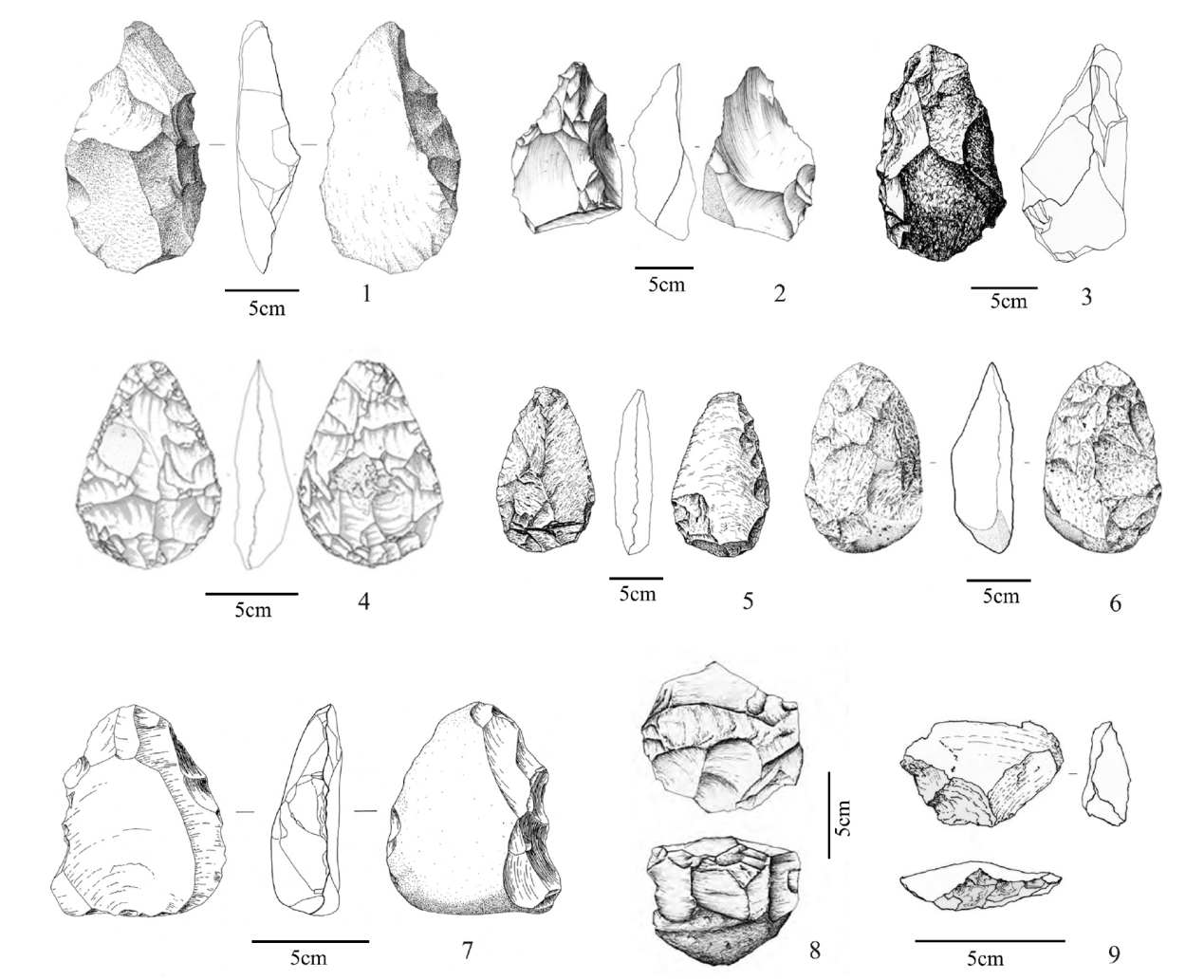
图1 旧大陆西部阿舍利技术复合体的技术表现 1.石刀Knife,EF-HR 遗址,1.3~1.6 Ma[13];2.手斧Handaxe,OGS-12遗址,1.6 Ma[91];3.手斧Handaxe,Ubeidiya遗址,1.4 Ma[84];4. 两面器Biface,Saint-Pierre-lès-Elbeuf遗址,中更新世晚期late Middle Pleistocene[66];5.手斧Handaxe,GBY遗址,800 ka[92];6.手斧Handaxe,Sima de los Huesos遗址,430 ka[93];7.组织性石核Organized core,Rietputs 15遗址,1.3 Ma[6];8.层级剥片石核Hierarchical reduction core,Peninj遗址,1.6 Ma[4];9.预制石片Flake detached from prepared core,Nyabusosi 18遗址,1.5 Ma[5]
Fig.1 Technological hallmarks of the Acheulean technocomplex in the western Old World
| 技术特征Technological proxies | 奥杜威Oldowan | 阿舍利Acheulean |
|---|---|---|
| 大石片毛坯 Large flake blanks | 无证据 No evidence | 高频率High frequency |
| 大型切割工具 LCTs | 无证据 No evidence | 高频率High frequency |
| 盘状石核剥片 Discoid flaking | 零星出现 Occasionally | 高频率High frequency |
| 其他结构性剥片 Other structured flaking schemes | 无证据 No evidence | 高频率High frequency |
| 修理工具 Non-standardized retouched tools | 低频率Low frequency | 高频率High frequency |
| 小型汇聚刃工具 Small convergent tools | 零星出现Occasionally | 高频率High frequency |
| 长型石片 Elongated flakes | 零星出现Occasionally | 低频率Low frequency |
| 预制石核技术 Prepared core technology | 无证据 No evidence | 高频率High frequency |
| 模式化剥片序列 Standardized flaking sequence | 无证据 No evidence | 高频率High frequency |
| 非连续石器生产链 Fragmented reduction sequence | 零星出现Occasionally | 高频率High frequency |
| 长剥片序列 Long reduction sequence | 低频率Low frequency | 高频率High frequency |
| 原料管理 Raw material management | 低频率Low frequency | 高频率High frequency |
| 动作精度高 High manual precision | 低频率Low frequency | 高频率High frequency |
| 两面修型 Bifacial volume management | 零星出现Occasionally | 高频率High frequency |
表1 阿舍利工业复合体部分技术特征与奥杜威工业的区别(修改自文献[109])
Tab.1 Differences of technological proxies between certain aspects of the Acheulean technocomplex and Oldowan industry (Modified from reference[109])
| 技术特征Technological proxies | 奥杜威Oldowan | 阿舍利Acheulean |
|---|---|---|
| 大石片毛坯 Large flake blanks | 无证据 No evidence | 高频率High frequency |
| 大型切割工具 LCTs | 无证据 No evidence | 高频率High frequency |
| 盘状石核剥片 Discoid flaking | 零星出现 Occasionally | 高频率High frequency |
| 其他结构性剥片 Other structured flaking schemes | 无证据 No evidence | 高频率High frequency |
| 修理工具 Non-standardized retouched tools | 低频率Low frequency | 高频率High frequency |
| 小型汇聚刃工具 Small convergent tools | 零星出现Occasionally | 高频率High frequency |
| 长型石片 Elongated flakes | 零星出现Occasionally | 低频率Low frequency |
| 预制石核技术 Prepared core technology | 无证据 No evidence | 高频率High frequency |
| 模式化剥片序列 Standardized flaking sequence | 无证据 No evidence | 高频率High frequency |
| 非连续石器生产链 Fragmented reduction sequence | 零星出现Occasionally | 高频率High frequency |
| 长剥片序列 Long reduction sequence | 低频率Low frequency | 高频率High frequency |
| 原料管理 Raw material management | 低频率Low frequency | 高频率High frequency |
| 动作精度高 High manual precision | 低频率Low frequency | 高频率High frequency |
| 两面修型 Bifacial volume management | 零星出现Occasionally | 高频率High frequency |
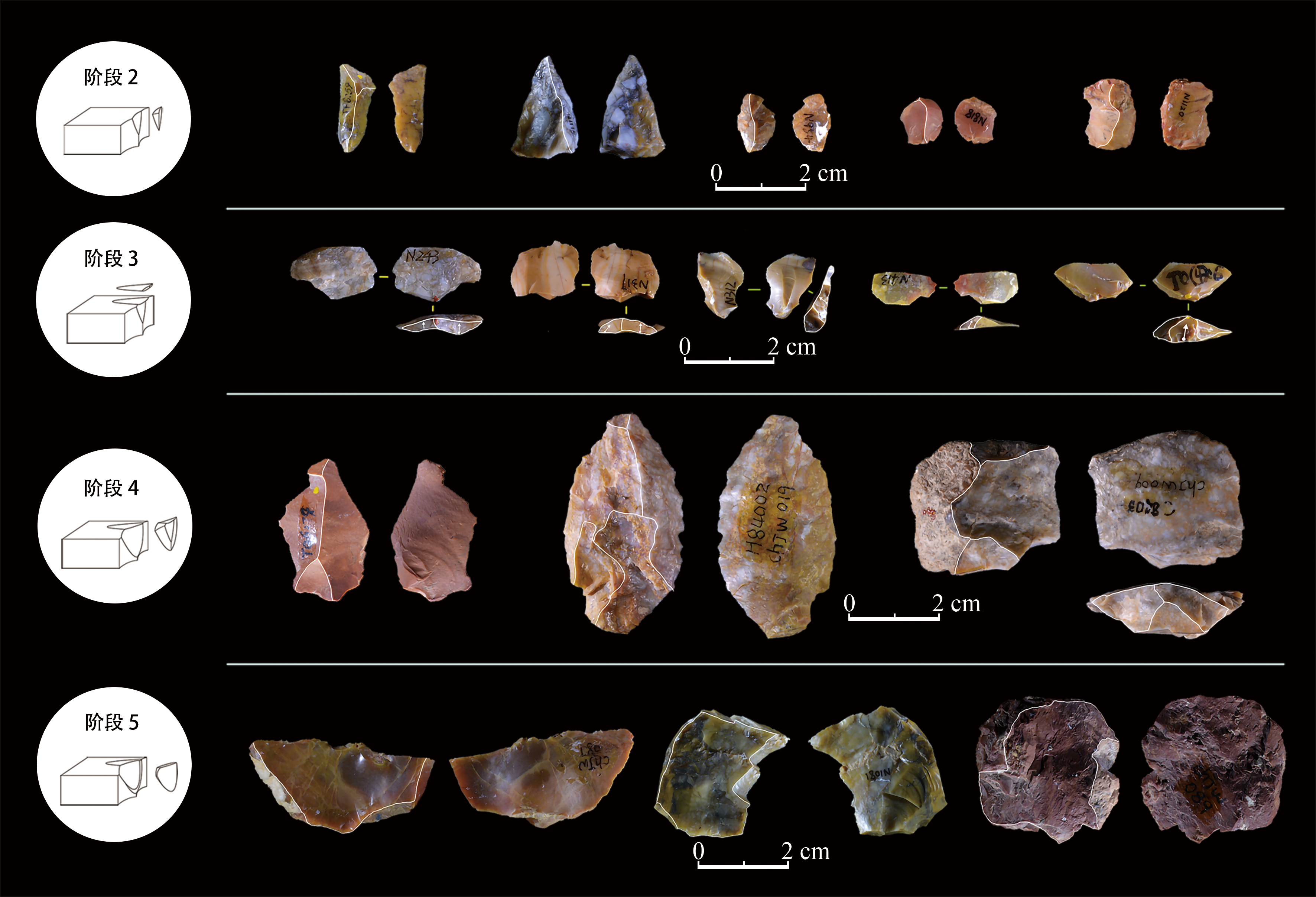
图2 岑家湾遗址预制石核技术各阶段剥片产品 阶段1的石片因与其他剥片策略所产生的石片无法区分而不在此展示Flakes detached at Stage 1 are indistinguishable from those produced by other flaking strategies and are therefore not included in this figure
Fig.2 Flakes detached at each stage of prepared core technology from Cenjiawan site
| [1] |
de la Torre I. The origins of the Acheulean: Past and present perspectives on a major transition in human evolution[J]. Philosophical Transactions of the Royal Society B: Biological Sciences, 2016, 371(1698): 20150245
doi: 10.1098/rstb.2015.0245 URL |
| [2] | Kuman K. Acheulean Industrial Complex[A]. In: SmithC(Ed.). Encyclopedia of Global Archaeology[M]. New York: Springer, 2014: 7-18 |
| [3] |
de la Torre I, Mora R, Martínez-Moreno J. The early Acheulean in Peninj (Lake Natron, Tanzania)[J]. Journal of Anthropological Archaeology, 2008, 27(2): 244-264
doi: 10.1016/j.jaa.2007.12.001 URL |
| [4] | de la Torre I. Technological Strategies in the Lower Pleistocene at Peninj (west of Lake Natron, Tanzania)[A]. In: Schick K, Toth N (Eds.). The Cutting Edge: New Approaches to the Archaeology of Human Origins[M]. Gosport: Stone Age Institute Press, 2009: 93-113 |
| [5] |
Mesfin I, Texier PJ. Prepared core technology from the Early Pleistocene site of Nyabusosi 18, Uganda[J]. Journal of Archaeological Science: Reports, 2022, 46: 103695
doi: 10.1016/j.jasrep.2022.103695 URL |
| [6] |
Leader GM, Kuman K, Gibbon RJ, et al. Early Acheulean organised core knapping strategies ca. 1.3 Ma at Rietputs 15, Northern Cape Province, South Africa[J]. Quaternary International, 2018, 480: 16-28
doi: 10.1016/j.quaint.2016.08.046 URL |
| [7] |
Hou YM, Potts R, Yuan BY, et al. Mid-Pleistocene Acheulean-like Stone Techonology of the Bose Basin, South China[J]. Science, 2000, 287: 1622-1626
doi: 10.1126/science.287.5458.1622 URL |
| [8] |
Wang W, Bae CJ, Huang S, et al. Middle Pleistocene bifaces from Fengshudao (Bose Basin, Guangxi, China)[J]. Journal of Human Evolution, 2014, 69: 110-122
doi: 10.1016/j.jhevol.2013.11.002 pmid: 24630526 |
| [9] |
Li H, Kuman K, Li CR. What is currently (un)known about the Chinese Acheulean, with implications for hypotheses on the earlier dispersal of hominids[J]. Comptes Rendus Palevol, 2018, 17(1-2): 120-130
doi: 10.1016/j.crpv.2015.09.008 URL |
| [10] |
Li H, Wang S, Lotter MG, et al. The temporal-spatial evolution of handaxe technology in China: Recent progress and future directions[J]. Science Bulletin, 2024, 69(14): 2161-2165
doi: 10.1016/j.scib.2024.04.047 URL |
| [11] | Kleindienst MR. Component of the East African Acheulian assemblage:an analytic approach[A]. In: Mortelmans G, Nenquin J (Eds.). Actes du IV Congrès Panafricain de Préhistoire et de l´Etude du Quaternaire, Leopoldville, 1959[C]. Tervuren: Belgie Annalen, Musée Royal de l´Afrique Centrale, 1962: 81-108 |
| [12] |
Clark JD, Kurashina H. An analysis of Earlier Stone Age bifaces from Gadeb (Locality 8E), Northern Bale Highlands, Ethiopia[J]. South African Archaeological Bulletin, 1979, 34: 93-109
doi: 10.2307/3887867 URL |
| [13] |
de la Torre I, Mora R. Technological behaviour in the early Acheulean of EF-HR (Olduvai Gorge, Tanzania)[J]. Journal of Human Evolution, 2018, 120: 329-377
doi: 10.1016/j.jhevol.2018.01.003 URL |
| [14] | Clark JGD. World Prehistory: A new outline (2nd edition)[M]. Cambridge: Cambridge University Press, 1969 |
| [15] | 李锋. 克拉克的“技术模式”与中国旧石器技术演化研究[J]. 考古, 2017, 9: 73-81 |
| [16] |
Bar-Yosef O, Belfer-Cohen A. From Africa to Eurasia—early dispersals[J]. Quaternary International, 2001, 75: 19-28
doi: 10.1016/S1040-6182(00)00074-4 URL |
| [17] |
Villa P. Early Italy and the colonization of Western Europe[J]. Quaternary International, 2001, 75: 113-130
doi: 10.1016/S1040-6182(00)00083-5 URL |
| [18] |
Pei SW, Niu DW, Guan Y, et al. Middle Pleistocene hominin occupation in the Danjiangkou Reservoir Region, Central China: studies of formation processes and stone technology of Maling 2A site[J]. Journal of Archaeological Science, 2015, 53: 391-407
doi: 10.1016/j.jas.2014.10.022 URL |
| [19] |
Liao W, Tian C, Fan Y, et al. New discovery of Acheulean artifacts from the fluvial gravel bed of terminal Early Pleistocene in Bose Basin, southern China[J]. Journal of Archaeological Science: Reports, 2024, 58: 104693
doi: 10.1016/j.jasrep.2024.104693 URL |
| [20] |
Yang SX, Huang WW, Hou YM, et al. Is the Dingcun lithic assembly a “chopper-chopping tool industry”, or “Late Acheulian”?[J]. Quaternary International, 2014, 321: 3-11
doi: 10.1016/j.quaint.2013.05.012 URL |
| [21] | Diez-Martín F, Eren MI. The Early Acheulean in Africa:Past paradigms, current ideas, and future directions[A]. In: Domínguez-Rodrigo M(Ed.). Stone Tools and Fossil Bones: Debates in the Archaeology of Human Origins[C]. Cambridge: Cambridge University Press, 2012: 310-358 |
| [22] | Mortillet GD. Classification des diverses périodes de l’âge de la pierre[A]. In: Extrait du Compte Rendu du Congrès International d’Anthropologie et d’Archéologie Préhistoriques, 6me Session, Bruxelles, 1872[C]. Bruxelles: Weissenbruch, 1873: 432-444 |
| [23] | Mortillet GD. Le Préhistorique. Antiquité de l´homme[M]. Paris: C. Reinwald, Bibliotèque des sciences contemporaines, 1883 |
| [24] | Mortillet G, Mortillet A. La préhistoire: origine et antiquité de l’homme[M]. Paris: Schleicher, 1910 |
| [25] | Breuil H. Les industries à éclats du paléolithique ancien, I, Le Clatonien[J]. Préhistoire, 1932, 1: 125-190 |
| [26] | Leakey LSB. Stone Age Africa. An outline of Prehistory in Africa[M]. London: Oxford University Press, 1936: 218 |
| [27] | Leakey LSB. Olduvai Gorge. A Report On The Evolution Of The Hand-Axe Culture In Beds I-IV[M]. Cambridge: Cambridge University Press, 1951 |
| [28] |
Goodwin AJH. The Stone Ages in South Africa[J]. Africa: Journal of the International African Institute, 1929, 2(2): 174-182
doi: 10.2307/1155825 URL |
| [29] | Goodwin AJH. A Commentary on the History and Present Position of South African Prehistory with Full Bibliography[J]. Bantu Studies, 1935, IX: 291-417 |
| [30] | Leakey MD. Olduvai Gorge. Excavations in Beds I and II, 1960-1963[M]. Cambridge: Cambridge University Press, 1971, Vol 3 |
| [31] |
Binford LR. Archaeology as Anthropology[J]. American Antiquity, 1962, 28(2): 217-225
doi: 10.2307/278380 URL |
| [32] | Binford LR, Binford SR. A Preliminary Analysis of Functional Variability in the Mousterian of Levallois Facies[J]. American Anthropologist, 1966, 68(2): 238-295 |
| [33] | Isaac GL. New evidence from Olorgesailie relating to the character of Acheulean occupation sites[A]. In: Cuscoy LD. Actas del V Congreso Panafricano de Prehistoria y de Estudio del Cuaternario[C]. Tenerife: Museo Arqueológico de Tenerife, 1966, 135-145 |
| [34] |
Isaac GL. Studies of Early Culture in East Africa[J]. World Archaeology, 1969, 1(1): 1-28
doi: 10.1080/00438243.1969.9979423 URL |
| [35] | Isaac GL. The Stratigraphy of the Peninj Group- Early Middle Pleistocene Formations West of Lake Natron, Tanzania[A]. In: Bishop WW, Clark JD(Eds.). Background to Evolution in Africa[M]. Chicago: University of Chicago Press, 1967: 229-257 |
| [36] | Isaac GL. The Archaeology of Human Origins:Studies of the Lower Pleistocene in East Africa 1971-1981[A]. In: Wendorf F, Close AE(Eds.). Advances in World Archaeology[M]. Orlando: Academic Press, 1984: 1-87 |
| [37] |
Isaac GL. The first geologists—the archaeology of the original rock breakers[J]. Geological Society, London, Special Publications, 1978, 6(1): 139-147
doi: 10.1144/GSL.SP.1978.006.01.11 URL |
| [38] | Toth N. Experiments in quarrying large flake blanks at Kalambo Falls[A]. In: ClarkJD(Ed.). Kalambo Falls Prehistoric Site, III: The Earlier Cultures: Middle and Earlier Stone Age[M]. Cambridge: Cambridge University Press, 2001: 600-604 |
| [39] | Madsen B, Goren-Inbar N. Acheulian Giant Core Technology and beyond: An archaeological and experimental Case Study[J]. Eurasian Prehistory, 2004, 2(1): 3-52 |
| [40] |
Stout D. Skill and Cognition in Stone Tool Production: An Ethnographic Case Study from Irian Jaya[J]. Current Anthropology, 2002, 43(5): 693-722
doi: 10.1086/342638 URL |
| [41] | Texier PJ. Approche expérimentale qualitative des principales chaînes opératoires d´un nouveau site acheuléen d´Afrique orientale[A]. In: La vien aux temps préhistoriques. Preactes du 23 Congrès Préhistorique de France[C]. Paris:Société Préhistorique Française, 1989: 32-33 |
| [42] | Texier PJ, Roche H. The impact of predetermination on the development of some Acheulean chaînes opératoires[A]. In: Bermúdez De Castro JM, Arsuaga JL, Carbonell E (Eds.). Evolución humana en Europa y los yacimientos de la Sierra de Atapuerca[C]. Valladolid: Junta de Castilla y León, 1995: 403-420 |
| [43] | Clark JD. The Acheulian Industrial Complex in Africa and Elsewhere[A]. In: Corruchini RS, Ciochon RL(Eds.). Integrative Paths to the Past:Paleoanthropological Advances in Honor of F. Clark Howell[M]. New Jersey: Prentice Hall Inc., 1994: 451-469 |
| [44] |
Wynn T, Tierson L. Regional Comparison of the Shapes of Later Acheulean Handaxes[J]. American Anthropologist, 1990, 92: 73-84
doi: 10.1525/aa.1990.92.1.02a00050 URL |
| [45] |
Wynn T. Handaxe Enigmas[J]. World Archaeology, 1995, 27 (1): 10-24
doi: 10.1080/00438243.1995.9980290 URL |
| [46] |
Wynn T, Gowlett JAJ. The handaxe reconsidered[J]. Evolutionary Anthropology, 2018, 27 (1): 21-29
doi: 10.1002/evan.21552 pmid: 29446559 |
| [47] |
Wynn T. The intelligence of later Acheulean hominids[J]. Man, 1979, 14: 371-391
doi: 10.2307/2801865 URL |
| [48] | Gowlett JAJ. Mental Abilities of Early Homo:Elements of Constraint and Choice in Rule Systems[A]. In: Mellars P, GibsonK(Eds.). Modelling the early human mind[M]. Cambridge: McDonald Institute Monographs, 1996: 191-215 |
| [49] | Gowlett JAJ. The elements of design form in Acheulian bifaces: modes, modalities, rules and language[A]. In: Goren-Inbar N, Sharon G(Eds.). Axe Age: Acheulian Toolmaking from Quarry to Discard[M]. London: Equinox, 2006: 203-221 |
| [50] |
Stout D. Stone toolmaking and the evolution of human culture and cognition[J]. Philosophical Transactions of the Royal Society B: Biological Sciences, 2011, 366(1567): 1050-1059
doi: 10.1098/rstb.2010.0369 URL |
| [51] |
Stout D, Apel J, Commander J, et al. Late Acheulean technology and cognition at Boxgrove, UK[J]. Journal of Archaeological Science, 2014, 41: 576-590
doi: 10.1016/j.jas.2013.10.001 URL |
| [52] | de la Torre I, Mora R. How Many Handaxes Make an Acheulean? A Case Study from the SHK-Annexe Site, Olduvai Gorge, Tanzania[A]. In: Cole J, Mcnabb J, Grove M, Hosfield R(Eds.). Landscapes of Human Evolution: Contributions in honour of John Gowlett[M]. Oxford: Archaeopress, 2020: 64-91 |
| [53] | Gowlett JAJ. Culture and conceptualisation: the Oldowan-Acheulian gradient[A]. In: Bailey GN, Callow P(Eds.). Stone Age Prehistory: Studies in Memory of Charles McBurney[M]. Cambridge: Cambridge University Press, 1986: 243-260 |
| [54] | Goren-Inbar N, Alperson-Afil N, Sharon G, et al. The Acheulian Site of Gesher Benot Ya’aqov. Volume IV[M]. Verlag: Springer, 2018 |
| [55] |
Sharon G, Goren-Inbar N. Soft Percussor Use at the Gesher Benot Ya´aqov Acheulian Site?[J]. Journal of the Israel Prehistoric Society, 1999, 28: 55-79
doi: 10.61247/s207129 URL |
| [56] |
de la Torre I, Mora R, Domínguez-Rodrigo M, et al. The Oldowan industry of Peninj and its bearing on the reconstruction of the technological skills of Lower Pleistocene hominids[J]. Journal of Human Evolution, 2003, 44: 203-224
pmid: 12662943 |
| [57] |
Brain CK, Sillen A. Evidence from the Swartkrans Cave for the earliest use of fire[J]. Nature, 1988, 336: 464-466
doi: 10.1038/336464a0 |
| [58] |
Gowlett JAJ, Harris JWK, Walton D, et al. Early archaeological sites, hominid remains and traces of fire from Chesowanja, Kenya[J]. Nature, 1981, 294: 125-129
doi: 10.1038/294125a0 |
| [59] |
de la Torre I, Doyon L, Benito-Calvo A, et al. Systematic bone tool production at 1.5 million years ago[J]. Nature, 2025, 640: 130-134
doi: 10.1038/s41586-025-08652-5 |
| [60] |
Belitzky S, Goren-Inbar N, Werker E. A Middle Pleistocene wooden plank with man-made polish[J]. Journal of Human Evolution, 1991, 20(4): 349-353
doi: 10.1016/0047-2484(91)90015-N URL |
| [61] |
Potts R, Behrensmeyer AK, Ditchfield P. Paleolandscape variation and Early Pleistocene hominid activities: Members 1 and 7, Olorgesailie Formation, Kenya[J]. Journal of Human Evolution, 1999, 37: 747-788
pmid: 10536090 |
| [62] |
Gallotti R, Mohib A, Fernandes P, et al. Dedicated core-on-anvil production of bladelet-like flakes in the Acheulean at Thomas Quarry I - L1 (Casablanca, Morocco)[J]. Scientific Reports, 2020, 10(1): 9225
doi: 10.1038/s41598-020-65903-3 pmid: 32514002 |
| [63] | Moncel MH, Ashton N. From 800 to 500 ka in Western Europe: The Oldest Evidence of Acheuleans in Their Technological, Chronological, and Geographical Framework[A]. In: Gallotti R, Mussi M (Eds.). The Emergence of the Acheulean in East Africa and Beyond: Contributions in Honor of Jean Chavaillon[C]. Springer International Publishing, 2018: 215-235 |
| [64] |
Gallotti R, Peretto C. The Lower/early Middle Pleistocene small débitage productions in Western Europe: New data from Isernia La Pineta t.3c (Upper Volturno Basin, Italy)[J]. Quaternary International, 2015, 357: 264-281
doi: 10.1016/j.quaint.2014.06.055 URL |
| [65] |
Gallotti R. The East African origin of the Western European Acheulean technology: Fact or paradigm?[J]. Quaternary International, 2016, 411: 9-24
doi: 10.1016/j.quaint.2015.10.115 URL |
| [66] |
Moncel M-H, Ashton N, Lamotte A, et al. The Early Acheulian of north-western Europe[J]. Journal of Anthropological Archaeology, 2015, 40: 302-331
doi: 10.1016/j.jaa.2015.09.005 URL |
| [67] | Leakey MD. Preliminary survey of the cultural material from Beds I and II, Olduvai Gorge, Tanzania[A]. In: Bishop WW, Clark JD(Eds.). Background to Evolution in Africa[M]. Chicago: University of Chicago Press, 1967: 417-446 |
| [68] |
Asfaw B, Beyene Y, Suwa G, et al. The earliest Acheulean from Konso-Gardula[J]. Nature, 1992, 360: 732-735
doi: 10.1038/360732a0 |
| [69] | Mussi M, Skinner MM, Melis RT, et al. Early Homo erectus lived at high altitudes and produced both Oldowan and Acheulean tools[J]. Science, 2023: eadd9115 |
| [70] |
Spoor F, Leakey MG, Gathogo PN, et al. Implications of new early Homo fossils from Ileret, east of Lake Turkana, Kenya[J]. Nature, 2007, 448(9): 688-691
doi: 10.1038/nature05986 |
| [71] |
Moncel MH, Santagata C, Pereira A, et al. The origin of early Acheulean expansion in Europe 700 ka ago: new findings at Notarchirico (Italy)[J]. Scientific Reports, 2020, 10(1): 13802
doi: 10.1038/s41598-020-68617-8 |
| [72] | Roberts MB, Parfitt SA(Eds.). Boxgrove. A Middle Pleistocene hominid site at Eartham Quarry, Boxgrove, West Sussex[M]. London: Englisht Heritage, 1999 |
| [73] |
Arsuaga JL, Martínez I, Arnold LJ, et al. Neandertal roots: Cranial and chronological evidence from Sima de los Huesos[J]. Science, 2014, 344(6190): 1358-1363
doi: 10.1126/science.1253958 pmid: 24948730 |
| [74] |
Leakey LSB. Was Homo erectus Responsible for the Hand-axe Culture?[J]. Journal of Human Evolution, 1973, 2: 493-498
doi: 10.1016/0047-2484(73)90127-9 URL |
| [75] |
Rightmire GP. Brain Size and Encephalization in Early to Mid-Pleistocene Homo[J]. American Journal of Physical Anthropology, 2004, 124: 109-123
pmid: 15160365 |
| [76] | Toth N, Schick KD. Hominin Brain Reorganization, Technological Change, and Cognitive Complexity[A]. In: Broadfield D, Yuan M, Schick K, et al(Eds.). The Human Brain Evolving: Paleoneurological Studies in Honor of Ralph L. Holloway[M]. Gosport: Stone Age Insitutte Press, 2010: 293-312 |
| [77] |
Stout D, Toth N, Schick KD, et al. Neural correlates of Early Stone Age toolmaking: technology, language and cognition in human evolution[J]. Philosophical Transactions of the Royal Society B: Biological Sciences, 2008, 363(1499): 1939-1949
doi: 10.1098/rstb.2008.0001 URL |
| [78] |
Stout D, Chaminade T. Stone tools, language and the brain in human evolution[J]. Philosophical Transactions of the Royal Society B: Biological Sciences, 2012, 367(1585): 75-87
doi: 10.1098/rstb.2011.0099 URL |
| [79] |
Gossa T, Asrat A, Hovers E, et al. Claims for 1.9-2.0 Ma old early Acheulian and Oldowan occupations at Melka Kunture are not supported by a robust age model[J]. Quaternary Science Review, 2024, 326: 108506
doi: 10.1016/j.quascirev.2024.108506 URL |
| [80] |
Mussi M. Reply to Gossa et al. (2024) “Claims for 1.9-2.0 Ma old early Acheulian and Oldowan occupations at Melka Kunture are not supported by a robust age model”[J]. Quaternary Science Reviews, 2024, 328: 108536
doi: 10.1016/j.quascirev.2024.108536 URL |
| [81] |
Lepre CJ, Roche H, Kent DV, et al. An earlier origin for the Acheulian[J]. Nature, 2011, 477(7362): 82-85
doi: 10.1038/nature10372 |
| [82] |
Beyene Y, Katoh S, Woldegabriel G, et al. The characteristics and chronology of the earliest Acheulean at Konso, Ethiopia[J]. PNAS, 2012, 110(5): 1584-1591
doi: 10.1073/pnas.1221285110 URL |
| [83] |
Pappu S, Gunnell Y, Akhilesh K, et al. Early Pleistocene Presence of Acheulian Hominins in South India[J]. Science, 2011, 331: 1596-1599
doi: 10.1126/science.1200183 pmid: 21436450 |
| [84] | Bar-Yosef O, Goren-Inbar N. The Lithic Assemblages of ´Ubeidiya. A Lower Palaeolithic Site in the Jordan Valley[M]. Jerusalem: Quedem, Monographs of the Institute of Archaeology, 1993 |
| [85] |
Herzlinger G, Brenet M, Varanda A, et al. Revisiting the Acheulian Large Cutting Tools of ‘Ubeidiya, Israel[J]. Journal of Paleolithic Archaeology, 2021, 4(4): 31
doi: 10.1007/s41982-021-00108-2 |
| [86] |
Mosquera M, Saladié P, Ollé A, et al. Barranc de la Boella (Catalonia, Spain): an Acheulean elephant butchering site from the European late Early Pleistocene[J]. Journal of Quaternary Science, 2015, 30(7): 651-666
doi: 10.1002/jqs.v30.7 URL |
| [87] |
Mosquera M, Ollé A, Saladié P, et al. The Early Acheulean technology of Barranc de la Boella (Catalonia, Spain)[J]. Quaternary International, 2016, 393: 95-111
doi: 10.1016/j.quaint.2015.05.005 URL |
| [88] | Gowlett JAJ. Why the Muddle in the Middle Matters:the Language of Comparative and Direct in Human Evolution[A]. In: Barton CM, Clark GA(Eds.). Rediscovering Darwin: Evolutionary Theory and Archeological Explanation[C]. Arlington: Archaeological Papers of the American Anthropological Association, 1997: 49-65 |
| [89] |
Goren-Inbar N, Feibel CS, Verosub KL, et al. Pleistocene Milestones on the Out-of-Africa Corridor at Gesher Benot Ya´aqov, Israel[J]. Science, 2000, 289: 944-947
pmid: 10937996 |
| [90] |
García-Medrano P, Ollé A, Ashton N, et al. The Mental Template in Handaxe Manufacture: New Insights into Acheulean Lithic Technological Behavior at Boxgrove, Sussex, UK[J]. Journal of Archaeological Method and Theory, 2018, 26(1): 396-422
doi: 10.1007/s10816-018-9376-0 |
| [91] | Semaw S, Rogers MJ, Cáceres I, et al. The Early Acheulean -1.6-1.2 Ma from Gona, Ethiopia:Issues related to the Emergence of the Acheulean in Africa[A]. In: Gallotti R, MussiM(Eds.). The Emergence of the Acheulean in East Africa and Beyond: Contributions in Honor of Jean Chavaillon[C]. Vertebrate Paleobiology and Paleoanthropology Series, Pessac: Springer International Publishing AG, 2018: 115-128 |
| [92] |
Saragusti I, Goren-Inbar N. The biface assemblage from Gesher Benot Ya´aqov, Israel: illuminating patterns in “Out of Africa” dispersal[J]. Quaternary International, 2001, 75: 85-89
doi: 10.1016/S1040-6182(00)00080-X URL |
| [93] |
Ollé A, Mosquera M, Rodríguez X P, et al. The Early and Middle Pleistocene technological record from Sierra de Atapuerca (Burgos, Spain)[J]. Quaternary International, 2013, 295: 138-167
doi: 10.1016/j.quaint.2011.11.009 URL |
| [94] |
de la Torre I. The Early Stone Age lithic assemblages of Gadeb (Ethiopia) and the Developed Oldowan/early Acheulean in East Africa[J]. Journal of Human Evolution, 2011, 60(6): 768-812
doi: 10.1016/j.jhevol.2011.01.009 pmid: 21481918 |
| [95] | Texier JP. The Oldowan assemblage from NY 18 site at Nyabusosi (Toro-Uganda)[J]. Prehistory, 1995: 647-653 |
| [96] | Mora R, Domínguez-Rodrigo M, de la Torre I, et al. The Archaeology of the Peninj “ST Complex” (Lake Natron, Tanzania)[A]. In: Martínez-Moreno J, Mora R, de la Torre I (Eds.). Oldowan: Rather more than smashing stones. First Hominid Technology Workshop. Bellaterra, December 2001[C]. Barcelona: Treballs d´Arqueologia, 2003: 77-116 |
| [97] |
Delagnes A, Lenoble A, Harmand S, et al. Interpreting pachyderm single carcass sites in the African Lower and Early Middle Pleistocene record: A multidisciplinary approach to the site of Nadung’a 4 (Kenya)[J]. Journal of Anthropological Archaeology, 2006, 25(4): 448-465
doi: 10.1016/j.jaa.2006.03.002 URL |
| [98] | Isaac GL. Olorgesailie. Archeological Studies of a Middle Pleistocene Lake Basin in Kenya[M]. Chicago: University of Chicago Press, 1977 |
| [99] | JelinekAJ. The Middle Paleolithic in the Southern Levant from the perspective of the Tabun cave[A]. In: SanlavilleJCYP(Eds.). Prehistoire du Levant[M]. Paris: CNRS, 1981: 265-280 |
| [100] |
Jelinek AJ. The Tabun Cave and Paleolithic Man in the Levant[J]. Science, 1982, 216(4553): 1369-1375
pmid: 17798344 |
| [101] |
Goren-Inbar N, Sharon G, Alperson-Afil N, et al. The Acheulean massive scrapers of Gesher Benot Ya‘aqovda product of the biface chaîne opératoire[J]. Journal of Human Evolution, 2008, 55: 702-712
doi: 10.1016/j.jhevol.2008.07.005 pmid: 18757076 |
| [102] | Texier PJ. L´ensemble lithique oldowayen sur quartz du site NY18 à Nyabusosi[J]. Préhistoire-Anthropologie Méditerranéennes, 1997, 6: 227-237 |
| [103] | Roche H, Texier PJ. La notion de complexité dans un ensemble lithique. Application aux séries acheuléenes d´Isenya (Kenya)[A]. In: 25 ans d´études technologiques en Préhistoire[C]. Juan-les-Pins: APDCA, 1991: 99-108 |
| [104] | de la Torre I, Mora R. The Technology of the ST Site Complex[A]. In: Domínguez-Rodrigo M, Alcalá L, Luque L (Eds.). Peninj: A research project on human origins (1995-2005)[M]. Oxford: Oxbow, 2009: 145-189 |
| [105] | de la Torre I, Mora R. Technological Strategies in the Lower Pleistocene at Olduvai Beds I & II[M]. Liege:ERAUL 112, 2005 |
| [106] |
Lycett SJ, Von Cramon-Taubadel N. Acheulean variability and hominin dispersals: a model-bound approach[J]. Journal of Archaeological Science, 2008, 35(3): 553-562
doi: 10.1016/j.jas.2007.05.003 URL |
| [107] |
White MJ. The Clactonian Question: On the Interpretation of Core-and-Flake Assemblages in the British Lower Paleolithic[J]. Journal of World Prehistory, 2000, 14(1): 1-63
doi: 10.1023/A:1007874901792 |
| [108] |
Aureli D, Rocca R, Lemorini C, et al. Mode 1 or mode 2? “Small tools” in the technical variability of the European Lower Palaeolithic: The site of Ficoncella (Tarquinia, Lazio, central Italy)[J]. Quaternary International, 2016, 393: 169-184
doi: 10.1016/j.quaint.2015.07.055 URL |
| [109] |
Ma DD, Pei SW, Xie F, et al. Earliest Prepared core technology in Eurasia from Nihewan (China): Implications for early human abilities and dispersals in East Asia[J]. PNAS, 2024, 121(11): e2313123121
doi: 10.1073/pnas.2313123121 URL |
| [110] | 林圣龙. 关于全谷里的手斧[J]. 人类学学报, 1995, 14(3): 189-205 |
| [111] | 林圣龙, 何乃汉. 关于百色的手斧[J]. 人类学学报, 1995, 14(2): 118-131+195-198 |
| [112] | 林圣龙. 对九件手斧标本的再研究和关于莫维斯理论之拙见[J]. 人类学学报, 1994, 13(3): 189-208 |
| [113] | 高星. 中国旧石器时代手斧的特点与意义[J]. 人类学学报, 2012, 31(2): 97-112 |
| [114] | 谢光茂. 关于百色手斧问题:兼论手斧的划分标准[J]. 人类学学报, 2002, 21(1): 65-73 |
| [115] | 黄慰文. 中国的手斧[J]. 人类学学报, 1987, 6(1): 61-68 |
| [116] | 贾兰坡. 在中国发现的手斧[J]. 科学通报, 1956, 12: 39-41 |
| [117] | 裴文中, 张森水. 中国猿人石器研究[M]. 北京: 科学出版社, 1985, 277 |
| [118] |
Li H, Li CR, Kuman K. Rethinking the “Acheulean” in East Asia: Evidence from recent investigations in the Danjiangkou Reservoir Region, central China[J]. Quaternary International, 2014, 347: 163-175
doi: 10.1016/j.quaint.2014.03.059 URL |
| [119] | 侯亚梅, 黄慰文. 关于旧大陆早期人类文化发展格局—百色手斧挑战“莫氏线”[J]. 中国科学院院刊, 2001, 1: 56-58+35 |
| [120] | 贺存定. 重庆发现的手斧及其问题[J]. 长江文明, 2016, 2: 24-33 |
| [121] | 胡好玥. 中国手斧等大型切割工具研究的回顾与思考[J]. 人类学学报, 2025, 22(2): 301-315 |
| [122] | 谢光茂. 百色盆地旧石器时代考古50年[J]. 南方文物, 2024, 6: 23-35 |
| [123] | 郑喆轩, 冯玥, 谭培阳, 等. 四川稻城县皮洛旧石器时代遗址[J]. 考古, 2022, 7: 3-14+2 |
| [124] | 王社江, 鹿化煜, 张红艳, 等. 陕西蓝田地区新发现黄土地层中的旧石器及其年代[J]. 科学通报, 2014, 59(14): 1318-1326 |
| [125] | 王社江. 洛南盆地的大型石刀[J]. 人类学学报, 2007, 26(1): 26-33 |
| [126] |
Norton CJ, Bae K. The Movius Line sensu lato (Norton et al., 2006) further assessed and defined[J]. Journal of Human Evolution, 2008, 55: 1148-1150
doi: 10.1016/j.jhevol.2008.08.003 pmid: 18809202 |
| [127] |
Wang W, Lycett SJ, Cramon-Taubadel NV, et al. Comparison of Handaxes from Bose Basin (China) and the Western Acheulean Indicates Convergence of Form, Not Cognitive Differences[J]. PLoS ONE, 2012, 7(4): e35804
doi: 10.1371/journal.pone.0035804 URL |
| [128] |
Corvinus G. Homo erectus in East and Southeast Asia, and the questions of the age of the species and its association with stone artifacts, with special attention to handaxe-like tools[J]. Quaternary International, 2004, 117(1): 141-151
doi: 10.1016/S1040-6182(03)00124-1 URL |
| [129] |
Lycett SJ, Bae CJ. The Movius Line controversy: the state of the debate[J]. World Archaeology, 2010, 42(4): 521-544
doi: 10.1080/00438243.2010.517667 URL |
| [130] |
Petraglia MD, Shipton C. Large cutting tool variation west and east of the Movius Line[J]. Journal of Human Evolution, 2008, 55(6): 962-966
doi: 10.1016/j.jhevol.2007.11.007 pmid: 18801556 |
| [131] |
Schick K, Zhuan D. Early Paleolithic of China and Eastern Asia[J]. Evolutionary Anthropology, 1993, 2(1): 22-35
doi: 10.1002/evan.v2:1 URL |
| [132] | Gallotti R, Mussi M. The Emergence of the Acheulean in East Africa and Beyond: Contributions in Honor of Jean Chavaillon[C]. Vertebrate Paleobiology and Paleoanthropology Series. Pessac: Springer International Publishing AG, 2018 |
| [1] | 姚艳燕, 艾婉婷, 胡敏航, 付琼耀, 李国山, 钟洁美, 胡鹏程, 黄胜敏, 田淳, 梁华, 廖卫, 王伟, 易智星. 广西崇左岩利1号洞早-中更新世过渡期的巨猿化石[J]. 人类学学报, 2026, 45(02): 199-209. |
| [2] | 姚艳燕, 廖卫, 李炬平, 易智星, 田淳, 钟洁美, 高超, 王伟, 梁华. 广西崇左岩利2号洞发现中更新世早期的猩猩牙齿化石[J]. 人类学学报, 2026, 45(02): 210-223. |
| [3] | 易智星, 仇若萱, 王伟, 廖卫, 梁华, 田淳, 米尔阿迪力·吐尔逊江, 张一景, 姚艳燕. 更新世中晚期猩猩第四乳前臼齿的三维釉质厚度[J]. 人类学学报, 2026, 45(02): 248-257. |
| [4] | 魏屹. 旧石器时代装饰品原料浅析[J]. 人类学学报, 2026, 45(02): 387-402. |
| [5] | 杜抱朴, 杜靖. 中国台湾地区人群头面部性状的性别差异[J]. 人类学学报, 2026, 45(02): 333-344. |
| [6] | 胡越. 贵州观音洞遗址的石核剥片策略和修理技术[J]. 人类学学报, 2025, 44(06): 1019-1033. |
| [7] | 李三灵, 刘亚林, 赵文杰, 陈清懿, 李浩. 中国南方旧石器时代晚期石制品细小化现象初探[J]. 人类学学报, 2025, 44(06): 1034-1046. |
| [8] | 胡好玥. 中国手斧等大型切割工具研究的回顾与思考[J]. 人类学学报, 2025, 44(02): 301-315. |
| [9] | 宋光捷, 蔡大伟, 朱存世, 胡松梅, 周静, 任晓燕. 古DNA揭示中国西北地区史前人类对野生动物资源的利用[J]. 人类学学报, 2025, 44(01): 117-131. |
| [10] | 郑连斌. 中国活体测量研究的回顾[J]. 人类学学报, 2024, 43(04): 529-535. |
| [11] | 廖卫. 中国南方猩猩化石的研究进展[J]. 人类学学报, 2024, 43(02): 199-213. |
| [12] | 王华, 李占扬, Thijs van KOLFSCHOTEN. 德国西宁根与中国灵井的骨器比较[J]. 人类学学报, 2024, 43(02): 214-232. |
| [13] | 侯佳岐, 王法岗. 泥河湾盆地山兑东旧石器地点初步研究[J]. 人类学学报, 2023, 42(06): 742-750. |
| [14] | 李咏兰, 于会新, 张兴华, 宇克莉, 包金萍, 郑连斌. 中国不同地理分区人群的头面部特征[J]. 人类学学报, 2023, 42(06): 793-806. |
| [15] | 浣发祥, 杨石霞, 陈苇, 陈伟驹, 朱利东, 张玉修. 四川汉源富林遗址石制品再研究[J]. 人类学学报, 2023, 42(02): 177-190. |
| 阅读次数 | ||||||
|
全文 |
|
|||||
|
摘要 |
|
|||||
 京ICP证05002819号-3