

主管:中国科学院
主办:中国科学院古脊椎动物与古人类研究所
出版:科学出版社
主办:中国科学院古脊椎动物与古人类研究所
出版:科学出版社
人类学学报 ›› 2026, Vol. 45 ›› Issue (02): 210-223.doi: 10.16359/j.1000-3193/AAS.2026.0009
姚艳燕1,2,3( ), 廖卫1, 李炬平3, 易智星1,2, 田淳1, 钟洁美1, 高超2, 王伟1, 梁华4()
收稿日期:2025-11-03
修回日期:2026-02-06
出版日期:2026-04-15
发布日期:2026-04-17
通讯作者:
梁华,博士,主要从事第四纪哺乳动物演化研究。E-mail: hua-liang@foxmail.com
作者简介:姚艳燕,副研究馆员,主要研究华南地区洞穴化石埋藏学、第四纪哺乳动物群。E-mail: yaoyanyan@amgx.org
基金资助:
YAO Yanyan1,2,3(), LIAO Wei1, LI Juping3, YI Zhixing1,2, TIAN Chun1, ZHONG Jiemei1, GAO Chao2, WANG Wei1, LIANG Hua4()
Received:2025-11-03
Revised:2026-02-06
Online:2026-04-15
Published:2026-04-17
摘要:
近一个世纪来,华南地区陆续发现丰富的猩猩牙齿化石,时代涵盖更新世多个阶段。本文报道的是广西崇左岩利2号洞新发现的34枚中更新世早期猩猩牙齿化石,并将其与更新世不同时期的化石猩猩(猩猩魏氏种、戴氏种、杜氏种、古苏门答腊种、爪哇种和猩猩未定种)和现生猩猩(Pongo pygmaeus和Pongo abelii)进行对比。综合考虑岩利2号洞的猩猩化石牙齿尺寸大小,上、下颌门齿不发育或微弱发育的齿带,上颌臼齿舌侧齿带较低的出现率,上、下颌臼齿中度至重度褶皱较低的出现率等特征,本研究将岩利2号洞猩猩化石归类到猩猩魏氏种(Pongo weidenreichi)。通过与东南亚大陆其他遗址的猩猩化石对比,岩利2号洞上颌臼齿舌侧齿带的出现率比中、晚更新世的猩猩魏氏种和戴氏种的低,研究结果表明中国南方猩猩化石的形态特征可能在中更新世早期发生了变化,这项研究为认识东亚大型猿类的分类提供了新的科学依据。
中图分类号:
姚艳燕, 廖卫, 李炬平, 易智星, 田淳, 钟洁美, 高超, 王伟, 梁华. 广西崇左岩利2号洞发现中更新世早期的猩猩牙齿化石[J]. 人类学学报, 2026, 45(02): 210-223.
YAO Yanyan, LIAO Wei, LI Juping, YI Zhixing, TIAN Chun, ZHONG Jiemei, GAO Chao, WANG Wei, LIANG Hua. Early Middle Pleistocene Pongo from Yanli Cave 2, Chongzuo, Guangxi[J]. Acta Anthropologica Sinica, 2026, 45(02): 210-223.
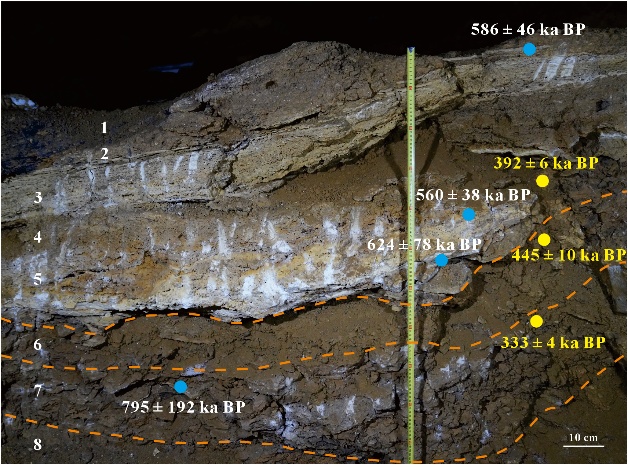
图1 岩利2号洞地层剖面图 本图修改自文献[66]/ Modified from reference [66]。左边数字代表不同的地层,橙色虚线代表不同地层的界线,蓝色和黄色圆点分别代表用于铀系测年的钙板和牙齿样品/The numbers on the left denote different geological strata, the orange dashed lines represent boundaries between strata, the blue and yellow dots indicate flowstone and tooth samples used for uranium-series dating, respectively
Fig.1 Stratigraphic section of the Yanli Cave 2
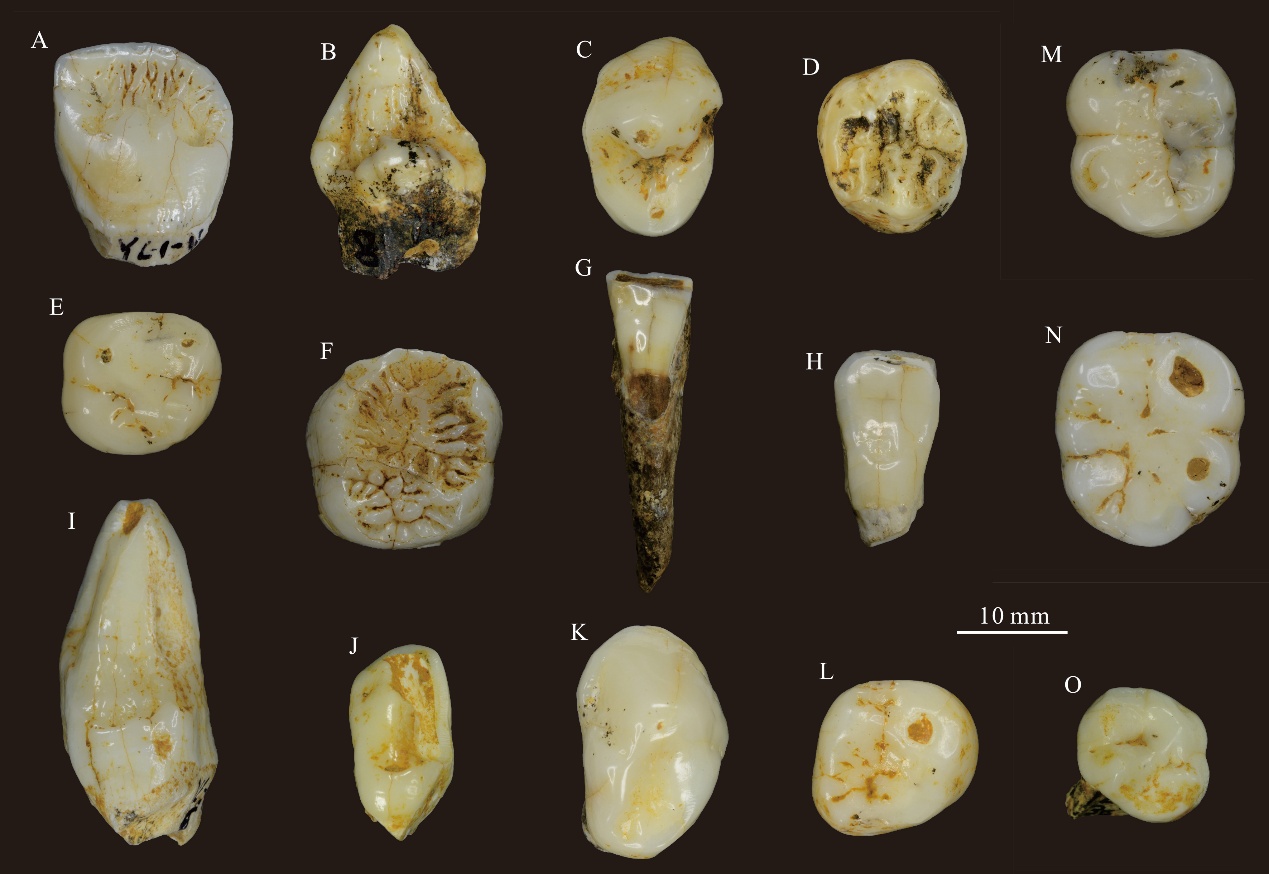
图2 岩利2号洞猩猩代表性牙齿化石 A. YL-1-15-1, I1, 左侧left;B. YL-2-6-8, C1, 左侧left;C. YL-2-7-24, P3, 右侧right;D. YL-R-27, P4, 左侧left;E. YL-2-6-26, M1, 左侧left;F. YL-1-15-22, M2, 左侧left;G. YL-R-2, i1, 右侧right;H. YL-R-4, i2, 左侧 left;I. YL-2-6-6, c1, 右侧right;J. YL-2-6-9, c1, 右侧right;K. YL-R-10, p3,右侧right;L. YL-1-1-15, p4, 右侧right;M. YL-K-D-19, m2, 左侧left;N. YL-1-1-16, m3, 右侧right;O. YL-R-36, DP4, 右侧right
Fig.2 Representative teeth of fossil orangutan from Yanli Cave 2
| 牙齿特征Dental feature | 岩利2号洞/ Yanli Cave 2 | 猩猩魏氏种 P. weidenreichi | 猩猩魏氏种 P. weidenreichi | 猩猩戴氏种 P. devosi | 现生猩猩 P. pygmaeus |
|---|---|---|---|---|---|
| 颊齿总面积Combined area of cheek teeth | 21.5% | 38.1%~18.9% | 19.7% | 5.4% | 小 |
| 上颌门齿齿带和突起Lingual cingulum and pillar on upper incisors | 微弱发育Weakly developed | 不发育Undeveloped | 发育 Developed | 发育Developed | 发育Developed |
| 下颌门齿齿带和突起Lingual cingulum and pillar on lower incisors | 不发育Undeveloped | 不发育Undeveloped | 微弱发育Weakly developed | 发育Developed | 发育Developed |
| 上颌臼齿舌侧齿带的出现率Incidence of upper molar lingual cingulum trace | 20% | 50% | 46% | 31% | 10% |
| 上颌和下颌臼齿中度-重度褶皱的出现率Incidence of moderate to heavy wrinkling of upper and lower molars | 64% | 54% | 81% | 95% | 100% |
| 数据来源Data sources | 本文This article | [9] | [7] | [6] | [9] |
表1 岩利2号洞猩猩牙齿化石与华南化石猩猩和现生猩猩形态对比
Tab.1 Features distinguishing the fossil Pongo teeth from Yanli Cave 2 from those of fossil Pongo and extant P. pygmaeus
| 牙齿特征Dental feature | 岩利2号洞/ Yanli Cave 2 | 猩猩魏氏种 P. weidenreichi | 猩猩魏氏种 P. weidenreichi | 猩猩戴氏种 P. devosi | 现生猩猩 P. pygmaeus |
|---|---|---|---|---|---|
| 颊齿总面积Combined area of cheek teeth | 21.5% | 38.1%~18.9% | 19.7% | 5.4% | 小 |
| 上颌门齿齿带和突起Lingual cingulum and pillar on upper incisors | 微弱发育Weakly developed | 不发育Undeveloped | 发育 Developed | 发育Developed | 发育Developed |
| 下颌门齿齿带和突起Lingual cingulum and pillar on lower incisors | 不发育Undeveloped | 不发育Undeveloped | 微弱发育Weakly developed | 发育Developed | 发育Developed |
| 上颌臼齿舌侧齿带的出现率Incidence of upper molar lingual cingulum trace | 20% | 50% | 46% | 31% | 10% |
| 上颌和下颌臼齿中度-重度褶皱的出现率Incidence of moderate to heavy wrinkling of upper and lower molars | 64% | 54% | 81% | 95% | 100% |
| 数据来源Data sources | 本文This article | [9] | [7] | [6] | [9] |
| [1] | Groves CP. Primate Taxonomy[M]. Washington: Smithsonian Institution Press, 2001, 1-350 |
| [2] | Nater A, Mattle-Greminger MP, Nurcahyo A, et al. Morphometric, behavioral, and genomic evidence for a new orangutan species[J]. Current Biology, 2017, 27: 3487-3498 |
| [3] | Goossens B, Chikhi L, Jalil MF, et al. Taxonomy, geographic variation and population genetics of Bornean and Sumatran orangutans[A]. In: Wich SA, Atmoko SS, Setia TM, et al(Eds.). Orangutans: Geographic Variation in Behavioral Ecology and Conservation[C]. New York: Oxford University Press, 2009, 363-401 |
| [4] | Xu XF, Arnason U. The mitochondrial DNA molecule of sumatran orangutan and a molecular proposal for two (Bornean and Sumatran) species of orangutan[J]. Journal of Molecular Evolution, 1996, 43: 431-437 |
| [5] | Bien M, Chia L. Cave and rock-shelter deposits in Yunnan[J]. Bulletin of the Geological Society of China, 1938, 18: 325-347 |
| [6] | Liang H, Harrison T, Shao Q, et al. Evidence for the smallest fossil Pongo in southern China[J]. Journal of human evolution, 2024, 189: 103507 |
| [7] | Liang H, Harrison T, Shao Q, et al. Middle Pleistocene Pongo from Ganxian Cave in southern China with implications for understanding dental size evolution in orangutans[J]. Journal of human evolution, 2023, 178: 103348 |
| [8] | Liao W, Harrison T, Yao Y, et al. Evidence for the latest fossil Pongo in southern China[J]. Journal of human evolution, 2022, 170: 103233 |
| [9] | Harrison T, Zhang Y, Yang L, et al. Evolutionary trend in dental size in fossil orangutans from the Pleistocene of Chongzuo, Guangxi, southern China[J]. Journal of Human Evolution, 2021, 161: 103090 |
| [10] | Harrison T, Jin CZ, Zhang YQ, et al. Fossil Pongo from the Early Pleistocene Gigantopithecus fauna of Chongzuo, Guangxi, southern China[J]. Quaternary International, 2014, 354: 59-67 |
| [11] | Pei W. Fossil mammals from the Kwangsi caves[J]. Bulletin of the Geological Society of China, 1935, 14: 413-425 |
| [12] | Wang CB, Zhao LX, Jin CZ, et al. New discovery of Early Pleistocene orangutan fossils from Sanhe Cave in Chongzuo, Guangxi, southern China[J]. Quaternary International, 2014, 354: 68-74 |
| [13] | Wang W, Potts R, Baoyin Y, et al. Sequence of mammalian fossils, including hominoid teeth, from the Bubing Basin caves, South China[J]. Journal of Human Evolution, 2007, 52: 370-379 |
| [14] | 陈德珍, 祁国琴. 云南西畴人类化石及共生的哺乳动物群[J]. 古脊椎动物与古人类, 1978, 16(1): 33-46 |
| [15] | 陈耿娇, 王頠, 莫进尤, 等. 广西田东雾云洞更新世脊椎动物群[J]. 古脊椎动物学报, 2002, 40(1): 42-51 |
| [16] | 顾玉眠, 黄万波, 宋方义, 等. 两广部分地区猩猩化石的研究[J]. 人类学学报, 1987, 6(4): 272-283 |
| [17] | 顾玉眠, 王淑琴, 张文定, 等. 广西洞穴调查报告[J]. 人类学学报, 1986, 5(2): 198-199 |
| [18] | 韩德芬. 广西大新黑洞哺乳动物化石[J]. 古脊椎动物与古人类, 1982, 20(1): 59-64 |
| [19] | 李有恒, 吴茂霖, 彭书琳, 等. 广西田东县祥周公社定模洞调查报告[J]. 人类学学报, 1985, 4(2): 127-131 |
| [20] | 刘昌芝. 粤北第四纪哺乳动物化石调查简报[J]. 古脊椎动物与古人类, 1962, 6(2): 202-203 |
| [21] | 裴文中. 广西柳城巨猿洞及其他山洞的第四纪哺乳动物[J]. 古脊椎动物与古人类, 1962, 6(3): 211-218 |
| [22] | 宋方义, 邱立诚, 王令红. 广东封开黄岩洞古人类文化遗址简讯[J]. 古脊椎动物与古人类, 1981, 19(1): 85-86 |
| [23] | 吴茂霖, 王令红, 张银运, 等. 贵州桐梓发现的古人类化石及其文化遗物[J]. 古脊椎动物与古人类, 1975, 13(1): 14-23 |
| [24] | 吴新智, 越资奎, 袁振新, 等. 广西东北地区调查简报[J]. 古脊椎动物与古人类, 1962, 6(4): 408-414 |
| [25] | 张银运, 王令红, 董兴仁. 广西巴马发现的巨猿牙齿化石[J]. 古脊椎动物与古人类, 1975, 13(3): 148-153 |
| [26] | 张玉萍. 广东肇庆更新世哺乳类化石[J]. 古脊椎动物与古人类, 1959, 1(3): 141-144 |
| [27] | 赵凌霞, 同号文, 许春华, 等. 贵州毕节发现的巨猿牙齿化石及其意义[J]. 第四纪研究, 2006, 26: 548-554 |
| [28] | 赵凌霞, 王翠斌, 金昌柱, 等. 广西崇左木榄山洞古人类遗址中发现的猩猩类牙齿化石及其分类演化意义[J]. 科学通报, 2009, 54: 2920-2926 |
| [29] | 赵凌霞, 张忠文, 戴犁. 贵州毕节团结乡麻窝口洞发现晚更新世猩猩化石[J]. 人类学学报, 2009, 28(2): 191 |
| [30] | Ciochon R, Long VT, Larick R, et al. Dated co-occurrence of Homo erectus and Gigantopithecus from Tham Khuyen Cave, Vietnam[J]. Proceedings of the National Academy of Sciences of the United States of America, 1996, 93: 3016-3020 |
| [31] | Ciochon RL. Lang Trang Caves: a new Middle Pleistocene hominid site from northern Vietnam[J]. American Journal of Physical Anthropology, 1990, 81: 205 |
| [32] | Drawhorn GM. The systematics and paleodemography of fossil orangutans (genus Pongo)[D]. PhD thesis, California: University of California Davis, 1995 |
| [33] | Olsen JW, Ciochon RL. A review of evidence for postulated Middle Pleistocene occupations in Vietnam[J]. Journal of Human Evolution, 1990, 19: 761-788 |
| [34] | Schwartz JH, Long VT, Cuong NL, et al. A diverse hominoid fauna from the Late Middle Pleistocene breccia cave of Tham Khuyen, Socialist Republic of Vietnam[J]. Anthropological papers of the Ameirican Museum of Natural History, 1994, 73: 1-11 |
| [35] | Schwartz JH, Long VT, Cuong NL, et al. A review of the Pleistocene hominoid fauna of the Socialist Republic of Vietnam (excluding Hylobatidae)[J]. Anthropological papers of the Ameirican Museum of Natural History, 1995, 76: 1-233 |
| [36] | Bacon AM, Demeter F, Tougard C, et al. The discovery of a Pleistocene fauna in karstic fills at Tam Hang in Laos: preliminary results[J]. Comptes Rendus Palevol, 2008, 7: 277-288 |
| [37] | Bacon AM, Duringer P, Antoine PO, et al. The Middle Pleistocene mammalian fauna from Tam Hang karstic deposit, northern Laos: New data and evolutionary hypothesis[J]. Quaternary International, 2011, 245: 315-332 |
| [38] | Kahlke H. A review of the Pleistocene history of the orang-utan (Pongo Lacépede 1799)[J]. Asian Perspectives, 1972, 15: 5-14 |
| [39] | Bacon AM, Duringer P, Westaway K, et al. Testing the savannah corridor hypothesis during MIS2: The Boh Dambang hyena site in southern Cambodia[J]. Quaternary International, 2018, 464: 417-439 |
| [40] | Filoux A, Wattanapituksakul A. The Late Pleistocene orangutan from Tham Prakai Phet: new discoveries[J]. Annales De Paleontologie, 2019, 105: 287-293 |
| [41] | Filoux A, Wattanapituksakul A, Lespes C, et al. A Pleistocene mammal assemblage containing Ailuropoda and Pongo from Tham Prakai Phet cave, Chaiyaphum Province, Thailand[J]. Geobios, 2015, 48: 341-349 |
| [42] | Tougard C. Biogeography and migration routes of large mammal faunas in South-East Asia during the Late Middle Pleistocene: focus on the fossil and extant faunas from Thailand[J]. Palaeogeography Palaeoclimatology Palaeoecology, 2001, 168: 337-358 |
| [43] | Tougard C, Montuire S. Pleistocene paleoenvironmental reconstructions and mammalian evolution in South-East Asia: focus on fossil faunas from Thailand[J]. Quaternary Science Reviews, 2006, 25: 126-141 |
| [44] | Zeitoun V, Lenoble A, Laudet F, et al. The Cave of the Monk (Ban Fa Suai, Chiang Dao wildlife sanctuary, northern Thailand)[J]. Quaternary International, 2010, 220: 160-173 |
| [45] | Ibrahim YK, Lim TT, Westaway KE, et al. First discovery of Pleistocene orangutan (Pongo sp.) fossils in Peninsular Malaysia: Biogeographic and paleoenvironmental implications[J]. Journal of Human Evolution, 2013, 65: 770-797 |
| [46] | Lim TT. Biogeographic distribution and metric dental variation of fossil and living orangutans (Pongo spp.)[J]. Primates, 2016, 57: 39-50 |
| [47] | Harrison T. The palaeoecological context at Niah Cave, Sarawak: evidence from the primate fauna[J]. Bulletin of the Indo-Pacific Prehistory Association, 1996, 14: 90-100 |
| [48] | Harrison T. Archaeological and ecological implications of the primate fauna from prehistoric sites in Borneo[J]. Bulletin of the Indo-Pacific Prehistory Association, 2000, 20: 134-146 |
| [49] | Hooijer DA. The orang-utan in Niah Cave prehistory[J]. Sarawak Museum Journal, 1960, 9: 408-421 |
| [50] | Badoux D. Fossil mammals from two deposits at Punung (Java)[D]. PhD thesis, Kemink: University of Utrecht, 1959 |
| [51] | De vos J. The Pongo faunas from Java and Sumatra and their significance for biostratigraphical and paleoecological interpretations[J]. Proceedings B, 1983, 86: 271-281 |
| [52] | Westaway KE, Morwood MJ, Roberts RG, et al. Age and biostratigraphic significance of the Punung Rainforest Fauna, East Java, Indonesia, and implications for Pongo and Homo[J]. Journal of Human Evolution, 2007, 53: 709-717 |
| [53] | Harrison T, Krigbaum J, Manser J. Primate biogeography and ecology on the Sunda Shelf Islands: a paleontological and zooarchaeological perspective[A]. In: Lehman SM, Fleagle JG(Eds.). Primate Biogeography[C]. New York: Springer, 2006, 331-372 |
| [54] | Westaway KE, Louys J, Awe RD, et al. An early modern human presence in Sumatra 73,000-63,000 years ago[J]. Nature, 2017, 548: 322-325 |
| [55] | 王翠斌, 赵凌霞, 金昌柱, 等. 中国更新世猩猩类牙齿化石的测量研究及其分类学意义[J]. 人类学学报, 2009, 28(2): 192-200 |
| [56] | Jin CZ, Harrison T, Dong W, et al. Multidisciplinary perspectives on the Gigantopithecus fauna and Quaternary biostratigraphy in eastern Asia[J]. Quaternary International, 2014, 354: 1-3 |
| [57] | Sun L, Wang Y, Liu CC, et al. Magnetochronological sequence of the Early Pleistocene Gigantopithecus faunas in Chongzuo, Guangxi, southern China[J]. Quaternary International, 2014, 354: 15-23 |
| [58] | Zhang Y, Westaway KE, Haberle S, et al. The demise of the giant ape Gigantopithecus blacki[J]. Nature, 2024, 625(7995): 535-539 |
| [59] | Rink WJ, Wang W, Bekken D, et al. Geochronology of Ailuropoda-Stegodon fauna and Gigantopithecus in Guangxi Province, southern China[J]. Quaternary Research, 2008, 69(3): 377-387 |
| [60] | Shao QF, Wang Y, Voinchet P, et al. U-series and ESR/U-series dating of the Stegodon-Ailuropoda fauna at Black Cave, Guangxi, southern China with implications for the timing of the extinction of Gigantopithecus blacki[J]. Quaternary International, 2017, 434: 65-74 |
| [61] | Liu W, Jin CZ, Zhang YQ, et al. Human remains from Zhirendong, South China, and modern human emergence in East Asia[J]. Proceedings of the National Academy of Sciences of the United States of America, 2010, 107: 19201-19206 |
| [62] | Cai YJ, Qiang XK, Wang XL, et al. The age of human remains and associated fauna from Zhiren Cave in Guangxi, southern China[J]. Quaternary International, 2017, 434: 84-91 |
| [63] | Ge J, Deng C, Wang Y, et al. Climate-influenced cave deposition and human occupation during the Pleistocene in Zhiren Cave, southwest China[J]. Quaternary International, 2020, 559: 14-23 |
| [64] | Hooijer DA. Prehistoric teeth of man and of the orang-utan from central Sumatra, with notes on the fossil orang-utan from Java and southern China[M]. Leiden: Zoologische Mededeelingen, 1948, 175-301 |
| [65] | Yao YY, Liao W, Christopher JB, et al. New discovery of Late Pleistocene modern human teeth from Chongzuo, Guangxi, southern China[J]. Quaternary International, 2020, 563: 5-12 |
| [66] | Yao YY, Fan YB, Bae CJ, et al. Early Mid-Pleistocene mammal fauna from Yanlidong Cave, South China[J]. Historical biology, 2023, 1-18 |
| [67] | Hilton S. Dental Anthropology[M]. Cambridge University Press, 1996, 1-366 |
| [68] | Scott GR, Turner CG. The anthropology of modern human teeth: dental morphology and its variation in recent human populations[M]. Cambridge University Press, 1997 |
| [69] | Ortiz A, Skinner M, Bailey S, et al. Carabelli’s trait revisited: an examination of mesiolingual features at the enamel dentine junction and enamel surface of Pan and Homo sapiens upper molars[J]. Journal of Human Evolution, 2012, 63: 586-596 |
| [70] | Van Reenen JF, Reid C. The Carabelli trait in early South African hominids:a morphological study[A]. In: Moggi-Cecchi J(Eds.), Aspects of Dental Biology: Paleontology, Anthropology and Evolution[C]. International Institute for the Study of Man, Florence, 1995: 291-298 |
| [1] | 姚艳燕, 艾婉婷, 胡敏航, 付琼耀, 李国山, 钟洁美, 胡鹏程, 黄胜敏, 田淳, 梁华, 廖卫, 王伟, 易智星. 广西崇左岩利1号洞早-中更新世过渡期的巨猿化石[J]. 人类学学报, 2026, 45(02): 199-209. |
| [2] | 王思元, 李金燕, 梁华, 谢耀樟, 廖卫, 王伟. 广西西部新发现的猩猩牙齿化石及其分类演化意义[J]. 人类学学报, 2026, 45(02): 224-235. |
| [3] | 徐世林, 杨雨薇, 梁华, 姚艳燕, 田淳, 董如珣, 黄楠楠, 廖卫, 王伟. 中国南方新发现的晚更新世早期猩猩牙齿[J]. 人类学学报, 2026, 45(02): 236-247. |
| [4] | 易智星, 仇若萱, 王伟, 廖卫, 梁华, 田淳, 米尔阿迪力·吐尔逊江, 张一景, 姚艳燕. 更新世中晚期猩猩第四乳前臼齿的三维釉质厚度[J]. 人类学学报, 2026, 45(02): 248-257. |
| [5] | 董哲, 战世佳. 安徽地区发现的阿舍利大型工具[J]. 人类学学报, 2025, 44(06): 998-1008. |
| [6] | 刘武, 吴秀杰. 华龙洞古人类化石及其在人类演化上的意义[J]. 人类学学报, 2025, 44(05): 727-741. |
| [7] | 裴树文, 董哲, 耿帅杰, 叶芷, 马东东, 张亚盟, 金泽田. 华龙洞遗址发现的石制品及人类行为[J]. 人类学学报, 2025, 44(05): 765-778. |
| [8] | 同号文, 江左其杲, 李强, 常美静, 刘博轩, 金泽田. 安徽东至华龙洞哺乳动物化石新材料[J]. 人类学学报, 2025, 44(05): 779-798. |
| [9] | 常美静, 李强, 倪喜军, 张玄, 同号文. 非飞行小哺乳动物化石反映的华龙洞人生存环境[J]. 人类学学报, 2025, 44(05): 799-815. |
| [10] | 刘驷统, 刘博轩, 金泽田, 邓国栋, 同号文, 吴秀杰. 华龙洞遗址出土的哺乳动物距骨化石[J]. 人类学学报, 2025, 44(05): 816-835. |
| [11] | 江左其杲, 刘博轩, 刘驷统, 贺乐天, 同号文. 华龙洞1号地点的食肉目哺乳动物化石及其时代和古生态意义[J]. 人类学学报, 2025, 44(05): 836-849. |
| [12] | 史静耸, 胡海虔, 邓国栋, 金泽田. 安徽东至华龙洞1号地点中更新统蛇类化石[J]. 人类学学报, 2025, 44(05): 850-861. |
| [13] | 刘博轩, 刘驷统, 金泽田, 邓国栋, 吴秀杰. 从大额牛牙齿看华龙洞人的狩猎行为[J]. 人类学学报, 2025, 44(05): 862-873. |
| [14] | 赵克良, 白广一, 惠家明, 张玄, 李小强. 华龙洞遗址古人类生存的植被与环境背景[J]. 人类学学报, 2025, 44(05): 906-916. |
| [15] | 刘武. 二十一世纪中国人类演化研究的发现、认识与理论探索[J]. 人类学学报, 2024, 43(06): 881-899. |
| 阅读次数 | ||||||
|
全文 |
|
|||||
|
摘要 |
|
|||||
 京ICP证05002819号-3