人类学学报 ›› 2025, Vol. 44 ›› Issue (05): 742-753.doi: 10.16359/j.1000-3193/AAS.2025.0075cstr: 32091.14.j.1000-3193/AAS.2025.0075

• 人类化石及其年代 • 上一篇    下一篇

安徽东至华龙洞遗址沉积演化过程及其年代

蔡演军1(), 裴树文2,3, 金泽田4   

  1. 1.西安交通大学全球环境变化研究院,西安 710054
    2.中国科学院古脊椎动物与古人类研究所,脊椎动物演化与人类起源重点实验室,北京 100044
    3.旧石器时代人类演化与遗传国家文物局重点科研基地,北京 100044
    4.安徽省东至县文化和旅游局,东至 247200
  • 收稿日期:2025-06-20 修回日期:2025-07-16 出版日期:2025-10-15 发布日期:2025-10-13
  • 作者简介:蔡演军,教授,主要从事第四纪地质与全球变化以及地层年代学研究。E-mail: yanjun_cai@xjtu.edu.cn
  • 基金资助:
    西安交通大学青年拔尖人才(A 类)项目

Sedimentary feature and chronology of Hualongdong site in Dongzhi, Anhui Province

CAI Yanjun1(), PEI Shuwen2,3, JIN Zetian4   

  1. 1. Institute of Global Environment Change, Xi'an Jiaotong University, Xi'an 710054
    2. Key Laboratory of Vertebrate Evolution and Human Origins, Institute of Vertebrate Paleontology and Paleoanthropology, Chinese Academy of Sciences, Beijing 100044
    3. Key Scientific Research Base on Paleolithic Human Evolution and Paleogenetics (IVPP), SACH. Beijing 100044
    4. Administration of Culture and Tourism of Dongzhi County, Dongzhi 247200
  • Received:2025-06-20 Revised:2025-07-16 Online:2025-10-15 Published:2025-10-13

摘要:

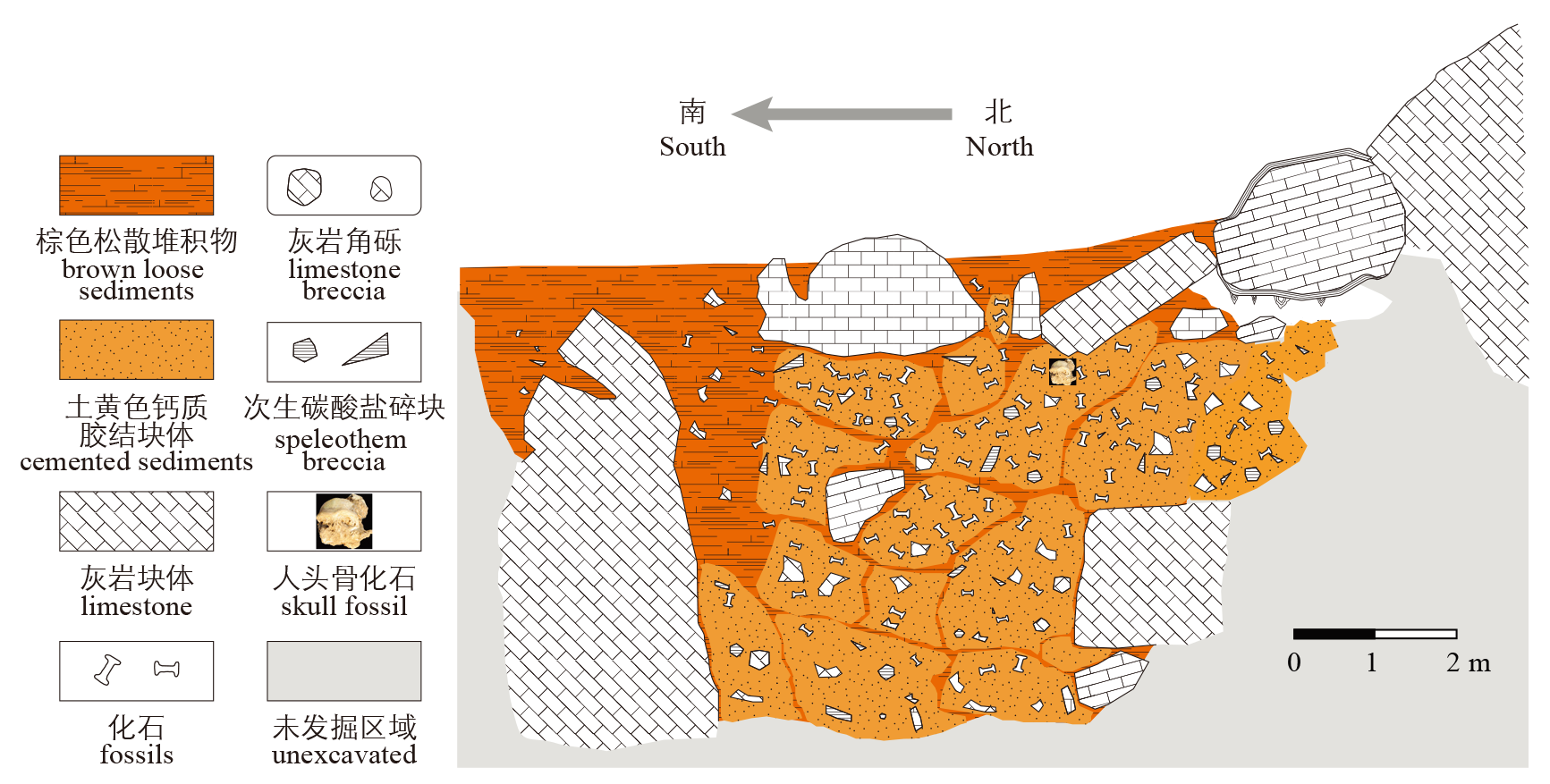
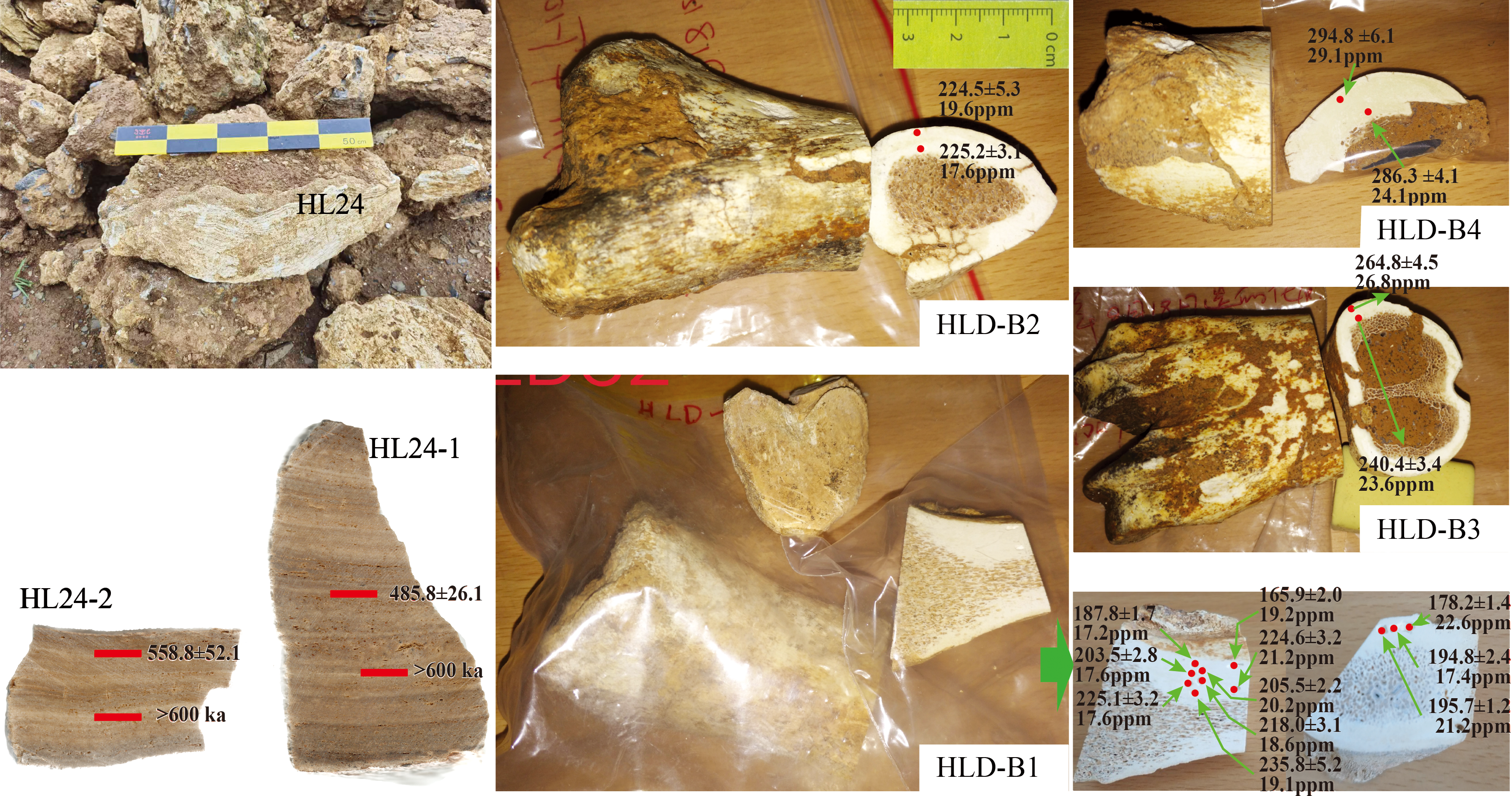
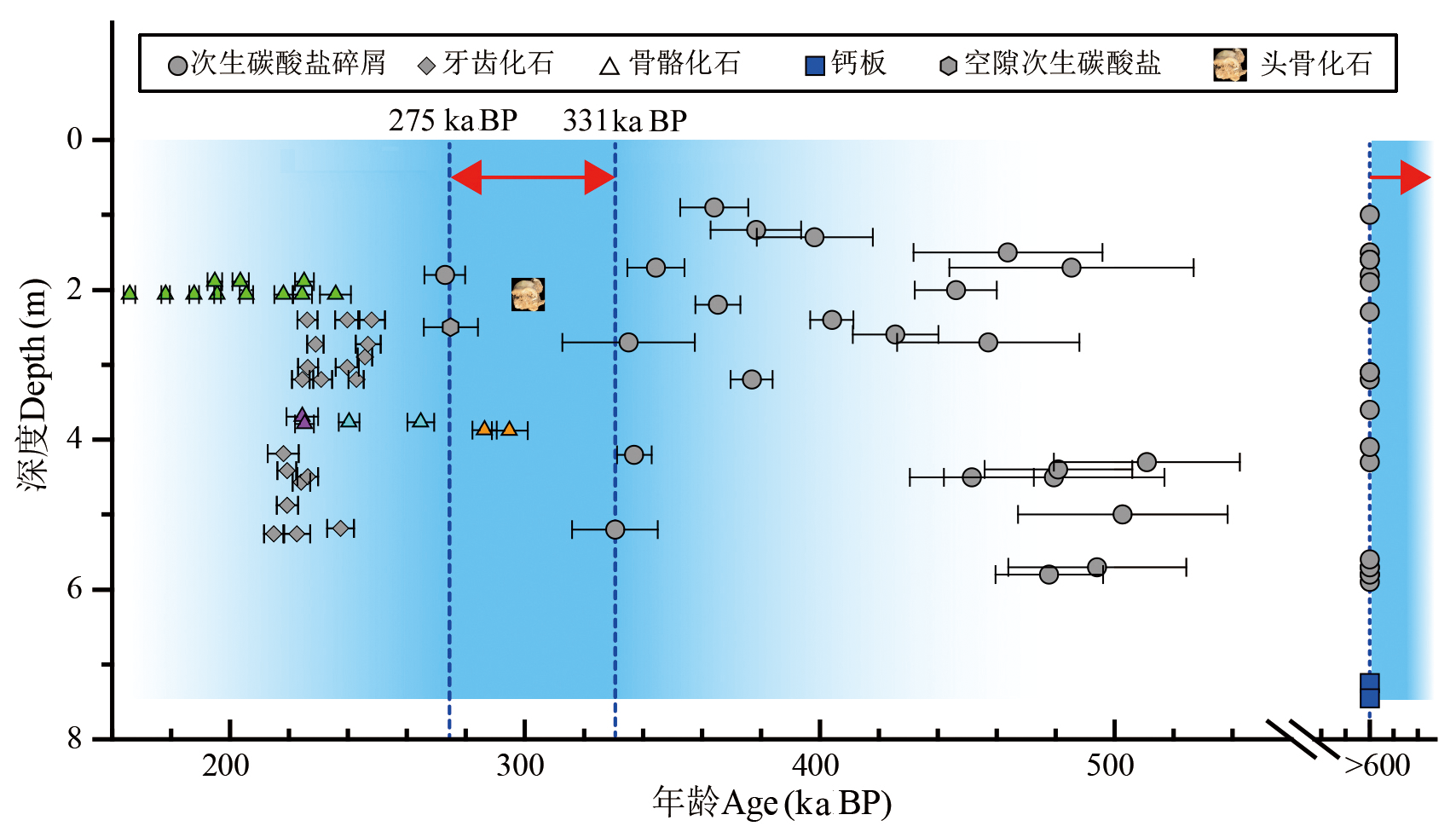
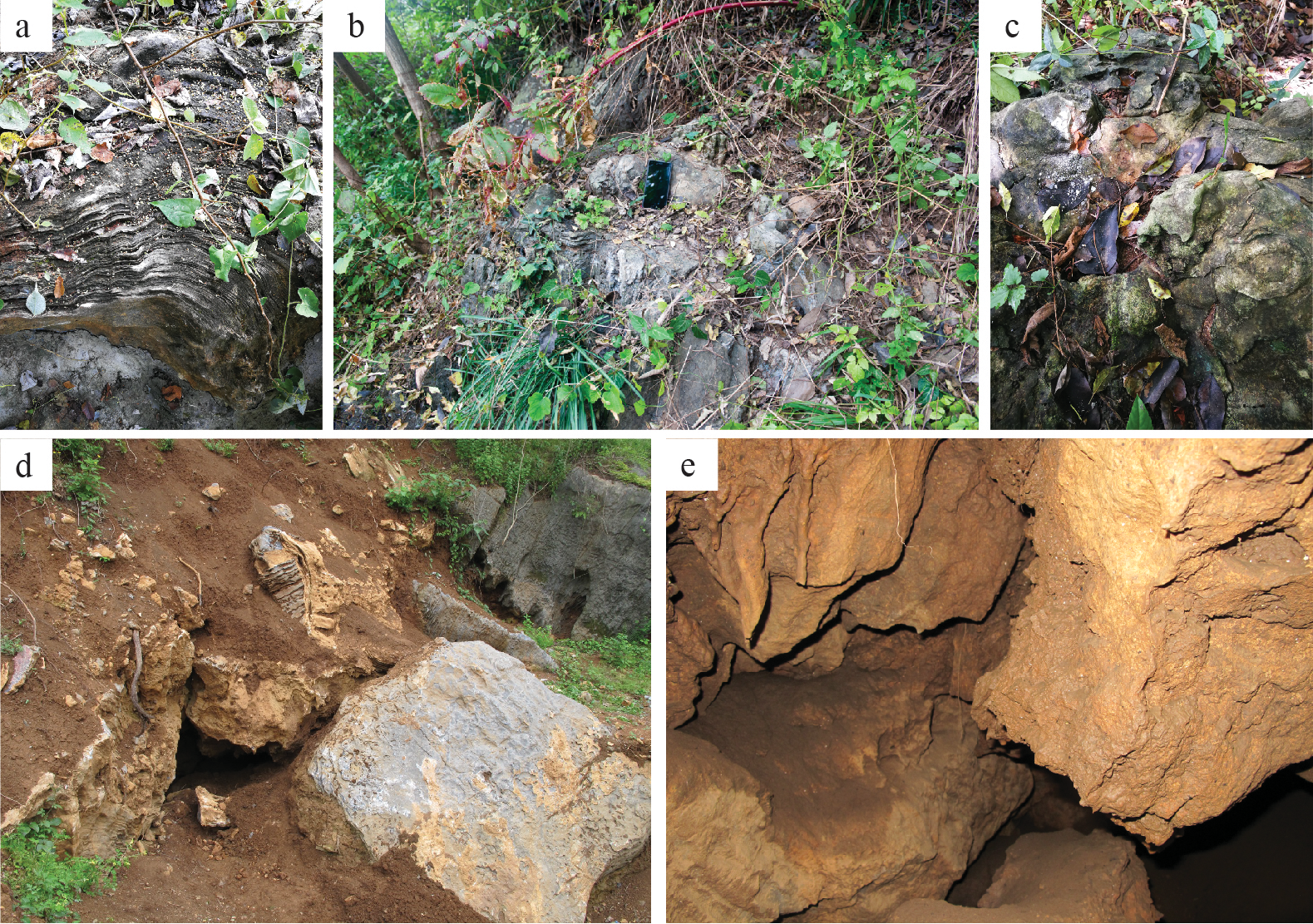
安徽东至华龙洞遗址沉积过程及其年代的确定,对于古人类演化及其生存环境与适应生存行为的研究具有重要的意义。本文综合分析华龙洞遗址及周边区域地质、地貌和沉积特征,分析发掘过程中采取的洞穴次生碳酸盐沉积以及动物化石的230Th-234U-238U测年结果,确认华龙洞遗址是古洞穴坍塌过程中由洞穴堆积物和围岩碎块混杂堆积而形成的,从古洞穴到遗址堆积大致经历洞穴形成发育期、稳定沉积期和快速坍塌堆积三个阶段,古洞穴坍塌和遗址混合堆积物的形成发生在距今21.6万年之后,含有化石的古洞穴堆积物是遗址混合堆积的主要组成。已有年代和遗址堆积物中新发现钙板的230Th-234U-238U测年结果表明,洞穴稳定沉积期至少经历两个时期的洞穴堆积过程,早期沉积大于60万年,晚期沉积从距今大约33.1万年到大约27.5万年前。综合目前获得的所有洞穴次生碳酸盐与化石牙齿和骨骼的230Th-234U-238U测年数据,研究推测华龙洞遗址人类最为完整的头骨化石埋藏年代可以确定在距今27.5万~33.1万年,属中更新世晚期。本研究表明,代表性化石标本的铀系测年可为遗址的年代学研究提供一定的约束,对遗址动物群及古人类演化研究具有重要意义。

关键词: 华龙洞遗址, 沉积演化过程, 洞穴次生碳酸盐, 哺乳动物化石, 铀系测年

Abstract:

Resolving sedimentary processes and constraining the ages of the Hualongdong site in Dongzhi County, Anhui Province, are crucial for researching ancient human evolution, as well as its living environment and adaptive survival behaviors. This paper comprehensively analyzes the geological, geomorphological, and sedimentary characteristics of the deposits at the Hualongdong site and its surroundings. In addition, we also examine the 230Th-234U-238U dating results of the speleothem debris and animal fossils collected during the excavation. It is confirmed that the deposits at the Hualongdong site formed from a mixture of cave deposits and surrounding rock fragments during the collapse of an ancient karst cave. The transition from the ancient karst cave to the accumulation at the Hualongdong site occurred in three main stages: the cave formation and development period, a relatively stable deposition period, and a rapid collapse and accumulation period. The collapse of the ancient karst cave and the formation of mixed deposits at the site occurred later than approximately 216 thousand years before present (ka BP), and ancient cave deposits containing fossils are the main components of the mixed accumulation at the site. Along with the dating results attained previously, the 230Th-234U-238U dating results of the recently discovered flowstone within the deposits indicate that the cave underwent at least two accumulation periods during its stable sedimentation phase, with early deposition occurring prior to 600 ka BP and later deposition spanning from around 331 to 275 ka BP. The mixing of deposition across at least two depositing episodes adds complexity to the chronological study of the site. By integrating the 230Th-234U-238U dating results of all available speleothem, fossil teeth and bones, this study speculates that the burial age of the most complete human skull fossil discovered at the Hualongdong site can be bracketed between 275 and 331 ka BP, placing it in the late Middle Pleistocene. We suggested that Uranium-series dating of representative fossil specimens can offer vital insights for the chronological study of the site and is strongly recommended for understanding the evolution of the fauna and ancient humans at this site.

Key words: Hualongdong site, deposition process, speleothem, mammalian fossils, U-series dating

中图分类号: