

主管:中国科学院
主办:中国科学院古脊椎动物与古人类研究所
出版:科学出版社
主办:中国科学院古脊椎动物与古人类研究所
出版:科学出版社
人类学学报 ›› 2026, Vol. 45 ›› Issue (05): 1007-1018.doi: 10.16359/j.1000-3193/AAS.2025.0078cstr: 32091.14.j.1000-3193/AAS.2025.0078
• 综述 • 上一篇
胡贺文( ), 郭怡()
收稿日期:2025-06-09
修回日期:2025-07-09
出版日期:2026-10-15
发布日期:2026-10-16
通讯作者:
郭怡,教授,主要研究方向为生物考古。E-mail: guoyi10@zju.edu.cn
作者简介:胡贺文,硕士研究生,主要研究方向为生物考古。E-mail: hewen_zju@163.com
基金资助:
HU Hewen(), GUO Yi()
Received:2025-06-09
Revised:2025-07-09
Online:2026-10-15
Published:2026-10-16
摘要:
人骨生物磷灰石中的碳、氧稳定同位素蕴含着先民生前活动信息,常被应用于古人类食谱重建、人群迁徙和个体生命史等研究中。在热带/亚热带骨骼胶原蛋白普遍流失的情况下,骨骼生物磷灰石便成为同位素分析的不二选择。然而,国内对骨骼生物磷灰石的保存情况研究较少,特别在南方地区,这极大地限制了相关古人类研究的开展。为此,本文系统综述了国内外人骨生物磷灰石稳定同位素的相关研究,重点阐述生物磷灰石的碳氧稳定同位素在还原古食谱、揭示古人类复杂行为模式等应用方面的进展。在此基础上,围绕生物磷灰石成岩作用原理、污染鉴别以及去除污染三个方面,论述成岩污染研究领域的学术研究现状、存在问题和具体对策。此外,还对骨骼生物磷灰石研究在考古学中的应用进行了展望。
中图分类号:
胡贺文, 郭怡. 人骨生物磷灰石碳氧稳定同位素的研究进展[J]. 人类学学报, 2026, 45(05): 1007-1018.
HU Hewen, GUO Yi. Research progress on stable isotopes of carbon and oxygen in human bone bioapatite[J]. Acta Anthropologica Sinica, 2026, 45(05): 1007-1018.
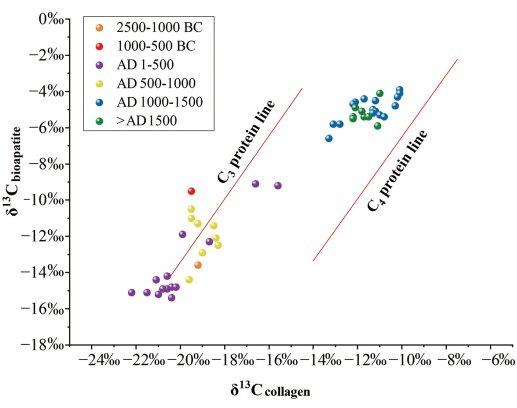
图1 安大略省南部不同时期骨骼生物磷灰石和骨胶原数据在回归线模型中的投点[22] 本图改绘自文献[22] / This figure is adapted from reference [22]
Fig.1 Projections of stable carbon isotope data from bioapatite and collagen at different periods in Southern Ontario in regression line models
| [1] |
Vogel JC, Van Der Merwe NJ. Isotopic evidence for early maize cultivation in New York State[J]. American Antiquity, 1977, 42(2): 238-242
doi: 10.2307/278984 URL |
| [2] |
Ambrose SH, Krigbaum J. Bone chemistry and bioarchaeology[J]. Journal of Anthropological Archaeology, 2003, 22(3): 193-199
doi: 10.1016/S0278-4165(03)00033-3 URL |
| [3] |
Makarewicz CA, Sealy J. Dietary reconstruction, mobility, and the analysis of ancient skeletal tissues: Expanding the prospects of stable isotope research in archaeology[J]. Journal of Archaeological Science, 2015, 56: 146-158
doi: 10.1016/j.jas.2015.02.035 URL |
| [4] |
Guo Y, Lou J, Xiang C, et al. Investigating dietary patterns and human mobility in bone apatite at the Zhuangqiaofen site (5000-3700 BP), Zhejiang Province, China[J]. Quaternary International, 2018, 493: 245-251
doi: 10.1016/j.quaint.2018.05.047 URL |
| [5] | 刘晓迪, 胡耀武. 华南地区新石器早中期动物骨中羟磷灰石的污染鉴别及机制——以广西桂林甑皮岩遗址为例[J]. 第四纪研究, 2021, 41(1): 189-200 |
| [6] | 郭怡, 项晨, 夏阳, 等. 中国南方古人骨中羟磷灰石稳定同位素分析的可行性初探——以浙江省庄桥坟遗址为例[J]. 第四纪研究, 2017, 37(1): 143-154 |
| [7] |
Zazzo A, Saliège JF. Radiocarbon dating of biological apatites: a review[J]. Palaeogeography, Palaeoclimatology, Palaeoecology, 2011, 310(1-2): 52-61
doi: 10.1016/j.palaeo.2010.12.004 URL |
| [8] |
Sullivan CH, Krueger HW. Carbon isotope analysis of separate chemical phases in modern and fossil bone[J]. Nature, 1981, 292(5821): 333-335
doi: 10.1038/292333a0 |
| [9] | Libby WF. Radiocarbon Dating (2nd edition)[M]. With chapter by Johnson F. Chicago: University of Chicago Press, 1955, 20-30 |
| [10] | Taylor RE. Radiocarbon dating of bone: to collagen and beyond[A]. In: Taylor RE, Long A, Kra RS(Eds.). Radiocarbon After Four Decades: An Interdisciplinary Perspective[M]. New York: Springer, 1992, 375-402 |
| [11] |
Smith BN, Epstein S. Two categories of 13C/12C ratios for higher plants[J]. Plant physiology, 1971, 47(3): 380-384
doi: 10.1104/pp.47.3.380 pmid: 16657626 |
| [12] |
DeNiro MJ, Epstein S. Influence of diet on the distribution of carbon isotopes in animals[J]. Geochimica et Cosmochimica Acta, 1978, 42(5): 495-506
doi: 10.1016/0016-7037(78)90199-0 URL |
| [13] |
Haynes V. Radiocarbon: analysis of inorganic carbon of fossil bone and enamel[J]. Science, 1968, 161(3842): 687-688
pmid: 4298852 |
| [14] |
Hassan AA, Termine JD, Haynes CV. Mineralogical studies on bone apatite and their implications for radiocarbon dating[J]. Radiocarbon, 1977, 19(3): 364-374
doi: 10.1017/S0033822200003684 URL |
| [15] |
Lee-Thorp JA, Sealy JC, Van Der Merwe NJ. Stable carbon isotope ratio differences between bone collagen and bone apatite, and their relationship to diet[J]. Journal of Archaeological Science, 1989, 16(6): 585-599
doi: 10.1016/0305-4403(89)90024-1 URL |
| [16] |
Weiner S, Bar-Yosef O. States of preservation of bones from prehistoric sites in the Near East: a survey[J]. Journal of Archaeological Science, 1990, 17(2): 187-196
doi: 10.1016/0305-4403(90)90058-D URL |
| [17] |
Wright LE, Schwarcz HP. Infrared and isotopic evidence for diagenesis of bone apatite at Dos Pilas, Guatemala: palaeodietary implications[J]. Journal of Archaeological Science, 1996, 23(6): 933-944
doi: 10.1006/jasc.1996.0087 URL |
| [18] |
Longinelli A. Oxygen isotopes in mammal bone phosphate: a new tool for paleohydrological and paleoclimatological research?[J]. Geochimica et Cosmochimica Acta, 1984, 48(2): 385-390
doi: 10.1016/0016-7037(84)90259-X URL |
| [19] |
Ericson JE. Strontium isotope characterization in the study of prehistoric human ecology[J]. Journal of human evolution, 1985, 14(5): 503-514
doi: 10.1016/S0047-2484(85)80029-4 URL |
| [20] |
Schoeninger MJ, Moore KM, Murray ML, et al. Detection of bone preservation in archaeological and fossil samples[J]. Applied Geochemistry, 1989, 4(3): 281-292
doi: 10.1016/0883-2927(89)90030-9 URL |
| [21] |
Price TD, Blitz J, Burton J, et al. Diagenesis in prehistoric bone: problems and solutions[J]. Journal of Archaeological Science, 1992, 19(5): 513-529
doi: 10.1016/0305-4403(92)90026-Y URL |
| [22] |
Harrison RG, Katzenberg MA. Paleodiet studies using stable carbon isotopes from bone apatite and collagen: examples from Southern Ontario and San Nicolas Island, California[J]. Journal of Anthropological Archaeology, 2003, 22(3): 227-244
doi: 10.1016/S0278-4165(03)00037-0 URL |
| [23] |
Kellner CM, Schoeninger MJ. A simple carbon isotope model for reconstructing prehistoric human diet[J]. American Journal of Physical Anthropology, 2007, 133(4): 1112-1127
pmid: 17530667 |
| [24] |
Hopkins III JB, Ferguson JM. Estimating the diets of animals using stable isotopes and a comprehensive Bayesian mixing model[J]. PLoS ONE, 2012, 7(1): e28478
doi: 10.1371/journal.pone.0028478 URL |
| [25] |
Fernandes R, Millard AR, Brabec M, et al. Food reconstruction using isotopic transferred signals (FRUITS): a Bayesian model for diet reconstruction[J]. PloS ONE, 2014, 9(2): e87436
doi: 10.1371/journal.pone.0087436 URL |
| [26] | 林怡嫺, 吴小红. 稳定同位素研究古食谱模型的发展[A].见:北京大学考古文博学院,北京大学中国考古学研究中心(编).考古学研究(十四):科技考古研究专号[C]. 北京: 科学出版社, 2022, 1-21 |
| [27] | Kennett DJ, Prufer KM, Culleton BJ, et al. Early isotopic evidence for maize as a staple grain in the Americas[J]. Science Advances, 2020, 6(23): eaba3245 |
| [28] |
Ugan A, Neme G, Gil A, et al. Geographic variation in bone carbonate and water δ18O values in Mendoza, Argentina and their relationship to prehistoric economy and settlement[J]. Journal of Archaeological Science, 2012, 39(8): 2752-2763
doi: 10.1016/j.jas.2012.04.013 URL |
| [29] |
Britton K, Fuller BT, Tütken T, et al. Oxygen isotope analysis of human bone phosphate evidences weaning age in archaeological populations[J]. American Journal of Physical Anthropology, 2015, 157(2): 226-241
doi: 10.1002/ajpa.22704 pmid: 25677569 |
| [30] | 胡耀武. 古代人类食谱及其相关研究[D].博士学位论文, 合肥: 中国科学技术大学, 2002 |
| [31] | 胡耀武, 王昌燧, 何德亮, 等. 古代人骨羟磷灰石的去污染研究[J]. 考古, 2006, 7: 68-74 |
| [32] | 刘化石, 夏珏宝, 郭贵诚, 等. 新石器时代晚期凉山地区粟黍农业初探:来自河东田、河头地遗址先民骨骼生物磷灰石的稳定同位素证据[J]. 第四纪研究, 2023, 43(5): 1404-1416 |
| [33] | 张春超, 甘恢元, 张国文. 新石器时代晚期淮河下游地区的生业经济——以江苏省泗洪县赵庄遗址人和动物骨的稳定同位素分析为例[J]. 第四纪研究, 2024, 44(2): 499-511 |
| [34] |
Xie SY, Guo Y, Wu X. Millet consumption in south Xinjiang during the 1st millennium BCE: Isotopic evidence from bone bioapatite at the Ji’erzankale site[J]. Quaternary International, 2022, 634: 38-47
doi: 10.1016/j.quaint.2022.06.014 URL |
| [35] | Ambrose SH, Norr L. Experimental evidence for the relationship of the carbon isotope ratios of whole diet and dietary protein to those of bone collagen and carbonate[A]. In: Lambert JB, Grupe G (Eds.). Prehistoric Human Bone: Archaeology at the Molecular Level[M]. Berlin, Heidelberg: Springer, 1993, 1-37 |
| [36] |
Touzeau A, Amiot R, Blichert-Toft J, et al. Diet of ancient Egyptians inferred from stable isotope systematics[J]. Journal of Archaeological Science, 2014, 46: 114-124
doi: 10.1016/j.jas.2014.03.005 URL |
| [37] |
Sharp ZD, Atudorei V, Furrer H. The effect of diagenesis on oxygen isotope ratios of biogenic phosphates[J]. American Journal of Science, 2000, 300(3): 222-237
doi: 10.2475/ajs.300.3.222 URL |
| [38] |
Lamb AL, Evans JE, Buckley R, et al. Multi-isotope analysis demonstrates significant lifestyle changes in King Richard III[J]. Journal of Archaeological Science, 2014, 50: 559-565
doi: 10.1016/j.jas.2014.06.021 URL |
| [39] | Cook SF. The Fossilization of Human Bone: Calcium, Phosphate, and Carbonate[M]. Berkeley: University of California Press, 1951, 263-279 |
| [40] |
Tamers MA, Pearson FJ. Validity of radiocarbon dates on bone[J]. Nature, 1965, 208(5015): 1053-1055
doi: 10.1038/2081053a0 |
| [41] |
Hedges REM. Bone diagenesis: an overview of processes[J]. Archaeometry, 2002, 44(3): 319-328
doi: 10.1111/arch.2002.44.issue-3 URL |
| [42] |
Nielsen-Marsh CM, Hedges REM. Patterns of diagenesis in bone I: the effects of site environments[J]. Journal of Archaeological Science, 2000, 27(12): 1139-1150
doi: 10.1006/jasc.1999.0537 URL |
| [43] |
Kendall C, Eriksen AMH, Kontopoulos I, et al. Diagenesis of archaeological bone and tooth[J]. Palaeogeography, Palaeoclimatology, Palaeoecology, 2018, 491: 21-37
doi: 10.1016/j.palaeo.2017.11.041 URL |
| [44] |
Hedges REM, Millard AR, Pike AWG. Measurements and relationships of diagenetic alteration of bone from three archaeological sites[J]. Journal of Archaeological Science, 1995, 22(2): 201-209
doi: 10.1006/jasc.1995.0022 URL |
| [45] |
Nudelman F, Lausch AJ, Sommerdijk NAJM, et al. In vitro models of collagen biomineralization[J]. Journal of Structural Biology, 2013, 183(2): 258-269
doi: 10.1016/j.jsb.2013.04.003 pmid: 23597833 |
| [46] |
Zhang Y, Wang CQ, Li Y, et al. Carbonate and cation substitutions in hydroxylapatite in breast cancer micro-calcifications[J]. Mineralogical Magazine, 2021, 85(3): 321-331
doi: 10.1180/mgm.2021.23 URL |
| [47] |
Wopenka B, Pasteris JD. A mineralogical perspective on the apatite in bone[J]. Materials Science and Engineering: C, 2005, 25(2): 131-143
doi: 10.1016/j.msec.2005.01.008 URL |
| [48] |
Rey C, Collins B, Goehl T, et al. The carbonate environment in bone mineral: a resolution-enhanced Fourier transform infrared spectroscopy study[J]. Calcified Tissue International, 1989, 45: 157-164
doi: 10.1007/BF02556059 pmid: 2505907 |
| [49] |
Pan Y, Fleet ME. Compositions of the apatite-group minerals: substitution mechanisms and controlling factors[J]. Reviews in Mineralogy and Geochemistry, 2002, 48(1): 13-49
doi: 10.2138/rmg.2002.48.2 URL |
| [50] |
Cazalbou S, Combes C, Eichert D, et al. Poorly crystalline apatites: evolution and maturation in vitro and in vivo[J]. Journal of Bone and Mineral Metabolism, 2004, 22: 310-317
pmid: 15221488 |
| [51] |
Trueman CN, Privat K, Field J. Why do crystallinity values fail to predict the extent of diagenetic alteration of bone mineral?[J]. Palaeogeography, Palaeoclimatology, Palaeoecology, 2008, 266(3-4): 160-167
doi: 10.1016/j.palaeo.2008.03.038 URL |
| [52] |
Von Endt DW, Ortner DJ. Experimental effects of bone size and temperature on bone diagenesis[J]. Journal of Archaeological Science, 1984, 11(3): 247-253
doi: 10.1016/0305-4403(84)90005-0 URL |
| [53] |
Keenan SW, Engel AS. Early diagenesis and recrystallization of bone[J]. Geochimica et Cosmochimica Acta, 2017, 196: 209-223
doi: 10.1016/j.gca.2016.09.033 URL |
| [54] |
Keenan SW. From bone to fossil: A review of the diagenesis of bioapatite[J]. American Mineralogist, 2016, 101(9): 1943-1951
doi: 10.2138/am-2016-5737 URL |
| [55] |
Blake RE, O’Neil JR, Garcia GA. Oxygen isotope systematics of biologically mediated reactions of phosphate: I. Microbial degradation of organophosphorus compounds[J]. Geochimica et Cosmochimica Acta, 1997, 61(20): 4411-4422
doi: 10.1016/S0016-7037(97)00272-X URL |
| [56] |
Trueman CNG, Behrensmeyer AK, Tuross N, et al. Mineralogical and compositional changes in bones exposed on soil surfaces in Amboseli National Park, Kenya: diagenetic mechanisms and the role of sediment pore fluids[J]. Journal of Archaeological Science, 2004, 31(6): 721-739
doi: 10.1016/j.jas.2003.11.003 URL |
| [57] |
Dal Sasso G, Lebon M, Angelini I, et al. Bone diagenesis variability among multiple burial phases at Al Khiday (Sudan) investigated by ATR-FTIR spectroscopy[J]. Palaeogeography, Palaeoclimatology, Palaeoecology, 2016, 463: 168-179
doi: 10.1016/j.palaeo.2016.10.005 URL |
| [58] |
Berna F, Matthews A, Weiner S. Solubilities of bone mineral from archaeological sites: the recrystallization window[J]. Journal of Archaeological Science, 2004, 31(7): 867-882
doi: 10.1016/j.jas.2003.12.003 URL |
| [59] | Zazzo A, Lécuyer C, Mariotti A. Experimentally-controlled carbon and oxygen isotope exchange between bioapatites and water under inorganic and microbially-mediated conditions[J]. Geochimica et Cosmochimica Acta, 2004, 68(1): 1-12 |
| [60] |
Scaggion C, Dal Sasso G, Nodari L, et al. An FTIR-based model for the diagenetic alteration of archaeological bones[J]. Journal of Archaeological Science, 2024, 161: 105900
doi: 10.1016/j.jas.2023.105900 URL |
| [61] |
Dal Sasso G, Asscher Y, Angelini I, et al. A universal curve of apatite crystallinity for the assessment of bone integrity and preservation[J]. Scientific Reports, 2018, 8(1): 12025
doi: 10.1038/s41598-018-30642-z pmid: 30104595 |
| [62] |
Pucéat E, Reynard B, Lécuyer C. Can crystallinity be used to determine the degree of chemical alteration of biogenic apatites?[J]. Chemical Geology, 2004, 205(1-2): 83-97
doi: 10.1016/j.chemgeo.2003.12.014 URL |
| [63] |
Chesson LA, Beasley MM, Bartelink EJ, et al. Using bone bioapatite yield for quality control in stable isotope analysis applications[J]. Journal of Archaeological Science: Reports, 2021, 35: 102749
doi: 10.1016/j.jasrep.2020.102749 URL |
| [64] | Krueger HW, Sullivan CH. Models for carbon isotope fractionation between diet and bone[A]. In: Turnlund JR, Johnson PE (Eds.). Stable Isotopes in Nutrition: ACS Symposium Series 258[C]. Washington, DC: American Chemical Society, 1984, 205-220 |
| [65] |
Beasley MM, Schoeninger MJ, Miller R, et al. Preservation of bone organic fraction is not predictive of the preservation of bone inorganic fraction when assessing stable isotope analysis sample quality control measures[J]. Journal of Archaeological Science, 2024, 162: 105886
doi: 10.1016/j.jas.2023.105886 URL |
| [66] |
Keenan SW, Engel AS, Roy A, et al. Evaluating the consequences of diagenesis and fossilization on bioapatite lattice structure and composition[J]. Chemical Geology, 2015, 413: 18-27
doi: 10.1016/j.chemgeo.2015.08.005 URL |
| [67] |
Featherstone JDB, Pearson S, LeGeros RZ. An infrared method for quantification of carbonate in carbonated apatites[J]. Caries Research, 1984, 18(1): 63-66
pmid: 6580956 |
| [68] |
Sponheimer M, Lee-Thorp JA. Alteration of enamel carbonate environments during fossilization[J]. Journal of Archaeological Science, 1999, 26(2): 143-150
doi: 10.1006/jasc.1998.0293 URL |
| [69] |
France CAM, Sugiyama N, Aguayo E. Establishing a preservation index for bone, dentin, and enamel bioapatite mineral using ATR-FTIR[J]. Journal of Archaeological Science: Reports, 2020, 33: 102551
doi: 10.1016/j.jasrep.2020.102551 URL |
| [70] |
Shemesh A. Crystallinity and diagenesis of sedimentary apatites[J]. Geochimica et Cosmochimica Acta, 1990, 54(9): 2433-2438
doi: 10.1016/0016-7037(90)90230-I URL |
| [71] |
Smith CI, Nielsen-Marsh CM, Jans MME, et al. Bone diagenesis in the European Holocene I: patterns and mechanisms[J]. Journal of Archaeological Science, 2007, 34(9): 1485-1493
doi: 10.1016/j.jas.2006.11.006 URL |
| [72] |
Beasley MM, Bartelink EJ, Taylor L, et al. Comparison of transmission FTIR, ATR, and DRIFT spectra: implications for assessment of bone bioapatite diagenesis[J]. Journal of Archaeological Science, 2014, 46: 16-22
doi: 10.1016/j.jas.2014.03.008 URL |
| [73] |
Koch PL, Tuross N, Fogel ML. The effects of sample treatment and diagenesis on the isotopic integrity of carbonate in biogenic hydroxylapatite[J]. Journal of Archaeological Science, 1997, 24(5): 417-429
doi: 10.1006/jasc.1996.0126 URL |
| [74] |
Garvie-Lok SJ, Varney TL, Katzenberg MA. Preparation of bone carbonate for stable isotope analysis: the effects of treatment time and acid concentration[J]. Journal of Archaeological Science, 2004, 31(6): 763-776
doi: 10.1016/j.jas.2003.10.014 URL |
| [75] |
Snoeck C, Pellegrini M. Comparing bioapatite carbonate pre-treatments for isotopic measurements: Part 1—Impact on structure and chemical composition[J]. Chemical Geology, 2015, 417: 394-403
doi: 10.1016/j.chemgeo.2015.10.004 URL |
| [76] |
Pellegrini M, Snoeck C. Comparing bioapatite carbonate pre-treatments for isotopic measurements: Part 2—Impact on carbon and oxygen isotope compositions[J]. Chemical Geology, 2016, 420: 88-96
doi: 10.1016/j.chemgeo.2015.10.038 URL |
| [77] |
Crowley BE, Wheatley PV. To bleach or not to bleach? Comparing treatment methods for isolating biogenic carbonate[J]. Chemical Geology, 2014, 381: 234-242
doi: 10.1016/j.chemgeo.2014.05.006 URL |
| [78] |
Key Jr MM, Smith AM, Phillips NJ, et al. Effect of removal of organic material on stable isotope ratios in skeletal carbonate from taxonomic groups with complex mineralogies[J]. Rapid communications in mass spectrometry, 2020, 34(20): e8901
doi: 10.1002/rcm.v34.20 URL |
| [79] |
Dotsika E, Zisi N, Tsoukala E, et al. Palaeoclimatic information from isotopic signatures of Late Pleistocene Ursus ingressus bone and teeth apatite (Loutra Arideas Cave, Macedonia, Greece)[J]. Quaternary International, 2011, 245(2): 291-301
doi: 10.1016/j.quaint.2011.01.027 URL |
| [80] |
Nakasi MA, Stathopoulou E, Tassi M, et al. Oxygen isotope analysis of pygmy hippo’s fossil bone and tooth apatite from Aghia Napa, Cyprus[J]. Journal of Archaeological Science: Reports, 2023, 48: 103854
doi: 10.1016/j.jasrep.2023.103854 URL |
| [81] |
Moloughney VP, Pinder DM, Pestle WJ. Particle size matters: The effect of particle size on carbon and oxygen isotope composition of bone hydroxyapatite[J]. American Journal of Physical Anthropology, 2020, 171(4): 718-724
doi: 10.1002/ajpa.24006 pmid: 31943129 |
| [82] |
Piga G, Baró MD, Escobal IG, et al. A structural approach in the study of bones: fossil and burnt bones at nanosize scale[J]. Applied Physics A, 2016, 122: 1031
doi: 10.1007/s00339-016-0562-1 URL |
| [83] | 胡耀武, 王昌燧, 左健, 等. 古人类骨中羟磷灰石的XRD和喇曼光谱分析[J]. 生物物理学报, 2001, 17(4): 621-626 |
| [1] | 朱思媚, 孙艺丹. 稳定同位素分析在古代人类哺乳和断奶行为研究中的应用[J]. 人类学学报, 2026, 45(04): 709-720. |
| [2] | 蔡卓通, 梅宏成, 接昭玮, 朱军, 张淙赫, 许奥翔, 李亚军, 胡灿, 王伟, 李智. 陕西三城市居民指甲多元稳定同位素的比较与溯源[J]. 人类学学报, 2026, 45(04): 732-741. |
| [3] | 王欣, 赵辉, 白彩霞, 李怡晓, 董豫. 山西吕梁后石墓地牙齿和骨骼的稳定同位素[J]. 人类学学报, 2026, 45(01): 88-100. |
| [4] | 马姣, 江左其杲, 金泽田, 邓国栋, 陈逸迎, 严毅. 安徽华龙洞熊科动物的稳定同位素古生态[J]. 人类学学报, 2025, 44(05): 884-894. |
| [5] | 马姣, 付永旭, 陈相龙, 武仙竹, 胡耀武. 贵州牛坡洞遗址动物骨骼的碳氮稳定同位素变化[J]. 人类学学报, 2025, 44(04): 688-700. |
| [6] | 朱语桐, 张国文, 郑万泉, 张燕. 四川宁南钟家梁子遗址人骨的稳定同位素[J]. 人类学学报, 2024, 43(05): 767-779. |
| [7] | 黄嫣, 胡耀武. 陶器脂肪酸揭示古人类食谱的研究进展[J]. 人类学学报, 2024, 43(05): 865-880. |
| [8] | 周立刚, 曹艳朋, 楚小龙, 孙蕾. 河南淅川下寨遗址人骨的C和N稳定同位素[J]. 人类学学报, 2024, 43(03): 405-414. |
| [9] | 李楠, 李成伟, 何嘉宁. 西周时期一例疑似刖刑的病例[J]. 人类学学报, 2022, 41(05): 826-836. |
| [10] | 雷帅, 郭怡. 生物考古学视野下人类的牙齿与饮食[J]. 人类学学报, 2022, 41(03): 501-513. |
| [11] | 张全超, 孙语泽, 侯亮亮, 吉平, 朱永刚. 哈民忙哈遗址人和动物骨骼的C、N稳定同位素分析[J]. 人类学学报, 2022, 41(02): 261-273. |
| [12] | 赵东月, 吕正, 张泽涛, 刘波, 凌雪, 万杨, 杨帆. 通过稳定同位素分析云南大阴洞遗址先民的生业经济方式[J]. 人类学学报, 2022, 41(02): 295-307. |
| [13] | 王宁, 桑哲成, 刘效彬, 吴倩. 商代前期中原地区多品种农作物种植制度的初探:以河南新郑望京楼遗址为例[J]. 人类学学报, 2022, 41(01): 96-107. |
| [14] | 刘晓迪, 魏东, 王婷婷, 张昕煜, 胡耀武. 内蒙古东南部战国时期的农业经济及人群融合[J]. 人类学学报, 2021, 40(05): 764-775. |
| [15] | 何欣龙, 梅宏成, 王继芬, 朱军, 郭鹏然, 胡灿, 何亚, 龚晓晓, 胡展纶. 新疆和田、哈密和阿勒泰市居民指甲中氢、氧稳定同位素的比较[J]. 人类学学报, 2021, 40(05): 888-894. |
| 阅读次数 | ||||||
|
全文 |
|
|||||
|
摘要 |
|
|||||
 京ICP证05002819号-3
