

主管:中国科学院
主办:中国科学院古脊椎动物与古人类研究所
出版:科学出版社
主办:中国科学院古脊椎动物与古人类研究所
出版:科学出版社
人类学学报 ›› 2026, Vol. 45 ›› Issue (05): 991-1006.doi: 10.16359/j.1000-3193/AAS.2025.0107cstr: 32091.14.j.1000-3193/AAS.2025.0107
林乃如1,2( ), SANO Katsuhiro1,2,3, 杨石霞4,5,6()
收稿日期:2025-06-09
修回日期:2025-09-02
出版日期:2026-10-15
发布日期:2026-10-16
通讯作者:
杨石霞,研究员,主要从事旧石器时代考古学和人类行为演化研究。E-mail: yangshixia@ivpp.ac.cn
作者简介:林乃如,在读研究生,主要研究方向为旧石器时代考古学和实验考古学。E-mail: linnairu16@foxmail.com
基金资助:
LIN Nairu1,2(), SANO Katsuhiro1,2,3, YANG Shixia4,5,6()
Received:2025-06-09
Revised:2025-09-02
Online:2026-10-15
Published:2026-10-16
摘要:
旧石器时代的复合工具常被视为“行为现代性”过程的指征之一,标志着史前人类的工具制作出现重要创新。旧石器时代的复合工具可上溯至旧石器时代中期,并在旧石器时代晚期得到极大发展,其过程伴随着狩猎行为的普遍化和加工行为的高效化。此外,复合工具的设计与制造过程所需的多层思维和精细操作能力是反映制造者认知水平与体质发展的重要间接证据,相关的神经科学研究甚至指出复合工具与语言发展之间存在密切联系。目前,国际学术界在旧石器时代的复合工具研究中有较多尝试,而国内学界对此的讨论仍然较少。本文尝试梳理旧石器时代复合工具研究中的概念框架与研究方法,系统介绍持续更新的技术-类型分析、痕迹学分析和残留物分析等方法在复合工具识别中的应用。在此基础上,本文就复合工具的多维研究视角及其在人类演化中的意义展开深入讨论。
中图分类号:
林乃如, SANO Katsuhiro, 杨石霞. 旧石器时代复合工具的研究进展与展望[J]. 人类学学报, 2026, 45(05): 991-1006.
LIN Nairu, SANO Katsuhiro, YANG Shixia. Advances and future directions in Paleolithic composite tool research[J]. Acta Anthropologica Sinica, 2026, 45(05): 991-1006.
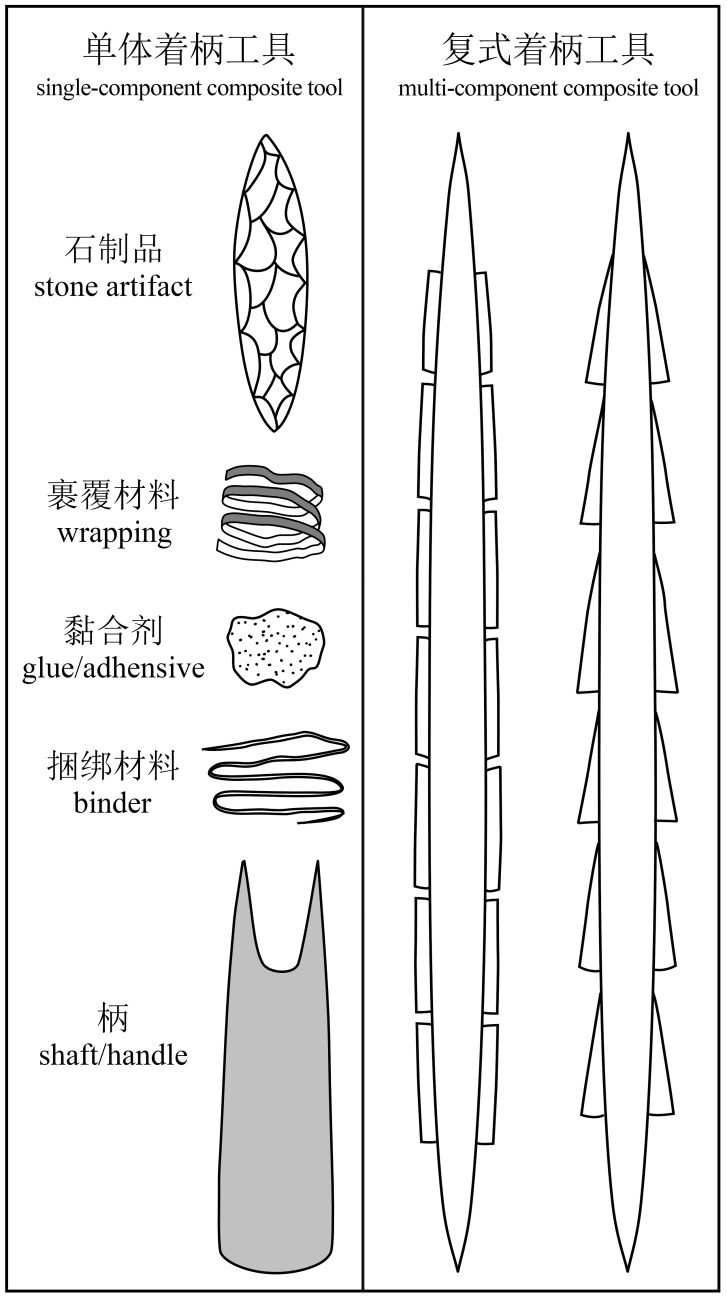
图1 旧石器时代复合工具的主要大类
Fig.1 Primary types of Paleolithic composite tools
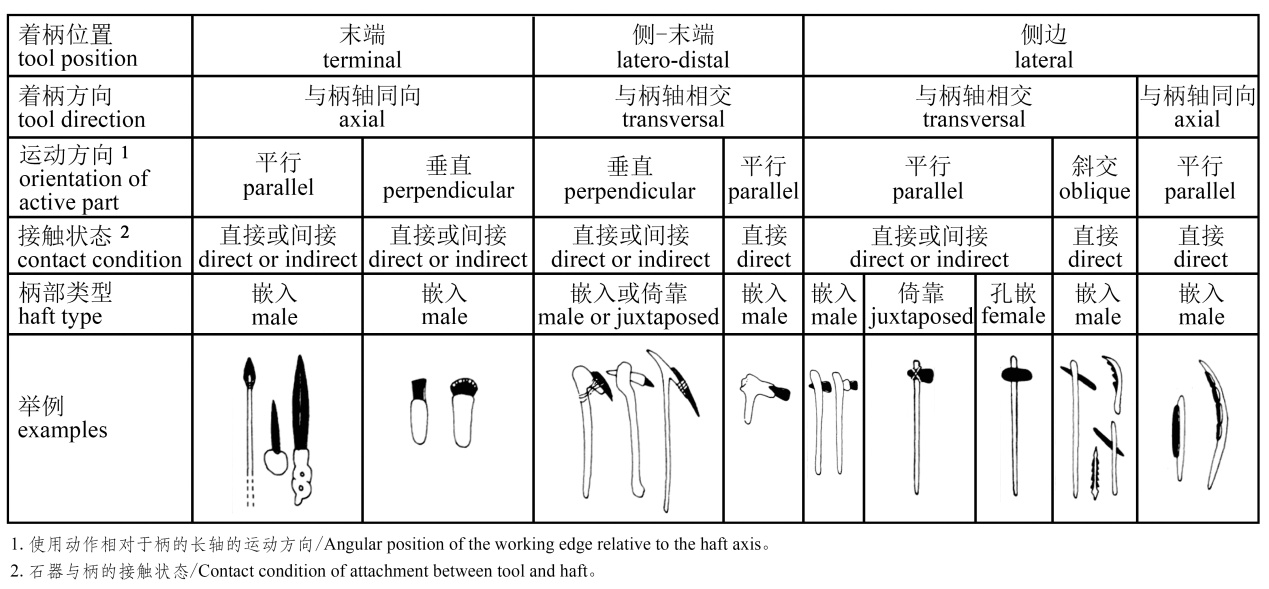 |
表1 复合工具的多种类型(修改自[15])
Tab.1 Diverse hafting arrangements of composite tools (Modified after [15])
| |
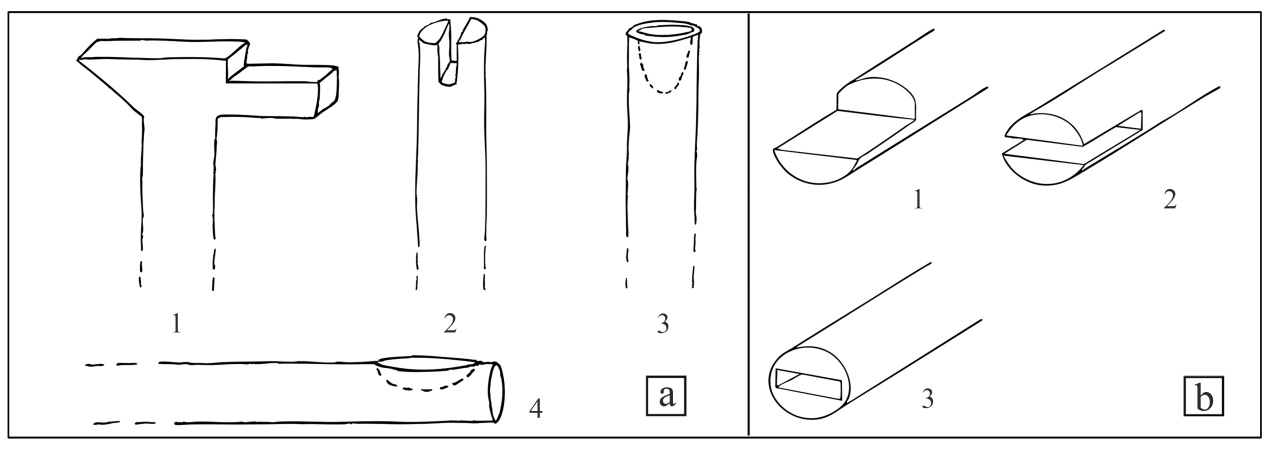
图2 痕迹学实验中的着柄设计 a. Rots着柄实验中的柄类型Haft types in Rots’ hafting experiments[21];b. Midoshima着柄实验中的柄类型Haft types in Midoshima’s hafting experiments[6]。1.倚靠式juxtaposed haft;2.开放嵌入式male split haft;3.包裹嵌入式male haft;4.半倚靠式male grooved lateral haft
Fig.2 Hafting design used in traceological experiments
| 变量Variables | 对着柄痕的影响Impact on the hafting traces | |
|---|---|---|
| 主要变量Predominant variables | 固定方式Hafting arrangement | 分布位置和个别特征Positioning and some characteristics |
| 着柄材料Hafting material | 形态和光泽Morphology and polish | |
| 使用动作Use motion | 分布模式Distribution pattern | |
| 被加工物Worked material | 发达程度Trace intensity | |
| 次要变量Secondary variables | 石料的粗糙程度Raw material coarseness | 发达程度和可视程度Trace intensity and visibility |
| 修理Retouch | 可识别程度和对着柄方法的解释Identifiability and interpretability | |
| 外凸特征Tool protrusion | 发达程度Trace intensity | |
| 轮廓形态Stone tool morphology | 分布模式Distribution pattern | |
表2 不同变量对着柄痕的影响(基于Rots的实验结论[21])
Tab.2 Variables related to hafting traces (after Rots[21])
| 变量Variables | 对着柄痕的影响Impact on the hafting traces | |
|---|---|---|
| 主要变量Predominant variables | 固定方式Hafting arrangement | 分布位置和个别特征Positioning and some characteristics |
| 着柄材料Hafting material | 形态和光泽Morphology and polish | |
| 使用动作Use motion | 分布模式Distribution pattern | |
| 被加工物Worked material | 发达程度Trace intensity | |
| 次要变量Secondary variables | 石料的粗糙程度Raw material coarseness | 发达程度和可视程度Trace intensity and visibility |
| 修理Retouch | 可识别程度和对着柄方法的解释Identifiability and interpretability | |
| 外凸特征Tool protrusion | 发达程度Trace intensity | |
| 轮廓形态Stone tool morphology | 分布模式Distribution pattern | |
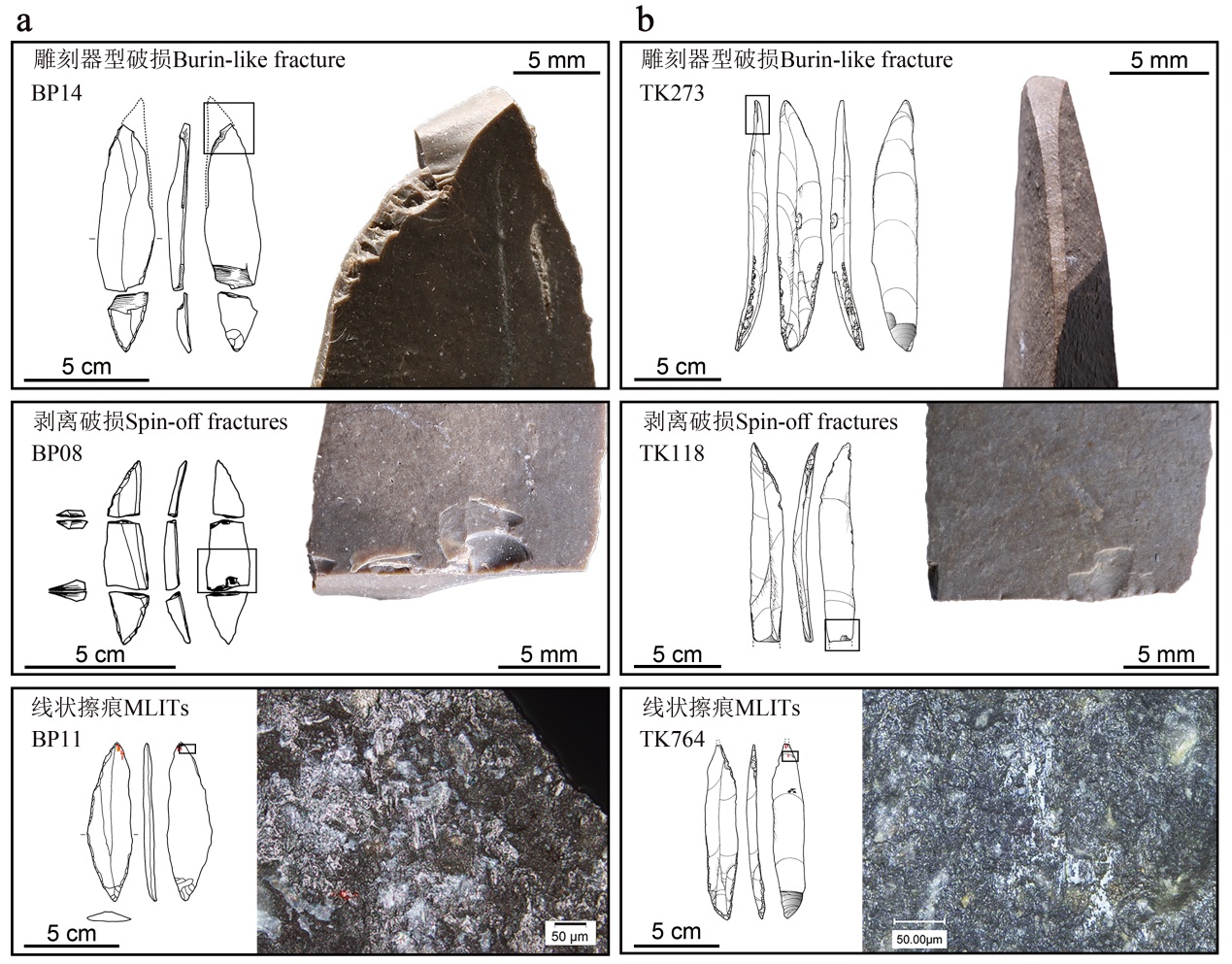
图3 实验标本与考古标本中的投射撞击破损和线状擦痕 a.实验标本,实验标本引自Sano / experimental data from Sano [28];b.考古标本,引自日本~27600 cal BP的高仓山遗址/ archaeological data from the Takakurayama site, Japan[32,33]
Fig.3 DIFs and MLITs on experimental and archaeological specimens
| 位置Location | 遗址名称Site | 年代Date | 主要成分 Main components | 检测方法 Identification method | 参考文献Reference | |
|---|---|---|---|---|---|---|
| 欧洲 | 意大利 | Campitello Quarry | >200 ka | 桦焦油 | EDX, FTIR, GC-MS | [ |
| 法国 | Le Moustier | Middle Paleolithic | 天然沥青,赭石 | EDX, IR, GC-MS, CT | [ | |
| 德国 | Inden-Altdorf | c. 120 ka | 桦焦油 | SEM, EDX | [ | |
| 荷兰 | Zandmotor | ~50 ka | 桦焦油 | THM-Py-GC/MS, μ-CT | [ | |
| 意大利 | Grotta del Fossellone | 55~40 ka | 树脂,蜂蜡 | GC-MS | [ | |
| 意大利 | Grotta del Cavallo | 45~40 ka | 树胶,赭石,蜂蜡 | FTIR, SEM, EDX | [ | |
| 德国 | Königsaue | >48 ka, >43 ka | 桦焦油 | GC, GC-MS | [ | |
| 意大利 | Grotta di Sant’Agostino | ~43 ka | 树脂 | GC-MS | [ | |
| 罗马尼亚 | Gura Cheii-Râşnov Cave | 33~29 ka | 天然沥青 | FTIR, EDX, ICP-AES, XRD, GC-MS | [ | |
| 法国 | Les Vachons | MIS 3 | 桦焦油 | EDX | [ | |
| 黎凡特地区 | 叙利亚 | Umm el Tlel | c.70 ka, >40 ka | 天然沥青 | GC-MS | [ |
| 叙利亚 | Hummal | 80~50 ka | 天然沥青 | GC-MS, SEM, EDX, FTIR, CRM, XRD | [ | |
| 非洲 | 摩洛哥 | Ifri n’ Ammar | 171~83 ka | 淀粉,植物组织,骨? | SEM-EDS | [ |
| 南非 | Rose Cottage Cave | 68~60 ka | 树脂,赭石 | 残留物的形态分析 | [ | |
| 南非 | Sibudu Cave | >61 ka | 树脂,赭石 | 残留物的形态分析 | [ | |
| 南非 | Umhlatuzana Rock Shelter | MIS 4 | 树脂,赭石 | 残留物的形态分析 | [ | |
| 南非 | Diepkloof Rock Shelter | 60~56 ka | 松焦油 | GC-MS | [ | |
| 南非 | Border Cave | 44~42 ka | 松焦油 | GC-MS | [ | |
| 亚洲 | 日本 | Shimohara-Fujimi-cho | Middle Upper Paleolithic | 有机物 | RS, XRF | [ |
| 中国 | 上湖 | ~26 ka | 植物来源黏合剂 | SEM-EDS, RS, FTIR, Py-GC/MS | [ | |
表3 旧石器时代复合工具中的黏合剂(修改自[39])
Tab.3 Adhesive evidence of Paleolithic composite tools (Modified after [39])
| 位置Location | 遗址名称Site | 年代Date | 主要成分 Main components | 检测方法 Identification method | 参考文献Reference | |
|---|---|---|---|---|---|---|
| 欧洲 | 意大利 | Campitello Quarry | >200 ka | 桦焦油 | EDX, FTIR, GC-MS | [ |
| 法国 | Le Moustier | Middle Paleolithic | 天然沥青,赭石 | EDX, IR, GC-MS, CT | [ | |
| 德国 | Inden-Altdorf | c. 120 ka | 桦焦油 | SEM, EDX | [ | |
| 荷兰 | Zandmotor | ~50 ka | 桦焦油 | THM-Py-GC/MS, μ-CT | [ | |
| 意大利 | Grotta del Fossellone | 55~40 ka | 树脂,蜂蜡 | GC-MS | [ | |
| 意大利 | Grotta del Cavallo | 45~40 ka | 树胶,赭石,蜂蜡 | FTIR, SEM, EDX | [ | |
| 德国 | Königsaue | >48 ka, >43 ka | 桦焦油 | GC, GC-MS | [ | |
| 意大利 | Grotta di Sant’Agostino | ~43 ka | 树脂 | GC-MS | [ | |
| 罗马尼亚 | Gura Cheii-Râşnov Cave | 33~29 ka | 天然沥青 | FTIR, EDX, ICP-AES, XRD, GC-MS | [ | |
| 法国 | Les Vachons | MIS 3 | 桦焦油 | EDX | [ | |
| 黎凡特地区 | 叙利亚 | Umm el Tlel | c.70 ka, >40 ka | 天然沥青 | GC-MS | [ |
| 叙利亚 | Hummal | 80~50 ka | 天然沥青 | GC-MS, SEM, EDX, FTIR, CRM, XRD | [ | |
| 非洲 | 摩洛哥 | Ifri n’ Ammar | 171~83 ka | 淀粉,植物组织,骨? | SEM-EDS | [ |
| 南非 | Rose Cottage Cave | 68~60 ka | 树脂,赭石 | 残留物的形态分析 | [ | |
| 南非 | Sibudu Cave | >61 ka | 树脂,赭石 | 残留物的形态分析 | [ | |
| 南非 | Umhlatuzana Rock Shelter | MIS 4 | 树脂,赭石 | 残留物的形态分析 | [ | |
| 南非 | Diepkloof Rock Shelter | 60~56 ka | 松焦油 | GC-MS | [ | |
| 南非 | Border Cave | 44~42 ka | 松焦油 | GC-MS | [ | |
| 亚洲 | 日本 | Shimohara-Fujimi-cho | Middle Upper Paleolithic | 有机物 | RS, XRF | [ |
| 中国 | 上湖 | ~26 ka | 植物来源黏合剂 | SEM-EDS, RS, FTIR, Py-GC/MS | [ | |
| [1] |
Kuhn SL, Shimelmitz R. From hafting to retooling: Miniaturization as tolerance control in paleolithic and neolithic blade production[J]. Journal of Archaeological Method and Theory, 2023, 30(2): 678-701
doi: 10.1007/s10816-022-09575-5 |
| [2] |
McBrearty S, Brooks AS. The revolution that wasn’t: a new interpretation of the origin of modern human behavior[J]. Journal of human evolution, 2000, 39(5): 453-563
doi: 10.1006/jhev.2000.0435 URL |
| [3] |
Scerri EML, Will M. The revolution that still isn’t: The origins of behavioral complexity in Homo sapiens[J]. Journal of Human Evolution, 2023, 179: 103358
doi: 10.1016/j.jhevol.2023.103358 URL |
| [4] | Barham LS. From hand to handle: The first industrial revolution[M]. Oxford: Oxford University Press, 2013 |
| [5] | Iovita R, Sano K (Eds.). Multidisciplinary approaches to the study of Stone Age weaponry[M]. London: Springer, 2016 |
| [6] | Midoshima T. An Experimental Trace Study of Obsidian Lithics[M]. Tokyo: Doseisha, 2020 (in Japanese) |
| [7] | Langejans G, Aleo A, Fajardo S, et al. Archaeological adhesives[A/OL]. In: Aldenderfer M(Ed.). Oxford Research Encyclopedia of Anthropology[M/OL]. New York, NY: Oxford Academic, 2022. DOI: 10.1093/acrefore/9780190854584.013.198 |
| [8] |
Boëda E, Connan J, Dessort D, et al. Bitumen as a hafting material on Middle Palaeolithic artefacts[J]. Nature, 1996, 380(6572): 336-338
doi: 10.1038/380336a0 |
| [9] |
Boëda E, Bonilauri S, Connan J, et al. Middle Palaeolithic bitumen use at Umm el Tlel around 70 000 BP[J]. Antiquity, 2008, 82(318): 853-861
doi: 10.1017/S0003598X00097623 URL |
| [10] |
Boëda E, Bonilauri S, Connan J, et al. New evidence for significant use of bitumen in Middle Palaeolithic technical systems at Umm el Tlel (Syria) around 70,000 BP[J]. Paléorient, 2008, 34(2): 67-83
doi: 10.3406/paleo.2008.5257 URL |
| [11] |
Monnier GF, Hauck TC, Feinberg JM, et al. A multi-analytical methodology of lithic residue analysis applied to Paleolithic tools from Hummal, Syria[J]. Journal of Archaeological Science, 2013, 40(10): 3722-3739
doi: 10.1016/j.jas.2013.03.018 URL |
| [12] | Serizawa C. Hafting method of microblades[A]. In: Serizawa C, Sutoh T (Eds.). The Araya site: report of the second and third term excavations, 1988-1989[C]. Sendai:Department of archaeology, graduate school of arts and letters, Tohoku University, and the Kawaguchi board of education, 2003, 84-88 (in Japanese) |
| [13] | Sano K. The emergence of complex hunting technology: innovation of Homo sapiens[A]. In: Nishiaki Y(Ed.). Homo sapiens and Archaic humans 3: shifting story in people and culture[M]. Tokyo: Rokuichi Shobo, 2015, 127-139 (in Japanese) |
| [14] |
Zhang SQ, Doyon L, Zhang Y, et al. Innovation in bone technology and artefact types in the late Upper Palaeolithic of China: Insights from Shuidonggou Locality 12[J]. Journal of Archaeological Science, 2018, 93: 82-93
doi: 10.1016/j.jas.2018.03.003 URL |
| [15] | Stordeur D. Manches et emmanchements préhistoriques: quelques propositions préliminaires[A]. In: Stordeur D (Ed.). La Main et l’Outil. Manches et emmanchements préhistoriques[C]. Lyon: Maison de l’Orient et de la Méditerranée, 1987, 11-34 |
| [16] |
Tomasso S, Cnuts D, Mikdad A, et al. Changes in hafting practices during the Middle Stone Age at Ifri n’Ammar[J]. Quaternary International, 2020, 555: 21-32
doi: 10.1016/j.quaint.2020.03.026 URL |
| [17] |
Slade AM. To haft and to hold: Evidence for the hafting of Clovis fluted points[J]. Journal of Lithic Studies, 2021, 8(3): 133-151
doi: 10.2218/jls.3033 URL |
| [18] |
Alperson-Afil N, Goren-Inbar N. Acheulian hafting: Proximal modification of small flint flakes at Gesher Benot Ya’aqov, Israel[J]. Quaternary International, 2016, 411: 34-43
doi: 10.1016/j.quaint.2015.12.068 URL |
| [19] |
Pétillon JM, Bignon O, Bodu P, et al. Hard core and cutting edge: experimental manufacture and use of Magdalenian composite projectile tips[J]. Journal of Archaeological Science, 2011, 38(6): 1266-1283
doi: 10.1016/j.jas.2011.01.002 URL |
| [20] |
Wang FG, Yang SX, Ge JY, et al. Innovative ochre processing and tool use in China 40,000 years ago[J]. Nature, 2022, 603(7900): 284-289
doi: 10.1038/s41586-022-04445-2 |
| [21] | Rots V. Prehension and Hafting Traces on Flint Tools: A Methodology[M]. Leuven: Leuven University Press, 2010 |
| [22] | Odell GH, Odell-Vereecken F. Verifying the reliability of lithic use-wear assessments by ‘blind tests’: the low-power approach[J]. Journal of Field Archaeology, 1980, 7(1): 87-120 |
| [23] |
Odell GH. The mechanics of use-breakage of stone tools: some testable hypotheses[J]. Journal of Field archaeology, 1981, 8(2): 197-209
doi: 10.1179/009346981791505120 URL |
| [24] |
Odell GH. Prehistoric hafting and mobility in the North American Midcontinent: Examples from Illinois[J]. Journal of Anthropological Archaeology, 1994, 13(1): 51-73
doi: 10.1006/jaar.1994.1004 URL |
| [25] |
Keeley LH. Hafting and retooling: effects on the archaeological record[J]. American antiquity, 1982, 47(4): 798-809
doi: 10.2307/280285 URL |
| [26] | Stordeur D(Ed.). La Main et l’Outil. Manches et emmanchements préhistoriques[C]. Lyon: Maison de l’Orient et de la Méditerranée, 1987 |
| [27] | 杨石霞. 人类演化中的“行为现代性”与“现代人行为”探讨[J]. 人类学学报, 2025, 44(2): 181-192 |
| [28] |
Sano K, Oba M. Backed point experiments for identifying mechanically-delivered armatures[J]. Journal of Archaeological Science, 2015, 63: 13-23
doi: 10.1016/j.jas.2015.08.005 URL |
| [29] | Sano K, Denda Y, Oba M. Experiments in fracture patterns and impact velocity with replica hunting weapons from Japan[A]. In: Iovita R, Sano K (Eds.). Multidisciplinary approaches to the study of Stone Age weaponry[C]. Dordrecht: Springer, 2016, 29-46 |
| [30] |
Groman-Yaroslavski I, Zaidner Y, Weinstein-Evron M. Complexity and sophistication of Early Middle Paleolithic flint tools revealed through use-wear analysis of tools from Misliya Cave, Mount Carmel, Israel[J]. Journal of Human Evolution, 2021, 154: 102955
doi: 10.1016/j.jhevol.2021.102955 URL |
| [31] |
Coppe J, Taipale N, Rots V. Terminal ballistic analysis of impact fractures reveals the use of spearthrower 31 ky ago at Maisières-Canal, Belgium[J]. Scientific Reports, 2023, 13(1): 18305
doi: 10.1038/s41598-023-45554-w |
| [32] | Kanomata Y, Sano K. The Takakurayama site: studies of the late paleolithic culture in the Mogami river basin, vol.3[M]. Sendai: Tohoku culture research room, graduate school of arts and letters, Tohoku University, 2016 (in Japanese) |
| [33] | Kanomata Y, Kumagai R. The Hakusan E and Hakusan B sites: studies of the late paleolithic culture in the Mogami river basin, vol.4[M]. Sendai: Tohoku culture research room, graduate school of arts and letters, Tohoku University. 2019, 101-106 (in Japanese) |
| [34] |
Fischer A, Hansen PV, Rasmussen P. Macro and micro wear traces on lithic projectile points[J]. Journal of Danish Archaeology, 1984, 3: 19-46
doi: 10.1080/0108464X.1984.10589910 URL |
| [35] | Sano K. Hunting evidence from stone artefacts from the Magdalenian cave site Bois Laiterie, Belgium: a fracture analysis[J]. Quartär, 2009, 56: 67-86 |
| [36] |
Sano K. Evidence for the use of the bow-and-arrow technology by the first modern humans in the Japanese islands[J]. Journal of Archaeological Science: Reports, 2016, 10: 130-141
doi: 10.1016/j.jasrep.2016.09.007 URL |
| [37] |
Lee GK, Sano K. Were tanged points mechanically delivered armatures? Functional and morphometric analyses of tanged points from an Upper Paleolithic site at Jingeuneul, Korea[J]. Archaeological and Anthropological Sciences, 2019, 11(6): 2453-2465
doi: 10.1007/s12520-018-0703-x |
| [38] | 关莹, 高星. 旧石器时代残留物分析:回顾与展望[J]. 人类学学报, 2009, 28(4): 418-429 |
| [39] | Sano K, Omori T. Residue study and use-wear analysis on backed points[A]. In: Suzuki M, Ichikawa M (Eds.). Shimohara and Fujimi-cho sites 3: excavation of the Upper Palaeolithic site(1)[C]. Tokyo: Meiji University, 2016, 120-127 (in Japanese) |
| [40] |
Mazza PPA, Martini F, Sala B, et al. A new Palaeolithic discovery: tar-hafted stone tools in a European Mid-Pleistocene bone-bearing bed[J]. Journal of Archaeological Science, 2006, 33(9): 1310-1318
doi: 10.1016/j.jas.2006.01.006 URL |
| [41] | Schmidt P, Iovita R, Charrié-Duhaut A, et al. Ochre-based compound adhesives at the Mousterian type-site document complex cognition and high investment[J]. Science Advances, 2024, 10(8): eadl0822 |
| [42] |
Pawlik AF, Thissen JP. Hafted armatures and multi-component tool design at the Micoquian site of Inden-Altdorf, Germany[J]. Journal of Archaeological Science, 2011, 38(7): 1699-1708
doi: 10.1016/j.jas.2011.03.001 URL |
| [43] |
Niekus MJT, Kozowyk PR, Langejans GH, et al. Middle Paleolithic complex technology and a Neandertal tar-backed tool from the Dutch North Sea[J]. Proceedings of the National Academy of Sciences, 2019, 116(44): 22081-22087
doi: 10.1073/pnas.1907828116 URL |
| [44] | Degano I, Soriano S, Villa P, et al. Hafting of Middle Paleolithic tools in Latium (central Italy): new data from Fossellone and Sant’Agostino caves[J]. PLoS ONE, 2019, 14(6): e0213473 |
| [45] | Sano K, Arrighi S, Stani C, et al. The earliest evidence for mechanically delivered projectile weapons in Europe[J]. Nature Ecology & Evolution, 2019, 3(10): 1409-1414 |
| [46] |
Koller J, Baumer U, Mania D. High-tech in the middle Palaeolithic: Neandertal-manufactured pitch identified[J]. European Journal of Archaeology, 2001, 4(3): 385-397
doi: 10.1179/eja.2001.4.3.385 URL |
| [47] | Picin A. Short-term occupations at the lakeshore: a technological reassessment of the open-air site Königsaue (Germany)[J]. Quartär, 2016, 63: 7-32 |
| [48] |
Cârciumaru M, Ion RM, Niţu EC, et al. New evidence of adhesive as hafting material on Middle and Upper Palaeolithic artefacts from Gura Cheii-Râşnov Cave (Romania)[J]. Journal of Archaeological Science, 2012, 39(7): 1942-1950
doi: 10.1016/j.jas.2012.02.016 URL |
| [49] |
Dinnis R, Pawlik A, Gaillard C. Bladelet cores as weapon tips? Hafting residue identification and micro-wear analysis of three carinated burins from the late Aurignacian of Les Vachons, France[J]. Journal of Archaeological Science, 2009, 36(9): 1922-1934
doi: 10.1016/j.jas.2009.04.020 URL |
| [50] |
Hauck TC, Connan J, Charrié-Duhaut A, et al. Molecular evidence of bitumen in the Mousterian lithic assemblage of Hummal (Central Syria)[J]. Journal of Archaeological Science, 2013, 40(8): 3252-3262
doi: 10.1016/j.jas.2013.03.022 URL |
| [51] | Gibson NE, Wadley L, Williamson BS. Microscopic residues as evidence of hafting on backed tools from the 60000 to 68000 year-old Howiesons Poort layers of Rose Cottage Cave, South Africa[J]. Southern African Humanities, 2004, 16(1): 1-11 |
| [52] | Wadley L. Ochre crayons or waste products? Replications compared with MSA ‘crayons’ from Sibudu Cave, South Africa[J]. Before Farming, 2005, 2005(3): 1-12 |
| [53] |
Lombard M. The gripping nature of ochre: the association of ochre with Howiesons Poort adhesives and Later Stone Age mastics from South Africa[J]. Journal of Human Evolution, 2007, 53(4): 406-419
pmid: 17643475 |
| [54] |
Charrié-Duhaut A, Porraz G, Cartwright CR, et al. First molecular identification of a hafting adhesive in the late Howiesons Poort at Diepkloof Rock Shelter (Western Cape, South Africa)[J]. Journal of Archaeological Science, 2013, 40(9): 3506-3518
doi: 10.1016/j.jas.2012.12.026 URL |
| [55] |
Villa P, Soriano S, Tsanova T, et al. Border Cave and the beginning of the Later Stone Age in South Africa[J]. Proceedings of the National Academy of Sciences, 2012, 109(33): 13208-13213
doi: 10.1073/pnas.1202629109 URL |
| [56] |
Zhang Y, Li S, Lotter MG, et al. First Evidence for Adhesive and Composite-tool Use During the Upper Palaeolithic in South China[J]. Lithic Technology, 2025, 51(2): 108-117
doi: 10.1080/01977261.2025.2518836 URL |
| [57] |
Roebroeks W, Villa P. On the earliest evidence for habitual use of fire in Europe[J]. Proceedings of the National Academy of Sciences, 2011, 108(13): 5209-5214
doi: 10.1073/pnas.1018116108 URL |
| [58] |
Hardy BL, Moncel MH, Kerfant C, et al. Direct evidence of Neanderthal fibre technology and its cognitive and behavioral implications[J]. Scientific Reports, 2020, 10(1): 4889
doi: 10.1038/s41598-020-61839-w pmid: 32273518 |
| [59] |
Taipale N, Rots V. Functional perspectives on lithic standardization[J]. Lithic Technology, 2023, 48(4): 452-475
doi: 10.1080/01977261.2023.2190670 URL |
| [60] |
Pargeter J, Shea JJ. Going big versus going small: Lithic miniaturization in hominin lithic technology[J]. Evolutionary Anthropology: Issues, News, and Reviews, 2019, 28(2): 72-85
doi: 10.1002/evan.v28.2 URL |
| [61] |
Rots V. Insights into early Middle Palaeolithic tool use and hafting in Western Europe. The functional analysis of level IIa of the early Middle Palaeolithic site of Biache-Saint-Vaast (France)[J]. Journal of Archaeological Science, 2013, 40(1): 497-506
doi: 10.1016/j.jas.2012.06.042 URL |
| [62] | Sahle Y, Brooks AS. Assessment of complex projectiles in the early Late Pleistocene at Aduma, Ethiopia[J]. PLoS ONE, 2019, 14(5): e0216716 |
| [63] |
Wilkins J, Schoville BJ, Brown KS, et al. Evidence for early hafted hunting technology[J]. Science, 2012, 338(6109): 942-946
doi: 10.1126/science.1227608 pmid: 23161998 |
| [64] |
Lombard M. Quartz-tipped arrows older than 60 ka: further use-trace evidence from Sibudu, KwaZulu-Natal, South Africa[J]. Journal of Archaeological Science, 2011, 38(8): 1918-1930
doi: 10.1016/j.jas.2011.04.001 URL |
| [65] |
Lombard M. Re-considering the origins of Old World spearthrower-and-dart hunting[J]. Quaternary Science Reviews, 2022, 293: 107677
doi: 10.1016/j.quascirev.2022.107677 URL |
| [66] | Sano K. Development of hunting tools and the dispersal of Homo Sapiens: from Africa to Europe[A]. In: Harunari H(Ed.). What Changed History? Volume 1: Nature History and Paleolithic/Jomon Archaeology[M]. Tokyo: yuzankaku, 2023, 85-96 (in Japanese) |
| [67] |
Moroni A, Boscato P, Ronchitelli A. What roots for the Uluzzian? Modern behaviour in Central-Southern Italy and hypotheses on AMH dispersal routes[J]. Quaternary International, 2013, 316: 27-44
doi: 10.1016/j.quaint.2012.10.051 URL |
| [68] | Yang SX, Zhang JF, Yue JP, et al. Initial Upper Palaeolithic material culture by 45,000 years ago at Shiyu in northern China[J]. Nature Ecology & Evolution, 2024, 8(3): 552-563 |
| [69] |
Rots V, Van Peer P. Early evidence of complexity in lithic economy: core-axe production, hafting and use at Late Middle Pleistocene site 8-B-11, Sai Island (Sudan)[J]. Journal of Archaeological Science, 2006, 33(3): 360-371
doi: 10.1016/j.jas.2005.08.002 URL |
| [70] |
Rots V, Van Peer P, Vermeersch PM. Aspects of tool production, use, and hafting in Palaeolithic assemblages from Northeast Africa[J]. Journal of Human Evolution, 2011, 60(5): 637-664
doi: 10.1016/j.jhevol.2011.01.001 pmid: 21392816 |
| [71] | Rots V. Hafting and the interpretation of site function in the European Middle Palaeolithic[A]. In: Conard NJ, Delagnes A (Eds.). Settlement Dynamics of the Middle Palaeolithic and Middle Stone Age: Vol. IV[C]. Tübingen: Kerns Verlag, 2015, 383-410 |
| [72] | Rots V, Lentfer C, Schmid VC, et al. Pressure flaking to serrate bifacial points for the hunt during the MIS5 at Sibudu Cave (South Africa)[J]. PloS ONE, 2017, 12(4): e0175151 |
| [73] |
Tomasso S, Rots V. What is the use of shaping a tang? Tool use and hafting of tanged tools in the Aterian of Northern Africa[J]. Archaeological and Anthropological Sciences, 2018, 10: 1389-1417
doi: 10.1007/s12520-016-0448-3 |
| [74] |
Taipale N, Rots V. Every hunter needs a knife: Hafted butchering knives from Maisières-Canal and their effect on lithic assemblage characteristics[J]. Journal of Archaeological Science: Reports, 2021, 36: 102874
doi: 10.1016/j.jasrep.2021.102874 URL |
| [75] | Zipkin AM, Wagner M, McGrath K, et al. An experimental study of hafting adhesives and the implications for compound tool technology[J]. PloS ONE, 2014, 9(11): e112560 |
| [76] |
Kozowyk PR, Soressi M, Pomstra D, et al. Experimental methods for the Palaeolithic dry distillation of birch bark: implications for the origin and development of Neandertal adhesive technology[J]. Scientific reports, 2017, 7(1): 8033
doi: 10.1038/s41598-017-08106-7 pmid: 28860591 |
| [77] |
Wadley L. Putting ochre to the test: replication studies of adhesives that may have been used for hafting tools in the Middle Stone Age[J]. Journal of Human Evolution, 2005, 49(5): 587-601
pmid: 16126249 |
| [78] | Wynn T. Tools and the evolution of human intelligence[A]. In: Byrne RW, Whiten A (Eds.). Machiavellian intelligence: Social expertise and the evolution of intellect in monkeys, apes, and humans[C]. Oxford: Clarendon Press / Oxford University Press, 1988, 271-284 |
| [79] |
Ambrose SH. Coevolution of composite-tool technology, constructive memory, and language: implications for the evolution of modern human behavior[J]. Current Anthropology, 2010, 51(S1): S135-S147
doi: 10.1086/650296 URL |
| [80] |
Coolidge FL, Wynn T. Working memory, its executive functions, and the emergence of modern thinking[J]. Cambridge Archaeological Journal, 2005, 15(1): 5-26
doi: 10.1017/S0959774305000016 URL |
| [81] |
Stout D, Toth N, Schick K, et al. Neural correlates of Early Stone Age toolmaking: technology, language and cognition in human evolution[J]. Philosophical Transactions of the Royal Society B: Biological Sciences, 2008, 363(1499): 1939-1949
doi: 10.1098/rstb.2008.0001 URL |
| [82] |
Key A, Farr I, Hunter R, et al. Why invent the handle? Electromyography (EMG) and efficiency of use data investigating the prehistoric origin and selection of hafted stone knives[J]. Archaeological and Anthropological Sciences, 2021, 13: 162
doi: 10.1007/s12520-021-01421-1 |
| [83] | Coe D, Barham L, Gardiner J, et al. A biomechanical investigation of the efficiency hypothesis of hafted tool technology[J]. Journal of the Royal Society Interface, 2022, 19(188): 20210660 |
| [84] |
Mika A, Lierenz J, Smith A, et al. Hafted technologies likely reduced stone tool-related selective pressures acting on the hominin hand[J]. Scientific Reports, 2023, 13(1): 15582
doi: 10.1038/s41598-023-42096-z |
| [85] |
Li H, Li ZY, Gao X, et al. Technological behavior of the early Late Pleistocene archaic humans at Lingjing (Xuchang, China)[J]. Archaeological and Anthropological Sciences, 2019, 11(7): 3477-3490
doi: 10.1007/s12520-018-0759-7 |
| [86] |
Lin NR, Wang H, Huan FX, et al. Lithic miniaturization and hafted tools in early Late Pleistocene Salawusu, North China[J]. Journal of Archaeological Science: Reports, 2023, 48: 103831
doi: 10.1016/j.jasrep.2023.103831 URL |
| [87] | 张晓凌, 高星, 沈辰, 等. 虎头梁遗址尖状器功能的微痕研究[J]. 人类学学报, 2010, 29(4): 337-354 |
| [88] | 刘吉颖, 任海云, 杜水生. 山西下川遗址富益河圪梁地点上文化层燧石制品微痕研究[J]. 第四纪研究, 2025, 45(5): 1254-1262 |
| [89] | 丁伯涛. 吉林省和龙大洞遗址端刮器的实验考古学研究[D].硕士学位论文, 长春: 吉林大学, 2020 |
| [90] |
Chen H, Wang Y, Chen C. Function and behaviour: use-wear evidence from Upper Paleolithic tools in southern Shanxi Province, North China[J]. Documenta Praehistorica, 2016, 43: 499-506
doi: 10.4312/dp.43 URL |
| [91] |
Chen H, Hou YM, Yang ZM, et al. A preliminary study on human behavior and lithic function at the Wulanmulun site, Inner Mongolia, China[J]. Quaternary International, 2014, 347(1): 133-138
doi: 10.1016/j.quaint.2014.04.049 URL |
| [92] | Chen H, Lian H, Wang J, et al. Hafting wear on quartzite tools: An experimental case from the Wulanmulun Site, Inner Mongolia of north China[J]. Quaternary International, 2017, 427: 184-192 |
| [93] | 刘吉颖. 浙江紫金山遗址燧石制品的功能研究[D].硕士学位论文, 杭州: 浙江大学, 2017 |
| [94] | 徐哲, 张晓凌, 裴树文. 射击类带尖石制品使用微痕动态形成过程的实验研究[J]. 人类学学报, 2020, 39(2): 208-222 |
| [95] | 高星, 沈辰. 石器微痕分析的考古学实验研究[M]. 北京: 科学出版社, 2008, 145-175 |
| [96] | 余官玥, 仪明洁, 张晓凌, 等. 水洞沟地区白云岩细石叶的微痕实验研究[J]. 人类学学报, 2020, 39(2): 193-207 |
| [97] | 刘吉颖. 以色列Ohalo II遗址后旧石器时代小石叶组合的破损模式和情境埋藏研究[D].博士学位论文, 杭州: 浙江大学, 2022 |
| [98] |
Liu JY, Nadel D, Chen H, et al. An experimental-based characterization of breakage patterns of prehistoric bladelets: The combined impact of knapping, exposure to fire and trampling[J]. Journal of Archaeological Science: Reports, 2024, 57: 104619
doi: 10.1016/j.jasrep.2024.104619 URL |
| [1] | 宋艳花, 吴梦遥, 吴洋, 郭军亮, 马峰, 张建军, 吴小红, 郭玉杰. 山西阳城析城山遗址第1和第2地点发掘报告[J]. 人类学学报, 2026, 45(02): 358-371. |
| [2] | 阮齐军, 张帅, 李想, 刘建辉, 郭相奇, 李俊, 车德才, 李俊仪, 郑晓勇, 永春, 王珍珍, 贾真秀, 李浩. 云南元谋盆地老鸦塘旧石器遗址群调查报告[J]. 人类学学报, 2025, 44(06): 978-988. |
| [3] | 刘武, 吴秀杰. 华龙洞古人类化石及其在人类演化上的意义[J]. 人类学学报, 2025, 44(05): 727-741. |
| [4] | 杨石霞. 人类演化中的"行为现代性"与"现代人行为"探讨[J]. 人类学学报, 2025, 44(02): 181-192. |
| [5] | 刘武. 二十一世纪中国人类演化研究的发现、认识与理论探索[J]. 人类学学报, 2024, 43(06): 881-899. |
| [6] | 裴树文, 蔡演军, 董哲, 同号文, 盛锦朝, 金泽田, 吴秀杰, 刘武. 安徽东至华龙洞遗址洞穴演化与古人类活动[J]. 人类学学报, 2022, 41(04): 593-607. |
| [7] | 杨石霞, 许竞文, 浣发祥. 古人类对赭石的利用行为在其演化中的意义[J]. 人类学学报, 2022, 41(04): 649-658. |
| [8] | Francesc RIBOT Trafí, Mario GARCÍA Bartual, Alfredo José ALTAMIRANO Enciso, 王谦. 犬齿窝与人类中面部骨骼的演化[J]. 人类学学报, 2022, 41(02): 193-217. |
| [9] | 刘武, 惠家明, 何嘉宁, 吴秀杰. 门齿孔位置在中国古人类化石与现代人群的表现及其演化意义[J]. 人类学学报, 2021, 40(05): 739-750. |
| [10] | 徐哲, 马姣, 裴树文. 哺乳动物牙釉质碳氧稳定同位素揭示早期人类演化与环境关系[J]. 人类学学报, 2021, 40(03): 454-468. |
| [11] | 陆莹, 孙雪峰, 王社江, 鹿化煜. 早、中更新世中国古人类年代序列与区域演化特征[J]. 人类学学报, 2021, 40(03): 411-426. |
| [12] | 葛俊逸, 邓成龙, 邵庆丰, 裴树文, 唐锐枰, 涂华, 高星. 中国古人类遗址年代学的研究进展与问题[J]. 人类学学报, 2021, 40(03): 393-410. |
| [13] | 王谦, 张全超. 全球健康史项目亚洲模块—— 亚洲古代人群健康、疾病和生活方式的大数据[J]. 人类学学报, 2020, 39(04): 727-732. |
| [14] | 吴秀杰, 严毅. 资阳人头骨化石的内部解剖结构[J]. 人类学学报, 2020, 39(04): 511-520. |
| [15] | 尼古拉斯 J. 康纳德, 韩芳. 文化现代性与行为超级适应性之路 ——中科院古脊椎动物与古人类研究所系列课程纪要[J]. 人类学学报, 2019, 38(03): 419-445. |
| 阅读次数 | ||||||
|
全文 |
|
|||||
|
摘要 |
|
|||||
 京ICP证05002819号-3
