

主管:中国科学院
主办:中国科学院古脊椎动物与古人类研究所
出版:科学出版社
主办:中国科学院古脊椎动物与古人类研究所
出版:科学出版社
人类学学报 ›› 2025, Vol. 44 ›› Issue (06): 1083-1093.doi: 10.16359/j.1000-3193/AAS.2025.0019cstr: 32091.14.j.1000-3193/AAS.2025.0019
贾真秀1,2( ), 赤列次仁3, 李浩1,2, 童艳3, 夏格旺堆3, 陈发虎1,2
收稿日期:2024-03-17
接受日期:2024-07-19
出版日期:2025-12-15
发布日期:2025-12-15
作者简介:贾真秀,高级工程师,主要从事旧石器时代考古学研究。E-mail: zxjia@itpcas.ac.cn
基金资助:
JIA Zhenxiu1,2(), TINLEY Tsring3, LI Hao1,2, TONG Yan3, SHARGAN Wangdue3, CHEN Fahu1,2
Received:2024-03-17
Accepted:2024-07-19
Online:2025-12-15
Published:2025-12-15
摘要:
2021-2022年,我们在西藏拉萨堆龙曲流域史前人类活动野外调查时,共发现3处有原生埋藏地层的旧石器遗址以及10处地表采集石器点,海拔分布均在4000 m左右。此次13处地点调查发现的79件石制品均为石核-石片技术组合类型,无手斧、石叶或细石叶等技术产品。对尚嘎岗和邱桑寺两处重要遗址的文化层进行了光释光年代测定,初步结果显示两处遗址的年代均不晚于距今10万年。通过此次野外工作,确认了位于高原腹地的堆龙曲流域存在明确的、有原生埋藏地层的旧石器时代遗址,且遗址分布范围较为广泛。然而目前调查发现的石制品数量有限,难以对遗址的技术属性和文化内涵进行全面而深入的研究和探讨,但当前研究无疑为今后的工作提供了宝贵的线索。
中图分类号:
贾真秀, 赤列次仁, 李浩, 童艳, 夏格旺堆, 陈发虎. 西藏拉萨堆龙曲流域2021-2022年旧石器考古调查简报[J]. 人类学学报, 2025, 44(06): 1083-1093.
JIA Zhenxiu, TINLEY Tsring, LI Hao, TONG Yan, SHARGAN Wangdue, CHEN Fahu. A preliminary report of the 2021-2022 paleolithic archaeological survey in Duilong River valley, Lhasa, Xizang[J]. Acta Anthropologica Sinica, 2025, 44(06): 1083-1093.
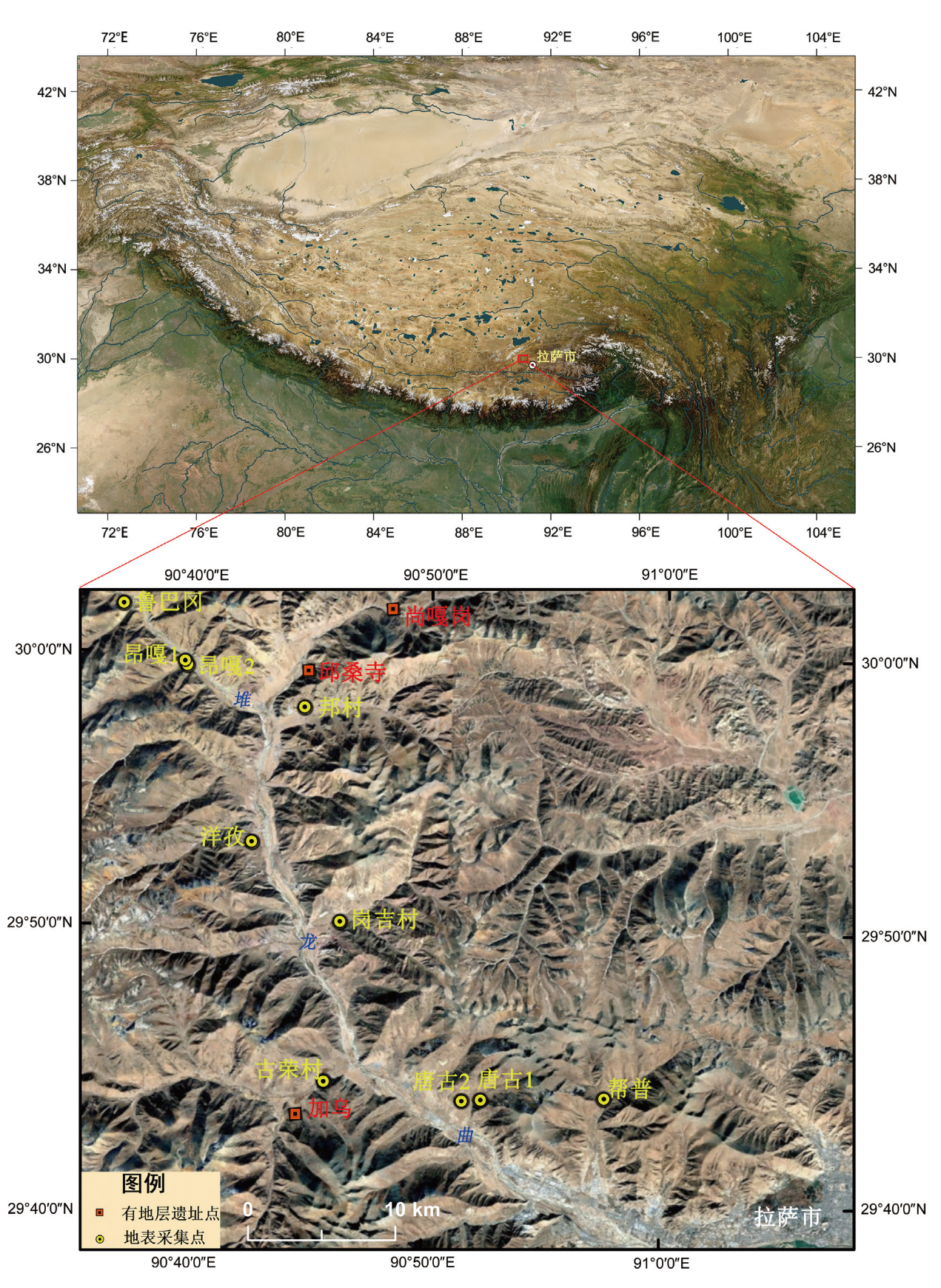
图1 2021-2022年调查发现的遗址点分布图
Fig.1 The geographic location of the distribution of the newly discovered localities (2021-2022 surveys)
| 序号No. | 名称Localities | 经度Longitude | 纬度Latitude | 海拔 Altitude(m) | 地理位置Position | 石制品Lithics |
|---|---|---|---|---|---|---|
| 1 | 尚嘎岗遗址Zangs dKar sGang | 90°48′20″E | 30°1′42″N | 4170 | 尚嘎岗村东南,亚惹曲第2级阶地 | 54 |
| 2 | 邱桑寺遗址Chu bZang | 90°44′49″E | 29°59′24″N | 4081 | 邱桑村东侧、邱桑寺南侧的小冲沟 | 5 |
| 3 | 加乌遗址rGyavu | 90°44′48″E | 29°48′16″N | 3980 | 加乌村东南 | 2 |
| 4 | 昂嘎1地点Ngang dKar 1 | 90°39′42″E | 29°59′32″N | 4072 | 昂嘎村西北,达曲南岸的台地上 | 1 |
| 5 | 昂嘎2地点Ngang dKar 2 | 90°39′32″E | 29°59′30″N | 4101 | 昂嘎村西北,达曲北岸的台地上 | 1 |
| 6 | 帮普地点sPang Pu 2 | 90°57′36″E | 29°43′56″N | 3966 | 色钦东北方问的台地上 | 2 |
| 7 | 唐古1地点Thang Gu 1 | 90°52′24″E | 29°43′49″N | 3962 | 唐古村南侧的冲沟 | 3 |
| 8 | 唐古2地点Thang Gu 2 | 90°51′36″E | 29°43′46″N | 3843 | 唐古村西北侧的冲沟 | 2 |
| 9 | 鲁巴冈地点Lu Pa sGangs | 90°36′58″E | 30°0′43″N | 4182 | 鲁巴冈村西侧,达布曲与堆龙曲的交汇处西南向 | 2 |
| 10 | 岗吉村地点sGang sKyid | 90°46′20″~25″E | 29°50′15″~25″N | 3910~3940 | 岗吉村南侧对岸,第2至第4级阶地上 | 3 |
| 11 | 邦村地点sBarng | 90°44′41″E | 29°58′4″N | 4000 | 邦村西,扑青朗第1级阶地 | 1 |
| 12 | 古荣地点rGu Rum | 90°45′46″E | 29°44′24″N | 3840 | 古荣村东南,塞曲左岸 | 1 |
| 13 | 洋孜地点Yangs rTse | 90°42′33″E | 29°53′7″N | 3930 | 洋孜村东北,堆龙曲右岸第2级阶地上 | 1 |
表1 堆龙曲流域发现的旧石器遗址信息表
Tab.1 A summary of newly discovered localities in Duilong River area
| 序号No. | 名称Localities | 经度Longitude | 纬度Latitude | 海拔 Altitude(m) | 地理位置Position | 石制品Lithics |
|---|---|---|---|---|---|---|
| 1 | 尚嘎岗遗址Zangs dKar sGang | 90°48′20″E | 30°1′42″N | 4170 | 尚嘎岗村东南,亚惹曲第2级阶地 | 54 |
| 2 | 邱桑寺遗址Chu bZang | 90°44′49″E | 29°59′24″N | 4081 | 邱桑村东侧、邱桑寺南侧的小冲沟 | 5 |
| 3 | 加乌遗址rGyavu | 90°44′48″E | 29°48′16″N | 3980 | 加乌村东南 | 2 |
| 4 | 昂嘎1地点Ngang dKar 1 | 90°39′42″E | 29°59′32″N | 4072 | 昂嘎村西北,达曲南岸的台地上 | 1 |
| 5 | 昂嘎2地点Ngang dKar 2 | 90°39′32″E | 29°59′30″N | 4101 | 昂嘎村西北,达曲北岸的台地上 | 1 |
| 6 | 帮普地点sPang Pu 2 | 90°57′36″E | 29°43′56″N | 3966 | 色钦东北方问的台地上 | 2 |
| 7 | 唐古1地点Thang Gu 1 | 90°52′24″E | 29°43′49″N | 3962 | 唐古村南侧的冲沟 | 3 |
| 8 | 唐古2地点Thang Gu 2 | 90°51′36″E | 29°43′46″N | 3843 | 唐古村西北侧的冲沟 | 2 |
| 9 | 鲁巴冈地点Lu Pa sGangs | 90°36′58″E | 30°0′43″N | 4182 | 鲁巴冈村西侧,达布曲与堆龙曲的交汇处西南向 | 2 |
| 10 | 岗吉村地点sGang sKyid | 90°46′20″~25″E | 29°50′15″~25″N | 3910~3940 | 岗吉村南侧对岸,第2至第4级阶地上 | 3 |
| 11 | 邦村地点sBarng | 90°44′41″E | 29°58′4″N | 4000 | 邦村西,扑青朗第1级阶地 | 1 |
| 12 | 古荣地点rGu Rum | 90°45′46″E | 29°44′24″N | 3840 | 古荣村东南,塞曲左岸 | 1 |
| 13 | 洋孜地点Yangs rTse | 90°42′33″E | 29°53′7″N | 3930 | 洋孜村东北,堆龙曲右岸第2级阶地上 | 1 |
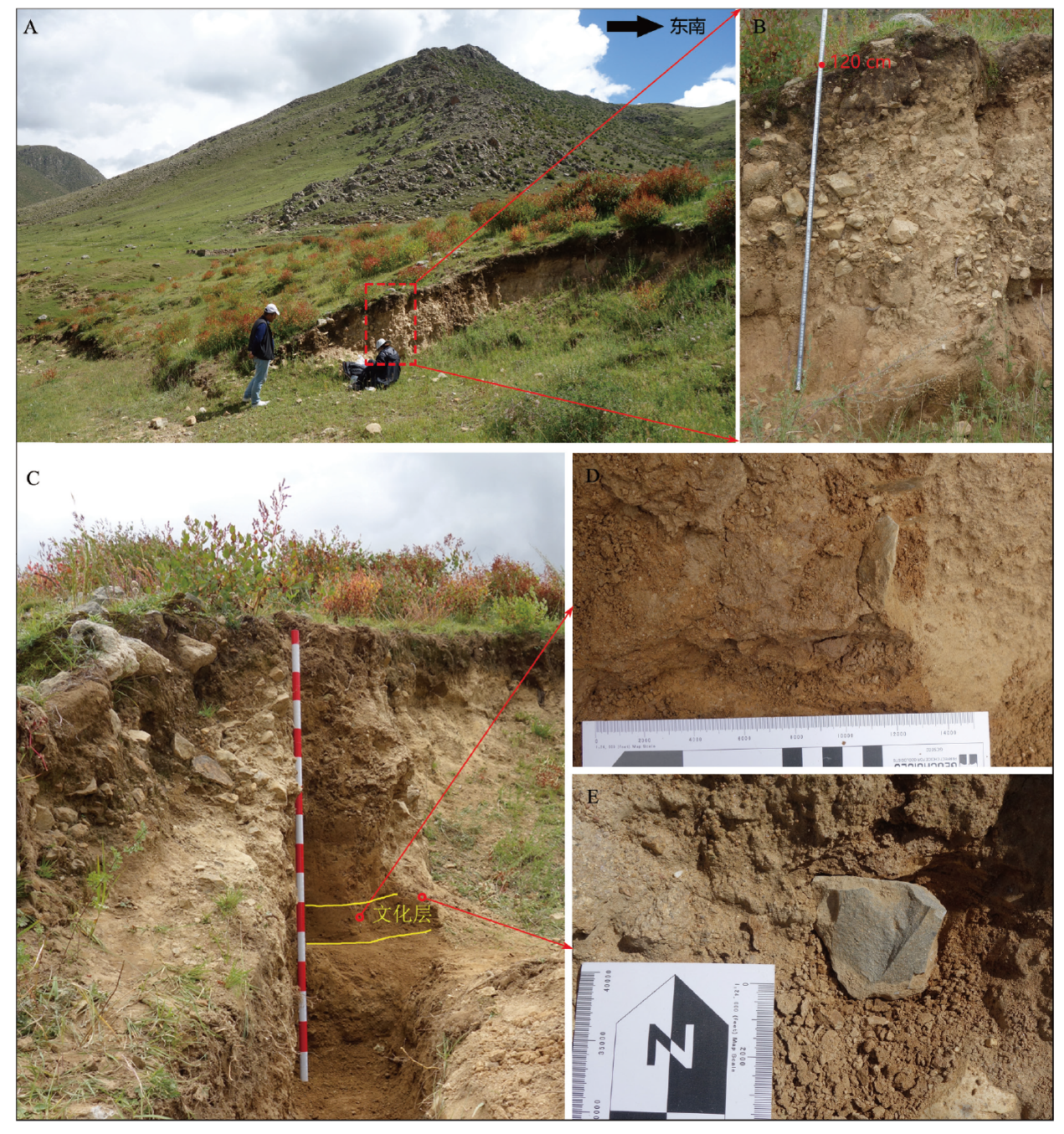
图2 尚嘎岗遗址及地层剖面 A.尚嘎岗遗址Shanggagang site;B.发现时遗址剖面The original stratigraphic profile of the site;C.清理后剖面The stratigraphic profile after cleaning;D, E.地层中发现的完整石片The whole flakes discovered from the profile
Fig.2 The Shanggagang site and its stratigraphic profile
| 编号No. | 类型Type | 原料Raw materials | 原型Blank | 长宽厚 L-W-T(mm) | 质量Mass, m(g) | 台面数Platform n | 台面性质Platform type | 台面角(°) Platform angle | 剥片面数量flaking surface n | 片疤数Scars n | 自然面比Cortex percent |
|---|---|---|---|---|---|---|---|---|---|---|---|
| 21SKG-01 | 盘状石核 | 砂岩 | 砾石 | 63×50×30 | 99 | 4 | 自/人 | 60°-85° | 1 | 7 | 40% |
| 21SKG-02 | 多面体石核 | 火成岩 | 砾石 | 69×51×33 | 133 | 4 | 自/人 | 80°-115° | 1 | 6 | 15% |
| 21SKG-04 | 砸击石核 | 花岗岩 | 岩块 | 38×20×15 | 15 | 2 | 自/人 | 90°-100° | 2 | 4 | 5% |
| 21SKG-C01 | 多面体石核 | 火成岩 | 砾石 | 59×56×36 | 111 | 3 | 自/人 | 45°-90° | 2 | 6 | 50% |
| 22SKG-C01 | 盘状石核 | 火成岩 | 岩块 | 96×84×40 | 344 | 2 | 自/人 | 40°-90° | 2 | 19 | 10% |
| 22SKG-C02 | 盘状石核 | 火成岩 | 岩块 | 67×58×29 | 145 | 2 | 人 | 60°-80° | 2 | 19 | 0% |
| 22SKG-C03 | 盘状石核 | 石英 | 岩块 | 53×50×30 | 79 | 2 | 人 | 60°-80° | 2 | 13 | 0% |
| 21QSS-01 | 多面体石核 | 火成岩 | 砾石 | 83×70×61 | 368 | 4 | 自/人 | 105°-110° | 4 | 12 | 15% |
| 21GJC-C03 | 盘状石核 | 砂岩 | 砾石 | 106×104×54 | 677 | 1 | 自然 | 60°-70° | 4 | 6 | 65% |
| 22AG2-C01 | 多面体石核 | 燧石 | 岩块 | 89×64×53 | 296 | 3 | 人工 | 80°-110° | 3 | 11 | 60% |
| 22TG1-C02 | 砸击石核 | 石英 | 岩块 | 45×22×22 | 26 | 3 | \ | \ | 3 | 4 | 5% |
| 22TG2-C01 | 盘状石核 | 火成岩 | 砾石 | 125×121×50 | 1122 | 2 | 自然 | 70°-90° | 2 | 20 | 70% |
表2 调查新发现石核信息统计表
Tab.2 A summary of cores from new localities
| 编号No. | 类型Type | 原料Raw materials | 原型Blank | 长宽厚 L-W-T(mm) | 质量Mass, m(g) | 台面数Platform n | 台面性质Platform type | 台面角(°) Platform angle | 剥片面数量flaking surface n | 片疤数Scars n | 自然面比Cortex percent |
|---|---|---|---|---|---|---|---|---|---|---|---|
| 21SKG-01 | 盘状石核 | 砂岩 | 砾石 | 63×50×30 | 99 | 4 | 自/人 | 60°-85° | 1 | 7 | 40% |
| 21SKG-02 | 多面体石核 | 火成岩 | 砾石 | 69×51×33 | 133 | 4 | 自/人 | 80°-115° | 1 | 6 | 15% |
| 21SKG-04 | 砸击石核 | 花岗岩 | 岩块 | 38×20×15 | 15 | 2 | 自/人 | 90°-100° | 2 | 4 | 5% |
| 21SKG-C01 | 多面体石核 | 火成岩 | 砾石 | 59×56×36 | 111 | 3 | 自/人 | 45°-90° | 2 | 6 | 50% |
| 22SKG-C01 | 盘状石核 | 火成岩 | 岩块 | 96×84×40 | 344 | 2 | 自/人 | 40°-90° | 2 | 19 | 10% |
| 22SKG-C02 | 盘状石核 | 火成岩 | 岩块 | 67×58×29 | 145 | 2 | 人 | 60°-80° | 2 | 19 | 0% |
| 22SKG-C03 | 盘状石核 | 石英 | 岩块 | 53×50×30 | 79 | 2 | 人 | 60°-80° | 2 | 13 | 0% |
| 21QSS-01 | 多面体石核 | 火成岩 | 砾石 | 83×70×61 | 368 | 4 | 自/人 | 105°-110° | 4 | 12 | 15% |
| 21GJC-C03 | 盘状石核 | 砂岩 | 砾石 | 106×104×54 | 677 | 1 | 自然 | 60°-70° | 4 | 6 | 65% |
| 22AG2-C01 | 多面体石核 | 燧石 | 岩块 | 89×64×53 | 296 | 3 | 人工 | 80°-110° | 3 | 11 | 60% |
| 22TG1-C02 | 砸击石核 | 石英 | 岩块 | 45×22×22 | 26 | 3 | \ | \ | 3 | 4 | 5% |
| 22TG2-C01 | 盘状石核 | 火成岩 | 砾石 | 125×121×50 | 1122 | 2 | 自然 | 70°-90° | 2 | 20 | 70% |
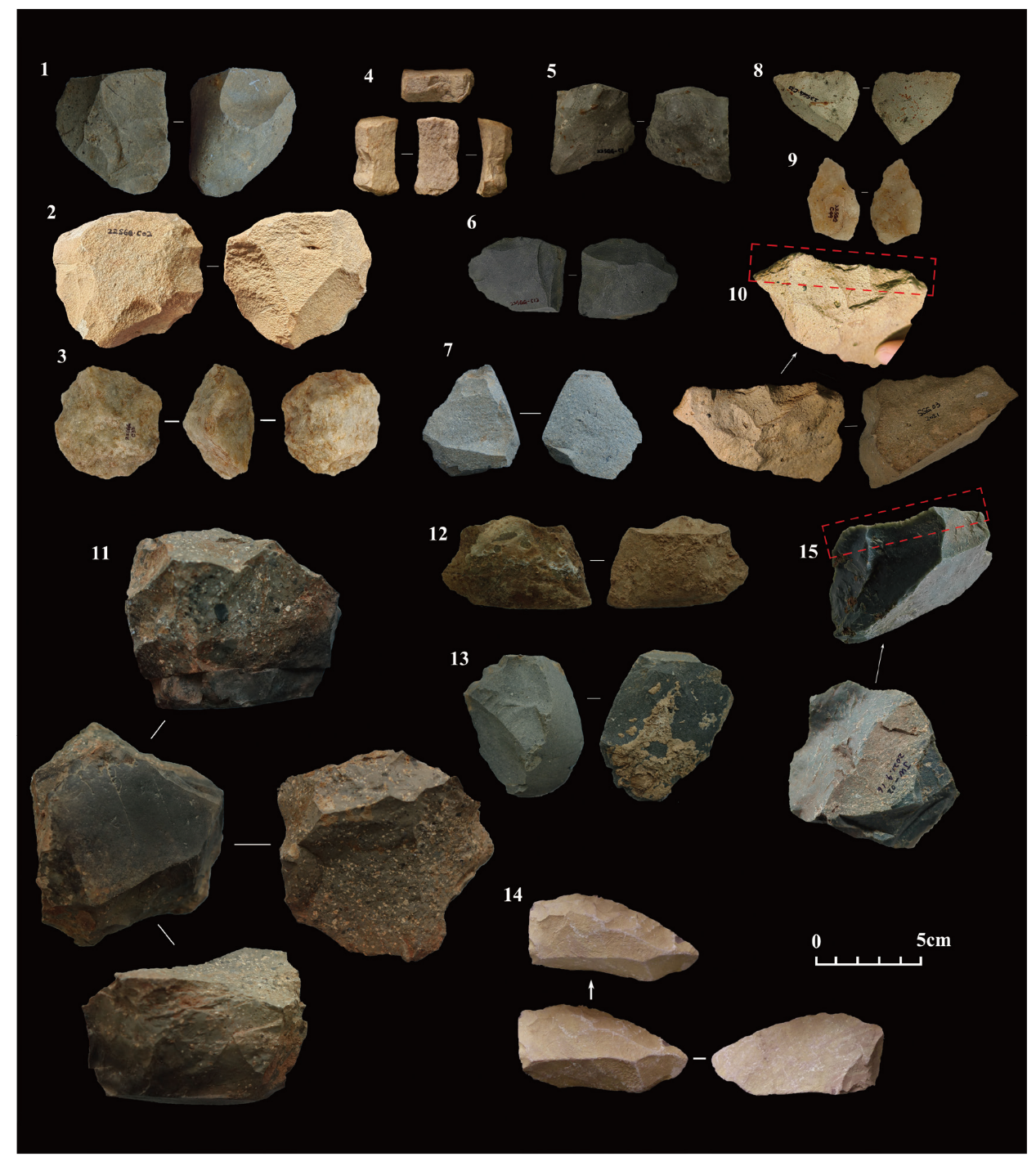
图3 尚嘎岗、邱桑寺及加乌遗址发现的部分石制品 1-3.盘状石核Discoid cores,21SKG-01, 22SKG-C02, 22SKG-C33;4.砸击石核Bipolar core,21SKG-04;5-7.完整石片Whole flakes,22SKG-C07, 22SKG-C12, 21SKG-07;8, 10.刮削器Scrapers,22SKG-C32, 21SKG-03;9.尖状器Point,22SKG-C44;11.多面体石核Polyhedron core,21QSS-01;12, 13.完整石片Whole flakes,21QSS-02, 21QSS-03;14.刮削器Scraper,21JW-01;15.石核断块Core chunk,21JW-02。 1-10为尚嘎岗遗址石制品,其中1、4、7、10为地层中发现,其余为地表采集 / No. 1-10 artifacts were from the Shanggagang site, No. 1, 4, 7, 10 came from the original context, and the others collected from the surface;11-13为邱桑寺遗址石制品,均出自地层中 / No. 11-13 artifacts were from the Qiusangsi site original context;14-15为加乌遗址石制品,其中14发地层中发现,15为地表采集 /No. 14-15 artifacts were from the Jiawu site, No. 14 came from the original context, and No. 15 collected from the surface。 注:红色虚线区域疑似使用痕迹,Suspected use wear in the red area
Fig.3 Some stone artifacts of Shanggagang site, Qiusangsi site and Jiawu site
| 编号No. | 类型Type | 原料Raw material | 远端形状Distal feature | 长宽厚 L-W-T(mm) | 质量Mass (g) | 台面性质Platform type | 台面尺寸Platform size (mm) | 背面自然面比Cortex percent of dorsal surface | 背面片疤数Scar numbers of dorsal surface | 疤向Scar direction | 石片角Flake angle |
|---|---|---|---|---|---|---|---|---|---|---|---|
| 21SKG-06 | VI | 石英 | 羽状 | 31×45×18 | 40 | 人工 | 44×18 | 0 | 3 | ↓→ | 100° |
| 21SKG-07 | V | 火成岩 | 羽状 | 80×51×19 | 60 | 人工 | 23×1 | 45 | 4 | ↓ | 100° |
| 21SKG-08 | III | 砂岩 | 羽状 | 50×30×13 | 26 | 自然 | 34×12 | 0 | 1 | ↓ | 110° |
| 21SKG-C02 | VI | 石英 | 羽状 | 26×31×8 | 9 | 人工 | 23×8 | 0 | 2 | ↓→ | 100° |
| 21SKG-C03 | VI | 火成岩 | 羽状 | 39×37×8 | 13 | 人工 | 26×7 | 0 | 1 | ↓ | 115° |
| 21SKG-C04 | VI | 火成岩 | 羽状 | 42×54×9 | 20 | 人工 | 20×6 | 0 | 3 | ↓ | 115° |
| 21SKG-C05 | 砸击 | 石英 | 羽状 | 21×21×14 | 7 | 人工 | / | 10 | 1 | ↓ | 100° |
| 21SKG-C06 | V | 火山玻璃 | 羽状 | 39×39×11 | 18 | 人工 | 20×1 | 15 | 5 | ↓ | 100° |
| 22SGG-C01 | III | 燧石 | 羽状 | 42×57×11 | 28 | 人工 | 27×9 | 100 | 0 | 140° | |
| 22SGG-C02 | V | 火成岩 | 羽状 | 56×67×20 | 104 | 人工 | 43×16 | 40 | 3 | ↓← | 120° |
| 22SGG-C03 | VI | 火成岩 | 羽状 | 42×34×12 | 17 | 人工 | 11×7 | 0 | 3 | ↓← | 100° |
| 22SGG-C04 | VI | 火成岩 | 羽状 | 30×37×10 | 17 | 人工 | 29×13 | 0 | 1 | ↓ | 135° |
| 22SGG-C05 | VI | 火成岩 | 羽状 | 50×43×13 | 28 | 人工 | 22×8 | 0 | 6 | ↓← | 120° |
| 22SGG-C06 | VI | 火成岩 | 羽状 | 27×42×8 | 11 | 人工 | 14×8 | 0 | 2 | ↓ | 120° |
| 22SGG-C07 | V | 燧石 | 羽状 | 48×40×11 | 21 | 人工 | 16×11 | 3 | 4 | ↓↘ | 115° |
| 22SGG-C08 | III | 火成岩 | 羽状 | 38×47×10 | 22 | 自然 | 23×11 | 0 | 2 | ↓ | 125° |
| 22SGG-C10 | VI | 火成岩 | 羽状 | 18×38×7 | 7 | 人工 | 21×10 | 0 | 2 | ↙ | 135° |
| 22SGG-C12 | VI | 火成岩 | 羽状 | 25×44×12 | 24 | 人工 | 31×16 | 0 | 4 | ↓ | 128° |
| 22SGG-C13 | V | 火成岩 | 羽状 | 41×46×9 | 19 | 人/自 | 36×10 | 5 | 3 | ↙ | 100° |
| 22SGG-C14 | VI | 火成岩 | 羽状 | 46×28×15 | 20 | 人工 | 9×3 | 0 | 8 | ↓↑ | 80° |
| 22SGG-C16 | II | 燧石 | 羽状 | 47×45×14 | 20 | 自然 | 13×7 | 45 | 2 | ↓ | 110° |
| 22SGG-C18 | V | 燧石 | 羽状 | 39×39×15 | 18 | 人工 | 15×6 | 10 | 3 | ↙↘ | 105° |
| 22SGG-C19 | VI | 火成岩 | 羽状 | 39×46×10 | 17 | 人工 | 16×5 | 0 | 120° | ||
| 22SGG-C20 | VI | 燧石 | 羽状 | 45×41×13 | 22 | 人工 | 13×4 | 0 | 6 | ↓ | 125° |
| 22SGG-C23 | VI | 火成岩 | 羽状 | 56×56×21 | 87 | 人工 | 37×15 | 0 | 5 | ↙↘ | 120° |
| 22SGG-C27 | V | 火成岩 | 羽状 | 53×41×14 | 30 | 人工 | 36×12 | 5 | / | / | 80° |
| 22SGG-C31 | VI | 火成岩 | 羽状 | 39×32×11 | 13 | 人工 | 27×8 | 0 | 1 | ↓ | 89° |
| 21QSS-02 | VI | 火成岩 | 羽状 | 32×60×14 | 31 | 自然 | 40×12 | 0 | 2 | ↓ | 125° |
| 21QSS-03 | V | 火成岩 | 羽状 | 55×46×18 | 55 | 自然 | 24×9 | 45 | 2 | ↓↘ | 125° |
| 21GJC-C01 | V | 砂岩 | 崩断 | 58×54×18 | 71 | 人工 | 35×13 | 45 | 2 | ↓ | 120° |
| 21BC-C01 | I | 火成岩 | 羽状 | 73×51×15 | 55 | 自然 | 30×10 | 100 | / | / | 90° |
| 21YZ-C01 | II | 砂岩 | 羽状 | 72×144×20 | 322 | 自然 | 82×26 | 80 | 1 | ↓ | 125° |
| 21GR-C01 | III | 花岗岩 | 羽状 | 70×113×30 | 275 | 自然 | 67×40 | 0 | 1 | ↓ | 115° |
| 22LBG-C01 | VI | 火成岩 | 羽状 | 45×39×14 | 28 | 人工 | 34×14 | 0 | 2 | ↓ | 110° |
| 22LBG-C03 | VI | 燧石 | 羽状 | 54×25×9 | 15 | 人工 | 16×6 | 0 | 4 | ↓↗↖ | 100° |
| 22AG1-C01 | VI | 火成岩 | 羽状 | 33×64×30 | 45 | 人工 | 28×12 | 0 | 1 | ↓ | 140° |
| 22BP-C01 | II | 火成岩 | 羽状 | 93×65×37 | 272 | 人工 | 57×7 | 90 | 2 | ↓ | 110° |
| 22TG1-C01 | II | 燧石 | 羽状 | 32×19×11 | 5 | 人工 | 6×2 | 40 | 3 | ↓ | \ |
| 22TG1-C03 | II | 火成岩 | 羽状 | 54×77×24 | 108 | 人工 | 40×13 | 35 | 3 | ↓ | 115° |
| 22TG2-C02 | II | 火成岩 | 羽状 | 46×34×12 | 21 | 人工 | 7×3 | 60 | 4 | ↓ | 100° |
表3 调查新发现完整石片信息统计表
Tab.3 A summary of whole flakes from new localities
| 编号No. | 类型Type | 原料Raw material | 远端形状Distal feature | 长宽厚 L-W-T(mm) | 质量Mass (g) | 台面性质Platform type | 台面尺寸Platform size (mm) | 背面自然面比Cortex percent of dorsal surface | 背面片疤数Scar numbers of dorsal surface | 疤向Scar direction | 石片角Flake angle |
|---|---|---|---|---|---|---|---|---|---|---|---|
| 21SKG-06 | VI | 石英 | 羽状 | 31×45×18 | 40 | 人工 | 44×18 | 0 | 3 | ↓→ | 100° |
| 21SKG-07 | V | 火成岩 | 羽状 | 80×51×19 | 60 | 人工 | 23×1 | 45 | 4 | ↓ | 100° |
| 21SKG-08 | III | 砂岩 | 羽状 | 50×30×13 | 26 | 自然 | 34×12 | 0 | 1 | ↓ | 110° |
| 21SKG-C02 | VI | 石英 | 羽状 | 26×31×8 | 9 | 人工 | 23×8 | 0 | 2 | ↓→ | 100° |
| 21SKG-C03 | VI | 火成岩 | 羽状 | 39×37×8 | 13 | 人工 | 26×7 | 0 | 1 | ↓ | 115° |
| 21SKG-C04 | VI | 火成岩 | 羽状 | 42×54×9 | 20 | 人工 | 20×6 | 0 | 3 | ↓ | 115° |
| 21SKG-C05 | 砸击 | 石英 | 羽状 | 21×21×14 | 7 | 人工 | / | 10 | 1 | ↓ | 100° |
| 21SKG-C06 | V | 火山玻璃 | 羽状 | 39×39×11 | 18 | 人工 | 20×1 | 15 | 5 | ↓ | 100° |
| 22SGG-C01 | III | 燧石 | 羽状 | 42×57×11 | 28 | 人工 | 27×9 | 100 | 0 | 140° | |
| 22SGG-C02 | V | 火成岩 | 羽状 | 56×67×20 | 104 | 人工 | 43×16 | 40 | 3 | ↓← | 120° |
| 22SGG-C03 | VI | 火成岩 | 羽状 | 42×34×12 | 17 | 人工 | 11×7 | 0 | 3 | ↓← | 100° |
| 22SGG-C04 | VI | 火成岩 | 羽状 | 30×37×10 | 17 | 人工 | 29×13 | 0 | 1 | ↓ | 135° |
| 22SGG-C05 | VI | 火成岩 | 羽状 | 50×43×13 | 28 | 人工 | 22×8 | 0 | 6 | ↓← | 120° |
| 22SGG-C06 | VI | 火成岩 | 羽状 | 27×42×8 | 11 | 人工 | 14×8 | 0 | 2 | ↓ | 120° |
| 22SGG-C07 | V | 燧石 | 羽状 | 48×40×11 | 21 | 人工 | 16×11 | 3 | 4 | ↓↘ | 115° |
| 22SGG-C08 | III | 火成岩 | 羽状 | 38×47×10 | 22 | 自然 | 23×11 | 0 | 2 | ↓ | 125° |
| 22SGG-C10 | VI | 火成岩 | 羽状 | 18×38×7 | 7 | 人工 | 21×10 | 0 | 2 | ↙ | 135° |
| 22SGG-C12 | VI | 火成岩 | 羽状 | 25×44×12 | 24 | 人工 | 31×16 | 0 | 4 | ↓ | 128° |
| 22SGG-C13 | V | 火成岩 | 羽状 | 41×46×9 | 19 | 人/自 | 36×10 | 5 | 3 | ↙ | 100° |
| 22SGG-C14 | VI | 火成岩 | 羽状 | 46×28×15 | 20 | 人工 | 9×3 | 0 | 8 | ↓↑ | 80° |
| 22SGG-C16 | II | 燧石 | 羽状 | 47×45×14 | 20 | 自然 | 13×7 | 45 | 2 | ↓ | 110° |
| 22SGG-C18 | V | 燧石 | 羽状 | 39×39×15 | 18 | 人工 | 15×6 | 10 | 3 | ↙↘ | 105° |
| 22SGG-C19 | VI | 火成岩 | 羽状 | 39×46×10 | 17 | 人工 | 16×5 | 0 | 120° | ||
| 22SGG-C20 | VI | 燧石 | 羽状 | 45×41×13 | 22 | 人工 | 13×4 | 0 | 6 | ↓ | 125° |
| 22SGG-C23 | VI | 火成岩 | 羽状 | 56×56×21 | 87 | 人工 | 37×15 | 0 | 5 | ↙↘ | 120° |
| 22SGG-C27 | V | 火成岩 | 羽状 | 53×41×14 | 30 | 人工 | 36×12 | 5 | / | / | 80° |
| 22SGG-C31 | VI | 火成岩 | 羽状 | 39×32×11 | 13 | 人工 | 27×8 | 0 | 1 | ↓ | 89° |
| 21QSS-02 | VI | 火成岩 | 羽状 | 32×60×14 | 31 | 自然 | 40×12 | 0 | 2 | ↓ | 125° |
| 21QSS-03 | V | 火成岩 | 羽状 | 55×46×18 | 55 | 自然 | 24×9 | 45 | 2 | ↓↘ | 125° |
| 21GJC-C01 | V | 砂岩 | 崩断 | 58×54×18 | 71 | 人工 | 35×13 | 45 | 2 | ↓ | 120° |
| 21BC-C01 | I | 火成岩 | 羽状 | 73×51×15 | 55 | 自然 | 30×10 | 100 | / | / | 90° |
| 21YZ-C01 | II | 砂岩 | 羽状 | 72×144×20 | 322 | 自然 | 82×26 | 80 | 1 | ↓ | 125° |
| 21GR-C01 | III | 花岗岩 | 羽状 | 70×113×30 | 275 | 自然 | 67×40 | 0 | 1 | ↓ | 115° |
| 22LBG-C01 | VI | 火成岩 | 羽状 | 45×39×14 | 28 | 人工 | 34×14 | 0 | 2 | ↓ | 110° |
| 22LBG-C03 | VI | 燧石 | 羽状 | 54×25×9 | 15 | 人工 | 16×6 | 0 | 4 | ↓↗↖ | 100° |
| 22AG1-C01 | VI | 火成岩 | 羽状 | 33×64×30 | 45 | 人工 | 28×12 | 0 | 1 | ↓ | 140° |
| 22BP-C01 | II | 火成岩 | 羽状 | 93×65×37 | 272 | 人工 | 57×7 | 90 | 2 | ↓ | 110° |
| 22TG1-C01 | II | 燧石 | 羽状 | 32×19×11 | 5 | 人工 | 6×2 | 40 | 3 | ↓ | \ |
| 22TG1-C03 | II | 火成岩 | 羽状 | 54×77×24 | 108 | 人工 | 40×13 | 35 | 3 | ↓ | 115° |
| 22TG2-C02 | II | 火成岩 | 羽状 | 46×34×12 | 21 | 人工 | 7×3 | 60 | 4 | ↓ | 100° |
| 编号No. | 类型Type | 原料Raw material | 原型Blank | 长宽厚 L-W-T (mm) | 质量Mass (g) | 修理部位Retouched position | 修理方式Retouched mode | 刃缘数量Retouched edge number | 刃缘长(mm)Retouched edge length | 疤间关系Scar relationship | 刃角/尖角Edge / Point angel |
|---|---|---|---|---|---|---|---|---|---|---|---|
| 21 SKG-03 | 刮削器 | 火成岩 | 石核 | 77×46×23 | 78 | 两边 | 单向 | 2 | 68 | 叠压 | 40° |
| 21 SKG-05 | 刮削器 | 火成岩 | V型石片 | 47×46×20 | 50 | 左侧 | 正向 | 2 | 59 | 连续 | 45° |
| 21SKG-C06 | 刮削器 | 火成岩 | V型石片 | 39×39×11 | 18 | 左侧 | 复向 | 2 | 43 | 连续 | 50° |
| 21SKG-C07 | 刮削器 | 燧石 | 碎片 | 14×13×6 | 1 | 两侧 | 双向 | 2 | 22 | 连续 | 45° |
| 22SKG-C09 | 刮削器 | 火成岩 | VI型石片 | 68×58×16 | 45 | 底边 | 复向 | 2 | 57 | 连续 | 50° |
| 22SKG-C11 | 刮削器 | 火成岩 | VI型石片 | 26×21×8 | 6 | 单边 | 复向 | 1 | 26 | 连续 | 45° |
| 22SKG-C15 | 刮削器 | 燧石 | VI型石片 | 64×36×14 | 34 | 右侧 | 复向 | 1 | 46 | 间断 | 40° |
| 22SKG-C17 | 刮削器 | 燧石 | VI型石片 | 40×45×20 | 36 | 左右两侧 | 复向 | 3 | 81 | 连续 | 60° |
| 22SKG-C26 | 刮削器 | 火成岩 | 碎片 | 62×51×13 | 36 | 三边 | 双向 | 3 | 114 | 连续 | 80° |
| 22SKG-C29 | 刮削器 | 火成岩 | 碎片 | 62×51×13 | 36 | 单边 | 单向 | 1 | 16 | 连续 | 10° |
| 22SKG-C32 | 刮削器 | 火成岩 | III型石片 | 51×30×14 | 22 | 左侧 | 正向 | 1 | 46 | 连续 | 40° |
| 22SKG-C44 | 尖状器 | 石英 | 碎片 | 39×29×12 | 12 | 尖部 | 单向 | 2 | 35 | 连续 | 60° |
| 21JW-01 | 刮削器 | 砂岩 | VI型石片 | 83×41×21 | 80 | 四边 | 复向 | 4 | 167 | 连续 | 80° |
| 21GJC-C02 | 刮削器 | 砂岩 | 石核 | 95×77×28 | 225 | 三边 | 双向 | 3 | 251 | 连续 | 65° |
| 22BP-C02 | 刮削器 | 火成岩 | VI型石片 | 141×85×41 | 527 | 左右侧 | 复向 | 3 | 175 | 连续 | 55° |
表4 调查新发现石器信息统计表
Tab.4 A summary of tools from new localities
| 编号No. | 类型Type | 原料Raw material | 原型Blank | 长宽厚 L-W-T (mm) | 质量Mass (g) | 修理部位Retouched position | 修理方式Retouched mode | 刃缘数量Retouched edge number | 刃缘长(mm)Retouched edge length | 疤间关系Scar relationship | 刃角/尖角Edge / Point angel |
|---|---|---|---|---|---|---|---|---|---|---|---|
| 21 SKG-03 | 刮削器 | 火成岩 | 石核 | 77×46×23 | 78 | 两边 | 单向 | 2 | 68 | 叠压 | 40° |
| 21 SKG-05 | 刮削器 | 火成岩 | V型石片 | 47×46×20 | 50 | 左侧 | 正向 | 2 | 59 | 连续 | 45° |
| 21SKG-C06 | 刮削器 | 火成岩 | V型石片 | 39×39×11 | 18 | 左侧 | 复向 | 2 | 43 | 连续 | 50° |
| 21SKG-C07 | 刮削器 | 燧石 | 碎片 | 14×13×6 | 1 | 两侧 | 双向 | 2 | 22 | 连续 | 45° |
| 22SKG-C09 | 刮削器 | 火成岩 | VI型石片 | 68×58×16 | 45 | 底边 | 复向 | 2 | 57 | 连续 | 50° |
| 22SKG-C11 | 刮削器 | 火成岩 | VI型石片 | 26×21×8 | 6 | 单边 | 复向 | 1 | 26 | 连续 | 45° |
| 22SKG-C15 | 刮削器 | 燧石 | VI型石片 | 64×36×14 | 34 | 右侧 | 复向 | 1 | 46 | 间断 | 40° |
| 22SKG-C17 | 刮削器 | 燧石 | VI型石片 | 40×45×20 | 36 | 左右两侧 | 复向 | 3 | 81 | 连续 | 60° |
| 22SKG-C26 | 刮削器 | 火成岩 | 碎片 | 62×51×13 | 36 | 三边 | 双向 | 3 | 114 | 连续 | 80° |
| 22SKG-C29 | 刮削器 | 火成岩 | 碎片 | 62×51×13 | 36 | 单边 | 单向 | 1 | 16 | 连续 | 10° |
| 22SKG-C32 | 刮削器 | 火成岩 | III型石片 | 51×30×14 | 22 | 左侧 | 正向 | 1 | 46 | 连续 | 40° |
| 22SKG-C44 | 尖状器 | 石英 | 碎片 | 39×29×12 | 12 | 尖部 | 单向 | 2 | 35 | 连续 | 60° |
| 21JW-01 | 刮削器 | 砂岩 | VI型石片 | 83×41×21 | 80 | 四边 | 复向 | 4 | 167 | 连续 | 80° |
| 21GJC-C02 | 刮削器 | 砂岩 | 石核 | 95×77×28 | 225 | 三边 | 双向 | 3 | 251 | 连续 | 65° |
| 22BP-C02 | 刮削器 | 火成岩 | VI型石片 | 141×85×41 | 527 | 左右侧 | 复向 | 3 | 175 | 连续 | 55° |

图4 邱桑寺遗址与地层剖面 A.邱桑寺遗址Qiusangsi site;B, C.石制品所在剖面The original stratigraphic profiles of the discovered stone artifacts
Fig.4 The Qiusangsi site and its stratigraphic profile
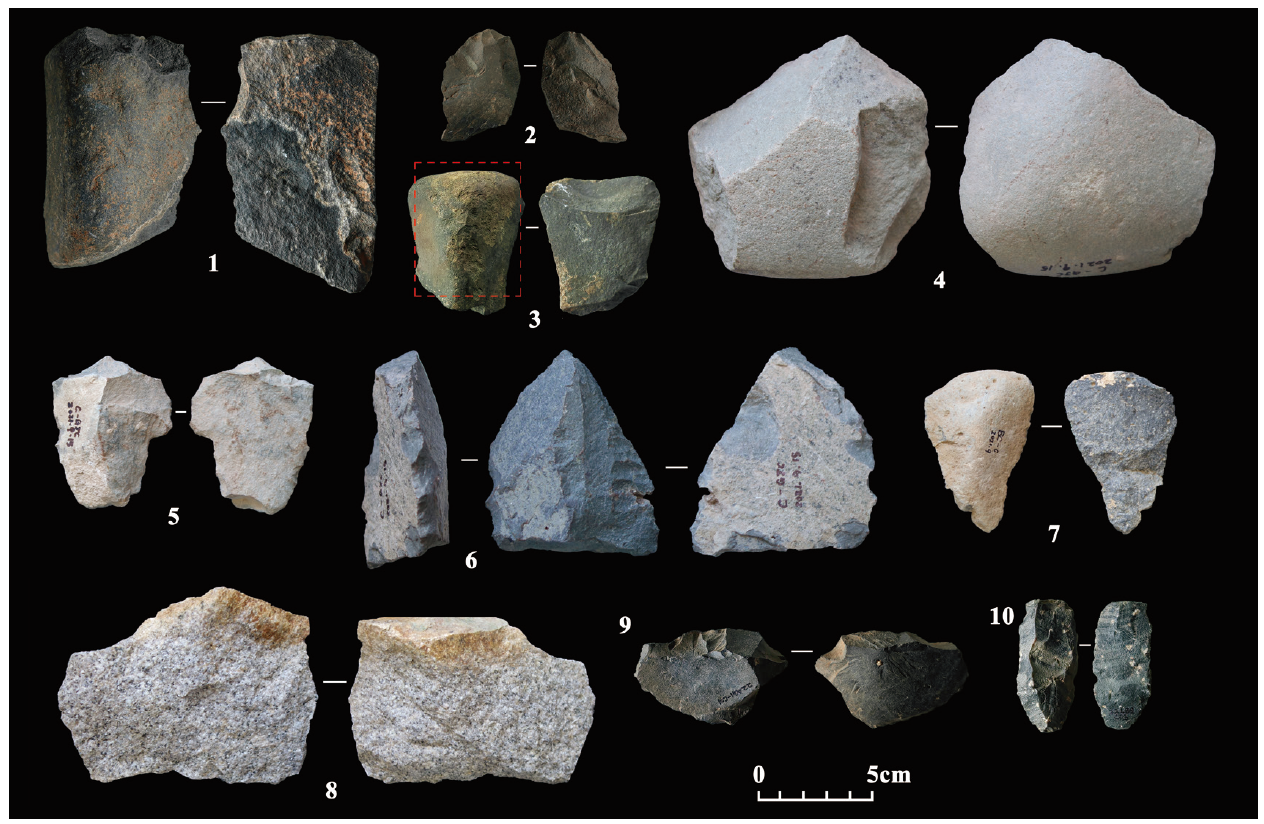
图5 地表采集点发现的部分石制品 1-2, 5, 7-10.完整石片Whole flakes,22BP-C01, 22TG2-C03, 21GJC-C01, 21BC-C01, 21GR-C01, 22AG1-C01, 22LBG-C03;3.石锤碎片Hammer fragment,22TG2-C03;4.盘状石核Discoid core,21GJC-C03;6.刮削器Scraper,21GJC-C02。 注:红色虚线区域为锤击痕迹Hammer usewear in the red area
Fig.5 Some stone artifacts from the collected sites
| [1] | Brantingham PJ, Gao X, Olsen JW, et al. A short chronology for the peopling of the Tibetan Plateau[J]. Developments in Quaternary Science, 2007, 9: 129-150 |
| [2] |
Brantingham PJ, Rhode D, Madsen DB. Archaeology Augments Tibet's Genetic History[J]. Science, 2010, 329(5998): 1467-1467
doi: 10.1126/science.329.5998.1467-a pmid: 20847252 |
| [3] |
Chen FH, Dong GH, Zhang DJ, et al. Agriculture facilitated permanent human occupation of the Tibetan Plateau after 3600 B.P[J]. Science, 2015, 347: 248-250
doi: 10.1126/science.1259172 pmid: 25593179 |
| [4] |
Chen FH, Welker F, Shen CC, et al. A late middle Pleistocene Denisovan mandible from the Tibetan Plateau[J]. Nature, 2019, 569: 409-412
doi: 10.1038/s41586-019-1139-x |
| [5] |
d’Alpoim Guedes J, Lu H, Li Y, et al. Moving agriculture onto the Tibetan plateau: the archaeobotanical evidence[J]. Archaeological and Anthropological Sciences, 2014, 6(3): 255-269
doi: 10.1007/s12520-013-0153-4 URL |
| [6] | 张东菊, 董广辉, 王辉, 等. 史前人类向青藏高原扩散的历史过程和可能驱动机制[J]. 中国科学:地球科学, 2016, 46(08): 1007-1023 |
| [7] |
Meyer MC, Aldenderfer MS, Wang Z, et al. Permanent human occupation of the central Tibetan Plateau in the early Holocene[J]. Science, 2017, 355: 64-67
doi: 10.1126/science.aag0357 pmid: 28059763 |
| [8] |
Zhang XL, Ha BB, Wang SJ, et al. The earliest human occupation of the high-altitude Tibetan Plateau 40 thousand to 30 thousand years ago[J]. Science, 2018, 362: 1049-1051
doi: 10.1126/science.aat8824 pmid: 30498126 |
| [9] |
Zhang DJ, Xia H, Chen FH, et al. Denisovan DNA in late Pleistocene sediments from Baishiya Karst Cave on the Tibetan plateau[J]. Science, 2020, 370(6516): 584-587
doi: 10.1126/science.abb6320 pmid: 33122381 |
| [10] |
Zhang DD, Bennett MR, Cheng H, et al. Earliest parietal art: Hominin hand and foot traces from the middle Pleistocene of Tibet[J]. Science Bulletin, 2021, 66(24): 2506-2515
doi: 10.1016/j.scib.2021.09.001 pmid: 36654210 |
| [11] | 张森水. 西藏定日新发现旧石器[A].见:珠穆朗玛峰地区科学考察报告•第四纪地质[C].北京: 科学出版社, 1976, 105-109 |
| [12] | 刘泽纯, 王富葆, 蒋赞初, 等. 西藏高原多格则与扎布地点的旧石器——兼论高原古环境对石器文化分布的影响[J]. 考古, 1986, 4: 289-299 |
| [13] | 胡东生, 王世和. 青藏高原可可西里地区发现的旧石器[J]. 科学通报, 1994, 39(10): 924-927 |
| [14] | 袁宝印, 黄慰文, 章典. 藏北高原晚更新世人类活动的新证据[J]. 科学通报, 2007, 13: 1567-1571 |
| [15] |
Madsen DB, Ma H, Brantingham PJ, et al. The late Upper Paleolithic occupation of the northern Tibetan Plateau margin[J]. Journal of Archaeological Science, 2006, 33(10): 1433-1444
doi: 10.1016/j.jas.2006.01.017 URL |
| [16] |
Madsen DB, Perreault C, Rhode D, et al. Early foraging settlement of the Tibetan Plateau highlands[J]. Archaeological Research in Asia, 2017, 11: 15-26
doi: 10.1016/j.ara.2017.04.003 URL |
| [17] |
Brantingham P J, Gao X. Peopling of the northern Tibetan Plateau[J]. World Archaeology, 2006, 38(3): 387-414
doi: 10.1080/00438240600813301 URL |
| [18] | 高星, 周振宇, 关莹. 青藏高原边缘地区晚更新世人类遗存与生存模式[J]. 第四纪研究, 2008, 28(6): 969-977 |
| [19] |
Rhode D, Brantingham PJ, Perreault C, et al. Mind the gaps: testing for hiatuses in regional radiocarbon date sequences[J]. Journal of Archaeological Science, 2014, 52: 567-577
doi: 10.1016/j.jas.2014.02.022 URL |
| [20] | 仪明洁, 高星, 张晓凌, 等. 青藏高原边缘地区史前遗址2009年调查试掘报告[J]. 人类学学报, 2011, 30: 124-136 |
| [21] |
侯光良, 曹广超, 鄂崇毅, 等. 青藏高原海拔4000m区域人类活动的新证据[J]. 地理学报, 2016, 71(7): 1231-1240
doi: 10.11821/dlxb201607011 |
| [22] | 郑喆轩, 冯玥, 谭培阳, 等. 四川稻城县皮洛旧石器时代遗址[J]. 考古, 2022, 7: 3-14+2. |
| [23] | Zhang DD, Li SH. Optical dating of Tibetan human hand and footprints: An implication for the palaeoenvironment of the last glaciation of the Tibetan Plateau[J]. Geophysical Research Letters, 2002, 29: 16-1-16-3. |
| [24] | 汤惠生, 夏格旺堆, 吕红亮. 西藏邱桑手脚印遗迹及相关问题[J]. 河北师范大学学报(哲学社会科学版), 2022, 45(5): 77-85 |
| [25] |
Tang HS, Xiage WD, Yin J, et al. The hand and footprints at Qiusang in Tibet: Recommendations for dating rock art by U-Th[J]. Journal of Archaeological Science, 2024, 161: 105899
doi: 10.1016/j.jas.2023.105899 URL |
| [1] | 郭晓明, 刘惜祯, 刘恒, 王春雪, 王法岗. 泥河湾盆地益堵泉旧石器时代晚期遗址2019年发掘简报[J]. 人类学学报, 2026, 45(03): 478-488. |
| [2] | 刘尔凡, 高佳璇, 牛东伟. 河北怀来盆地珠窝堡遗址出土的石制品[J]. 人类学学报, 2026, 45(03): 600-608. |
| [3] | 赵海龙, 周天路, 马冲, 杨博灿, 贾倩. 河北泥河湾盆地东缘石器原料的开发与利用[J]. 人类学学报, 2026, 45(01): 34-45. |
| [4] | 李三灵, 刘亚林, 赵文杰, 陈清懿, 李浩. 中国南方旧石器时代晚期石制品细小化现象初探[J]. 人类学学报, 2025, 44(06): 1034-1046. |
| [5] | 刘亚林, 魏天旭, 时萧, 王春雪, 孙雪峰, 邱宏亮. 2022年浙江安吉上白塘遗址发掘简报[J]. 人类学学报, 2025, 44(06): 1120-1130. |
| [6] | 张伟林, 颜茂都, 昝金波, 苗运法, 宋香锁, 张涛, 徐尊铂, 才让道吉, 阮齐军, 李浩. 元谋猿人遗址区域新生代地貌演化[J]. 人类学学报, 2025, 44(06): 952-966. |
| [7] | 裴树文, 董哲, 耿帅杰, 叶芷, 马东东, 张亚盟, 金泽田. 华龙洞遗址发现的石制品及人类行为[J]. 人类学学报, 2025, 44(05): 765-778. |
| [8] | 徐建炜, 刘连强, 成小雨, 赵永胜, 侯佳岐, 王法岗. 泥河湾盆地奶奶庙沟遗址2015年出土的石制品[J]. 人类学学报, 2025, 44(04): 556-567. |
| [9] | 李璇, 顾雪军. 2015~2018年河南栾川龙泉洞遗址发掘简报[J]. 人类学学报, 2025, 44(04): 714-726. |
| [10] | 谢光茂, 林强, 余明辉, 卢杰英. 广西隆安娅怀洞遗址发掘报告[J]. 人类学学报, 2025, 44(03): 365-388. |
| [11] | 邓婉文, 谢颖. 广西隆安娅怀洞遗址发现的小型石制品[J]. 人类学学报, 2025, 44(03): 413-426. |
| [12] | 郭云浩, 陈虹, 李大伟, 谢光茂, 薛理平. 广西娅怀洞遗址出土的玻璃陨石制品[J]. 人类学学报, 2025, 44(03): 451-465. |
| [13] | 李浩, 谢光茂, 李大伟, 李三灵, 肖培源, 陈清懿, 王雨晴, 贾真秀, 吴雁, 卢杰英. 广西娅怀洞遗址B区出土的旧石器[J]. 人类学学报, 2025, 44(03): 404-412. |
| [14] | 李燊, 任雪岩, 刘连强, 杨石霞, 岳健平, 王法岗. 泥河湾盆地半山遗址2003年出土的石制品[J]. 人类学学报, 2025, 44(02): 193-200. |
| [15] | 刘吉颖, 任海云, 杜水生. 山西下川富益河圪梁地点燧石制品的微痕分析[J]. 人类学学报, 2025, 44(02): 201-209. |
| 阅读次数 | ||||||
|
全文 |
|
|||||
|
摘要 |
|
|||||
 京ICP证05002819号-3