

主管:中国科学院
主办:中国科学院古脊椎动物与古人类研究所
出版:科学出版社
主办:中国科学院古脊椎动物与古人类研究所
出版:科学出版社
人类学学报 ›› 2026, Vol. 45 ›› Issue (05): 815-838.doi: 10.16359/j.1000-3193/AAS.2026.0061cstr: 32091.14.j.1000-3193/AAS.2026.0061
• 特邀文章 • 下一篇
BAE Christopher J1,2( ), 陈逸迎1
收稿日期:2026-01-19
修回日期:2026-04-21
出版日期:2026-10-15
发布日期:2026-10-16
作者简介:Bae Christopher J, Ph.D. Professor. E-mail: cjbae@hawaii.edu.cn
基金资助:
BAE Christopher J1,2(), CHEN Yiying1
Received:2026-01-19
Revised:2026-04-21
Online:2026-10-15
Published:2026-10-16
摘要:
伴随着中国地区古人类和旧石器遗址不断的新发现和新研究,中国地区人类演化的研究越来越引起世界学者的关注,目前东亚地区已成为探究人类演化的最重要区域。自20世纪初发现周口店遗址,中国古人类研究的历史已超过105年。目前,中国古人类学研究的科研团队已有多个,诸多重要的科学问题和假说被提出或解决。伴随国际媒体的报道,也出现许多争议,包括古人类何时抵达中国、谁是最早抵达中国的古人类、龙骨坡化石属于人还是猿、莫维斯线的争议、中更新世古人类的演化路径与多样性,以及现代人起源与扩散假说等。对中国早更新世遗址的研究,主要聚焦的问题是——最早的古人类及其文化。已有一些遗址的测年结果早于200万年,如西侯度遗址、上陈遗址等。这对“第一次出非洲说”的时间提出了挑战,若古人类在200万年前已经到达东亚,那么将改变我们对直立人最早出非洲的人属成员的认知。另一争议是重庆巫山龙骨坡遗址,早期研究指出该遗址发现古人类的下颌和牙齿,而后续研究表明这些化石更可能属于猿类。对于中更新世古人类的研究,主要聚焦在对距今30万年这一重要节点的古人类化石的分类上。此时,古人类呈现出更多不适合归属于直立人的进步特征。一些学者将这段时间出现的古人类化石归类为早期智人、古老型智人、海德堡人或者中更新世古人类。有学者提出,海德堡人和中更新世古人类是“垃圾桶分类”,应重新对这一时期的化石进行分类,尤其是关于丹尼索瓦人的归属问题,学界争论很大。在中国,新提出的人属物种有龙人(H. longi)和巨颅人(H. juluensis)。此外,马坝人和华龙洞人的归属仍未有定论。旧石器研究方面,在“莫维斯线”的合理性受到质疑的同时,东亚地区阿舍利和勒瓦娄哇技术的存在与否及其测年的可靠性也存有争议。晚更新世最重要的议题之一是现代人出现与扩散的时间。随着研究深入,单一起源和多地区起源假说均被证明存在漏洞,“同化假说(Assimilation Model)”被提出,中国地区古人类与旧石器研究是解决这一系列问题的重要一环。虽然大量报道指出在南方地区发现了早于十万年的现代人化石,但是由于南方多为洞穴遗址,地层非常复杂,这些遗址的测年数据饱受争议。北方地区的研究则集中于考古学遗物,包括石制品、骨制品等,特别是对“行为现代性”的研究。另外,近年来在青藏高原地区发现的遗址将人类适应并占据高海拔地区的时间提前到中更新世晚期,古DNA研究也为人类对高海拔地区的适应提供了新的视角。本文第一作者与多位中国古人类学者长期合作,发表了多篇聚焦中国古人类演化的文章,在回顾过去数十年中国古人类学研究进展的基础上,本文对国际学术界关注的中国地区人类演化的热点问题进行了综述和探讨。
中图分类号:
BAE Christopher J, 陈逸迎. 中国古人类学主要议题的探讨[J]. 人类学学报, 2026, 45(05): 815-838.
BAE Christopher J, CHEN Yiying. Discussion on the major topics in Chinese paleoanthropology[J]. Acta Anthropologica Sinica, 2026, 45(05): 815-838.
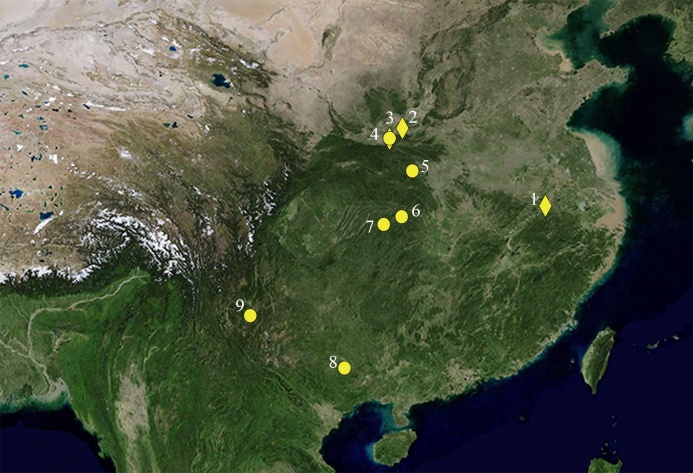
Fig.1 Early Pleistocene sites mentioned in the text 审图号:GS京(2026)2485号 Yellow circles indicate paleoanthropological sites. Yellow diamonds indicate archaeological sites.1. Renzidong;2. Xihoudu;3. Shangchen;4. Lantian/Gongwangling;5. Yunxian;6. Longgudong;7. Longgupo;8. Mohui Cave;9. Yuanmou.
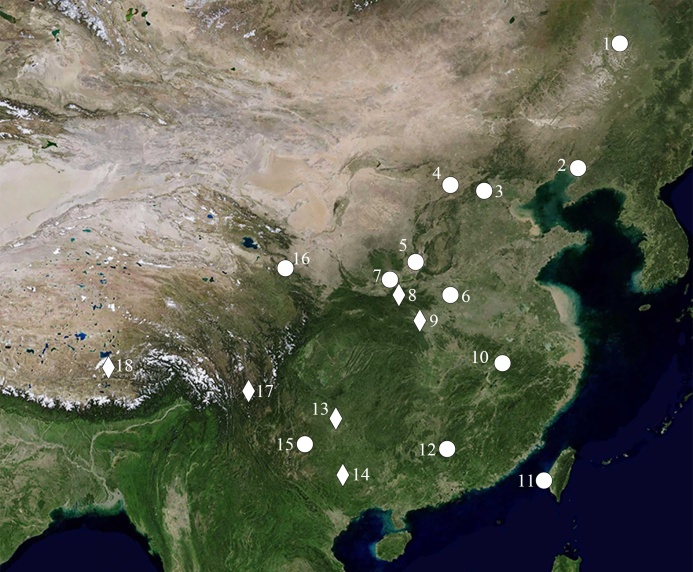
Fig.2 Middle to early Late Pleistocene sites mentioned in the text 审图号:GS京(2026)2485号 White circles indicate paleoanthropological sites. White diamonds indicate archaeological sites.1. Harbin; 2. Jinniushan;3. Zhoukoudian;4. Xujiayao-Houjiayao;5. Dingcun;6. Lingjing/Xuchang; 7. Dali;8. Luonan; 9. Danjiangkou;10. Hualong Cave;11. Penghu; 12. Maba;13. Guanyindong;14. Baise Basin;15. Panxian Dadong;16. Baishiya Karst Cave;17. Piluo;18. Qiusang Hot Spring.
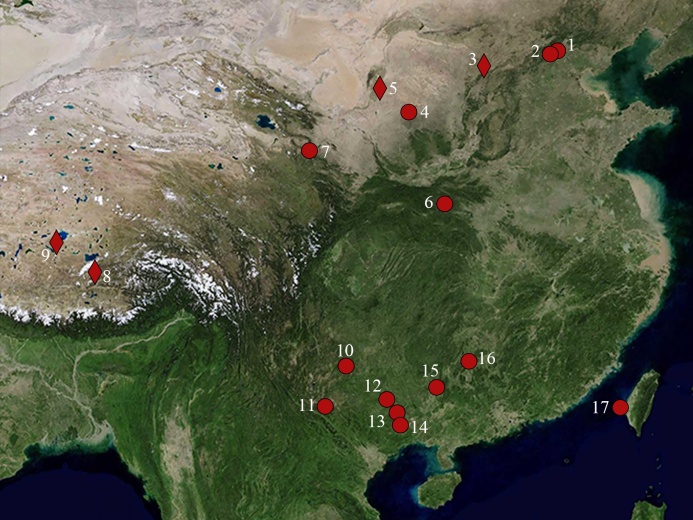
Fig.3 Late Pleistocene sites mentioned in the text 审图号:GS京(2026)2485号 Red circles indicate paleoanthropological sites. Red diamonds indicate archaeological sites.1. ZKD Upper Cave;2. Tianyuan Cave; 3. Shiyu; 4. Salawusu; 5. Shuidonggou; 6. Huanglong Cave;7. Baishiya Karst Cave;8. Qiusang Hot Spring;9. Nwya Devu;10. Panxian Dadong;11. Malu Cave; 12. Luna Cave;13. Yahuai Cave;14. Zhiren Cave; 15. Liujiang;16. Fuyan Cave; 17. Penghu.
| [1] | Dennell R. From Sangiran to Olduvai, 1937-1960:The quest for “Centres” of hominid origins in Asia and Africa[A]. In: Corbey R, Roebroeks W(Eds). Studying Human Origins: Disciplinary History and Epistemology[C]. Netherland: Amsterdam University Press, 2001, 45-66 |
| [2] | Bae CJ. The Paleoanthropology of Eastern Asia[M]. Honolulu: University of Hawai`i Press, 2024 |
| [3] | Cartmill M, Smith FH. The Human Lineage[M]. Hoboken, NJ, USA: John Wiley & Sons, 2022 |
| [4] |
Antón SC, Josh Snodgrass J. Origins and Evolution of Genus Homo: New Perspectives[J]. Current Anthropology, 2012, 53(S6): S479-S496
doi: 10.1086/667692 URL |
| [5] | Antón SC, Potts R, Aiello LC. Evolution of early Homo: An integrated biological perspective[J]. Science, 2014, 345(6192): 1236828 |
| [6] |
Antón SC, Middleton ER. Making meaning from fragmentary fossils: Early Homo in the Early to early Middle Pleistocene[J]. Journal of Human Evolution, 2023, 179: 103307
doi: 10.1016/j.jhevol.2022.103307 URL |
| [7] |
Bae CJ, Manthey C. Out of Africa I revisited: Life history, energetics, and the evolutionary capacity for early hominin dispersals[J]. Quaternary Science Reviews, 2025, 370: 109690
doi: 10.1016/j.quascirev.2025.109690 URL |
| [8] |
Baab KL, Kaifu Y, Freidline SE, et al. New reconstruction of DAN5 cranium (Gona, Ethiopia) supports complex emergence of Homo erectus[J]. Nature Communications, 2025, 16(1): 10878
doi: 10.1038/s41467-025-66381-9 |
| [9] | Nery V, Neves W, Valota L, et al. Testing the taxonomy of Dmanisi hominin fossils through dental crown area[J]. PLoS ONE, 2025, 20(12): e0336484 |
| [10] |
Antón SC, Carl C. Swisher III. Early Dispersals of Homo from Africa[J]. Annual Review of Anthropology, 2004, 33: 271-296
doi: 10.1146/anthro.2004.33.issue-1 URL |
| [11] |
Carotenuto F, Tsikaridze N, Rook L, et al. Venturing out safely: The biogeography of Homo erectus dispersal out of Africa[J]. Journal of Human Evolution, 2016, 95: 1-12
doi: 10.1016/j.jhevol.2016.02.005 pmid: 27260171 |
| [12] |
Scardia G, Neves WA, Tattersall I, et al. What kind of hominin first left Africa?[J]. Evolutionary Anthropology: Issues, News, and Reviews, 2021, 30(2): 122-127
doi: 10.1002/evan.v30.2 URL |
| [13] | 吴新智. 巫山龙骨坡似人下颌属于猿类[J] .人类学学报, 2000, 19(1): 1-10 |
| [14] | Boëda E, Hou Y-M. Étude du site de Longgupo - Synthèse[J]. Anthropologie, 2011, 115: 176-196 |
| [15] |
Han F, Bahain J-J, Deng C, et al. The earliest evidence of hominid settlement in China: Combined electron spin resonance and uranium series (ESR/U-series) dating of mammalian fossil teeth from Longgupo cave[J]. Quaternary International, 2017, 434: 75-83
doi: 10.1016/j.quaint.2015.02.025 URL |
| [16] | Shen G, Wang Y, Tu H, et al. Isochron 26Al/10Be burial dating of Xihoudu: Evidence for the earliest human settlement in northern China[J]. L’Anthropologie, 2020, 124: 102790 |
| [17] |
Scardia G, Parenti F, Miggins D P, et al. Chronologic constraints on hominin dispersal outside Africa since 2. 48 Ma from the Zarqa Valley, Jordan[J]. Quaternary Science Reviews, 2019, 219: 1-19
doi: 10.1016/j.quascirev.2019.06.007 URL |
| [18] |
Parenti F, Varejão F G, Scardia G, et al. The Oldowan of Zarqa Valley, Northern Jordan[J]. Journal of Paleolithic Archaeology, 2024, 7(1): 3
doi: 10.1007/s41982-023-00168-6 |
| [19] |
Gaillard C, Singh M, Malassé A D, et al. The lithic industries on the fossiliferous outcrops of the Late Pliocene Masol Formation, Siwalik Frontal Range, northwestern India (Punjab)[J]. Comptes Rendus Palevol, 2016, 15(3): 341-357
doi: 10.1016/j.crpv.2015.09.017 URL |
| [20] | Rightmire GP. The Evolution of Homo erectus: Comparative Anatomical Studies of An Extinct Human[M]. New York: Cambridge University Press, 1990 |
| [21] |
Antón SC. Natural history of Homo erectus[J]. American Journal of Physical Anthropology, 2003, 122(S37): 126-170
doi: 10.1002/(ISSN)1096-8644 URL |
| [22] | Baab K. Defining Homo erectus[J]. Journal of Human Evolution, 2015, 92: 2189-2219 |
| [23] |
Pope G G. Recent Advances in Far Eastern Paleoanthropology[J]. Annual Review of Anthropology, 1988, 17: 43-77
doi: 10.1146/anthro.1988.17.issue-1 URL |
| [24] |
Schepartz L A, Miller-Antonio S, Bakken D A. Upland resources and the early Palaeolithic occupation of Southern China, Vietnam, Laos, Thailand and Burma[J]. World Archaeology, 2000, 32(1): 1-13
doi: 10.1080/004382400409862 URL |
| [25] | Dennell R. The Palaeolithic Settlement of Asia[M]. Cambridge: Cambridge University Press, 2009 |
| [26] | 阮齐军, 王幼平. 元谋猿人遗址发现及研究历史回顾与展望[J]. 人类学学报, 2025, 44(6): 927-938 |
| [27] |
Luo L, Granger D E, Tu H, et al. The first radiometric age by isochron 26Al/10Be burial dating for the Early Pleistocene Yuanmou hominin site, southern China[J]. Quaternary Geochronology, 2020, 55: 101022
doi: 10.1016/j.quageo.2019.101022 URL |
| [28] |
Li T, Etler DA. New Middle Pleistocene hominid crania from Yunxian in China[J]. Nature, 1992, 357(6377): 404-407
doi: 10.1038/357404a0 |
| [29] |
Vialet A, Guipert G, He JN, et al. Homo erectus from the Yunxian and Nankin Chinese sites: Anthropological insights using 3D virtual imaging techniques[J]. Comptes Rendus Palevol, 2010, 9(6): 331-339
doi: 10.1016/j.crpv.2010.07.017 URL |
| [30] |
Feng XB, Yin QY, Gao F, et al. The phylogenetic position of the Yunxian cranium elucidates the origin of Homo longi and the Denisovans[J]. Science, 2025, 389(6767): 1320-1324
doi: 10.1126/science.ado9202 URL |
| [31] | Ni XJ, Zhang C, Li Q, et al. Phylogeny of Homo and its Implications for the Taxonomy of the Genus: Special Issue: What’s in a Name? Late Middle and Early Late Pleistocene Hominin Systematics[J]. PaleoAnthropology, 2025, (2): 398-412 |
| [32] | Ji Q, Wu WS, Ji YN, et al. Late Middle Pleistocene Harbin cranium represents a new Homo species[J]. Innovation, 2021, 2(3): 100132 |
| [33] | Ni XJ, Ji Q, Wu WS, et al. Massive cranium from Harbin in northeastern China establishes a new Middle Pleistocene human lineage[J]. Innovation, 2021, 2(3): 100130 |
| [34] | Tu H, Feng X, Luo L, et al. The oldest Homo erectus fossils in eastern Asia: The Yunxian site dates to -1.75 Ma[J]. Science Advances, 2026 |
| [35] |
Huang WP, Ciochon R, Gu YM, et al. Early Homo and associated artefacts from Asia[J]. Nature, 1995, 378(6554): 275-278
doi: 10.1038/378275a0 |
| [36] |
Schwartz JH, Tattersall I. Whose teeth?[J]. Nature, 1996, 381(6579): 201-202
doi: 10.1038/381201a0 |
| [37] |
Etler D, Crummett T, Wolpoff M. Longgupo: Early Homo colonizer or Late Pliocene Lufengpithecus survivor in South China?[J]. Human Evolution, 2001, 16(1): 1-12
doi: 10.1007/BF02438918 URL |
| [38] |
Ciochon RL. The mystery ape of Pleistocene Asia[J]. Nature, 2009, 459(7249): 910-911
doi: 10.1038/459910a |
| [39] | Bae CJ, Liu W, Wu XJ, et al. “Dragon man” prompts rethinking of Middle Pleistocene hominin systematics in Asia[J]. Innovation, 2023, 4(6): 100527 |
| [40] |
Bae CJ, Aiello LC, Hawks J, et al. Moving away from “the Muddle in the Middle” toward solving the Chibanian puzzle[J]. Evolutionary Anthropology: Issues, News, and Reviews, 2024, 33(1): e22011
doi: 10.1002/evan.v33.1 URL |
| [41] |
Stringer CB. Some further notes on the morphology and dating of the Petralona hominid[J]. Journal of Human Evolution, 1983, 12(8): 731-742
doi: 10.1016/S0047-2484(83)80128-6 URL |
| [42] |
Stringer CB. The status of Homo heidelbergensis (Schoetensack, 1908)[J]. Evolutionary Anthropology: Issues, News, and Reviews, 2012, 21(3): 101-107
doi: 10.1002/evan.v21.3 URL |
| [43] |
Rightmire GP. The human cranium from Bodo, Ethiopia: evidence for speciation in the Middle Pleistocene?[J]. Journal of Human Evolution, 1996, 31(1): 21-39
doi: 10.1006/jhev.1996.0046 URL |
| [44] |
Rightmire GP. Evidence from facial morphology for similarity of Asian and African representatives of Homo erectus[J]. American Journal of Physical Anthropology, 1998, 106(1): 61-85
doi: 10.1002/(SICI)1096-8644(199805)106:1<61::AID-AJPA5>3.0.CO;2-G pmid: 9590525 |
| [45] |
Rightmire GP. Brain size and encephalization in early to Mid-Pleistocene Homo[J]. American Journal of Physical Anthropology, 2004, 124(2): 109-123
pmid: 15160365 |
| [46] |
Bräuer G. The origin of modern anatomy: By speciation or intraspecific evolution?[J]. Evolutionary Anthropology: Issues, News, and Reviews, 2008, 17(1): 22-37
doi: 10.1002/evan.v17:1 URL |
| [47] |
Tattersall I, Schwartz JH. The morphological distinctiveness of Homo sapiens and its recognition in the fossil record: Clarifying the problem[J]. Evolutionary Anthropology: Issues, News, and Reviews, 2008, 17(1): 49-54
doi: 10.1002/evan.v17:1 URL |
| [48] | Bae CJ. The late Middle Pleistocene hominin fossil record of eastern Asia: Synthesis and review[J]. American Journal of Physical Anthropology, 2010, 143(S51): 75-93 |
| [49] |
Tattersall I. Species recognition in human paleontology[J]. Journal of Human Evolution, 1986, 15(3): 165-175
doi: 10.1016/S0047-2484(86)80043-4 URL |
| [50] |
Roksandic M, Radović P, Wu XJ, et al. Resolving the “muddle in the middle”: The case for Homo bodoensis sp. nov[J]. Evolutionary Anthropology Issues News and Reviews, 2022, 31(1): 20-29
doi: 10.1002/evan.v31.1 URL |
| [51] |
Roksandic M, Radović P, Wu XJ, et al. Homo bodoensis and why it matters[J]. Evolutionary Anthropology Issues News and Reviews, 2022, 31: 240-244
doi: 10.1002/evan.v31.5 URL |
| [52] |
Delson E, Stringer CB. The naming of Homo bodoensis by Roksandic and colleagues does not resolve issues surrounding Middle Pleistocene human evolution[J]. Evolutionary Anthropology: Issues, News, and Reviews, 2022, 31(5): 233-236
doi: 10.1002/evan.v31.5 URL |
| [53] |
Sarmiento EE, Pickford M. Muddying the muddle in the middle even more[J]. Evolutionary Anthropology: Issues, News, and Reviews, 2022, 31(5): 237-239
doi: 10.1002/evan.v31.5 URL |
| [54] |
Bae CJ, Radović P, Wu XJ, et al. Placing taxonomic nomenclatural stability above ethical concerns ignores societal norms[J]. Zoological Journal of the Linnean Society, 2023, 199(1): 5-6
doi: 10.1093/zoolinnean/zlad061 URL |
| [55] | Roksandic M, Musiba C, Radović P, et al. Change in biological nomenclature is overdue and possible[J]. Nature Ecology & Evolution, 2023, 7(8): 1166-1167 |
| [56] | Reed DN. Nomenclature and Taxonomy of Chibanian Hominins: Special Issue: What’s in a Name? Late Middle and Early Late Pleistocene Hominin Systematics[J]. PaleoAnthropology, 2025, (2): 288-301 |
| [57] | Roksandic M, Bae CJ. Middle Pleistocene Hominin Systematics: The “Chibanian Puzzle”[J]. PaleoAnthropology, 2025, (2): 279-287 |
| [58] | Bae CJ, Wu X. Making sense of eastern Asian Late Quaternary hominin variability[J]. Nature Communications, 2024, (15): 9479 |
| [59] | Wu XJ, Bae C J. Xujiayao Homo: A New Form of Large Brained Hominin in Eastern Asia[J]. Paleoanthropology, 2025, (2): 1-14 |
| [60] |
Wu XJ, Bae CJ, Friess M, et al. Evolution of cranial capacity revisited: A view from the late Middle Pleistocene cranium from Xujiayao, China[J]. Journal of Human Evolution, 2022, 163: 103119
doi: 10.1016/j.jhevol.2021.103119 URL |
| [61] | Harrison T.Cladistic Concepts and the Species Problem in Hominoid Evolution[A]. In: Species, species concepts and primate evolution[C]. Boston, MA: Springer US, 1993, 345-371 |
| [62] | Kaifu Y, Athreya S. Diversity and Evolution of Archaic Eastern Asian Hominins: A Synthetic Model of the Fossil and Genetic Records: Special Issue: What’s in a Name? Late Middle and Early Late Pleistocene Hominin Systematics[J]. PaleoAnthropology, 2025, (2): 370-397 |
| [63] |
Fu QM, Bai F, Rao HY, et al. The proteome of the late Middle Pleistocene Harbin individual[J]. Science, 2025, 389(6761): 704-707
doi: 10.1126/science.adu9677 pmid: 40531192 |
| [64] | Fu QM, Cao P, Dai QY, et al. Denisovan mitochondrial DNA from dental calculus of the >146,000-year-old Harbin cranium[J]. Cell, 2025, 188(15): p3919-3926 |
| [65] | Welker F, Ásmundsdóttir RD, Mylopotamitaki D, et al. Palaeoproteomic Contributions, and Current Limitations, to Understanding Middle and Late Pleistocene Human Evolution[J]. PaleoAnthropology, 2025, (2): 325-339 |
| [66] |
Figueiredo E, Bae C, Radović P, et al. Governance of biological nomenclature: mechanisms to address the needs of end-users are available and not onerous to implement[J]. Zoological Journal of the Linnean Society, 2023, 199(1): 3-4
doi: 10.1093/zoolinnean/zlad056 URL |
| [67] |
Wu XJ, Pei SW, Cai YJ, et al. Morphological description and evolutionary significance of 300 ka hominin facial bones from Hualongdong, China[J]. Journal of Human Evolution, 2021, 161: 103052
doi: 10.1016/j.jhevol.2021.103052 URL |
| [68] | 宫希成, 郑龙亭, 邢松, 等. 安徽东至华龙洞出土的人类化石[J] .人类学学报, 2014, 33(04): 427 |
| [69] |
Wu XJ, Pei SW, Cai YJ, et al. Archaic human remains from Hualongdong, China, and Middle Pleistocene human continuity and variation[J]. Proceedings of the National Academy of Sciences, 2019, 116(20): 9820-9824
doi: 10.1073/pnas.1902396116 URL |
| [70] |
Xing S, Wu X-J, Liu W, et al. Middle Pleistocene human femoral diaphyses from Hualongdong, Anhui Province, China[J]. American Journal of Physical Anthropology, 2021, 174(2): 285-298
doi: 10.1002/ajpa.v174.2 URL |
| [71] | Movius HL. Early Man and Pleistocene Stratigraphy in Southern and Eastern Asia[J]. Peabody Museum papers, 1944, 19(3) |
| [72] |
Lycett SJ, Bae CJ. The Movius line controversy: The state of the debate[J]. World Archaeology, 2010, 42(4): 521-544
doi: 10.1080/00438243.2010.517667 URL |
| [73] |
Lycett SJ, Norton CJ. A demographic model for Palaeolithic technological evolution: The case of east Asia and the Movius line[J]. Quaternary International, 2010, 211(1): 55-65
doi: 10.1016/j.quaint.2008.12.001 URL |
| [74] |
Moncel MH, Cucart-Mora C, Arzarello M, et al. What Is the Acheulean?[J]. Evolutionary Anthropology: Issues, News, and Reviews, 2026, 35(2): e70029
doi: 10.1002/evan.v35.2 URL |
| [75] |
Gao X. Paleolithic Cultures in China: Uniqueness and Divergence[J]. Current Anthropology, 2013, 54(S8): S358-S370
doi: 10.1086/673502 URL |
| [76] |
Wang YP. Late Pleistocene Human Migrations in China[J]. Current Anthropology, 2017, 58(S17): S504-S513
doi: 10.1086/693899 URL |
| [77] | Wang W, Fan Y, Bae CJ. The Bose (South China) Handaxes:Early Palaeolithic Bifaces and Early Hominin Cognition[A]. In: Wynn T, Overmann KA, Oxford Handbook of Cognitive Archaeology. Oxford University Press, 2024, 741-770 |
| [78] |
Gao X, Norton CJ. A critique of the Chinese “Middle Palaeolithic”[J]. Antiquity, 2002, 76(292): 397-412
doi: 10.1017/S0003598X00090517 URL |
| [79] |
Norton CJ. The current state of Korean paleoanthropology[J]. Journal of Human Evolution, 2000, 38(6): 803-825
pmid: 10835263 |
| [80] |
Norton CJ, Bae K, Harris JWK, et al. Middle Pleistocene handaxes from the Korean Peninsula[J]. Journal of Human Evolution, 2006, 51(5): 527-536
doi: 10.1016/j.jhevol.2006.07.004 pmid: 16949133 |
| [81] |
Hou YM, Potts R, Yuan BY, et al. Mid-Pleistocene Acheulean-like Stone Technology of the Bose Basin, South China[J]. Science, 2000, 287(5458): 1622-1626
pmid: 10698732 |
| [82] |
Michel V, Feng XB, Shen GJ, et al. First 40Ar/39Ar analyses of Australasian tektites in close association with bifacially worked artifacts at Nalai site in Bose Basin, South China: The question of the early Chinese Acheulean[J]. Journal of Human Evolution, 2021, 153: 102953
doi: 10.1016/j.jhevol.2021.102953 URL |
| [83] |
Koeberl C, Glass BP. Tektites and the Age Paradox in Mid-Pleistocene China[J]. Science, 2000, 289(5479): 507-507
pmid: 17832054 |
| [84] |
Langbroek M. Do tektites really date the bifaces from the Bose (Baise) Basin, Guangxi, southern China?[J]. Journal of Human Evolution, 2015, 80: 175-178
doi: 10.1016/j.jhevol.2014.06.019 pmid: 25528741 |
| [85] |
Wang W, Bae CJ, Huang SM, et al. Middle Pleistocene bifaces from Fengshudao (Bose Basin, Guangxi, China)[J]. Journal of Human Evolution, 2014, 69: 110-122
doi: 10.1016/j.jhevol.2013.11.002 pmid: 24630526 |
| [86] |
Wang W, Bae CJ. How old are the Bose (Baise) Basin (Guangxi, southern China) bifaces? The Australasian tektites question revisited[J]. Journal of Human Evolution, 2015, 80: 171-174
doi: 10.1016/j.jhevol.2014.10.013 pmid: 25481630 |
| [87] |
Song X, Zhu T, Mo J, et al. In situ (splash-form) tektites from the Middle Pleistocene laterite deposits in Bose Basin, south China[J]. Quaternary Science Reviews, 2025, 366: 109500
doi: 10.1016/j.quascirev.2025.109500 URL |
| [88] |
Liao W, Tian C, Fan Y, et al. New discovery of Acheulean artifacts from the fluvial gravel bed of terminal Early Pleistocene in Bose Basin, southern China[J]. Journal of Archaeological Science: Reports, 2024, 58: 104693
doi: 10.1016/j.jasrep.2024.104693 URL |
| [89] |
Wang W, Lycett SJ, Cramon-Taubadel N von, et al. Comparison of Handaxes from Bose Basin (China) and the Western Acheulean Indicates Convergence of Form, Not Cognitive Differences[J]. PLoS ONE, 2012, 7(4): e35804
doi: 10.1371/journal.pone.0035804 URL |
| [90] |
Lycett SJ. Why is there a lack of Mode 3 Levallois technologies in East Asia? A phylogenetic test of the Movius-Schick hypothesis[J]. Journal of Anthropological Archaeology, 2007, 26(4): 541-575
doi: 10.1016/j.jaa.2007.07.003 URL |
| [91] | Norton CJ, Gao X, Feng XW. The East Asian Middle Paleolithic Reexamined[A]. In: Camps M, Chauhan PR(Eds). Sourcebook of Paleolithic Transitions: Methods, Theories, and Interpretations. Dordrecht: Springer, 2009, 245-254 |
| [92] |
Petraglia MD, Shipton C. Erratum to “Large cutting tool variation west and east of the Movius Line” J. H. Evol. 55 (2008) 962-966[J]. Journal of Human Evolution, 2009, 57(3): 326-330
doi: 10.1016/j.jhevol.2009.03.001 pmid: 19780210 |
| [93] |
Li H, Kuman K, Li C. Re-examination of the morphological variability of East Asian handaxes from a comparative perspective[J]. World Archaeology, 2014, 46(5): 705-733
doi: 10.1080/00438243.2014.953707 URL |
| [94] |
Wang S, Lu H, Xing L. Chronological and typo-technological perspectives on the Palaeolithic archaeology in Lantian, central China[J]. Quaternary International, 2014, 347: 183-192
doi: 10.1016/j.quaint.2014.07.014 URL |
| [95] |
Tian C, Liao W, Zhang S, et al. Victoria West-like Core Technology from Fengshudao, an Early-Middle Pleistocene Site in Bose Basin, South China[J]. Lithic Technology, 2025, 50(1): 118-135
doi: 10.1080/01977261.2024.2366623 URL |
| [96] |
Norton CJ, Bae K. Erratum to “The Movius Line sensu lato (Norton et al., 2006) further assessed and defined” J. H. Evol. 55 (2008) 1148-1150[J]. Journal of Human Evolution, 2009, 57(3): 331-334
doi: 10.1016/j.jhevol.2009.03.002 URL |
| [97] | Seong C, Bae CJ. The eastern Asian "Middle Palaeolithic" revisited: a view from Korea[J]. Antiquity, 2016, 90(353): 151-165 |
| [98] |
Bae CJ. Late Pleistocene Human Evolution in Eastern Asia: Behavioral Perspectives[J]. Current Anthropology, 2017, 58(S17): S514-S526
doi: 10.1086/694078 URL |
| [99] |
Hu Y, Marwick B, Zhang JF, et al. Late Middle Pleistocene Levallois stone-tool technology in southwest China[J]. Nature, 2019, 565(7737): 82-85
doi: 10.1038/s41586-018-0710-1 |
| [100] |
Li F, Li YH, Gao X, et al. A refutation of reported Levallois technology from Guanyindong Cave in south China[J]. National Science Review, 2019, 6(6): 1094-1096
doi: 10.1093/nsr/nwz115 URL |
| [101] | 李峰, 李英华, 高星. 贵州观音洞遗址石制品剥片技术辨析[J] .人类学学报, 2020, 39(1): 1-11 |
| [102] |
Hu Y, Marwick B, Zhang JF, et al. Robust technological readings identify integrated structures typical of the Levallois concept in Guanyindong Cave, south China[J]. National Science Review, 2019, 6(6): 1096-1099
doi: 10.1093/nsr/nwz192 URL |
| [103] |
Hu Y, Marwick B, Lu H, et al. Evidence of Levallois strategies on cores at Guanyindong cave, Southwest China during the Late Middle Pleistocene[J]. Journal of Archaeological Science: Reports, 2023, 47:103727
doi: 10.1016/j.jasrep.2022.103727 URL |
| [104] |
Bae CJ, Douka K, Petraglia MD. On the origin of modern humans: Asian perspectives[J]. Science, 2017, 358(6368): eaai9067
doi: 10.1126/science.aai9067 URL |
| [105] |
Bae CJ, Douka K, Petraglia M D. Human Colonization of Asia in the Late Pleistocene: An Introduction to Supplement 17[J]. Current Anthropology, 2017, 58(S17): S373-S382
doi: 10.1086/694420 URL |
| [106] |
Bae CJ, Li F, Cheng L, et al. Hominin distribution and density patterns in Pleistocene China: Climatic influences[J]. Palaeogeography, Palaeoclimatology, Palaeoecology, 2018, 512: 118-131
doi: 10.1016/j.palaeo.2018.03.015 URL |
| [107] | Weidenreich F. The Skull of Sinanthropus pekinensis: A Comparative Study on a Primitive Hominid Skull[M]. Palaeontologia Sinica, 1943, 1-484 |
| [108] | Wu XZ, Poirier FE. Human Evolution in China: A Metric Description of Fossils and a Review of the Sites[M]. New York: Oxford University Press, 1995 |
| [109] |
Etler DA. The fossil evidence for human evolution in Asia[J]. Annual Review of Anthropology, 1996, 25(1): 275-301
doi: 10.1146/anthro.1996.25.issue-1 URL |
| [110] | Wolpoff M, Thorne A, Smith F, et al. Multiregional Evolution:A World-Wide Source for Modern Human Populations[A]. In: Smith FH, Liss, Ahern JCM(Eds). The Origins of Modern Humans:A world survey of the fossil evidence. New York: Alan R. Inc., 1984, 175-199 |
| [111] |
Pope GG. Evolution of the zygomaticomaxillary region in the genus Homo and its relevance to the origin of modern humans[J]. Journal of Human Evolution, 1991, 21(3): 189-213
doi: 10.1016/0047-2484(91)90061-Y URL |
| [112] |
Pope GG. Craniofacial evidence for the origin of modern humans in China[J]. American Journal of Physical Anthropology, 1992, 35(S15): 243-298
doi: 10.1002/(ISSN)1096-8644 URL |
| [113] | Etler D. Homo erectus in East Asia: Human Ancestor or Evolutionary Dead-End?[J]. Athena Review, 2006, 437-50 |
| [114] |
Cann RL, Stoneking M, Wilson AC. Mitochondrial DNA and human evolution[J]. Nature, 1987, 325(6099): 31-36
doi: 10.1038/325031a0 |
| [115] |
Stringer CB, Andrews P. Genetic and Fossil Evidence for the Origin of Modern Humans[J]. Science, 1988, 239(4845): 1263-1268
doi: 10.1126/science.3125610 pmid: 3125610 |
| [116] |
Relethford JH, Jorde LB. Genetic evidence for larger African population size during recent human evolution[J]. American Journal of Physical Anthropology, 1999, 108(3): 251-260
pmid: 10096677 |
| [117] |
Wu XZ. On the origin of modern humans in China[J]. Quaternary International, 2004, 117(1): 131-140
doi: 10.1016/S1040-6182(03)00123-X URL |
| [118] |
Harvati K, Röding C, Bosman AM, et al. Apidima Cave fossils provide earliest evidence of Homo sapiens in Eurasia[J]. Nature, 2019, 571(7766): 500-504
doi: 10.1038/s41586-019-1376-z |
| [119] |
Hershkovitz I, Weber G W, Quam R, et al. The earliest modern humans outside Africa[J]. Science, 2018, 359(6374): 456-459
doi: 10.1126/science.aap8369 pmid: 29371468 |
| [120] |
Bae CJ, Wang W, Zhao J, et al. Modern human teeth from Late Pleistocene Luna Cave (Guangxi, China)[J]. Quaternary International, 2014, 354: 169-183
doi: 10.1016/j.quaint.2014.06.051 URL |
| [121] |
Liu W, Wu XJ, Pei SW, et al. Huanglong Cave: A Late Pleistocene human fossil site in Hubei Province, China[J]. Quaternary International, 2010, 211(1): 29-41
doi: 10.1016/j.quaint.2009.06.017 URL |
| [122] |
Liu W, Jin CZ, Zhang YQ, et al. Human remains from Zhirendong, South China, and modern human emergence in East Asia[J]. Proceedings of the National Academy of Sciences, 2010, 107(45): 19201-19206
doi: 10.1073/pnas.1014386107 URL |
| [123] |
Liu W, Martinón-Torres M, Cai YJ, et al. The earliest unequivocally modern humans in southern China[J]. Nature, 2015, 526(75): 696-699
doi: 10.1038/nature15696 |
| [124] |
Michel V, Valladas H, Shen GJ, et al. The earliest modern Homo sapiens in China?[J]. Journal of Human Evolution, 2016, 101: 101-104
doi: 10.1016/j.jhevol.2016.07.008 URL |
| [125] | Sun XF, Wen SQ, Lu CQ, et al. Ancient DNA and multimethod dating confirm the late arrival of anatomically modern humans in southern China[J]. Proceedings of the National Academy of Sciences, 2021, 118(8): e2019158118 |
| [126] |
Shen GJ, Wang W, Wang Q, et al. U-Series dating of Liujiang hominid site in Guangxi, Southern China[J]. Journal of Human Evolution, 2002, 43(6): 817-829
pmid: 12473485 |
| [127] |
Ge JY, Xing S, Grün R, et al. New Late Pleistocene age for the Homo sapiens skeleton from Liujiang southern China[J]. Nature Communications, 2024, 15(1): 3611
doi: 10.1038/s41467-024-47787-3 |
| [128] |
Demeter F, Shackelford L, Westaway K, et al. Early Modern Humans from Tam Pà Ling, Laos: Fossil Review and Perspectives[J]. Current Anthropology, 2017, 58(S17): S527-S538
doi: 10.1086/694192 URL |
| [129] |
Westaway KE, Louys J, Awe RD, et al. An early modern human presence in Sumatra 73,000-63,000 years ago[J]. Nature, 2017, 548(7667): 322-325
doi: 10.1038/nature23452 URL |
| [130] |
Mellars P. Going East: New Genetic and Archaeological Perspectives on the Modern Human Colonization of Eurasia[J]. Science, 2006, 313(5788): 796-800
doi: 10.1126/science.1128402 pmid: 16902130 |
| [131] |
Oppenheimer S. The great arc of dispersal of modern humans: Africa to Australia[J]. Quaternary International, 2009, 202(1): 2-13
doi: 10.1016/j.quaint.2008.05.015 URL |
| [132] |
Boivin N, Fuller DQ, Dennell R, et al. Human dispersal across diverse environments of Asia during the Upper Pleistocene[J]. Quaternary International, 2013, 300: 32-47
doi: 10.1016/j.quaint.2013.01.008 URL |
| [133] |
Groucutt HS, Petraglia MD, Bailey G, et al. Rethinking the dispersal of Homo sapiens out of Africa[J]. Evolutionary Anthropology: Issues, News, and Reviews, 2015, 24(4): 149-164
doi: 10.1002/evan.v24.4 URL |
| [134] |
Li H, Li Z, Gao X, et al. Technological behavior of the early Late Pleistocene archaic humans at Lingjing (Xuchang, China)[J]. Archaeological and Anthropological Sciences, 2019, 11(7): 3477-3490
doi: 10.1007/s12520-018-0759-7 |
| [135] |
Zwyns N, Paine CH, Tsedendorj B, et al. The Northern Route for Human dispersal in Central and Northeast Asia: New evidence from the site of Tolbor-16, Mongolia[J]. Scientific Reports, 2019, 9(1): 11759
doi: 10.1038/s41598-019-47972-1 pmid: 31409814 |
| [136] | Bae CJ. Modern humans in Northeast Asia[J]. Nature Ecology & Evolution, 2024, 8(3): 368-369 |
| [137] | Yang SX, Zhang JF, Yue JP, et al. Initial Upper Palaeolithic material culture by 45,000 years ago at Shiyu in northern China[J]. Nature Ecology & Evolution, 2024, 8(3): 552-563 |
| [138] | 杨石霞. 人类演化中的“行为现代性”与“现代人行为”探讨[J]. 人类学学报, 2025, 44(2): 181-192 |
| [139] | Weidenreich F. On the earliest representatives of modern mankind recovered from the soil of east Asia[J]. Peking Natural History Bulletin, 1939, 13: 161-174 |
| [140] |
Bae CJ, Guyomarc’h P. Potential Contributions of Korean Pleistocene Hominin Fossils to Palaeoanthropology: A View from Ryonggok Cave[J]. Asian Perspectives, 2015, 54(1): 31-57
doi: 10.1353/asi.2015.0002 URL |
| [141] |
Shang H, Tong HW, Zhang SQ, et al. An Early Modern Human from Tianyuan Cave, Zhoukoudian, China[J]. Proceedings of the National Academy of Sciences, 2007, 104(16): 6573-6578
doi: 10.1073/pnas.0702169104 URL |
| [142] | Shang H, Trinkaus E. Early Modern Human from Tianyuan Cave, China[M]. College Station: Texas A&M University Press, 2010 |
| [143] |
Li F, Kuhn SL, Chen FY, et al. The easternmost Middle Paleolithic (Mousterian) from Jinsitai Cave, North China[J]. Journal of Human Evolution, 2018, 114: 76-84
doi: S0047-2484(17)30303-2 pmid: 29447762 |
| [144] |
Fu QM, Meyer M, Gao X, et al. DNA analysis of an early modern human from Tianyuan Cave, China[J]. Proceedings of the National Academy of Sciences, 2013, 110(6): 2223-2227
doi: 10.1073/pnas.1221359110 URL |
| [145] |
Norton CJ, Jin JJH. The evolution of modern human behavior in East Asia: Current perspectives[J]. Evolutionary Anthropology: Issues, News, and Reviews, 2009, 18(6): 247-260
doi: 10.1002/evan.v18:6 URL |
| [146] |
Wang W, Bae CJ, Xu X. Chinese Prehistoric Eyed Bone Needles: A Review and Assessment[J]. Journal of World Prehistory, 2020, 33(3): 385-423
doi: 10.1007/s10963-020-09144-2 |
| [147] |
Pei SW, Gao X, Wang HM, et al. The Shuidonggou site complex: new excavations and implications for the earliest Late Paleolithic in North China[J]. Journal of Archaeological Science, 2012, 39(12): 3610-3626
doi: 10.1016/j.jas.2012.06.028 URL |
| [148] |
Xu T, Zhao YC, Marsh EJ, et al. The Late Paleolithic of the Changbai Mountains: A refined chronological framework for the Dadong site in Northeast China[J]. Quaternary Science Reviews, 2025, 370: 109688
doi: 10.1016/j.quascirev.2025.109688 URL |
| [149] |
Lin NR, Wang H, Huan FX, et al. Lithic miniaturization and hafted tools in early Late Pleistocene Salawusu, North China[J]. Journal of Archaeological Science: Reports, 2023, 48: 103831
doi: 10.1016/j.jasrep.2023.103831 URL |
| [150] |
Xie GM, Lin Q, Wu Y, et al. The Late Paleolithic industries of southern China (Lingnan region)[J]. Quaternary International, 2020, 535: 21-28
doi: 10.1016/j.quaint.2018.09.043 URL |
| [151] | 谢光茂, 林强, 余明辉, 等. 广西隆安娅怀洞遗址发掘报告[J]. 人类学学报, 2025, 44(3): 365-388 |
| [152] |
Bae CJ, Bae K. The nature of the Early to Late Paleolithic transition in Korea: Current perspectives[J]. Quaternary International, 2012, 281: 26-35
doi: 10.1016/j.quaint.2011.08.044 URL |
| [153] |
Jablonski NG, Whitfort MJ, Roberts-Smith N, et al. The influence of life history and diet on the distribution of catarrhine primates during the Pleistocene in eastern Asia[J]. Journal of Human Evolution, 2000, 39(2): 131-157
pmid: 10968926 |
| [154] | Norton CJ, Jin CZ, Wang Y, et al. Rethinking the Palearctic-Oriental Biogeographic Boundary in Quaternary China[A]. In: Norton CJ, Braun DR(Eds). Asian Palaeoanthropology:From Africa to China and Beyond. Dordrecht: Springer Netherlands, 2010, 81-100 |
| [155] | Norton CJ, Gao X, Liu W, et al. Central-East China - A Plio-Pleistocene Dispersal Corridor:The Current State of Evidence for Hominin Occupations[A]. In: Norton CJ, Braun DR(Eds). Asian Palaeoanthropology: From Africa to China and Beyond. Dordrecht: Springer Netherlands, 2010, 159-168 |
| [156] |
Nakazawa Y, Bae CJ. Quaternary paleoenvironmental variation and its impact on initial human dispersals into the Japanese Archipelago[J]. Palaeogeography, Palaeoclimatology, Palaeoecology, 2018, 512: 145-155
doi: 10.1016/j.palaeo.2017.12.030 URL |
| [157] |
Aldenderfer M, Yinong Z. The Prehistory of the Tibetan Plateau to the Seventh Century A.D.: Perspectives and Research from China and the West Since 1950[J]. Journal of World Prehistory, 2004, 18(1): 1-55
doi: 10.1023/B:JOWO.0000038657.79035.9e |
| [158] | Aldenderfer M. Peopling the Tibetan Plateau: Insights from Archaeology[J]. High Altitude Medicine & Biology, 2011, 12(2): 141-147 |
| [159] |
Zhang PQ, Zhang XL, Li LH, et al. The peopling of the hinterland of the Tibetan Plateau during the late MIS 3[J]. Science Bulletin, 2022, 67(23): 2411-2415
doi: 10.1016/j.scib.2022.11.008 pmid: 36566063 |
| [160] |
Brantingham PJ, Ma H, Olsen JW, et al. Speculation on the timing and nature of Late Pleistocene hunter-gatherer colonization of the Tibetan Plateau[J]. Chinese Science Bulletin, 2003, 48(14): 1510-1516
doi: 10.1360/02wd0276 URL |
| [161] |
Madsen DB, Perreault C, Rhode D, et al. Early foraging settlement of the Tibetan Plateau highlands[J]. Archaeological Research in Asia, 2017, 11: 15-26
doi: 10.1016/j.ara.2017.04.003 URL |
| [162] |
张晓凌, 王呈祥, 谭韵瑶, 等. 青藏高原旧石器时代考古发现与研究[J]. 人类学学报, 2024, 43(06): 967-978
doi: 10.16359/j.1000-3193/AAS.2024.0093 |
| [163] |
Zhang DD, Bennett MR, Cheng H, et al. Earliest parietal art: hominin hand and foot traces from the middle Pleistocene of Tibet[J]. Science Bulletin, 2021, 66(24): 2506-2515
doi: 10.1016/j.scib.2021.09.001 pmid: 36654210 |
| [164] |
Gao Y, Zhang DD, Zhang H, et al. Prehistoric human hand and footprints in Quesang on the central Tibetan Plateau from the Bølling-Allerød Interstadial[J]. Archaeological and Anthropological Sciences, 2025, 17(3): 71
doi: 10.1007/s12520-025-02181-y |
| [165] |
Chen FH, Welker F, Shen CC, et al. A late Middle Pleistocene Denisovan mandible from the Tibetan Plateau[J]. Nature, 2019, 569(7756): 409-412
doi: 10.1038/s41586-019-1139-x |
| [166] |
Zhang DJ, Xia H, Chen FH, et al. Denisovan DNA in Late Pleistocene sediments from Baishiya Karst Cave on the Tibetan Plateau[J]. Science, 2020, 370(6516): 584-587
doi: 10.1126/science.abb6320 pmid: 33122381 |
| [167] |
Zhang XL, Ha BB, Wang SJ, et al. The earliest human occupation of the high-altitude Tibetan Plateau 40 thousand to 30 thousand years ago[J]. Science, 2018, 362(6418): 1049-1051
doi: 10.1126/science.aat8824 pmid: 30498126 |
| [168] | Moore LG, Niermeyer S, Zamudio S. Human adaptation to high altitude: Regional and life-cycle perspectives[J]. American Journal of Physical Anthropology, 1998, 107(S27): 25-64 |
| [169] | Beall CM. Adaptations to Altitude: A Current Assessment[J]. Annual Review of Anthropology, 2001, (30): 423-456 |
| [170] |
Huerta-Sánchez E, Jin X, Asan , et al. Altitude adaptation in Tibetans caused by introgression of Denisovan-like DNA[J]. Nature, 2014, 512(7513): 194-197
doi: 10.1038/nature13408 |
| [171] |
Zhang XJ, Witt KE, Bañuelos MM, et al. The history and evolution of the Denisovan-EPAS1 haplotype in Tibetans[J]. Proceedings of the National Academy of Sciences, 2021, 118(22): e2020803118
doi: 10.1073/pnas.2020803118 URL |
| [172] |
Xia H, Zhang DJ, Wang J, et al. Middle and Late Pleistocene Denisovan subsistence at Baishiya Karst Cave[J]. Nature, 2024, 632(8023): 108-113
doi: 10.1038/s41586-024-07612-9 |
| [173] |
Norton CJ, Gao X. Hominin-carnivore interactions during the Chinese Early Paleolithic: Taphonomic perspectives from Xujiayao[J]. Journal of Human Evolution, 2008, 55(1): 164-178
doi: 10.1016/j.jhevol.2008.02.006 pmid: 18387651 |
| [174] |
Shao QF, Wang FG, Ge JY, et al. New U-series and coupled ESR/U-series dating of Xujiayao (northern China), the type site for Homo juluensis[J]. Quaternary Science Reviews, 2026, 373: 109742
doi: 10.1016/j.quascirev.2025.109742 URL |
| [175] |
Zhang YQ, Harrison T. Gigantopithecus blacki: a giant ape from the Pleistocene of Asia revisited[J]. American Journal of Physical Anthropology, 2017, 162(S63): 153-177
doi: 10.1002/ajpa.v162.S63 URL |
| [176] |
Liang H, Harrison T, Shao QF, et al. Middle Pleistocene Pongo from Ganxian Cave in southern China with implications for understanding dental size evolution in orangutans[J]. Journal of Human Evolution, 2023, 178: 103348
doi: 10.1016/j.jhevol.2023.103348 URL |
| [177] |
Liao W, Harrison T, Yao YY, et al. Evidence for the latest fossil Pongo in southern China[J]. Journal of Human Evolution, 2022, 170: 103233
doi: 10.1016/j.jhevol.2022.103233 URL |
| [178] |
Xiao DF, Bae CJ, Shen GJ, et al. Metric and geometric morphometric analysis of new hominin fossils from Maba (Guangdong, China)[J]. Journal of Human Evolution, 2014, 74: 1-20
doi: S0047-2484(14)00085-2 pmid: 25104621 |
| [1] | 雷蕾, 冶鑫, 李大伟, 谢光茂, 李超荣, 李浩. 百色盆地与丹江口库区手斧三维几何形态比较研究[J]. 人类学学报, 2025, 44(06): 989-997. |
| [2] | 董哲, 战世佳. 安徽地区发现的阿舍利大型工具[J]. 人类学学报, 2025, 44(06): 998-1008. |
| [3] | 刘武, 吴秀杰. 华龙洞古人类化石及其在人类演化上的意义[J]. 人类学学报, 2025, 44(05): 727-741. |
| [4] | 华杰群, 葛俊逸, 陆成秋, 沈中山, 邢松, 卢泽基, 高星, 邓成龙. 湖北郧县学堂梁子古人类遗址年代学研究进展[J]. 人类学学报, 2025, 44(02): 316-332. |
| [5] | 关莹, 王社江, 周振宇, 高星, 张茜. 洛南手斧上的淀粉粒与古人类使用石器的策略[J]. 人类学学报, 2024, 43(06): 1064-1074. |
| [6] | 吴秀杰. 中更新世晚期许家窑人化石的研究进展[J]. 人类学学报, 2024, 43(01): 5-18. |
| [7] | 陈逸迎, 吴秀杰. 周口店5号直立人额骨眶上圆枕处的创伤痕迹[J]. 人类学学报, 2023, 42(06): 721-732. |
| [8] | 贺存定, 张瑾, 高磊, 贺欣熠, 李大地. 重庆市西北涪江流域旧石器考古调查[J]. 人类学学报, 2023, 42(06): 815-826. |
| [9] | 黄明, 左志强, 李浩, 高玉, 孙雪峰, 李国, 肖培源. 成都王家堰旧石器遗址第1地点发掘报告[J]. 人类学学报, 2023, 42(04): 514-522. |
| [10] | 邢松. 现代人出现和演化的化石证据[J]. 人类学学报, 2022, 41(06): 1069-1082. |
| [11] | 吴秀杰. 周口店直立人头骨创伤与人工切割痕迹辨析[J]. 人类学学报, 2022, 41(04): 608-617. |
| [12] | 李浩, 雷蕾, 李大伟, 张萌. 述评典型阿舍利遗址的石器技术及其蕴含的古人类行为[J]. 人类学学报, 2022, 41(02): 354-369. |
| [13] | 李京亚, 赵静芳, 宋国定. 丹江口库区梁家岗2号和东岗旧石器地点的调查与发掘[J]. 人类学学报, 2022, 41(01): 108-120. |
| [14] | 李浩, 李超荣, 雷蕾. 丹江口库区大土包子旧石器遗址发掘简报[J]. 人类学学报, 2020, 39(03): 349-356. |
| [15] | 刘武, 吴秀杰, 邢松. 更新世中期中国古人类演化区域连续性与多样性的化石证据[J]. 人类学学报, 2019, 38(04): 473-490. |
| 阅读次数 | ||||||
|
全文 |
|
|||||
|
摘要 |
|
|||||
 京ICP证05002819号-3
