

主管:中国科学院
主办:中国科学院古脊椎动物与古人类研究所
出版:科学出版社
主办:中国科学院古脊椎动物与古人类研究所
出版:科学出版社
人类学学报 ›› 2026, Vol. 45 ›› Issue (04): 670-682.doi: 10.16359/j.1000-3193/AAS.2025.0083cstr: 32091.14.j.1000-3193/AAS.2025.0083
郭胜言1,2,3( ), 浣发祥1,4, 岳健平1,4, 杨石霞1,4()
收稿日期:2024-12-30
修回日期:2025-06-26
出版日期:2026-08-15
发布日期:2026-08-12
通讯作者:
杨石霞,研究员,主要从事旧石器时代考古学和人类行为演化研究。E-mail: 作者简介:郭胜言,硕士研究生,主要研究方向为旧石器时代考古学。E-mail: guo_shengyan@126.com
基金资助:
GUO Shengyan1,2,3(), HUAN Faxiang1,4, YUE Jianping1,4, YANG Shixia1,4()
Received:2024-12-30
Revised:2025-06-26
Online:2026-08-15
Published:2026-08-12
摘要:
在旧石器时代考古领域,基于三维模型的石制品分析已成为重要的研究手段,本文主要介绍其在定性的观察与展示、基于标量和向量的定量分析和几何形态测量学定量分析中的应用。定性层面上,三维建模可帮助研究者整理标本、观察技术特征和展示石制品等。定量层面上,基于标量的定量分析方法可量化石制品的对称性、石皮比例、剥片强度、片疤方向和使用痕迹等;基于向量的几何形态测量学方法可辅助研究者开展石制品分类、不同组标本间对比研究,乃至探讨台面形状对石片形态的影响等规律性问题;其他基于向量的定量分析还能量化石制品的片疤方向和刃角,并助力石制品拼合。国内现已具备更广泛地将三维模型应用于石制品分析的条件,但研究实例尚不多见。基于三维模型的石制品分析未来有望从不同层面助益中国的旧石器时代考古研究。
中图分类号:
郭胜言, 浣发祥, 岳健平, 杨石霞. 旧石器研究中的三维模型分析方法与应用[J]. 人类学学报, 2026, 45(04): 670-682.
GUO Shengyan, HUAN Faxiang, YUE Jianping, YANG Shixia. The analytical method and application of three-dimensional models in Paleolithic study[J]. Acta Anthropologica Sinica, 2026, 45(04): 670-682.
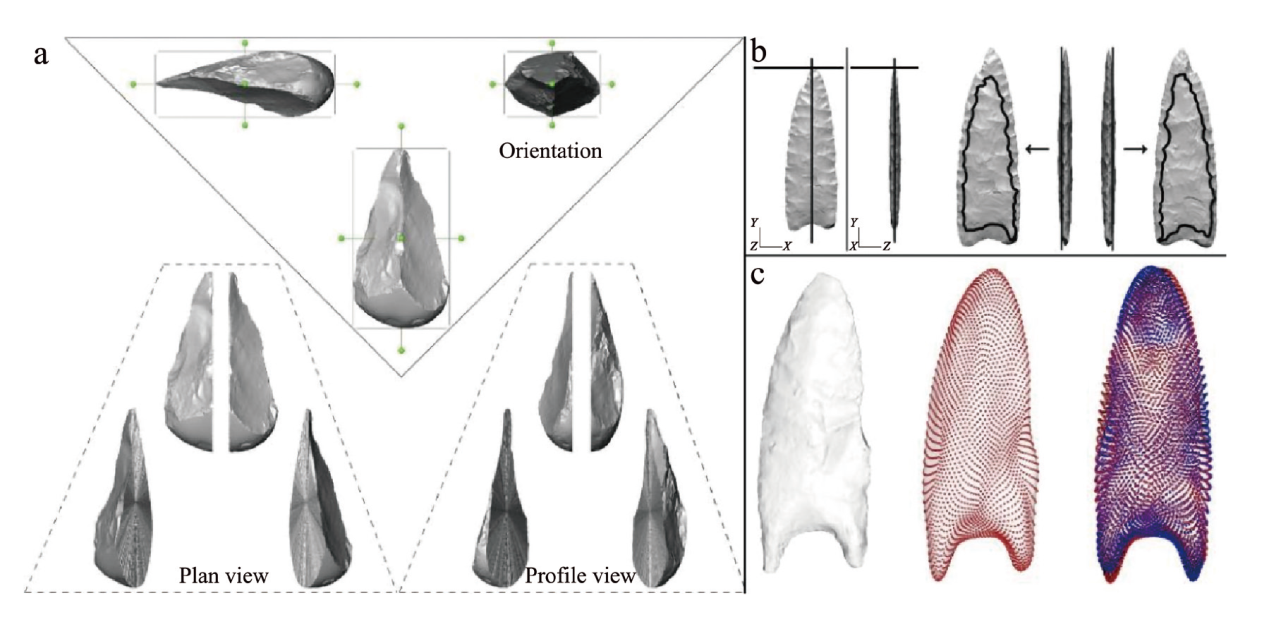
图1 基于三维模型的对称性量化方法
Fig.1 Approaches to quantify symmetry based on 3D modeling[24,26] a.沿长轴切割模型后对比两侧的体积Segmenting the model based on the long axis and comparing the volume of each portion[24]; b.计算模型二维投影的对称性Calculating the symmetry of the model’s 2D projective plane[26]; c.在原模型上叠加镜像模型并计算二者间的距离Superimposing the mirror model on the original model and calculating the distance between the two[26]。
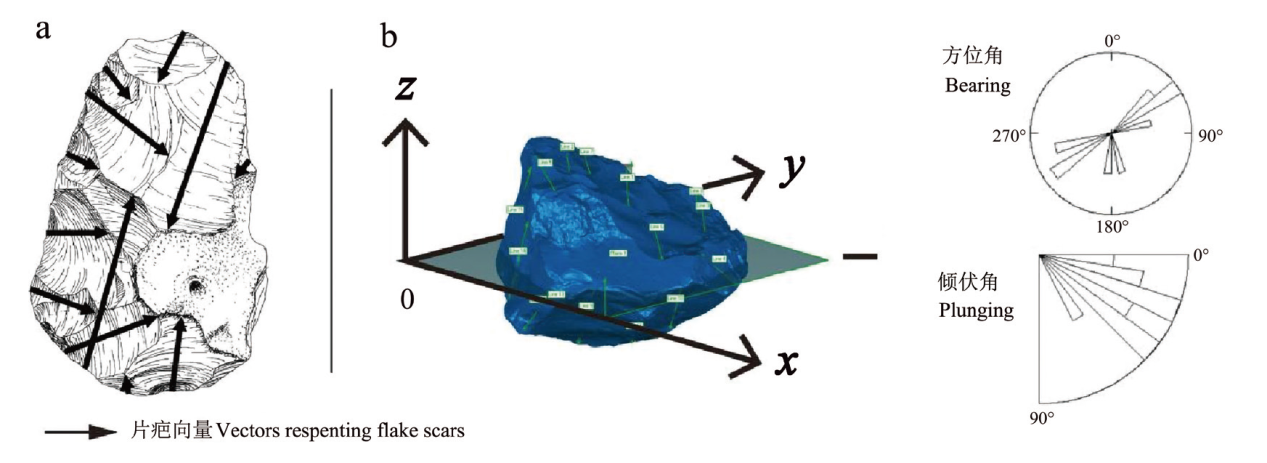
图2 基于三维模型的片疤方向量化方法 a.用平行指数衡量片疤方向规则程度的传统方法The traditional method of measuring the regularity of scar patterning using the index of parallelness[60];b.用伸长率和各向同性率衡量片疤规则程度的新方法The new method of measuring the regularity of scar patterning using elongation ratio and isotropy ratio[61]
Fig.2 Approaches to quantify flake scar patterning based on 3D modeling[60,61]
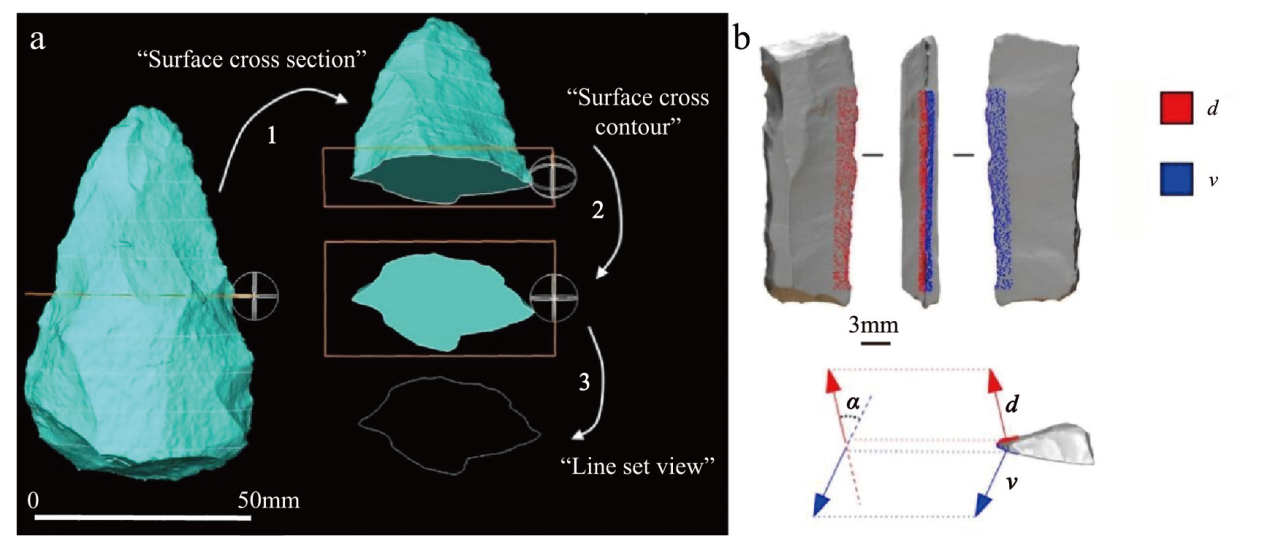
图3 基于三维模型的刃角测量方法 a.基于标量的刃角计算方法An edge angle calculation method based on scalars[64]; b.基于腹面法向量(v)和背面法向量(d)的刃角(α)计算方法A method to calculate edge angles (α) based on normal vectors of ventral faces (v) and dorsal faces (d)[65]
Fig.3 Approaches to measure angles based on 3D modeling[64,65]
| [1] | Roberts LG. Machine Perception of Three-Dimensional Solids[D]. PhD thesis, Cambridge: Massachusetts Institute of Technology, 1963 |
| [2] |
Grosman L. Reaching the Point of No Return: The Computational Revolution in Archaeology[J]. Annual Review of Anthropology, 2016, 45: 129-145
doi: 10.1146/anthro.2016.45.issue-1 URL |
| [3] |
Wyatt-Spratt S. After the Revolution: A Review of 3D Modelling as a Tool for Stone Artefact Analysis[J]. Journal of Computer Applications in Archaeology, 2022, 5(1): 215-237
doi: 10.5334/jcaa.103 URL |
| [4] | 赵海龙, 仝广, 闫晓蒙. 基于Agisoft PhotoScan的石器三维建模与应用[J]. 人类学学报, 2021, 40(1): 40-48 |
| [5] | 周振宇, 关莹. 多视角三维重建技术在石制品研究中的应用[J]. 人类学学报, 2017, 36(1): 38-48 |
| [6] | 雷蕾, 贺乐天, 李大伟, 等. 三维几何形态测量方法在石制品分析中的应用[J]. 人类学学报, 2021, 40(6): 970-980 |
| [7] | 刘楠. 几何形态测量学在考古中的应用:以体质人类学与石制品研究为例[D]. 硕士学位毕业论文, 长春: 吉林大学, 2021, 77-87 |
| [8] | 战世佳, 董哲, 林雪川. 多重影像建模技术在打制石器制图及分析中的应用[J]. 东南文化, 2017, 5: 12-20 |
| [9] | Di Maida G, Hattermann M, Delpiano D. 3D models of lithic artefacts: A test on their efficacy[J]. Digital Applications in Archaeology and Cultural Heritage, 2023, 30: e00279 |
| [10] |
Grosman L, Muller A, Dag I, et al. Artifact3-D: New software for 3D analysis and documentation of archaeological artifacts[J]. PLoS ONE, 2022, 17(6): e0268401
doi: 10.1371/journal.pone.0268401 URL |
| [11] |
1Lin NR, Wang H, Huan FX, et al. Lithic miniaturization and hafted tools in early Late Pleistocene Salawusu, North China[J]. Journal of Archaeological Science: Reports, 2023, 48: 103831
doi: 10.1016/j.jasrep.2023.103831 URL |
| [12] | 彭菲, 高星, 王惠民, 等. 水洞沟旧石器时代晚期遗址发现带有刻划痕迹的石制品[J]. 科学通报, 2012, 57(26): 2475-2481 |
| [13] |
Magnani M. Three-Dimensional Alternatives to Lithic Illustration[J]. Advances in Archaeological Practice, 2014, 2(4): 285-297
doi: 10.7183/2326-3768.2.4.285 URL |
| [14] | Moore MW. Museum of Stone Tools[DB/OL]. URL: https://stonetoolsmuseum.com/, 2024 |
| [15] |
Harmand S, Lewis JE, Feibel CS, et al. 3.3-million-year-old stone tools from Lomekwi 3, West Turkana, Kenya[J]. Nature, 2015, 521: 310-315
doi: 10.1038/nature14464 |
| [16] |
Zhu Z, Dennell R, Huang W, et al. Hominin occupation of the Chinese Loess Plateau since about 2.1 million years ago[J]. Nature, 2018, 559: 608-612
doi: 10.1038/s41586-018-0299-4 |
| [17] | Linsel F, Bullenkamp JP, Mara H. Reusing 3D Measurement Data of Lithic Artifacts to Develop Analytical Methods[J]. Archäologische Informationen, 2024, 47: 141-155 |
| [18] |
Karkazi E, Athanassiou A, Darlas A, et al. Beyond the walls: the design and development of the Petralona Cave virtual museum utilising 3D technologies[J]. Virtual Archaeology Review, 2024, 15(30): 80-96
doi: 10.4995/var.2024.20014 URL |
| [19] |
Douglass M, Kuhnel D, Magnani M, et al. Community outreach, digital heritage and private collections: a case study from the North American Great Plains[J]. World Archaeology, 2017, 49(5): 623-638
doi: 10.1080/00438243.2017.1309299 URL |
| [20] |
Sánchez-Martínez J, Calmet K, Moreno JM, et al. Virtual reconstruction of stone tool refittings by using 3D modelling and the Blender Engine: The application of the ‘ReViBE’ protocol to the archaeological record[J]. PLoS ONE, 2024, 19(8): e0309611
doi: 10.1371/journal.pone.0309611 URL |
| [21] |
Wynn T. Archaeology and cognitive evolution[J]. Behavioral and Brain Sciences, 2002, 25(3): 389-402
pmid: 12879699 |
| [22] |
Saragusti I, Karasik A, Sharon I, et al. Quantitative analysis of shape attributes based on contours and section profiles in artifact analysis[J]. Journal of Archaeological Science, 2005, 32(6): 841-853
doi: 10.1016/j.jas.2005.01.002 URL |
| [23] | Grosman L, Goldsmith Y, Smilansky U. Morphological Analysis of Nahal Zihor Handaxes: A Chronological Perspective[J]. Paleoanthropology, 2011, 203-215 |
| [24] |
Li H, Kuman K, Li C. The symmetry of handaxes from the Danjiangkou Reservoir Region (central China): A methodological consideration[J]. Quaternary International, 2016, 400: 65-72
doi: 10.1016/j.quaint.2015.05.033 URL |
| [25] |
Feizi N, Nasab HV, Wynn T. Consider the third dimension: A new approach for measuring the symmetry of the middle Paleolithic points of the Mirak Site[J]. Comptes Rendus Palevol, 2018, 17(6): 388-398
doi: 10.1016/j.crpv.2017.11.004 URL |
| [26] |
Sholts SB, Gingerich JAM, Schlager S, et al. Tracing social interactions in Pleistocene North America via 3D model analysis of stone tool asymmetry[J]. PLoS ONE, 2017, 12(7): e0179933
doi: 10.1371/journal.pone.0179933 URL |
| [27] | Dibble HL, Schurmans UA, Iovita RP, et al. The measurement and interpretation of cortex in lithic assemblages[J]. American Anriquity, 2005, 70(3): 545-560 |
| [28] |
Lin SCH, Douglass MJ, Holdaway SJ, et al. The application of 3D laser scanning technology to the assessment of ordinal and mechanical cortex quantification in lithic analysis[J]. Journal of Archaeological Science, 2010, 37(4): 694-702
doi: 10.1016/j.jas.2009.10.030 URL |
| [29] |
Lin SCH, Peng F, Zwyns N, et al. Detecting patterns of local raw material utilization among informal lithic assemblages at the late Paleolithic site of Shuidonggou Locality 2 (China)[J]. Archaeological Research in Asia, 2019, 17: 137-148
doi: 10.1016/j.ara.2018.11.003 URL |
| [30] | Dibble HL. Interpreting Typological Variation of Middle Paleolithic Scrapers: Function, Style, or Sequence of Reduction?[J]. Journal of Field Archaeology, 1984, 11(4): 431-436 |
| [31] |
Braun DR, Rogers MJ, Harris JWK, et al. Landscape-scale variation in hominin tool use: Evidence from the Developed Oldowan[J]. Journal of Human Evolution, 2008, 55(6): 1053-1063
doi: 10.1016/j.jhevol.2008.05.020 pmid: 18845314 |
| [32] |
Shipton C, Clarkson C, Pal JN, et al. Generativity, hierarchical action and recursion in the technology of the Acheulean to Middle Palaeolithic transition: A perspective from Patpara, the Son Valley, India[J]. Journal of Human Evolution, 2013, 65(2): 93-108
doi: 10.1016/j.jhevol.2013.03.007 pmid: 23746433 |
| [33] |
Lombao D, Cueva-Temprana A, Mosquera M, et al. A new approach to measure reduction intensity on cores and tools on cobbles: the Volumetric Reconstruction Method[J]. Archaeological and Anthropological Science, 2020, 12: 222
doi: 10.1007/s12520-020-01154-7 |
| [34] |
Shipton C, Clarkson C. Flake scar density and handaxe reduction intensity[J]. Journal of Archaeological Science: Reports, 2015, 2: 169-175
doi: 10.1016/j.jasrep.2015.01.013 URL |
| [35] |
Li H, Kuman K, Li C. Quantifying the Reduction Intensity of Handaxes with 3D Technology: A Pilot Study on Handaxes in the Danjiangkou Reservoir Region, Central China[J]. PLoS ONE, 2015, 10(9): e0135613
doi: 10.1371/journal.pone.0135613 URL |
| [36] |
Lombao D, Rabuñal JR, Morales JI, et al. The Technological Behaviours of Homo antecessor: Core Management and Reduction Intensity at Gran Dolina-TD6.2 (Atapuerca, Spain)[J]. Journal of Archaeological Method and Theory, 2023, 30: 964-1001
doi: 10.1007/s10816-022-09579-1 |
| [37] |
Lombao D, Falcucci A, Moos E, et al. Unravelling technological behaviors through core reduction intensity. The case of the early Protoaurignacian assemblage from Fumane Cave[J]. Journal of Archaeological Science, 2023, 160, 105889
doi: 10.1016/j.jas.2023.105889 URL |
| [38] |
Lombao D, Morales JI, Mosquera M, et al. Beyond Large-Shaped Tools: Technological Innovations and Continuities at the Late Early Pleistocene Assemblage of El Barranc de la Boella (Tarragona, Spain)[J]. Journal of Paleolithic Archaeology, 2024, 7: 25
doi: 10.1007/s41982-024-00189-9 |
| [39] | 周光照(主编). 中国大百科全书·物理学[M]. 北京: 中国大百科全书出版社, 2009, 532 |
| [40] |
Caruana MV, Lotter MG, Lombard M. A Techno-Functional Analysis of Acheulean Backed Knives from Wonderboom, South Africa[J]. Journal of Field Archaeology, 2023, 48: 198-209
doi: 10.1080/00934690.2022.2157094 URL |
| [41] |
Zupancich A, Mutri G, Caricola I, et al. The application of 3D modeling and spatial analysis in the study of groundstones used in wild plants processing[J]. Archaeological and Anthropological Sciences, 2019, 11: 4801-4827
doi: 10.1007/s12520-019-00824-5 |
| [42] |
Dietrich L, Haibt M. Bread and porridge at Early Neolithic Göbekli Tepe: A new method to recognize products of cereal processing using quantitative functional analyses on grinding stones[J]. Journal of Archaeological Science: Reports, 2020, 33: 102525
doi: 10.1016/j.jasrep.2020.102525 URL |
| [43] |
Benito-Calvo A, Arroyo A, Sánchez-Romero L, et al. Quantifying 3D micro-surface changes on experimental stones used to break bones and their implications for the analysis of Early Stone Age pounding tools[J]. Archaeometry, 2018, 60(3): 419-436
doi: 10.1111/arcm.v60.3 URL |
| [44] |
Benito-Calvo A, Crittenden AN, Livengood SV. 3D 360° surface morphometric analysis of pounding stone tools used by Hadza foragers of Tanzania: A new methodological approach for studying percussive stone artefacts[J]. Journal of Archaeological Science: Reports, 2018, 20: 611-621
doi: 10.1016/j.jasrep.2018.06.003 URL |
| [45] | 张锋, 李萍. 几何形态测量学在古生物学研究中的应用概况[J]. 古生物学报, 2016, 55(4): 518-531 |
| [46] |
Okumura M, Araujo AGM. Archaeology, biology, and borrowing: A critical examination of Geometric Morphometrics in Archaeology[J]. Journal of Archaeological Science, 2019, 101: 149-158
doi: 10.1016/j.jas.2017.09.015 URL |
| [47] | Lycett SJ, Chauhan PR. Analytical Approaches to Palaeolithic Technologies:An Introduction[A]. In: Lycett SJ, Chauhan PR(Eds.). New Perspectives on Old Stones[C]. New York: Springer, 2010, 1-17 |
| [48] | Zelditch ML, Swiderski DL, Sheets HD, et al. Geometric Morphometrics for Biologists: A Primer[M]. San Diego: Academic Press, 2004, 88-89 |
| [49] |
Smith Hl, Jennings TA, Smallwood AM. The third dimension of stone points: 2D vs. 3D geometric morphometric shape analysis[J]. Archaeological and Anthropological Sciences, 2024, 16: 170
doi: 10.1007/s12520-024-02069-3 |
| [50] |
Herzlinger G, Grosman L. AGMT3-D: A software for 3-D landmarks-based geometric morphometric shape analysis of archaeological artifacts[J]. PLoS ONE, 2018, 13(11): e0207890
doi: 10.1371/journal.pone.0207890 URL |
| [51] |
Adams DC, Otárola-Castillo E. Geomorph: An R package for the collection and analysis of geometric morphometric shape data[J]. Methods in Ecology and Evolution, 2013, 4: 393-399
doi: 10.1111/mee3.2013.4.issue-4 URL |
| [52] | Schlager S. Morpho and Rvcg - shape analysis in R[A]. In: Zheng G, Li S, Székely G(Eds.). Statistical shape and deformation analysis[C]. London: Academic Press, 2017, 217-256 |
| [53] |
Li H, Lei L, Li D, et al. Characterizing the shape of Large Cutting Tools from the Baise Basin (South China) using a 3D geometric morphometric approach[J]. Journal of Archaeological Science: Reports, 2021, 36: 102820
doi: 10.1016/j.jasrep.2021.102820 URL |
| [54] |
Bustos-Pérez G, Gravina B, Brenet M, et al. Combining quantitative approaches to differentiate between backed products from discoidal and Levallois reduction sequences[J]. Journal of Archaeological Science: Reports, 2022, 46: 103723
doi: 10.1016/j.jasrep.2022.103723 URL |
| [55] |
Hashemi SM, Nasab HV, Berillon G, et al. An investigation of the flake-based lithic tool morphology using 3D geometric morphometrics: A case study from the Mirak Paleolithic Site, Iran[J]. Journal of Archaeological Science: Reports, 2021, 37: 102948
doi: 10.1016/j.jasrep.2021.102948 URL |
| [56] |
Shipton C, White M. Handaxe types, colonization waves, and social norms in the British Acheulean[J]. Journal of Archaeological Science: Reports, 2020, 31: 102352
doi: 10.1016/j.jasrep.2020.102352 URL |
| [57] |
Falcucci A, Karakostis FA, Göldner D, et al. Bringing shape into focus: Assessing differences between blades and bladelets and their technological significance in 3D form[J]. Journal of Archaeological Science: Reports, 2022, 43: 103490
doi: 10.1016/j.jasrep.2022.103490 URL |
| [58] | Selden RZ, Dockall JE, Shafer HJ. Lithic morphological organisation: Gahagan bifaces from the Southern Caddo Area[J]. Digital Applications in Archaeology and Cultural Heritage, 2018, 10: e00080 |
| [59] |
Archer W, Pop CM, Rezek Z, et al. A geometric morphometric relationship predicts stone flake shape and size variability[J]. Archaeological and Anthropological Sciences, 2018, 10: 1991-2003
doi: 10.1007/s12520-017-0517-2 |
| [60] |
Clarkson C, Vinicius L, Lahr MM. Quantifying flake scar patterning on cores using 3D recording techniques[J]. Journal of Archaeological Science, 2006, 33(1): 132-142
doi: 10.1016/j.jas.2005.07.007 URL |
| [61] |
Lin SC, Clarkson C, Julianto IMA, et al. A new method for quantifying flake scar organisation on cores using orientation statistics[J]. Journal of Archaeological Science, 2024, 167: 105998
doi: 10.1016/j.jas.2024.105998 URL |
| [62] |
Hiscock P. The Meaning of Edge Angles?[J]. Australian Archaeology, 1982, 14: 79-85
doi: 10.1080/03122417.1982.12092841 URL |
| [63] |
Dibble HL. A Comparative Study of Basic Edge Angle Measurement Techniques[J]. American Antiquity, 1980, 45(4): 857-865
doi: 10.2307/280156 URL |
| [64] |
Viallet C. A new method of three-dimensional morphometry for analyzing the functional potentialities of bifaces. Contribution to the study of artefacts from AU P3 from the “Caune de l’ Arago” (France)[J]. Comptes Rendus Palevol, 2019, 18: 236-250
doi: 10.1016/j.crpv.2018.11.001 |
| [65] |
Valletta F, Smilansky U, Goring-Morris AN, et al. On measuring the mean edge angle of lithic tools based on 3-D models - A case study from the southern Levantine Epipalaeolithic[J]. Archaeological and Anthropological Sciences, 2020, 12: 49
doi: 10.1007/s12520-019-00954-w |
| [66] |
Hofman JL. The refitting of chipped-stone artifacts as an Analytical and interpretive tool[J]. Current Anthropology, 1981, 22(6): 691-693
doi: 10.1086/202754 URL |
| [67] | 杨溪, 李锋. 人工智能辅助的打制石器拼合与可视化[J]. 史前考古, 2024, 1(2): 207-223 |
| [68] | Altansukh A, You M, Altantsetseg E, et al. A New Matching Algorithm for Stone Tool Reassembly Based on Contour Points of Flake Surface[J]. The Journal of the Society for Art and Science, 2024, 23(2): 4:1-4:17 |
| [69] |
Riel-Salvatore J, Bae M, MacCartney P, et al. Palaeolithic archaeology and 3D visualization technology: recent developments[J]. Antiquity, 2002, 76(294): 929-930
doi: 10.1017/S0003598X00091614 URL |
| [70] |
Yahalom-Mack N, Herzlinger G, Bogdanovsky A, et al. Combining chemical and lead isotope analyses with 3-D geometric-morphometric shape analysis: A methodological case study of socketed bronze arrowheads from the southern Levant[J]. Journal of Archaeological Science, 2020, 118: 105147
doi: 10.1016/j.jas.2020.105147 URL |
| [71] | Bae CJ. The Paleoanthropology of Eastern Asia[M]. Honolulu: University of Hawai‘i Press, 2024, 72-78 |
| [72] |
Wang FG, Yang SX, Ge JY, et al. Innovative ochre processing and tool use in China 40000 years ago[J]. Nature, 2022, 603: 284-289
doi: 10.1038/s41586-022-04445-2 |
| [73] |
Barker G, Barton H, Bird M, et al. The ‘human revolution’ in lowland tropical Southeast Asia: the antiquity and behavior of anatomically modern humans at Niah Cave (Sarawak, Borneo)[J]. Journal of Human Evolution, 2007, 52(3): 243-261
doi: 10.1016/j.jhevol.2006.08.011 URL |
| [74] | Hirst CS, White S, Smith SE. Standardisation in 3D Geometric Morphometrics: Ethics, Ownership, and Methods[J]. Archaeologies: Journal of the World Archaeological Congress, 2018, 14(2): 272-298 |
| [75] | 周志华. 机器学习[M]. 北京: 清华大学出版社, 2016, 1-4 |
| [76] |
Bickler SH. Machine Learning Arrives in Archaeology[J]. Advances in Archaeological Practice, 2021, 9(2): 186-191
doi: 10.1017/aap.2021.6 |
| [77] |
Grove M, Blinkhorn J. Neural networks differentiate between Middle and Later Stone Age lithic assemblages in eastern Africa[J]. PLoS ONE, 2020, 15(8): e0237528
doi: 10.1371/journal.pone.0237528 URL |
| [78] |
Figueroa JDO, Reeves JS, McPherron SP, et al. A proof of concept for machine learning-based virtual knapping using neural networks[J]. Scientific Reports, 2021, 11: 19966
doi: 10.1038/s41598-021-98755-6 pmid: 34620893 |
| [1] | 袁文明, 史永红, 李磊, 海青, 李占扬. 山西昔阳虎窑洞旧石器遗址调查简报[J]. 人类学学报, 2026, 45(04): 753-763. |
| [2] | 魏屹. 旧石器时代装饰品着色研究的回顾与思考[J]. 人类学学报, 2026, 45(04): 801-814. |
| [3] | 牛东伟, 刘尔凡, 薛峰, 谢飞. 河北怀来盆地古人类文化遗存的考古发现与研究[J]. 人类学学报, 2026, 45(03): 419-435. |
| [4] | 郭晓明, 刘惜祯, 刘恒, 王春雪, 王法岗. 泥河湾盆地益堵泉旧石器时代晚期遗址2019年发掘简报[J]. 人类学学报, 2026, 45(03): 478-488. |
| [5] | 黄冰柔, 牛东伟, 裴树文, 郭玉杰. 河北蔚县盆地东沟遗址的光释光年龄[J]. 人类学学报, 2026, 45(03): 543-555. |
| [6] | 刘尔凡, 高佳璇, 牛东伟. 河北怀来盆地珠窝堡遗址出土的石制品[J]. 人类学学报, 2026, 45(03): 600-608. |
| [7] | 薛峰, 杨诗雨, 梅惠杰, 梁立雪, 魏屹, 牛东伟, 李鼎元. 河北怀来南家沟遗址2016年发掘报告[J]. 人类学学报, 2026, 45(03): 609-622. |
| [8] | 廖汝雪, 傅裕, 王腾飞, 赵雄伟, 张潜, 陈彦伊, 陈少坤, 韩非, 吴雁, 胡鑫, 牛文渊, 韦璇, 黄先锋, 黄万波, 李英华. 重庆巫山龙骨坡遗址2023年发掘报告[J]. 人类学学报, 2026, 45(02): 345-357. |
| [9] | 宋艳花, 吴梦遥, 吴洋, 郭军亮, 马峰, 张建军, 吴小红, 郭玉杰. 山西阳城析城山遗址第1和第2地点发掘报告[J]. 人类学学报, 2026, 45(02): 358-371. |
| [10] | 薛峰, 牛东伟, 李鼎元. 怀来盆地南家沟旧石器时代遗址2015年度发掘报告[J]. 人类学学报, 2026, 45(02): 372-386. |
| [11] | 魏屹. 旧石器时代装饰品原料浅析[J]. 人类学学报, 2026, 45(02): 387-402. |
| [12] | 徐廷, 黄抡月, 任进成, 葛俊逸, 高星. 吉林省抚松县枫林遗址第2地点发掘简报[J]. 人类学学报, 2026, 45(01): 174-186. |
| [13] | 赵海龙, 周天路, 马冲, 杨博灿, 贾倩. 河北泥河湾盆地东缘石器原料的开发与利用[J]. 人类学学报, 2026, 45(01): 34-45. |
| [14] | 肖培源, 阮齐军, 李浩. 中国西南基纳型旧石器中期技术的发现与研究进展[J]. 人类学学报, 2025, 44(06): 1009-1018. |
| [15] | 胡越. 贵州观音洞遗址的石核剥片策略和修理技术[J]. 人类学学报, 2025, 44(06): 1019-1033. |
| 阅读次数 | ||||||
|
全文 |
|
|||||
|
摘要 |
|
|||||
 京ICP证05002819号-3