

主管:中国科学院
主办:中国科学院古脊椎动物与古人类研究所
出版:科学出版社
主办:中国科学院古脊椎动物与古人类研究所
出版:科学出版社
人类学学报 ›› 2026, Vol. 45 ›› Issue (03): 570-585.doi: 10.16359/j.1000-3193/AAS.2026.0016cstr: 32091.14.j.1000-3193/AAS.2026.0016
杜雨薇1( ), 耿帅杰2,3,4, 徐静玥2,3,4, 叶芷2,3,4, 张乐5, 马东东2,3, 裴树文2,3()
收稿日期:2025-12-10
接受日期:2026-02-12
出版日期:2026-06-15
发布日期:2026-06-12
通讯作者:
裴树文,研究员,主要从事旧石器时代考古学和地质考古学研究。E-mail: peishuwen@ivpp.ac.cn
作者简介:杜雨薇,讲师,主要从事旧石器时代动物考古学研究。E-mail: duyuwei@jlu.edu.cn
基金资助:
DU Yuwei1(), GENG Shuaijie2,3,4, XU Jingyue2,3,4, YE Zhi2,3,4, ZHANG Yue5, MA Dongdong2,3, PEI Shuwen2,3()
Received:2025-12-10
Accepted:2026-02-12
Online:2026-06-15
Published:2026-06-12
摘要:
古人类与动物资源之间的关系是探讨古人类生存策略的重要议题,但目前对东亚早-中更新世期遗址的相关研究仍较有限。蔡家沟遗址位于泥河湾盆地东南部的蔚县盆地,2019-2021年共发掘A、B、C三处地点,出土了大量动物化石和石制品,26Al/10Be埋藏测年结果为0.47±0.13 Ma至0.64±0.21 Ma,属中更新世早期。本研究基于A、B地点动物化石的埋藏学观察,综合分析风化、生物化学腐蚀及食肉动物啃咬等自然因素与人工因素对动物骨骼的影响。结果显示,尽管自然因素在一定程度上参与了动物骨骼堆积的形成过程,但骨骼的富集与改造主要由古人类活动造成。人工切割、砸击等痕迹的出现频率及其在骨骼各解剖部位的分布表明,蔡家沟古人类主动获取以马科动物为主的大中型有蹄类动物资源,并在附近区域开展剥皮、肢解、割肉与敲骨取髓等处理行为,同时可能将部分高营养或较难处理的骨骼部位带离遗址。本项研究为探索东亚北部中高纬度地区早期古人类的资源利用策略提供了新的证据。
中图分类号:
杜雨薇, 耿帅杰, 徐静玥, 叶芷, 张乐, 马东东, 裴树文. 泥河湾盆地蔡家沟遗址A和B地点动物骨骼的埋藏学观察[J]. 人类学学报, 2026, 45(03): 570-585.
DU Yuwei, GENG Shuaijie, XU Jingyue, YE Zhi, ZHANG Yue, MA Dongdong, PEI Shuwen. Taphonomic observation of the faunal remains from Locality A and B of the Caijiagou site in the Nihewan Basin[J]. Acta Anthropologica Sinica, 2026, 45(03): 570-585.
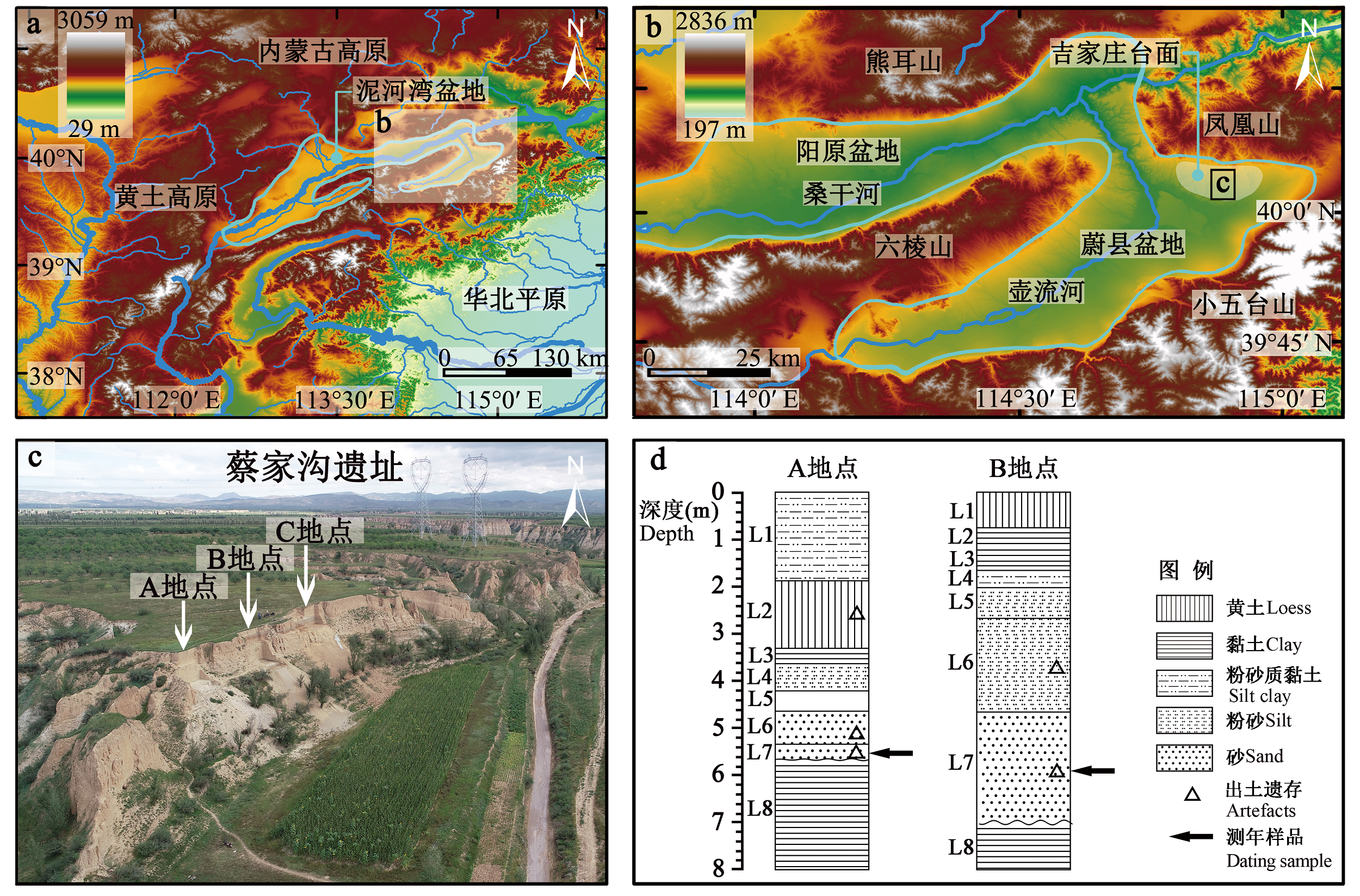
图1 蔡家沟遗址地理位置与A、B两地点地层剖面图 a.泥河湾盆地的地理位置Location of the Nihewan Basin;b.吉家庄台面的地理位置Location of the Jijiazhuang Platform;c.蔡家沟遗址的地貌景观Landscape view of the Caijiagou site;d.蔡家沟遗址A、B地点的地层分布Stratigraphy sequence of the Caijiagou-A and B
Fig.1 Geographical location of Caijiagou site and stratigraphic profiles of locality A and B
| 地点 Localities→ 动物种类 Taxon↓ | A地点/Caijiagou-A | B地点/Caijiagou-B | ||||
|---|---|---|---|---|---|---|
| NISP | MNI | NISP | MNI | |||
| 啮齿目Rodentia | 7 | NA | 7 | NA | ||
| 食肉目Carnivora | 2 | NA | 0 | 0 | ||
| 奇蹄目Perissodactyla | 三门马Equus sanmeniensis | 128 | 5 | 67 | 3(1) | |
| 披毛犀Coelodonta antiquitatis | 110 | 3(1) | 49 | 2(1) | ||
| 偶蹄目Artiodactyla | 葛氏斑鹿Cervus (Sika) grayi | 16 | 1 | 12 | 1 | |
| 羚羊Gazella sp. | 3 | 2 | 2 | 1 | ||
| 恰克图转角羚羊Spirocerus kiakhtensis | 0 | 0 | 0 | 0 | ||
| 野牛Bison sp. | 70 | 1 | 41 | 3(1) | ||
| 体型1-2等级的有蹄类/Size 1-2 ungulates | 1 | NA | 0 | NA | ||
| 体型2-3等级的有蹄类/Size 2-3 ungulates | 10 | NA | 2 | NA | ||
| 体型3-4等级的有蹄类/Size 3-4 ungulates | 33 | NA | 29 | NA | ||
| 其他 Others | 6 | NA | 2 | NA | ||
| 总计 Total | 386 | 12 | 211 | 10 | ||
表1 蔡家沟遗址A、B地点动物群分类构成
Tab.1 Taxonomic composition of faunal assemblages at the Caijiagou-A and B
| 地点 Localities→ 动物种类 Taxon↓ | A地点/Caijiagou-A | B地点/Caijiagou-B | ||||
|---|---|---|---|---|---|---|
| NISP | MNI | NISP | MNI | |||
| 啮齿目Rodentia | 7 | NA | 7 | NA | ||
| 食肉目Carnivora | 2 | NA | 0 | 0 | ||
| 奇蹄目Perissodactyla | 三门马Equus sanmeniensis | 128 | 5 | 67 | 3(1) | |
| 披毛犀Coelodonta antiquitatis | 110 | 3(1) | 49 | 2(1) | ||
| 偶蹄目Artiodactyla | 葛氏斑鹿Cervus (Sika) grayi | 16 | 1 | 12 | 1 | |
| 羚羊Gazella sp. | 3 | 2 | 2 | 1 | ||
| 恰克图转角羚羊Spirocerus kiakhtensis | 0 | 0 | 0 | 0 | ||
| 野牛Bison sp. | 70 | 1 | 41 | 3(1) | ||
| 体型1-2等级的有蹄类/Size 1-2 ungulates | 1 | NA | 0 | NA | ||
| 体型2-3等级的有蹄类/Size 2-3 ungulates | 10 | NA | 2 | NA | ||
| 体型3-4等级的有蹄类/Size 3-4 ungulates | 33 | NA | 29 | NA | ||
| 其他 Others | 6 | NA | 2 | NA | ||
| 总计 Total | 386 | 12 | 211 | 10 | ||
| 地点Localities→ 骨骼单元Skeletal elements↓ | A地点/Caijiagou-A | B地点/Caijiagou-B | |||||
|---|---|---|---|---|---|---|---|
| MNE | MAU | %MAU | MNE | MAU | %MAU | ||
| 下颌骨Mandible | 0.9 | 0.5 | 52.9% | 0.2 | 0.2 | 15.4% | |
| 寰椎Atlas | 0 | 0.0 | 0.0% | 0 | 0.0 | 0.0% | |
| 枢椎Axis | 0 | 0.0 | 0.0% | 0 | 0.0 | 0.0% | |
| 颈椎Cervical vertebra | 1.7 | 0.2 | 28.6% | 0.9 | 0.2 | 13.8% | |
| 胸椎Thoracic vertebra | 0.9 | 0.1 | 5.9% | 0.9 | 0.1 | 3.8% | |
| 腰椎Lumbar vertebra | 0.5 | 0.1 | 9.8% | 0.9 | 0.2 | 11.5% | |
| 肋骨Rib | 3.5 | 0.1 | 11.4% | 2.9 | 0.1 | 6.2% | |
| 肩胛骨Scapula | 0.9 | 0.5 | 52.9% | 0 | 0.0 | 0.0% | |
| 髋骨Innominate | 0.4 | 0.2 | 23.5% | 1 | 0.5 | 38.5% | |
| 肱骨Humerus | 0.7 | 0.4 | 41.2% | 0.4 | 0.2 | 15.4% | |
| 股骨Femur | 1 | 0.5 | 58.8% | 1.2 | 0.6 | 46.2% | |
| 桡骨Radius | 1.7 | 0.9 | 100.0% | 2.6 | 1.3 | 100.0% | |
| 尺骨Ulna | 0.2 | 0.1 | 11.8% | 2 | 1.0 | 76.9% | |
| 胫骨Tibia | 0.9 | 0.5 | 52.9% | 1 | 0.5 | 38.5% | |
| 腕跗骨 Carpal/tarsal | 0 | 0.0 | 0.0% | 1 | 0.1 | 5.9% | |
| 掌跖骨Metapodial | 0.8 | 0.2 | 23.5% | 1.5 | 0.4 | 28.8% | |
| 第一趾节骨Phalanx 1 | 0 | 0.0 | 0.0% | 1 | 0.3 | 19.2% | |
| 第二趾节骨Phalanx 2 | 1 | 0.3 | 29.4% | 0 | 0.0 | 0.0% | |
| 第三趾节骨Phalanx 3 | 1.6 | 0.4 | 47.1% | 0 | 0.0 | 0.0% | |
表2 蔡家沟遗址A、B地点三门马的骨骼单元分布
Tab.2 Bone element abundance of Equus sanmeniensis from the Caijiagou-A and B
| 地点Localities→ 骨骼单元Skeletal elements↓ | A地点/Caijiagou-A | B地点/Caijiagou-B | |||||
|---|---|---|---|---|---|---|---|
| MNE | MAU | %MAU | MNE | MAU | %MAU | ||
| 下颌骨Mandible | 0.9 | 0.5 | 52.9% | 0.2 | 0.2 | 15.4% | |
| 寰椎Atlas | 0 | 0.0 | 0.0% | 0 | 0.0 | 0.0% | |
| 枢椎Axis | 0 | 0.0 | 0.0% | 0 | 0.0 | 0.0% | |
| 颈椎Cervical vertebra | 1.7 | 0.2 | 28.6% | 0.9 | 0.2 | 13.8% | |
| 胸椎Thoracic vertebra | 0.9 | 0.1 | 5.9% | 0.9 | 0.1 | 3.8% | |
| 腰椎Lumbar vertebra | 0.5 | 0.1 | 9.8% | 0.9 | 0.2 | 11.5% | |
| 肋骨Rib | 3.5 | 0.1 | 11.4% | 2.9 | 0.1 | 6.2% | |
| 肩胛骨Scapula | 0.9 | 0.5 | 52.9% | 0 | 0.0 | 0.0% | |
| 髋骨Innominate | 0.4 | 0.2 | 23.5% | 1 | 0.5 | 38.5% | |
| 肱骨Humerus | 0.7 | 0.4 | 41.2% | 0.4 | 0.2 | 15.4% | |
| 股骨Femur | 1 | 0.5 | 58.8% | 1.2 | 0.6 | 46.2% | |
| 桡骨Radius | 1.7 | 0.9 | 100.0% | 2.6 | 1.3 | 100.0% | |
| 尺骨Ulna | 0.2 | 0.1 | 11.8% | 2 | 1.0 | 76.9% | |
| 胫骨Tibia | 0.9 | 0.5 | 52.9% | 1 | 0.5 | 38.5% | |
| 腕跗骨 Carpal/tarsal | 0 | 0.0 | 0.0% | 1 | 0.1 | 5.9% | |
| 掌跖骨Metapodial | 0.8 | 0.2 | 23.5% | 1.5 | 0.4 | 28.8% | |
| 第一趾节骨Phalanx 1 | 0 | 0.0 | 0.0% | 1 | 0.3 | 19.2% | |
| 第二趾节骨Phalanx 2 | 1 | 0.3 | 29.4% | 0 | 0.0 | 0.0% | |
| 第三趾节骨Phalanx 3 | 1.6 | 0.4 | 47.1% | 0 | 0.0 | 0.0% | |
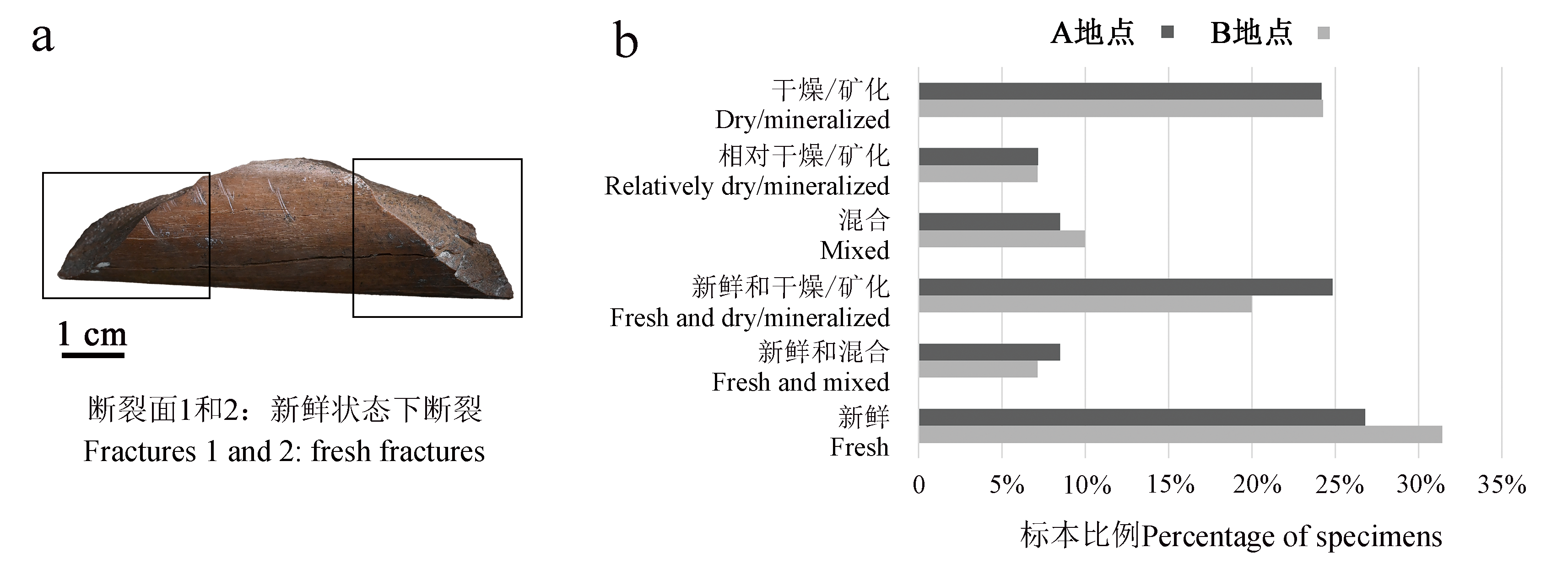
图2 蔡家沟遗址A、B地点肢骨断裂面的类型分布 a. 破裂肢骨的两端断裂面two sides of fractured limb bones;b.两处地点不同肢骨断裂面类型的分布频率comparison of limb-bone fracture types between the two localities
Fig.2 The distribution of different fracture types of limb bones from Caijiagou-A and B
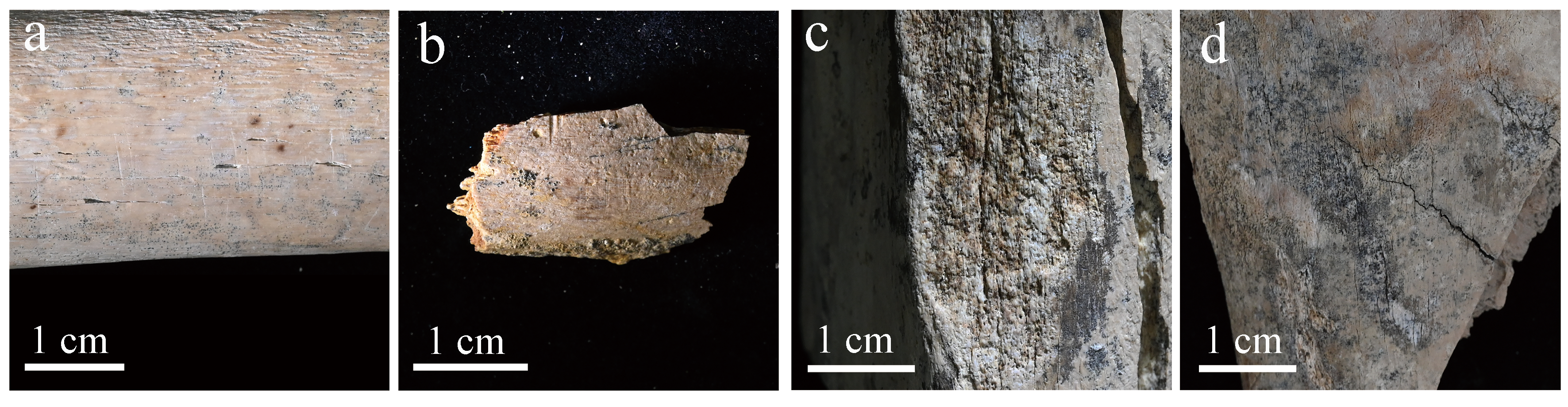
图3 蔡家沟遗址A、B地点动物骨骼上的摩擦痕迹(a, b)与生物化学痕迹(c, d)
Fig.3 Abrasion marks (a, b) and biochemical marks (c, d) on animal bones at Caijiagou-A and B
| 地点 Localities→ 骨骼单元Skeletal elements↓ | A地点/Caijiagou-A | B地点/Caijiagou-B | |||||
|---|---|---|---|---|---|---|---|
| NISP | NISP-gnaw | %gnaw | NISP | NISP-gnaw | %gnaw | ||
| 颅骨Cranium | 20 | 0 | 0.0% | 34 | 1 | 2.9% | |
| 下颌骨Mandible | 25 | 2 | 8.0% | 13 | 2 | 15.4% | |
| 颈椎Cervical vertebra | 4 | 0 | 0.0% | 3 | 1 | 33.3% | |
| 胸椎Thoracic vertebra | 15 | 0 | 0.0% | 7 | 1 | 14.3% | |
| 腰椎Lumbar vertebra | 3 | 0 | 0.0% | 6 | 0 | 0.0% | |
| 肋骨Rib | 72 | 4 | 5.6% | 34 | 3 | 8.8% | |
| 肩胛骨Scapula | 12 | 2 | 16.7% | 6 | 1 | 16.7% | |
| 髋骨Innominate | 14 | 0 | 0.0% | 3 | 0 | 0.0% | |
| 肱骨Humerus | 24 | 2 | 8.3% | 9 | 2 | 22.2% | |
| 股骨Femur | 12 | 0 | 0.0% | 9 | 3 | 33.3% | |
| 桡骨Radius | 21 | 2 | 9.5% | 10 | 1 | 10.0% | |
| 尺骨Ulna | 5 | 0 | 0.0% | 1 | 0 | 0.0% | |
| 胫骨Tibia | 36 | 6 | 16.7% | 12 | 3 | 25.0% | |
| 跟骨Calcaneum | 2 | 0 | 0.0% | 3 | 0 | 0.0% | |
| 距骨Astragalus | 2 | 0 | 0.0% | 0 | 0 | 0.0% | |
| 其他腕跗骨Other carpal/tarsal | 3 | 0 | 0.0% | 1 | 0 | 0.0% | |
| 掌/跖骨Metapodial | 14 | 1 | 7.1% | 9 | 0 | 0.0% | |
| 第一趾节骨Phalanx 1 | 0 | 0 | 0.0% | 1 | 0 | 0.0% | |
| 第二趾节骨Phalanx 2 | 5 | 0 | 0.0% | 0 | 0 | 0.0% | |
| 第三趾节骨Phalanx 3 | 2 | 0 | 0.0% | 0 | 0 | 0.0% | |
| 总计Total | 291 | 19 | 6.5% | 161 | 18 | 11.2% | |
表3 蔡家沟遗址A、B地点动物骨骼中食肉动物啃咬痕迹的骨骼单元分布
Tab.3 Distribution of skeletal elements with carnivore gnaw marks on animal bones at Caijiagou-A and B
| 地点 Localities→ 骨骼单元Skeletal elements↓ | A地点/Caijiagou-A | B地点/Caijiagou-B | |||||
|---|---|---|---|---|---|---|---|
| NISP | NISP-gnaw | %gnaw | NISP | NISP-gnaw | %gnaw | ||
| 颅骨Cranium | 20 | 0 | 0.0% | 34 | 1 | 2.9% | |
| 下颌骨Mandible | 25 | 2 | 8.0% | 13 | 2 | 15.4% | |
| 颈椎Cervical vertebra | 4 | 0 | 0.0% | 3 | 1 | 33.3% | |
| 胸椎Thoracic vertebra | 15 | 0 | 0.0% | 7 | 1 | 14.3% | |
| 腰椎Lumbar vertebra | 3 | 0 | 0.0% | 6 | 0 | 0.0% | |
| 肋骨Rib | 72 | 4 | 5.6% | 34 | 3 | 8.8% | |
| 肩胛骨Scapula | 12 | 2 | 16.7% | 6 | 1 | 16.7% | |
| 髋骨Innominate | 14 | 0 | 0.0% | 3 | 0 | 0.0% | |
| 肱骨Humerus | 24 | 2 | 8.3% | 9 | 2 | 22.2% | |
| 股骨Femur | 12 | 0 | 0.0% | 9 | 3 | 33.3% | |
| 桡骨Radius | 21 | 2 | 9.5% | 10 | 1 | 10.0% | |
| 尺骨Ulna | 5 | 0 | 0.0% | 1 | 0 | 0.0% | |
| 胫骨Tibia | 36 | 6 | 16.7% | 12 | 3 | 25.0% | |
| 跟骨Calcaneum | 2 | 0 | 0.0% | 3 | 0 | 0.0% | |
| 距骨Astragalus | 2 | 0 | 0.0% | 0 | 0 | 0.0% | |
| 其他腕跗骨Other carpal/tarsal | 3 | 0 | 0.0% | 1 | 0 | 0.0% | |
| 掌/跖骨Metapodial | 14 | 1 | 7.1% | 9 | 0 | 0.0% | |
| 第一趾节骨Phalanx 1 | 0 | 0 | 0.0% | 1 | 0 | 0.0% | |
| 第二趾节骨Phalanx 2 | 5 | 0 | 0.0% | 0 | 0 | 0.0% | |
| 第三趾节骨Phalanx 3 | 2 | 0 | 0.0% | 0 | 0 | 0.0% | |
| 总计Total | 291 | 19 | 6.5% | 161 | 18 | 11.2% | |
| 地点 Localities→ 骨骼单元Skeletal elements↓ | A地点/Caijiagou-A | B地点/Caijiagou-B | |||||||||
|---|---|---|---|---|---|---|---|---|---|---|---|
| NISP | NISP-cut | %cut | NISP-impact | %impact | NISP | NISP-cut | %cut | NISP-impact | %impact | ||
| 颅骨Cranium | 20 | 0 | 0.0% | 0 | 0.0% | 34 | 0 | 0.0% | 0 | 0.0% | |
| 下颌骨Mandible | 25 | 1 | 4.0% | 0 | 0.0% | 13 | 3 | 23.1% | 4 | 30.8% | |
| 颈椎Cervical vertebra | 4 | 0 | 0.0% | 0 | 0.0% | 3 | 0 | 0.0% | 0 | 0.0% | |
| 胸椎Thoracic vertebra | 15 | 3 | 20.0% | 2 | 13.3% | 7 | 1 | 14.3% | 0 | 0.0% | |
| 腰椎Lumbar vertebra | 3 | 0 | 0.0% | 0 | 0.0% | 6 | 0 | 0.0% | 0 | 0.0% | |
| 肋骨Rib | 75 | 4 | 5.3% | 0 | 0.0% | 34 | 2 | 5.9% | 1 | 2.9% | |
| 肩胛骨Scapula | 12 | 1 | 8.3% | 0 | 0.0% | 6 | 0 | 0.0% | 0 | 0.0% | |
| 髋骨Innominate | 14 | 0 | 0.0% | 0 | 0.0% | 3 | 0 | 0.0% | 0 | 0.0% | |
| 肱骨Humerus | 24 | 5 | 20.8% | 0 | 0.0% | 9 | 1 | 11.1% | 0 | 0.0% | |
| 股骨Femur | 12 | 1 | 8.3% | 1 | 8.3% | 9 | 1 | 11.1% | 0 | 0.0% | |
| 桡骨Radius | 21 | 5 | 23.8% | 0 | 0.0% | 10 | 1 | 10.0% | 0 | 0.0% | |
| 尺骨Ulna | 5 | 0 | 0.0% | 0 | 0.0% | 1 | 0 | 0.0% | 0 | 0.0% | |
| 胫骨Tibia | 36 | 1 | 2.8% | 1 | 2.8% | 12 | 2 | 16.7% | 0 | 0.0% | |
| 跟骨Calcaneum | 2 | 0 | 0.0% | 0 | 0.0% | 3 | 0 | 0.0% | 0 | 0.0% | |
| 距骨Astragalus | 2 | 0 | 0.0% | 0 | 0.0% | 0 | 0 | 0.0% | 0 | 0.0% | |
| 其他腕跗骨Other carpal/tarsal | 3 | 0 | 0.0% | 0 | 0.0% | 1 | 1 | 100.0% | 0 | 0.0% | |
| 掌/跖骨Metapodial | 14 | 2 | 14.3% | 0 | 0.0% | 9 | 0 | 0.0% | 0 | 0.0% | |
| 第一趾节骨Phalanx 1 | 0 | 0 | 0.0% | 0 | 0.0% | 1 | 0 | 0.0% | 0 | 0.0% | |
| 第二趾节骨Phalanx 2 | 5 | 0 | 0.0% | 0 | 0.0% | 0 | 0 | 0.0% | 0 | 0.0% | |
| 第三趾节骨Phalanx 3 | 2 | 0 | 0.0% | 0 | 0.0% | 0 | 0 | 0.0% | 0 | 0.0% | |
| 其他肢骨Limb bones | 11 | 2 | 18.2% | 2 | 18.2% | 8 | 1 | 12.5% | 0 | 0.0% | |
| 总计Total | 305 | 24 | 7.9% | 6 | 2.0% | 169 | 13 | 7.7% | 5 | 3.0% | |
表4 蔡家沟遗址A、B地点动物骨骼切割痕迹和砍砸痕迹的骨骼单元分布
Tab.4 Distribution of skeletal elements with cut marks or impact marks on animal bones at Caijiagou-A and B
| 地点 Localities→ 骨骼单元Skeletal elements↓ | A地点/Caijiagou-A | B地点/Caijiagou-B | |||||||||
|---|---|---|---|---|---|---|---|---|---|---|---|
| NISP | NISP-cut | %cut | NISP-impact | %impact | NISP | NISP-cut | %cut | NISP-impact | %impact | ||
| 颅骨Cranium | 20 | 0 | 0.0% | 0 | 0.0% | 34 | 0 | 0.0% | 0 | 0.0% | |
| 下颌骨Mandible | 25 | 1 | 4.0% | 0 | 0.0% | 13 | 3 | 23.1% | 4 | 30.8% | |
| 颈椎Cervical vertebra | 4 | 0 | 0.0% | 0 | 0.0% | 3 | 0 | 0.0% | 0 | 0.0% | |
| 胸椎Thoracic vertebra | 15 | 3 | 20.0% | 2 | 13.3% | 7 | 1 | 14.3% | 0 | 0.0% | |
| 腰椎Lumbar vertebra | 3 | 0 | 0.0% | 0 | 0.0% | 6 | 0 | 0.0% | 0 | 0.0% | |
| 肋骨Rib | 75 | 4 | 5.3% | 0 | 0.0% | 34 | 2 | 5.9% | 1 | 2.9% | |
| 肩胛骨Scapula | 12 | 1 | 8.3% | 0 | 0.0% | 6 | 0 | 0.0% | 0 | 0.0% | |
| 髋骨Innominate | 14 | 0 | 0.0% | 0 | 0.0% | 3 | 0 | 0.0% | 0 | 0.0% | |
| 肱骨Humerus | 24 | 5 | 20.8% | 0 | 0.0% | 9 | 1 | 11.1% | 0 | 0.0% | |
| 股骨Femur | 12 | 1 | 8.3% | 1 | 8.3% | 9 | 1 | 11.1% | 0 | 0.0% | |
| 桡骨Radius | 21 | 5 | 23.8% | 0 | 0.0% | 10 | 1 | 10.0% | 0 | 0.0% | |
| 尺骨Ulna | 5 | 0 | 0.0% | 0 | 0.0% | 1 | 0 | 0.0% | 0 | 0.0% | |
| 胫骨Tibia | 36 | 1 | 2.8% | 1 | 2.8% | 12 | 2 | 16.7% | 0 | 0.0% | |
| 跟骨Calcaneum | 2 | 0 | 0.0% | 0 | 0.0% | 3 | 0 | 0.0% | 0 | 0.0% | |
| 距骨Astragalus | 2 | 0 | 0.0% | 0 | 0.0% | 0 | 0 | 0.0% | 0 | 0.0% | |
| 其他腕跗骨Other carpal/tarsal | 3 | 0 | 0.0% | 0 | 0.0% | 1 | 1 | 100.0% | 0 | 0.0% | |
| 掌/跖骨Metapodial | 14 | 2 | 14.3% | 0 | 0.0% | 9 | 0 | 0.0% | 0 | 0.0% | |
| 第一趾节骨Phalanx 1 | 0 | 0 | 0.0% | 0 | 0.0% | 1 | 0 | 0.0% | 0 | 0.0% | |
| 第二趾节骨Phalanx 2 | 5 | 0 | 0.0% | 0 | 0.0% | 0 | 0 | 0.0% | 0 | 0.0% | |
| 第三趾节骨Phalanx 3 | 2 | 0 | 0.0% | 0 | 0.0% | 0 | 0 | 0.0% | 0 | 0.0% | |
| 其他肢骨Limb bones | 11 | 2 | 18.2% | 2 | 18.2% | 8 | 1 | 12.5% | 0 | 0.0% | |
| 总计Total | 305 | 24 | 7.9% | 6 | 2.0% | 169 | 13 | 7.7% | 5 | 3.0% | |
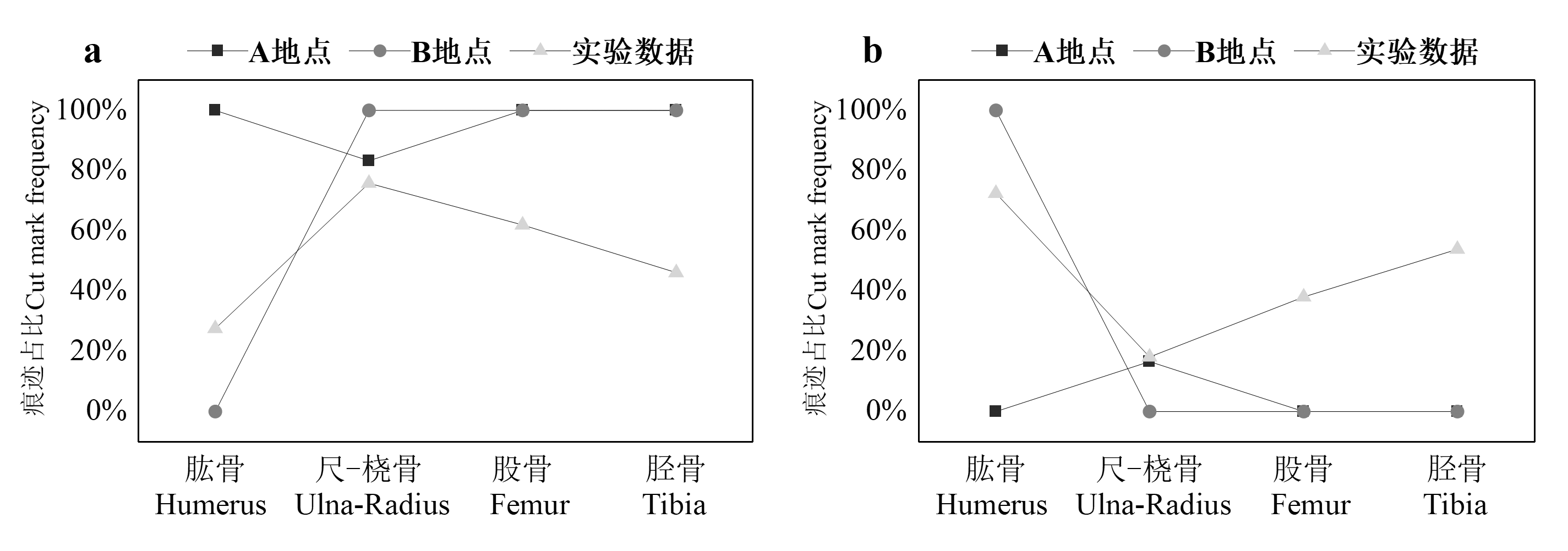
图4 蔡家沟A、B地点与实验数据的动物骨骼切割痕迹分布频率对比 实验数据均来自Domínguez-Rodrigo和 Barba[38]控制实验/The control experiments of Domínguez-Rodrigo & Barba[38]。 a. 肌肉组织被完全消耗的区域Hot Zones;b. 肌肉组织仍有残留的区域Cold Zones
Fig.4 Comparison of cut-mark distribution frequencies on animal bones between the Caijiagou-A and B assemblages and experimental data
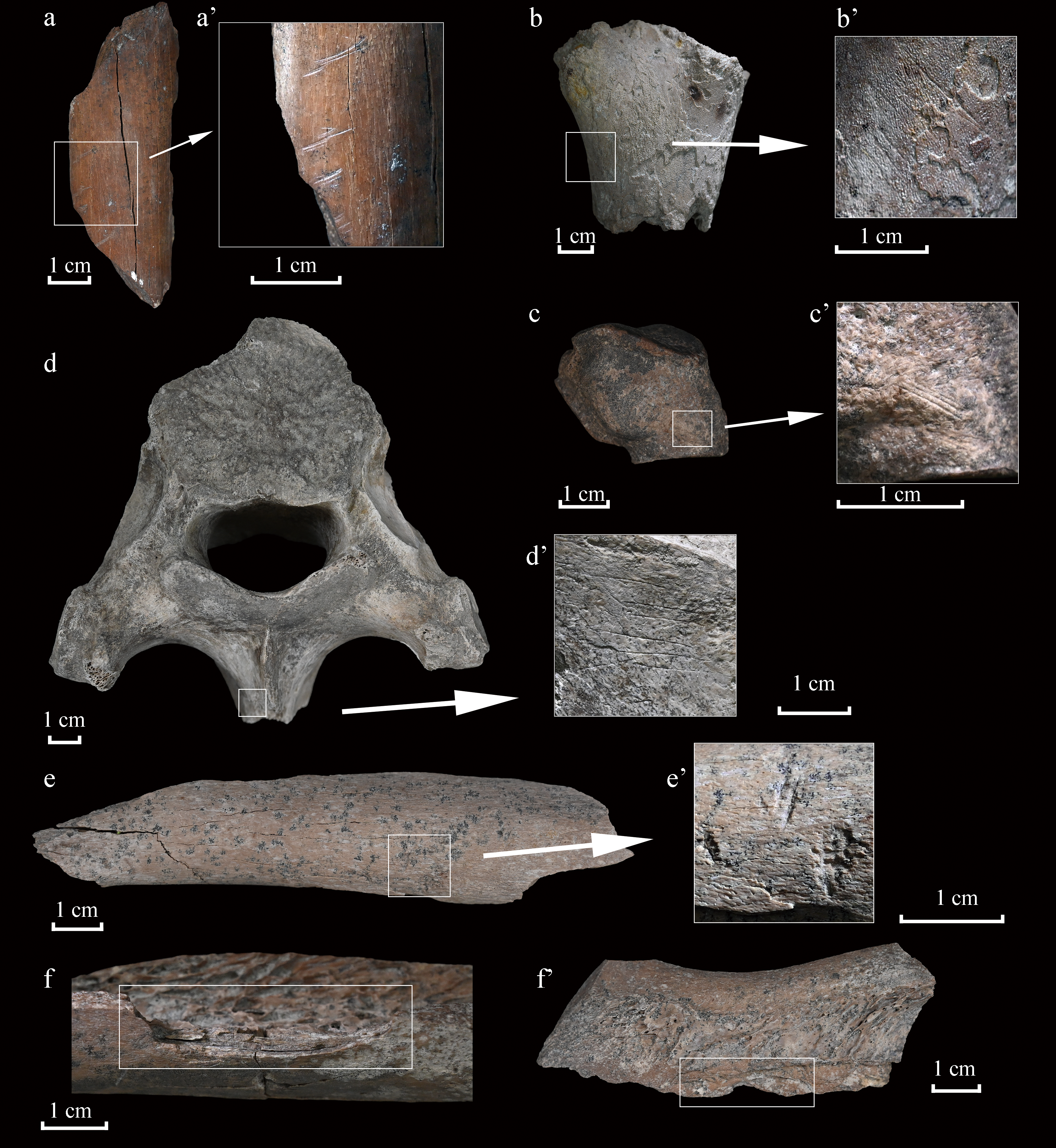
图5 蔡家沟遗址动物骨骼的切割痕迹(a-a’, b-b’, c-c’和d-d’)、砍砸痕(e-e’)与砍砸疤(f-f’)
Fig.5 Cut marks (a-a’, b-b’, c-c’ and d-d’), impact marks (e-e’) and percussion notches (f-f’) on animal bones at Caijiagou-A and B
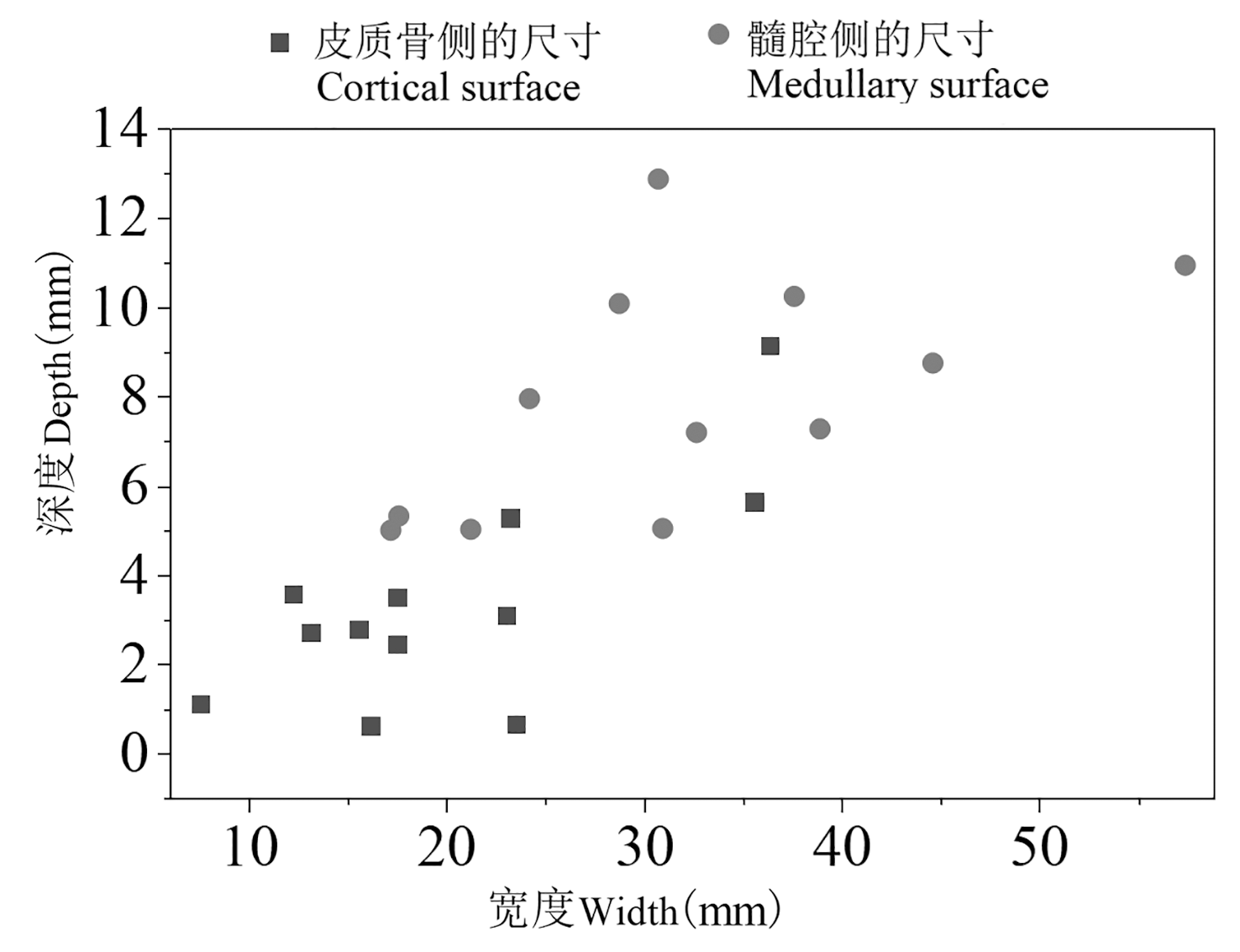
图6 蔡家沟遗址A、B地点动物骨骼凹形缺口的尺寸大小
Fig.6 Size data of notches on animal bones at Caijiagou-A and B
| [1] |
Norton CJ, Gao X. Hominin-carnivore interactions during the Chinese Early Paleolithic: Taphonomic perspectives from Xujiayao[J]. Journal of Human Evolution, 2008, 55(1): 164-178
doi: 10.1016/j.jhevol.2008.02.006 pmid: 18387651 |
| [2] | 张双权. 河南许昌灵井动物群的埋藏学研究[D]. 博士研究生毕业论文, 北京: 中国科学院大学, 2009 |
| [3] | 黄慰文, 侯亚梅, 斯信强, 等. 盘县大洞:贵州旧石器初期遗址综合研究[M]. 北京: 科学出版社, 2012 |
| [4] |
Li JS, Bunn HT, Zhang SQ, et al. Equid prey acquisition and Archaic Homo adaptability at the early Late Pleistocene site of Xujiayao, China[J]. International Journal of Osteoarchaeology, 2018, 28(1): 75-82
doi: 10.1002/oa.v28.1 URL |
| [5] | 王晓敏, 王法岗, 陈福友, 等. 泥河湾盆地板井子晚更新世遗址古人类对动物资源的消费策略[J]. 人类学学报, 2022, 41(6): 1005-1016 |
| [6] |
Xia H, Zhang DJ, Wang J, et al. Middle and Late Pleistocene Denisovan subsistence at Baishiya Karst Cave[J]. Nature, 2024, 632: 108-113
doi: 10.1038/s41586-024-07612-9 |
| [7] | Reitz EJ, Wing ES. Zooarchaeology[M]. Second edition, Cambridge: Cambridge University Press, 2008 |
| [8] |
Pineda A, Saladié P. Beyond the problem of bone surface preservation in taphonomic studies of Early and Middle Pleistocene open-air sites[J]. Journal of Archaeological Method and Theory, 2022, 29(4): 1090-1130
doi: 10.1007/s10816-022-09550-0 |
| [9] |
Stiner MC. Carnivory, coevolution, and the geographic spread of the genus Homo[J]. Journal of Archaeological Research, 2002, 10: 1-63
doi: 10.1023/A:1014588307174 |
| [10] |
Ferraro JV, Plummer TW, Pobiner BL, et al. Earliest archaeological evidence of persistent hominin carnivory[J]. PLOS One, 2013, 8(4): e62174
doi: 10.1371/journal.pone.0062174 URL |
| [11] |
Binford LR, Ho CK, Aigner JS, et al. Taphonomy at a distance: Zhoukoudian, the cave home of Beijing Man? [and Comments and Reply][J]. Current Anthropology, 1985, 26(4): 413-442
doi: 10.1086/203303 URL |
| [12] |
Binford LR, Stone NM, Aigner JS, et al. Zhoukoudian: A closer look (and Comments and Reply)[J]. Current Anthropology, 1986, 27(5): 453-475
doi: 10.1086/203469 URL |
| [13] |
Binford LR, Stone NM. On inferences from the Zhoukoudian fauna: Reply to Bunn and Kroll[J]. Current Anthropology, 1987, 28(3): 358-362
doi: 10.1086/203536 URL |
| [14] | Boaz NT, Ciochon RL, Xu QQ, et al. Large mammalian carnivores as a taphonomic factor in the bone accumulation at Zhoukoudian[J]. Acta Anthropologica Sinica, 2000, 19: 224-234 |
| [15] | Peterson CE, Shen C, Chen C, et al. Taphonomy of an Early Pleistocene archaeofauna from Xiaochangliang, Nihewan Basin, North China[A]. In: Shen C, Keates S. Current Research in the Chinese Pleistocene Archaeology[C]. Oxford: British Archaeological Reports, 2003 |
| [16] |
Shen C, Zhang XL, Gao X. Zhoukoudian in transition: Research history, lithic technologies, and transformation of Chinese Palaeolithic archaeology[J]. Quaternary International, 2016, 400: 4-13
doi: 10.1016/j.quaint.2015.10.001 URL |
| [17] | 张双权, 高星, 陈福友, 等. 周口店第一地点西剖面2009-2010年发掘报告[J]. 人类学学报, 2016, 35(1): 63-75 |
| [18] |
Gao X, Zhang SQ, Zhang Y, et al. Evidence of hominin use and maintenance of fire at Zhoukoudian[J], Current Anthropology, 2017, 58(16): S267-S277
doi: 10.1086/692501 URL |
| [19] | 杜雨薇, 张乐, 叶芷, 等. 蔚县盆地吉家庄旧石器遗址动物骨骼的埋藏学分析[J]. 人类学学报, 2023, 42(3): 359-372 |
| [20] | 王晓敏, 刘连强, 陈国鹏, 等. 泥河湾盆地马圈沟遗址哺乳动物破碎长骨反映的古人类行为[J]. 人类学学报, 2024, 43(1): 91-105 |
| [21] |
Deng CL, Zhu RX, Zhang R, et al. Timing of the Nihewan formation and faunas[J]. Quaternary Research, 2008, 69: 77-90
doi: 10.1016/j.yqres.2007.10.006 URL |
| [22] |
Ao H, An Z, Dekkers MJ, et al. Pleistocene magnetochronology of the fauna and Paleolithic sites in the Nihewan Basin: Significance for environmental and hominin evolution in North China[J]. Quaternary Geochronology, 2013, 18(6):78 92
doi: 10.1016/j.quageo.2013.06.004 URL |
| [23] | 马东东, 牛东伟, 裴树文, 等. 蔚县盆地2017-2018年旧石器考古调查简报[J]. 人类学学报, 2021, 40(1): 128-136 |
| [24] | Brain CK. The hunters or the hunted? An introduction to African cave taphonomy[M]. Chicago: University of Chicago Press, 1981 |
| [25] |
Bunn HT, Bartram LE, Kroll EM. Variability in bone assemblage formation from Hadza hunting, scavenging, and carcass processing[J]. Journal of Anthropological Archaeology, 1988, 7(4): 412-457
doi: 10.1016/0278-4165(88)90004-9 URL |
| [26] | Binford LR. Faunal remains from Klasies River Mouth[M]. Orlando: Academic Press, 1984 |
| [27] | 张乐, Norton CJ, 张双权, 等. 量化单元在马鞍山遗址动物骨骼研究中的运用[J]. 人类学学报, 2008, 27(1): 79-90 |
| [28] |
Villa P, Mahieu E. Breakage patterns of human long bones[J]. Journal of Human Evolution, 1991, 21: 27-48
doi: 10.1016/0047-2484(91)90034-S URL |
| [29] | Outram AK. The identification and Palaeoeconomic context of prehistoric bone marrow and grease exploitation[D]. PhD thesis, Durham: Durham University, 1998 |
| [30] |
Outram AK. A new approach to identifying bone marrow and grease exploitation: Why the “indeterminate’’ fragments should not be ignored[J]. Journal of Archaeological Science, 2001, 28: 401-410
doi: 10.1006/jasc.2000.0619 URL |
| [31] |
Johnson E, Parmenter PCP, Outram AK. A new approach to profiling taphonomic history through bone fracture analysis, with an example application to the Linearbandkeramik site of Ludwinowo 7[J]. Journal of Archaeological Science: Reports, 2016, 9: 623-629
doi: 10.1016/j.jasrep.2016.08.047 URL |
| [32] |
Behrensmeyer AK. Taphonomic and ecologic information from bone weathering[J]. Paleobiology, 1978, 4: 150-162
doi: 10.1017/S0094837300005820 URL |
| [33] |
Gümrükçü M, Pante MC. Assessing the effects of fluvial abrasion on bone surface modifications using high-resolution 3-D scanning[J]. Journal of Archaeological Science: Reports, 2018, 21: 208-221
doi: 10.1016/j.jasrep.2018.06.037 URL |
| [34] | Fernandez-Jalvo Y, Andrews P. Atlas of Taphonomic Identifications: 1001+ images of fossil and recent mammal bone modification[M]. Dordrecht: Springer, 2016 |
| [35] |
Potts R. Shipman P. Cutmarks made by stone tools on bones from Olduvai Gorge, Tanzania[J]. Nature, 1981, 291: 577-580
doi: 10.1038/291577a0 |
| [36] |
Blumenschine RJ, Marean CW, Capaldo SD. Blind tests of inter-analyst correspondence and accuracy in the identification of cut marks, percussion marks, and carnivore tooth marks on bone surfaces[J]. Journal of Archaeological Science, 1996, 23: 493-507
doi: 10.1006/jasc.1996.0047 URL |
| [37] | 张乐, 王春雪, 张双权, 等. 马鞍山旧石器时代遗址古人类行为的动物考古学研究[J]. 中国科学:地球科学, 2009, 1256-1265 |
| [38] | Domínguez-Rodrigo M, Barba R. The behavioral meaning of cut marks at the FLK Zinj level: the carnivore-hominid-carnivore hypothesis falsified (II)[A]. In: Domínguez Rodrigo M, Barba R, Egeland CP. Deconstructing Olduvai: A Taphonomic Study of the Bed I Sites[C]. Dordrecht: Springer, 2007, 75-100 |
| [39] |
Blumenschine RJ, Selvaggio MM. Percussion marks on bone surfaces as a new diagnostic of hominid behavior[J]. Nature, 1988, 333: 763-765
doi: 10.1038/333763a0 |
| [40] |
Capaldo SD, Blumenschine R. A quantitative diagnosis of notches made by hammerstone percussion and carnivore gnawing on bovid long bones[J]. American Antiquity. 1994, 59(4): 724-748
doi: 10.2307/282345 URL |
| [41] |
Galán AB, Rodríguez M, De Juana S, et al. A new experimental study on percussion marks and notches and their bearing on the interpretation of hammerstone-broken faunal assemblages[J]. Journal of Archaeological Science, 2009, 36(3): 776-784
doi: 10.1016/j.jas.2008.11.003 URL |
| [42] |
Lam YM, Chen XB, Pearson OM. Intertaxonomic variability in patterns of bone density and the differential representation of Bovid, Cervid, and Equid elements in the archaeological record[J]. American Antiquity, 1999, 64(2): 343-362
doi: 10.2307/2694283 URL |
| [43] | Binford LR. Bones: ancient men and modern myths[M]. New York: Academic Press, 1981 |
| [44] | Nilssen J. An actualistic butchery study in South Africa and its implications for reconstructing hominid strategies of carcass acquisition and butchery in the Upper Pleistocene and Plio-Pleistocene[D]. PhD thesis, Cape Town: University of Cape Town, 2000 |
| [45] |
Egeland CP, Pickering TR, Domínguez-Rodrigo M, et al. Disentangling Early Stone Age palimpsests: determining the functional independence of hominid- and carnivore-derived portions of archaeofaunas[J]. Journal of Human Evolution, 2004, 47(5): 343-357
pmid: 15530352 |
| [46] | Feh C, Boldsukh T, Tourenq C. Are family groups in equids a response to cooperative hunting by predators? The case of Mongolian Kulans (Equus hemionus luteus Matschie)[J]. Revue d’Écologie (La Terre et La Vie), 1994, 49(1): 11-20 |
| [47] | Stiner MC. Honor among Thieves: A zooarchaeological study of Neandertal ecology[M]. Princeton: Princeton University Press, 1994 |
| [48] | Gaudzinski S. On the variability of Middle Palaeolithic procurement tactics: the case of Salzgitter Lebenstedt, Northern Germany[J]. International Journal of Osteoarchaeology, 2000, 38: 497-521 |
| [49] |
Driver JC, Maxwell D. Bison death assemblages and the interpretation of human hunting behaviour[J]. Quaternary International, 2013, 297: 100-109
doi: 10.1016/j.quaint.2012.12.038 URL |
| [50] |
Discamps E, Costamagno S. Improving mortality profile analysis in zooarchaeology: A revised zoning for ternary diagrams[J]. Journal of Archaeological Science, 2015, 58: 62-76
doi: 10.1016/j.jas.2015.03.021 URL |
| [51] |
O’Connell JF, Hawkes K, Blurton-Jones NG. Patterns in the distribution, site structure and assemblage composition of Hadza kill-butchering sites[J]. Journal of Archaeological Science, 1992, 19(3): 319-345
doi: 10.1016/0305-4403(92)90020-4 URL |
| [52] |
Morin E. Fat composition and Nunamiut decision-making: a new look at the marrow and bone grease indices[J]. Journal of Archaeological Science, 2007, 34: 69-82
doi: 10.1016/j.jas.2006.03.015 URL |
| [1] | 裴树文, 牛东伟, 马东东. 泥河湾盆地蔚县中更新世古人类活动遗址的发现与科学价值[J]. 人类学学报, 2026, 45(03): 403-418. |
| [2] | 牛东伟, 刘尔凡, 薛峰, 谢飞. 河北怀来盆地古人类文化遗存的考古发现与研究[J]. 人类学学报, 2026, 45(03): 419-435. |
| [3] | 单佳璐, 李怡晓, 王法岗, 郭玉杰, 李锋. 泥河湾盆地新庙庄遗址2号地点2018年发现材料初步研究[J]. 人类学学报, 2026, 45(03): 447-461. |
| [4] | 沈柯, 李锋, 王晓敏, 王法岗, 郭北姮, 高星. 板井子遗址第2地点2023~2024年发掘报告[J]. 人类学学报, 2026, 45(03): 462-477. |
| [5] | 王心蕊, 张芷瑶, 黄冰柔, 王法岗, 郭玉杰. 泥河湾盆地武家梁旧石器遗址1号地点的光释光测年[J]. 人类学学报, 2026, 45(03): 489-499. |
| [6] | 耿帅杰, 裴树文, 杜雨薇, 徐静玥, 叶芷, 刘子仪. 泥河湾盆地蔚县蔡家沟遗址A地点发掘简报[J]. 人类学学报, 2026, 45(03): 500-514. |
| [7] | 叶芷, 裴树文, 马东东, 贾真秀, 王法岗, 杨海勇. 泥河湾盆地蔚县前上营遗址B地点发掘报告[J]. 人类学学报, 2026, 45(03): 515-531. |
| [8] | 刘子仪, 耿帅杰, 丁馨, 徐静玥, 叶芷, 牛东伟, 裴树文. 泥河湾盆地蔚县北官堡遗址B地点的埋藏过程[J]. 人类学学报, 2026, 45(03): 556-569. |
| [9] | 刘尔凡, 高佳璇, 牛东伟. 河北怀来盆地珠窝堡遗址出土的石制品[J]. 人类学学报, 2026, 45(03): 600-608. |
| [10] | 姚艳燕, 艾婉婷, 胡敏航, 付琼耀, 李国山, 钟洁美, 胡鹏程, 黄胜敏, 田淳, 梁华, 廖卫, 王伟, 易智星. 广西崇左岩利1号洞早-中更新世过渡期的巨猿化石[J]. 人类学学报, 2026, 45(02): 199-209. |
| [11] | 姚艳燕, 廖卫, 李炬平, 易智星, 田淳, 钟洁美, 高超, 王伟, 梁华. 广西崇左岩利2号洞发现中更新世早期的猩猩牙齿化石[J]. 人类学学报, 2026, 45(02): 210-223. |
| [12] | 王思元, 李金燕, 梁华, 谢耀樟, 廖卫, 王伟. 广西西部新发现的猩猩牙齿化石及其分类演化意义[J]. 人类学学报, 2026, 45(02): 224-235. |
| [13] | 赵海龙, 周天路, 马冲, 杨博灿, 贾倩. 河北泥河湾盆地东缘石器原料的开发与利用[J]. 人类学学报, 2026, 45(01): 34-45. |
| [14] | 董哲, 战世佳. 安徽地区发现的阿舍利大型工具[J]. 人类学学报, 2025, 44(06): 998-1008. |
| [15] | 刘武, 吴秀杰. 华龙洞古人类化石及其在人类演化上的意义[J]. 人类学学报, 2025, 44(05): 727-741. |
| 阅读次数 | ||||||
|
全文 |
|
|||||
|
摘要 |
|
|||||
 京ICP证05002819号-3