

主管:中国科学院
主办:中国科学院古脊椎动物与古人类研究所
出版:科学出版社
主办:中国科学院古脊椎动物与古人类研究所
出版:科学出版社
人类学学报 ›› 2025, Vol. 44 ›› Issue (06): 1034-1046.doi: 10.16359/j.1000-3193/AAS.2025.0095cstr: 32091.14.j.1000-3193/AAS.2025.0095
李三灵1( ), 刘亚林2, 赵文杰3, 陈清懿4, 李浩4()
收稿日期:2025-03-10
接受日期:2025-06-10
出版日期:2025-12-15
发布日期:2025-12-15
通讯作者:
李浩,研究员,主要从事旧石器考古研究。E-mail: 作者简介:李三灵,副研究员,主要从事旧石器考古研究。E-mail: lisanling@henu.edu.cn
基金资助:
LI Sanling1(), LIU Yalin2, ZHAO Wenjie3, CHEN Qingyi4, LI Hao4()
Received:2025-03-10
Accepted:2025-06-10
Online:2025-12-15
Published:2025-12-15
摘要:
石制品细小化现象在中国南方地区旧石器时代晚期广泛出现,但是学者对其出现时间和技术特征等问题的讨论比较有限。本文首先对细小石器技术的概念进行梳理和界定,并阐明其与小石器技术或小型石片石器技术的区别。在此基础上,较为系统地总结和介绍中国南方地区旧石器时代晚期细小石制品组合的发现和最新研究情况。我们认为:石制品细小化现象在我国南方地区出现的时间至少在距今4万年前,并延续至更新世末期,甚至进入全新世阶段;细小石制品组合的主要特征包括:对燧石、石英等硅质岩原料的选择偏好,石制品尺寸的显著细小化,使用砸击技术,制作琢背器等石器类型。这些特征与东南亚和南亚地区旧石器时代晚期石制品组合表现出较多相似性,很可能指示了人群和技术的跨区域扩散传播。
中图分类号:
李三灵, 刘亚林, 赵文杰, 陈清懿, 李浩. 中国南方旧石器时代晚期石制品细小化现象初探[J]. 人类学学报, 2025, 44(06): 1034-1046.
LI Sanling, LIU Yalin, ZHAO Wenjie, CHEN Qingyi, LI Hao. A preliminary exploration of the phenomenon of miniaturization of stone artifacts during the late Paleolithic period in South China[J]. Acta Anthropologica Sinica, 2025, 44(06): 1034-1046.
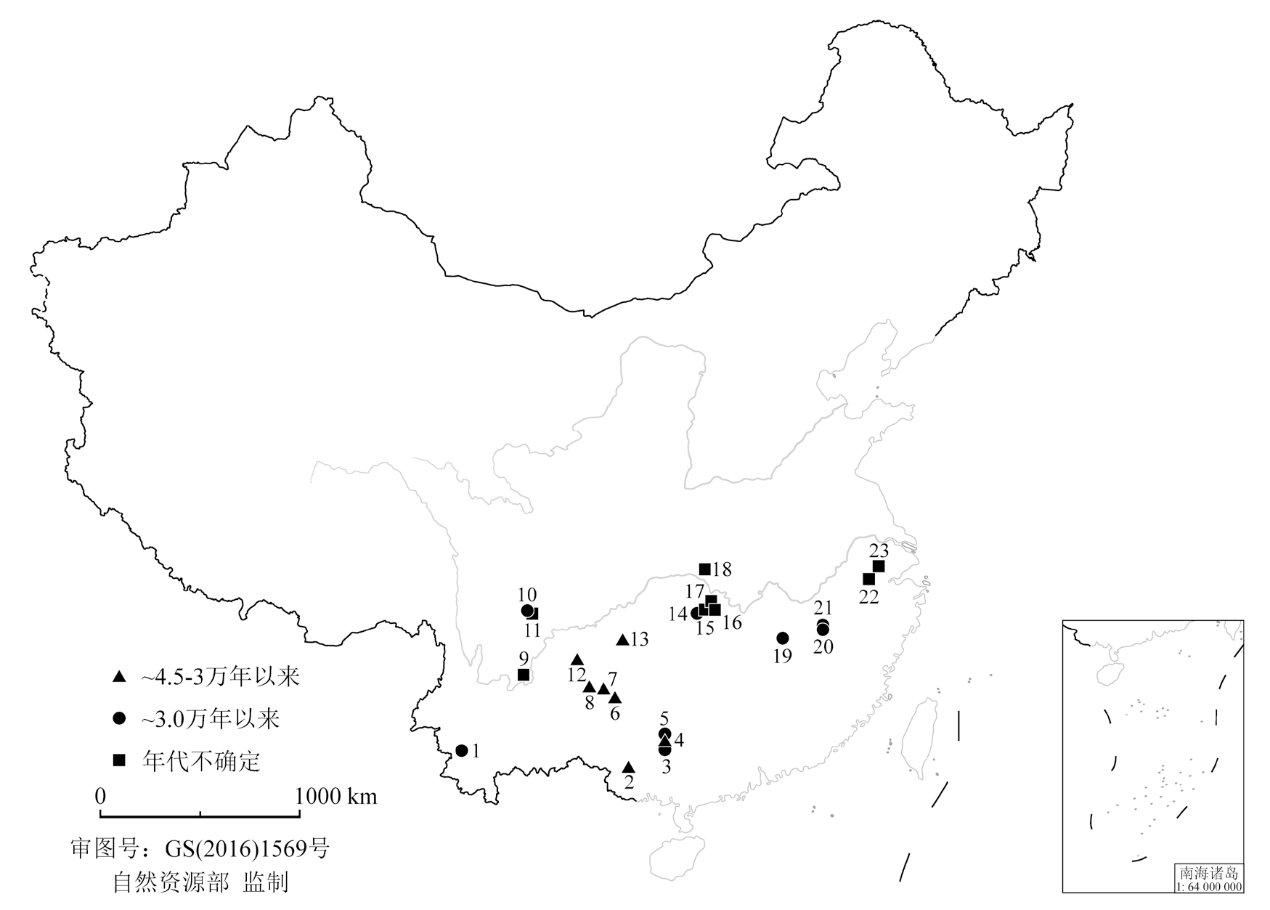
图1 中国南方旧石器时代晚期石制品细小化遗址分布 1.佛洞地 Fodongdi Cave;2.娅怀洞 Yahuai Cave;3.白莲洞 Bailian Cave;4.凤岩 Fengyan Cave;5.鲤鱼嘴 Liyuzui Rockshelter;6.大洞 Dadong Cave;7.招果洞 Zhaoguodong Cave;8.穿洞 Chuandong Cave;9.回龙湾 Huilongwan site;10.富林 Fulin site;11.狮子山 Shizishan site;12.老鸦洞 Laoya Cave;13.马鞍山 Ma’anshan Cave;14.燕耳洞 Yaner Cave;15.十里岗 Shiligang site;16.八十垱 Bashidang site;17.袁家山 Yuanjiashan site;18.夹口山 Jiakoushan site;19.上湖 Shanghu site;20.吊桶环 Diaotonghuan Cave;21.仙人洞 Xianrendong Cave;22.银锭岗 Yindinggang site;23.三山岛 Sanshandao site
Fig.1 Distribution of sites exhibiting lithic miniaturization in the Upper Paleolithic in southern China
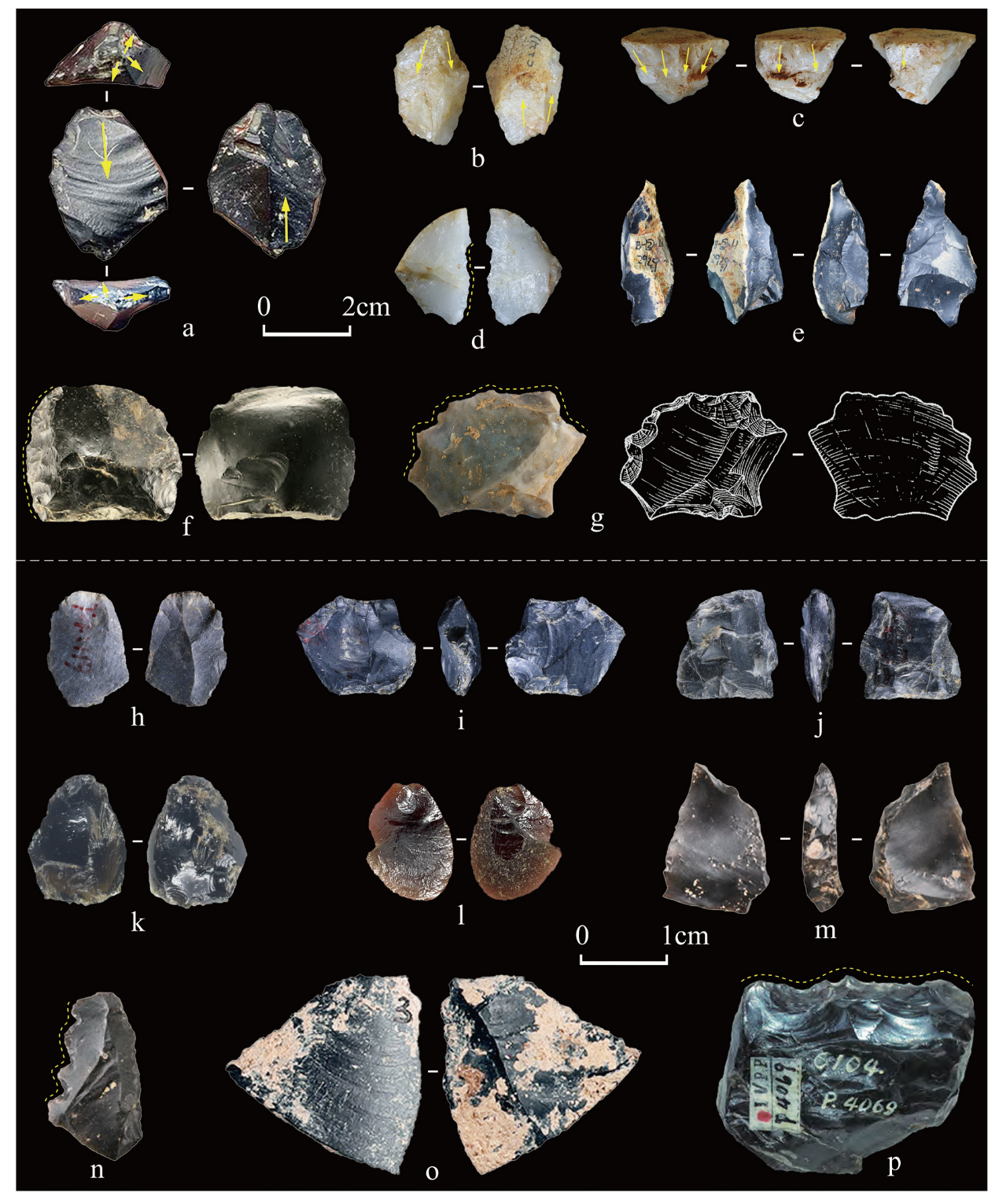
图2 中国南方旧石器时代晚期有代表性的细小石制品 a.砸击石核bipolar core,招果洞遗址Zhaoguodong Cave;b.砸击石核bipolar core,上湖遗址Shanghu site;c.锤击石核freehand core,上湖遗址Shanghu site;d.刮削器scraper,上湖遗址Shanghu site;e.尖状器point,上湖遗址Shanghu site;f.刮削器scraper,马鞍山遗址Ma’anshan Cave;g.刮削器scraper,凤岩遗址Fengyan Cave;h.砸击石片bipolar flake,银锭岗遗址Yindinggang site;i.砸击石核bipolar core,银锭岗遗址Yindinggang site;j.砸击石核bipolar core,银锭岗遗址Yindinggang site;k.砸击石核bipolar core,娅怀洞遗址Yahuai Cave;l.锤击石片freehand flake,娅怀洞遗址Yahuai Cave;m.琢背小刀backed knife,十里岗遗址Shiligang site;n.锯齿刃器denticulate,十里岗遗址Shiligang site;o.锤击石片freehand flake,招果洞遗址Zhaoguodong Cave;p.刮削器scraper,富林遗址Fulin site
Fig.2 The representative miniaturized lithics in the Upper Paleolithic in southern China
| [1] | 张森水. 管窥新中国旧石器考古学的重大发展[J]. 人类学学报, 1999, 3: 193-214 |
| [2] | 吕遵谔. 中国考古学研究的世纪回顾:旧石器时代考古卷[M]. 北京: 科学出版社, 2004 |
| [3] |
Bar-Yosef O, Wang YP. Paleolithic archaeology in China[J]. Annual review of anthropology, 2012, 41(1): 319-335
doi: 10.1146/anthro.2012.41.issue-1 URL |
| [4] | Gao X. Paleolithic cultures in China: Uniqueness and divergence[J]. Current Anthropology, 2013, 54(S8): 358-370 |
| [5] | 高星. 更新世东亚人群连续演化的考古证据及相关问题论述[J]. 人类学学报, 2014, 33(3): 237-253 |
| [6] | 张森水. 我国南方旧石器时代晚期文化的若干问题[J]. 人类学学报, 1983, 3: 218-230 |
| [7] | 广西柳州市白莲洞洞穴科学博物馆. 柳州白莲洞[M]. 北京: 科学出版社, 2009 |
| [8] | 北京大学考古文博学院, 江西省文物考古研究所. 仙人洞与吊桶环[M]. 北京: 文物出版社, 2014 |
| [9] |
Bar-Yosef O, Belfer-Cohen A. Following Pleistocene road signs of human dispersals across Eurasia[J]. Quaternary International, 2013, 285: 30-43
doi: 10.1016/j.quaint.2011.07.043 URL |
| [10] | 王幼平. 砾石工业传统与华南旧石器晚期文化[J]. 南方文物, 2021, 1: 91-97 |
| [11] | 王幼平. 华南晚更新世晚期人类行为复杂化的个案:江西万年吊桶环遗址的发现[J]. 人类学学报, 2016, 35(3): 397-406 |
| [12] |
Wang FG, Yang SX, Ge JY, et al. Innovative ochre processing and tool use in China 40,000 years ago[J]. Nature, 2022, 603(7900): 284-289
doi: 10.1038/s41586-022-04445-2 |
| [13] | 贾兰坡, 盖培, 尤玉桂. 山西峙峪旧石器时代遗址发掘报告[J]. 考古学报, 1972, 1: 39-58+135-136 |
| [14] | 王益人. 贾兰坡与华北两大旧石器传统[J]. 人类学学报, 2002, 3: 171-177 |
| [15] | 张森水. 中国北方旧石器工业的区域渐进与文化交流[J]. 人类学学报, 1990, 4: 322-333 |
| [16] | 杜水生, 刘富良. 华北北部小石器文化成因分析[J]. 考古学研究, 2008, 232-243 |
| [17] | 刘连强, 蒲昱晓, 侯佳岐, 等. 泥河湾盆地马圈沟遗址鱼咀沟1号地点2017-2018年发掘出土的石制品[J]. 人类学学报, 2024, 43(1): 40-54 |
| [18] | 王幼平. 华北晚更新世的石片石器[J]. 人类学学报, 2019, 38(4): 525-535 |
| [19] | 湖南省文物考古研究所, 石门县博物馆. 石门燕耳洞旧石器遗址试掘[J]. 湖南考古辑刊, 1994, 6: 1-7 |
| [20] | 袁家荣. 长江中游地区的旧石器时代考古[A]. 见:吕遵谔(编). 中国考古学研究的世纪回顾:旧石器时代考古卷[C]. 北京: 科学出版社, 2004, 370-391 |
| [21] | 蒋远金, 叶亮, 李刚. 浅析白莲洞遗址的石器工业[J]. 史前研究, 2009, 145-153 |
| [22] | 蒋远金, 刘文. 鲤鱼嘴遗址旧石器文化向新石器文化过渡的探讨[J]. 史前研究, 2004, 232-240 |
| [23] | 中国社会科学院考古研究所华南一队, 广西文物保护与考古研究所, 柳州白莲洞洞穴科学博物馆, 等. 广西柳州市凤岩遗址2023年发掘简报[J]. 考古, 2025, 2: 3-18 |
| [24] | 浣发祥, 杨石霞, 陈苇, 等. 四川汉源富林遗址石制品再研究[J]. 人类学学报, 2023, 42(2): 177-190 |
| [25] | 李浩. 探究早期现代人的南方扩散路线[J]. 人类学学报, 2022, 41(4): 630-648 |
| [26] | 李浩, 肖培源, 彭培洺, 等. 西南丝绸之路上的旧石器文化与人群交流[J]. 人类学学报, 2024, 43(6): 979-992 |
| [27] |
Pargeter J. Lithic miniaturization in late Pleistocene southern Africa[J]. Journal of Archaeological Science: Reports, 2016, 10: 221-236
doi: 10.1016/j.jasrep.2016.09.019 URL |
| [28] |
Pargeter J, Faith JT. Lithic miniaturization as adaptive strategy: A case study from Boomplaas Cave, South Africa[J]. Archaeological and Anthropological Sciences, 2020, 12(9): 225
doi: 10.1007/s12520-020-01176-1 |
| [29] |
Pargeter J, Shea JJ. Going big versus going small: Lithic miniaturization in hominin lithic technology[J]. Evolutionary Anthropology: Issues, News, and Reviews, 2019, 28(2): 72-85
doi: 10.1002/evan.v28.2 URL |
| [30] | Kuhn SL, Elston RG. Introduction:Thinking small globally[A]. In: Elston RG, Kuhn SL (eds.). Thinking small: Global perspectives on microlithization[C]. Washington: American Anthropological Association, 2002, 1-7 |
| [31] |
Brown KS, Marean CW, Jacobs Z, et al. An early and enduring advanced technology originating 71,000 years ago in South Africa[J]. Nature, 2012, 491(7425): 590-593
doi: 10.1038/nature11660 |
| [32] |
Mellars P. Going east: New genetic and archaeological perspectives on the modern human colonization of Eurasia[J]. Science, 2006, 313(5788): 796-800
doi: 10.1126/science.1128402 pmid: 16902130 |
| [33] |
McBrearty S, Brooks AS. The revolution that wasn’t: A new interpretation of the origin of modern human behavior[J]. Journal of human evolution, 2000, 39(5): 453-563
doi: 10.1006/jhev.2000.0435 URL |
| [34] |
Clarkson C, Harris C, Li B, et al. Human occupation of northern India spans the Toba super-eruption -74,000 years ago[J]. Nature Communications, 2020, 11(1): 961
doi: 10.1038/s41467-020-14668-4 pmid: 32098950 |
| [35] |
Clarkson C, Petraglia M, Korisettar R, et al. The oldest and longest enduring microlithic sequence in India: 35 000 years of modern human occupation and change at the Jwalapuram Locality 9 rockshelter[J]. Antiquity, 2009, 83(320): 326-348
doi: 10.1017/S0003598X0009846X URL |
| [36] | Wedage O, Picin A, Blinkhorn J, et al. Microliths in the South Asian rainforest -45-4 ka: New insights from Fa-Hien Lena Cave, Sri Lanka[J]. PloS One, 2019, 14(10): e0222606 |
| [37] | 李浩, 谢光茂, 李大伟, 等. 广西娅怀洞遗址B区出土的旧石器[J]. 人类学学报, 2025, 44(3): 404-412 |
| [38] | 李意愿. 石器工业与适应行为:澧水流域晚更新世古人类文化研究[M]. 上海: 上海古籍出版社, 2020 |
| [39] | 赵文杰, 李三灵, 李浩. 江西旧石器考古新发现与认识[J]. 南方文物, 2023, 6: 53-60 |
| [40] | 陈淳, 张祖方. 三山文化:江苏吴县三山岛旧石器时代晚期遗址发掘报告[J]. 南京博物院院刊, 1987, 1: 7-29 |
| [41] | 浙江省文物考古研究所, 长兴县文物保护管理所. 七里亭与银锭岗[M]. 北京: 科学出版社, 2009 |
| [42] | 钟倩, 向其芳, 李杭. 以夹口山遗址发掘为中心湖北当阳九里岗遗址群旧-新石器时代过渡阶段的探索[J]. 大众考古, 2024, 7: 20-29+98 |
| [43] | 李意愿, 谭远辉, 罗希, 等. 湖南澧县十里岗旧石器时代遗址发掘简报[J]. 考古与文物, 2020, 1: 3-13 |
| [44] | 袁家荣. 洞庭湖西部平原旧石器文化向新石器文化过渡的研究[J]. 考古学研究, 2008, 317-332 |
| [45] | 李意愿. 澧县袁家山遗址黑褐色土文化层出土石制品的初步研究[J]. 湖南考古辑刊, 2018, 214-225+376-377 |
| [46] | 李意愿. 十里岗遗址石制品微痕初步研究[J]. 湖南考古辑刊, 2016, 196-214 |
| [47] | 李三灵, 赵文杰, 高玉, 等. 江西高安盆地旧石器遗址调查简报[J]. 人类学学报, 2023, 42(6): 807-814 |
| [48] | 李三灵. MIS 2阶段江西上湖遗址古人类石器工业及流动策略研究[D]. 博士学位毕业论文, 北京: 北京师范大学, 2023 |
| [49] | 赵文杰, 贾真秀, 李三灵, 等. 2020年江西高安上湖旧石器遗址发掘报告[J]. 人类学学报, 2023, 42(3): 373-380 |
| [50] | 张兴龙, 姜铭, 黄明, 等. 贵州贵安新区岩孔村招果洞遗址2020年发掘简报[J]. 考古, 2024, 4: 3-20+129 |
| [51] | Lu HL, Zhang XL, Qin YP, et al. New Evidence of Human Occupation in Southwest China Since 44,800 Years ago[J]. Lithic Technology, 2024, 1-21 |
| [52] | 关莹, 蔡回阳, 王晓敏, 等. 贵州毕节老鸦洞遗址2013年发掘报告[J]. 人类学学报, 2015, 34(4): 461-477 |
| [53] | 关莹, 蔡回阳, 王新金, 等. 贵州毕节老鸦洞遗址1985年出土的石制品[J]. 人类学学报, 2017, 36(3): 304-317 |
| [54] | 胡晓纯, 高星. 贵州马鞍山遗址1986年出土石制品初步研究[J]. 人类学学报, 2022, 41(5): 788-803 |
| [55] | 张森水. 穿洞史前遗址(1981年发掘)初步研究[J]. 人类学学报, 1995, 2: 132-146+190-192 |
| [56] |
Zhao M, Shen GJ, He JN, et al. AMS 14C dating of the hominin archaeological site Chuandong Cave in Guizhou Province, southwestern China[J]. Quaternary International, 2017, 447: 102-110
doi: 10.1016/j.quaint.2017.04.037 URL |
| [57] |
Wang YN, Zhang XL, Sun XF, et al. A new chronological framework for Chuandong Cave and its implications for the appearance of modern humans in southern China[J]. Journal of Human Evolution, 2023, 178: 103344
doi: 10.1016/j.jhevol.2023.103344 URL |
| [58] | 张兴龙, 毕忠荣, 龙小平, 等. 贵州清水苑大洞遗址发掘简报[J]. 人类学学报, 2017, 36(4): 512-526 |
| [59] |
Huan FX, Yang SX, Gao F, et al. Technological diversity in the tropical-subtropical zone of Southwest China during the terminal Pleistocene: Excavations at Fodongdi Cave[J]. Archaeological and Anthropological Sciences, 2024, 16(1): 25
doi: 10.1007/s12520-023-01928-9 |
| [60] | Huan FX, Yang SX, Marwick B, et al. Lithic miniaturization in South China since the terminal Pleistocene: A multivariate analysis of lithic reduction from Fodongdi, Fulin and Xiqiaoshan[J]. Journal of Geographical Sciences, 2025, 1-23 |
| [61] | 郑喆轩, 李文成, 柳江, 等. 四川攀枝花市回龙湾洞穴遗址1987年发掘石制品整理简报[J]. 四川文物, 2021, 4: 4-13+2 |
| [62] | 张森水. 富林文化[J]. 古脊椎动物与古人类, 1977, 1: 14-27+83-85 |
| [63] | 陈全家. 四川汉源狮子山旧石器[J]. 人类学学报, 1991, 1: 42-49+88 |
| [64] |
Anderson DD. Cave archaeology in southeast Asia[J]. Geoarchaeology: An International Journal, 1997, 12(6): 607-638
doi: 10.1002/(ISSN)1520-6548 URL |
| [65] |
Shipton C, O’Connor S, Jankowski N, et al. A new 44,000-year sequence from Asitau Kuru (Jerimalai), Timor-Leste, indicates long-term continuity in human behaviour[J]. Archaeological and Anthropological Sciences, 2019, 11: 5717-5741
doi: 10.1007/s12520-019-00840-5 |
| [66] | Reynolds T, Barker G. Reconstructing Late Pleistocene climates, landscapes, and human activities in northern Borneo from excavations in the Niah Caves[A]. In: Kaifu Y, Izuho M, Goebel T, et al (eds.). Emergence and diversity of modern human behavior in Paleolithic Asia[C]. College Station: Texas A&M University Press, 2015, 140-157 |
| [67] |
Shipton C, Blinkhorn J, Archer W, et al. The Middle to Later Stone Age transition at Panga ya Saidi, in the tropical coastal forest of eastern Africa[J]. Journal of human Evolution, 2021, 153: 102954
doi: 10.1016/j.jhevol.2021.102954 URL |
| [68] |
Villa P, Soriano S, Tsanova T, et al. Border cave and the beginning of the later stone age in South Africa[J]. Proceedings of the National Academy of Sciences, 2012, 109(33): 13208-13213
doi: 10.1073/pnas.1202629109 URL |
| [69] |
McCall GS, Thomas JT. Re-examining the South African Middle-to-Later Stone Age transition: Multivariate analysis of the Umhlatuzana and Rose Cottage Cave stone tool assemblages[J]. Azania: Archaeological Research in Africa, 2009, 44(3): 311-330
doi: 10.1080/00672700903337519 URL |
| [70] |
Roberts P, Boivin N, Petraglia M. The Sri Lankan ‘microlithic’tradition c. 38,000 to 3,000 years ago: Tropical technologies and adaptations of Homo sapiens at the southern edge of Asia[J]. Journal of World Prehistory, 2015, 28: 69-112
doi: 10.1007/s10963-015-9085-5 URL |
| [71] |
Petraglia M, Clarkson C, Boivin N, et al. Population increase and environmental deterioration correspond with microlithic innovations in South Asia ca. 35,000 years ago[J]. Proceedings of the National Academy of Sciences, 2009, 106(30): 12261-12266
doi: 10.1073/pnas.0810842106 URL |
| [72] | Sano K, Arrighi S, Stani C, et al. The earliest evidence for mechanically delivered projectile weapons in Europe[J]. Nature ecology & evolution, 2019, 3(10): 1409-1414 |
| [73] | Wedage O, Amano N, Langley MC, et al. Specialized rainforest hunting by Homo sapiens -45,000 years ago[J]. Nature Communications, 2019, 10(1): 08623-1 |
| [74] |
Perera N, Kourampas N, Simpson IA, et al. People of the ancient rainforest: Late Pleistocene foragers at the Batadomba-lena rockshelter, Sri Lanka[J]. Journal of human evolution, 2011, 61(3): 254-269
doi: 10.1016/j.jhevol.2011.04.001 pmid: 21777951 |
| [75] |
Barker G, Barton H, Bird M, et al. The ‘human revolution’in lowland tropical Southeast Asia: The antiquity and behavior of anatomically modern humans at Niah Cave (Sarawak, Borneo)[J]. Journal of human evolution, 2007, 52(3): 243-261
doi: 10.1016/j.jhevol.2006.08.011 URL |
| [76] | 张双权, 裴树文, 张乐, 等. 水洞沟遗址第7地点动物化石初步研究[J]. 人类学学报, 2014, 33(3): 343-354 |
| [77] | 张乐, 王春雪, 张双权, 等. 马鞍山旧石器时代遗址古人类行为的动物考古学研究[J]. 中国科学(D辑:地球科学), 2009, 39(9): 1256-1265 |
| [78] | 宋艳波, 谢光茂, 赵文丫. 广西隆安娅怀洞遗址出土动物遗存初步研究[J]. 第四纪研究, 2020, 40(2): 344-346+348-353 |
| [79] |
Knutsson H, Knutsson K, Taipale N, et al. How shattered flakes were used: Micro-wear analysis of quartz flake fragments[J]. Journal of Archaeological Science: Reports, 2015, 2: 517-531
doi: 10.1016/j.jasrep.2015.04.008 URL |
| [80] | Delagnes A, Wadley L, Villa P, et al. Crystal quartz backed tools from the Howiesons Poort at Sibudu Cave[J]. Southern African Humanities, 2006, 18(1): 43-56 |
| [81] |
Hiscock P. Making it small in the Palaeolithic: Bipolar stone-working, miniature artefacts and models of core recycling[J]. World Archaeology, 2015, 47(1): 158-169
doi: 10.1080/00438243.2014.991808 URL |
| [82] |
Horta P, Bicho N, Cascalheira J. Lithic bipolar methods as an adaptive strategy through space and time[J]. Journal of Archaeological Science: Reports, 2022, 41: 103263
doi: 10.1016/j.jasrep.2021.103263 URL |
| [83] | Delpiano D, Gravina B, Peresani M. Back(s) to basics: The concept of backing in stone tool technologies for tracing hominins’ technical innovations[J]. Evolutionary Anthropology: Issues, News, and Reviews, 2024, 33(6): e22045 |
| [84] |
Pargeter J, Chen C, Buchanan B, et al. Stone tool backing and adhesion in hunting weaponry: First results of an experimental program[J]. Journal of Archaeological Science: Reports, 2022, 45: 103639
doi: 10.1016/j.jasrep.2022.103639 URL |
| [85] | 陈宥成, 曲彤丽. 试论旧大陆旧石器时代琢背刀[J]. 北方文物, 2021, 4: 24-32 |
| [1] | 郭晓明, 刘惜祯, 刘恒, 王春雪, 王法岗. 泥河湾盆地益堵泉旧石器时代晚期遗址2019年发掘简报[J]. 人类学学报, 2026, 45(03): 478-488. |
| [2] | 薛峰, 杨诗雨, 梅惠杰, 梁立雪, 魏屹, 牛东伟, 李鼎元. 河北怀来南家沟遗址2016年发掘报告[J]. 人类学学报, 2026, 45(03): 609-622. |
| [3] | 姚艳燕, 艾婉婷, 胡敏航, 付琼耀, 李国山, 钟洁美, 胡鹏程, 黄胜敏, 田淳, 梁华, 廖卫, 王伟, 易智星. 广西崇左岩利1号洞早-中更新世过渡期的巨猿化石[J]. 人类学学报, 2026, 45(02): 199-209. |
| [4] | 易智星, 仇若萱, 王伟, 廖卫, 梁华, 田淳, 米尔阿迪力·吐尔逊江, 张一景, 姚艳燕. 更新世中晚期猩猩第四乳前臼齿的三维釉质厚度[J]. 人类学学报, 2026, 45(02): 248-257. |
| [5] | 宋艳花, 吴梦遥, 吴洋, 郭军亮, 马峰, 张建军, 吴小红, 郭玉杰. 山西阳城析城山遗址第1和第2地点发掘报告[J]. 人类学学报, 2026, 45(02): 358-371. |
| [6] | 薛峰, 牛东伟, 李鼎元. 怀来盆地南家沟旧石器时代遗址2015年度发掘报告[J]. 人类学学报, 2026, 45(02): 372-386. |
| [7] | 徐廷, 黄抡月, 任进成, 葛俊逸, 高星. 吉林省抚松县枫林遗址第2地点发掘简报[J]. 人类学学报, 2026, 45(01): 174-186. |
| [8] | 李璇, 顾雪军. 2015~2018年河南栾川龙泉洞遗址发掘简报[J]. 人类学学报, 2025, 44(04): 714-726. |
| [9] | 谢光茂, 林强, 余明辉, 卢杰英. 广西隆安娅怀洞遗址发掘报告[J]. 人类学学报, 2025, 44(03): 365-388. |
| [10] | 谢颖, 付琳. 广西隆安娅怀洞遗址出土的穿孔石器[J]. 人类学学报, 2025, 44(03): 439-450. |
| [11] | 胡章华, 陈洪波, 谢莉, 王雨晴, 谢光茂. 广西娅怀洞遗址出土的蚌器[J]. 人类学学报, 2025, 44(03): 477-487. |
| [12] | 李浩, 谢光茂, 李大伟, 李三灵, 肖培源, 陈清懿, 王雨晴, 贾真秀, 吴雁, 卢杰英. 广西娅怀洞遗址B区出土的旧石器[J]. 人类学学报, 2025, 44(03): 404-412. |
| [13] | 王颖, 张乐, 杨石霞, 张双权. 山西峙峪遗址出土动物骨骼的埋藏学[J]. 人类学学报, 2025, 44(02): 255-269. |
| [14] | 蔡馨毅, 杜水生. 山西下川遗址水井背地点石核的剥片技术[J]. 人类学学报, 2025, 44(01): 14-26. |
| [15] | 刘鸿丰, 曹艳朋, 楚小龙, 高星. 淅川下寨遗址出土石制品的锐棱砸击技术[J]. 人类学学报, 2025, 44(01): 27-41. |
| 阅读次数 | ||||||
|
全文 |
|
|||||
|
摘要 |
|
|||||
 京ICP证05002819号-3