

主管:中国科学院
主办:中国科学院古脊椎动物与古人类研究所
出版:科学出版社
主办:中国科学院古脊椎动物与古人类研究所
出版:科学出版社
人类学学报 ›› 2025, Vol. 44 ›› Issue (03): 389-403.doi: 10.16359/j.1000-3193/AAS.2025.0034cstr: 32091.14.j.1000-3193/AAS.2025.0034
贺乐天1( ), 谢光茂2,3(), 林强3, 李大伟4, 吴秀杰1
收稿日期:2024-01-05
修回日期:2024-03-25
出版日期:2025-06-15
发布日期:2025-06-15
通讯作者:
谢光茂,研究员,主要从事史前考古研究。E-mail: 作者简介:贺乐天,副研究员,主要从事古人类学研究。E-mail: heletian@ivpp.ac.cn
基金资助:
HE Letian1(), XIE Guangmao2,3(), LIN Qiang3, LI Dawei4, WU Xiujie1
Received:2024-01-05
Revised:2024-03-25
Online:2025-06-15
Published:2025-06-15
摘要:
获得个体准确的性别和年龄信息是生物人类学研究的基础。受演化特点和保存程度的限制,古人类化石的性别和年龄鉴定经常存在争议。本文以广西娅怀洞遗址出土的更新世晚期头骨、下颌骨及牙齿为研究对象,使用肉眼观察、测量、micro-CT扫描等方法辅助对其性别和年龄进行判断。娅怀洞1号个体头骨和下颌骨形态的观测及对比分析表明,其为女性的可能性大。基于该个体头骨骨缝愈合的情况、头骨的多项特征以及对其牙齿磨耗与年龄关系的校正,我们认为其死亡年龄在30~40岁。
中图分类号:
贺乐天, 谢光茂, 林强, 李大伟, 吴秀杰. 广西更新世晚期娅怀洞人的性别与年龄[J]. 人类学学报, 2025, 44(03): 389-403.
HE Letian, XIE Guangmao, LIN Qiang, LI Dawei, WU Xiujie. Sex and age-at-death of the Yahuai Cave Man from the Late Pleistocene of Guangxi[J]. Acta Anthropologica Sinica, 2025, 44(03): 389-403.
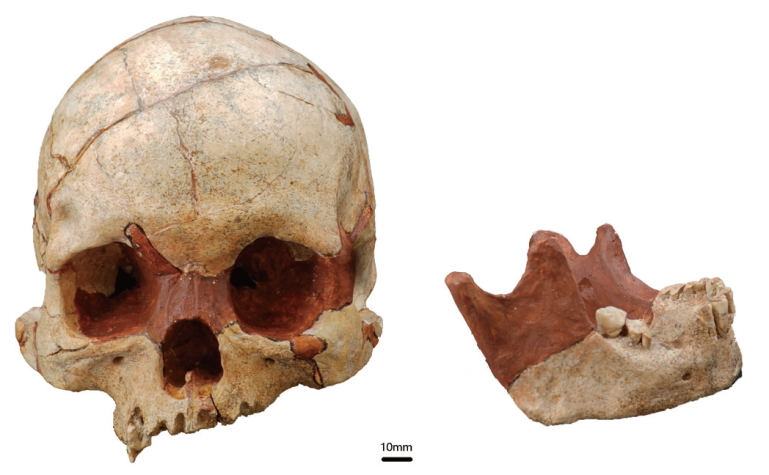
图1 YH1头骨(左)及下颌骨(右)
Fig.1 Crania (left) and mandible (right) of YH1
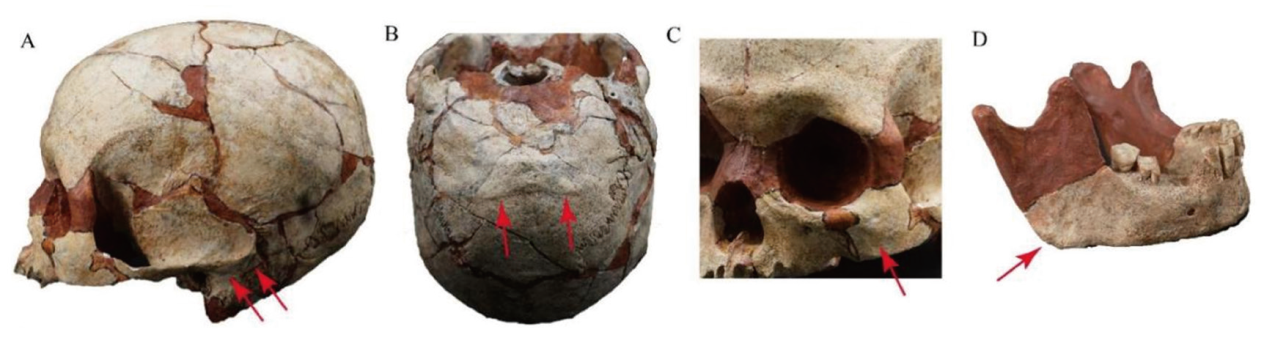
图2 YH1头骨及下颌骨的部分形态特征 A. 乳突上嵴 supramastoid crest;B. 枕圆枕 occipital torus;C. 颧结节 malar tubercles;D. 下颌角咬肌附着处masseter attachment of the mandibular angle
Fig.2 Some morphological features of the crania and mandible of the YH1
| 性别Gender | 颅长g-op | 颅宽eu-eu | 颅高ba-b | 最小额宽ft-ft | 最大额宽co-co | 额弦n-b | 顶弦b-l | 颧宽zy-zy | 上面高n-sd | |
|---|---|---|---|---|---|---|---|---|---|---|
| 山顶洞101 (UC101) | 男 M | 204.0 | 143.0 | 136.0 | 107.0 | 143.0 | 115.5 | 120.8 | 143.0 | 77.0 |
| Wadjak-1 | 男 M | 200.0 | 151.0 | 137.0 | 97.0 | / | 115.0 | 117.0 | 144.0 | 66.0 |
| 柳江人Liujiang | 男 M | 189.3 | 142.2 | 134.8 | 95.2 | / | 117.2 | 119.2 | 136.0 | 67.9 |
| Minatogawa I | 男 M | 182.0 | 148.0 | 134.0 | 89.0 | / | 115.0 | 117.0 | 144.0 | 63.0 |
| 平均值Mean | 193.8 | 146.1 | 135.5 | 97.1 | 143.0 | 115.7 | 118.5 | 141.8 | 68.5 | |
| Moh Khiew Cave | 女 F | / | / | / | / | 118.0 | / | / | / | 67.0 |
| Niah Cave | 女 F | 175.0 | 145.0 | / | / | / | / | / | / | / |
| 山顶洞103 (UC103) | 女 F | 184.0 | 131.0 | 143.0 | 101.0 | 137.0 | 107.0 | 120.0 | 131.0 | 68.5 |
| Hang Cho Cave | 女 F | 192.0 | 138.0 | 135.0 | 100.0 | 112.0 | 130.0 | 117.0 | 128.0 | 61.0 |
| 平均值Mean | 女 F | 190.0 | 143.0 | 136.5 | 98.0 | 130.6 | 116.5 | 118.5 | 138. 3 | 67.4 |
| 娅怀洞Yahuai | 188.9 | 145.5 | 141.2 | 109.0 | 130.0 | 118.0 | 122.9 | 146.4 | 62.0 |
表1 与更新世晚期人类头骨化石部分测量项目的比较(mm)
Tab.1 Comparison with some measurements of late Pleistocene human skull fossils
| 性别Gender | 颅长g-op | 颅宽eu-eu | 颅高ba-b | 最小额宽ft-ft | 最大额宽co-co | 额弦n-b | 顶弦b-l | 颧宽zy-zy | 上面高n-sd | |
|---|---|---|---|---|---|---|---|---|---|---|
| 山顶洞101 (UC101) | 男 M | 204.0 | 143.0 | 136.0 | 107.0 | 143.0 | 115.5 | 120.8 | 143.0 | 77.0 |
| Wadjak-1 | 男 M | 200.0 | 151.0 | 137.0 | 97.0 | / | 115.0 | 117.0 | 144.0 | 66.0 |
| 柳江人Liujiang | 男 M | 189.3 | 142.2 | 134.8 | 95.2 | / | 117.2 | 119.2 | 136.0 | 67.9 |
| Minatogawa I | 男 M | 182.0 | 148.0 | 134.0 | 89.0 | / | 115.0 | 117.0 | 144.0 | 63.0 |
| 平均值Mean | 193.8 | 146.1 | 135.5 | 97.1 | 143.0 | 115.7 | 118.5 | 141.8 | 68.5 | |
| Moh Khiew Cave | 女 F | / | / | / | / | 118.0 | / | / | / | 67.0 |
| Niah Cave | 女 F | 175.0 | 145.0 | / | / | / | / | / | / | / |
| 山顶洞103 (UC103) | 女 F | 184.0 | 131.0 | 143.0 | 101.0 | 137.0 | 107.0 | 120.0 | 131.0 | 68.5 |
| Hang Cho Cave | 女 F | 192.0 | 138.0 | 135.0 | 100.0 | 112.0 | 130.0 | 117.0 | 128.0 | 61.0 |
| 平均值Mean | 女 F | 190.0 | 143.0 | 136.5 | 98.0 | 130.6 | 116.5 | 118.5 | 138. 3 | 67.4 |
| 娅怀洞Yahuai | 188.9 | 145.5 | 141.2 | 109.0 | 130.0 | 118.0 | 122.9 | 146.4 | 62.0 |
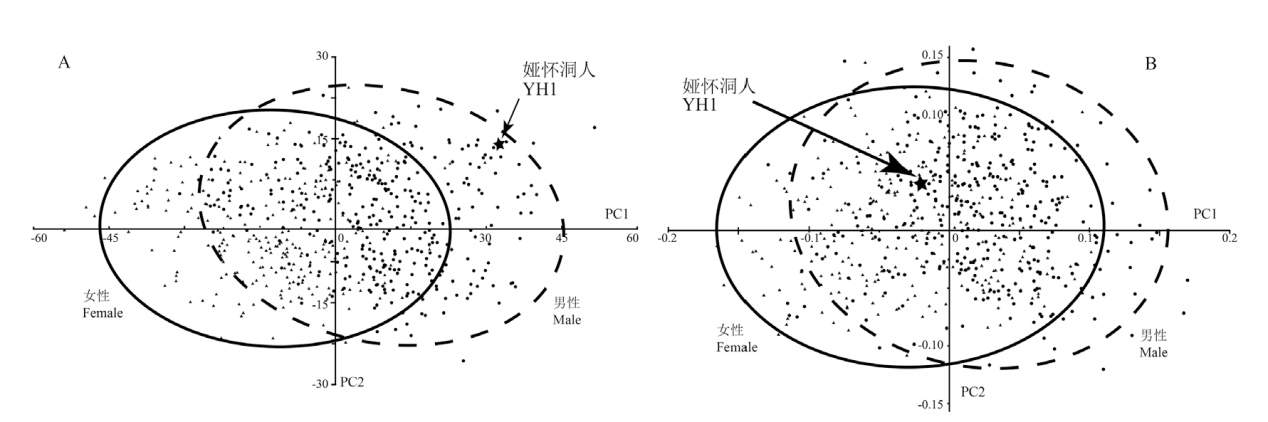
图3 YH1与对比组人群头骨测量原始数据及校正数据的主成分分析
Fig.3 Principal component analysi of the original and corrected craniofacial measurements of the YH1 and comparison group A.原始数据 diagram A shows the raw data; B.校正后的数据 diagram B shows the corrected data.虚线圈内为男性95%置信区间,实线圈内为女性95%置信区间95% confidence interval for male in the dashed circle, and 95% confidence interval for for female in the solid circle
| 山顶洞 UC101 | 山顶洞UC108 | 山顶洞UC104 | 新石器时代Neo 1 | 新石器时代Neo 2 | 娅怀洞1号YH1 | |
|---|---|---|---|---|---|---|
| 性别Sex | 男 Male | 男 Male | 女 Female | 男 Male | 女 Female | |
| 下颌体长Length of body (mm) | 90.7 | / | 78.7 | 77.2 | 74.2 | (75) |
| 下颌角间宽Bigonial breadth (mm) | 116.0 | / | 100.0 | 104.6 | 100.0 | (105) |
| 下颌骨弧Arc of body (mm) | 228.0 | / | 192.0 | 200.3 | 190.4 | (183.7) |
| 下颌体高(M1/M2)Corpus height at M1/M2 (mm) | 33.6 | 30.8 | 26.2 | 32.0 | 29.2 | 32.7 |
| 下颌体高(颏孔处)Corpus height at mental foramen (mm) | 35.0 | 31.3 | 29.9 | 32.9 | 30.1 | 32.8 |
| 下颌体厚(M1/M2)Corpus thickness at M1/M2 (mm) | 13.6 | 12.4 | 15.0 | 15.5 | 14.6 | 15.7 |
| 下颌体厚(颏孔)Corpus thickness at mental foramen (mm) | 12.0 | 11.3 | 12.3 | 13.8 | 12.7 | 13.1 |
| 粗壮指数(M1/M2)Corpus robusticity index at M1/M2 | 40.5 | 40.3 | 57.3 | 48.4 | 50.0 | 48.0 |
| 粗壮指数(颏孔)Corpus robusticity index at mental foramen | 34.3 | 35.8 | 41.1 | 42.0 | 42.2 | 39.7 |
表2 与对比组下颌骨部分测量项目的比较
Tab.2 Comparison of some mandibular measurement values with other human fossils and population groups
| 山顶洞 UC101 | 山顶洞UC108 | 山顶洞UC104 | 新石器时代Neo 1 | 新石器时代Neo 2 | 娅怀洞1号YH1 | |
|---|---|---|---|---|---|---|
| 性别Sex | 男 Male | 男 Male | 女 Female | 男 Male | 女 Female | |
| 下颌体长Length of body (mm) | 90.7 | / | 78.7 | 77.2 | 74.2 | (75) |
| 下颌角间宽Bigonial breadth (mm) | 116.0 | / | 100.0 | 104.6 | 100.0 | (105) |
| 下颌骨弧Arc of body (mm) | 228.0 | / | 192.0 | 200.3 | 190.4 | (183.7) |
| 下颌体高(M1/M2)Corpus height at M1/M2 (mm) | 33.6 | 30.8 | 26.2 | 32.0 | 29.2 | 32.7 |
| 下颌体高(颏孔处)Corpus height at mental foramen (mm) | 35.0 | 31.3 | 29.9 | 32.9 | 30.1 | 32.8 |
| 下颌体厚(M1/M2)Corpus thickness at M1/M2 (mm) | 13.6 | 12.4 | 15.0 | 15.5 | 14.6 | 15.7 |
| 下颌体厚(颏孔)Corpus thickness at mental foramen (mm) | 12.0 | 11.3 | 12.3 | 13.8 | 12.7 | 13.1 |
| 粗壮指数(M1/M2)Corpus robusticity index at M1/M2 | 40.5 | 40.3 | 57.3 | 48.4 | 50.0 | 48.0 |
| 粗壮指数(颏孔)Corpus robusticity index at mental foramen | 34.3 | 35.8 | 41.1 | 42.0 | 42.2 | 39.7 |
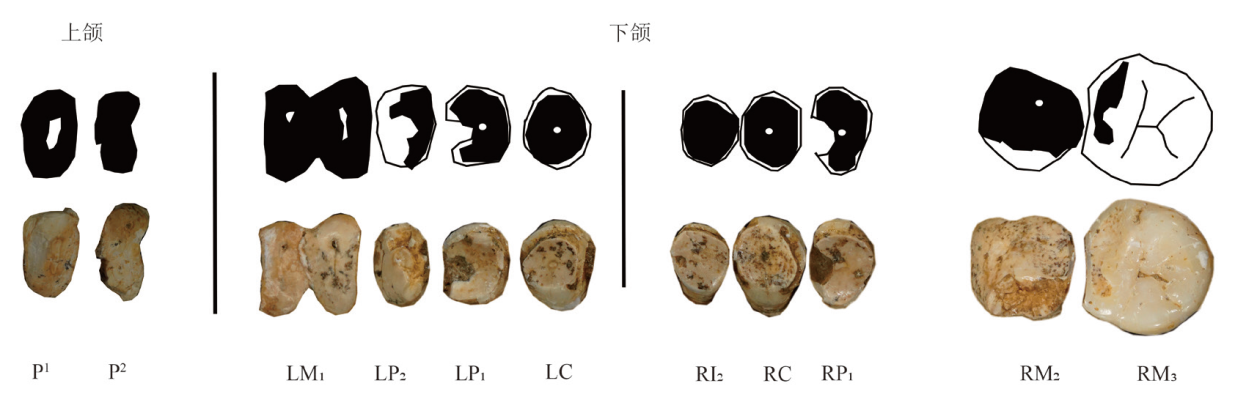
图4 YH1牙齿磨耗情况及示意图 外围白色代表牙釉质,黑色代表暴露的牙本质,中心白色代表暴露的牙髓腔 the outer white represents the enamel, the black represents the exposed dentin, and the central white represents the exposed pulp cavity
Fig.4 The dental wear of the YH1
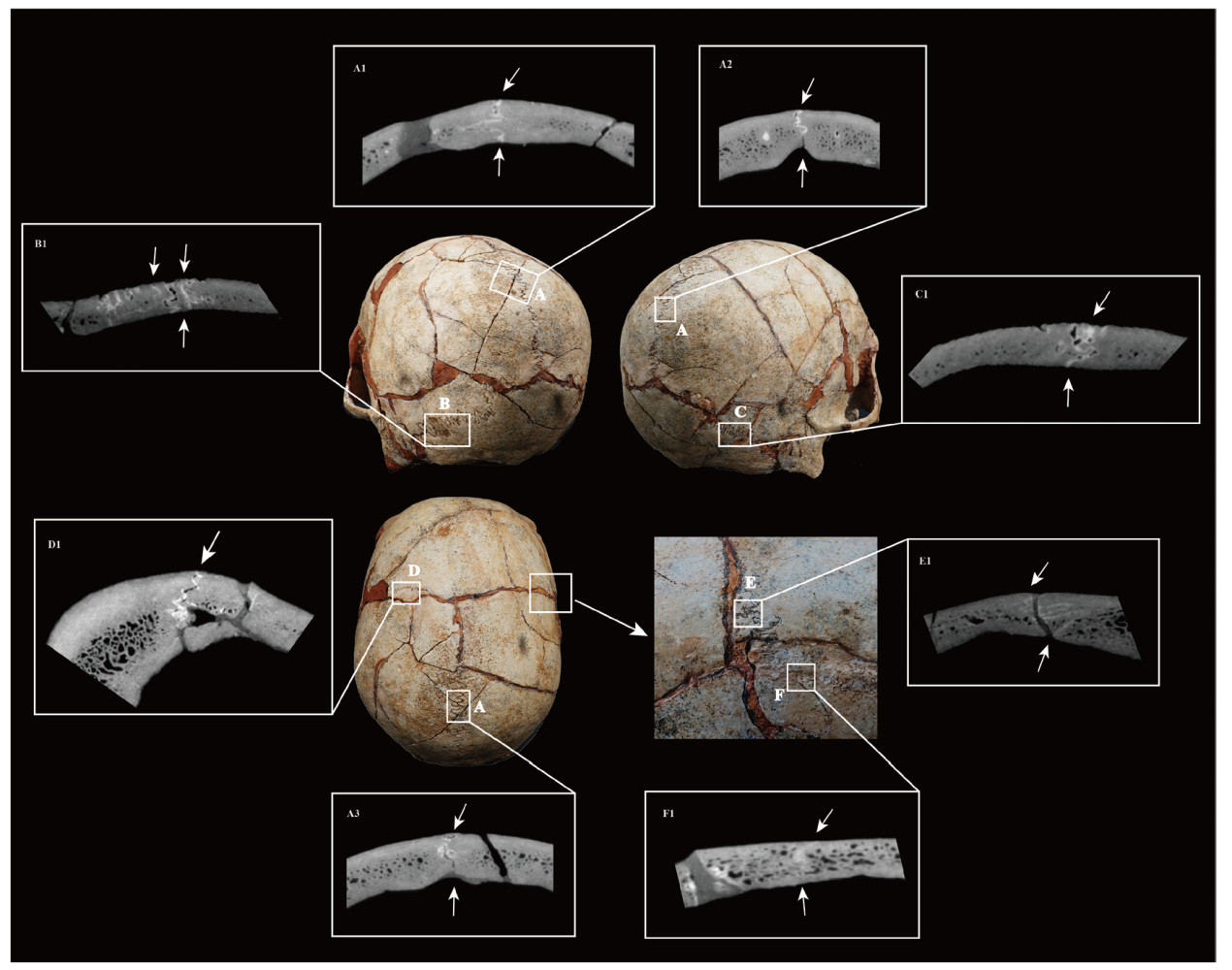
图5 YH1颅缝保存情况及愈合情况 A. 矢状缝中间段和人字点段(A1和A2矢状缝未愈合,A3内矢状缝愈合痕迹)A sagittal suture (A1&A2 sagittal suture not healed; A3 intracranial sagittal suture healed);B. 左侧人字缝中间段和星点段(B1 左侧人字缝未愈合)B pars intermedia and pars asterica of left lambdoidal suture (B1 not healed);C. 右侧人字缝中间段(C1 右侧人字缝未愈合)C pars intermedia of right lambdoidal suture (B1 not healed);D. 左侧冠状缝前囟点段(D1 左侧冠状缝前囟段未愈合)pars bregmatica of left coronal suture (D1 not healed) ;E. 右侧冠状缝中间段(E1 右侧冠状缝中间段未愈合)pars complicate of right coronal suture (E1 medial segment of right coronal suture not healed);F. 右侧冠状缝翼点段(F1 右侧内冠状缝翼点段愈合痕迹)F pars pterica of right coronal suture (F1 right intracranial suture healed)
Fig.5 Preservation and healing of cranial suture in the YH1
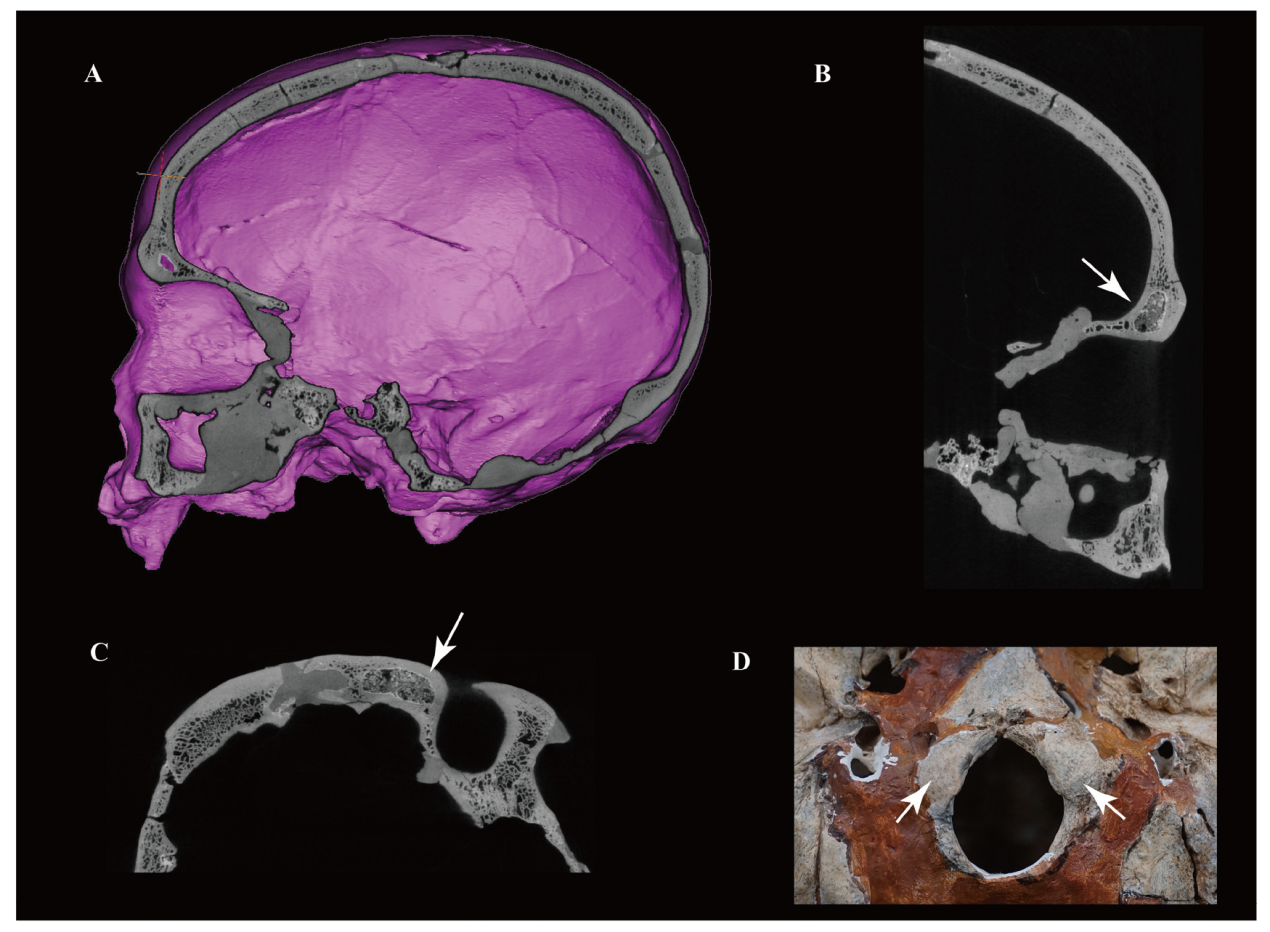
图6 YH1其他与年龄相关的头骨特征 A.内、外板和板障的厚度(额结节处矢状切面)thickness of the inner table, outter table and diploë (sagittal section at frontal tubercle) ;B-C. 左侧额窦(矢状切面和水平切面)left frontal sinus (sagittal section and horizontal section);D.双侧枕髁关节面 articular surface of occipital condylar
Fig.6 Other age-related skull features of the YH1
| [1] | Smith FH. Sexual differences in European Neanderthal crania with special reference to the Krapina Remains[J]. Journal of Human Evolution, 1980, 9(5): 359-375 |
| [2] | Franklin D, Cardini A, Flavel A, et al. Estimation of sex from cranial measurements in a Western Australian population[J]. Forensic Science International, 2013, 229(1-3): 158.e1-158.e8 |
| [3] | Clark MA, Cheverko CM, Simon A, et al. The decade under review: Recent trends and challenges in the use of macroscopic age-at-death estimation methods in bioarchaeology[J]. International Journal of Osteoarchaeology, 2023, 33(1): 150-163 |
| [4] |
Phenice T. A newly developed visual method of sexing the OS pubis[J]. American Journal of Physical Anthropology, 1969, 30: 297-302
doi: 10.1002/ajpa.1330300214 pmid: 5772048 |
| [5] |
Bruzek J. A method for visual determination of sex, using the human hip bone[J]. American Journal of Physical Anthropology, 2002, 117: 157-168
doi: 10.1002/ajpa.10012 pmid: 11815949 |
| [6] | Buikstra J, Ubelaker D(eds). Standards for data collection from human skeletal remains[M]. Arkansas Archaeological Survey: Fayetteville, 1994 |
| [7] | Iscan MY. Forensic anthropology of sex and body size[J]. Forensic Science International, 2005, 147: 107-112 |
| [8] | Ubelaker DH, DeGaglia CM. Population variation in skeletal sexual dimorphism[J]. Forensic Science International, 2017, 278: e401-e407 |
| [9] | Hassan NA-M, Brown KIA, Eyers J, et al. Ancient DNA study of the remains of putative infanticide victims from the Yewden Roman villa site at Hambleden, England[J]. Journal of Archaeological Science, 2014, 43: 192-197 |
| [10] | 张宝帅, 吴晓桐, 吴高, 等. 釉原蛋白微损分析方法鉴定人骨性别的有效性与优化[J]. 人类学学报, 2023, 42(4): 472-487 |
| [11] |
Schmitt P, Murail E, Cunha DR. Variability of the pattern of aging on the human skeleton: evidence from bone indicators and implications on age at death estimation[J]. Journal of Forensic Sciences, 2002, 47(6): 1203-1209
pmid: 12455640 |
| [12] | Xanthopoulou P, Valakos E, Youlatos D, et al. Assessing the accuracy of cranial and pelvic aging methods on human skeletal remains from a modern Greek assemblage[J]. Forensic Science International, 2018, 286: 266.e1-266.e8 |
| [13] | Brooks S, Suchey JM. Skeletal age determination based on the os pubis: A comparison of the Acsadi-Nemeskeri and Suchey-Brooks methods[J]. Journal of Human Evolution, 1990, 5, 227-238 |
| [14] |
Meindl RS, Lovejoy CO. Ectocranial suture closure: A revised method for the determination of skeletal age at death based on the lateral-anterior sutures[J]. American Journal of Physical Anthropology, 1985, 68(1): 57-66
doi: 10.1002/ajpa.1330680106 pmid: 4061602 |
| [15] | Iscan MY, Loth SR, Wright RK. Age estimation from the rib by phase analysis- white males[J]. Journal of Forensic Sciences, 1984, 29(4): 1094-1104 |
| [16] |
Iscan MY, Loth SR, Wright RK. Metamorphosis at the sternal rib end: A new method to estimate age at death in white males[J]. American Journal of Physical Anthropology, 1984, 65(2): 147-156
pmid: 6507605 |
| [17] | Iscan MY, Loth SR, Wright RK. Age estimation from the rib by phase analysis white females[J]. Journal of Forensic Sciences, 1985, 30(3): 853-863 |
| [18] | Brothwell DR. The relationship of tooth wear to aging[A]. In: MY Isçan (ed.). Age Markers in the Human Skeleton[C]. Charles C Thomas Publisher, 1989, 303-316 |
| [19] |
Lovejoy CO. Dental wear in the Libben population- its functional pattern and role in the determination of adult skeletal age at death[J]. American Journal of Physical Anthropology, 1985, 68(1): 47-56
doi: 10.1002/ajpa.1330680105 pmid: 4061601 |
| [20] | 魏博源, 朱文, 钟耳顺, 等. 广西崇左冲塘新石器遗址人骨和牙齿年龄的组织学鉴定[J]. 人类学学报, 1994, 2: 134-137 |
| [21] | Xing S, Tafforeau P, O’Hara M, et al. First systematic assessment of dental growth and development in an archaic hominin (genus, Homo) from East Asia[J]. Science Advance. 2019, 5(1): eaau0930 |
| [22] | Cerrito P, Nava A, Radovčić D, et al. Dental cementum virtual histology of Neanderthal teeth from Krapina (Croatia, 130-120 kyr): an informed estimate of age, sex and adult stressors[J]. Journal of the Royal Society Interface, 2022, 19: 20210820 |
| [23] |
Xu C, Qu H, Wang G, et al. A novel strategy for forensic age prediction by DNA methylation and support vector regression model[J]. Scientific Reports, 2015, 5: 17788
doi: 10.1038/srep17788 pmid: 26635134 |
| [24] |
Srettabunjong S, Satitsri S, Thongnoppakunw, et al. The study on telomere length for age estimation in a Thai population[J]. The American Journal of Forensic Medicine and Pathology, 2014, 35(2): 148-153
doi: 10.1097/PAF.0000000000000095 pmid: 24781401 |
| [25] | Bolden JL, Milner GR, Konigsberg LW, et al. Transition analysis: a new method for estimating age from skeletons[A]. In: Hoppa RD,Vaupel JW(eds). Paleodemography: Age distributions from skeletal samples[C]. New York: Cambridge University Press, 2002, 73-106 |
| [26] | Getz SM. Improved skeletal age-at-death estimation and its impact on archaeological analyses(Doctoral Dissertation)[D]. University Park, PA: The Pennsylvania State University, 2017, 40-41 |
| [27] | Wu Y, Xie G, Mao L, et al. Phytolith evidence for human-plant subsistence in Yahuai Cave (Guangxi, South China) over the past 30000 years[J]. 中国科学:地球科学(英文版), 2020, 63(11): 1745-1757 |
| [28] | Matsumura H, Xie G, Nguyen LC, et al. Female craniometrics support the ‘two-layer model’ of human dispersal in Eastern Eurasia[J]. Scientific Report, 2021, 11: 20830 |
| [29] | 吴秀杰. 中国全新世人群头骨形态特征的变异[D].博士学位论文, 北京: 中国科学院研究生院, 2006 |
| [30] | Recommendations for age and sex diagnoses of skeleton[J]. Journal of Human Evolution, 1980, 9(7): 533-549 |
| [31] | 吴新智. 周口店山顶洞人化石的研究[J]. 古脊椎动物与古人类, 1961, 3: 181-211 |
| [32] | 吴汝康. 广西柳江发现的人类化石[J]. 古脊椎动物与古人类, 1959, 3: 97-104 |
| [33] | Storm P. The evolutionary significance of the Wajak skulls[M]. Nationaal Natuurhistorisch Museum, 1995 |
| [34] | Suzuki H. Skulls of Minatogawa Man[M]. University Museum Bulletin, The University of Tokyo, 1982, 19: 7-49 |
| [35] | Matsumura H, Yoneda M, Dodo Y, et al. Terminal Pleistocene human skeleton from Hang Cho cave, northern Vietnam: implications for the biological affinities of Hoabinhian people[J]. Anthropological Sciences. 2008, 116: 201-217 |
| [36] |
Matsumura H, Pookajorn S. A morphometric analysis of the Late Pleistocene human skeleton from the Moh Khiew Cave in Thailand[J]. Homo, 2005, 56: 93-118
doi: 10.1016/j.jchb.2005.05.004 pmid: 16130834 |
| [37] | Curnoe D, Datan I, Tacon PS, et al. Deep skull from Niah Cave and the Pleistocene peopling of Southeast Asia[J]. Frontiers in Ecology and Evolution, 2016, 4: 1-17 |
| [38] | Howells WW. Cranial variation in Man: A study by multivariate analysis of patterns of difference among recent human populations[M]. Cambridge: Harvard University Press, 1973 |
| [39] | Howells WW. Who’s Who in Skulls. Ethnic identification of crania from measurements[M]. Cambridge: Harvard University Press, 1995 |
| [40] |
Howells WW. Howells’ Craniometric data on the Internet[J]. American Journal of Physical Anthropology. 1996, 101: 441-442
pmid: 8922187 |
| [41] | Darroch JN, Mosimann JE. Canonical and principal components of shape[J]. Biometrika, 1985, 72: 241-252 |
| [42] | 李海军. 中国现代人群下颌骨的形态变异与功能适应[D]. 博士学位论文, 北京: 中国科学院研究生院, 2010 |
| [43] |
Nikolova S, Toneva D, Georgiev I, et al. Sagittal suture maturation: morphological reorganization, relation to aging, and reliability as an age-at-death indicator[J]. American Journal of Physical Anthropology, 2019, 169(1): 78-92
doi: 10.1002/ajpa.23810 pmid: 30848843 |
| [44] |
Fan F, Tu M, Li R, et al. Age estimation by multidetector computed tomography of cranial sutures in Chinese male adults[J]. American Journal of Physical Anthropology, 2020, 171(3): 550-558
doi: 10.1002/ajpa.23998 pmid: 31891181 |
| [45] |
Chiba F, Makino Y, Motomura A, et al. Age estimation by multidetector CT images of the sagittal suture[J]. International Journal of Legal Medicine, 2013, 127: 1005-1011
doi: 10.1007/s00414-013-0883-y pmid: 23760604 |
| [46] | 莫世泰, 张文光, 雷绍伯, 等. 中国人颅骨缝的变化与年龄关系[J]. 人类学学报, 1989, 2: 131-138 |
| [47] |
裘诗文, 涂梦, 范飞, 等. 应用颅缝薄层CT扫描推断汉族成人年龄[J]. 法医学杂志, 2020, 36(4): 507-513
doi: 10.12116/j.issn.1004-5619.2020.04.015 |
| [48] | Todd TW, Lyon D. Endocranial suture closure. Its progress and age relationship. Part I. adult males of white stock[J]. American Journal of Physical Anthropology, 1924, 7(3): 325-384 |
| [49] |
Boldsen JL. Analysis of dental attrition and mortality in the Medieval village of Tirup, Denmark[J]. American Journal of Physical Anthropology, 2005, 126: 169-176
pmid: 15386219 |
| [50] | Walker PL, Dean G, Shapiro P. Estimating age from tooth wear in archaeological populations[J]. Advances in Dental Anthropology, 1991, 169: 187 |
| [51] |
McKee JK, Molnar S. Measurements of tooth wear among Australian aborigines: II. Intra-populational variation in patterns of dental attrition[J]. American Journal of Physical Anthropology, 1988, 76(1): 125-136
doi: 10.1002/ajpa.1330760111 pmid: 3407755 |
| [52] | 吴汝康, 柏惠英. 华北人颅骨臼齿磨耗年龄变化[J]. 古脊椎动物与古人类, 1965, 9(2): 217-222 |
| [53] | 莫世泰, 等. 对华南人颅骨臼齿磨耗年龄变化的研究[J]. 广西医学院学报, 1983, 1: 23-29 |
| [54] | Milella M, Franklin D, Belcastro MG, et al. Sexual differences in human cranial morphology: Is one sex more variable or one region more dimorphic?[J]. The Anatomical Record, 2021, 304: 2789-2810 |
| [55] | 杨茂有, 刘武, 邰凤久. 下颌骨的性别判别分析研究[J]. 人类学学报, 1988, 4: 329-334 |
| [56] | Harth S, Obert M, Ramsthaler F, et al. Estimating age by assessing the ossification degree of cranial sutures with the aid of Flat-Panel-CT[J]. Legal Medicine, 2009, 11(S1): s186-s189 |
| [57] | 国外刑事技术参考资料. 关于颅穹骨厚度的年龄变异性[J]. 刑事技术, 1977, 2: 33-36 |
| [58] |
Boer D, Hans HH, Merwe VD, et al. Human cranial vault thickness in a contemporary sample of 1097 autopsy cases: relation to body weight, stature, age, sex and ancestry[J]. International Journal of Legal Medicine, 2016, 130(5): 1371-1377
doi: 10.1007/s00414-016-1324-5 pmid: 26914798 |
| [59] | Elizabeth ML, Urban JE, Lynch SK, et al. Evaluation of Skull Cortical Thickness Changes With Age and Sex From Computed Tomography Scans[J]. Journal of Bone & Mineral Research, 2016, 32(2): 299-307 |
| [60] | 吴秀杰, 严毅. 资阳人头骨化石的内部解剖结构[J]. 人类学学报, 2020, 39(4): 511-520 |
| [61] | 吴汝康. 化石人类头骨年龄和性別的鉴定[J]. 古脊椎动物与古人类, 1962, 1: 116-118 |
| [62] | 张银运, 邢松. 周口店直立人3号头骨的性别和年龄:南京直立人头骨的启示[J]. 人类学学报, 2011, 30(3): 241-249 |
| [63] |
Michel J, Paganelli A, Varoquaux A, et al. Determination of sex: interest of frontal sinus 3D reconstructions[J]. Journal of Forensic Sciences. 2015, 60(2): 269-273
doi: 10.1111/1556-4029.12630 pmid: 25676659 |
| [64] | Zulkiflee NDI, Singh MKC, Alias A, et al. Morphological changes of the frontal sinus with age: a two-dimensional geometric morphometric study[J]. Forensic Imaging, 2023, 35: 200569 |
| [65] | Robles M, Rando C, Morgan RM. The utility of three-dimensional models of paranasal sinuses to establish age, sex, and ancestry across three modern populations: A preliminary study[J]. Australian Journal of Forensic Sciences, 2020, 54(3): 326-345 |
| [66] | Fatu C, Puisoru M, Rotaru M, et al. Morphometric evaluation of the frontal sinus in relation to age[J]. Annals of Anatomy-Anatomischer Anzeiger, 2006, 188(3): 275-280 |
| [67] | Genoves S. Sex determination in earlier man[A]. In: DBrothwell, EHiggs (eds). Science in Archaeology[M]. New York: Praeger, 1969, 342-352 |
| [68] | Keen JA. A study of sex differences in males and females skulls[J]. Americal Journal of Physical Anthropology, 1950, 8: 65-79 |
| [69] | Lahr MM, Wright RVS. The question of robusticity and the relationship between cranial size and shape in Homo sapiens[J]. Journal of Human Evolution, 1996, 31(2): 157-191 |
| [70] | 陈晓颖, 游海杰, 宋美玲, 等. 广西敢造遗址史前居民口腔的健康状况[J]. 人类学学报, 2023, 42(1): 98-109 |
| [71] | 陈伟驹, 李法军. 鲤鱼墩遗址出土人牙的牙齿磨耗和龋齿[J]. 人类学学报, 2013, 32(1): 45-51 |
| [72] | 中国社会科学院考古研究所, 等(编). 桂林甑皮岩[R]. 北京: 文物出版社, 2009, 405-425 |
| [73] | 朱芳武, 卢为善. 桂林甑皮岩新石器时代遗址2例儿童的年龄问题[J]. 人类学学报, 1995, 2: 147-150 |
| [74] | 张弛, 洪晓纯. 中国华南及其邻近地区的新石器时代采集渔猎文化[J]. 考古学研究, 2008, 415-434 |
| [75] | Armelagos GJ, Van Gerven DP. Sexual dimorphism and human evolution: an overview[J]. Journal of Human Evolution, 1980, 9: 437-446 |
| [1] | 姚力, 罗震, 葛恒, 马晓赟, 林哲涵. 基于人类赤脚足迹图像的性别判定[J]. 人类学学报, 2026, 45(02): 296-309. |
| [2] | 杜抱朴, 刘丽, 祝彤, 于洛嘉, 景朋, 杜靖, 高艳. 中国北方全新世中晚期人群的颅骨性状[J]. 人类学学报, 2026, 45(01): 128-139. |
| [3] | 杨诗雨, 郭结, 毛瑞林, 张全超. 甘肃漳县墩坪墓地东周人群的牙齿磨耗[J]. 人类学学报, 2025, 44(04): 618-631. |
| [4] | 郭远哲, 赵凌霞, 仪明洁, 张立召, 张乐, 张双权. 贵州韦家洞遗址大型鹿科动物的死亡年龄[J]. 人类学学报, 2025, 44(04): 674-687. |
| [5] | 姚艳燕, 黄胜敏, 廖卫, 李金燕, 张一景, 莫进尤, 王伟. 广西吹风洞早更新世动物群的埋藏学[J]. 人类学学报, 2025, 44(03): 514-528. |
| [6] | 李海军, 曾雨欣, 阿迪力江·外力, 奴尔买买提·卡迪尔, 张海龙, 李文瑛. 古代人群牙齿磨耗研究概述[J]. 人类学学报, 2025, 44(02): 333-351. |
| [7] | 凌亮优, 孙战伟, 李楠, 成芷菡, 冉智宇, 何嘉宁. 陕西洛川月家庄墓地人类颅骨的形态学[J]. 人类学学报, 2025, 44(01): 66-77. |
| [8] | 王舒, 王春雪, 张翔宇, 周亚威. 西安北沈家桥墓地人颅骨的形态及其族源[J]. 人类学学报, 2025, 44(01): 78-91. |
| [9] | 赵瑞敏, 刘凯, 孙鹏, 张忠良. 基于拇指与食指指纹组合特征分析人的性别及年龄[J]. 人类学学报, 2024, 43(03): 427-439. |
| [10] | 周亚威, 王煜, 侯晓刚, 李树云. 山西大同金茂园遗址人群颅骨的形态学[J]. 人类学学报, 2024, 43(02): 233-246. |
| [11] | 贺乐天, 陈国科, 杨谊时. 甘肃五坝墓地人骨反映的史前人群变迁[J]. 人类学学报, 2024, 43(02): 247-258. |
| [12] | 陈峰, 曾雨欣, 付昶, 张海龙, 王博, 肖小勇, 李海军. 新疆且末扎滚鲁克墓地二期居民的牙齿磨耗[J]. 人类学学报, 2024, 43(02): 273-286. |
| [13] | 李海军, 杨筱雨, 赵钰洁. 人类颅骨厚度研究的概述与展望[J]. 人类学学报, 2023, 42(06): 827-841. |
| [14] | 张宝帅, 吴晓桐, 吴高, 金正耀, 范安川. 釉原蛋白微损分析方法鉴定人骨性别的有效性与优化[J]. 人类学学报, 2023, 42(04): 472-487. |
| [15] | 杜抱朴, 殷钰喆, 谭伊, 张宇格, 范博, 姚植正, 郭航. 中国现代人群两性身高差异分布及其影响因素[J]. 人类学学报, 2023, 42(02): 191-200. |
| 阅读次数 | ||||||
|
全文 |
|
|||||
|
摘要 |
|
|||||
 京ICP证05002819号-3