

主管:中国科学院
主办:中国科学院古脊椎动物与古人类研究所
出版:科学出版社
主办:中国科学院古脊椎动物与古人类研究所
出版:科学出版社
人类学学报 ›› 2025, Vol. 44 ›› Issue (05): 799-815.doi: 10.16359/j.1000-3193/AAS.2025.0067cstr: 32091.14.j.1000-3193/AAS.2025.0067
常美静1,2( ), 李强1,2(), 倪喜军1,2, 张玄1, 同号文1,2
收稿日期:2025-03-26
修回日期:2025-06-03
出版日期:2025-10-15
发布日期:2025-10-13
通讯作者:
李强,研究员,主要从事新生代地层与古生物研究。E-mail: liqiang@ivpp.ac.cn
作者简介:常美静,博士研究生,主要从事第四纪小哺乳动物化石研究。E-mail: changmeijing@ivpp.ac.cn
基金资助:
CHANG Meijing1,2(), LI Qiang1,2(), NI Xijun1,2, ZHANG Xuan1, TONG Haowen1,2
Received:2025-03-26
Revised:2025-06-03
Online:2025-10-15
Published:2025-10-13
摘要:
本文对2015-2017年华龙洞遗址发现的非飞行小哺乳动物化石进行了研究,结果显示可鉴定标本数共5645件,包含3目11科38属49种(含2个未定种),其中现生种类45种、化石种类仅有2种(灭绝种占比4.26%)。在标本和物种数量上,目一级和科一级分别以啮齿目和鼠科占优,属一级姬鼠属占主导地位。在物种组成上,华龙洞遗址的非飞行小哺乳动物化石组合和中国南方中更新世中晚期的玉米洞、兴隆洞、岩灰洞和宝坛寺等组合比较相似。与安徽现生小哺乳动物组合对比显示,自中更新世晚期以来,东至地区的小哺乳动物发生了明显的物种更替。基于八个优势现生种的生境分析显示,华龙洞遗址在中更新世晚期可能是温带-亚热带山地森林与草地混合的环境;随机森林算法计算得到的古年均温和古年均降水量值明显低于东至现今的气象数据,指示当时气候相对干凉。
中图分类号:
常美静, 李强, 倪喜军, 张玄, 同号文. 非飞行小哺乳动物化石反映的华龙洞人生存环境[J]. 人类学学报, 2025, 44(05): 799-815.
CHANG Meijing, LI Qiang, NI Xijun, ZHANG Xuan, TONG Haowen. Survival paleoenvironment of the Hualongdong Hominid reflected by non-volant micromammalian fossils[J]. Acta Anthropologica Sinica, 2025, 44(05): 799-815.
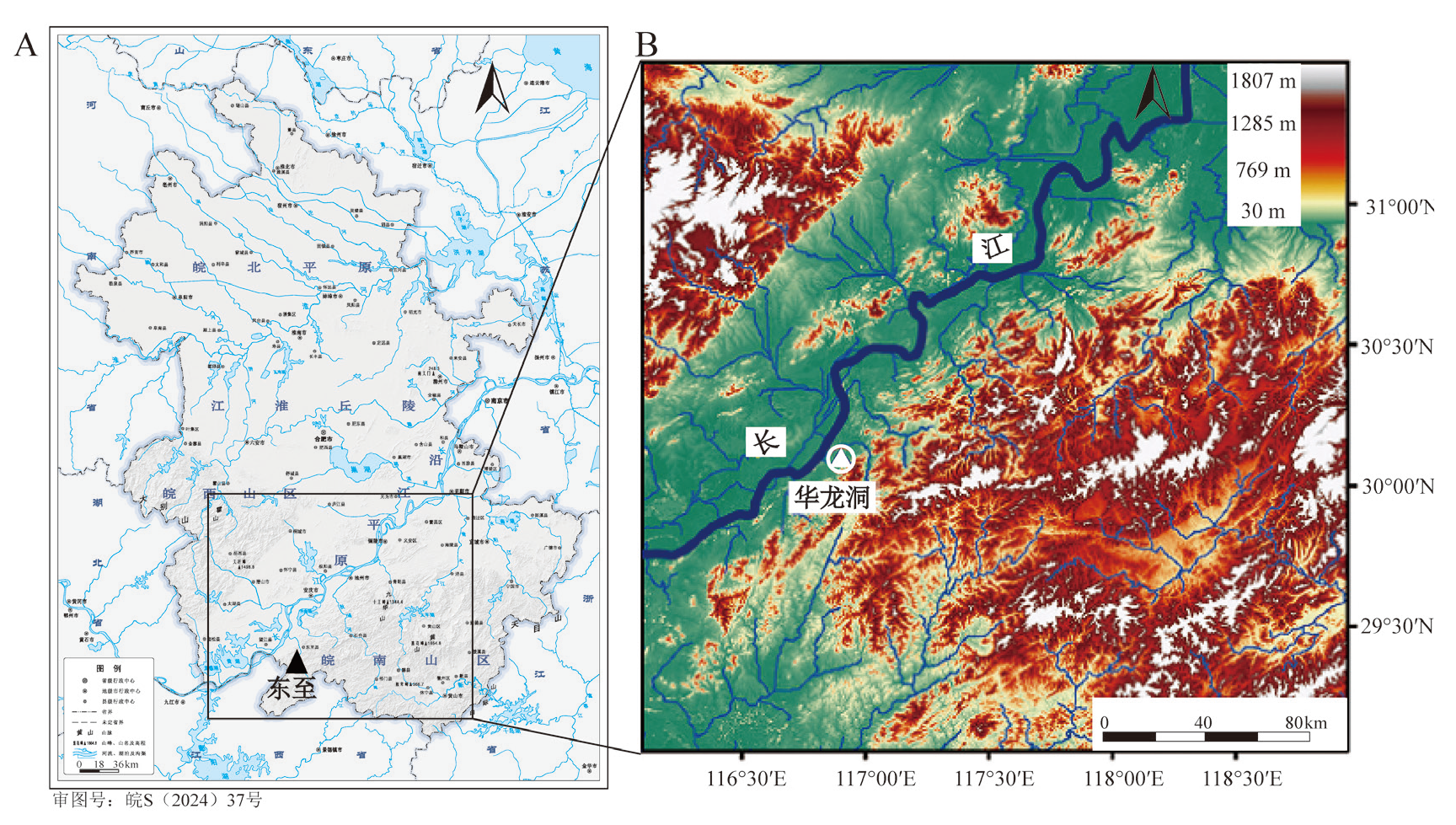
图1 华龙洞遗址地理位置和地形图(审图号:皖S(2024)37号) 本图修改自文献[16] / This image modified after [16],▴代表华龙洞遗址indicates the Hualongdong site
Fig.1 Geographic location and topographic map in the adjacent area of HLD site
| 物种Species | NISP | MNI | 地理区系 Geographic region | 气候带Climatic zones | 栖息环境Habitat | ||
|---|---|---|---|---|---|---|---|
| Eulipotyphla 劳亚食虫目 | Erinaceidae猬科 | Erinaceus amurensis东北刺猬 | 8 | 2 | P | 温带和亚热带temperate and subtropical | 森林、草原、灌丛forests, grasslands and shrublands |
| Hylomys suillus毛猬 | 26 | 6 | O | 亚热带和热带subtropical and tropical | 森林、灌丛forests and shrublands | ||
| Talpidae鼹科 | Uropsilus soricipes少齿鼩鼹 | 84 | 16 | O | 亚热带subtropical | 森林forests | |
| Mogera insularis海岛缺齿鼹 | 37 | 5 | O | 亚热带和热带subtropical and tropical | 森林forests | ||
| Mogera latouchei华南缺齿鼹 | 58 | 12 | O | 亚热带subtropical | 森林forests | ||
| Mogera robusta大缺齿鼹 | 1 | 1 | P | 温带temperate | 森林、草原forests and grasslands | ||
| Soricidae鼩鼱科 | Blarinella quadraticauda川鼩 | 18 | 3 | O | 亚热带subtropical | 森林 forests | |
| Parablarinella griselda淡灰黑齿鼩鼱 | 4 | 2 | O | 亚热带和温带subtropical and temperate | 森林forests | ||
| Sorex cylindricauda纹背鼩鼱 | 94 | 23 | O | 亚热带subtropical | 森林forests | ||
| Anourosorex squamipes四川短尾鼩 | 135 | 21 | O | 亚热带和热带subtropical and tropical | 森林forests | ||
| Chodsigoa caovansunga高氏缺齿鼩 | 24 | 5 | O | 热带tropical | 森林forests | ||
| Chodsigoa hypsibia川西缺齿鼩 | 86 | 18 | O | 亚热带subtropical | 森林forests | ||
| Chimarrogale leander利安德水鼩 | 7 | 2 | O | 亚热带subtropical | 森林forests | ||
| ?Neomys fodiens水鼩鼱 | 3 | 1 | P | 温带和寒带temperate and arctic | 森林、草原forests and grasslands | ||
| †Crocidura wongi翁氏麝鼩 | 99 | 28 | |||||
| Lagomorpha 兔形目 | Leporidae兔科 | Lepus sinensis华南兔 | 4 | 2 | O | 亚热带和热带subtropical and tropical | 草原、灌丛grasslands and shrublands |
| Rodentia 啮齿目 | Sciuridae松鼠科 | Sciurus vulgaris北松鼠 | 6 | 3 | P | 温带和寒带temperate and arctic | 森林forests |
| Tamiops swinhoei隐纹花鼠 | 18 | 3 | O | 亚热带和热带subtropical and tropical | 森林forests | ||
| Tamiops maritimus倭花鼠 | 38 | 7 | O | 亚热带和热带subtropical and tropical | 森林forests | ||
| Callosciurus erythraeus赤腹松鼠 | 25 | 4 | O | 亚热带和热带subtropical and tropical | 森林forests | ||
| Hylopetes phayrei海南小飞鼠 | 3 | 1 | O | 亚热带和热带subtropical and tropical | 森林forests | ||
| Pteromys volans小飞鼠 | 429 | 39 | P | 温带和寒带temperate and arctic | 森林forests | ||
| Aëretes melanopterus沟牙鼯鼠 | 18 | 3 | O | 亚热带subtropical | 森林forests | ||
| Belomys pearsonii毛耳飞鼠 | 22 | 4 | O | 亚热带和热带subtropical and tropical | 森林forests | ||
| Trogopterus xanthipes复齿鼯鼠 | 1 | 1 | O | 亚热带和温带subtropical and temperate | 森林forests | ||
| Hystricidae豪猪科 | Atherurus macrourus大帚尾豪猪 | 6 | 2 | O | 亚热带和热带subtropical and tropical | 森林forests | |
| Cricetidae仓鼠科 | †Cricetinus varians变异相似仓鼠 | 356 | 38 | ||||
| Cricetulus sp.仓鼠未定种 | 4 | 1 | |||||
| Arvicolidae䶄科 | Lasiopodomys brandtii布氏田鼠 | 534 | 60 | P | 温带temperate | 草原steppes | |
| Alexandromys oeconomus根田鼠 | 80 | 23 | P | 温带和寒带temperate and arctic | 灌丛shrublands | ||
| Alexandromys maximowiczii莫氏田鼠 | 141 | 19 | P | 温带temperate | 森林、森林草原forests and forest-steppe zones | ||
| Eothenomys melanogaster黑腹绒鼠 | 1002 | 101 | O | 亚热带和热带subtropical and tropical | 灌丛shrublands | ||
| Platacanthomyidae 刺睡鼠科 | Typhlomys cinereus猪尾鼠 | 128 | 22 | O | 亚热带和热带subtropical and tropical | 森林forests | |
| Spalacidae鼹形鼠科 | Rhizomys sinensis中华竹鼠 | 21 | 4 | O | 亚热带和热带subtropical and tropical | 森林forests | |
| Muridae鼠科 | Apodemus agrarius黑线姬鼠 | 783 | 118 | C | 温带和亚热带temperate and subtropical | 森林、草地forests and grasslands | |
| Apodemus draco中华姬鼠 | 293 | 49 | O | 亚热带和温带subtropical and temperate | 森林forests | ||
| Apodemus chevrieri高山姬鼠 | 254 | 51 | O | 亚热带subtropical | 森林、草原forests and grasslands | ||
| Apodemus peninsulae大林姬鼠 | 17 | 6 | P | 温带和亚热带temperate and subtropical | 灌丛、森林scrublands and forests | ||
| Apodemus sp.姬鼠未定种 | 3 | 1 | |||||
| Micromys minutus巢鼠 | 92 | 21 | C | 温带至热带temperate to tropical | 草原、灌丛grassland and scrub | ||
| Mus musculus小家鼠 | 296 | 57 | C | 寒带至热带arctic to tropical | 草原、灌丛grassland and scrub | ||
| Mus pahari锡金小鼠 | 1 | 1 | O | 亚热带和热带subtropical and tropical | 草原grasslands | ||
| Hapalomys delacouri小狨鼠 | 2 | 1 | O | 热带和亚热带tropical and subtropical | 森林forests | ||
| Vernaya fulva滇攀鼠 | 34 | 8 | O | 亚热带subtropical | 森林forests | ||
| Leopoldamys edwardsi小泡巨鼠 | 6 | 3 | O | 亚热带和热带subtropical and tropical | 森林forests | ||
| Niviventer andersoni安氏白腹鼠 | 226 | 29 | O | 亚热带subtropical | 森林forests | ||
| Niviventer confucianus北社鼠 | 96 | 14 | O | 亚热带和热带subtropical and tropical | 森林forests | ||
| Berylmys bowersi青毛巨鼠 | 6 | 2 | O | 亚热带和热带subtropical and tropical | 森林、灌丛forests and shrublands | ||
| Rattus norvegicus褐家鼠 | 16 | 3 | C | 寒带至热带arctic to tropical | 森林forests | ||
| 总计Total | P: 1219 | P: 154 | P: 9/45 | ||||
| O: 2777 | O: 425 | O: 32/45 | |||||
| C: 1187 | C:199 | C: 4/45 | |||||
表1 中更新世晚期华龙洞遗址非飞行小哺乳动物物种组成
Tab.1 Faunal composition of small non-volant micromammals at HLD site in late Middle Pleistocene
| 物种Species | NISP | MNI | 地理区系 Geographic region | 气候带Climatic zones | 栖息环境Habitat | ||
|---|---|---|---|---|---|---|---|
| Eulipotyphla 劳亚食虫目 | Erinaceidae猬科 | Erinaceus amurensis东北刺猬 | 8 | 2 | P | 温带和亚热带temperate and subtropical | 森林、草原、灌丛forests, grasslands and shrublands |
| Hylomys suillus毛猬 | 26 | 6 | O | 亚热带和热带subtropical and tropical | 森林、灌丛forests and shrublands | ||
| Talpidae鼹科 | Uropsilus soricipes少齿鼩鼹 | 84 | 16 | O | 亚热带subtropical | 森林forests | |
| Mogera insularis海岛缺齿鼹 | 37 | 5 | O | 亚热带和热带subtropical and tropical | 森林forests | ||
| Mogera latouchei华南缺齿鼹 | 58 | 12 | O | 亚热带subtropical | 森林forests | ||
| Mogera robusta大缺齿鼹 | 1 | 1 | P | 温带temperate | 森林、草原forests and grasslands | ||
| Soricidae鼩鼱科 | Blarinella quadraticauda川鼩 | 18 | 3 | O | 亚热带subtropical | 森林 forests | |
| Parablarinella griselda淡灰黑齿鼩鼱 | 4 | 2 | O | 亚热带和温带subtropical and temperate | 森林forests | ||
| Sorex cylindricauda纹背鼩鼱 | 94 | 23 | O | 亚热带subtropical | 森林forests | ||
| Anourosorex squamipes四川短尾鼩 | 135 | 21 | O | 亚热带和热带subtropical and tropical | 森林forests | ||
| Chodsigoa caovansunga高氏缺齿鼩 | 24 | 5 | O | 热带tropical | 森林forests | ||
| Chodsigoa hypsibia川西缺齿鼩 | 86 | 18 | O | 亚热带subtropical | 森林forests | ||
| Chimarrogale leander利安德水鼩 | 7 | 2 | O | 亚热带subtropical | 森林forests | ||
| ?Neomys fodiens水鼩鼱 | 3 | 1 | P | 温带和寒带temperate and arctic | 森林、草原forests and grasslands | ||
| †Crocidura wongi翁氏麝鼩 | 99 | 28 | |||||
| Lagomorpha 兔形目 | Leporidae兔科 | Lepus sinensis华南兔 | 4 | 2 | O | 亚热带和热带subtropical and tropical | 草原、灌丛grasslands and shrublands |
| Rodentia 啮齿目 | Sciuridae松鼠科 | Sciurus vulgaris北松鼠 | 6 | 3 | P | 温带和寒带temperate and arctic | 森林forests |
| Tamiops swinhoei隐纹花鼠 | 18 | 3 | O | 亚热带和热带subtropical and tropical | 森林forests | ||
| Tamiops maritimus倭花鼠 | 38 | 7 | O | 亚热带和热带subtropical and tropical | 森林forests | ||
| Callosciurus erythraeus赤腹松鼠 | 25 | 4 | O | 亚热带和热带subtropical and tropical | 森林forests | ||
| Hylopetes phayrei海南小飞鼠 | 3 | 1 | O | 亚热带和热带subtropical and tropical | 森林forests | ||
| Pteromys volans小飞鼠 | 429 | 39 | P | 温带和寒带temperate and arctic | 森林forests | ||
| Aëretes melanopterus沟牙鼯鼠 | 18 | 3 | O | 亚热带subtropical | 森林forests | ||
| Belomys pearsonii毛耳飞鼠 | 22 | 4 | O | 亚热带和热带subtropical and tropical | 森林forests | ||
| Trogopterus xanthipes复齿鼯鼠 | 1 | 1 | O | 亚热带和温带subtropical and temperate | 森林forests | ||
| Hystricidae豪猪科 | Atherurus macrourus大帚尾豪猪 | 6 | 2 | O | 亚热带和热带subtropical and tropical | 森林forests | |
| Cricetidae仓鼠科 | †Cricetinus varians变异相似仓鼠 | 356 | 38 | ||||
| Cricetulus sp.仓鼠未定种 | 4 | 1 | |||||
| Arvicolidae䶄科 | Lasiopodomys brandtii布氏田鼠 | 534 | 60 | P | 温带temperate | 草原steppes | |
| Alexandromys oeconomus根田鼠 | 80 | 23 | P | 温带和寒带temperate and arctic | 灌丛shrublands | ||
| Alexandromys maximowiczii莫氏田鼠 | 141 | 19 | P | 温带temperate | 森林、森林草原forests and forest-steppe zones | ||
| Eothenomys melanogaster黑腹绒鼠 | 1002 | 101 | O | 亚热带和热带subtropical and tropical | 灌丛shrublands | ||
| Platacanthomyidae 刺睡鼠科 | Typhlomys cinereus猪尾鼠 | 128 | 22 | O | 亚热带和热带subtropical and tropical | 森林forests | |
| Spalacidae鼹形鼠科 | Rhizomys sinensis中华竹鼠 | 21 | 4 | O | 亚热带和热带subtropical and tropical | 森林forests | |
| Muridae鼠科 | Apodemus agrarius黑线姬鼠 | 783 | 118 | C | 温带和亚热带temperate and subtropical | 森林、草地forests and grasslands | |
| Apodemus draco中华姬鼠 | 293 | 49 | O | 亚热带和温带subtropical and temperate | 森林forests | ||
| Apodemus chevrieri高山姬鼠 | 254 | 51 | O | 亚热带subtropical | 森林、草原forests and grasslands | ||
| Apodemus peninsulae大林姬鼠 | 17 | 6 | P | 温带和亚热带temperate and subtropical | 灌丛、森林scrublands and forests | ||
| Apodemus sp.姬鼠未定种 | 3 | 1 | |||||
| Micromys minutus巢鼠 | 92 | 21 | C | 温带至热带temperate to tropical | 草原、灌丛grassland and scrub | ||
| Mus musculus小家鼠 | 296 | 57 | C | 寒带至热带arctic to tropical | 草原、灌丛grassland and scrub | ||
| Mus pahari锡金小鼠 | 1 | 1 | O | 亚热带和热带subtropical and tropical | 草原grasslands | ||
| Hapalomys delacouri小狨鼠 | 2 | 1 | O | 热带和亚热带tropical and subtropical | 森林forests | ||
| Vernaya fulva滇攀鼠 | 34 | 8 | O | 亚热带subtropical | 森林forests | ||
| Leopoldamys edwardsi小泡巨鼠 | 6 | 3 | O | 亚热带和热带subtropical and tropical | 森林forests | ||
| Niviventer andersoni安氏白腹鼠 | 226 | 29 | O | 亚热带subtropical | 森林forests | ||
| Niviventer confucianus北社鼠 | 96 | 14 | O | 亚热带和热带subtropical and tropical | 森林forests | ||
| Berylmys bowersi青毛巨鼠 | 6 | 2 | O | 亚热带和热带subtropical and tropical | 森林、灌丛forests and shrublands | ||
| Rattus norvegicus褐家鼠 | 16 | 3 | C | 寒带至热带arctic to tropical | 森林forests | ||
| 总计Total | P: 1219 | P: 154 | P: 9/45 | ||||
| O: 2777 | O: 425 | O: 32/45 | |||||
| C: 1187 | C:199 | C: 4/45 | |||||
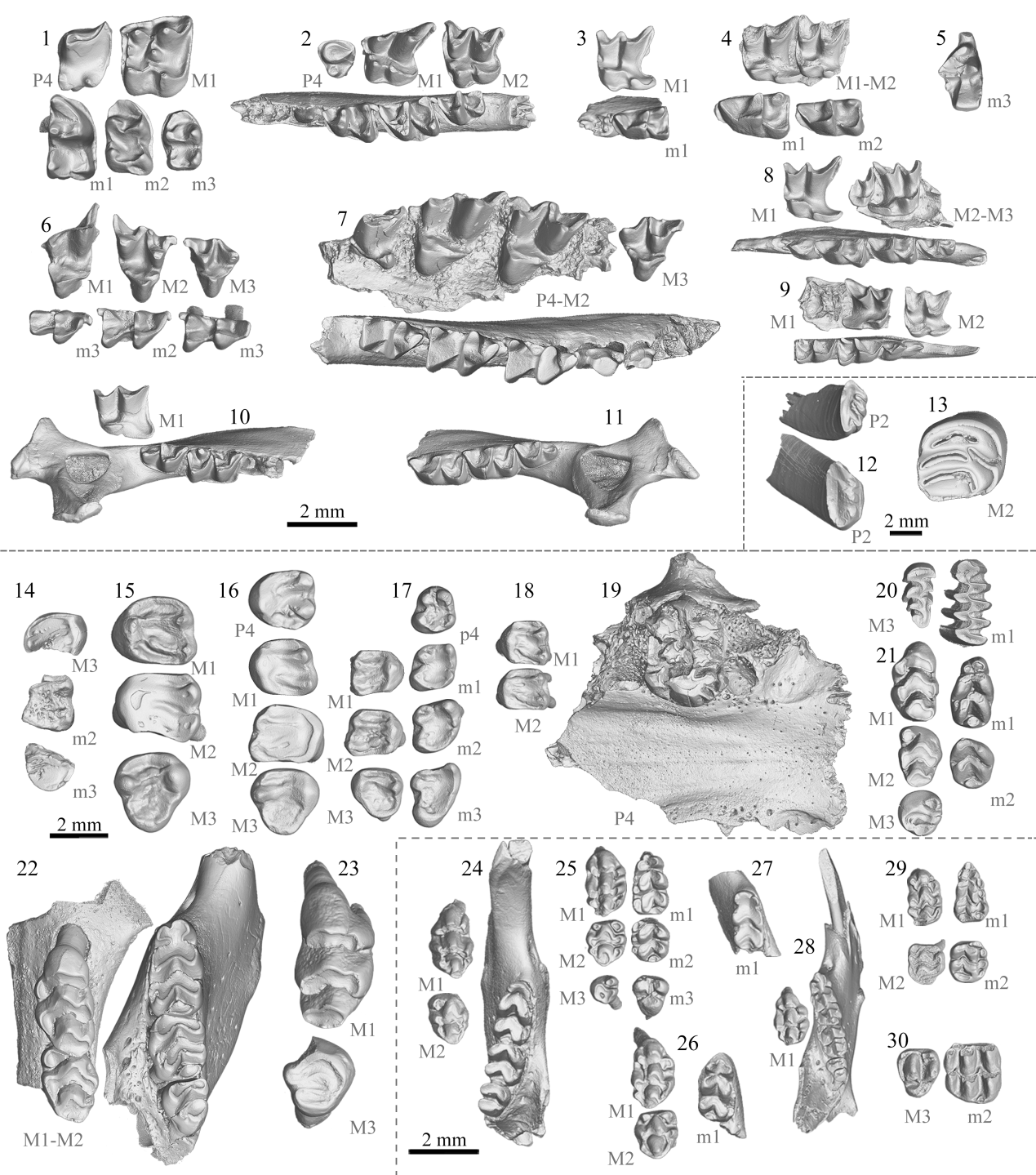
图2 华龙洞遗址2015-2017年发掘出的小哺乳动物化石新增种类 1.小毛猬Hylomys suillus;2. 少齿鼩鼹Uropsilus soricipes,带p4-m3的左下颌left mandible with p4-m3;3. ?水鼩鼱Neomys fodiens;4. 利安德水鼩 Chimarrogale leander;5. 大缺齿鼹Mogera robusta;6. 华南缺齿鼹Mogera latouchei;7. 海岛缺齿鼹Mogera insularis,带左P4-M2的头骨碎片skull fragment with left P4-M2、带p3-m3的右下颌right mandible with p3-m3;8. 川西缺齿鼩Chodsigoa hypsibia,带i、p4-m3的左下颌left mandible with i and p4-m3;9. 高氏缺齿鼩 Chodsigoa caovansunga,带i-m2的右下颌right mandible with i-m2;10. 淡灰黑齿鼩鼱 Parablarinella griselda,带m2-m3的破损右下颌broken right mandible with m2-m3;11. 川鼩Blarinella quadraticauda,带m1-m3的破损左下颌broken left mandible with m1-m3;12. 华南兔Lepus sinensis;13. 大帚尾豪猪Atherurus macrourus;14. 海南小飞鼠 Hylopetes phayrei;15. 北松鼠Sciurus vulgaris;16. 赤腹松鼠Callosciurus erythraeus;17. 隐纹花鼠Tamiops swinhoei;18. 倭花鼠Tamiops maritimus;19. 复齿鼯鼠Trogopterus xanthipes,带右P4的头骨碎片skull fragment with right P4;20. 莫氏田鼠Alexandromys maximowiczii;21. 北社鼠Niviventer confucianus;22. 安氏白腹鼠Niviventer andersoni,带左M1-M2的头骨碎片skull fragment with left M1-M2、带m1-m3的左下颌left mandible with m1-m3;23. 青毛巨鼠Berylmys bowersi;24. 黑线姬鼠Apodemus agrarius,带m1-m3的右下颌right mandible with m1-m3;25. 中华姬鼠Apodemus draco;26. 大林姬鼠Apodemus peninsulae;27. 锡金小鼠Mus pahari;28. 小巢鼠Micromys minutus,带i和m1-m3的左下颌left mandible with i and m1-m3;29. 滇攀鼠Vernaya fulva;30. 小狨鼠Hapalomys delacouri. 本图改绘自文献[6,21] / This image based on references [6,21]
Fig.2 New added micromammalian species from HLD site in 2015-2017 excavation
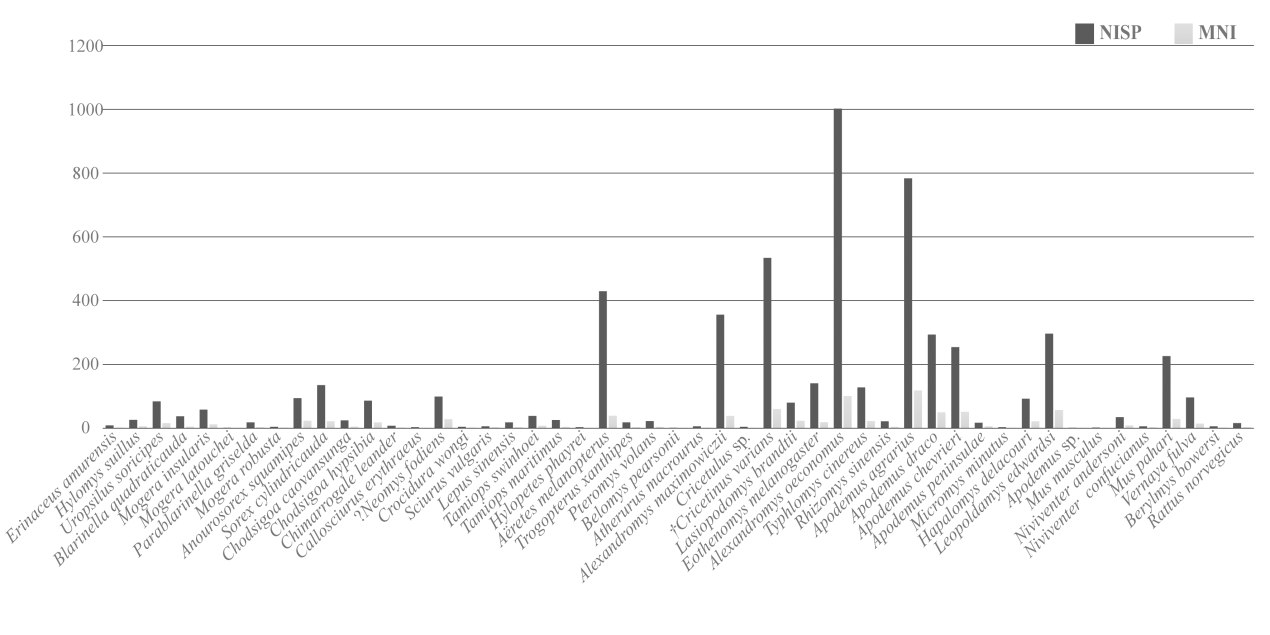
图3 华龙洞遗址非飞行小哺乳动物组合NISP和MNI情况
Fig.3 NISP and MNI of non-volant micromammalian assemblage from HLD site
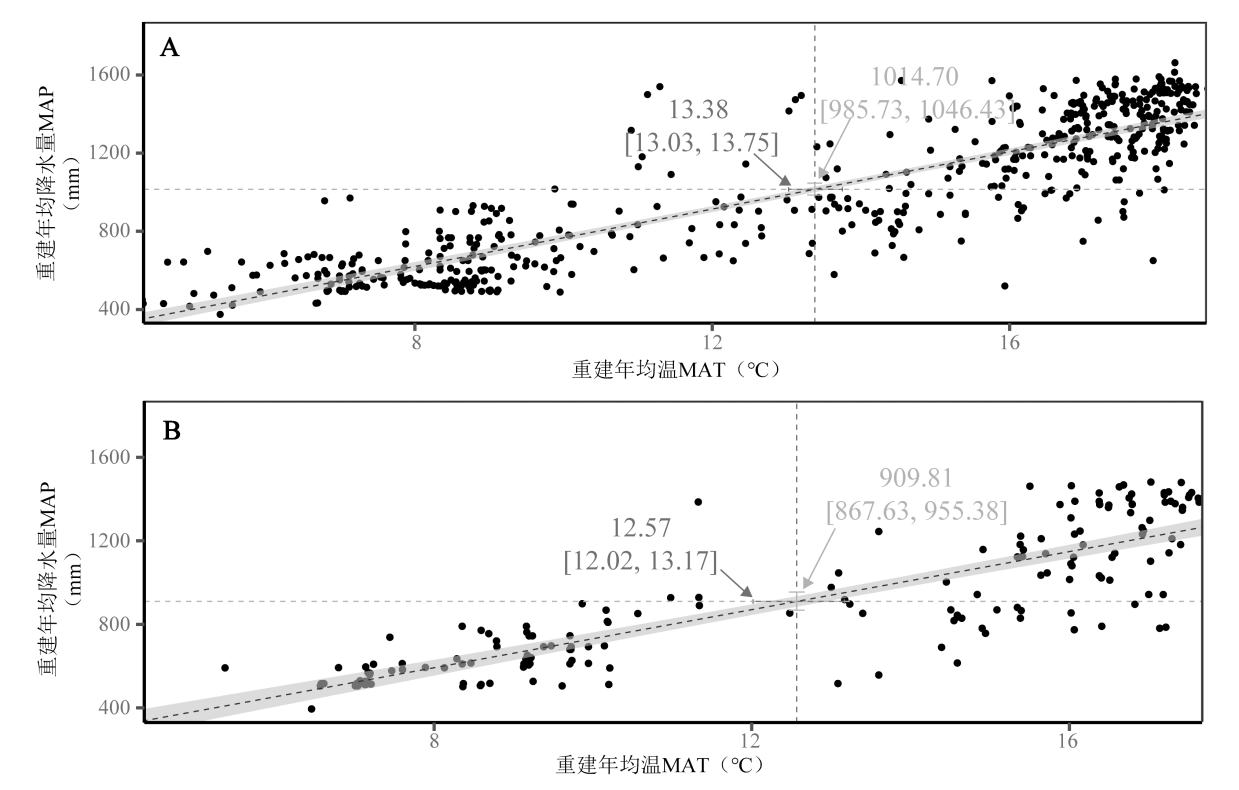
图4 根据现生非飞行小哺乳动物栖息环境的气象数据重建中更新世晚期华龙洞遗址的MAT和MAP A. 基于45个现生种类的重建 the reconstrucion inferred by considering all the extant micromammals;B. 基于8个优势种的重建 the reconstruction considering only the eight species most abundant。黑点为根据实际值(MAT和MAP)得出的预测值,阴影中的黑色虚线为根据预测值得出的回归线,灰色阴影区表示95%的置信区间,[]外的数字为均值,[]中数字代表回归线的95%的置信区间 The black dots represent the predicted values based on the actual values (MAT and MAP), the black dash lines in gray shaded areas represent the regression lines based on the predicted values, the gray shaded areas indicate the 95% confidence intervals, the numbers outside [] represent the mean values, and the numbers in [] represent the 95% confidence intervals of the regression lines
Fig.4 MAT and MAP at late Middle Pleistocene based on modern meteorological data for non-volant small mammals in HLD site
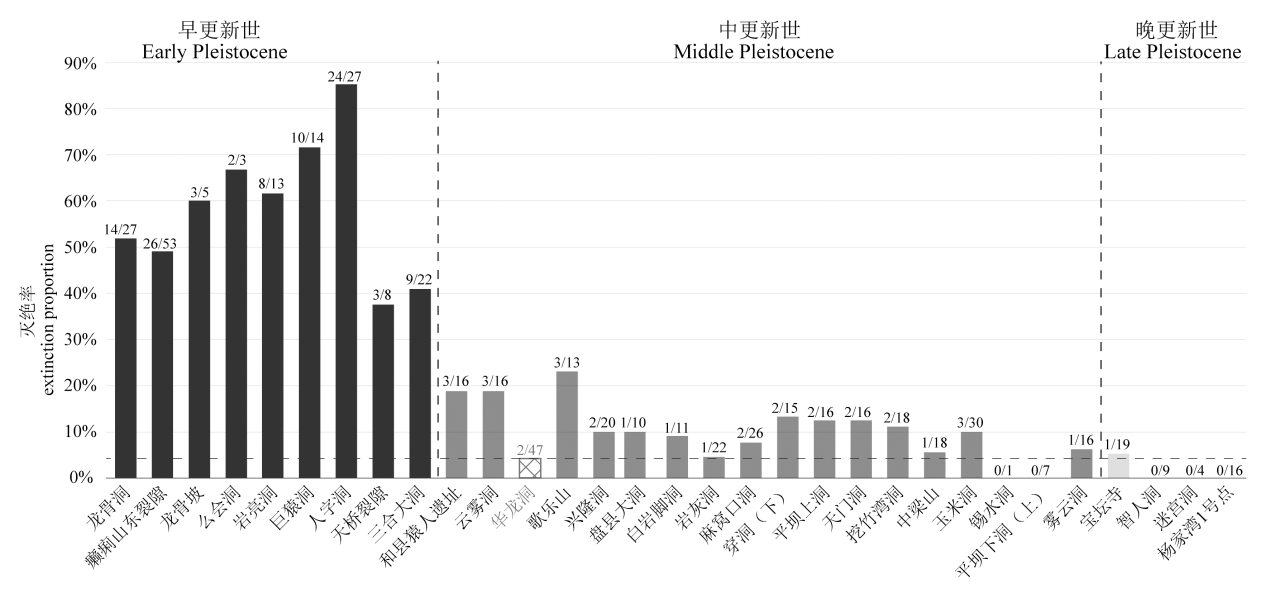
图5 中国南方更新世小哺乳动物组合灭绝率情况
Fig.5 The extinction proportion of non-volant micromammalian faunas from south China
| [1] | 黄万波, 方笃生, 叶永相. 安徽和县猿人化石及有关问题的初步研究[J]. 古脊椎动物与古人类, 1982, 20(3): 248-256 |
| [2] | 许春华, 张银运, 陈才第, 等. 安徽巢县发现的人类枕骨化石和哺乳动物化石[J]. 人类学学报, 1984, 3(3): 202-209 |
| [3] | 穆西南, 许汉奎, 穆道成, 等. 南京汤山古人类化石的发现及其意义[J]. 古生物学报, 1993, 32(4): 393-399 |
| [4] | 郑龙亭, 黄万波. 和县人遗址[M]. 北京: 中华书局, 2001, 1-126 |
| [5] | 吴汝康, 李星学, 吴新智, 等. 南京直立人[M]. 南京: 江苏科学出版社, 2002, 1-316 |
| [6] | Wu X, Pei S, Cai Y, et al. Archaic human remains from Hualongdong, China, and Middle Pleistocene human continuity and variation[J]. Proceedings of the National Academy of Sciences, 2019, 116(20): 9820-9824 |
| [7] | 刘武, 吴秀杰. 华龙洞古人类化石及其在人类演化中的意义[J]. 人类学学报, 2025, 44(5): 727-741 |
| [8] | 裴树文, 董哲, 耿帅杰, 等. 华龙洞遗址发现的石制品及人类行为[J]. 人类学学报, 2025, 44(5): 765-778 |
| [9] | 同号文, 江左其杲, 李强, 等. 安徽东至华龙洞哺乳动物化石新材料[J]. 人类学学报, 2025, 44(5): 779-798 |
| [10] | 江左其杲, 刘博轩, 刘驷统, 等. 华龙洞1号地点的食肉目哺乳动物化石及其时代和古生态意义[J]. 人类学学报, 2025, 44(5): 836-849 |
| [11] | 陈胜前, 罗虎. 安徽东至县华龙洞旧石器时代遗址发掘简报[J]. 考古, 2012, 4: 7-13 |
| [12] | 盛锦朝, 董哲, 金泽田. 华龙洞——古人类的家园 (1)[J]. 化石, 2017, 1: 28-36 |
| [13] | 董哲, 金泽田, 盛锦朝. 华龙洞——古人类的家园(3):发现人类头骨化石[J]. 化石, 2018, 2: 70-75 |
| [14] | 盛锦朝, 金泽田, 董哲. 华龙洞——古人类的家园 (2):重返华龙洞[J]. 化石, 2018, 1: 25-31 |
| [15] | 李潇丽, 董哲, 裴树文, 等. 安徽东至华龙洞洞穴发育与古人类生存环境[J]. 海洋地质与第四纪地质, 2017, 37(3): 169-179 |
| [16] | 裴树文, 蔡演军, 董哲, 等. 安徽东至华龙洞遗址洞穴演化与古人类活动[J]. 人类学学报, 2022, 41(4): 593-607 |
| [17] | 董哲, 战世佳. 安徽东至县华龙洞旧石器时代遗址出土石制品研究[J]. 东南文化, 2015, 6: 63-71 |
| [18] | 董哲, 裴树文, 盛锦朝, 等. 安徽东至华龙洞古人类遗址 2014-2016 年出土的石制品[J]. 第四纪研究, 2017, 37(4): 778-788 |
| [19] | 宫希成, 郑龙亭, 邢松, 等. 安徽东至华龙洞出土的人类化石[J]. 人类学学报, 2014, 33(4): 427-436 |
| [20] | 张邦启. 安徽东至华龙洞遗址出土直立人头骨化石探析[J]. 化石, 2019, 1: 28-31 |
| [21] | 同号文, 吴秀杰, 董哲, 等. 安徽东至华龙洞古人类遗址哺乳动物化石的初步研究[J]. 人类学学报, 2018, 37(2): 284-305 |
| [22] | Jiangzuo QG, Werdelin L, Zhang K, et al. Prionailurus kurteni (Felidae, Carnivora), a new species of small felid from the late Middle Pleistocene fossil hominin locality of Hualongdong, southern China[J]. Annales Zoologici Fennici, 2024, 61(1): 335-342 |
| [23] | Ni X, Qiu Z. The micromammalian fauna from the Leilao, Yuanmou hominoid lo+cality: Implications for biochronology and paleoecology[J]. Journal of Human Evolution, 2002, 42(5): 535-546 |
| [24] | 金昌柱, 秦大公, 潘文石, 等. 广西崇左三合巨猿大洞早更新世小哺乳动物群[J]. 第四纪研究, 2008, 28(6): 1129-1137 |
| [25] | Blanco-Lapaz A, Mata-González M, Starkovich BM, et al. Late Pleistocene environments in the southern Zagros of Iran and their implications for human evolution[J]. Archaeological and Anthropological Sciences, 2022, 14(8): 161 |
| [26] | 李强, 倪喜军. 小化石筛洗法[J]. Bio-101, 2021: e1010613 |
| [27] | 李传夔, 邱铸鼎, 等. 啮型类II:啮齿目I. 中国古脊椎动物志·第3卷(总第十八册上·第5册上)[M]. 北京: 科学出版社, 2019, 1-545 |
| [28] | 邱铸鼎, 李传夔, 郑绍华, 等. 啮型类II:啮齿目II. 中国古脊椎动物志·第3卷(总第十八册上·第5册下)[M]. 北京: 科学出版社, 2020, 1-535 |
| [29] | 魏辅文, 杨奇森, 吴毅, 等. 中国兽类分类与分布[M]. 北京: 科学出版社, 2022, 1-622 |
| [30] | 张荣祖. 中国动物地理[M]. 北京: 科学出版社, 2011, 1-330 |
| [31] | 蒋志刚, 马勇, 吴毅, 等. 中国哺乳动物多样性及地理分布[M]. 北京: 科学出版社, 2015, 1-400 |
| [32] | R Core Team. R: A language and environment for statistical computing[CP/OL]. URL: https://www.R-project.org/, 2023-10-31 |
| [33] | Breiman L. Random forests[J]. Machine learning, 2001, 45: 5-32 |
| [34] | Wickham H, François R, Henry L, et al. dplyr: A grammar of data manipulation[CP]. URL: https://CRAN.R-project.org/package=dplyr, 2023-11-17 |
| [35] | Wickham H, Vaughan D, Girlich M. tidyr: tidy messy data[CP]. URL: https://CRAN.R-project.org/package=tidyr, 2023-01-24 |
| [36] | Kuhn M. Building predictive models in R using the caret package[J]. Journal of Statistical Software, 2008, 28: 1-26 |
| [37] | Liaw A, Wiener M. Classification and regression by randomForest[J]. R News, 2002, 2(3): 18-22. |
| [38] | Ridgeway G. gbm: Generalized Boosted Regression Models[CP]. URL: https://www.R-project.org/, 2024-06-28 |
| [39] | Wickham H. ggplot2: Elegant Graphics for Data Analysis[M]. Springer-Verlag New York, 2016 |
| [40] | 郑绍华, 张联敏. 翼手目及啮齿类[A]. 见:黄万波,方其仁(主编). 巫山猿人遗址[M]. 北京: 海洋出版社, 1991, 46-86 |
| [41] | 黄万波, 徐自强. 14万年前“奉节人”——天坑地缝地区发现古人类遗址[M]. 北京: 中华书局, 2002, 1-83 |
| [42] | 郑绍华. 建始人遗址[M]. 北京: 科学出版社, 2004, 1-412 |
| [43] | 张兆群. 中国更新世兔属化石的厘定[J]. 古脊椎动物学报, 2010, 48(3): 262-274 |
| [44] | 郑绍华. 川黔地区第四纪啮齿类[M]. 北京: 科学出版社, 1993, 1-270 |
| [45] | 陈少坤, 裴健, 易军, 等. 重庆巫山玉米洞遗址出土哺乳动物化石初步观察及时代分析[J]. 第四纪研究, 2017, 37(4): 845-852 |
| [46] | 陈少坤, 庞丽波, 吴雁, 等. 重庆巫山玉米洞遗址晚更新世鼠科动物化石[J]. 第四纪研究, 2023, 43(3): 803-818 |
| [47] | Shao Q, Philippe A, He C, et al. Applying a Bayesian approach for refining the chronostratigraphy of the Yumidong site in the Three Gorges region, central China[J]. Quaternary Geochronology, 2022, 70: 101304 |
| [48] | 沈冠军, 金林红. 桐梓人遗址岩灰洞的铀系年龄[J]. 人类学学报, 1991, 10(1): 65-72 |
| [49] | 王岐山. 安徽兽类志[M]. 合肥: 安徽科学技术出版社, 1990, 1-315 |
| [50] |
裴枭鑫, 曲潍滢, 张敏, 等. 中国巢鼠属分类与分布的讨论[J]. 兽类学报, 2021, 41(6): 631-640
doi: 10.16829/j.slxb.150554 |
| [51] |
裴枭鑫, 曲潍滢, 任学洋, 等. 皖南地区非飞行小型兽类多样性调查及编目[J]. 生物多样性, 2022, 30(4): 21301
doi: 10.17520/biods.2021301 |
| [52] | Chen Z, Hu J, He K, et al. Molecular and morphological evidence support a new species of Asiatic short-tailed shrew (Eulipotyphla: Soricidae)[J]. Journal of Mammalogy, 2023, 104(6): 1455-1467 |
| [53] | Shi Z, Yao H, He K, et al. A new species of forest hedgehog (Mesechinus, Erinaceidae, Eulipotyphla, Mammalia) from eastern China[J]. ZooKeys, 2023, 1185: 143 |
| [54] | Xu Y, Hu J, Shi Z, et al. Integrative systematics and evolutionary history of Berylmys bowersi (Mammalia, Rodentia, Muridae)[J]. Ecology and Evolution, 2023, 13(7): e10234 |
| [55] | Chassovnikarova T, Dimitrov H, Markov G, et al. Distribution and habitat association of field mouse (Apodemus agrarius, Pallas, 1771) in national park “Strandja”[A]. In: Gruev B, Nikolova M, Donev A (eds.). Proceedings of the Balkan Scientific Conference of Biology[C]. Plovdiv, 2005, 428-436 |
| [56] | Liu X, Wei F, Li M, et al. Molecular phylogeny and taxonomy of wood mice (genus Apodemus Kaup, 1829) based on complete mtDNA cytochrome b sequences, with emphasis on Chinese species[J]. Molecular phylogenetics and evolution, 2004, 33(1): 1-15 |
| [57] | Wilson DE, Lacher E, Mittermeier RA. Handbook of the mammals of the world: Rodents II[M]. Barcelona: Lynx Editions, 2017, 7 |
| [58] | Lv X, Cheng J, Meng Y, et al. Disjunct distribution and distinct intraspecific diversification of Eothenomys melanogaster in South China[J]. BMC Evolutionary Biology, 2018, 18: 1-14 |
| [59] | Alexeeva N, Erbajeva M, Khenzykhenova F. Lasiopodomys brandti in Pleistocene of Transbaiklia and adjacent territories: distribution area, evolutionary development in context of global and regional events[J]. Quaternary International, 2015, 355: 11-17 |
| [60] |
Baca M, Popović D, Lemanik A, et al. Highly divergent lineage of narrow-headed vole from the Late Pleistocene Europe[J]. Scientific reports, 2019, 9(1): 17799
doi: 10.1038/s41598-019-53937-1 pmid: 31780683 |
| [61] | Li K, Kohn MH, Zhang S, et al. The colonization and divergence patterns of Brandt's vole (Lasiopodomys brandtii) populations reveal evidence of genetic surfing[J]. BMC Evolutionary Biology, 2017, 17: 1-17 |
| [62] | Hanski IK. Home ranges and habitat use in the declining flying squirrel Pteromys volans in managed forests[J]. Wildlife Biology, 1998, 4(1): 33-46 |
| [63] | Selonen V, Hanski IK. Young flying squirrels (Pteromys volans) dispersing in fragmented forests[J]. Behavioral Ecology, 2004, 15(4): 564-571 |
| [64] | Suzuki H, Aplin KP, Pialek J. Phylogeny and biogeography of the genus Mus in Eurasia[A]. In: Macholan M, Baird SJE, Munclinger P, et al (eds.). Evolution of the house mouse [M]. Cambridge: Cambridge University Press, 2012, 35-64 |
| [65] | Suzuki H. Evolutionary history of the subgenus Mus in Eurasia with special emphasis on the House Mouse Mus musculus[J]. Records Australian Museum, 2020, 72(5): 317-323 |
| [1] | 裴树文, 牛东伟, 马东东. 泥河湾盆地蔚县中更新世古人类活动遗址的发现与科学价值[J]. 人类学学报, 2026, 45(03): 403-418. |
| [2] | 耿帅杰, 裴树文, 杜雨薇, 徐静玥, 叶芷, 刘子仪. 泥河湾盆地蔚县蔡家沟遗址A地点发掘简报[J]. 人类学学报, 2026, 45(03): 500-514. |
| [3] | 叶芷, 裴树文, 马东东, 贾真秀, 王法岗, 杨海勇. 泥河湾盆地蔚县前上营遗址B地点发掘报告[J]. 人类学学报, 2026, 45(03): 515-531. |
| [4] | 刘子仪, 耿帅杰, 丁馨, 徐静玥, 叶芷, 牛东伟, 裴树文. 泥河湾盆地蔚县北官堡遗址B地点的埋藏过程[J]. 人类学学报, 2026, 45(03): 556-569. |
| [5] | 杜雨薇, 耿帅杰, 徐静玥, 叶芷, 张乐, 马东东, 裴树文. 泥河湾盆地蔡家沟遗址A和B地点动物骨骼的埋藏学观察[J]. 人类学学报, 2026, 45(03): 570-585. |
| [6] | 刘尔凡, 高佳璇, 牛东伟. 河北怀来盆地珠窝堡遗址出土的石制品[J]. 人类学学报, 2026, 45(03): 600-608. |
| [7] | 姚艳燕, 艾婉婷, 胡敏航, 付琼耀, 李国山, 钟洁美, 胡鹏程, 黄胜敏, 田淳, 梁华, 廖卫, 王伟, 易智星. 广西崇左岩利1号洞早-中更新世过渡期的巨猿化石[J]. 人类学学报, 2026, 45(02): 199-209. |
| [8] | 姚艳燕, 廖卫, 李炬平, 易智星, 田淳, 钟洁美, 高超, 王伟, 梁华. 广西崇左岩利2号洞发现中更新世早期的猩猩牙齿化石[J]. 人类学学报, 2026, 45(02): 210-223. |
| [9] | 王思元, 李金燕, 梁华, 谢耀樟, 廖卫, 王伟. 广西西部新发现的猩猩牙齿化石及其分类演化意义[J]. 人类学学报, 2026, 45(02): 224-235. |
| [10] | 阮齐军, 王幼平. 元谋猿人遗址发现及研究历史回顾与展望[J]. 人类学学报, 2025, 44(06): 927-938. |
| [11] | 董哲, 战世佳. 安徽地区发现的阿舍利大型工具[J]. 人类学学报, 2025, 44(06): 998-1008. |
| [12] | 刘武, 吴秀杰. 华龙洞古人类化石及其在人类演化上的意义[J]. 人类学学报, 2025, 44(05): 727-741. |
| [13] | 蔡演军, 裴树文, 金泽田. 安徽东至华龙洞遗址沉积演化过程及其年代[J]. 人类学学报, 2025, 44(05): 742-753. |
| [14] | 金泽田, 吴秀杰, 邓国栋, 刘武. 华龙洞人6号头骨的面貌复原及其形态特点[J]. 人类学学报, 2025, 44(05): 754-764. |
| [15] | 裴树文, 董哲, 耿帅杰, 叶芷, 马东东, 张亚盟, 金泽田. 华龙洞遗址发现的石制品及人类行为[J]. 人类学学报, 2025, 44(05): 765-778. |
| 阅读次数 | ||||||
|
全文 |
|
|||||
|
摘要 |
|
|||||
 京ICP证05002819号-3