

主管:中国科学院
主办:中国科学院古脊椎动物与古人类研究所
出版:科学出版社
主办:中国科学院古脊椎动物与古人类研究所
出版:科学出版社
人类学学报 ›› 2025, Vol. 44 ›› Issue (05): 779-798.doi: 10.16359/j.1000-3193/AAS.2025.0066cstr: 32091.14.j.1000-3193/AAS.2025.0066
同号文1,2( ), 江左其杲1, 李强1, 常美静1,2, 刘博轩1,2, 金泽田3
收稿日期:2025-03-21
修回日期:2025-06-05
出版日期:2025-10-15
发布日期:2025-10-13
作者简介:同号文,研究员,主要研究方向为第四纪哺乳动物学。E-mail: tonghaowen@ivpp.ac.cn
基金资助:
TONG Haowen1,2(), JIANGZUO Qigao1, LI Qiang1, CHANG Meijing1,2, LIU Boxuan1,2, JIN Zetian3
Received:2025-03-21
Revised:2025-06-05
Online:2025-10-15
Published:2025-10-13
摘要:
安徽华龙洞遗址的1号地点是近些年来中国境内发现的最重要的中更新世晚期古人类化石地点。该遗址发现于1988年,自2017年之后,动物群名单中新增加了如下属种:仰鼻猴属(未定种)、犬属(未定种)、武陵山大熊猫、豹、云豹、柯氏豹猫、华龙林狸、果子狸、食蟹獴、最后斑鬣狗、马属(未定种)、斯迪凡犀属(未定种)、水鹿、獐及鬣羚等;还增添了更多更完好的化石标本,例如黑熊、巴氏大熊猫、虎、葛氏斑鹿、李氏野猪及大额牛等,后两者代表了各自目前所知的最大个体;华龙洞的棕熊、马、李氏野猪和大角鹿代表了各自在中国大陆东部地区最靠南的化石分布。目前,华龙洞遗址出土的哺乳动物化石已多达93种。此外,武陵山大熊猫的发现使得华龙洞遗址动物群的时代变得复杂起来,因为该种大熊猫之前仅发现于早更新世晚期地层,与华龙洞遗址的形成时间不一致,这很可能与新老地层混杂有关。华龙洞动物群的优势种是大额牛和鹿类动物,这与湖北白龙洞遗址的情况十分相似。
中图分类号:
同号文, 江左其杲, 李强, 常美静, 刘博轩, 金泽田. 安徽东至华龙洞哺乳动物化石新材料[J]. 人类学学报, 2025, 44(05): 779-798.
TONG Haowen, JIANGZUO Qigao, LI Qiang, CHANG Meijing, LIU Boxuan, JIN Zetian. New mammalian fossils from the Hualongdong site in Dongzhi County, Anhui[J]. Acta Anthropologica Sinica, 2025, 44(05): 779-798.
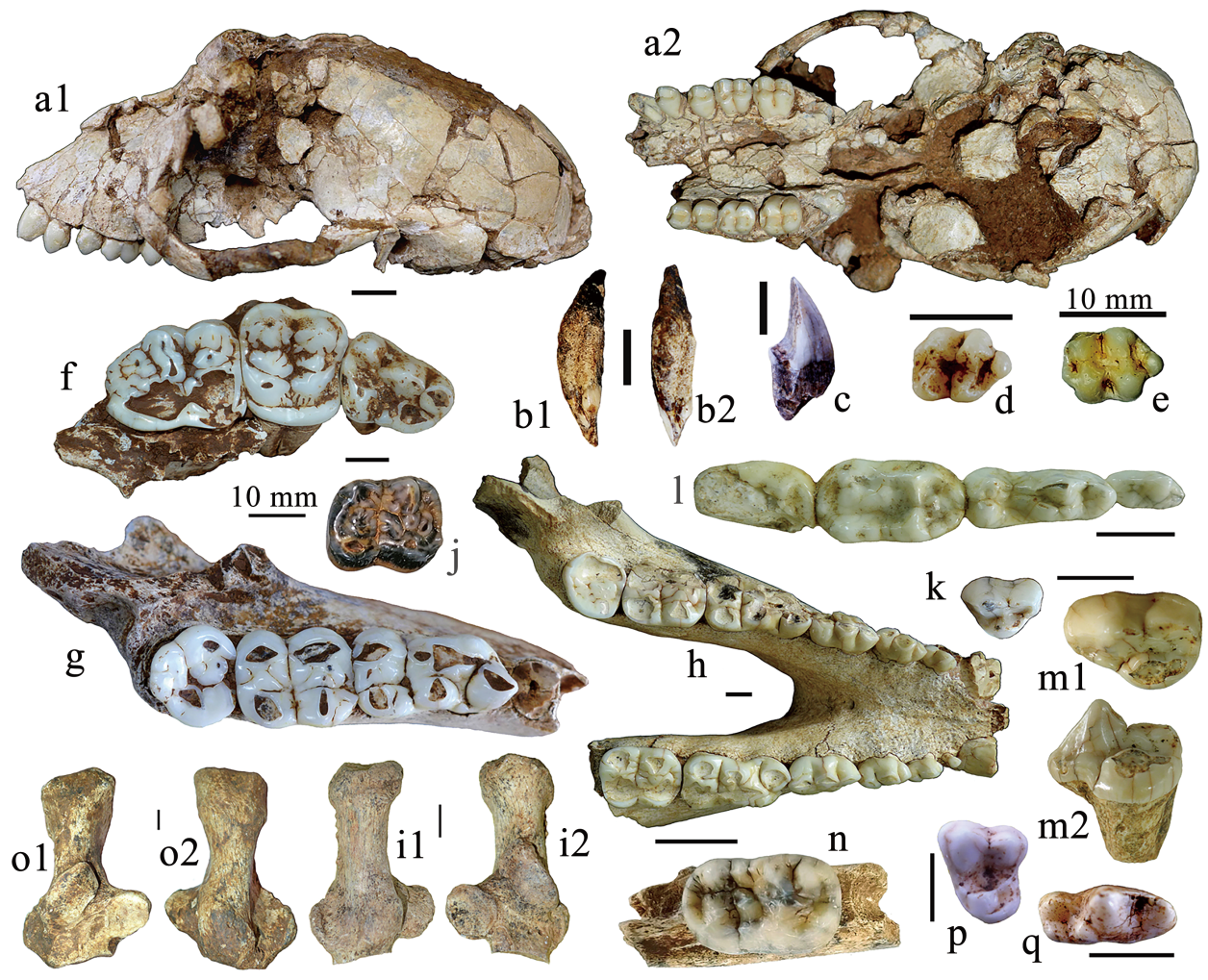
图1 猴科、犬科及熊科动物化石 a-c.猕猴Macaca mulatta;a1-a2, 头骨skull;b1-b2, 雄性右上犬齿male right upper canine;c,雄性右下犬齿male right lower canine。d-e.仰鼻猴属(未定种) Rhinopithecus sp.;d, 左left M3;e, 右right M3。f-i.巴氏大熊猫Ailuropoda baconi;f, 右上颌right maxilla with P4-M2;g, 左下颌left mandible with m1-3;h, 下颌骨带齿列mandible with teeth (IVPP V 34057);i1-i2, 左跟骨left calcaneus。j.武陵山大熊猫Ailuropoda wulingshanensis;右right m2。k-l.黑熊Ursus thibetanus;k, 左left P4;l, 左下颊齿left p4-m3。m-o.棕熊Ursus arctos;m1-m2, 左left P4;n, 右下颌残段partial right mandible with m2;o1-o2, 右跟骨right calcaneus。p-q.犬属(未定种) Canis sp.;p, 左left M1;q, 左left m1。a1.侧视lateral view;a2.腹视ventral view;b1.前视anterior view;b2, m2.舌侧视lingual views;c.颊侧视buccal view;d-e, f-g, j-l, m1, n, p-q.冠面视occlusal views;i2, o1.背视dorsal views;i1, o2.腹视plantar views. 比例尺代表10 mm, scale bars equal 10 mm
Fig.1 Fossils of cercopithecids, canids and ursids
| 解剖部位Elements ↓ | 属种Taxa → | 巴氏大熊猫Ailuropoda baconi | 大熊猫现生种Ailuropoda melaneus | 黑熊Ursus thibetanus | 棕熊Ursus arctos | |||||
|---|---|---|---|---|---|---|---|---|---|---|
| 来源Sources → | 华龙洞00133 | IVPP OV 1236 | IVPP C/043 | 华龙洞 | IVPP OV2101 | 华龙洞 | ||||
| 跟骨Calcaneus | L | 60.66 | 67.3~68.8 | 80.6 | - | 90.9 | 93.1 | |||
| W | 39.05 | 39.4~39.6 | 51.2 | - | 55.2 | 59.5 | ||||
| 距骨Astragalus | L | - | 47.3~47.4 | 45.2 | 42 | 53.4 | 54 | |||
| W | - | 36.5~37.7 | 49.9 | 39 | 54.2 | 46 | ||||
表1 华龙洞熊科动物跟骨和距骨测量数据及与相关现生属种的比较 (mm)
Tab.1 Dimensions of calcaneus and astragalus of ursids from HLD, compared with those of the related extant species
| 解剖部位Elements ↓ | 属种Taxa → | 巴氏大熊猫Ailuropoda baconi | 大熊猫现生种Ailuropoda melaneus | 黑熊Ursus thibetanus | 棕熊Ursus arctos | |||||
|---|---|---|---|---|---|---|---|---|---|---|
| 来源Sources → | 华龙洞00133 | IVPP OV 1236 | IVPP C/043 | 华龙洞 | IVPP OV2101 | 华龙洞 | ||||
| 跟骨Calcaneus | L | 60.66 | 67.3~68.8 | 80.6 | - | 90.9 | 93.1 | |||
| W | 39.05 | 39.4~39.6 | 51.2 | - | 55.2 | 59.5 | ||||
| 距骨Astragalus | L | - | 47.3~47.4 | 45.2 | 42 | 53.4 | 54 | |||
| W | - | 36.5~37.7 | 49.9 | 39 | 54.2 | 46 | ||||
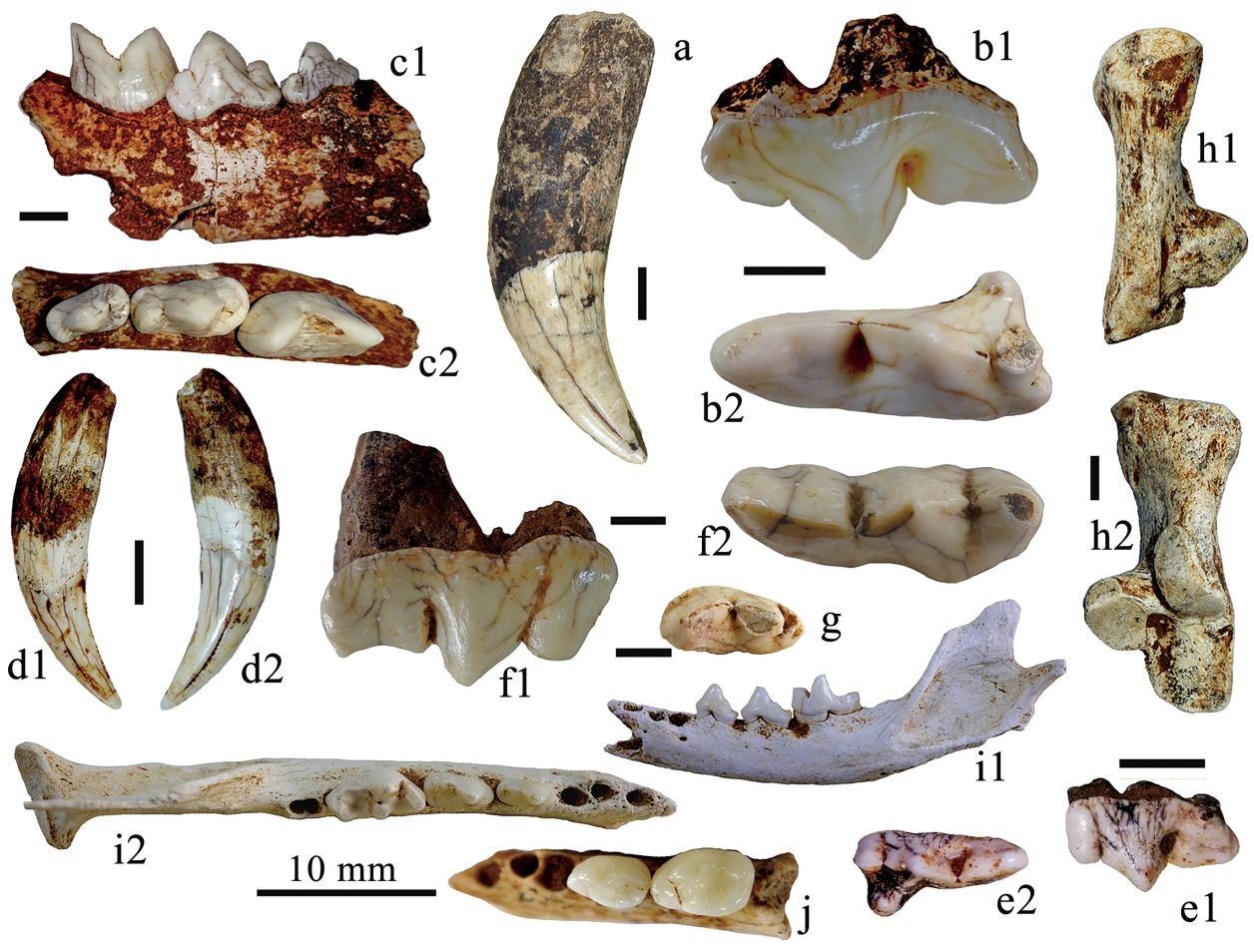
图2 猫形亚目动物化石 a-c.虎Panthera tigris, a, 左上犬齿left canine;b1-b2,左left P4;c1-c2, 右下颌残段partial right mandible with p3-m1。d-e.云豹(未定种) Neofelis sp., d1-d2, 右上犬齿right C;e1-e2, 左left P4。f-h.中国硕鬣狗Pachycrocuta sinensis, f1-f2, 右 right P4;g, 右right m1;h1-h2, 左跟骨left calcaneus。i1-i2.大灵猫(未定种) Viverra sp., 左下颌partial left mandible with p3-m1。J.果子狸Paguma lavarta, 右下颌残段partial right mandible with p4-m1。a, b1, c1, d2, e1.颊侧视buccal views;b2, c2, e2, f2, g, j.冠面视occlussal views;d1.舌侧视lingual views;h1.腹视plantar view;h2.背视dorsal view. 比例尺代表10 mm, scale bars equal 10 mm
Fig.2 Fossils of feliforms
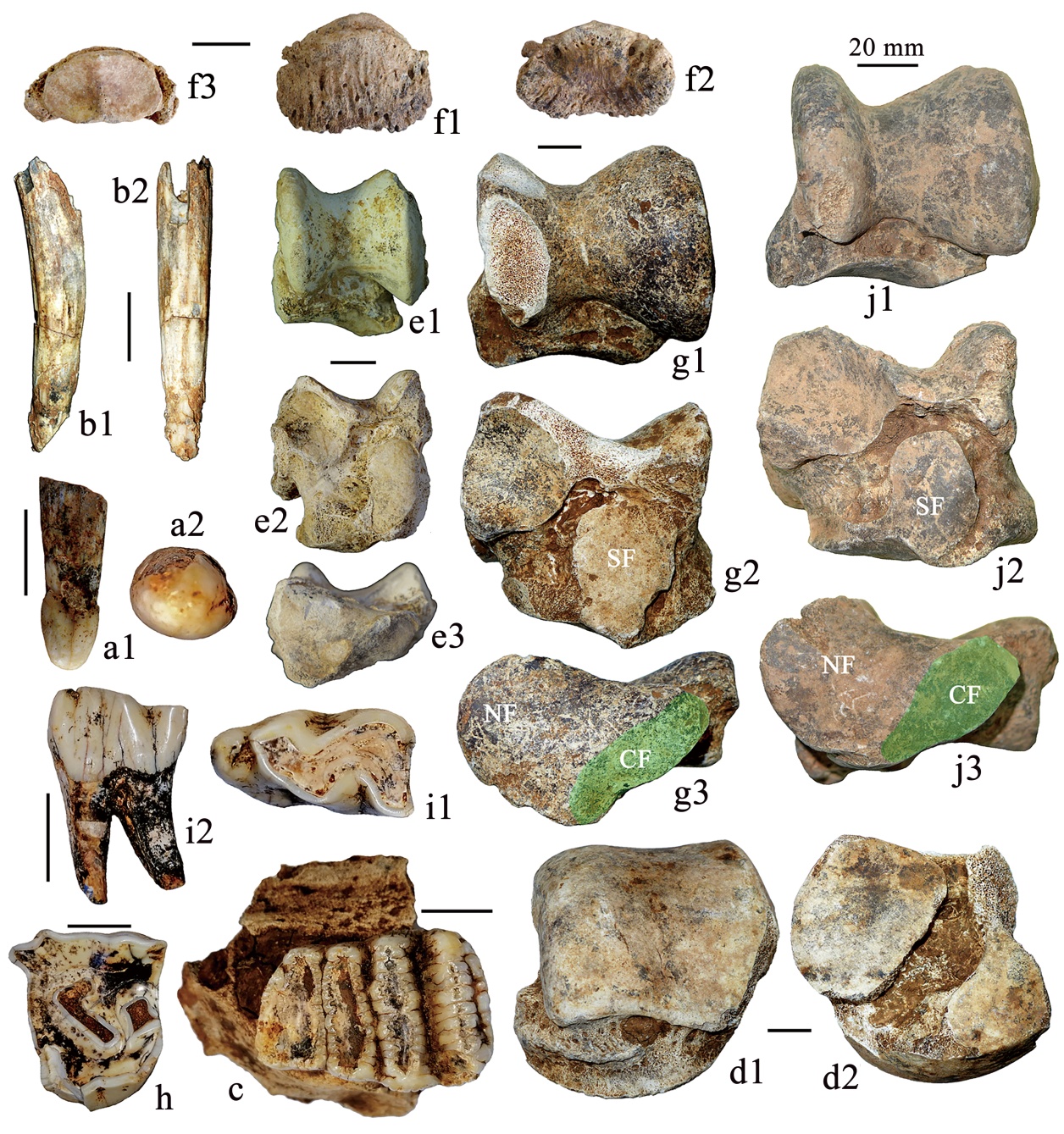
图3 剑齿象科和角形亚目奇蹄类化石 a-d.剑齿象Stegodon orientalis; a-b, 上乳门齿DI2 (IVPP V 34058);c, 右上颌带right DP3;d, 左距骨left astragalus。e-f.巨貘Megatapirus augustus; e1-e3, 左距骨left astragalus (IVPP V 34059);f1-f3, 中趾第三趾节骨 3rd or distal phalanx of 3rd finger。g1-g3.苏门犀Dicerorhinus sumatrensis, 左距骨left astragalus。h-j.斯迪凡犀(未定种) Stephanorhinus sp.; h, 左left P3;i1-i2, 右right p2;j1-j3, 左距骨left astragalus。a1, b1.颊视buccal views;a2, c, h, i1.冠视occlusal views;b2,前视anterior views;d1, e1, f1, g1, j1.背视dorsal views;d2, e2, f2, j2.腹视plantar views;f3.近端视proximal view;e3, g3, j3.远端视distal views;i2. 舌侧视lingual view。CF: 骰骨关节面cuboid facet;NF: 舟骨关节面navicular facet;SF: 载距突关节面sustentacular facet。 比例尺代表20 mm / scale bars equal 20 mm.
Fig.3 Fossils of stegodontid and ceratomorphs
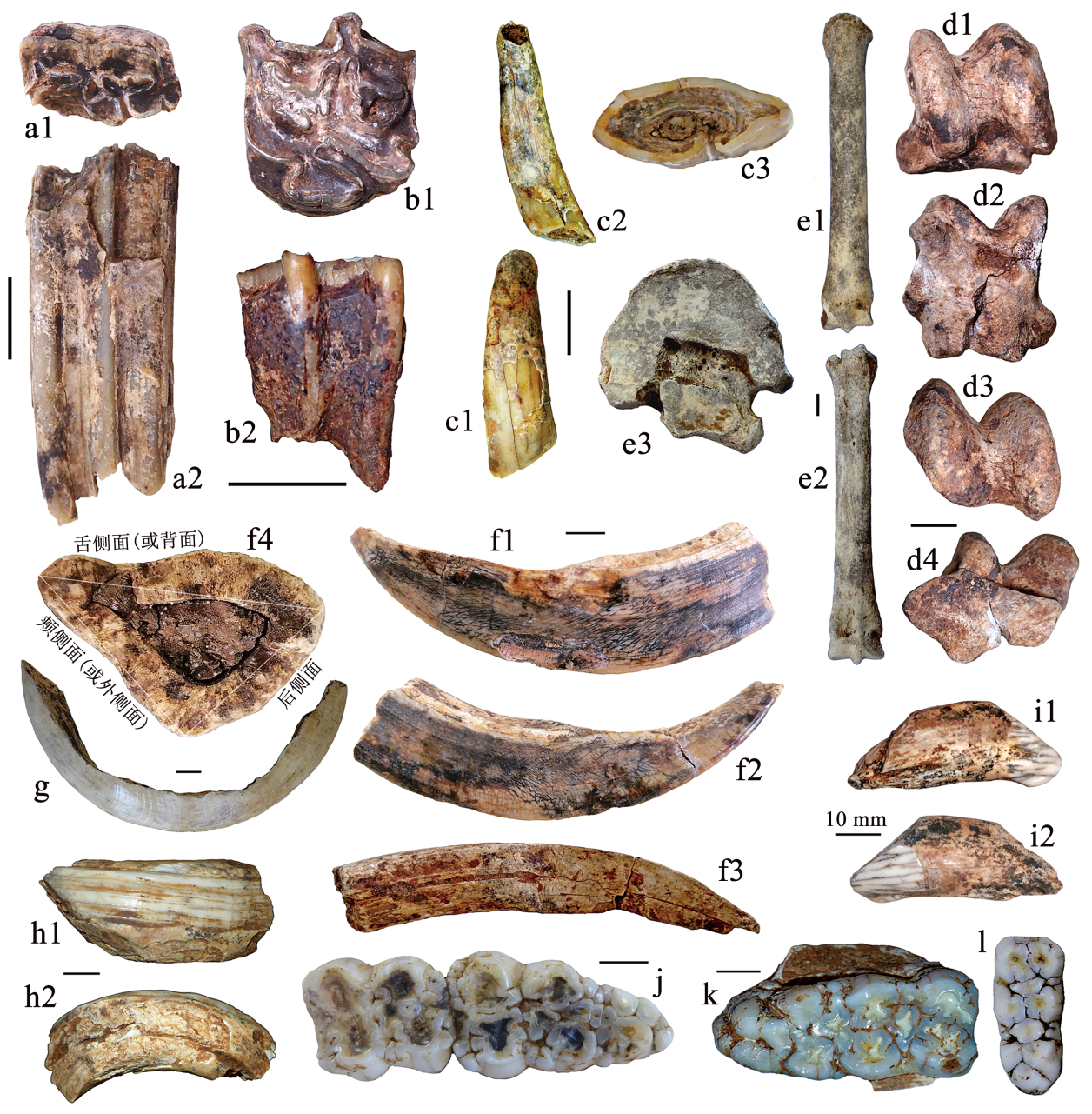
图4 马属(未定种)及猪科动物化石 a-e.马属(未定种)Equus sp.; a1-a2, 右下right p3;b1-b2, 左left P3 or P4;c1-c3, 左上left I3;d1-d4, 左距骨left astragalus;e1-e3, 右第三蹠骨right Mt III。f-k.李氏野猪Sus lydekkeri; f1-f4, 雄性右下犬齿male right lower canine;g, 雄性右下犬齿male right lower canine;h1-h2, 雄性左上犬齿male left upper canine (IVPP V 34060);i1-i2, 雌性右上犬齿 female right upper canine;j, 左left M2-3;k, 左left m3。l.野猪 Sus scrofa; 右right m3。a1, b1, c3, j-l.冠面视occlusal views;a2, b2, f2. 颊侧视buccal views;c1. 唇侧视labial view;c2.舌侧视lingual view;f1, g. 前舌侧视anterolingual views;f3, h2. 后侧视posterior views;f4. 横截面cross-section;h1, i2. 下侧视inferior views;i1.背视dorsal view;e1. 前视anterior view;e2. 后视posterior view;d2. 腹视plantar view;d3, e3. 近端视proximal views;d4. 远端视distal view. 比例尺代表10 mm / scale bars equal 10 mm;c3, e3. 局部放大expanded not to scale
Fig.4 Fossils of Equus sp. and suids
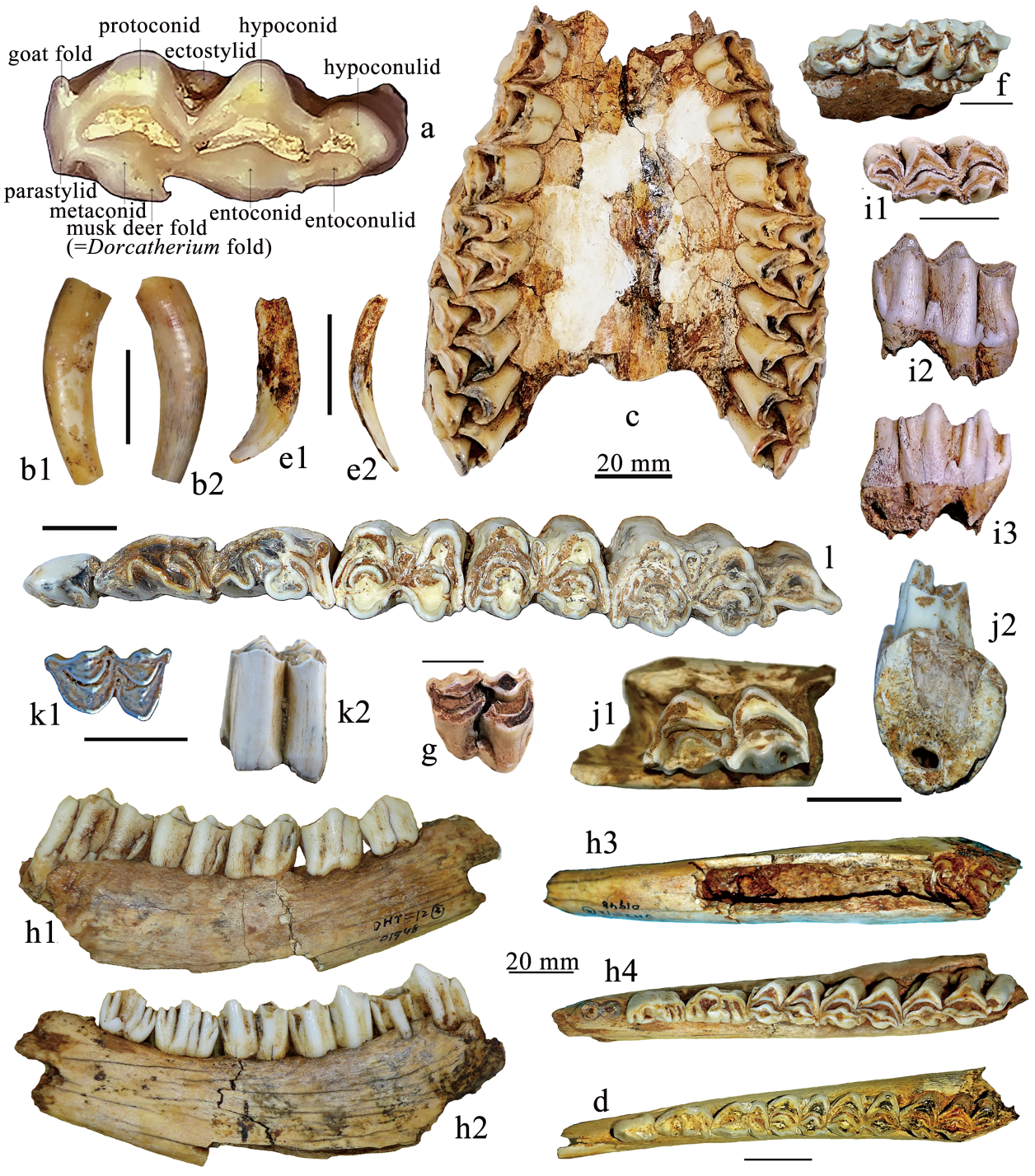
图5 反刍类动物化石 a. 反刍类齿冠结构术语,以麝左m3为例left m3 of Moschus to show the dental terms for ruminants。b1-b2. 獐Hydropotes sp.,雄性右上犬齿male right upper canine。c-d.葛氏斑鹿Cervus grayi; c.上颌maxilla with P2-M3 of both sides;d. 右下颌right mandible with p2-m3。 e1-e2. 赤麂Muntiacus muntjak,雄性右上犬齿male right upper canine。f-i. 水鹿Rusa unicolor; f. 左上颌left maxilla with DP2-4; g. 右right M2;h1-h4. 右下颌right mandible with p3-m3; i1-i3. 左left m3。 j1-j2.中国大角鹿(未定种) Sinomegaceros sp., partial left mandible with m2。k1-k2. 鬣羚(未定种) Capricornis sp., 右right M3。l. 大额牛Bos (Bibos) sp., 右下颊齿列right p2-m3。 a, c, d, f, g, h4, i1, j1, k1, l. 冠面视occlusal views;b1, h2, i3, k2. 舌侧视lingual views;b2, e1, i2, h1. 颊侧视buccal views;e2, 远中侧视distal view;h3. 腹视inferior view; j2, 近中侧视mesial view。 比例尺代表20 mm / scale bars equal 20 mm。a, 局部放大expanded not to scale
Fig.5 Fossils of ruminants
| 属种名Taxa | 地点Locality | 下颌骨在m3中叶处厚度/Mandible thickness under m3 | 下颌骨在m3中叶处舌侧高度/Mandible lingual height under m3 | 厚度指数 (t/h×100) Pachyostosis index | 出处Sources |
|---|---|---|---|---|---|
| Sinomegaceros sp. | 华龙洞 | 26.9* | ?(缺损) | - | 本文 |
| Megaloceros ordosianus | 萨拉乌苏 | 36.3~40.7 | 47.5~48.6 | 74.7-85.7 | [ |
| Megaloceros sp. | 周口店第3地点 | 28.5 | 44.1 | 64.6 | [ |
| Sinomegaceros sp. | 丁村98地点 | 24.2* | 46.1* | - | [ |
| Sinomegaceros cf. ordosianus | 丁村96地点 | 24~32* | 40* | - | [ |
| Megaloceros pachyosteus | 大荔人地点 | 38 (36~40) | 46 (44~48) | 82.6 (81.8~83.3) | [ |
| Megaloceros pachyosteus | 南京葫芦洞小洞 | 36.1(32~45.3) | 47.4(43.5~52.8) | 76.2 | [ |
| Megaloceros pachyosteus | 周口店第1地点 | 41.3 (29.6~51.9) | 51.2 (43~61.8) | 80.3 (64.1~91.1) | [ |
| Megaloceros konwanlinensis | 蓝田公王岭 | 43.7 | 54.8 | 79.7 | [ |
| Megaloceros flabellatus | 周口店第13地点 | 36.4 (35~40) | 46.7 (44~49) | 77.9 (72.9~81.6) | [ |
| Rusa unicolor | 现生(VO 567) | 22.1 | 38.1 | 58 | 本文 |
表2 中国大角鹿下颌骨测量数据及与现生水鹿的比较 (mm)
Tab.2 Dimensions of mandibles of Sinomegaceros species, compared with that of Rusa unicolor
| 属种名Taxa | 地点Locality | 下颌骨在m3中叶处厚度/Mandible thickness under m3 | 下颌骨在m3中叶处舌侧高度/Mandible lingual height under m3 | 厚度指数 (t/h×100) Pachyostosis index | 出处Sources |
|---|---|---|---|---|---|
| Sinomegaceros sp. | 华龙洞 | 26.9* | ?(缺损) | - | 本文 |
| Megaloceros ordosianus | 萨拉乌苏 | 36.3~40.7 | 47.5~48.6 | 74.7-85.7 | [ |
| Megaloceros sp. | 周口店第3地点 | 28.5 | 44.1 | 64.6 | [ |
| Sinomegaceros sp. | 丁村98地点 | 24.2* | 46.1* | - | [ |
| Sinomegaceros cf. ordosianus | 丁村96地点 | 24~32* | 40* | - | [ |
| Megaloceros pachyosteus | 大荔人地点 | 38 (36~40) | 46 (44~48) | 82.6 (81.8~83.3) | [ |
| Megaloceros pachyosteus | 南京葫芦洞小洞 | 36.1(32~45.3) | 47.4(43.5~52.8) | 76.2 | [ |
| Megaloceros pachyosteus | 周口店第1地点 | 41.3 (29.6~51.9) | 51.2 (43~61.8) | 80.3 (64.1~91.1) | [ |
| Megaloceros konwanlinensis | 蓝田公王岭 | 43.7 | 54.8 | 79.7 | [ |
| Megaloceros flabellatus | 周口店第13地点 | 36.4 (35~40) | 46.7 (44~49) | 77.9 (72.9~81.6) | [ |
| Rusa unicolor | 现生(VO 567) | 22.1 | 38.1 | 58 | 本文 |
| 属种Taxa | 麝Moschus moschiferus | 獐 Hydropotes inermis | ||||||||
|---|---|---|---|---|---|---|---|---|---|---|
| 遗址Site | IVPP OV 474 Extant | 周口店田园洞Tianyuandong | 北京十渡太平洞Xitaipingdong | IVPP OV 067 Extant | 安徽和县Hexian | 西安半坡Banpo | 安阳殷墟Yinxu | 浙江河姆渡Hemudu | 河南新蔡Xincai | |
| 长L | 76 | 75.5 | 60.6~62.5 | 67 | 66 | 58~70 | 72 | 63 | 62.5 | |
| 宽W | 8.2 | 8.2 | 9.8 | 12.2 | 11 | 10.2~12.5 | 11 | 10.5 | 11 | |
| 出处Sources | [ | [ | [ | 本文 | [ | [ | [ | [ | [ | |
表3 獐和麝雄性上犬齿测量 (mm)
Tab.3 Dimensions of male upper canines of Hydropotes and Moschus
| 属种Taxa | 麝Moschus moschiferus | 獐 Hydropotes inermis | ||||||||
|---|---|---|---|---|---|---|---|---|---|---|
| 遗址Site | IVPP OV 474 Extant | 周口店田园洞Tianyuandong | 北京十渡太平洞Xitaipingdong | IVPP OV 067 Extant | 安徽和县Hexian | 西安半坡Banpo | 安阳殷墟Yinxu | 浙江河姆渡Hemudu | 河南新蔡Xincai | |
| 长L | 76 | 75.5 | 60.6~62.5 | 67 | 66 | 58~70 | 72 | 63 | 62.5 | |
| 宽W | 8.2 | 8.2 | 9.8 | 12.2 | 11 | 10.2~12.5 | 11 | 10.5 | 11 | |
| 出处Sources | [ | [ | [ | 本文 | [ | [ | [ | [ | [ | |
| 属种Taxa | 大额牛属(未定种)Bos (Bibos) sp. | 大额牛Bos (Bibos) gaurus | 谷氏大额牛Bibos gaurus grangeri | 原始牛Bos primigenius | 水牛Bubalus bubalis | |||||
|---|---|---|---|---|---|---|---|---|---|---|
| 遗址Site | 华龙洞Hualongdong | 白龙洞Bailongdong | 盐井沟 Yanjinggou | 阳原丁家堡Dingjiabao | 欧洲丹麦 Denmark | 盐井沟 Yanjinggou | ||||
| 地质时代Age | Ca. 0.3 Ma | 0.5 Ma | 中更新世 | 晚更新世 | 新石器时代 | 中更新世 | ||||
| p2-m3 长度length | 172 | 136.1~149.8 | 142~172 | 168.1* | 158~194 (172.3) | 165~178 | ||||
| 出处Source | 本文 | [ | [ | [ | [ | [ | ||||
表4 大额牛、原始牛及水牛下颊齿列长度比较 (mm)
Tab.4 Comparisons in cheek tooth series length among Bibos, Bos and Bubalus
| 属种Taxa | 大额牛属(未定种)Bos (Bibos) sp. | 大额牛Bos (Bibos) gaurus | 谷氏大额牛Bibos gaurus grangeri | 原始牛Bos primigenius | 水牛Bubalus bubalis | |||||
|---|---|---|---|---|---|---|---|---|---|---|
| 遗址Site | 华龙洞Hualongdong | 白龙洞Bailongdong | 盐井沟 Yanjinggou | 阳原丁家堡Dingjiabao | 欧洲丹麦 Denmark | 盐井沟 Yanjinggou | ||||
| 地质时代Age | Ca. 0.3 Ma | 0.5 Ma | 中更新世 | 晚更新世 | 新石器时代 | 中更新世 | ||||
| p2-m3 长度length | 172 | 136.1~149.8 | 142~172 | 168.1* | 158~194 (172.3) | 165~178 | ||||
| 出处Source | 本文 | [ | [ | [ | [ | [ | ||||
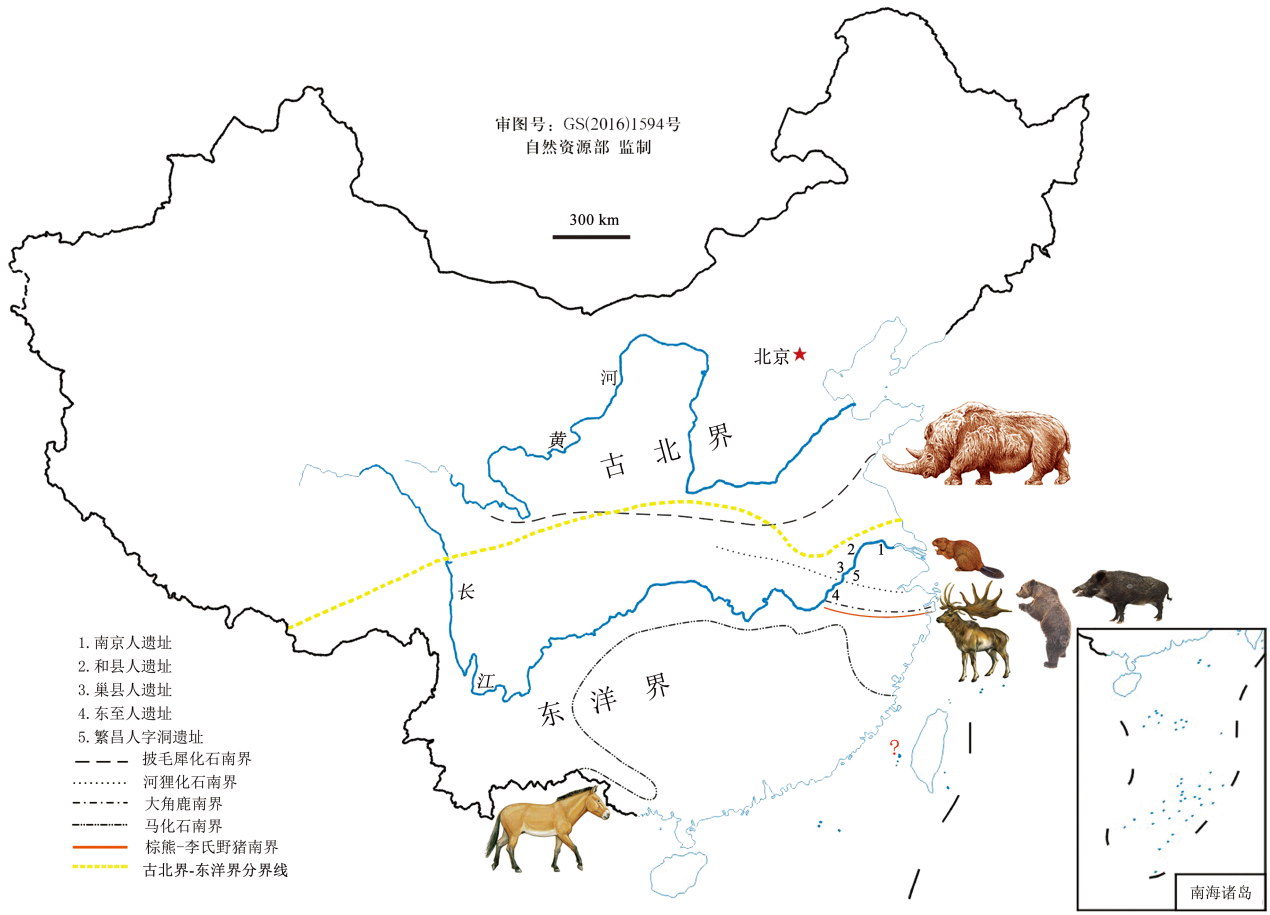
图6 我国几种北方动物迁徙的最南界
Fig.6 Southermost occurrences of selected boreal mammals in China
| [1] | Wu XJ, Pei SW, Cai YJ, et al. Archaic human remains from Hualongdong, China, and Middle Pleistocene human continuity and variation[J]. PNAS, 2019, 116: 9820-9824 |
| [2] | Wu XJ, Pei SW, Cai YJ, et al. Morphological description and evolutionary significance of 300 ka hominin facial bones from Hualongdong, China[J]. Journal of Human Evolution, 2021, 161: 103052 |
| [3] | 陈胜前, 罗虎. 安徽东至县华龙洞旧石器时代遗址发掘简报[J]. 考古, 2012, 4: 7-13 |
| [4] | 同号文, 吴秀杰, 董哲, 等. 安徽东至华龙洞2014-2016年出土哺乳动物化石初步研究[J]. 人类学学报, 2018, 36(2): 284-305 |
| [5] | 董哲, 裴树文, 盛锦朝, 等. 安徽东至华龙洞古人类遗址2014-2016年出土的石制品[J]. 第四纪研究, 2017, 37(4): 778-788 |
| [6] | 裴树文, 蔡演军, 董哲, 等. 安徽东至华龙洞遗址洞穴演化与古人类活动[J]. 人类学学报, 2022, 41(4): 593-607 |
| [7] | 江左其杲, 刘博轩, 刘驷统, 等. 华龙洞1号地点的食肉目哺乳动物化石及其时代和古生态意义[J]. 人类学学报, 2025, 44(5): 836-849 |
| [8] | 常美静, 李强, 倪喜军, 等. 非飞行小哺乳动物化石反映的华龙洞人生存环境[J]. 人类学学报, 2025, 44(5): 799-815 |
| [9] | 邱占祥, 黄为龙, 郭志慧. 中国的三趾马化石[M]. 中国古生物志,总号第175册.新丙种第25号[M]. 北京: 科学出版社. 1987, 1-250 |
| [10] |
Trotter M, Hixo BB, MacDonald BJ. Development and size of the teeth of Macaca mulatta[J]. American Journal of Anatomy, 1977, 150: 109-128
pmid: 412407 |
| [11] | Iwamoto M. On a skull of a fossil macaque from the Shikimizu limestone quarry in the Shikoku District, Japan[J]. Primates, 1975, 16: 83-94 |
| [12] | Tong HW. Fossils of Macaca mulatta from Tianyuan Cave, with notes on some previously unpublished specimens of Macaca from Zhoukoudian Area[J]. Acta Geologica Sinica, 2014, 88(5): 1397-1408 |
| [13] | 赵晓进, 张红绪, 李卫国, 等. 太行山的猕猴头骨和某些体征研究初报[J]. 动物学报, 1997, 16(S1): 124-127 |
| [14] |
Leigh SR, Setchell JM, Buchanan LS. Ontogenetic bases of canine dimorphism in anthropoid primates[J]. American Journal of Physical Anthropology, 2005, 127: 296-311
pmid: 15584072 |
| [15] | Young CC. On the Insectivora, Chiroptera, Rodentia and Primates other than Sinanthropus from locality 1 at Choukoutien[M]. Palaeontologia Sinica, 1934, Ser. C, 8(3): 1-139 |
| [16] | 路纪琪, 薛德明, 吕九全, 等. 太行山猕猴牙齿与颅长的相关性[J]. 动物学杂志, 2001, 36(5): 51-56 |
| [17] | 张耀平, 李致祥, 彭燕章, 等. 金丝猴的牙齿[J]. 动物学报, 1983, 29(3): 239-248 |
| [18] | Colbert EH, Hooijer DA. Pleistocene mammals from the limestone fissures of Szechuan, China[M]. Bulletin of the American Museum of Natural History, 1953, 102(1): 1-134 |
| [19] | Chang CH, Takai M, Ogino S. First discovery of colobine fossils from the early to middle Pleistocene of southern Taiwan[J]. Journal of Human Evolution, 2012, 63(3): 439-451 |
| [20] | Takai M, Zhang YQ, Kono RT, et al. Changes in the composition of the Pleistocene primate fauna in southern China[J]. Quaternary International, 2014, 354: 75-85 |
| [21] | 王应祥, 蒋学龙, 冯庆. 中国叶猴类的分类、现状与保护[J]. 动物学研究, 1999, 20(4): 66-75 |
| [22] | Smith AT, 解焱(主编). 中国兽类野外手册[M]. 长沙: 湖南教育出版社, 2009, 1-671 |
| [23] | Swindler DR. Primate dentition-An introduction to the teeth of non-human primates[M]. Cambridge: Cambridge University Press, 2002, 1-296 |
| [24] | Tong HW, Hu N, Wang XM. New remains of Canis chihliensis (Mammalia, Carnivora) from Shanshenmiaozui, a Lower Pleistocene Site in Yangyuan, Hebei[J]. Vertebrata PalAsiatica, 2012, 50(4): 335-360 |
| [25] | Jiangzuo QG, Liu JY, Wagner J, et al. Taxonomical revision of fossil Canis in Middle Pleistocene sites of Zhoukoudian, Beijing, China and a review of fossil records of Canis mosbachensis variabilis in China[J]. Quaternary International, 2018, 482: 93-108 |
| [26] | 尤玉柱, 祁国琴. 云南元谋更新世哺乳动物化石新材料[J]. 古脊椎动物与古人类, 1973, 11(1): 66-85 |
| [27] | Jiangzuo QG, Werdelin L, Zhang K, et al. Prionailurus kurteni (Felidae, Carnivora), a new species of small felid from the late Middle Pleistocene fossil hominin locality of Hualongdong, southern China[J]. Annales Zoologici Fennici, 2024, 61(1): 335-342 |
| [28] | 陈代贤主编. 虎、豹及其类似动物骨骼比较解剖图志[M]. 北京: 中国医药科技出版社, 1995, 1-58 |
| [29] | Chiang PJ, Allen ML. A review of our current knowledge of clouded leopards (Neofelis nebulosa)[J]. International Journal of Avian & Wildlife Biology, 2017, 2(5): 00032 |
| [30] | 同号文, 张贝, 武仙竹, 等. 湖北郧西白龙洞中更新世古人类遗址的哺乳动物化石[J]. 人类学学报, 2019, 38(4): 613-641 |
| [31] | Pei WC. On the Carnivora from Locality 1 of Choukoutien[M]. Palaeontologia Sinica, Ser C, 1934, 8(1): 1-166 |
| [32] | 黄河象研究小组. 黄河象[M]. 北京: 科学出版社, 1975, 1-46 |
| [33] | Hooijer DA. Fossil proboscidea from the Malay Archipelago and the Punjab[M]. Zoologische Verhande Leiden, 1955, 28: 1-146 |
| [34] | Chen X, Tong HW. On the hindfoot bones of Mammuthus trogontherii from Shanshenmiaozui in Nihewan Basin, China[J]. Quaternary International, 2017, 445(2017): 50-59 |
| [35] | 裴文中. 哺乳动物化石的研究[A]. 见:裴文中(主编). 山西襄汾县丁村旧石器时代遗址发掘报告[M]. 北京: 科学出版社, 1958, 20-74 |
| [36] | 邓涛, 薛祥煦. 中国的真马化石及其生活环境[M]. 北京: 海洋出版社, 1999, 1-158 |
| [37] | Eisenmann V. Etude des dents jugales inférieures des Equus actuels et fossiles[J]. Palaeovertebrata, 1981, 10: 3-4 |
| [38] | 裴文中. 云南元谋更新世初期的哺乳动物化石(附广西柳城“巨猿洞”马化石的研究)[J]. 古脊椎动物与古人类, 1961, 1: 16-31 |
| [39] | 刘后一, 尤玉柱. 云南元谋云南马化石新材料——兼论云南马的定义及亚洲化石马属的系统关系[J]. 古脊椎动物与古人类, 1974, 2: 126-138 |
| [40] |
Landry Z, Roloson MJ, Fraser D. Investigating the reliability of metapodials as taxonomic Indicators for Beringian horses[J]. Journal of Mammalian Evolution, 2022, 29: 863-875
doi: 10.1007/s10914-022-09626-4 pmid: 36438779 |
| [41] | 黄万波, 方其仁. 巫山猿人遗址[M]. 北京: 海洋出版社, 1991, 1-205 |
| [42] | 郑绍华(主编). 建始人遗址[M]. 北京: 科学出版社, 2004, 1-412 |
| [43] | 同号文, 邱占祥. 奇蹄目[M]. 见:金昌柱, 刘金毅(主编). 安徽繁昌人字洞——早期人类活动遗址[M]. 北京: 科学出版社, 2009, 286-320 |
| [44] | 房迎三, 董为. 奇蹄目[M]. 见:南京博物院江苏省考古研究所(编著). 南京驼子洞早更新世哺乳动物群[M]. 北京: 科学出版社, 2007, 73-84 |
| [45] | 许春华, 张银运, 陈才弟, 等. 安徽巢县发现的人类枕骨化石和哺乳动物化石[J]. 人类学学报, 1984, 3(3): 202-209 |
| [46] | 黄蕴平, 姜林海, 贾维勇. 第四章-动物化石[M]. 见:南京市博物馆、北京大学考古学系汤山考古发掘队(编著). 南京人化石地点(1993-1994)[M]. 北京: 文物出版社, 1996, 83-247 |
| [47] | 郑龙亭, 黄万波. 和县人遗址[M]. 北京: 中华书局, 2001, 1-126 |
| [48] | 祁国琴, 何传坤. 台湾第四纪澎湖海沟动物群及古地理环境[J]. 第四纪研究, 1999, 2: 185 |
| [49] | 胡连荣. 舟山海底哺乳动物化石与个人生存环境[M]. 北京: 中国文史出版社, 2005, 1-172 |
| [50] | 胡海虔. 重庆万州盐井沟更新世貘类(哺乳动物纲,奇蹄目)化石新材料及相关研究[D]. 博士学位毕业论文, 北京: 中国科学院大学, 2024, 1-202 |
| [51] | Guérin C. Les Rhinocéros (Mammalia, Perissodactyla) du Miocène Terminal au Pléistocène Superieur en Europe Occidentale: Comparaison avec les Espèces Actuelles[M]. Documents des Laboratoires de Géologie de Lyon, 1980, 79(1-3): 1-1185 |
| [52] | 陈少坤, 黄万波, 裴健, 等. 三峡地区最晚更新世的梅氏犀兼述中国南方更新世的犀牛化石[J]. 人类学学报, 2012, 31(04): 381-394 |
| [53] | 同号文, 武仙竹. 湖北神农架犀牛洞梅氏犀( 真犀科,哺乳动物纲) 化石[J]. 科学通报, 2010, 55(11): 1015-1025 |
| [54] | Sala B, Fortelius M. The rhinoceroses of Isernia La Pineta (early Middle Pleistocene, Southern Italy)[J]. Palaeontographia Italica, 1993, 80: 157-174 |
| [55] | Tong HW, Chen X, Zhang B. New fossil materials of Sus lydekkeri from the Early Pleistocene Shanshenmiaozui site in Nihewan Basin of North China[J]. Vertebrata PalAsiatica, 2025, 63(3): 210-241 |
| [56] | 张贝. 中国南方中-晚更新世鹿类化石研究[D]. 博士学位毕业论文, 北京: 中国科学院大学, 2021, 1-202 |
| [57] | Young CC. On the artiodactyla from the Sinanthropus site at Choukoutien[M]. Palaeontologia Sinica, Ser. C, 1932, 8(2): 1-100 |
| [58] | Zhang B, Tong HW. New fossils of sambar (Rusa unicolor) from Bailong Cave, a Middle Pleistocene human site in Hubei, China[J]. Quaternary International, 2020, 550: 120-129 |
| [59] | Pei WC. On the mammalian remains from locality 3 at Choukoutien[M]. Palaeotologia Sinica, Ser. C, 1936, 7(5): 1-108 |
| [60] | 同号文, 李虹, 谢骏义, 等. 第四章:脊椎动物化石[M]. 见:董光荣,李保生,陈永志(主编). 萨拉乌苏河晚第四纪地质与古人类综合研究[M]. 北京: 科学出版社, 2017, 157-204 |
| [61] | 吴新智, 尤玉柱. 大荔人遗址的初步观察[J]. 古脊椎动物与古人类, 1979, 17(4): 294-303 |
| [62] | 胡长康, 齐陶. 陕西蓝田公王岭更新世哺乳动物群[M]. 中国古生物志,新丙种第21号, 1978, 1-64 |
| [63] | Teilhard de CP, Pei WC. The fossil mammals from Locality 13 of Choukoutien[M]. Palaeotologia Sinica, New Ser. C, 1941, 11: 1-106 |
| [64] | 同号文, 刘金毅, 张双权. 周口店田园洞大中型哺乳动物记述[J]. 人类学学报, 2004, 23(3): 213-223 |
| [65] | 同号文, 张双权, 李青, 等. 北京房山十渡西太平洞晚更新世哺乳动物化石[J]. 古脊椎动物学报, 2008, 46(1): 51-70 |
| [66] | 李有恒, 韩德芬. 陕西西安半坡新石器时代遗址中之兽类骨骼[J]. 古脊椎动物与古人类, 1959, 1(4): 173-185 |
| [67] | Teilhard de Chardin P, Young CC. On the mammalian remains from the archaeological site of Anyang[M]. Palaeontologia Sinica, Ser. C, 1936, 12(1): 1-61 |
| [68] | 魏丰, 吴维棠, 张明华, 等. 浙江余姚河姆渡新石器时代遗址动物群[M]. 北京: 海洋出版社, 1990, 1-125 |
| [69] | 裴文中. 河南新蔡的第四纪哺乳类动物化石[J]. 古生物学报, 1956, 4(1): 77-100 |
| [70] | Vislobokova IA, Lavrov AV. The earliest musk deer of the genus Moschus and their significance in clarifying of evolution and relationships of the family Moschidae[J]. Paleontological Journal, 43, 2009, 326-338 |
| [71] | 陈冠芳. 偶蹄目[M]. 见:郑绍华(编). 建始人遗址[M]. 北京: 科学出版社, 2004, 254-308 |
| [72] | 王晓敏. 湖北郧西白龙洞更新世大额牛Bos (Bibos) gaurus及其年龄结构研究[D]. 硕士学位毕业论文, 北京: 中国科学院大学, 2013, 1-83 |
| [73] | 贾兰坡, 卫奇. 桑干河阳原县丁家堡水库全新统中的动物化石[J]. 古脊椎动物与古人类, 1980, 18(4): 327-333 |
| [74] | Degerbøl M, Fredskild B. The urus (Bos primigenius Bojanus) and the Neolithic domesticated cattle (Bos taurus domesticus Linnè) in Denmark[J]. Kongelige Danske videnskabernes selskabs skrifter, 17, 1970, 1-234 |
| [75] | Hassanin A. Systematics and Phylogeny of Cattle. In: Garrick D, Ruvinsky A(Eds.). The Genetics of Cattle (Second edition)[M]. Boston: Cabi. 2015, 1-18 |
| [76] | Kovarovic K, Scott R. The evolution and skeletal anatomy of wild cattle (Bovini)[J]. In: Melletti M, Burton J(Eds.). Ecology, Evolution and Behaviour of Wild Cattle[C]. Cambridge University Press, 2014, 39-50 |
| [77] | Wright E. The History of the European aurochs (Bos primigenius) from the Middle Pleistocene to its extinction: An archaeological investigation of its evolution, morphological variability and response to human exploitation[D]. PhD. Thesis, University of Shefeld, 2013, 1-324 |
| [78] | Tong HW, Chen X, Zhang B, et al. New fossils of Bos primigenius (Artiodactyla, Mammalia) from Nihewan and Longhua of Hebei, China[J]. Vertebrata PalAsiatica, 2018, 56(1): 69-92 |
| [79] | van Vuure T. Retracing the Aurochs: History, Morphology and Ecology of an Extinct Wild Ox[M]. Sofia: Pensoft, 2005, 1-431 |
| [80] | 王晓敏, 许春华, 同号文. 湖北郧西白龙洞古人类遗址的大额牛化石[J]. 人类学学报, 2015, 34(3): 338-352 |
| [81] | Matsumoto H. On some fossil mammals from Szechuan, China[J]. The Science Reports of the Tohoku Imperial University, Sendai, Japan. Series 2 (Geol.), 1915, 3(1): 1-28 |
| [82] | Matthew W, Granger W. New fossil mammals from the Pliocene of Sze-chuan, China[J]. Bulletin of the American Museum of Natural History, 1923, 48: 563-598 |
| [83] | Zdansky O. Die Säugetiere der Quartärfauna von Choukoutien[M]. Palaeontologia Sinica, Ser. C, 1928, 5(4): 1-146 |
| [84] | Teilhard de Chardin P, Leroy P. Chinese fossil mammals[M]. Institut de Géo-Biologie, Pékin: The French Bookstore, 1942, 8: 1-142 |
| [85] |
Jin C, Ciochon RL, Dong W, et al. The first skull of the earliest giant panda[J]. Proceedings of the National Academy of Sciences of the United States of America, 2007, 104(26): 10932-10937
pmid: 17578912 |
| [86] | 武仙竹.郧县人遗址大熊猫的重要发现与研究认识[A].见:董为(编). 第十二届中国古脊椎动物学学术年会论文集[C]. 北京: 海洋出版社, 2010, 69-76 |
| [87] |
Sun JJ, Zhang B, Chen X, et al. New fossils of Late Pleistocene Sus scrofa from Yangjiawan Cave 2, Jiangxi, China[J]. Vertebrata PalAsiatica, 2021, 59(1): 64-80
doi: 10.19615/j.cnki.1000-3118.200819 |
| [88] | 李意愿, 裴树文, 同号文, 等. 湖南道县后背山福岩洞2011年发掘报告[J]. 人类学学报, 2013, 32(2): 133-143 |
| [89] | Zhang B, Chen X, Tong HW. Tooth remains of Late Pleistocene moschid and cervid (Artiodactyla, Mammalia) from Yangjiawan and Fuyan Caves of southern China[J]. Quaternary International, 2018, 490: 21-32 |
| [90] | 陈德珍, 祁国琴. 云南西畴人类化石及共生的哺乳动物群[J]. 古脊椎动物与古人类, 1978, 16(1): 33-46 |
| [1] | 裴树文, 牛东伟, 马东东. 泥河湾盆地蔚县中更新世古人类活动遗址的发现与科学价值[J]. 人类学学报, 2026, 45(03): 403-418. |
| [2] | 耿帅杰, 裴树文, 杜雨薇, 徐静玥, 叶芷, 刘子仪. 泥河湾盆地蔚县蔡家沟遗址A地点发掘简报[J]. 人类学学报, 2026, 45(03): 500-514. |
| [3] | 叶芷, 裴树文, 马东东, 贾真秀, 王法岗, 杨海勇. 泥河湾盆地蔚县前上营遗址B地点发掘报告[J]. 人类学学报, 2026, 45(03): 515-531. |
| [4] | 刘子仪, 耿帅杰, 丁馨, 徐静玥, 叶芷, 牛东伟, 裴树文. 泥河湾盆地蔚县北官堡遗址B地点的埋藏过程[J]. 人类学学报, 2026, 45(03): 556-569. |
| [5] | 杜雨薇, 耿帅杰, 徐静玥, 叶芷, 张乐, 马东东, 裴树文. 泥河湾盆地蔡家沟遗址A和B地点动物骨骼的埋藏学观察[J]. 人类学学报, 2026, 45(03): 570-585. |
| [6] | 刘尔凡, 高佳璇, 牛东伟. 河北怀来盆地珠窝堡遗址出土的石制品[J]. 人类学学报, 2026, 45(03): 600-608. |
| [7] | 姚艳燕, 艾婉婷, 胡敏航, 付琼耀, 李国山, 钟洁美, 胡鹏程, 黄胜敏, 田淳, 梁华, 廖卫, 王伟, 易智星. 广西崇左岩利1号洞早-中更新世过渡期的巨猿化石[J]. 人类学学报, 2026, 45(02): 199-209. |
| [8] | 姚艳燕, 廖卫, 李炬平, 易智星, 田淳, 钟洁美, 高超, 王伟, 梁华. 广西崇左岩利2号洞发现中更新世早期的猩猩牙齿化石[J]. 人类学学报, 2026, 45(02): 210-223. |
| [9] | 王思元, 李金燕, 梁华, 谢耀樟, 廖卫, 王伟. 广西西部新发现的猩猩牙齿化石及其分类演化意义[J]. 人类学学报, 2026, 45(02): 224-235. |
| [10] | 董哲, 战世佳. 安徽地区发现的阿舍利大型工具[J]. 人类学学报, 2025, 44(06): 998-1008. |
| [11] | 刘武, 吴秀杰. 华龙洞古人类化石及其在人类演化上的意义[J]. 人类学学报, 2025, 44(05): 727-741. |
| [12] | 蔡演军, 裴树文, 金泽田. 安徽东至华龙洞遗址沉积演化过程及其年代[J]. 人类学学报, 2025, 44(05): 742-753. |
| [13] | 金泽田, 吴秀杰, 邓国栋, 刘武. 华龙洞人6号头骨的面貌复原及其形态特点[J]. 人类学学报, 2025, 44(05): 754-764. |
| [14] | 裴树文, 董哲, 耿帅杰, 叶芷, 马东东, 张亚盟, 金泽田. 华龙洞遗址发现的石制品及人类行为[J]. 人类学学报, 2025, 44(05): 765-778. |
| [15] | 常美静, 李强, 倪喜军, 张玄, 同号文. 非飞行小哺乳动物化石反映的华龙洞人生存环境[J]. 人类学学报, 2025, 44(05): 799-815. |
| 阅读次数 | ||||||
|
全文 |
|
|||||
|
摘要 |
|
|||||
 京ICP证05002819号-3