

主管:中国科学院
主办:中国科学院古脊椎动物与古人类研究所
出版:科学出版社
主办:中国科学院古脊椎动物与古人类研究所
出版:科学出版社
人类学学报 ›› 2025, Vol. 44 ›› Issue (02): 255-269.doi: 10.16359/j.1000-3193/AAS.2024.0098cstr: 32091.14.j.1000-3193/AAS.2024.0098
王颖1,2( ), 张乐3, 杨石霞1,2, 张双权1,2()
收稿日期:2024-02-06
接受日期:2024-04-19
出版日期:2025-04-15
发布日期:2025-04-15
通讯作者:
张双权,研究员,主要从事脊椎动物埋藏学与旧石器时代动物考古学研究。E-mail: 作者简介:王颖,博士研究生,主要从事旧石器时代动物考古学和埋藏学研究。E-mail: wangying@ivpp.ac.com
基金资助:
WANG Ying1,2(), ZHANG Yue3, YANG Shixia1,2, ZHANG Shuangquan1,2()
Received:2024-02-06
Accepted:2024-04-19
Online:2025-04-15
Published:2025-04-15
摘要:
峙峪遗址位于山西省朔州市,广义泥河湾盆地的西缘,最新的光释光和14C加速器质谱仪测年结果显示其文化层年代约为45 kaBP。本文系统观察研究了该遗址早年发掘出土的152件动物骨骼的表面痕迹及断裂状态等埋藏学特征,结果显示:1)这批动物遗存受自然营力改造程度低且保留有大量人工痕迹,因此古人类是造成峙峪遗址动物骨骼富集与改造的首要因素;2)峙峪遗址是一处临河的狩猎-屠宰场所,古人类在此对猎物进行了肢解分割及选择性搬运,充分开发利用了这些动物的营养组分;3)峙峪遗址存在一定数量的、被当作骨修饰器(bone retoucher)使用的动物肢骨碎片,但没有发现经过人工有意识打制修整的其他权宜类骨角工具;4)动物骨片上的刻划痕表明,该遗址的古人类存在一定程度的象征行为。
中图分类号:
王颖, 张乐, 杨石霞, 张双权. 山西峙峪遗址出土动物骨骼的埋藏学[J]. 人类学学报, 2025, 44(02): 255-269.
WANG Ying, ZHANG Yue, YANG Shixia, ZHANG Shuangquan. Taphonomy of the animal remains from the Shiyu site, Shanxi[J]. Acta Anthropologica Sinica, 2025, 44(02): 255-269.
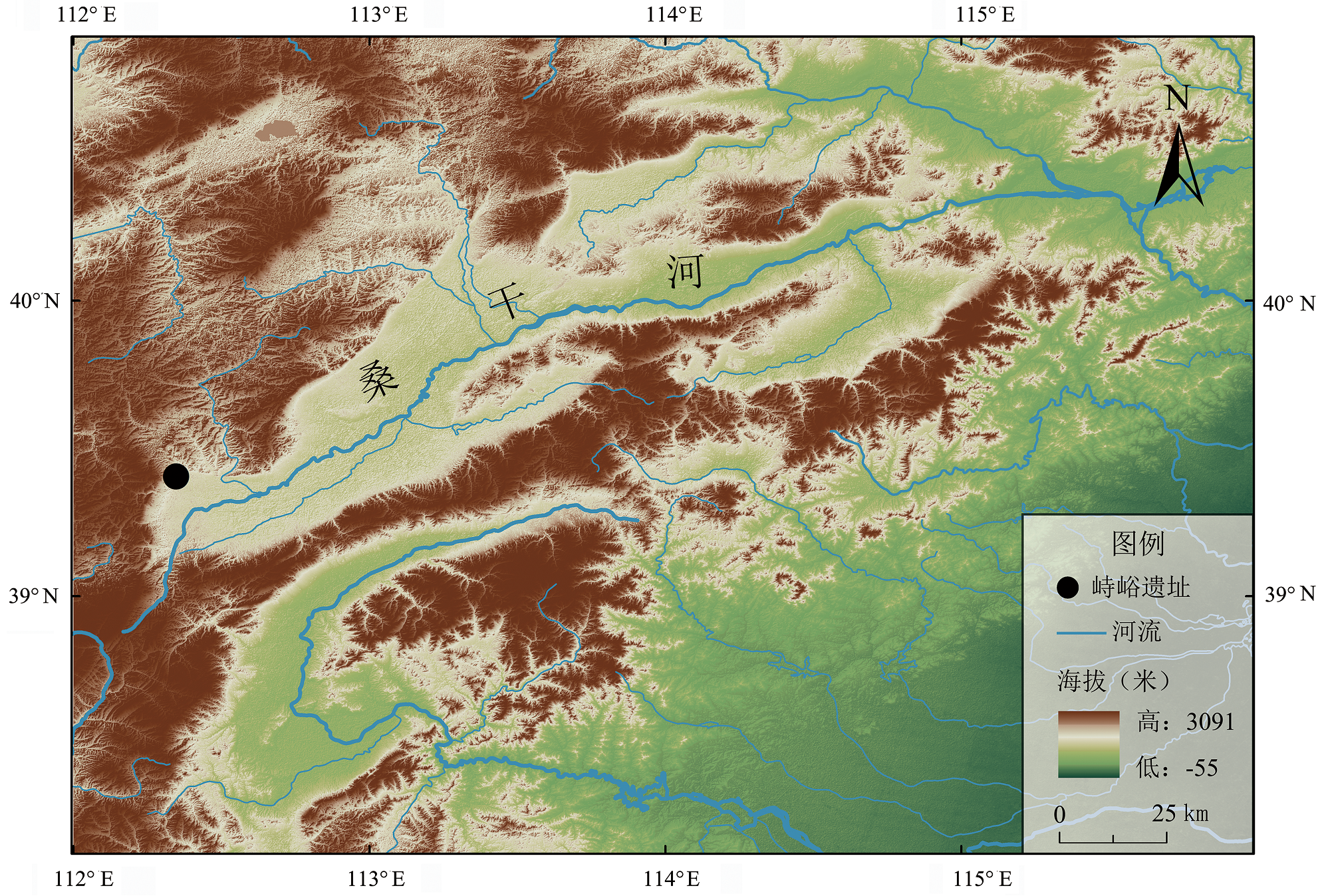
图1 峙峪遗址地理位置图
Fig.1 Location of the Shiyu site
| 骨骼部位 Element | 鹿Cervus sp. | 马Equus sp. | 牛Bos sp. | 总数Total |
|---|---|---|---|---|
| 下颌骨Mandible | 2 | 2 | ||
| 肋骨Rib | 1 | 2 | 3 | |
| 肱骨Humerus | 1 | 19 | 2 | 22 |
| 桡骨Radius | 2 | 11 | 1 | 14 |
| 股骨Femur | 2 | 2 | 1 | 5 |
| 胫骨Tibia | 4 | 18 | 22 | |
| 掌/跖骨Metapodial | 7 | 27 | 2 | 36 |
| 上中部长骨Upper/Middle long bone | 4 | 39 | 5 | 48 |
| 总数Total | 20 | 119 | 13 | 152 |
表1 峙峪遗址出土动物骨骼碎片各种属和各部位数量统计
Tab.1 Counts of animal species and elements from the Shiyu site (n)
| 骨骼部位 Element | 鹿Cervus sp. | 马Equus sp. | 牛Bos sp. | 总数Total |
|---|---|---|---|---|
| 下颌骨Mandible | 2 | 2 | ||
| 肋骨Rib | 1 | 2 | 3 | |
| 肱骨Humerus | 1 | 19 | 2 | 22 |
| 桡骨Radius | 2 | 11 | 1 | 14 |
| 股骨Femur | 2 | 2 | 1 | 5 |
| 胫骨Tibia | 4 | 18 | 22 | |
| 掌/跖骨Metapodial | 7 | 27 | 2 | 36 |
| 上中部长骨Upper/Middle long bone | 4 | 39 | 5 | 48 |
| 总数Total | 20 | 119 | 13 | 152 |
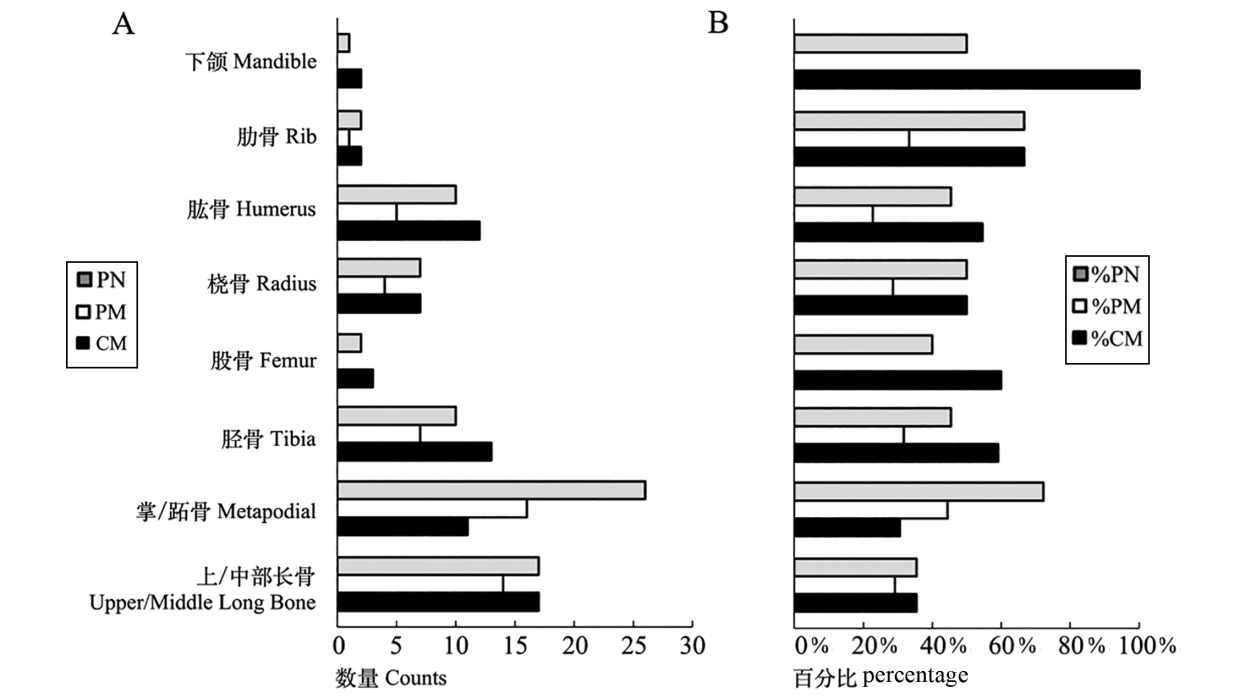
图2 各部位NISP出现切割痕(CM)、敲砸痕迹(PM)和敲砸疤(PN)的标本数量及其占比
Fig.2 The number of specimens with cut marks (CM), percussion marks (PM) and percussion notches (PN) and their percentage of each element of NISP
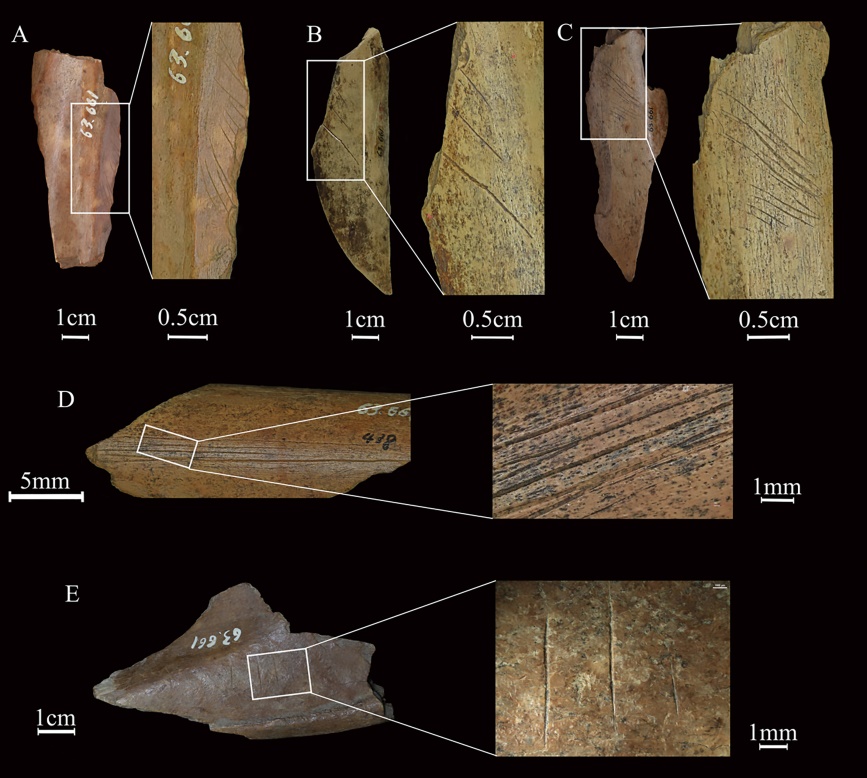
图3 峙峪遗址出土的带有切割痕和刻划痕的标本 A. 488号标本上的切割痕 CM on specimen 488;B. 143号标本的刻划痕迹 Engraved lines on specimen 143;C. 335号标本上的切割痕 CM on specimen 355;D. 438号标本平行于肢骨长轴的切割痕 CM on the specimen 438;E. 282号标本上的切割痕 CM on specimen 282
Fig.3 Specimen with cut marks and engraving from the Shiyu site
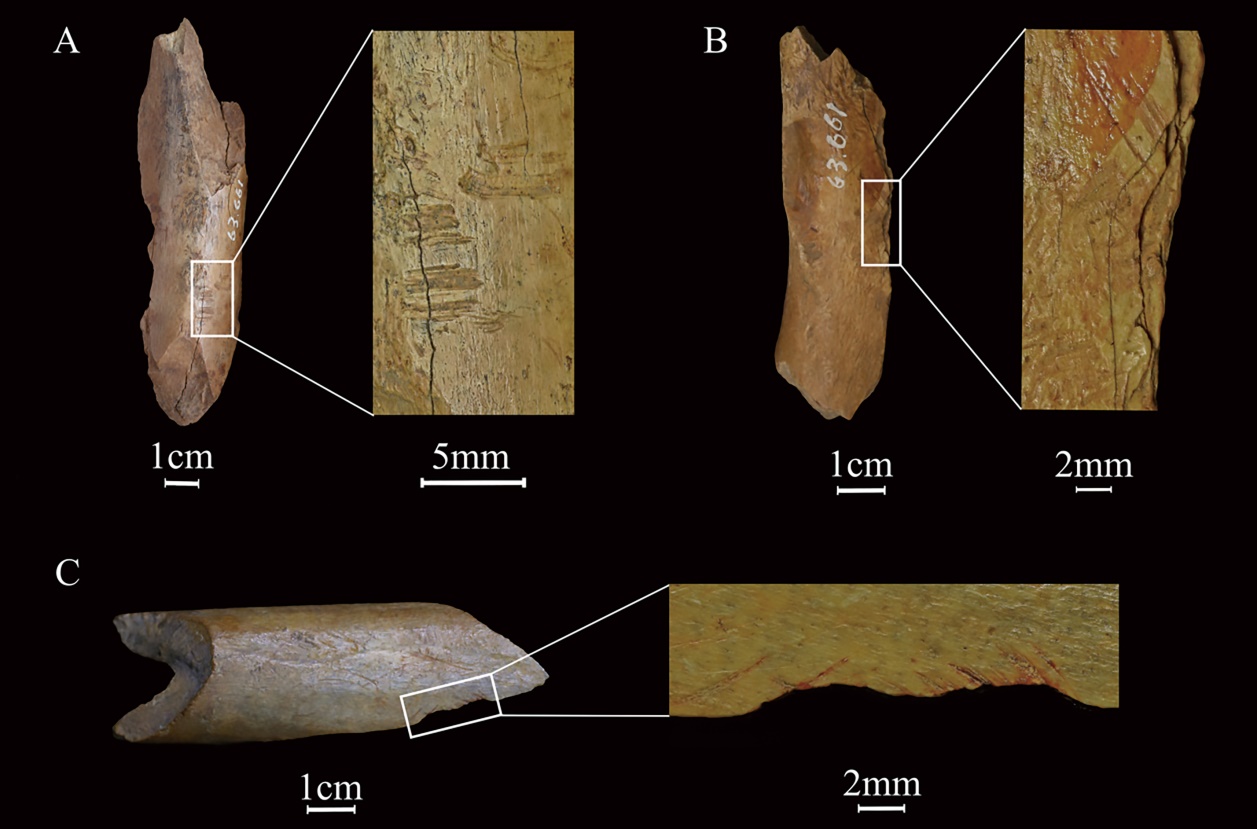
图4 峙峪遗址出土带有敲砸类痕迹的标本 A. 306号标本作为骨修饰器使用的痕迹 Bone retoucher(specimen 306);B. 156号标本的敲砸疤以及旁边的敲砸痕 PN and related PM on specimen 156 ;C. 155号标本的敲砸疤以及旁边的敲砸痕 PN and related PM on specimen 155
Fig.4 Specimen with percussion marks
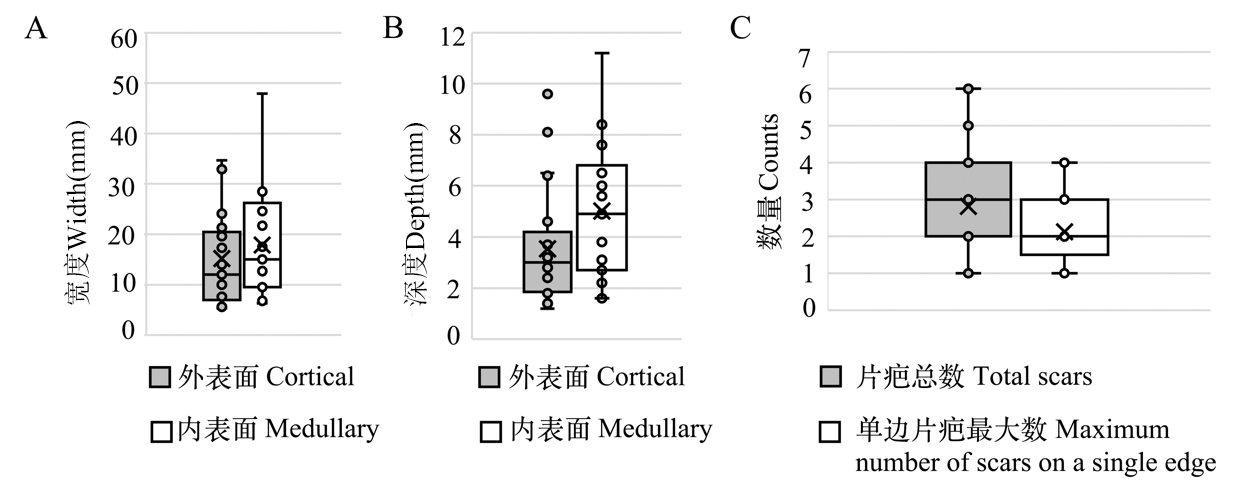
图5 敲砸疤的测量与统计图 A. PN的宽度The width of PN;B. PN的深度The depth of PN;C. 单个标本片疤数量The number of scars on a single specimen
Fig.5 Measurement data and statistics of PN
| [1] | 贾兰坡, 盖培, 尤玉桂. 山西峙峪旧石器时代遗址发掘报告[J]. 考古学报, 1972, 1: 39-58 |
| [2] | Yang S, Zhang J, Yue J, et al. Initial Upper Palaeolithic material culture by 45,000 years ago at Shiyu in northern China[J]. Nature Ecology & Evolution, 2024, 8(3): 552-563 |
| [3] | 尤玉柱, 李壮伟. 关于峙峪遗址若干问题的讨论[J]. 考古与文物, 1982, 5: 44-47 |
| [4] | 张俊山. 峙峪遗址碎骨的研究[J]. 人类学学报, 1991, 10(4): 13 |
| [5] | Bunn HT. Meat-eating and human evolution: studies on the diet and subsistence patterns of Plio-Pleistocene hominids in East Africa[D]. Ph.D Dissertation. California: University of California, 1982 |
| [6] | Behrensmeyer AK. Taphonomic and ecologic information from bone weathering[J]. Paleobiology, 1978, 4 (2): 150-162 |
| [7] | Fernandez-Jalvo Y, Andrews P. Atlas of Taphonomic Identifications: 1001+ Images of Fossil and Recent Mammal Bone Modification[M]. Dordrecht: Springer Netherlands, 2016 |
| [8] | Haynes G. A guide for differentiating mammalian carnivore taxa responsible for gnaw damage to herbivore limb bones[J]. Paleobiology, 1983, 164-172 |
| [9] | Binford LR. Bones: Ancient Men and Modern Myths[M]. New York: Academic press, 1981 |
| [10] | Potts R, Shipman P. Cutmarks made by stone tools on bones from Olduvai Gorge, Tanzania[J]. Nature, 1981, 291(5816): 577-580 |
| [11] | Bunn HT. Archaeological evidence for meat-eating by Plio-Pleistocene hominids from Koobi Fora and Olduvai Gorge[J]. Nature, 1981, 291(5816): 574-577 |
| [12] | Fisher JW. Bone surface modifications in zooarchaeology[J]. Journal of Archaeological Method and Theory, 1995, 2(1):7-68 |
| [13] | Blumenschine RJ, Selvaggio MM. Percussion marks on bone surfaces as a new diagnostic of hominid behaviour[J]. Nature, 1988, 333 (6175): 763-765 |
| [14] | Pickering TR, Egeland CP. Experimental patterns of hammerstone percussion damage on bones: implications for inferences of carcass processing by humans[J]. Journal of Archaeological Science, 2006, 33(4): 459-469 |
| [15] | Galán AB, Rodríguez M, De Juana S, et al. A new experimental study on percussion marks and notches and their bearing on the interpretation of hammerstone-broken faunal assemblages[J]. Journal of Archaeological Science, 2009, 36(3): 776-784 |
| [16] | Capaldo SD, Blumenschine RJ. A quantitative diagnosis of notches made by hammerstone percussion and carnivore gnawing in bovid long bones[J]. American Antiquity, 1994, 59(4): 724-748 |
| [17] | Johnson E. Current developments in bone technology[A]. In: Schiffer MB(eds). Advances in Archaeological Method and Theory[C]. New York and London: Academic Press, 1985, 157-235 |
| [18] | Villa P, Mahieu E. Breakage patterns of human long bones[J]. Journal Of Human Evolution, 1991, 21(1): 27-48 |
| [19] | Bunn HT. Comparative analysis of modern bone assemblages from a San hunter-gatherer camp in the Kalahari Desert, Botsuwana, and from a spotted hyena den near Nairobi, Kenya[A]. In: Clutton-Brock J and Grigson C(eds). Animal and Archaeology: 1. Hunters and Their Prey. BAR International Series. Oxford, 1983: 141-148 |
| [20] | Doyon L, Li Z, Wang H, et al. A 115,000-year-old expedient bone technology at Lingjing, Henan, China[J]. PLOS ONE, 2021, 16 (5): e0250156 |
| [21] | Yravedra J, Domínguez-Rodrigo M. The shaft-based methodological approach to the quantification of long limb bones and its relevance to understanding hominid subsistence in the Pleistocene: application to four Palaeolithic sites[J]. Journal of Quaternary Science: Published for the Quaternary Research Association, 2009, 24(1): 85-96 |
| [22] | Lyman RL. Vertebrate Taphonomy[M]. Cambridge: Cambridge University Press, 1994: 1-552 |
| [23] | Bunn HT, Kroll EM, Ambrose SH, et al. Systematic Butchery by Plio/Pleistocene Hominids at Olduvai Gorge, Tanzania [and Comments and Reply[J]. Current Anthropology, 1986, 27(5):431-452 |
| [24] | Pedergnana A, Ollé A. Building an experimental comparative reference collection for lithic micro-residue analysis based on a multi-analytical approach[J]. Journal of Archaeological Method and Theory, 2018, 25:117-154 |
| [25] | d’Errico F, Cacho C. Notation versus decoration in the Upper Palaeolithic: a case-study from Tossal de la Roca, Alicante, Spain[J]. Journal of Archaeological Science, 1994, 21(2): 185-200 |
| [26] |
Bromage TG, Boyde A. Microscopic criteria for the determination of directionality of cutmarks on bone[J]. American Journal of Physical Anthropology, 1984, 65(4): 359-366
pmid: 6524617 |
| [27] | d’Errico F, Lázničková-Galetová M, Caldwell D. Identification of a possible engraved Venus from Předmostí, Czech Republic[J]. Journal of Archaeological Science, 2011, 38(3): 672-683 |
| [28] | Li Z, Doyon L, Li H, et al. Engravings on bone from the archaic hominin site of Lingjing (Xuchang, Henan, China)[J]. Antiquity, 2019, 93(370): 886-900 |
| [29] | Chase PG. Tool-making tools and Middle Paleolithic behavior[J]. Current Anthropology, 1990, 31(4): 443-447 |
| [30] | Dominguez-Rodrigo M, Barba R. New estimates of tooth mark and percussion mark frequencies at the FLK Zinj site: the carnivore-hominid-carnivore hypothesis falsified[J]. Journal Of Human Evolution, 2006, 50(2): 170-194 |
| [31] | Blumenschine RJ. Percussion marks, tooth marks, and experimental determinations of the timing of hominid and carnivore access to long bones at FLK Zinjanthropus, Olduvai Gorge, Tanzania[J]. Journal of Human Evolution, 1995, 29(1): 21-51 |
| [32] | Lupo KD. Hadza Bone Assemblages and Hyena Attrition: an Ethnographic Example of the Influence of Cooking and Mode of Discard on the Intensity of Scavenger Ravaging[J]. Journal of Anthropological Archaeology, 1995, 14(3): 288-314 |
| [33] | Blasco R, Domínguez-Rodrigo M, Arilla M, et al. Breaking Bones to Obtain Marrow: a Comparative Study between Percussion by Batting Bone on an Anvil and Hammerstone Percussion[J]. Archaeometry, 2014, 56(6): 1085-1104 |
| [34] | Lupo KD, O’Connell JF. Cut and Tooth Mark Distributions on Large Animal Bones: Ethnoarchaeological Data from the Hadza and their Implications for Current Ideas about Early Human Carnivory[J]. Journal of Archaeological Science, 2002, 29(1): 85-109 |
| [35] | Domínguez-Rodrigo M. Testing Meat-eating in Early Hominids: an analysis of Butchery Marks on Defleshed Carcases[J]. Human Evolution, 1997, 12(3): 169-182 |
| [36] | Lam YM, Chen X, Pearson OM. Intertaxonomic Variability in Patterns of Bone Density and the Differential Representation of Bovid, Cervid, and Equid Elements in the Archaeological Record[J]. American Antiquity, 1999, 64(2): 343-362 |
| [37] | Munro ND, Bar-Oz G. Gazelle bone fat processing in the Levantine Epipalaeolithic[J]. Journal of Archaeological Science, 2005, 32(2): 223-239 |
| [38] | 戴静雯, 张双权, 张乐. 史前人类对动物骨骼油脂的开发和利用[J]. 人类学学报, 2021, 40(3): 503-512 |
| [39] | Lupo KD, Schmitt DN. Experiments in Bone Boiling Nutritional Returns and Archaeological Reflections[J]. Anthropozoologica, 1997, 25(26): 137-144 |
| [40] | Binford LR. Nunamiut Ethnoarchaeology[M]. New York: Academic Press, 1978: 1-509 |
| [41] | Bond G, Broecker W, Johnsen S, et al. Correlations between climate records from North Atlantic sediments and Greenland ice[J]. Nature, 1993, 365 (6442): 143-147 |
| [42] | 卫蕾华, 蒋汉朝, 何宏林, 等. 末次冰期山西洪洞高分辨率粒度和磁化率记录的H5事件及其气候演化意义[J]. 海洋地质与第四纪地质, 2018, 38(4): 10 |
| [43] | Porter SC, Zhisheng A. Correlation between climate events in the North Atlantic and China during the last glaciation[J]. Nature, 1995, 375(6529): 305-308 |
| [44] |
田庆春, 尹佳男, 郝晓龙. 临汾盆地黄土沉积记录的MIS 3气候变化[J]. 干旱区研究, 2022, 39(1): 10-20
doi: 10.13866/j.azr.2022.01.02 |
| [45] | McBrearty S, Brooks AS. The revolution that wasn’t: a new interpretation of the origin of modern human behavior[J]. Journal of Human Evolution, 2000, 39(5): 453-563 |
| [46] | Backwell LR, d’Errico F. Evidence of termite foraging by Swartkrans early hominids[J]. Proceedings of the National Academy of Sciences, 2001, 98(4): 1358-1363 |
| [47] | Klein RG. The Human Career: Human Biological and Cultural Origins[M]. University of Chicago Press, 2009 |
| [48] | Backwell L, d’Errico F. The first use of Bone Tools: a Reappraisal of the Evidence from Olduvai Gorge, Tanzania[J]. Palaeontologia Africana, 2005 |
| [49] | Pante M, Torre IDL, d’Errico F, et al. Bone tools from Beds II-IV, Olduvai Gorge, Tanzania, and implications for the origins and evolution of bone technology[J]. Journal of Human Evolution, 2020, 148: 102885 |
| [50] |
Rosell J, Blasco R, Campeny G, et al. Bone as a technological raw material at the Gran Dolina site (Sierra de Atapuerca, Burgos, Spain)[J]. Journal of Human Evolution, 2011, 61(1): 125-131
doi: 10.1016/j.jhevol.2011.02.001 pmid: 21420719 |
| [51] | Smith GM. Taphonomic resolution and hominin subsistence behaviour in the Lower Palaeolithic: differing data scales and interpretive frameworks at Boxgrove and Swanscombe (UK)[J]. Journal of Archaeological Science, 2013, 40(10): 3754-3767 |
| [52] | Moigne A-M, Valensi P, Auguste P, et al. Bone retouchers from Lower Palaeolithic sites: Terra Amata, Orgnac 3, Cagny-l’Epinette and Cueva del Angel[J]. Quaternary International, 2016, 409: 195-212 |
| [53] | Daujeard C, Valensi P, Fiore I, et al. A reappraisal of Lower to Middle Palaeolithic bone retouchers from south-eastern France(MIS 11 to 3)[A]. In: Hutson JM, García-Moreno A, Noack ES, et al(eds). The Origins of Bone Tool Technologies: Mainz: Römisch Germanisches ZentralMuseum, 2018: 93-132 |
| [54] | Bonhof WJ, van Kolfschoten T. The metapodial hammers from the Lower Palaeolithic site of Schöningen 13 II-4 (Germany): the results of experimental research[J]. Journal of Archaeological Science: Reports, 2021, 35: 102685 |
| [55] | Daujeard C, Moncel MH, Fiore I, et al. Middle Paleolithic bone retouchers in Southeastern France: Variability and Functionality[J]. Quaternary International, 2014, 326: 492-518 |
| [56] | Hutson JM, García-Moreno A, Noack ES, et al. The Origins of Bone Tool Technologies[C]. Mainz: Römisch Germanisches Zentral Museum, 2018: 317-326 |
| [57] | Doyon L, Li Z, Li H, et al. Discovery of circa 115,000-year-old bone retouchers at Lingjing, Henan, China[J]. PLOS ONE, 2018, 13(3): e0194318 |
| [58] | Ma S, Doyon L. Animals for Tools: The Origin and Development of Bone Technologies in China[J]. Frontiers in Earth Science, 2021, 9: 784313 |
| [59] | d’Errico F, Stringer CB. Evolution, Revolution or Saltation Scenario for the Emergence of Modern Cultures?[J]. Philosophical Transactions of the Royal Society B: Biological Sciences, 2011, 366(1567): 1060-1069 |
| [60] | Sirakov N, Guadelli JL, Ivanova S, et al. An ancient continuous human presence in the Balkans and the beginnings of human settlement in western Eurasia: A Lower Pleistocene example of the Lower Palaeolithic levels in Kozarnika cave (North-western Bulgaria)[J]. Quaternary International, 2010, (223-224): 94-106 |
| [61] | Joordens JCA, d’Errico F, Wesselingh FP, et al. Homo erectus at Trinil on Java used shells for tool production and engraving[J]. Nature, 2015, 518 (7538): 228-231 |
| [62] | 彭菲, 裴树文, 高星, 等. 水洞沟旧石器时代晚期遗址发现带有刻划痕迹的石制品[J]. 科学通报, 2012, 57(26): 2475-2481 |
| [63] | 高星, JW Olsen, 黄万波, 等. 三峡兴隆洞出土12-15万年前的古人类化石和象牙刻划[J]. 科学通报, 2003, 48(23): 2466-2472 |
| [64] | Pei WC. A Preliminary Report on the Late-Palæolithic Cave of Choukoutien1[J]. Bulletin of the Geological Society of China, 1934, 13(1): 327-358 |
| [65] | 尤玉柱. 峙峪遗址刻划符号初探[J]. 科学通报, 1982, 27(16): 1008-1010 |
| [66] | 阎家祺, 魏京武. 峙峪遗址“刻划符号”质疑[J]. 史前研究, 1987, 1: 19-20 |
| [1] | 郭晓明, 刘惜祯, 刘恒, 王春雪, 王法岗. 泥河湾盆地益堵泉旧石器时代晚期遗址2019年发掘简报[J]. 人类学学报, 2026, 45(03): 478-488. |
| [2] | 杜雨薇, 耿帅杰, 徐静玥, 叶芷, 张乐, 马东东, 裴树文. 泥河湾盆地蔡家沟遗址A和B地点动物骨骼的埋藏学观察[J]. 人类学学报, 2026, 45(03): 570-585. |
| [3] | 何湘栋, 梁越, 王春雪, 牛东伟, 杜雨薇. 蔚县盆地东沟遗址出土动物化石的初步研究[J]. 人类学学报, 2026, 45(03): 586-599. |
| [4] | 薛峰, 杨诗雨, 梅惠杰, 梁立雪, 魏屹, 牛东伟, 李鼎元. 河北怀来南家沟遗址2016年发掘报告[J]. 人类学学报, 2026, 45(03): 609-622. |
| [5] | 侯沂杉, 张乐, 张双权. 显微CT技术和骨组织学观察在动物考古学研究中的应用[J]. 人类学学报, 2026, 45(02): 280-295. |
| [6] | 宋艳花, 吴梦遥, 吴洋, 郭军亮, 马峰, 张建军, 吴小红, 郭玉杰. 山西阳城析城山遗址第1和第2地点发掘报告[J]. 人类学学报, 2026, 45(02): 358-371. |
| [7] | 薛峰, 牛东伟, 李鼎元. 怀来盆地南家沟旧石器时代遗址2015年度发掘报告[J]. 人类学学报, 2026, 45(02): 372-386. |
| [8] | 徐廷, 黄抡月, 任进成, 葛俊逸, 高星. 吉林省抚松县枫林遗址第2地点发掘简报[J]. 人类学学报, 2026, 45(01): 174-186. |
| [9] | 李三灵, 刘亚林, 赵文杰, 陈清懿, 李浩. 中国南方旧石器时代晚期石制品细小化现象初探[J]. 人类学学报, 2025, 44(06): 1034-1046. |
| [10] | 李璇, 顾雪军. 2015~2018年河南栾川龙泉洞遗址发掘简报[J]. 人类学学报, 2025, 44(04): 714-726. |
| [11] | 谢光茂, 林强, 余明辉, 卢杰英. 广西隆安娅怀洞遗址发掘报告[J]. 人类学学报, 2025, 44(03): 365-388. |
| [12] | 谢颖, 付琳. 广西隆安娅怀洞遗址出土的穿孔石器[J]. 人类学学报, 2025, 44(03): 439-450. |
| [13] | 胡章华, 陈洪波, 谢莉, 王雨晴, 谢光茂. 广西娅怀洞遗址出土的蚌器[J]. 人类学学报, 2025, 44(03): 477-487. |
| [14] | 曹雨昕, 孙璐, 张乐, 张双权. 骨骼表面人类齿痕特征的实验研究[J]. 人类学学报, 2025, 44(02): 242-254. |
| [15] | 蔡馨毅, 杜水生. 山西下川遗址水井背地点石核的剥片技术[J]. 人类学学报, 2025, 44(01): 14-26. |
| 阅读次数 | ||||||
|
全文 |
|
|||||
|
摘要 |
|
|||||
 京ICP证05002819号-3