人类学学报 ›› 2026, Vol. 45 ›› Issue (02): 358-371.doi: 10.16359/j.1000-3193/AAS.2025.0060

• 简报/考古报告 • 上一篇    下一篇

山西阳城析城山遗址第1和第2地点发掘报告

宋艳花1(), 吴梦遥2, 吴洋3, 郭军亮4, 马峰4, 张建军5, 吴小红6, 郭玉杰7,8   

  1. 1.山西大学考古文博学院,太原 030006
    2.山西省考古研究院,太原 030032
    3.吉林省文物考古研究所,长春 130013
    4.阳城县文物旅游发展中心,阳城 048100
    5.晋城博物馆,晋城 048000
    6.北京大学考古文博学院,北京 100871
    7.河北师范大学历史文化学院,石家庄 100875
    8.河北省东方人类起源与文明探源重点实验室,石家庄 050024
  • 收稿日期:2024-07-12 修回日期:2024-12-05 出版日期:2026-04-15 发布日期:2026-04-17
  • 作者简介:宋艳花,女,教授,主要从事旧石器时代考古学研究。E-mail: songyh@sxu.edu.cn
  • 基金资助:
    国家社科基金重点项目(20AKG001)

An excavation report of the Xichengshan Localities 1 and 2, Yangcheng, Shanxi

SONG Yanhua1(), WU Mengyao2, WU Yang3, GUO Junliang4, MA Feng4, ZHANG Jianjun5, WU Xiaohong6, GUO Yujie7,8   

  1. 1. School of Archaeology and Museology, Shanxi University, Taiyuan 030006
    2. Shanxi Provincial Institute of Archaeology, Taiyuan 030032
    3. Jilin Provincial Institute of Cultural Relics and Archaeology, Changchun 130013
    4. Yangcheng Cultural Heritage Tourism Development Center, Yangcheng 048100
    5. Jincheng Museum, Jincheng 048000
    6. School of Archaeology and Museology, Peking University, Beijing 100871
    7. College of History and Culture, Hebei Normal University, Shijiazhuang 050024
    8. Hebei Key Laboratory of East Asian Human Origin and Civilization Research, Shijiazhuang 050024
  • Received:2024-07-12 Revised:2024-12-05 Online:2026-04-15 Published:2026-04-17

摘要:

析城山遗址是山西省阳城县境内一处旧石器时代晚期遗址,石制品遍布析城山顶的岩溶洼地。2022年正式发掘的第1、2地点位于洼地北侧边坡。第1地点发掘面积8 m2,发掘深度1.9 m,第2地点发掘面积4 m2,深度1.6 m。两地点共出土石制品494件,未发现动物骨骼。石制品石料以燧石为主,还有少量石英、石英岩和水晶;打片和加工技术以锤击法为主,偶有砸击产品。下层属于简单石核—石片技术传统,器类单一;上层开始出现压制技术产生的细石核和细石叶,石器类型丰富,有刮削器、端刮器、尖状器、雕刻器、小型两面器,还有以小石叶、小石片和细石叶为毛坯加工的特殊器类。地层和测年数据提供了该区域石器技术传统在距今约2.8万年前后的变革,对探讨沁河流域古人类迁徙及其在较高海拔地区的文化适应具有重要意义。

关键词: 析城山遗址, 细石器, 船型石核, 复合工具, 旧石器时代晚期

Abstract:

The Xichengshan site is an open-air Paleolithic site located in the karst depression at the top of the Xichengshan Mountain, about 35 km southwest of Yangcheng County, Shanxi Province, North China. Stone artifacts characteristic of microlith were discovered in 2006 during the scenery spot exploitation. In 2020, a trial excavation was carried out by the School of History of Beijing Normal University, revealing the human activities with “core and flake” technology by the Niangniangchi lake (the only retained lake now) in early Upper Paleolithic Age (45590±510 BP cal, 95.4%, MIS 3). To find more information about microlith, new fieldwork was conducted by School of Archaeology and Museology of Shanxi University, Yangcheng County Museum of Cultural relics and Jincheng Cultural Relics Protection Center in Summer 2022.

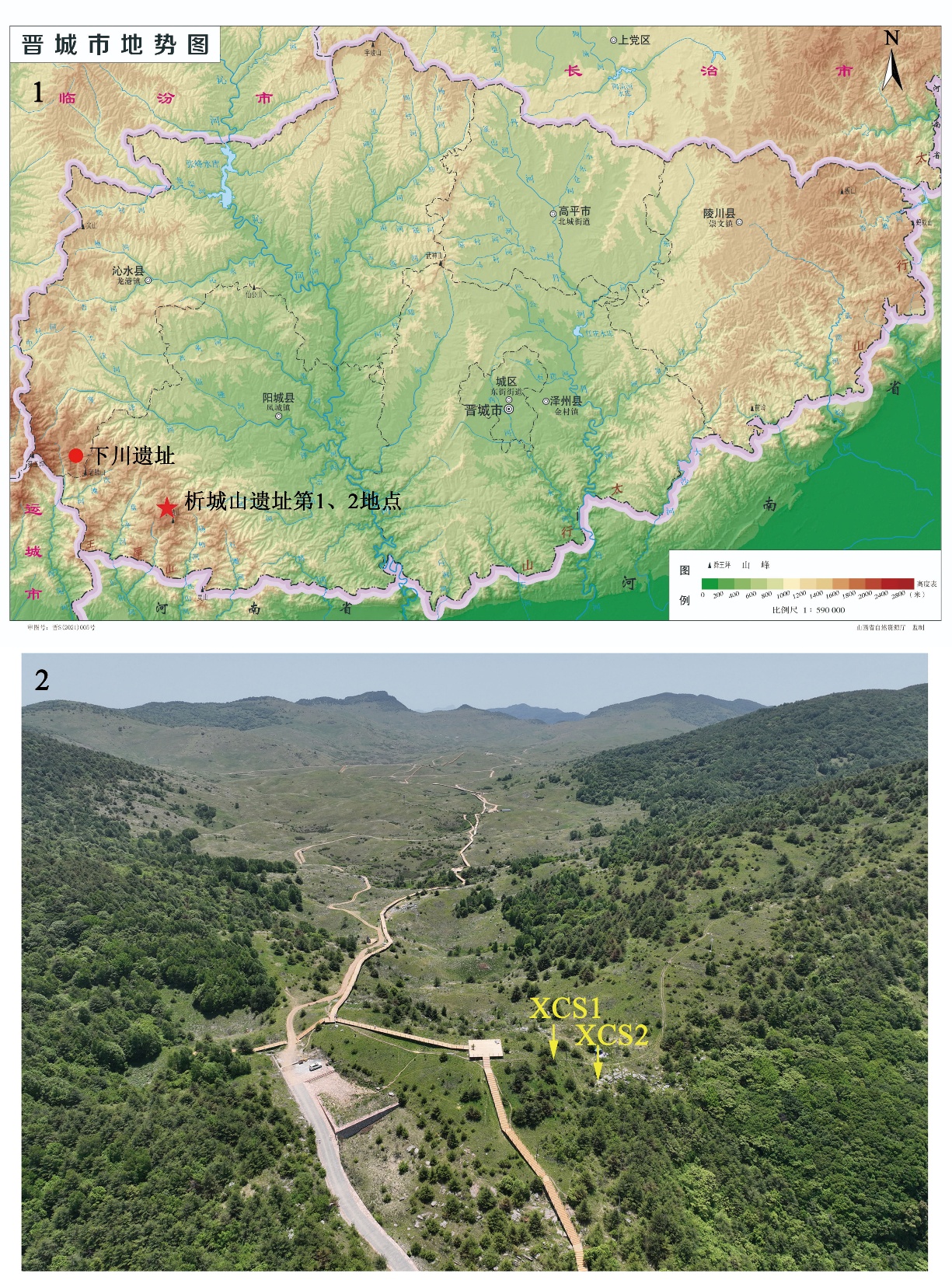
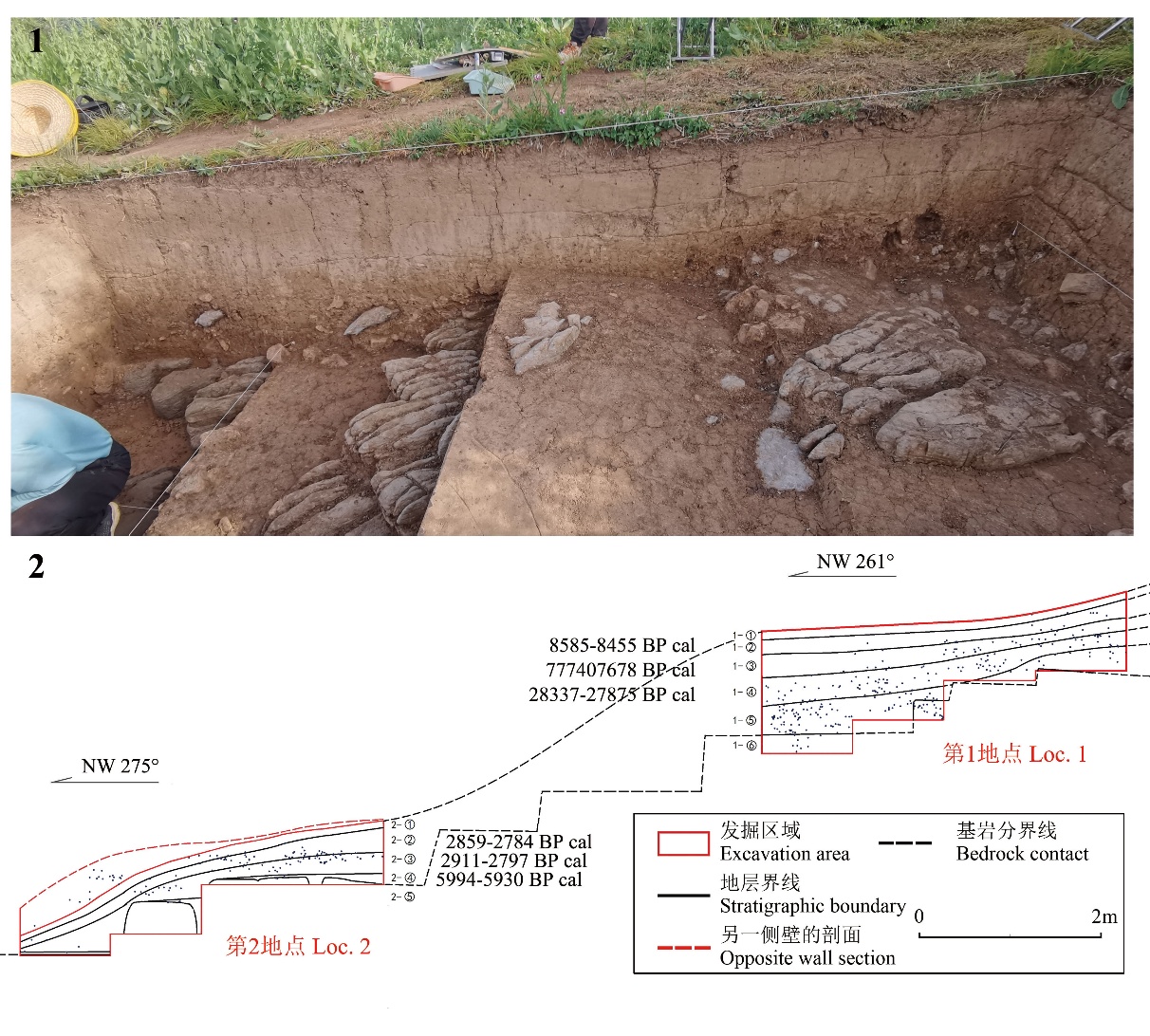
New survey found a universal distribution of microlith along the shore of ancient lakes in the karst depression. Locality 1 (XCS 1, 112°12′28″E, 35°21′00″N; 1701.943±3 m above sea level) and Locality 2 (XCS 2, 112°12′27″E, 35°21′00″N; 1708.111±2.4 m above sea level) are situated in the overflow port of the karst depression. The deposition and AMS14C data of charcoal samples showed the well developed and overflow of the underground water, forming the typical karst topography of clints and grikes at the bottom of Locality 1 and Locality 2 at least before 28 ka BP cal. XCS 1 located in the mid-part of the slope, with excavated areas of 8 m2, demonstrating 6 strata, and XCS 2, very bottom of the slope, 4 m2, 5 strata.

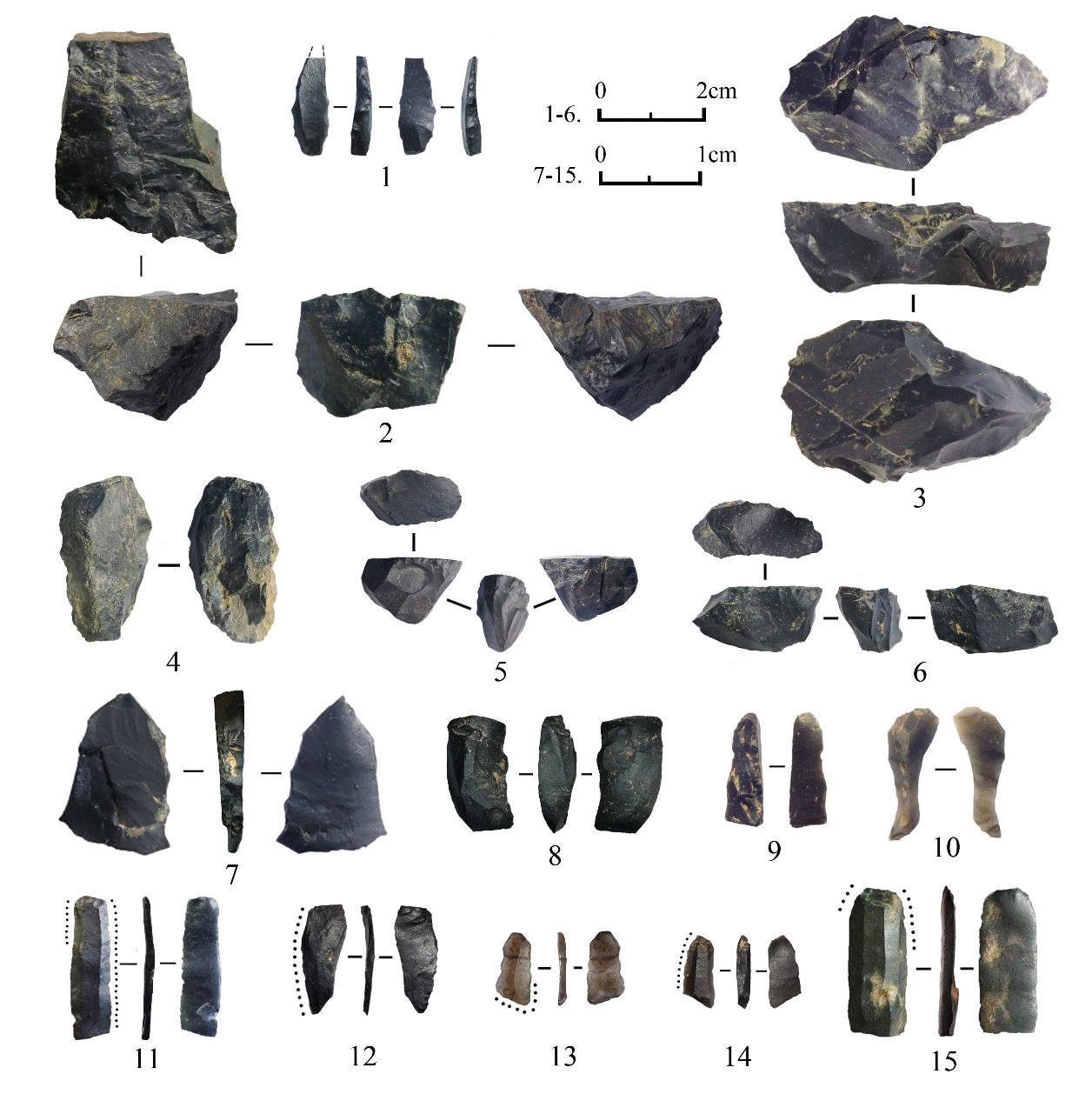
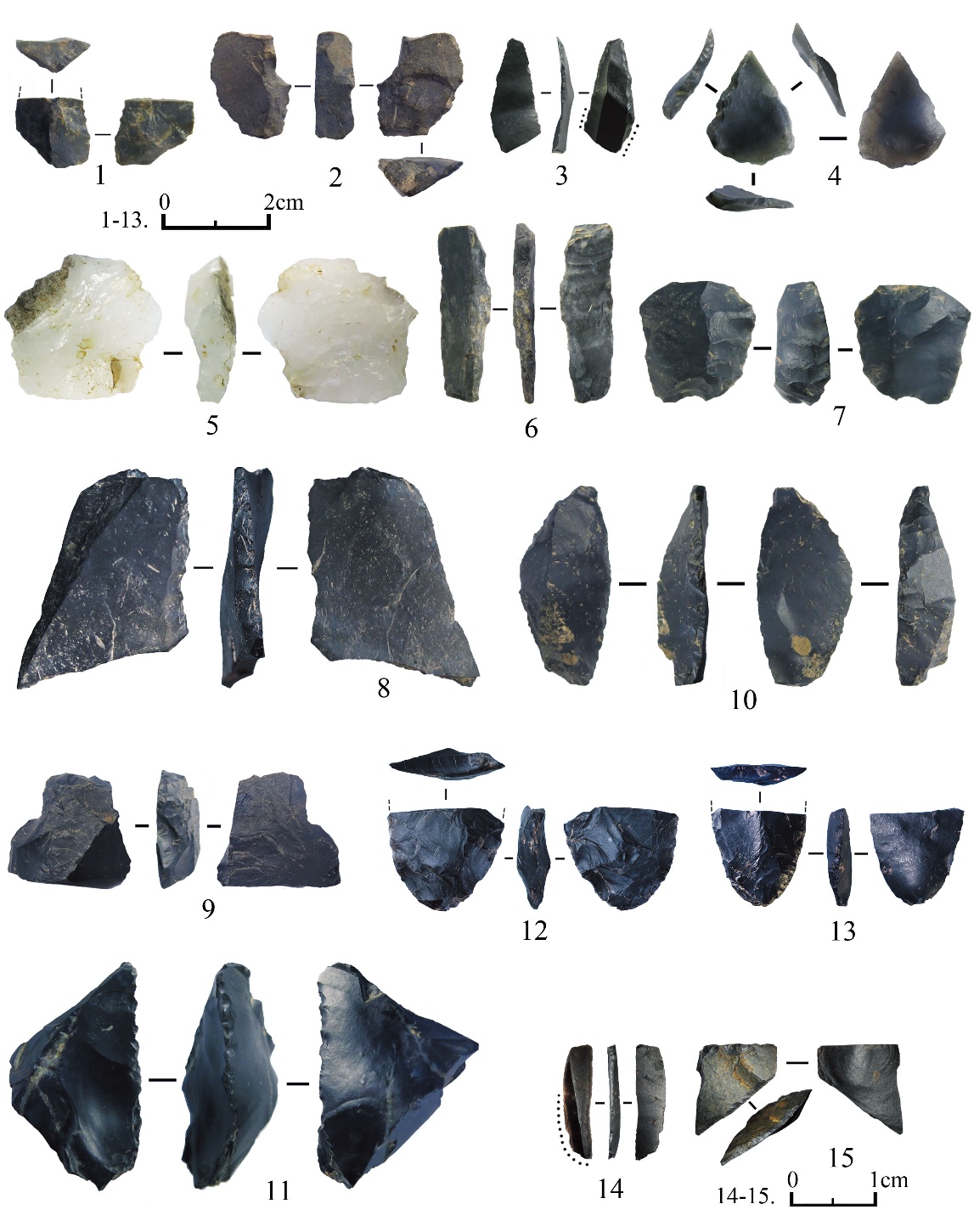
Totally 494 stone artifacts (without any animal bones) unearthed from the two localities can be divided into two stages according to the process of sedimentation and AMS14C and OSL data. In early stage in lower cultural horizon dating to ca. 28 ka BP cal, totally 35 artifacts form Layer 4, mucky clay of XCS 1, can be identified as stocks (1/35; 2.86%), flakes (20/35; 57.14%), chunks (10/35; 28.57%), chips (3/35; 8.57%) and tools (1/35; 2.86%). In late stage in upper cultural horizon after ca. 7.7 ka BP cal, a total of 459 artifacts transported from higher ground are identified as stocks (3/459; 0.65%), cores (4/459; 0.87%), microcores (5/459; 1.09%), flakes (171/459; 37.25%), microblades (40/459; 8.71%), chunks (173/459; 37.69%), chips (46/459; 10.02%) and tools (17/459; 3.70%). All the assemblages are dominated by flakes and chunks produced by hard or soft hammer percussion, occasionally anvil (bipolar) percussion. The microblade technology emerged in upper cultural horizon. Several flakes, chunks and microblades were used with clear microwear observed along used edges. The microcores are all boat-shaped ones. The tools are characteristic by small-sized compound tools, such as points, scrapers, end-scrapers, burins, denticulated tools, small bifacial tools, and some small flake-blanked, bladelet-blanked and microblade-blanked tools.

The raw materials are mainly local flint (431/494, 87.25%, including 404 black flints), with some quartz (58/494, 11.74%), crystal (3/494, 0.61%) and quartzite (2/494, 0.40%). Field investigation showed the source of black flint mainly in the Ordovician outcrops around the Yangcheng county 30 km northeast of Xichengshan site. The high-quality black flint mines, located at village Tulouzhuang, Xiacun, Yanggaoquan etc., were exploited early from Ming-Qing Dynasty to modern times. The black flint also exposed in northwest (Xiaojianshan and Suoquanling village), northeast (Hebei town) and northeast of Xichengshan karst depression, but the quality is inferior with joints. So the ancient human could have exploited the fine flint mainly farther away from the site. The specific source of other types of stone raw material remains to be investigated.

Given all these, Xichengshan site is a key activity area with high altitude among early microlithic people, and it is of great significance for the study of the migration of prehistoric people in the Late Pleistocene and their adaptation to the higher altitude area.

Key words: Xichengshan site, microlith, boat-shaped microcores, compound tools, Late Palaeolithic

中图分类号: