

主管:中国科学院
主办:中国科学院古脊椎动物与古人类研究所
出版:科学出版社
主办:中国科学院古脊椎动物与古人类研究所
出版:科学出版社
人类学学报 ›› 2026, Vol. 45 ›› Issue (03): 419-435.doi: 10.16359/j.1000-3193/AAS.2026.0039cstr: 32091.14.j.1000-3193/AAS.2026.0039
牛东伟1,2( ), 刘尔凡1, 薛峰1, 谢飞3
收稿日期:2026-02-24
接受日期:2026-04-30
出版日期:2026-06-15
发布日期:2026-06-12
作者简介:牛东伟,教授,博士生导师,主要从事旧石器时代考古学研究。E-mail: ndw1986@163.com
基金资助:
NIU Dongwei1,2(), LIU Erfan1, XUE Feng1, XIE Fei3
Received:2026-02-24
Accepted:2026-04-30
Online:2026-06-15
Published:2026-06-12
摘要:
作为我国北方乃至东亚地区旧石器时代遗址分布最密集、文化序列最完整的地区,泥河湾盆地现已成为世界范围内探索人类起源和演化的经典区域。怀来盆地作为广义泥河湾盆地的重要组成部分,是更新世期间古人类迁徙扩散与文化交流的重要通道。通过对怀来盆地2014年以来旧石器考古发现与多学科研究成果的系统梳理,本文从考古调查、遗址发掘、年代学研究、石制品研究、动物考古学研究、古环境重建等多个维度,初步勾勒出该区域中更新世晚期至晚更新世末期古人类文化遗存的基本面貌与生存演化图景。怀来盆地旧石器考古工作的持续开展,是从“狭义泥河湾”扩展到“广义泥河湾”考古的重要实践,相关研究可为探讨中国北方以及东亚地区古人类技术演化、生存适应、行为多样性和区域人群互动等科学问题提供重要材料和视角。未来需进一步强化多学科交叉与区域比较研究,推动该区域旧石器考古不断走向深入。
中图分类号:
牛东伟, 刘尔凡, 薛峰, 谢飞. 河北怀来盆地古人类文化遗存的考古发现与研究[J]. 人类学学报, 2026, 45(03): 419-435.
NIU Dongwei, LIU Erfan, XUE Feng, XIE Fei. Archaeological findings and research on hominin remains in the Huailai Basin, North China[J]. Acta Anthropologica Sinica, 2026, 45(03): 419-435.
| 名称Locality | 坐标Coordinate | 海拔Altitude(m) | 地理位置Location | 石制品Stone artifacts(n) | 动物化石Animal fossils(n) |
|---|---|---|---|---|---|
| 珠窝堡ZWB | 40°15′50″N, 115°34′13″E | 498 | 官厅镇珠窝堡村 | 5 | 若干Present |
| 西沟湾1号XGW1 | 40°15′53″N, 115°34′12″E | 490 | 官厅镇珠窝园村 | 1 | |
| 珠园1号ZY1 | 40°15′58″N, 115°33′57″E | 498 | 官厅镇珠窝园村 | 1 | |
| 珠园2号ZY2 | 40°15′53″N, 115°34′6″E | 494 | 官厅镇珠窝园村 | 1 | 若干Present |
| 南家沟NJG | 40°17′08″N, 115°34′07″E | 486 | 桑园镇辛窑村 | 5 | |
| 窑湾YW | 40°17′38″N, 115°34′01″E | 479 | 桑园镇窑湾村 | 1 | |
| 西水泉XSQ | 40°22′26″N, 115°31′19″E | 489 | 沙城镇西水泉村 | 5 | |
| 小东梁XDL | 40°28′27″N, 115°20′16″E | 681 | 鸡鸣驿西黄庄村 | 4 | |
| 十亩地沟SMDG | 40°10′09″N, 115°30′15″E | 875 | 孙庄子乡孙庄子村 | 1 | |
| 安梁AL | 40°10′03″N, 115°30′34″E | 865 | 孙庄子乡孙庄子村 | 1 | |
| 白窑沟BYG | 40°15′32″N, 115°34′34″E | 487 | 官厅镇珠窝堡村 | 2 | |
| 西沟湾2号XGW2 | 40°15′51″N, 115°34′15″E | 490 | 官厅镇珠窝园村 | 2 | |
| 吴河沟WHG | 40°17′34″N, 115°33′55″E | 478 | 桑园镇窑湾村 | 1 | |
| 林场LC | 40°14′12″N, 115°35′31″E | 485 | 水库林场管理处 | 1 | |
| 后沟HG | 40°15′47″N, 115°27′03″E | 637 | 桑园镇二堡村 | 4 | |
| 甘汲梁GJL | 40°25′26″N, 115°35′54″E | 713 | 土木镇甘汲梁村 | 7 | |
| 南山堡1号NSB1 | 40°27′52″N, 115°33′15″E | 704 | 存瑞镇南山堡村 | 1 | |
| 草庙子CMZ | 40°28′09″N, 115°37′58″E | 790 | 存瑞镇草庙子村 | 1 | |
| 霸王庄BWZ | 40°24′58″N, 115°34′37″E | 618 | 土木镇霸王庄村 | 1 | |
| 秦家沟QJG | 40°27′02″N, 115°32′11″E | 672 | 存瑞镇秦家沟村 | 1 | |
| 南山堡2号NSB2 | 40°27′55″N, 115°33′38″E | 716 | 存瑞镇南山堡村 | 2 |
表1 2014年以来怀来盆地考古调查发现旧石器地点信息
Tab.1 A summary of newly discovered localities in Huailai Basin since 2014
| 名称Locality | 坐标Coordinate | 海拔Altitude(m) | 地理位置Location | 石制品Stone artifacts(n) | 动物化石Animal fossils(n) |
|---|---|---|---|---|---|
| 珠窝堡ZWB | 40°15′50″N, 115°34′13″E | 498 | 官厅镇珠窝堡村 | 5 | 若干Present |
| 西沟湾1号XGW1 | 40°15′53″N, 115°34′12″E | 490 | 官厅镇珠窝园村 | 1 | |
| 珠园1号ZY1 | 40°15′58″N, 115°33′57″E | 498 | 官厅镇珠窝园村 | 1 | |
| 珠园2号ZY2 | 40°15′53″N, 115°34′6″E | 494 | 官厅镇珠窝园村 | 1 | 若干Present |
| 南家沟NJG | 40°17′08″N, 115°34′07″E | 486 | 桑园镇辛窑村 | 5 | |
| 窑湾YW | 40°17′38″N, 115°34′01″E | 479 | 桑园镇窑湾村 | 1 | |
| 西水泉XSQ | 40°22′26″N, 115°31′19″E | 489 | 沙城镇西水泉村 | 5 | |
| 小东梁XDL | 40°28′27″N, 115°20′16″E | 681 | 鸡鸣驿西黄庄村 | 4 | |
| 十亩地沟SMDG | 40°10′09″N, 115°30′15″E | 875 | 孙庄子乡孙庄子村 | 1 | |
| 安梁AL | 40°10′03″N, 115°30′34″E | 865 | 孙庄子乡孙庄子村 | 1 | |
| 白窑沟BYG | 40°15′32″N, 115°34′34″E | 487 | 官厅镇珠窝堡村 | 2 | |
| 西沟湾2号XGW2 | 40°15′51″N, 115°34′15″E | 490 | 官厅镇珠窝园村 | 2 | |
| 吴河沟WHG | 40°17′34″N, 115°33′55″E | 478 | 桑园镇窑湾村 | 1 | |
| 林场LC | 40°14′12″N, 115°35′31″E | 485 | 水库林场管理处 | 1 | |
| 后沟HG | 40°15′47″N, 115°27′03″E | 637 | 桑园镇二堡村 | 4 | |
| 甘汲梁GJL | 40°25′26″N, 115°35′54″E | 713 | 土木镇甘汲梁村 | 7 | |
| 南山堡1号NSB1 | 40°27′52″N, 115°33′15″E | 704 | 存瑞镇南山堡村 | 1 | |
| 草庙子CMZ | 40°28′09″N, 115°37′58″E | 790 | 存瑞镇草庙子村 | 1 | |
| 霸王庄BWZ | 40°24′58″N, 115°34′37″E | 618 | 土木镇霸王庄村 | 1 | |
| 秦家沟QJG | 40°27′02″N, 115°32′11″E | 672 | 存瑞镇秦家沟村 | 1 | |
| 南山堡2号NSB2 | 40°27′55″N, 115°33′38″E | 716 | 存瑞镇南山堡村 | 2 |
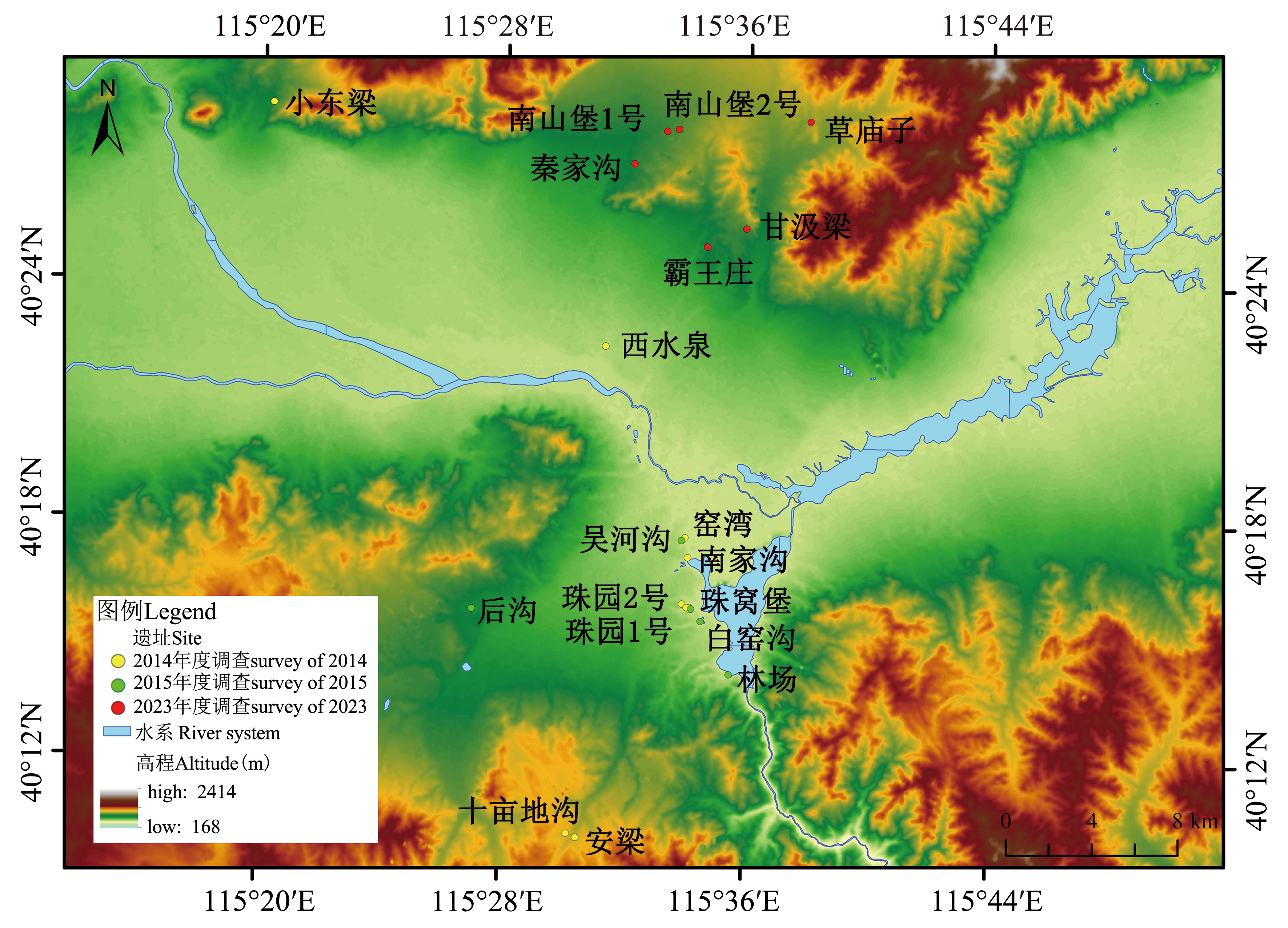
图1 怀来盆地旧石器地点分布图
Fig.1 The distribution of Paleolithic sites in Huailai Basin
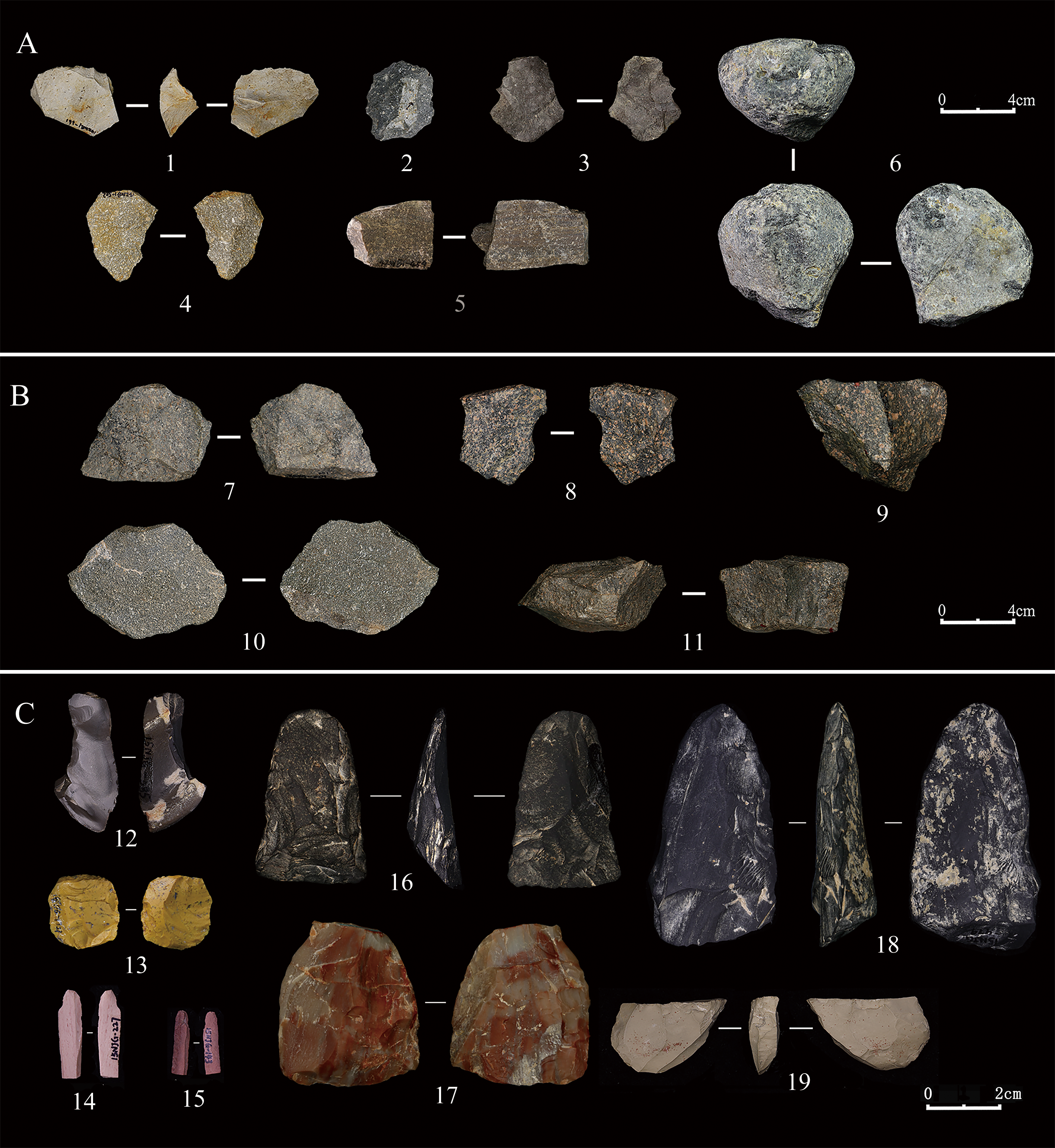
图2 发掘出土的部分石制品 A.珠窝堡遗址Zhuwobu site;B.西沟湾1号地点/ Xigouwan Locality 1;C.南家沟遗址Nanjiagou site。1. 14ZWB331,刮削器 scraper;2. 14ZWB33,刮削器 scraper;3. 14ZWB373,完整石片VI型 whole flake type VI;4. 14ZWB502,完整石片VI型 whole flake type VI;5. 14ZWB459,普通石核I2型 core I2 type;6. 14ZWB441,石锤 stone hammer;7. XGW1-001,完整石片V型 whole flake type V;8. XGW1-035,完整石片II型 whole flake type II;9. XGW1-207,普通石核I2型 core I2 type;10. XGW1-067,完整石片V型 whole flake type V;11. XGW1-198,普通石核II2型 core II2 type;12. 15NJG085,刮削器 scraper;13. 16NJG1721,端刮器 endscraper;14. 15NJG227,细石叶 microblade;15. 15NJG143,细石叶 microblade;16. 15NJG1014,锛状器 adze-shaped;17. 15NJG195,锛状器 adze-shaped;18. 15NJG979,两面尖状器 bifacial point;19. 15NJG295,细石核 microblade core
Fig.2 Some stone artifacts unearthed from the excavation
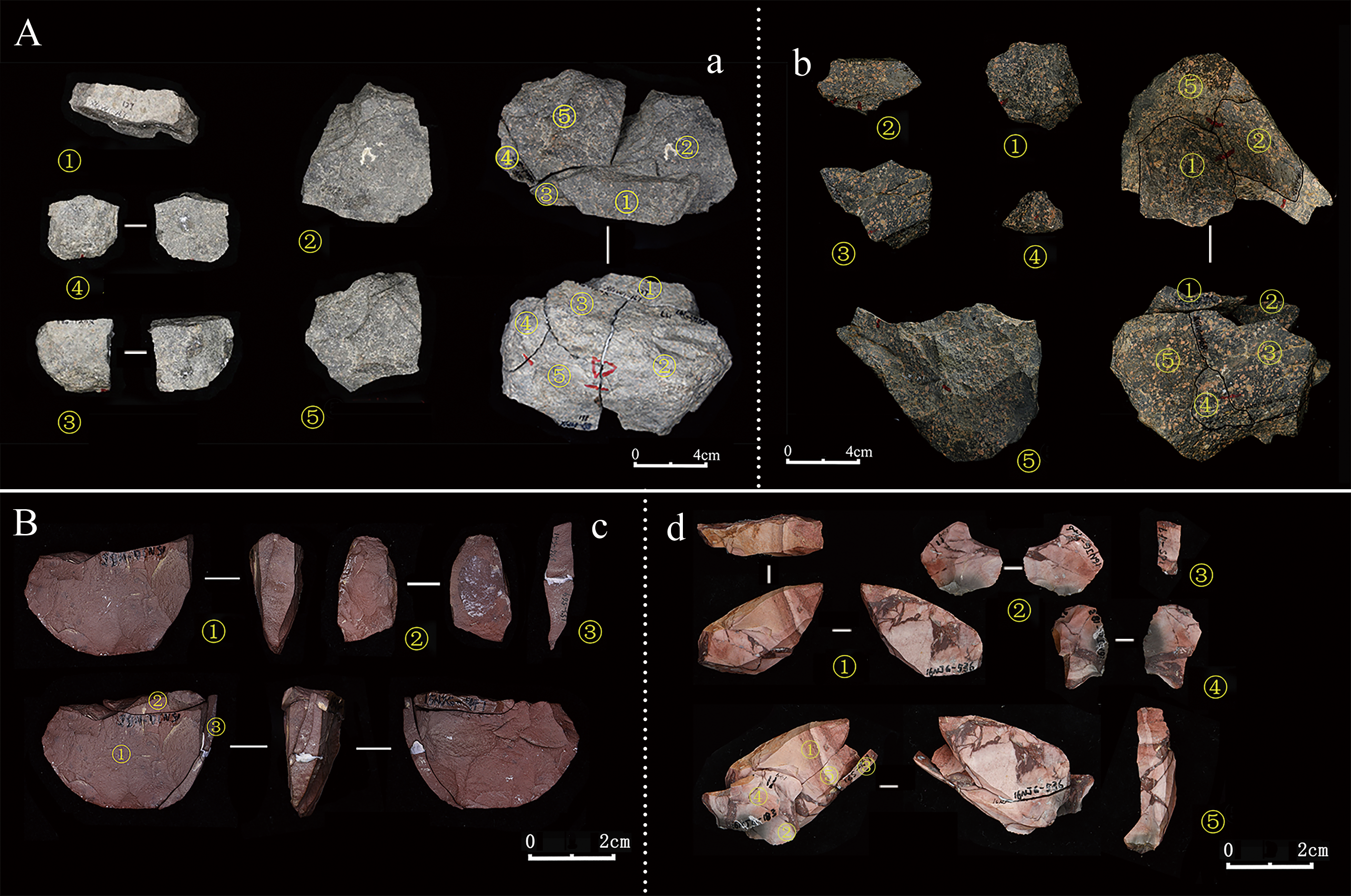
图3 石制品拼合组 A.西沟湾1号地点标本Specimens of Xigouwan Locality 1; B.南家沟遗址标本Specimens of Nanjiagou site; a. XGW1第1拼合组refitting group 1:拼合标本为断块 XGW1-137、断块 XGW1-197、石片 XGW1-083、石片XGW1-206 和石核 XGW1-198;b. XGW1第2拼合组refitting group 2:拼合标本为石片 XGW1-241、断块 XGW1-142、石片 XGW1-068、残片XGW1-043和石核 XGW1-089;c. 15NJG细石核拼合组microblade core refitting group:拼合标本为削片15NJG-947、细石核15NJG-1165和更新剥片面石片15NJGs-563+564;d. 16NJG细石核拼合组microblade core refitting group:拼合标本为两面去薄石片16NJG-183、修理底缘石片16NJG-746、更新剥片面石片16NJG-1277、细石核16NJG-539和细石叶16NJGs-47
Fig.3 Lithic refitting groups
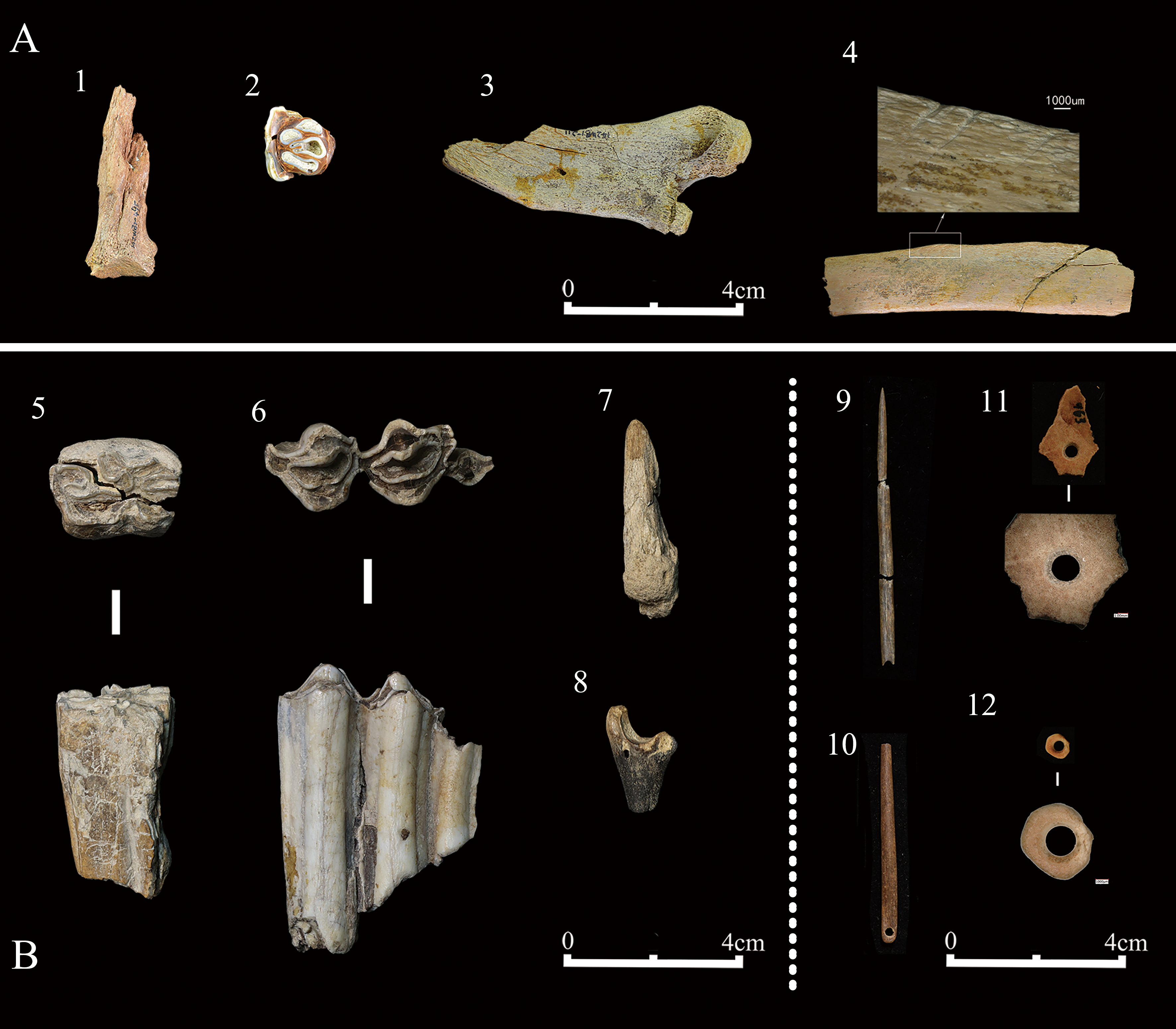
图4 动物化石、骨针、装饰品 A.珠窝堡遗址标本Specimens of Zhuwobu site;B.南家沟遗址标本Specimens of Nanjiagou site; 1. 2014ZWB1-495,转角羚羊角心残段 horn core fragment of Spirocerus sp.;2. 2014ZWB1-173+175+176,犀牛牙齿 teeth of Rhinocerotidae sp.;3. 2014ZWB1-221,犀牛肋骨残段 rib fragment of Rhinocerotidae sp.;4. 2014ZWB1-129,大型牛科动物肋骨残段及切割痕 rib fragment of Bovidae sp. with cut marks;5. 16NJG-292,马右下前臼齿 right lower premolar of Equus sp.;6. 16NJG-1845,牛左下臼齿 left lower molar of Bovidae sp.;7. 15NJG-1150,鹿角 antler of Cervus sp.;8. 筛选品:鸟右侧跖节骨right tarsometatarsus of Aves;9. 16NJG-2199+2200,骨针 bone needle;10. 16NJG-1590,骨针 bone needle;11.穿孔串珠半成品 ostrich eggshell bead;12. 15NJG-1054, 串珠 ostrich eggshell bead
Fig.4 Animal fossils, bone needles and personal ornaments
| [1] |
Hublin JJ, Ben-Ncer A, Bailey S, et al. New fossils from Jebel Irhoud, Morocco and the pan-African origin of Homo sapiens[J]. Nature, 2017, 546: 289-292
doi: 10.1038/nature22336 URL |
| [2] | Ni XJ, Ji Q, Wu WS, et al. Massive cranium from Harbin in northeastern China establishes a new Middle Pleistocene human lineage[J]. Innovation, 2021, 2: 100130 |
| [3] |
Harvati K, Reyes-Centeno H. Evolution of Homo in the Middle and Late Pleistocene[J]. Journal of Human Evolution, 2022, 173: 103279
doi: 10.1016/j.jhevol.2022.103279 URL |
| [4] |
Fu QM, Cao P, Dai QY, et al. Denisovan mitochondrial DNA from dental calculus of the >146,000-year-old Harbin cranium[J]. Cell, 2025, 188: 3919-3926
doi: 10.1016/j.cell.2025.05.040 URL |
| [5] |
Fu QM, Bai F, Rao HY, et al. The proteome of the late Middle Pleistocene Harbin individual[J]. Science, 2025, 389: 704-707
doi: 10.1126/science.adu9677 pmid: 40531192 |
| [6] |
Bae CJ, Wu XJ. Making sense of eastern Asian Late Quaternary hominin variability[J]. Nature Communications, 2024, 15: 9479
doi: 10.1038/s41467-024-53918-7 pmid: 39488555 |
| [7] |
Gibbons A. When modern humans met Neanderthals[J]. Science, 2021, 372: 115-116
doi: 10.1126/science.372.6538.115 pmid: 33833103 |
| [8] |
Wu XJ, Martínon-Torres M, Xing S, et al. The hominin teeth from the late Middle Pleistocene Hualongdong site, China[J]. Journal of Human Evolution, 2025, 206: 103727
doi: 10.1016/j.jhevol.2025.103727 URL |
| [9] |
Prüfer K, de Filippo C, Grote S, et al. A high-coverage Neandertal genome from Vindija Cave in Croatia[J]. Science, 2017, 358(6363): 655-658
doi: 10.1126/science.aao1887 pmid: 28982794 |
| [10] | Hoffmann DL, Angelucci DE, Villaverde V, et al. Symbolic use of marine shells and mineral pigments by Iberian Neandertals 115,000 years ago[J]. Science Advances, 2018, 4: eaar5255 |
| [11] | Iasi LNM, Chintalapati M, Skov L, et al. Neanderthal ancestry through time: Insights from genomes of ancient and present-day humans[J]. Science, 2024, 386: eadq3010 |
| [12] | Pigott EM, Cheshmedzhieva K, Zeller E, et al. A new late Neanderthal from Crimea reveals long-distance connections across Eurasia[J]. PNAS, 2025, 122(45): e2518974122 |
| [13] |
Reich D, Patterson N, Kircher M, et al. Genetic history of an archaic hominin group from Denisova Cave in Siberia[J]. Nature, 2010, 468(7327): 1053-1060
doi: 10.1038/nature09710 |
| [14] |
Chen FH, Welker F, Shen CC, et al. A late Middle Pleistocene Denisovan mandible from the Tibetan Plateau[J]. Nature, 2019, 569(7756): 409-412
doi: 10.1038/s41586-019-1139-x |
| [15] |
Zhang DJ, Xia H, Chen FH, et al. Denisovan DNA in Late Pleistocene sediments from Baishiya Karst Cave on the Tibetan Plateau[J]. Science, 2020, 370: 584-587
doi: 10.1126/science.abb6320 pmid: 33122381 |
| [16] |
Tsutaya T, Sawafuji R, Taurozzi AJ, et al. A male Denisovan mandible from Pleistocene Taiwan[J]. Science, 2025, 388(6743): 176-180
doi: 10.1126/science.ads3888 pmid: 40208980 |
| [17] |
Feng XB, Yin QY, Gao F, et al. The phylogenetic position of the Yunxian cranium elucidates the origin of Homo longi and the Denisovans[J]. Science, 2025, 389: 1320-1324
doi: 10.1126/science.ado9202 URL |
| [18] |
Gill JP, Ashton N, Wilkinson KN, et al. The shape of technology to come: An examination of evolutionary relationships between bifacial and core technologies at the Lower-Middle Palaeolithic boundary across regions in Eurasia[J]. Journal of Human Evolution, 2025, 205: 103702
doi: 10.1016/j.jhevol.2025.103702 URL |
| [19] | Oron M, Hovers E, Porat N, et al. Nubian Levallois Technology During MIS 5: Refitted Lithic Sequences and OSL Ages of Dimona South, Israel, and Their Broader Implications[J]. Journal of Paleoarchaeology, 2024, 7: 4 |
| [20] | Rose J I, Usyk V I, Bebber M, et al. Lithic Miniaturization and Technological Innovation on the Southern Dispersal Route Out of Africa[J]. Journal of Paleoarchaeology, 2025, 8: 40 |
| [21] |
Bar-Yosef O, Kuhn SL. The Big Deal about Blades: Laminar Technologies and Human Evolution[J]. American Anthropologist, 1999, 101(2): 322-338
doi: 10.1525/aa.1999.101.2.322 URL |
| [22] |
Vermeersch P, Otte M, Gilot E, et al. Blade Technology in the Egyptian-Nile Valley: Some New Evidence[J]. Science, 1982, 216: 626-628
pmid: 17783308 |
| [23] | Pérez-Balarezo A, Añanca C, Guadalupe E, et al. Evidence of Blade Technology in the Peruvian Highlands: The “Knife” of Huancarucma[J]. Lithic Technology, 2025, 1-12 |
| [24] |
d’Errico F, Backwell LR, Wadley L, et al. Technological and functional analysis of 80-60 ka bone wedges from Sibudu (KwaZulu-Natal, South Africa)[J]. Scientific Reports, 2022, 12: 16270
doi: 10.1038/s41598-022-20680-z |
| [25] |
Henshilwood CS, d’Errico F, Vanhaeren M, et al. Middle Stone Age shell beads from South Africa[J]. Science, 2004, 304(5669): 404
pmid: 15087540 |
| [26] |
d’Errico F, Vanhaeren M, Barton N, et al. Additional evidence on the use of personal ornaments in the Middle Paleolithic of North Africa[J]. PNAS, 2009, 106(38): 16051-16056
doi: 10.1073/pnas.0903532106 URL |
| [27] |
Vanhaeren M, d’Errico F, Henshilwood CS, et al. Early evidence of symbolic behaviour among African Homo sapiens 75,000 years ago at Blombos Cave, South Africa: new insights from the analysis of shell beads[J]. Journal of Human Evolution, 2013, 65(4): 404-420
doi: 10.1016/j.jhevol.2013.07.012 URL |
| [28] |
Peresani M, Vanhaeren M, Quaggiotto E, et al. An ochered fossil marine shell from the Mousterian of Fumane Cave, Italy[J]. PLOS ONE, 2013, 8(7): e68572
doi: 10.1371/journal.pone.0068572 URL |
| [29] |
Henshilwood CS, d’Errico F, van Niekerk KL, et al. An abstract drawing from the 73,000-year-old levels at Blombos Cave, South Africa[J]. Nature, 2018, 562: 115-118
doi: 10.1038/s41586-018-0514-3 |
| [30] |
Henshilwood CS, d’Errico F, Watts I. Engraved ochres from the Middle Stone Age levels at Blombos Cave, South Africa[J]. Journal of Human Evolution, 2009, 57(1): 27-47
doi: 10.1016/j.jhevol.2009.01.005 pmid: 19487016 |
| [31] | Yang SX, Zhang JF, Yue JP, et al. Initial Upper Palaeolithic material culture by 45,000 years ago at Shiyu in northern China[J]. Nature Ecology & Evolution, 2024, 8: 552-563 |
| [32] | Gao X. Paleolithic cultures in China: uniqueness and divergence[J]. Current Anthropology, 2013, 54: 358-370 |
| [33] |
Li F. Fact or fiction: the Middle Palaeolithic in China[J]. Antiquity, 2014, 88: 1303-1309
doi: 10.1017/S0003598X00115479 URL |
| [34] | Liu JH, Ruan QJ, Ge JY, et al. 300,000-year-old wooden tools from Gantangqing, southwest China[J]. Science 2025, 389, 78-83 |
| [35] |
Hu Y, Marwick B, Zhang JF, et al. Late Middle Pleistocene Levallois stone-tool technology in southwest China[J]. Nature, 2019, 565: 82-85
doi: 10.1038/s41586-018-0710-1 |
| [36] | Ruan QJ, Li H, Xiao PY, et al. Quina lithic technology indicates diverse Late Pleistocene human dynamics in East Asia[J]. Proc. Natl. Acad. Sci. USA, 2025, 122(14): e2418029122 |
| [37] | Doyon L, Li ZY, Wang H, et al. A 115,000-year-old expedient bone technology at Lingjing, Henan, China[J]. PLOS ONE, 2021, 16(5): e0250156 |
| [38] | van Kolfschoten T, Li ZY, Wang H, et al. The Middle Palaeolithic site Lingjing (Xuchang, Henan, China): preliminary new results[A]. In: Klinkenberg V, van Oosten R, van Driel-Murray C. A human environment: Studies in honour of 20 years Analecta editorship by prof. dr. Corrie Bakels[C]. Sidestone Press, 2020, 21-28 |
| [39] |
Yue JP, Song GD, Yang SX, et al. Technological innovations and hafted technology in central China -160,000-72,000 years ago[J]. Nature Communications, 2026, 17: 615
doi: 10.1038/s41467-025-67601-y |
| [40] | 郭晓明, 王法岗. 泥河湾百年科学探索述略[J]. 文物春秋, 2021, 4: 3-13 |
| [41] | 谢飞, 李珺, 刘连强. 泥河湾旧石器文化[M]. 石家庄: 花山文艺出版社, 2006, 1-27 |
| [42] | 杨景春. 怀来盆地的形成、发展、古河道演变与新构造运动的关系[J]. 中国第四纪研究, 1965, 4(2): 93-104 |
| [43] | 袁宝印, 孙建中, 刘坛森. 延怀盆地第四纪地层及地文期[A].见:河北省文物研究所.泥河湾研究论文选编[C].北京: 文物出版社, 1989, 475-488 |
| [44] | 谢飞. 河北旧石器时代晚期细石器遗存的分布及在华北马蹄形分布带中的位置[J]. 文物春秋, 2000, 2: 15-25 |
| [45] | 牛东伟, 薛峰, 李鼎元, 等. 怀来盆地2014年度旧石器考古调查简报[J]. 人类学学报, 2018, 37(1): 79-87 |
| [46] | 李鼎元, 牛东伟, 李延豪. 怀来盆地2015年度旧石器考古调查发现的石制品[J]. 文物春秋, 2018, 2: 16-20 |
| [47] | 周士航, 韩昕宸, 刘尔凡, 等. 河北怀来盆地旧石器考古调查新收获[N]. 中国文物报,2024-03-01(08) |
| [48] | 牛东伟, 王晓敏, 李鼎元, 等. 河北怀来县珠窝堡旧石器时代遗址试掘简报[J]. 考古, 2022, 3: 3-12 |
| [49] | 薛峰, 肖雨妮, 冷雨亭, 等. 怀来盆地西沟湾1号旧石器地点试掘简报[J]. 人类学学报, 2019, 38(2): 212-222 |
| [50] | 薛峰, 牛东伟, 李鼎元. 怀来盆地南家沟旧石器时代遗址2015年度发掘报告[J]. 人类学学报, 2026, 45(2): 372-386 |
| [51] | 李文朋, 刘春茹, 牛东伟, 等. 怀来盆地珠窝堡遗址ESR年代学初步研究[J]. 第四纪研究, 2018, 38(3): 680-687 |
| [52] | Guo YJ, Xian Q, Lu C, et al. Redating the Zhuwobu Paleolithic site in the Huailai basin, North China, using the MET-pIRIR procedure on K-feldspars[J]. Frontiers in Earth Science, 2022, 10: 1-15 |
| [53] | 薛峰. 怀来盆地西沟湾1号旧石器地点初步研究[D]. 硕士研究生毕业论文, 石家庄: 河北师范大学, 2019 |
| [54] | 任书德. 怀来盆地西沟湾1号地点古人类生存时期的气候环境背景[D]. 硕士研究生毕业论文, 石家庄: 河北师范大学, 2025 |
| [55] | 刘尔凡, 高佳璇, 牛东伟. 河北怀来盆地珠窝堡遗址出土的石制品[J]. 人类学学报, 2026, 45(3): 600-608 |
| [56] | 薛峰, 周士航, 牛东伟. 怀来盆地西沟湾1号地点原料和剥片技术分析[J]. 文物季刊, 2023, 3: 68-74 |
| [57] | 薛峰, 闫晓蒙, 牛东伟. 怀来盆地西沟湾1号地点石制品的拼合研究[J]. 人类学学报, 2021, 40(4): 575-586 |
| [58] | 朱之勇, 高星. 虎头梁遗址楔型细石核研究[J]. 人类学学报, 2006, 25(2): 129-142 |
| [59] | 卢纯. 怀来盆地珠窝堡遗址古环境初步研究[D]. 硕士研究生毕业论文, 石家庄: 河北师范大学, 2023 |
| [60] |
Bar-Yosef O. The Upper Paleolithic Revolution[J]. Annual Review of Anthropology, 2002, 31: 363-393
doi: 10.1146/anthro.2002.31.issue-1 URL |
| [61] | Bar-Yosef O. The Archaeological Framework of the Upper Paleolithic Revolution[J]. Diogenes, 2007, 54(2): 3-18 |
| [62] |
McBrearty S, Brooks AS. The revolution that wasn’t: a new interpretation of the origin of modern human behavior[J]. Journal of Human Evolution, 2000, 39(5): 453-563
doi: 10.1006/jhev.2000.0435 URL |
| [63] |
Scerri EML, Will M. The revolution that still isn’t:the origins of behavioral complexity in Homo sapiens[J]. Journal of Human Evolution, 2023, 179: 103358
doi: 10.1016/j.jhevol.2023.103358 URL |
| [64] |
d’Errico F, Henshilwood C S, Vanhaeren M, et al. Nassarius kraussianus shell beads from Blombos Cave: evidence for symbolic behaviour in the Middle Stone Age[J]. Journal of Human Evolution, 2005, 48(1): 3-24
pmid: 15656934 |
| [65] | 王法岗. 新庙庄遗址:跨越十万年的华北地区古人类“演化史”[N]. 光明日报,2025-08-03 (011) |
| [66] |
Wang FG, Yang SX, Ge JY, et al. Innovative ochre processing and tool use in China 40,000 years ago[J]. Nature, 2022, 603: 284-289
doi: 10.1038/s41586-022-04445-2 |
| [1] | 裴树文, 牛东伟, 马东东. 泥河湾盆地蔚县中更新世古人类活动遗址的发现与科学价值[J]. 人类学学报, 2026, 45(03): 403-418. |
| [2] | 单佳璐, 李怡晓, 王法岗, 郭玉杰, 李锋. 泥河湾盆地新庙庄遗址2号地点2018年发现材料初步研究[J]. 人类学学报, 2026, 45(03): 447-461. |
| [3] | 沈柯, 李锋, 王晓敏, 王法岗, 郭北姮, 高星. 板井子遗址第2地点2023~2024年发掘报告[J]. 人类学学报, 2026, 45(03): 462-477. |
| [4] | 郭晓明, 刘惜祯, 刘恒, 王春雪, 王法岗. 泥河湾盆地益堵泉旧石器时代晚期遗址2019年发掘简报[J]. 人类学学报, 2026, 45(03): 478-488. |
| [5] | 王心蕊, 张芷瑶, 黄冰柔, 王法岗, 郭玉杰. 泥河湾盆地武家梁旧石器遗址1号地点的光释光测年[J]. 人类学学报, 2026, 45(03): 489-499. |
| [6] | 耿帅杰, 裴树文, 杜雨薇, 徐静玥, 叶芷, 刘子仪. 泥河湾盆地蔚县蔡家沟遗址A地点发掘简报[J]. 人类学学报, 2026, 45(03): 500-514. |
| [7] | 叶芷, 裴树文, 马东东, 贾真秀, 王法岗, 杨海勇. 泥河湾盆地蔚县前上营遗址B地点发掘报告[J]. 人类学学报, 2026, 45(03): 515-531. |
| [8] | 黄冰柔, 牛东伟, 裴树文, 郭玉杰. 河北蔚县盆地东沟遗址的光释光年龄[J]. 人类学学报, 2026, 45(03): 543-555. |
| [9] | 刘子仪, 耿帅杰, 丁馨, 徐静玥, 叶芷, 牛东伟, 裴树文. 泥河湾盆地蔚县北官堡遗址B地点的埋藏过程[J]. 人类学学报, 2026, 45(03): 556-569. |
| [10] | 杜雨薇, 耿帅杰, 徐静玥, 叶芷, 张乐, 马东东, 裴树文. 泥河湾盆地蔡家沟遗址A和B地点动物骨骼的埋藏学观察[J]. 人类学学报, 2026, 45(03): 570-585. |
| [11] | 刘尔凡, 高佳璇, 牛东伟. 河北怀来盆地珠窝堡遗址出土的石制品[J]. 人类学学报, 2026, 45(03): 600-608. |
| [12] | 薛峰, 杨诗雨, 梅惠杰, 梁立雪, 魏屹, 牛东伟, 李鼎元. 河北怀来南家沟遗址2016年发掘报告[J]. 人类学学报, 2026, 45(03): 609-622. |
| [13] | 廖汝雪, 傅裕, 王腾飞, 赵雄伟, 张潜, 陈彦伊, 陈少坤, 韩非, 吴雁, 胡鑫, 牛文渊, 韦璇, 黄先锋, 黄万波, 李英华. 重庆巫山龙骨坡遗址2023年发掘报告[J]. 人类学学报, 2026, 45(02): 345-357. |
| [14] | 宋艳花, 吴梦遥, 吴洋, 郭军亮, 马峰, 张建军, 吴小红, 郭玉杰. 山西阳城析城山遗址第1和第2地点发掘报告[J]. 人类学学报, 2026, 45(02): 358-371. |
| [15] | 薛峰, 牛东伟, 李鼎元. 怀来盆地南家沟旧石器时代遗址2015年度发掘报告[J]. 人类学学报, 2026, 45(02): 372-386. |
| 阅读次数 | ||||||
|
全文 |
|
|||||
|
摘要 |
|
|||||
 京ICP证05002819号-3