

主管:中国科学院
主办:中国科学院古脊椎动物与古人类研究所
出版:科学出版社
主办:中国科学院古脊椎动物与古人类研究所
出版:科学出版社
人类学学报 ›› 2026, Vol. 45 ›› Issue (03): 556-569.doi: 10.16359/j.1000-3193/AAS.2026.0028cstr: 32091.14.j.1000-3193/AAS.2026.0028
刘子仪1,2,3( ), 耿帅杰1,2,3, 丁馨1,2, 徐静玥1,2,3, 叶芷1,2,3, 牛东伟4, 裴树文1,2()
收稿日期:2026-01-26
接受日期:2026-03-19
出版日期:2026-06-15
发布日期:2026-06-12
通讯作者:
裴树文,研究员,主要从事旧石器时代考古与地质考古研究。E-mail: peishuwen@ivpp.ac.cn
作者简介:刘子仪,硕士研究生,主要从事旧石器时代考古研究。E-mail: liuziyi@ivpp.ac.cn
基金资助:
LIU Ziyi1,2,3(), GENG Shuaijie1,2,3, DING Xin1,2, XU Jingyue1,2,3, YE Zhi1,2,3, NIU Dongwei4, PEI Shuwen1,2()
Received:2026-01-26
Accepted:2026-03-19
Online:2026-06-15
Published:2026-06-12
摘要:
泥河湾古湖发育末期古人类遗址的保存与埋藏特点尚有待揭示。本文对新近发现与发掘的蔚县暖泉北官堡B地点的遗址埋藏过程进行分析,地貌和沉积物特点表明,该地点埋藏于壶流河北岸的暖泉湖积台地内,文化遗存在泥河湾古湖消亡前的粉砂层内。光释光年代测定表明古人类在该遗址活动的时间大致在距今21万年前,处于中更新世晚期。遗物埋藏学(石制品磨圆程度、尺寸分布和技术组合)、空间分析(核密度估计)和组构分析(标本走向与特征向量)显示,中等强度的湖滨片流参与了北官堡遗址B地点的埋藏过程,对古人类技术组合的整体完整性造成了扰动。本研究表明,受气候等因素影响,泥河湾古湖发育后期规模萎缩,湖滨地带多受到地表径流的改造,古人类选择相对稳定的湖滨地貌景观活动,湖滨片流参与遗址后续的形成过程。对北官堡遗址B地点的进一步研究,有助于正确解读古人类的遗址利用方式与生存策略,同时对完善泥河湾盆地古人类对湖泊发育末期地貌景观的利用策略具有重要意义。
中图分类号:
刘子仪, 耿帅杰, 丁馨, 徐静玥, 叶芷, 牛东伟, 裴树文. 泥河湾盆地蔚县北官堡遗址B地点的埋藏过程[J]. 人类学学报, 2026, 45(03): 556-569.
LIU Ziyi, GENG Shuaijie, DING Xin, XU Jingyue, YE Zhi, NIU Dongwei, PEI Shuwen. Taphonomic history of Beiguanbu site Loc. B at Yuxian, Nihewan Basin[J]. Acta Anthropologica Sinica, 2026, 45(03): 556-569.
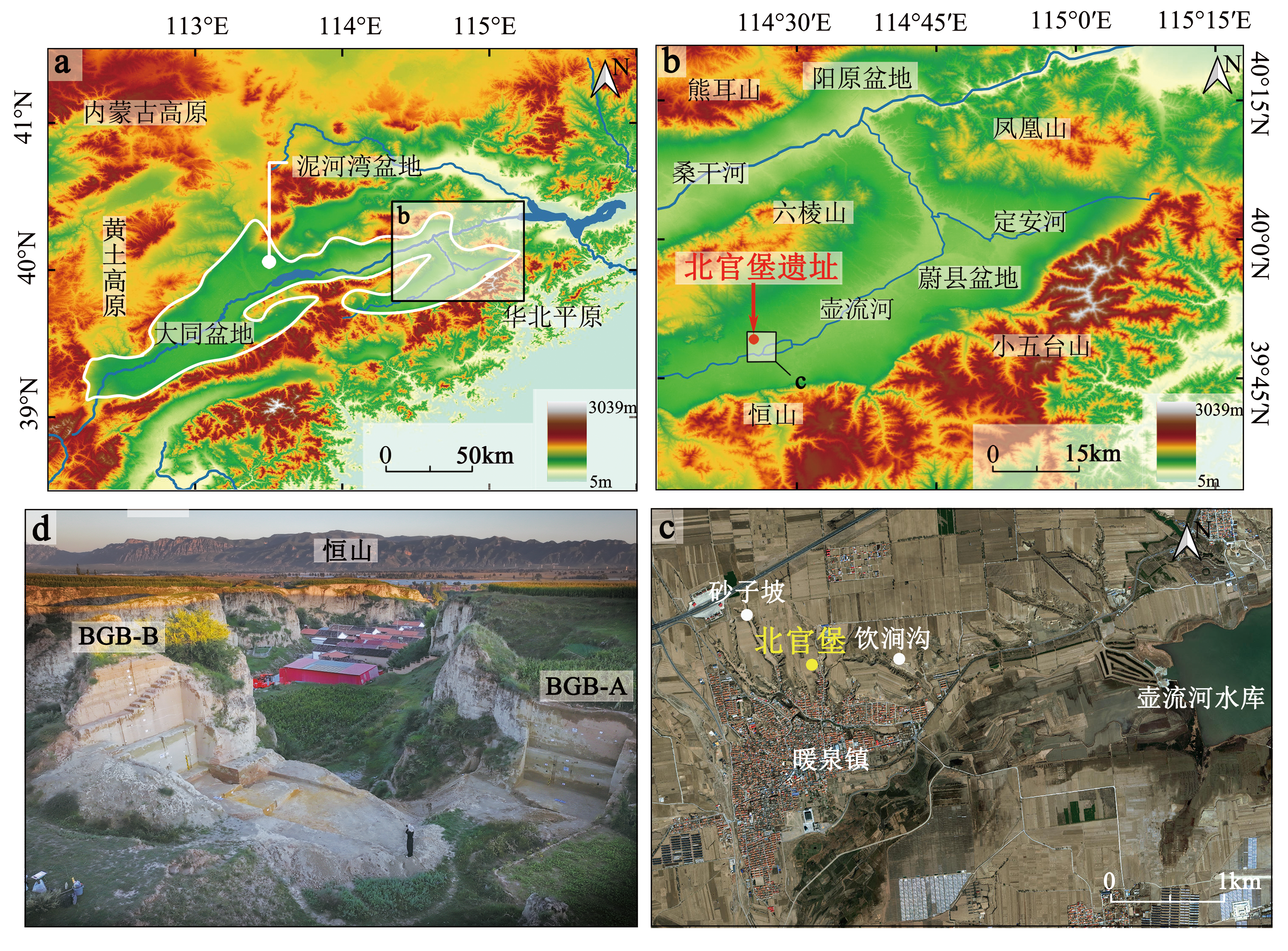
图1 北官堡遗址B地点地理位置图 a.泥河湾盆地 Nihewan Basin;b.暖泉台地 Nuanquan Platform;c.北官堡遗址Beiguanbu site;d.地点所处地貌 Locality geomorphology
Fig.1 Geographical location of Beiguanbu site Loc. B
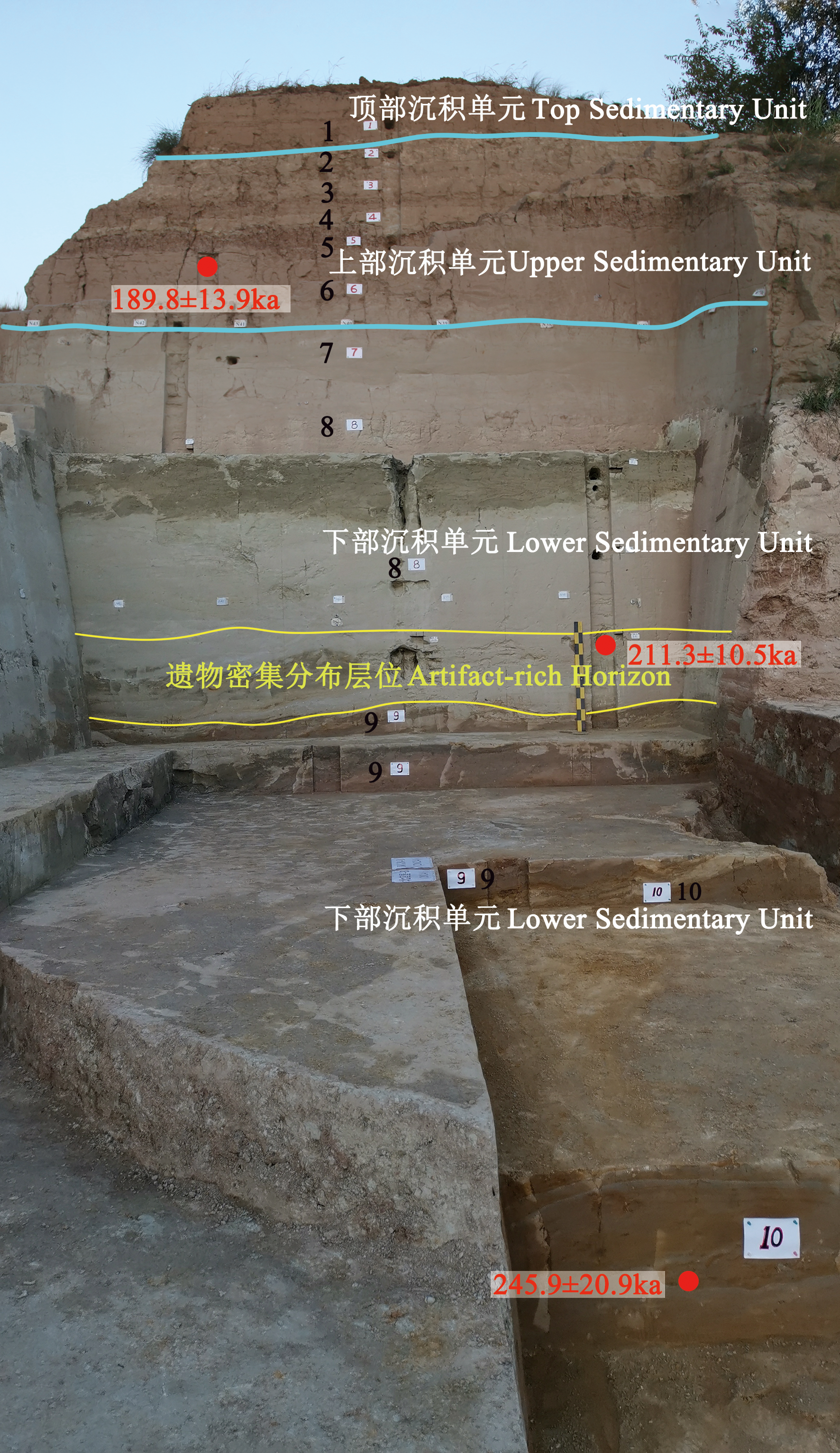
图2 北官堡遗址B地点地层剖面与光释光年代
Fig.2 Stratigraphic section and OSL dating of Beiguanbu site Loc. B
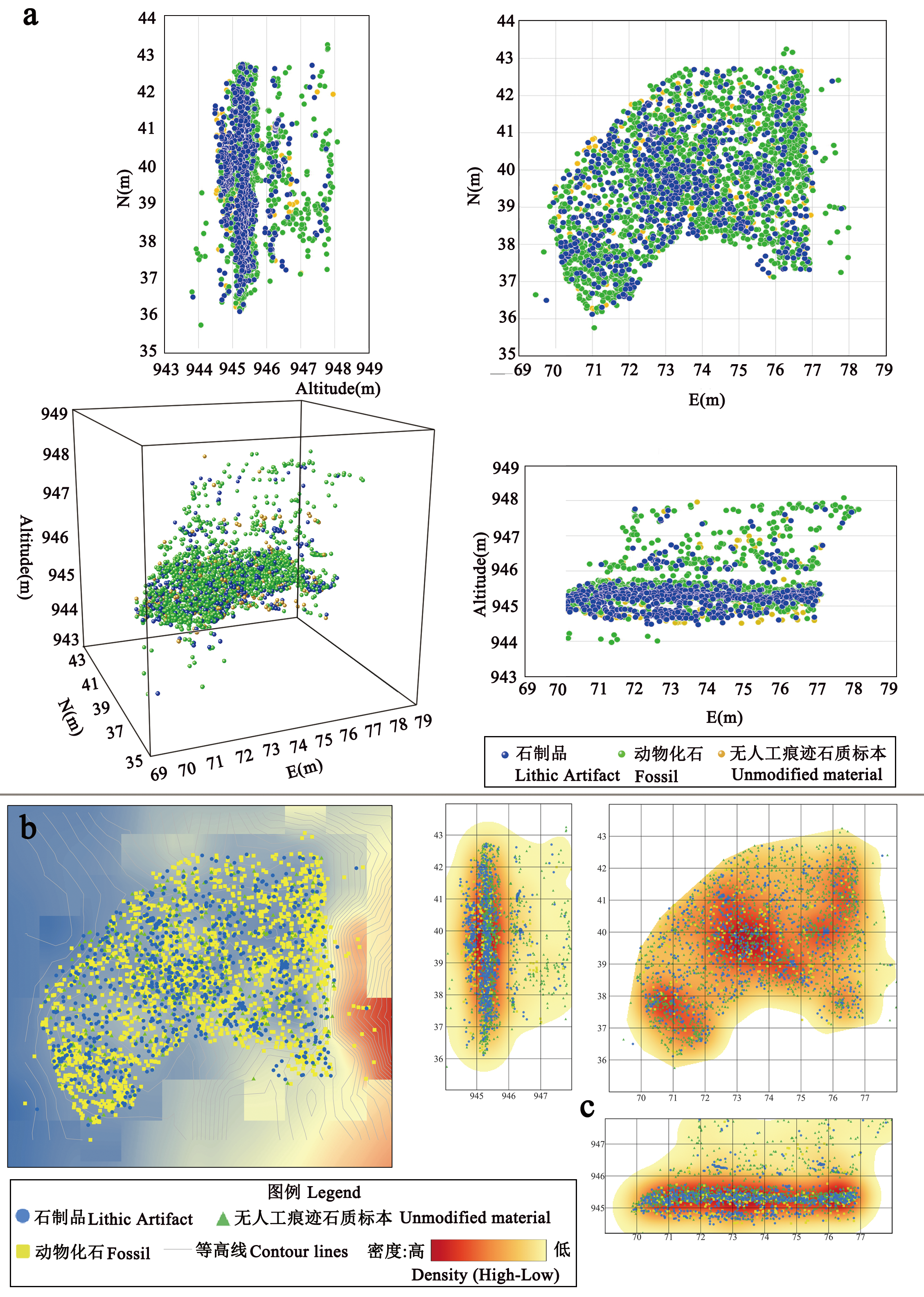
图3 北官堡遗址B地点石制品三维空间分布图 a. 石制品三维空间分布图(E-N-Altitude 坐标系)/3D spatial distribution of lithic remains; b.石制品在含等高线微地貌背景的 E-N 方向的空间分布特征/Spatial distribution of lithic remains in the E-N plane with contour lines showing microtopography; c.石制品空间分布核密度图Kernel density surfaces of lithic remains
Fig.3 3D spatial distribution and density feature of lithic remains from Beiguanbu site Loc. B
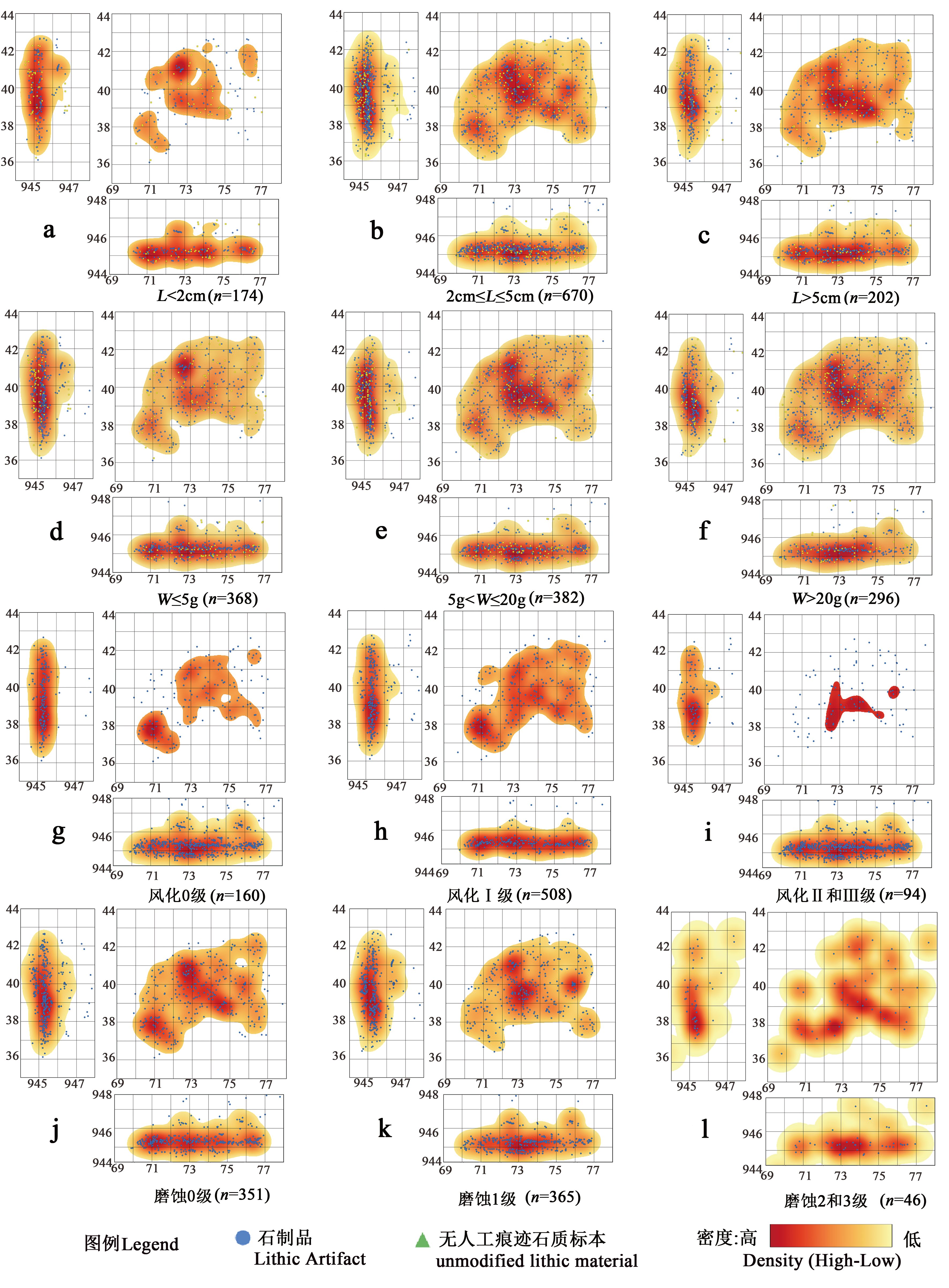
图4 北官堡遗址B地点石制品的空间分布与核密度特征 a-c.不同尺寸石制品的空间分布与核密度特征Kernel density surfaces of lithic remains with different size classes;d-f.不同质量石制品的空间分布与核密度特征Kernel density surfaces of lithic remains with different weight classes;g-i.不同风化等级石制品的空间分布与核密度特征 spatial distributions and kernel densities of lithic remains with different weathering stages;j-l.不同磨蚀等级石制品的空间分布与核密度特征spatial distributions and kernel densities of lithic remains with different abrasion stages
Fig.4 Spatial distributions and kernel density patterns of lithic remains from Beiguanbu site Loc. B
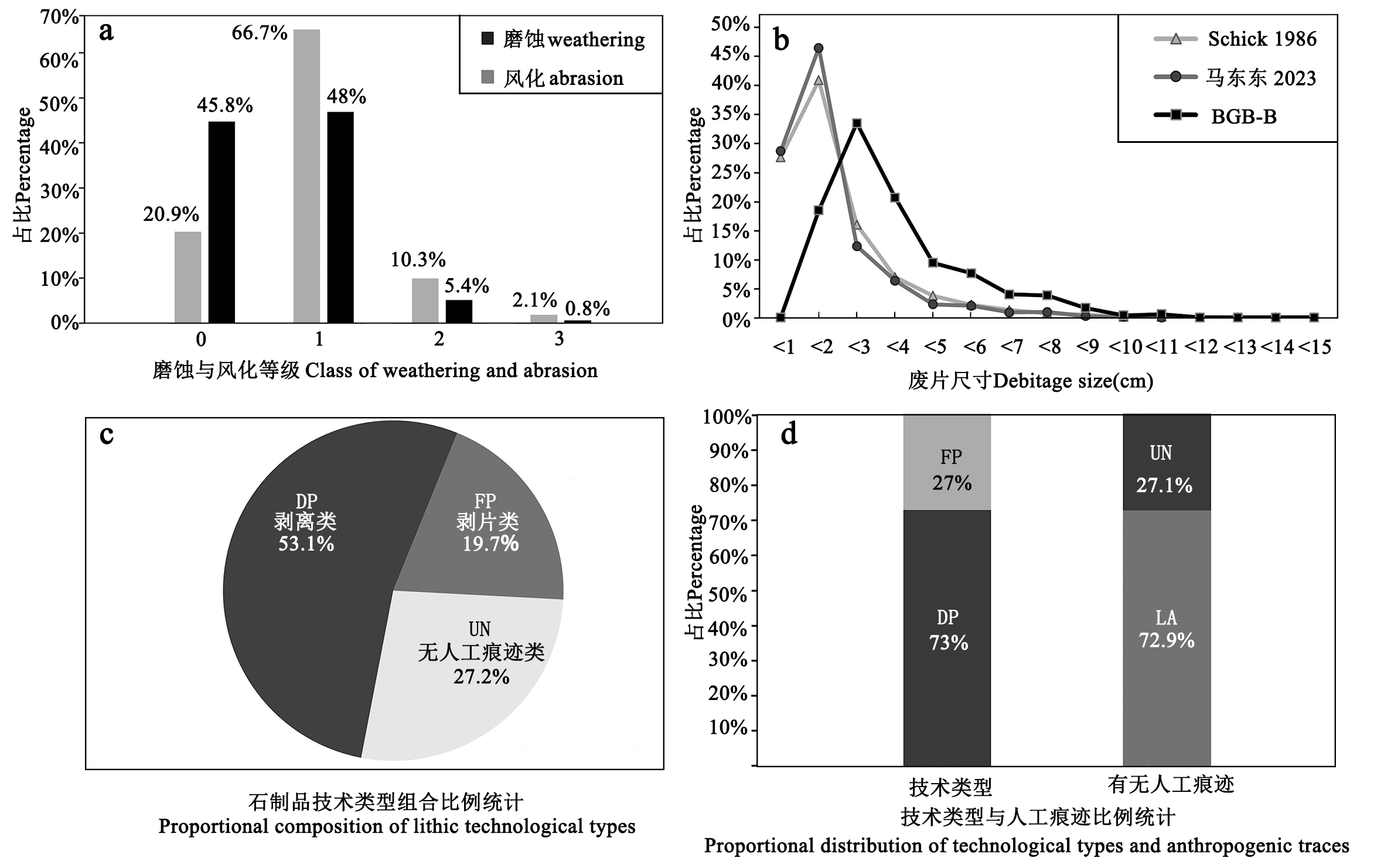
图5 北官堡遗址B地点石制品技术属性特征 a.石制品风化与磨蚀等级统计Class distribution of weathering and abrasion;b.废片尺寸分布特征Size distribution of debitage[15,33];c.石制品技术类型组合比例统计Proportional composition of lithic technological types;d.石制品技术类型与人工痕迹比例关系统计Proportional distribution of technological types and anthropogenic traces。FP, 剥片类剥片flaked pieces;DP, 剥离类废片detached pieces;LA, 石制品lithic artifacts;UN, 无人工痕迹石质标本unmodified lithic material
Fig.5 Technological attributes and preservation feature of lithics from Beiguanbu site Loc. B
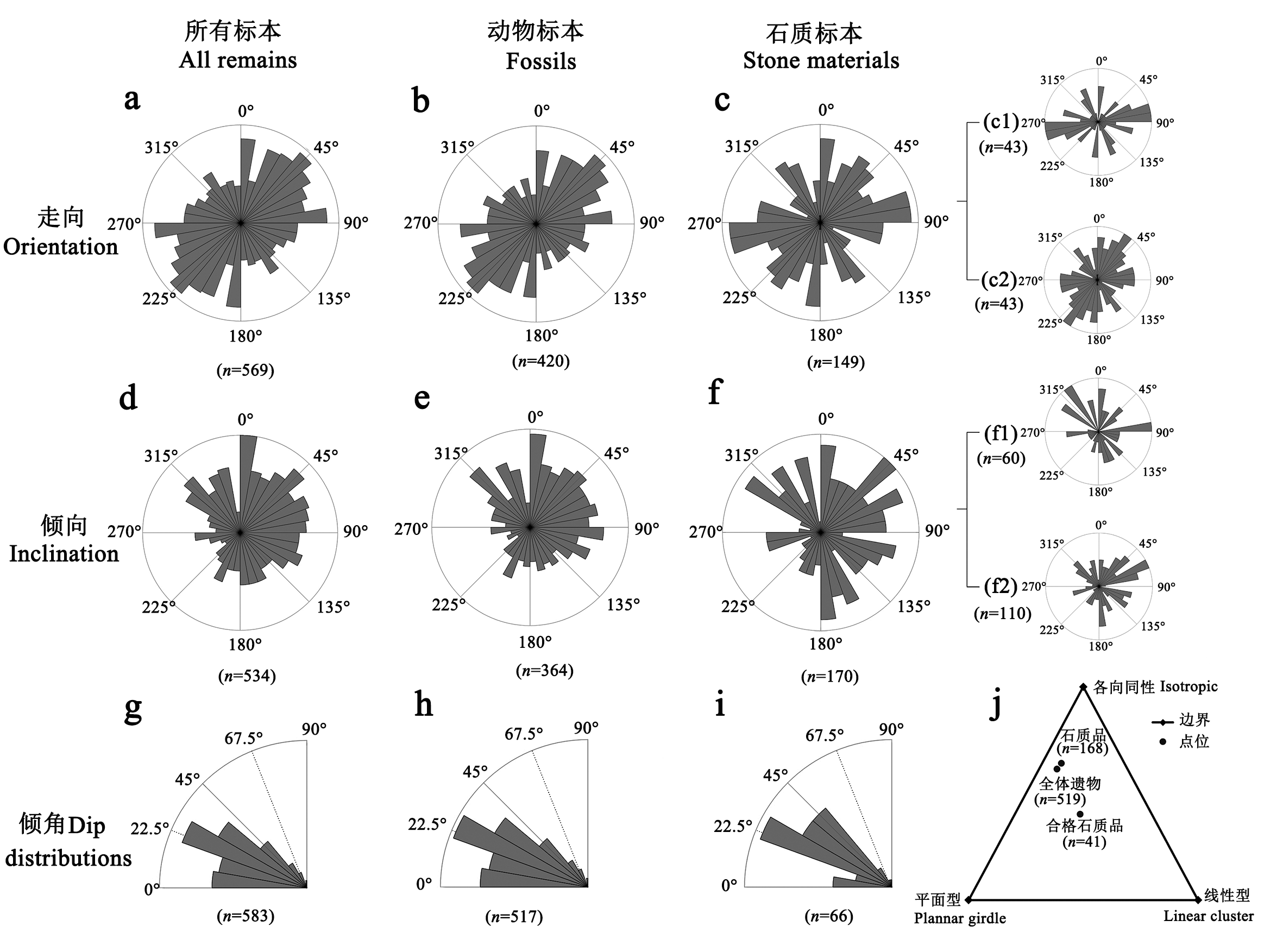
图6 北官堡遗址B地点出土标本分布走向、倾向与倾角分布 a.出土所有标本分布走向 orientation of all remains;b.动物化石分布走向 orientation of fossils;c.石质标本分布走向orientation of stone materials (c1:L<4 cm,c2:L≥4 cm);d.出土所有标本倾向 inclination of all remains;e.动物化石倾向 inclination of fossils;f.石质标本倾向 inclination of stone materials (f1:L<4 cm,f2:L≥4 cm);g.出土所有标本倾角 dip distributions of all remains;h.动物化石倾角 dip distributions of fossils;i.石质标本倾角 dip distributions of stone materials;j.遗物空间分布班恩图(各向同性指数与延伸指数)Benn’s diagram of spatial distribution of remains(Isotropy index and elongation index)
Fig.6 Rose diagrams showing orientation and inclination, and the dip distributions (in degree) of remains from Beiguanbu site Loc. B
| [1] | Isaac GL. Towards the interpretation of occupation debris: some experiments and observations[J]. Kroeber Anthropology Society Paper, 1967, 37: 31-57 |
| [2] | Schiffer MB. Formation process of the archaeological record[M]. Albuquerque: University of New Mexico Press, 1987 |
| [3] | Schick KD. Stone Age sites in the making: experiments in the formation and transformation of archaeological occurrences[M]. Oxford: British Archaeological Reports, 1986, 319 |
| [4] |
Petraglia MD, Potts R. Water flow and the formation of Early Pleistocene artifact sites in Olduvai Gorge, Tanzania[J]. Journal of Anthropological Archaeology, 1994, 13: 228-254
doi: 10.1006/jaar.1994.1014 URL |
| [5] | Morton AGT. Archaeological site formation: Understanding lake margin contexts[M]. Oxford: BAR International Series, 2004, 1211 |
| [6] |
de la Torre I, Wehr K. Site formation processes of the early Acheulean assemblage at EF-HR (Olduvai Gorge, Tanzania)[J]. Journal of Human Evolution, 2018, 120: 298-328
doi: S0047-2484(17)30304-4 pmid: 28802723 |
| [7] | 王法岗, 孙永春. 泥河湾考古图典[M]. 石家庄: 河北美术出版社, 2023 |
| [8] | 裴树文, 王法岗, 牛东伟. 二十一世纪以来泥河湾盆地古人类活动的发现与研究进展[J]. 人类学学报, 2024, 43(6): 913-933 |
| [9] |
Deng CL, Zhu RX, Zhang R, et al. Timing of the Nihewan Formation and faunas[J]. Quaternary Research, 2008, 69: 77-90
doi: 10.1016/j.yqres.2007.10.006 URL |
| [10] |
Guo YJ, Li B, Zhang JF, et al. Luminescence ages for three “Middle Palaeolithic” sites in the Nihewan Basin, northern China, and their archaeological and palaeoenvironmental implications[J]. Quaternary Research, 2016, 85(3): 456-470
doi: 10.1016/j.yqres.2016.03.002 URL |
| [11] | Pei S, Xie F, Deng C, et al. Early Pleistocene archaeological occurrences at the Feiliang site, and the archaeology of human origins in the Nihewan Basin, North China[J]. PLOS ONE, 2017, 12(11): e0187251 |
| [12] |
Ding X, Pei S W, Xie F, et al. Deciphering site formation processes in lakeshore environments: a case study of early Pleistocene site of Feiliang (Nihewan Basin, China)[J]. Archaeological and Anthropological Sciences, 2024, 16: 92
doi: 10.1007/s12520-024-02003-7 |
| [13] | 裴树文, 贾真秀, 马东东, 等. 泥河湾盆地麻地沟E5旧石器地点的遗址成因与石器技术[J]. 人类学学报, 2016, 35(4): 493-508 |
| [14] |
Jia Z, Pei S, Benito-Calvo A, et al. Site formation processes at Donggutuo: a major Early Pleistocene site in the Nihewan Basin, North China[J]. Journal of Quaternary Science, 2019, 34(8): 621-632
doi: 10.1002/jqs.v34.8 URL |
| [15] |
Ma DD, Pei SW, Xie F, et al. Site formation processes at Cenjiawan (Nihewan Basin, North China): a case study on the structure of the Early Pleistocene archaeological record in lakeshore environments[J]. Journal of Quaternary Science, 2023, 38(4): 488-504
doi: 10.1002/jqs.v38.4 URL |
| [16] | 叶芷, 杜雨薇, 裴树文, 等. 蔚县盆地吉家庄旧石器遗址的形成过程[J]. 人类学学报, 2023, 42(1): 46-60 |
| [17] | 牛东伟, 闫晓蒙, 马东东, 等. 蔚县盆地2019-2020年旧石器考古调查[J]. 人类学学报, 2022, 41(5): 936-944 |
| [18] | 张亚光, 马梦玲, 周明兴, 等. 河北蔚县盆地晚新世以来沉积古环境演化分析[J]. 地质论评, 2023, 69(S1): 37-39 |
| [19] | 夏正楷, 刘锡清. 泥河湾层古地理环境的初步认识[J]. 海洋地质与第四纪地质, 1984, 4(3): 101-110 |
| [20] | 夏正楷, 韩军青. 泥河湾盆地虎头梁湖相叠层石的生态环境分析[J]. 第四纪研究, 2008, 28(4): 344-350 |
| [21] |
de la Torre I, Vanwezer N, Benito-Calvo A, et al. Spatial and orientation patterns of experimental stone tool refits[J]. Archaeological and Anthropological Sciences, 2019, 11(9): 4569-4584
doi: 10.1007/s12520-018-0701-z |
| [22] |
Bertran P, Hetu B, Texier JP, et al. Fabric characteristics of subaerial slope deposits[J]. Sedimentology, 1997, 44(1): 1-16
doi: 10.1111/sed.1997.44.issue-1 URL |
| [23] | 裴树文. 旧石器时代旷野遗址形成过程研究综述[J]. 人类学学报, 2019, 38(1): 1-18 |
| [24] |
Schick KD. Geoarchaeological analysis of an Acheulean site at Kalambo Falls, Zambia[J]. Geoarchaeology, 1992, 7: 1-16
doi: 10.1002/gea.v7:1 URL |
| [25] |
Katsianis M, Tsipidis S, Kotsakis K, et al. A 3D digital workflow for archeological intra-site research using GIS[J]. Journal of Archaeological Science, 2008, 35: 655-667
doi: 10.1016/j.jas.2007.06.002 URL |
| [26] | Isaac GL. Bones in contention: competing explanations for the juxtaposition of Early Pleistocene artefacts and faunal remains[C]. In: Clutton-Brock J, Grigson C(Eds.). Animals and Archaeology, Vol. 1. Hunters and their Prey[M]. Oxford: BAR International Series 163, 1983, 3-19 |
| [27] |
de la Torre I. The Early Stone Age lithic assemblages of Gadeb (Ethiopia) and the Developed Oldowan/early Acheulean in East Africa[J]. Journal of Human Evolution, 2011, 60: 768-812
doi: 10.1016/j.jhevol.2011.01.009 pmid: 21481918 |
| [28] |
Levi-Sala I. Use wear and post-depositional surface modification: A word of caution[J]. Journal of Archaeological Science, 1986, 13: 229-244
doi: 10.1016/0305-4403(86)90061-0 URL |
| [29] | Kuman K. Site formation in the early South African Stone Age sites and its influence on the archaeological record[J]. South African Journal of Science, 2003, 99(5): 251-254 |
| [30] | Kasig A. Anthropogeologie-Eine neue wichtige Forschungsrichtung innerhalb der Geowissenschaften[J]. Nachrichten der Deutschen Geologischen Gesellschaft, 1979, 21: 61-67 |
| [31] |
Villa P. Conjoinable pieces and site formation processes[J]. American Antiquity, 1982, 47: 276-290
doi: 10.2307/279901 URL |
| [32] |
Peter B. Obviously sequential but continuous or staged? Refits and cognition in three late Paleolithic assemblages from Japan[J]. Journal of Anthropological Archaeology, 2002, 21(3): 329-343
doi: 10.1016/S0278-4165(02)00001-6 URL |
| [33] |
Schick KD. Modeling the formation of early stone artifact concentration[J]. Journal of Human Evolution, 1987, 16: 789-807
doi: 10.1016/0047-2484(87)90024-8 URL |
| [34] |
Lenoble A, Bertran P. Fabric of Palaeolithic levels: methods and implications for site formation processes[J]. Journal of Archaeological Science, 2004, 31(4): 457-469
doi: 10.1016/j.jas.2003.09.013 URL |
| [35] |
Benito-Calvo A, Martínez-Moreno J, Jordá Pardo JF, et al. Sedimentological and archaeological fabrics in Palaeolithic levels of the South-Eastern Pyrenees: Cova Gran and Roca dels Bous Sites (Lleida, Spain)[J]. Journal of Archaeological Science, 2009, 36(11): 2566-2577
doi: 10.1016/j.jas.2009.07.012 URL |
| [36] |
Villa P, Courtin J. The interpretation of stratified sites: A view from underground[J]. Journal of Archaeological Science, 1983, 10: 267-281
doi: 10.1016/0305-4403(83)90011-0 URL |
| [37] |
Sahnouni M, Heinzelin J. The site of Ain Hanech revisited: new investigations at this Lower Pleistocene site in North Algeria[J]. Journal of Archaeological Science, 1998, 25: 1083-1101
doi: 10.1006/jasc.1998.0278 URL |
| [38] |
Shea JJ. Artifact abrasion, fluvial processes, and “living floors” from the Early Paleolithic site of ‘Ubeidiya (Jordan Valley, Israel)[J]. Geoarchaeology, 1999, 14: 191-207
doi: 10.1002/(ISSN)1520-6548 URL |
| [39] | 徐静玥, 何湘栋, 牛东伟, 等. 泥河湾盆地蔚县东沟旧石器遗址的埋藏过程[J]. 人类学学报, 2024, 43(6): 1075-1090 |
| [40] |
Ao H, Dekkers MJ, An ZS, et al. Magnetostratigraphic evidence of a mid-Pliocene onset of the Nihewan Formation implications for early fauna and hominid occupation in the Nihewan Basin, North China[J]. Quaternary Science Reviews, 2013, 59: 30-42
doi: 10.1016/j.quascirev.2012.10.025 URL |
| [41] | 唐锐枰, 葛俊逸, 庞海娇, 等. 泥河湾黑土沟剖面磁组构特征及古湖水文环境变化[J]. 科学通报, 2020, 65(11): 1027-1045 |
| [42] | 吴文祥. 试论早期人类占据泥河湾盆地的时代[J]. 地球学报, 2002, 23(3): 249-254 |
| [43] | 李潇丽. 泥河湾盆地吉家庄遗址地层易溶盐沉积记录的古气候信息[J]. 海洋地质与第四纪地质, 2020, 40(5): 149-159 |
| [44] |
Ye Z, Pei S, Tu H, et al. 26Al/10Be burial dating and technological strategies of hominins at the Jijiazhuang Paleolithic site, Nihewan Basin, China: Implications for understanding Middle Pleistocene human adaptations in east Asia[J]. Quaternary Science Reviews, 2024, 339: 108837
doi: 10.1016/j.quascirev.2024.108837 URL |
| [45] | 白振平. 对蔚县盆地发育过程的初步认识[A].见:卫奇,谢飞(编). 泥河湾研究论文选编[C]. 北京: 文物出版社, 1989, 466-474 |
| [46] | 夏正楷. 大同-阳原盆地的新生代沉积和环境演变[A]. 见:王乃樑,杨景春,夏正楷,等(著). 山西地堑系新生代沉积与构造地貌[M]. 北京: 科学出版社, 1996, 1-72 |
| [1] | 裴树文, 牛东伟, 马东东. 泥河湾盆地蔚县中更新世古人类活动遗址的发现与科学价值[J]. 人类学学报, 2026, 45(03): 403-418. |
| [2] | 牛东伟, 刘尔凡, 薛峰, 谢飞. 河北怀来盆地古人类文化遗存的考古发现与研究[J]. 人类学学报, 2026, 45(03): 419-435. |
| [3] | 单佳璐, 李怡晓, 王法岗, 郭玉杰, 李锋. 泥河湾盆地新庙庄遗址2号地点2018年发现材料初步研究[J]. 人类学学报, 2026, 45(03): 447-461. |
| [4] | 沈柯, 李锋, 王晓敏, 王法岗, 郭北姮, 高星. 板井子遗址第2地点2023~2024年发掘报告[J]. 人类学学报, 2026, 45(03): 462-477. |
| [5] | 王心蕊, 张芷瑶, 黄冰柔, 王法岗, 郭玉杰. 泥河湾盆地武家梁旧石器遗址1号地点的光释光测年[J]. 人类学学报, 2026, 45(03): 489-499. |
| [6] | 耿帅杰, 裴树文, 杜雨薇, 徐静玥, 叶芷, 刘子仪. 泥河湾盆地蔚县蔡家沟遗址A地点发掘简报[J]. 人类学学报, 2026, 45(03): 500-514. |
| [7] | 叶芷, 裴树文, 马东东, 贾真秀, 王法岗, 杨海勇. 泥河湾盆地蔚县前上营遗址B地点发掘报告[J]. 人类学学报, 2026, 45(03): 515-531. |
| [8] | 杜雨薇, 耿帅杰, 徐静玥, 叶芷, 张乐, 马东东, 裴树文. 泥河湾盆地蔡家沟遗址A和B地点动物骨骼的埋藏学观察[J]. 人类学学报, 2026, 45(03): 570-585. |
| [9] | 刘尔凡, 高佳璇, 牛东伟. 河北怀来盆地珠窝堡遗址出土的石制品[J]. 人类学学报, 2026, 45(03): 600-608. |
| [10] | 赵海龙, 周天路, 马冲, 杨博灿, 贾倩. 河北泥河湾盆地东缘石器原料的开发与利用[J]. 人类学学报, 2026, 45(01): 34-45. |
| [11] | 刘武, 吴秀杰. 华龙洞古人类化石及其在人类演化上的意义[J]. 人类学学报, 2025, 44(05): 727-741. |
| [12] | 刘驷统, 刘博轩, 金泽田, 邓国栋, 同号文, 吴秀杰. 华龙洞遗址出土的哺乳动物距骨化石[J]. 人类学学报, 2025, 44(05): 816-835. |
| [13] | 江左其杲, 刘博轩, 刘驷统, 贺乐天, 同号文. 华龙洞1号地点的食肉目哺乳动物化石及其时代和古生态意义[J]. 人类学学报, 2025, 44(05): 836-849. |
| [14] | 史静耸, 胡海虔, 邓国栋, 金泽田. 安徽东至华龙洞1号地点中更新统蛇类化石[J]. 人类学学报, 2025, 44(05): 850-861. |
| [15] | 徐建炜, 刘连强, 成小雨, 赵永胜, 侯佳岐, 王法岗. 泥河湾盆地奶奶庙沟遗址2015年出土的石制品[J]. 人类学学报, 2025, 44(04): 556-567. |
| 阅读次数 | ||||||
|
全文 |
|
|||||
|
摘要 |
|
|||||
 京ICP证05002819号-3