

主管:中国科学院
主办:中国科学院古脊椎动物与古人类研究所
出版:科学出版社
主办:中国科学院古脊椎动物与古人类研究所
出版:科学出版社
人类学学报 ›› 2026, Vol. 45 ›› Issue (03): 500-514.doi: 10.16359/j.1000-3193/AAS.2025.0106cstr: 32091.14.j.1000-3193/AAS.2025.0106
耿帅杰1,2,3( ), 裴树文1,2(), 杜雨薇1,2,3, 徐静玥1,2,3, 叶芷1,2,3, 刘子仪1,2,3
收稿日期:2025-05-19
接受日期:2025-07-15
出版日期:2026-06-15
发布日期:2026-06-12
通讯作者:
裴树文,研究员,主要从事旧石器时代考古学和地质考古学研究。E-mail: peishuwen@ivpp.ac.cn
作者简介:耿帅杰,博士研究生,主要从事旧石器时代考古学研究。E-mail: gengshuaijie@ivpp.ac.cn
基金资助:
GENG Shuaijie1,2,3(), PEI Shuwen1,2(), DU Yuwei1,2,3, XU Jingyue1,2,3, YE Zhi1,2,3, LIU Ziyi1,2,3
Received:2025-05-19
Accepted:2025-07-15
Online:2026-06-15
Published:2026-06-12
摘要:
蔡家沟遗址是蔚县盆地东北部吉家庄台地一处重要的中更新世旧石器遗址,2019年9-10月发掘出土349件石质标本与569件动物化石。根据地层中的哺乳动物化石推测遗址年代为中更新世,26Al/10Be埋藏测年结果为0.47±0.13 Ma至0.64±0.21 Ma,属中更新世早期。蔡家沟遗址A地点石制品原料以火山岩为主,另有少量硅质白云岩、燧石等;石制品类型包括石核、石器、完整石片、碎片、断块、石锤等;石核剥片与石器修理均以锤击法为主,完整石片以V型和VI型为主,显示次级剥片特点;石核保留的剥片片疤数量较多,显示较高的石核利用率,部分盘状石核的存在反映出古人类较高的技术组织能力。从出土动物化石的保存状况与痕迹分布来看,古人类活动对该遗址动物骨骼的改造作用占据主导地位。蔡家沟遗址A地点的石制品具有原料搬运距离较远以及石核剥片策略高效等特点,相较盆地内早更新世遗址具有明显的进步性,对探讨泥河湾盆地中更新世古人类技术特点与行为演化具有重要意义。
中图分类号:
耿帅杰, 裴树文, 杜雨薇, 徐静玥, 叶芷, 刘子仪. 泥河湾盆地蔚县蔡家沟遗址A地点发掘简报[J]. 人类学学报, 2026, 45(03): 500-514.
GENG Shuaijie, PEI Shuwen, DU Yuwei, XU Jingyue, YE Zhi, LIU Ziyi. A preliminary report on the excavation of Caijiagou-A Paleolithic site in Yuxian, Nihewan Basin[J]. Acta Anthropologica Sinica, 2026, 45(03): 500-514.
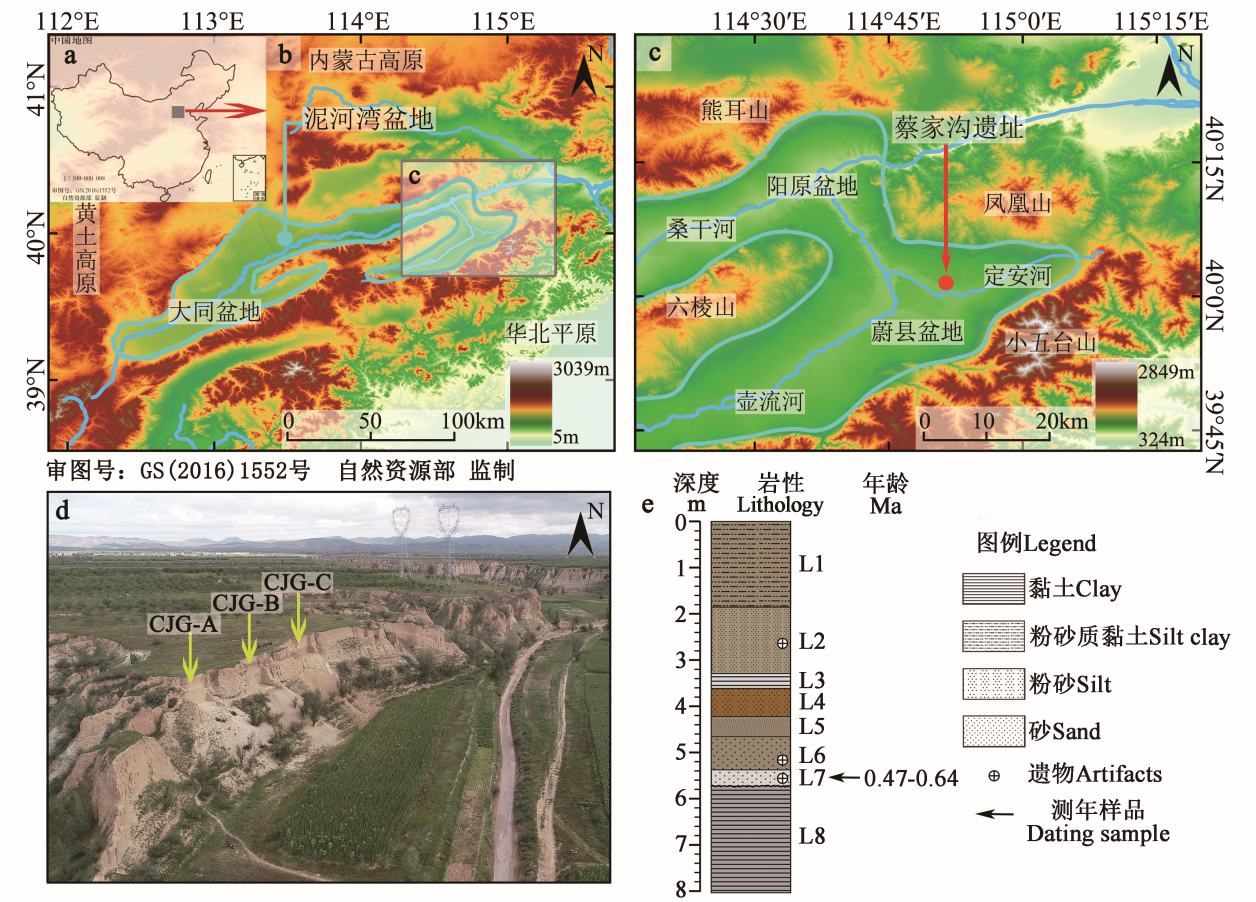
图1 蔡家沟遗址地理位置与地层剖面 a, b. 泥河湾盆地的地理位置Geographical location of the Nihewan Basin (senso lato),a图审图号:GS(2016)1552号;c. 蔡家沟遗址在泥河湾盆地中的位置Location of the Caijiagou site within the Nihewan Basin;d. 蔡家沟遗址区域无人机航拍图(自南向北拍摄)UAV aerial view of the Caijiagou site area (photographed from south to north);e. 蔡家沟A地点地层剖面柱与遗物埋藏年代Stratigraphic column and burial age of cultural remains at CJG-A site
Fig.1 Geographical location and stratigraphic profile of the Cajiagou site
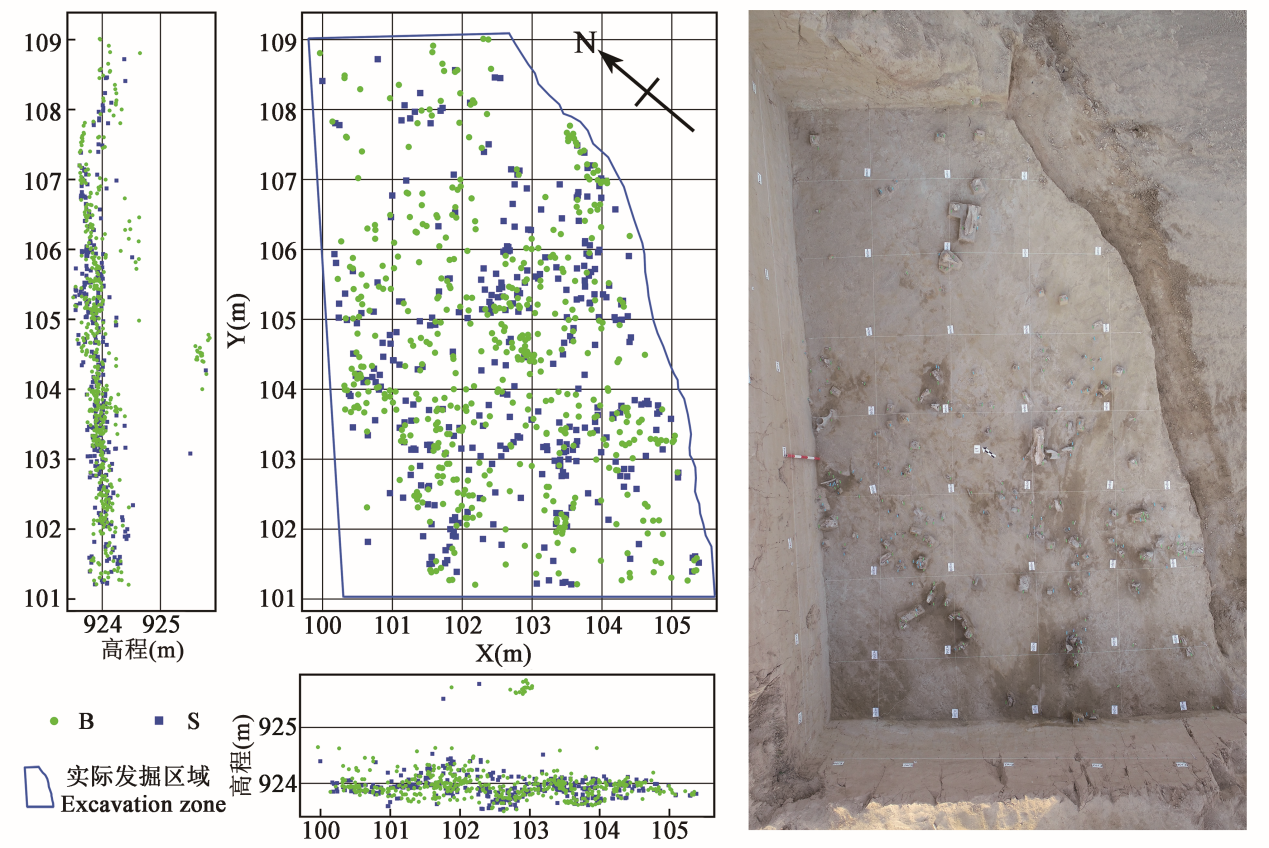
图2 CJG-A地点出土遗物分布图及现场平面照 B,动物化石Animal fossil;S,石质标本Stone artifact
Fig.2 Distribution of unearthed artifacts and site plan at the Caijiagou-A site
| 原料Raw materials 类型Types | 火山岩Lava | 硅质白云岩Dolomite | 燧石Chert | 石英Quartz | 其他Others | 总计Total | |||||||||||
|---|---|---|---|---|---|---|---|---|---|---|---|---|---|---|---|---|---|
| 数量n | 占比% | 数量n | 占比% | 数量n | 占比% | 数量n | 占比% | 数量n | 占比% | 数量n | 占比% | ||||||
| 剥离类Detached pieces | 264 | 75.6% | |||||||||||||||
| 完整石片Whole flakes | 136 | 49.8% | 13 | 30.2% | 4 | 33.3% | 3 | 37.5% | 3 | 23.1% | 159 | 45.6% | |||||
| 碎片Flake fragments | 21 | 7.7% | 4 | 9.3% | 3 | 25% | 0 | 0 | 2 | 15.4% | 30 | 8.6% | |||||
| 断块Chunks | 47 | 17.2% | 15 | 34.9% | 3 | 25% | 3 | 37.5% | 6 | 46.2% | 74 | 21.2% | |||||
| 剥片类Flaked pieces | 70 | 20.1% | |||||||||||||||
| 石核Cores | 25 | 9.2% | 4 | 9.3% | 0 | 0 | 1 | 12.5% | 0 | 0 | 30 | 8.3% | |||||
| 石器Retouched tools | 34 | 12.5% | 5 | 11.6% | 1 | 8.3% | 1 | 12.5% | 0 | 0 | 41 | 11.7% | |||||
| 打击类Pounded pieces | 2 | 0.6% | |||||||||||||||
| 石锤Hammerstones | 1 | 0.4% | 1 | 2.3% | 0 | 0 | 0 | 0 | 0 | 0 | 2 | 0.6% | |||||
| 天然类Unmodified pieces | 13 | 3.7% | |||||||||||||||
| 砾石Cobbles | 2 | 0.7% | 1 | 2.3% | 1 | 8.3% | 0 | 0 | 0 | 0 | 3 | 0.9% | |||||
| 岩块Blocks | 8 | 2.9% | 0 | 0 | 0 | 0 | 0 | 0 | 2 | 15.4% | 10 | 2.9% | |||||
| 总计Total | 273 | 78.2% | 43 | 12.3% | 12 | 3.4% | 8 | 2.3% | 13 | 3.7% | 349 | 100% | |||||
表1 蔡家沟A地点石制品分类型原料统计
Tab.1 Raw material frequencies acccording to lithic type at the Caijiagou-A site
| 原料Raw materials 类型Types | 火山岩Lava | 硅质白云岩Dolomite | 燧石Chert | 石英Quartz | 其他Others | 总计Total | |||||||||||
|---|---|---|---|---|---|---|---|---|---|---|---|---|---|---|---|---|---|
| 数量n | 占比% | 数量n | 占比% | 数量n | 占比% | 数量n | 占比% | 数量n | 占比% | 数量n | 占比% | ||||||
| 剥离类Detached pieces | 264 | 75.6% | |||||||||||||||
| 完整石片Whole flakes | 136 | 49.8% | 13 | 30.2% | 4 | 33.3% | 3 | 37.5% | 3 | 23.1% | 159 | 45.6% | |||||
| 碎片Flake fragments | 21 | 7.7% | 4 | 9.3% | 3 | 25% | 0 | 0 | 2 | 15.4% | 30 | 8.6% | |||||
| 断块Chunks | 47 | 17.2% | 15 | 34.9% | 3 | 25% | 3 | 37.5% | 6 | 46.2% | 74 | 21.2% | |||||
| 剥片类Flaked pieces | 70 | 20.1% | |||||||||||||||
| 石核Cores | 25 | 9.2% | 4 | 9.3% | 0 | 0 | 1 | 12.5% | 0 | 0 | 30 | 8.3% | |||||
| 石器Retouched tools | 34 | 12.5% | 5 | 11.6% | 1 | 8.3% | 1 | 12.5% | 0 | 0 | 41 | 11.7% | |||||
| 打击类Pounded pieces | 2 | 0.6% | |||||||||||||||
| 石锤Hammerstones | 1 | 0.4% | 1 | 2.3% | 0 | 0 | 0 | 0 | 0 | 0 | 2 | 0.6% | |||||
| 天然类Unmodified pieces | 13 | 3.7% | |||||||||||||||
| 砾石Cobbles | 2 | 0.7% | 1 | 2.3% | 1 | 8.3% | 0 | 0 | 0 | 0 | 3 | 0.9% | |||||
| 岩块Blocks | 8 | 2.9% | 0 | 0 | 0 | 0 | 0 | 0 | 2 | 15.4% | 10 | 2.9% | |||||
| 总计Total | 273 | 78.2% | 43 | 12.3% | 12 | 3.4% | 8 | 2.3% | 13 | 3.7% | 349 | 100% | |||||
| 大小与质量Size & Mass→ 石制品类型Types↓ | 最大长Length (mm) | 质量Mass (g) | |||||||
|---|---|---|---|---|---|---|---|---|---|
| 最小值Min | 最大值Max | 平均值Mean | SD | 最小值Min | 最大值Max | 平均值Mean | SD | ||
| 石核Cores(n=30) | 28.4 | 133.5 | 68.2 | 24.5 | 11.1 | 896.2 | 219.7 | 221.2 | |
| 石器Retouched tools(n=41) | 8.8 | 85.2 | 38.2 | 18.2 | 0.4 | 166.4 | 33.4 | 37.1 | |
| 完整石片Whole flakes(n=159) | 13.3 | 81.9 | 32.6 | 13.4 | 1 | 123.6 | 15.6 | 20.6 | |
| 碎片Flake fragments(n=30) | 13.6 | 50.6 | 23.8 | 8.3 | 0.3 | 27.6 | 3.8 | 5.4 | |
| 断块Chunks(n=74) | 12.9 | 78.7 | 36.4 | 15.8 | 0.5 | 136 | 22.5 | 28 | |
| 石锤Hammerstones(n=2) | 66.4 | 80.5 | 73.5 | 9.9 | 185.9 | 252.2 | 219.1 | 46.9 | |
表2 蔡家沟A地点石制品大小与质量统计
Tab.2 Size and mass of the stone artifacts from the Caijiagou-A site
| 大小与质量Size & Mass→ 石制品类型Types↓ | 最大长Length (mm) | 质量Mass (g) | |||||||
|---|---|---|---|---|---|---|---|---|---|
| 最小值Min | 最大值Max | 平均值Mean | SD | 最小值Min | 最大值Max | 平均值Mean | SD | ||
| 石核Cores(n=30) | 28.4 | 133.5 | 68.2 | 24.5 | 11.1 | 896.2 | 219.7 | 221.2 | |
| 石器Retouched tools(n=41) | 8.8 | 85.2 | 38.2 | 18.2 | 0.4 | 166.4 | 33.4 | 37.1 | |
| 完整石片Whole flakes(n=159) | 13.3 | 81.9 | 32.6 | 13.4 | 1 | 123.6 | 15.6 | 20.6 | |
| 碎片Flake fragments(n=30) | 13.6 | 50.6 | 23.8 | 8.3 | 0.3 | 27.6 | 3.8 | 5.4 | |
| 断块Chunks(n=74) | 12.9 | 78.7 | 36.4 | 15.8 | 0.5 | 136 | 22.5 | 28 | |
| 石锤Hammerstones(n=2) | 66.4 | 80.5 | 73.5 | 9.9 | 185.9 | 252.2 | 219.1 | 46.9 | |
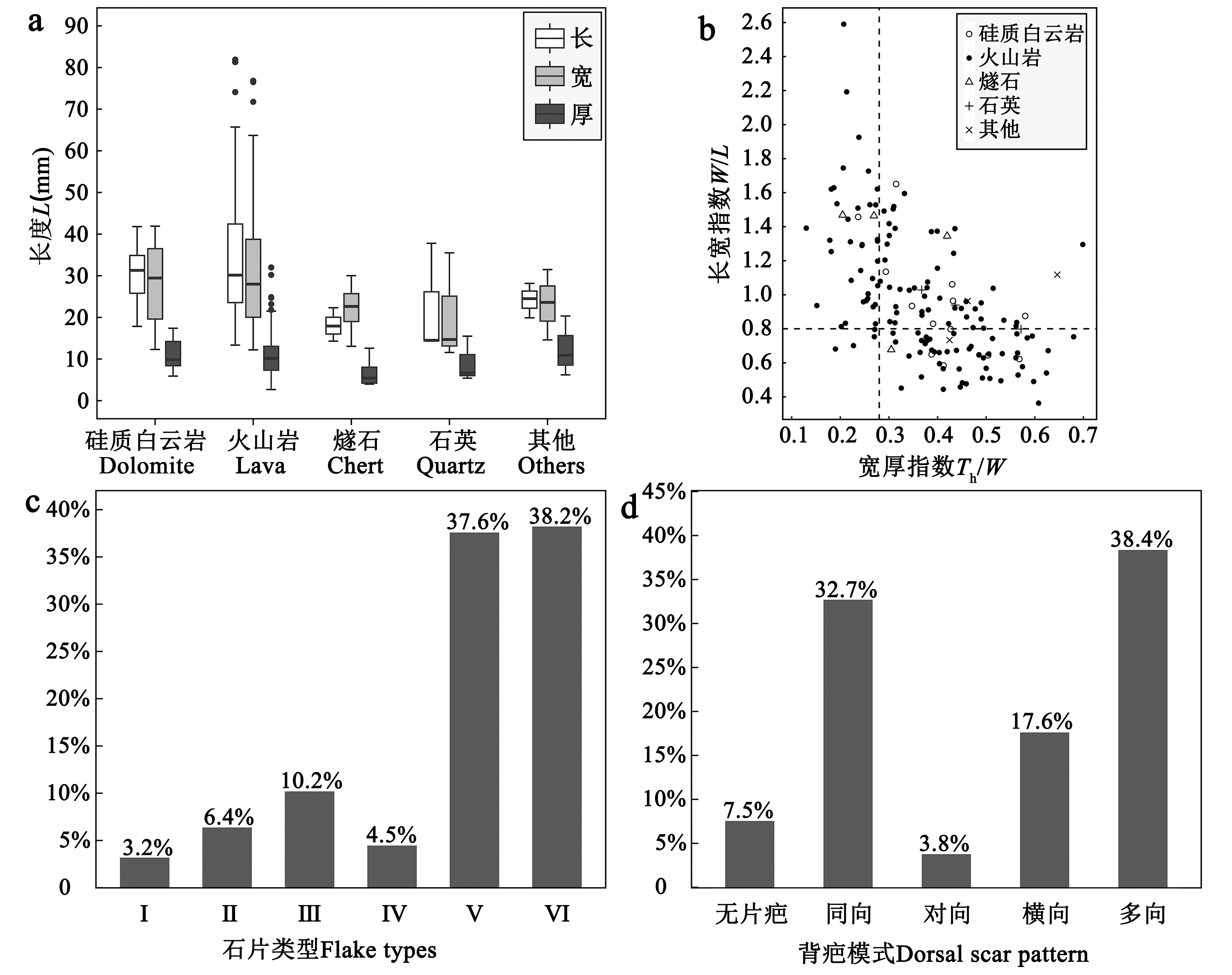
图3 蔡家沟A地点石片技术指标 a. 尺寸Dimension of flakes;b.形状特征Flake shape;c.类型Flake types;d.背面片疤分布模式Dorsal scar patterns
Fig.3 Technical indicators of whole flakes at CJG-A site
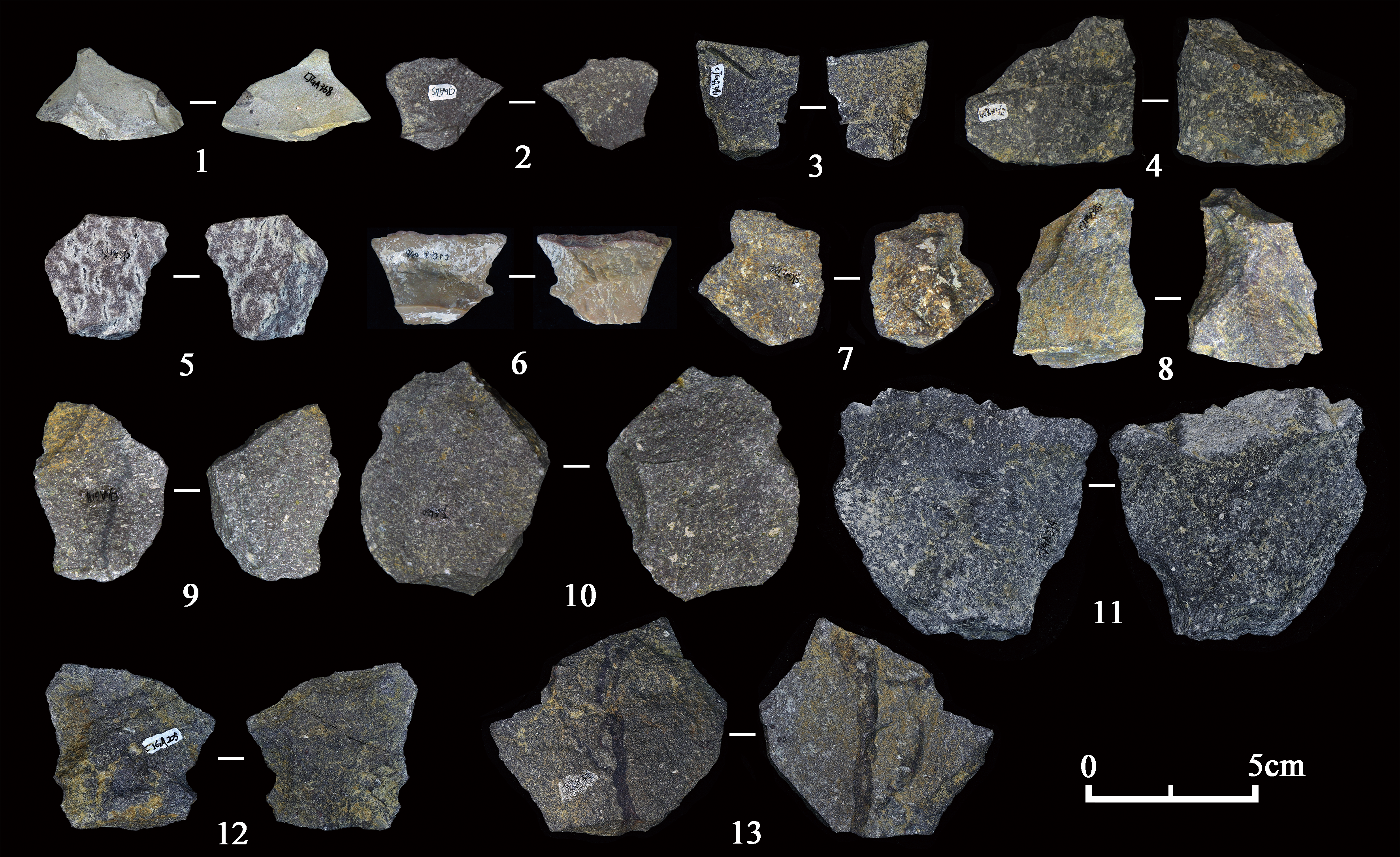
图4 蔡家沟A地点出土的部分石片 1-2. CJG-A:368、CJG-A:715,IV型/ Flake Type IV;3. CJG-A:391,II型/ Flake Type II;4-5, 7-8. CJG-A:254、CJG-A:191、CJG-A:734、CJG-A:383,VI型/ Flake Type VI;6, 9-13. CJG-A:038、CJG-A:618、CJG-A:620、CJG-A:379、CJG-A:205、CJG-A:798,V型/ Flake Type V
Fig.4 Selected flakes from CJG-A site
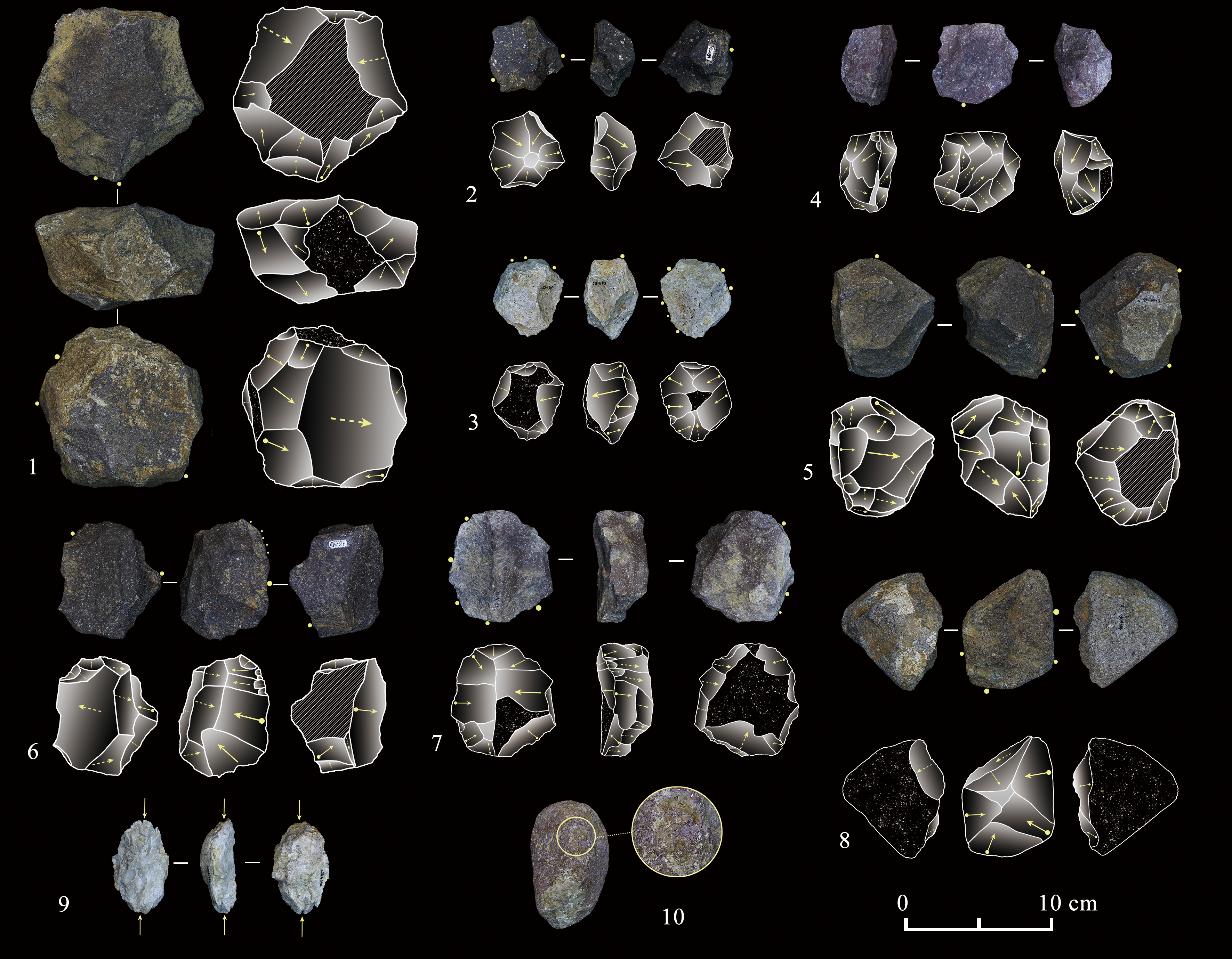
图5 蔡家沟A地点出土的部分石核、石锤及砸击品 1-3. CJG-A192、CJG-A189、CJG-A553,盘状剥片Discoid;4-5. CJG-A037、CJG-A213,多台面剥片Multificial;6. CJG-A376,单面陡钝对向剥片Unifacial abrupt bidirectional exploitation;7. CJG-A365,两面外围剥片Bifacial peripheral exploitation;8. CJG-A614,单面向心剥片Unifacial centripetal exploitation;9. CJG-A392,砸击石核Bipolar;10. CJG-A571,石锤Hammerstone
Fig.5 Selected cores, hammerstone and bipolar from CJG-A site
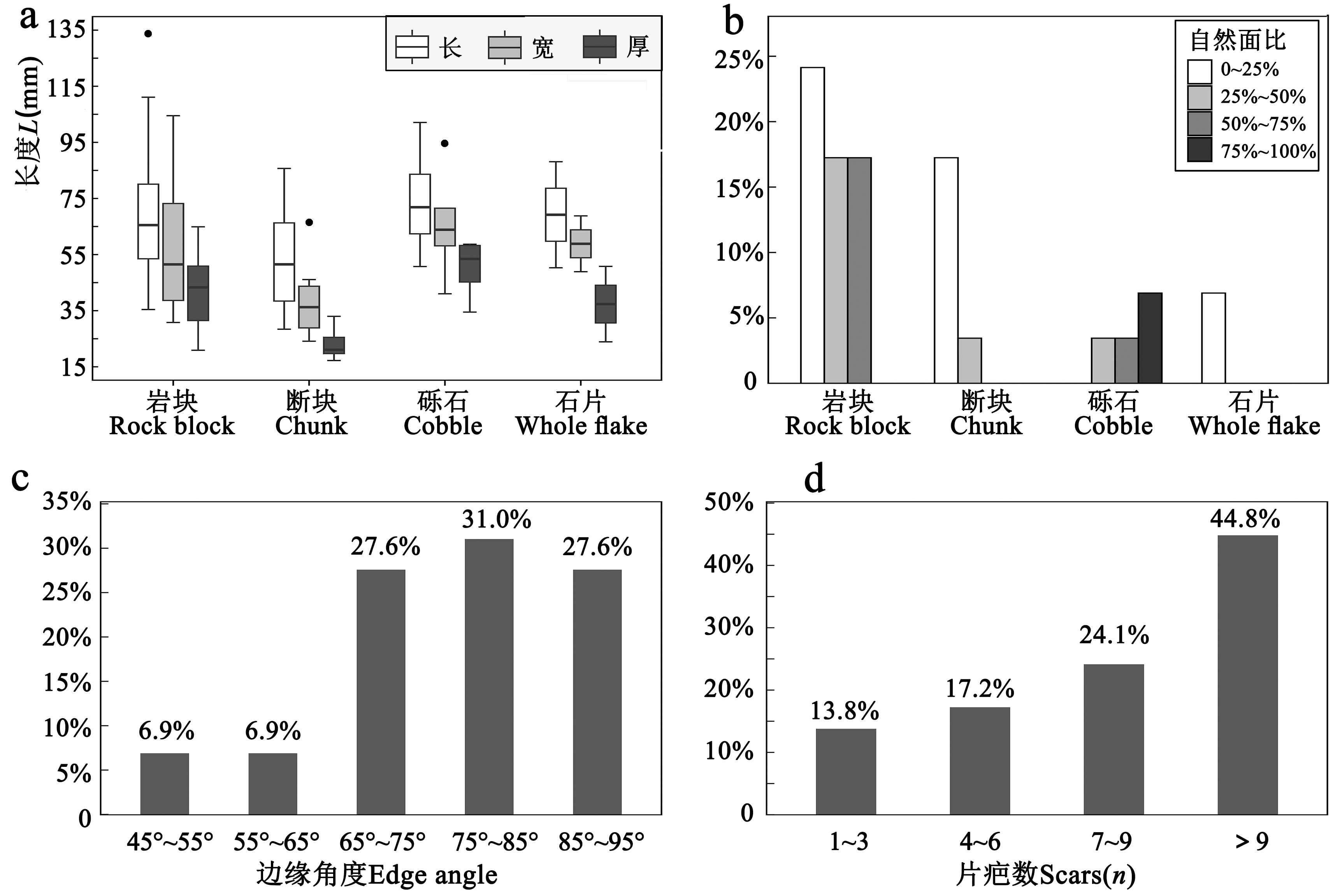
图6 蔡家沟A地点石核技术指标 a.尺寸(原型)Size by blank;b.自然面比Cortex ratios;c.边缘角Edge angles;d.片疤数Number of flake scars
Fig.6 Technical indicators of cores at CJG-A site
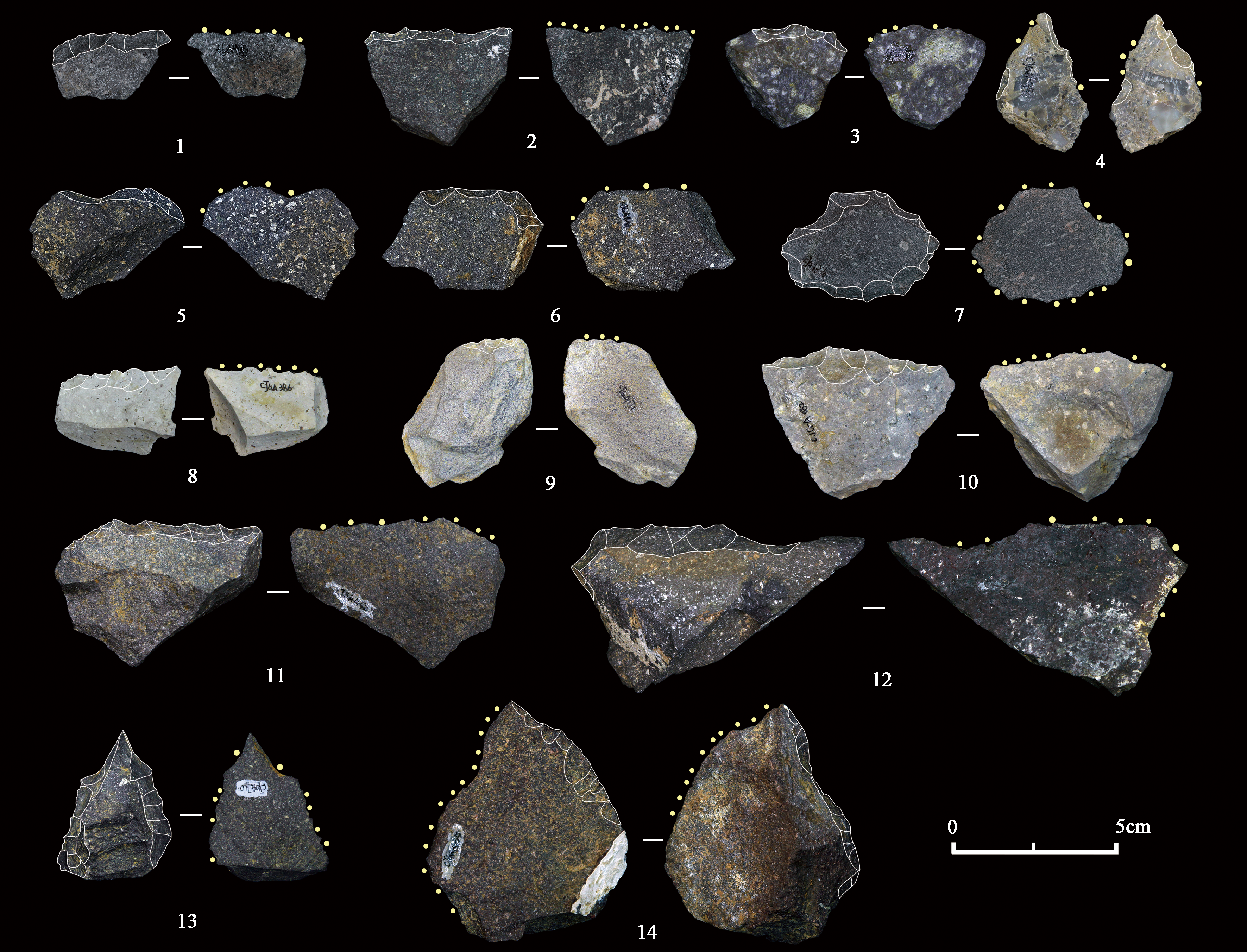
图7 蔡家沟A地点出土的石器 1, 3, 5-12. CJG-A:194、CJG-A:693、CJG-A:364、CJG-A:647、CJG-A:230、CJG-A:386、CJG-A:171、CJG-A:082、CJG-A:452、CJG-A:459,刮削器Scraper;2. CJG-A:846,锯齿刃器Denticulate;4, 13-14. CJG-A:049、CJG-A:710、 CJG-A:455,尖状器Point
Fig.7 Selected retouched tools from CJG-A site
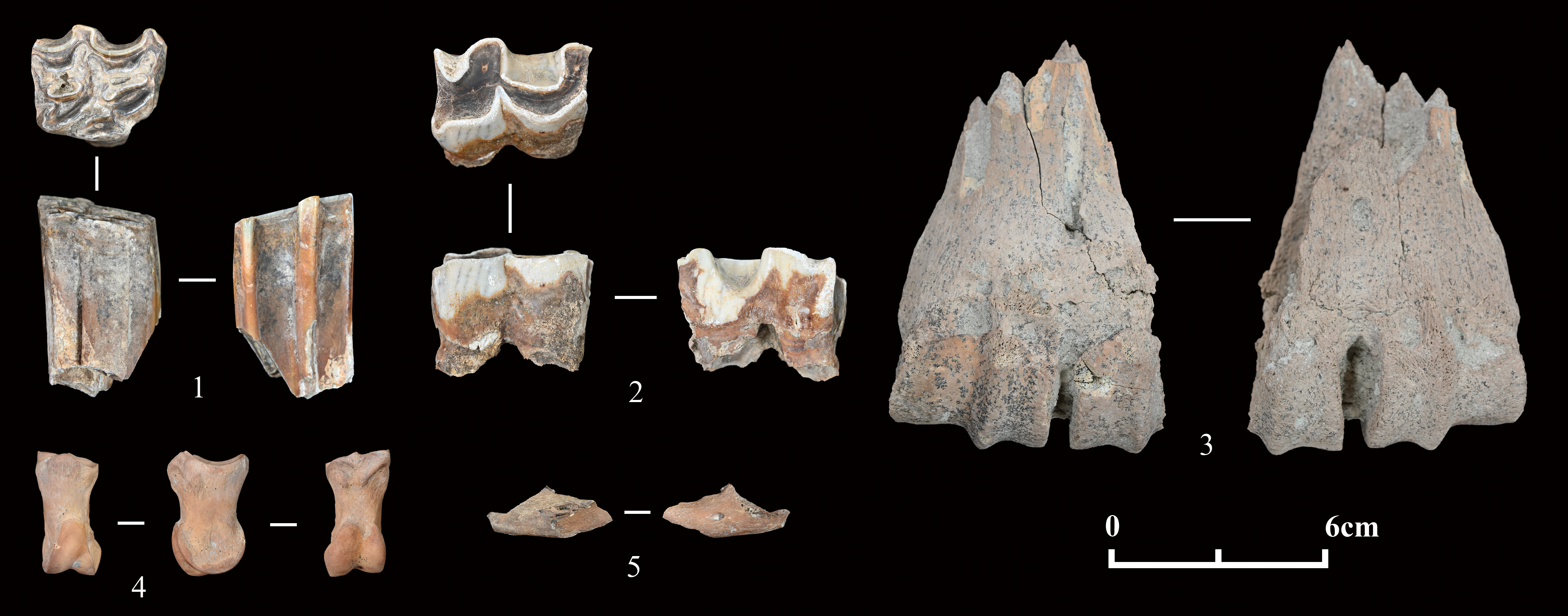
图8 蔡家沟A地点出土的部分哺乳动物化石 1. CJG-A: 246,三门马右侧上颌第二臼齿Right M2 of Equus sanmeniensis;2. CJG-A: 507,披毛犀左侧下颌前臼齿Left lower premolar of Coelodonta antiquitatis;3. CJG-A: 875,野牛掌骨远端残Distal metacarpal remain of Bison sp.;4. CJG-A: 104,葛氏斑鹿右侧第二趾节骨Right middle phalanx of Cervus (Sika) grayi;5. CJG-A: 700,啮齿类下颌骨残Mandible remain of Rodentia
Fig.8 Selected faunal specimens from CJG-A site
| [1] | 卫奇. 泥河湾盆地考证[J]. 文物春秋, 2016, 2: 3-11 |
| [2] | 谢飞, 李珺, 刘连强. 泥河湾旧石器文化[M]. 河北: 花山文艺出版社, 2006 |
| [3] | 周廷儒, 李华章, 李容全, 等. 泥河湾盆地新生代古地理研究[M]. 北京: 科学出版社, 1991 |
| [4] | 袁宝印, 夏正楷, 牛平山. 泥河湾裂谷与古人类[M]. 北京: 地质出版社, 2011 |
| [5] |
夏正楷. 泥河湾盆地的水下黄土堆积及其古气候意义[J]. 地理学报, 1992, 47(1): 58-65+98
doi: 10.11821/xb199201008 |
| [6] |
Barbour GB, Licent E, Teilhard de Chardin P. Geological study of the deposits of the Sangkanho basin[J]. Bulletin of Geological Society of China, 1927, 5: 263-278
doi: 10.1111/acgs.1926.5.issue-3-4 URL |
| [7] | Teilhard de Chardin P, Piveteau J. Les mammiferes fossils de Nihowan(Chine)[M]. Annales de Paleontologie, 1930, 19: 1-54 |
| [8] | 成胜泉. 泥河湾研究大事记[J]. 河北北方学院学报(社会科学版), 2016, S1: 31-64 |
| [9] | 裴树文, 王法岗, 牛东伟. 二十一世纪以来泥河湾盆地古人类活动的发现与研究进展[J]. 人类学学报, 2024, 43(6): 913-933 |
| [10] | 王法岗, 刘连强, 谢飞. 蔚县盆地前上营遗址发现的旧石器[A].见:董为(主编).第十三届中国古脊椎动物学学术年会论文集[C].北京: 海洋出版社, 2012, 165-170 |
| [11] | 裴树文, 马东东, 贾真秀, 等. 蔚县盆地吉家庄旧石器遗址发掘报告[J]. 人类学学报, 2018, 37(4): 510-528 |
| [12] | 马东东, 牛东伟, 裴树文, 等. 蔚县盆地2017-2018年旧石器考古调查简报[J]. 人类学学报, 2021, 40(1): 128-136 |
| [13] | 牛东伟, 闫晓蒙, 马东东, 等. 蔚县盆地2019-2020年旧石器考古调查[J]. 人类学学报, 2022, 41(5): 936-944 |
| [14] | 周士航, 何湘栋, 徐静玥, 等. 蔚县盆地东沟遗址2017年度发掘简报[J]. 人类学学报, 2024, 43(1): 132-142 |
| [15] |
Ye Z, Pei SW, Tu H, et al. 26Al/10Be burial dating and technological strategies of hominins at the Jijiazhuang Paleolithic site, Nihewan Basin, China: Implications for understanding Middle Pleistocene human adaptations in east Asia[J]. Quaternary Science Reviews, 2024, 339: 108837
doi: 10.1016/j.quascirev.2024.108837 URL |
| [16] |
Hao QZ, Wang L, Oldfield F, et al. Extra-long interglacial in Northern Hemisphere during MISs 15-13 arising from limited extent of Arctic ice sheets in glacial MIS 14[J]. Scientific Reports, 2015, 5(1): 12103
doi: 10.1038/srep12103 |
| [17] | Leaky MD. Olduvai Gorge: Excavations in Beds I and II, 1960-1963[M]. Cambridge: Cambridge University Press, 1971, vol.3 |
| [18] | Isaac GLl, Harris JWK. The stone artifact assemblages: A comparative study[A]. In: GLl Isaac(Ed.). Koobi Fora Research Project, Vol 3: Archaeology[C].Oxford: Clarendon Press, 1997 |
| [19] | de la Torre I, Mora R. Technological Strategies in the Lower Pleistocene at Olduvai Beds I&II[M]. Liege: Universite de Liege, Service de Prehistoire, 2005 |
| [20] | 裴树文, 侯亚梅. 东谷坨遗址石制品原料利用浅析[J]. 人类学学报, 2001, 20(4): 271-281 |
| [21] | Pei SW, Xie F, Deng CL, et al. Early Pleistocene archaeological occurrences at the Feiliang site, and the archaeology of human origins in the Nihewan Basin, North China[J]. PLoS ONE, 2017, 12(11): e0187251 |
| [22] | Toth N. The stone technologies of early hominids at Koobi Fora, Kenya: An experimental approach[D]. PhD Thesis, University of California, Berkeley, 1982 |
| [23] |
Toth N. The Oldowan reassessed: A close look at early stone artifacts[J]. Journal of Archaeological Science, 1985, 12: 101-120
doi: 10.1016/0305-4403(85)90056-1 URL |
| [24] | de la Torre I, Mora R, 裴树文, 等. 旧石器时代早期石制品分析方案[J]. 人类学学报, 2021, 40(4): 547-567 |
| [25] |
de la Torre I, Mora R. Oldowan technological behaviour at HWK EE (Olduvai Gorge, Tanzania)[J]. Journal of Human Evolution, 2018, 120: 236-273
doi: S0047-2484(18)30122-2 pmid: 29773229 |
| [26] | Inizan ML, Roche H, Tixier J. Technology of knapped stone[M]. Meudon: CREP, 1992 |
| [27] | Debenath A, Dibble H. Handbook of Paleolithic Typology: Lower and Middle Palaeolithic of Europe[M]. Philadelphia: University Museum University of Pennsylvania, 1994, Vol.1 |
| [28] | Andrefsky WJ. Lithics: Macroscopic approaches to analysis(2nd edition)[M]. Cambridge: Cambridge University Press, 2005 |
| [29] | Mcknight PE, Najab J. Mann-Whitney U Test[M]. John Wiley & Sons, Inc. 2010 |
| [30] |
Zhu RX, Potts R, Xie F, et al. New evidence on the earliest human presence at high northern latitudes in northeast Asia[J]. Nature, 2004, 431: 559-562
doi: 10.1038/nature02829 |
| [31] | 贾真秀, 裴树文, 马宁, 等. 泥河湾盆地麻地沟E6和E7旧石器地点发掘简报[J]. 人类学学报, 2016, 35(3): 343-358 |
| [32] | 刘连强, 王法岗, 杨石霞, 等. 泥河湾盆地马梁遗址第10地点2016年出土石制品研究[J]. 人类学学报, 2018, 37(3): 419-427 |
| [33] | 裴树文, 徐哲, 叶芷, 等. 泥河湾盆地中更新世气候转型期人类的适应行为[J]. 人类学学报, 2024, 43(1): 19-39 |
| [34] | Yang SX, Wang FG, Xie F, et al. Technological innovations at the onset of the Mid-Pleistocene Climate Transition in high-latitude East Asia[J]. National Science Review, 2021, 8(1): nwaa053 |
| [35] |
Xu Z, Pei SW, Hu YW, et al. Ecological shifts and hominin adaptations during the Mid-Pleistocene Climate Transition in Northeast Asia as evidenced by isotopic analysis (δ13C, δ18O) of mammalian enamel from Early Paleolithic sites in the Nihewan Basin, China[J]. Quaternary Science Reviews, 2023, 308: 108072
doi: 10.1016/j.quascirev.2023.108072 URL |
| [36] | Ma DD, Pei SW, Xie F, et al. Earliest Prepared Core Technology in Eurasia from Nihewan (China): Implications for early human abilities and dispersals in East Asia[J]. Proceedings of the National Academy of Sciences of USA, 2024, 121(11): e2313123121 |
| [37] | 谢飞, 李珺. 马圈沟遗址石制品的特征[J]. 文物春秋, 2002, 3: 1-6+19 |
| [38] | 陈淳, 沈辰, 陈万勇, 等. 河北阳原小长梁遗址1998年发掘报告[J]. 人类学学报, 1999, 18(3): 225-239 |
| [39] | Yang SX, Hou YM, Yue JP, et al. The lithic assemblages of Xiaochangliang, Nihewan Basin: implications for Early Pleistocene hominin behaviour in North China[J]. PLoS ONE, 2016, 11(5): e0155793 |
| [40] | 谢飞, 李珺, 成胜泉. 飞梁遗址发掘报告[A].见:河北省文物研究所.河北省考古文集[C].北京: 东方出版社, 1998, 1-29 |
| [41] |
Pei SW, Deng CL, de la Torre I, et al. Magnetostratigraphic and archaeological records at the Early Pleistocene site complex of Madigou (Nihewan Basin): Implications for human adaptations in North China[J]. Palaeogeography Palaeoclimatology Palaeoecology, 2019, 530: 176-189
doi: 10.1016/j.palaeo.2019.05.014 URL |
| [42] | 谢飞, 成胜泉. 河北阳原岑家湾发现的旧石器[J]. 人类学学报, 1990, 9(3): 265-272+286 |
| [43] |
Wang HQ, Deng CL, Zhu RX, et al. Magnetostratigraphic dating of the Donggutuo and Maliang paleolithic sites in the Nihewan Basin, North China[J]. Quaternary Research, 2005, 64(1): 1-11
doi: 10.1016/j.yqres.2005.04.001 URL |
| [44] | Yang SX, Petraglia MD, Hou YM, et al. The lithic assemblages of Donggutuo, Nihewan basin: Knapping skills of Early Pleistocene hominins in North China[J]. PLoS ONE, 2017, 12(9): e0185101 |
| [45] | Goldman-Neuman T, Hovers E. Interdisciplinary Approaches to the Oldowan[M]. Dordrecht: Springer Netherlands, 2009, 71-84 |
| [1] | 裴树文, 牛东伟, 马东东. 泥河湾盆地蔚县中更新世古人类活动遗址的发现与科学价值[J]. 人类学学报, 2026, 45(03): 403-418. |
| [2] | 牛东伟, 刘尔凡, 薛峰, 谢飞. 河北怀来盆地古人类文化遗存的考古发现与研究[J]. 人类学学报, 2026, 45(03): 419-435. |
| [3] | 单佳璐, 李怡晓, 王法岗, 郭玉杰, 李锋. 泥河湾盆地新庙庄遗址2号地点2018年发现材料初步研究[J]. 人类学学报, 2026, 45(03): 447-461. |
| [4] | 沈柯, 李锋, 王晓敏, 王法岗, 郭北姮, 高星. 板井子遗址第2地点2023~2024年发掘报告[J]. 人类学学报, 2026, 45(03): 462-477. |
| [5] | 王心蕊, 张芷瑶, 黄冰柔, 王法岗, 郭玉杰. 泥河湾盆地武家梁旧石器遗址1号地点的光释光测年[J]. 人类学学报, 2026, 45(03): 489-499. |
| [6] | 叶芷, 裴树文, 马东东, 贾真秀, 王法岗, 杨海勇. 泥河湾盆地蔚县前上营遗址B地点发掘报告[J]. 人类学学报, 2026, 45(03): 515-531. |
| [7] | 刘子仪, 耿帅杰, 丁馨, 徐静玥, 叶芷, 牛东伟, 裴树文. 泥河湾盆地蔚县北官堡遗址B地点的埋藏过程[J]. 人类学学报, 2026, 45(03): 556-569. |
| [8] | 杜雨薇, 耿帅杰, 徐静玥, 叶芷, 张乐, 马东东, 裴树文. 泥河湾盆地蔡家沟遗址A和B地点动物骨骼的埋藏学观察[J]. 人类学学报, 2026, 45(03): 570-585. |
| [9] | 刘尔凡, 高佳璇, 牛东伟. 河北怀来盆地珠窝堡遗址出土的石制品[J]. 人类学学报, 2026, 45(03): 600-608. |
| [10] | 姚艳燕, 艾婉婷, 胡敏航, 付琼耀, 李国山, 钟洁美, 胡鹏程, 黄胜敏, 田淳, 梁华, 廖卫, 王伟, 易智星. 广西崇左岩利1号洞早-中更新世过渡期的巨猿化石[J]. 人类学学报, 2026, 45(02): 199-209. |
| [11] | 姚艳燕, 廖卫, 李炬平, 易智星, 田淳, 钟洁美, 高超, 王伟, 梁华. 广西崇左岩利2号洞发现中更新世早期的猩猩牙齿化石[J]. 人类学学报, 2026, 45(02): 210-223. |
| [12] | 王思元, 李金燕, 梁华, 谢耀樟, 廖卫, 王伟. 广西西部新发现的猩猩牙齿化石及其分类演化意义[J]. 人类学学报, 2026, 45(02): 224-235. |
| [13] | 赵海龙, 周天路, 马冲, 杨博灿, 贾倩. 河北泥河湾盆地东缘石器原料的开发与利用[J]. 人类学学报, 2026, 45(01): 34-45. |
| [14] | 董哲, 战世佳. 安徽地区发现的阿舍利大型工具[J]. 人类学学报, 2025, 44(06): 998-1008. |
| [15] | 刘武, 吴秀杰. 华龙洞古人类化石及其在人类演化上的意义[J]. 人类学学报, 2025, 44(05): 727-741. |
| 阅读次数 | ||||||
|
全文 |
|
|||||
|
摘要 |
|
|||||
 京ICP证05002819号-3