

主管:中国科学院
主办:中国科学院古脊椎动物与古人类研究所
出版:科学出版社
主办:中国科学院古脊椎动物与古人类研究所
出版:科学出版社
人类学学报 ›› 2026, Vol. 45 ›› Issue (03): 515-531.doi: 10.16359/j.1000-3193/AAS.2025.0109cstr: 32091.14.j.1000-3193/AAS.2025.0109
叶芷1,2,3( ), 裴树文1,2(), 马东东1,2, 贾真秀4, 王法岗5, 杨海勇6
收稿日期:2025-06-27
接受日期:2025-08-04
出版日期:2026-06-15
发布日期:2026-06-12
通讯作者:
裴树文,研究员,主要从事旧石器时代考古与地质考古研究。E-mail: peishuwen@ivpp.ac.cn
作者简介:叶芷,博士研究生,主要从事旧石器时代考古研究。E-mail: yezhi@ivpp.ac.cn
基金资助:
YE Zhi1,2,3(), PEI Shuwen1,2(), MA Dongdong1,2, JIA Zhenxiu4, WANG Fagang5, YANG Haiyong6
Received:2025-06-27
Accepted:2025-08-04
Online:2026-06-15
Published:2026-06-12
摘要:
本文对2015年发现的前上营遗址B地点(QSY-B)的地貌地层发育、年代、遗物埋藏特点和出土石制品的技术特征进行报道。地貌和沉积物特点表明,该遗址的地层记录了泥河湾古湖扩张-收缩-扩张和消亡的过程,古人类活动于古湖水退去的湖滨相环境,顶部覆盖马兰期黄土。前上营遗址B地点为古人类单次活动、短暂停留形成的遗址,较弱的水流运动改变了标本的空间分布,但遗物组合较为完整。沉积物ESR年代测定表明,古人类在该遗址的活动时间大致为距今429±39 ka,处在中更新世。原料调查显示,古人类从距离遗址7~8 km以外区域获取石料,岩性以火山岩和硅质白云岩为主。古人类主要采用锤击法剥片,石核剥片效率和石片产出率高,部分石片显示边缘使用痕迹;多样化的修理石器是该遗址不同于盆地内早更新世石器工业的主要特点,表明古人类对资源环境的适应性及灵活的技术策略。动物化石表面保留人为割切痕迹,指示古人类对动物资源利用行为。前上营遗址B地点的发现和研究,对解读中更新世中国北方古人类的技术行为,以及探讨泥河湾盆地古人类在早-中更新世石器技术演变及适应策略具有重要意义。
中图分类号:
叶芷, 裴树文, 马东东, 贾真秀, 王法岗, 杨海勇. 泥河湾盆地蔚县前上营遗址B地点发掘报告[J]. 人类学学报, 2026, 45(03): 515-531.
YE Zhi, PEI Shuwen, MA Dongdong, JIA Zhenxiu, WANG Fagang, YANG Haiyong. Preliminary report on the excavation of Qianshangying-B Paleolithic site at Yuxian in the Nihewan Basin[J]. Acta Anthropologica Sinica, 2026, 45(03): 515-531.
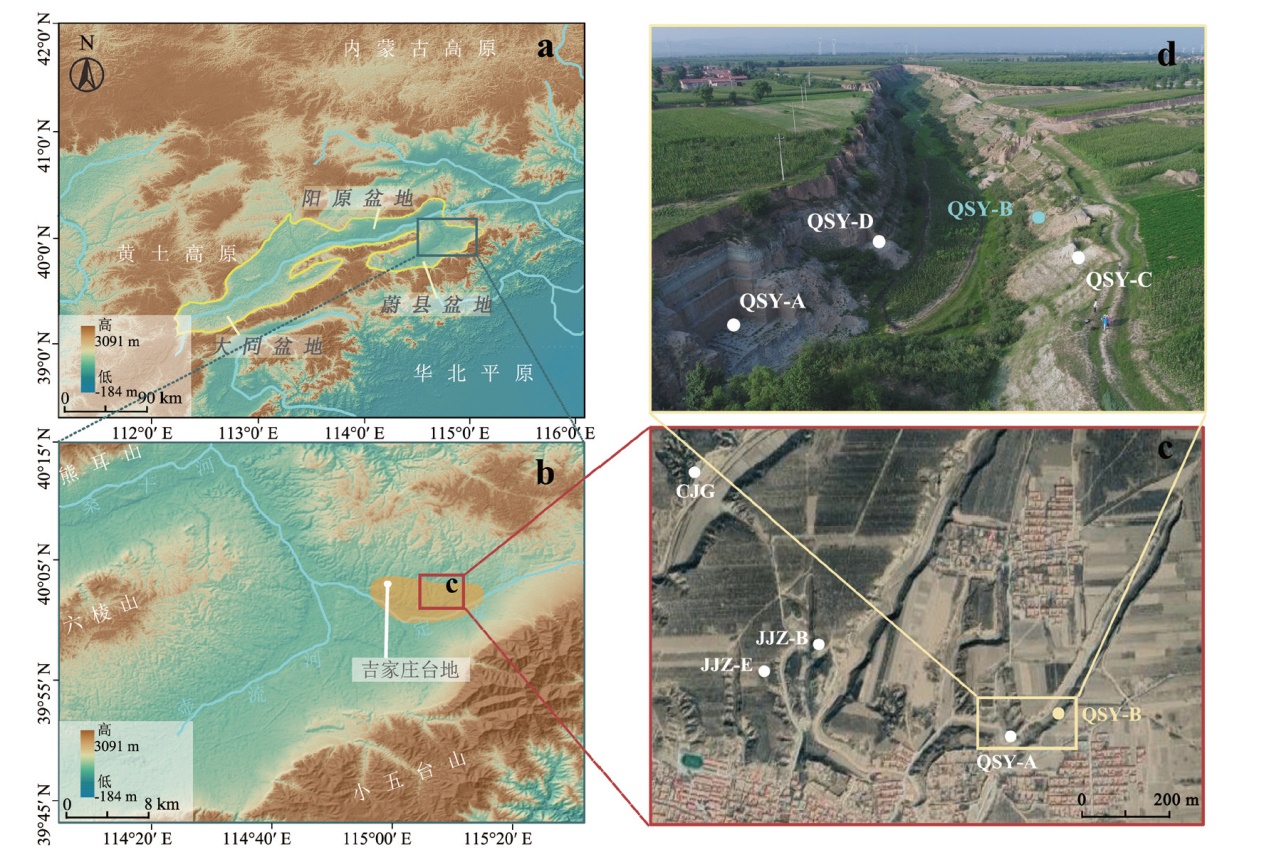
图1 前上营遗址B地点地理位置及地貌图 a-b.泥河湾盆地-蔚县盆地的地理位置Map showing the location of the Nihewan basin and Yuxian basin;c.前上营遗址及周边遗址地貌景观Geomorphological setting of Qianshangying and adjacent sites(CJG,蔡家沟遗址;QSY,前上营遗址;JJZ,吉家庄遗址);d. QSY-B地貌景观Geomorphologic location of QSY-B site
Fig.1 Geographic and geomorphologic location of QSY-B
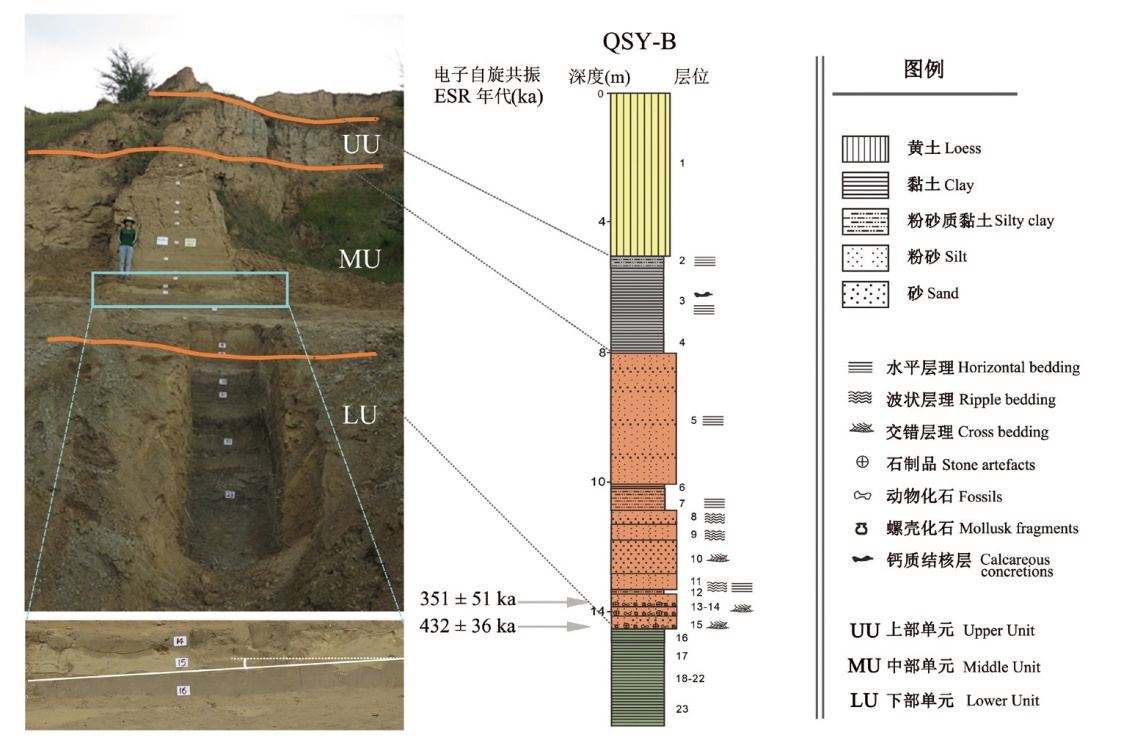
图2 前上营遗址B地点地层剖面与年代 UU,Upper Unit上部沉积单元;MU,Middle Unit中部沉积单元;LU,Lower Unit下部沉积单元
Fig.2 Stratigraphic profiles and dating results of QSY-B
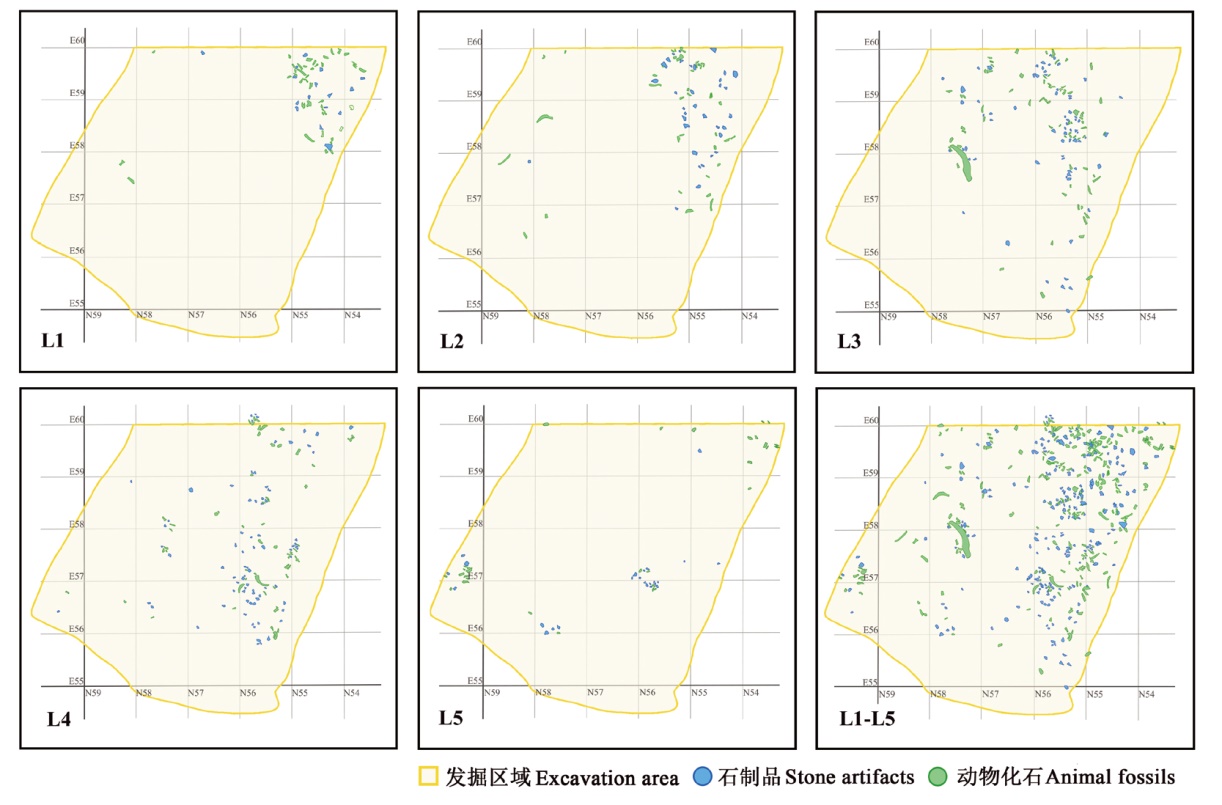
图3 前上营遗址B地点分层遗物分布图
Fig.3 Distribution of archaeological remains by stratigraphic levels at QSY-B
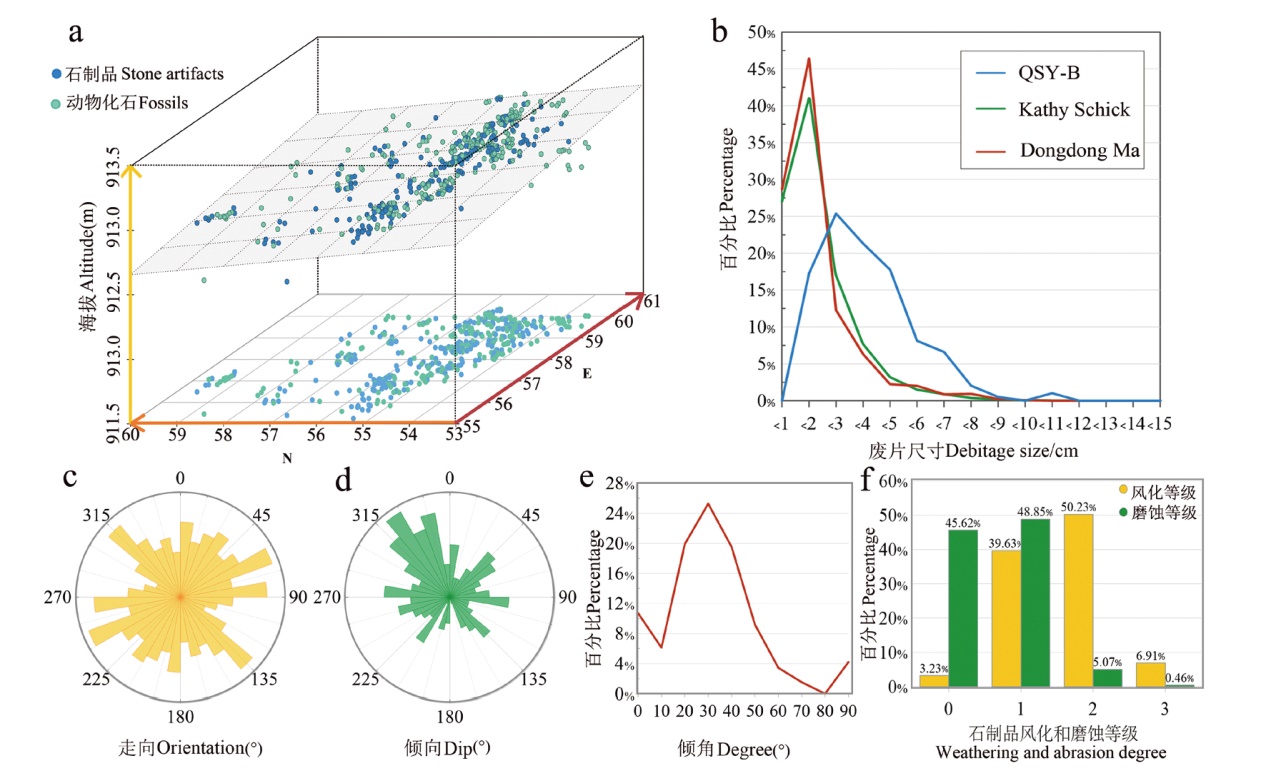
图4 前上营遗址B地点出土遗物的埋藏特点 a.标本三维空间分布3D spatial distribution of archaeological remains;b.废片尺寸分布图Size distribution of debitage;c-e.标本产状特征Orientation of archaeological remains;f.石制品风化和磨蚀程度Degree of weathering and abrasion on lithic artifacts
Fig.4 Taphonomic features of archaeological remains at QSY-B
| 原料Raw Material 石制品类型Types of stone artifacts | 火山岩Lava | 硅质白云岩Dolomite | 燧石Chert | 其他Other | 总计Sum | ||||||||||
|---|---|---|---|---|---|---|---|---|---|---|---|---|---|---|---|
| 数量n | 占比Percent | 数量n | 占比Percent | 数量n | 占比Percent | 数量n | 占比Percent | 数量n | 占比Percent | ||||||
| 剥离类 Detached | 石片Flake | 83 | 77.6% | 19 | 17.8% | 1 | 0.9% | 4 | 3.7% | 107 | 40.2% | ||||
| 碎片Flake fragment | 39 | 75.0% | 5 | 9.6% | 5 | 9.6% | 3 | 5.8% | 52 | 19.5% | |||||
| 断块Angular fragment | 23 | 57.5% | 14 | 35.0% | 1 | 2.5% | 2 | 5.0% | 40 | 15.0% | |||||
| 小计Total | 145 | 72.9% | 38 | 19.1% | 7 | 3.5% | 9 | 4.5% | 199 | 74.8% | |||||
| 剥片类 Flaked | 石核Core | 14 | 58.3% | 9 | 37.5% | 0 | 0.0% | 1 | 4.2% | 24 | 9.0% | ||||
| 石核断块Core fragment | 8 | 72.7% | 2 | 18.2% | 1 | 9.1% | 0 | 0.0% | 11 | 4.1% | |||||
| 石球Spheroid | 2 | 100.0% | 0 | 0.0% | 0 | 0.0% | 0 | 0.0% | 2 | 0.8% | |||||
| 修理石器Retouched tool | 15 | 53.6% | 7 | 25.0% | 1 | 3.6% | 5 | 17.9% | 28 | 10.5% | |||||
| 小计Total | 39 | 60.0% | 18 | 27.7% | 2 | 3.1% | 6 | 9.2% | 65 | 24.4% | |||||
| 打击类 Pounded | 石锤Hammer stone | 0 | 0.0% | 2 | 100.0% | 0 | 0.0% | 0 | 0.0% | 2 | 0.8% | ||||
| 总计Total | 184 | 69.2% | 58 | 21.8% | 9 | 3.4% | 15 | 5.6% | 266 | 100.0% | |||||
表1 前上营遗址B地点的石制品类型与原料
Tab.1 Frequencies of artifact category and raw material exploration at QSY-B
| 原料Raw Material 石制品类型Types of stone artifacts | 火山岩Lava | 硅质白云岩Dolomite | 燧石Chert | 其他Other | 总计Sum | ||||||||||
|---|---|---|---|---|---|---|---|---|---|---|---|---|---|---|---|
| 数量n | 占比Percent | 数量n | 占比Percent | 数量n | 占比Percent | 数量n | 占比Percent | 数量n | 占比Percent | ||||||
| 剥离类 Detached | 石片Flake | 83 | 77.6% | 19 | 17.8% | 1 | 0.9% | 4 | 3.7% | 107 | 40.2% | ||||
| 碎片Flake fragment | 39 | 75.0% | 5 | 9.6% | 5 | 9.6% | 3 | 5.8% | 52 | 19.5% | |||||
| 断块Angular fragment | 23 | 57.5% | 14 | 35.0% | 1 | 2.5% | 2 | 5.0% | 40 | 15.0% | |||||
| 小计Total | 145 | 72.9% | 38 | 19.1% | 7 | 3.5% | 9 | 4.5% | 199 | 74.8% | |||||
| 剥片类 Flaked | 石核Core | 14 | 58.3% | 9 | 37.5% | 0 | 0.0% | 1 | 4.2% | 24 | 9.0% | ||||
| 石核断块Core fragment | 8 | 72.7% | 2 | 18.2% | 1 | 9.1% | 0 | 0.0% | 11 | 4.1% | |||||
| 石球Spheroid | 2 | 100.0% | 0 | 0.0% | 0 | 0.0% | 0 | 0.0% | 2 | 0.8% | |||||
| 修理石器Retouched tool | 15 | 53.6% | 7 | 25.0% | 1 | 3.6% | 5 | 17.9% | 28 | 10.5% | |||||
| 小计Total | 39 | 60.0% | 18 | 27.7% | 2 | 3.1% | 6 | 9.2% | 65 | 24.4% | |||||
| 打击类 Pounded | 石锤Hammer stone | 0 | 0.0% | 2 | 100.0% | 0 | 0.0% | 0 | 0.0% | 2 | 0.8% | ||||
| 总计Total | 184 | 69.2% | 58 | 21.8% | 9 | 3.4% | 15 | 5.6% | 266 | 100.0% | |||||
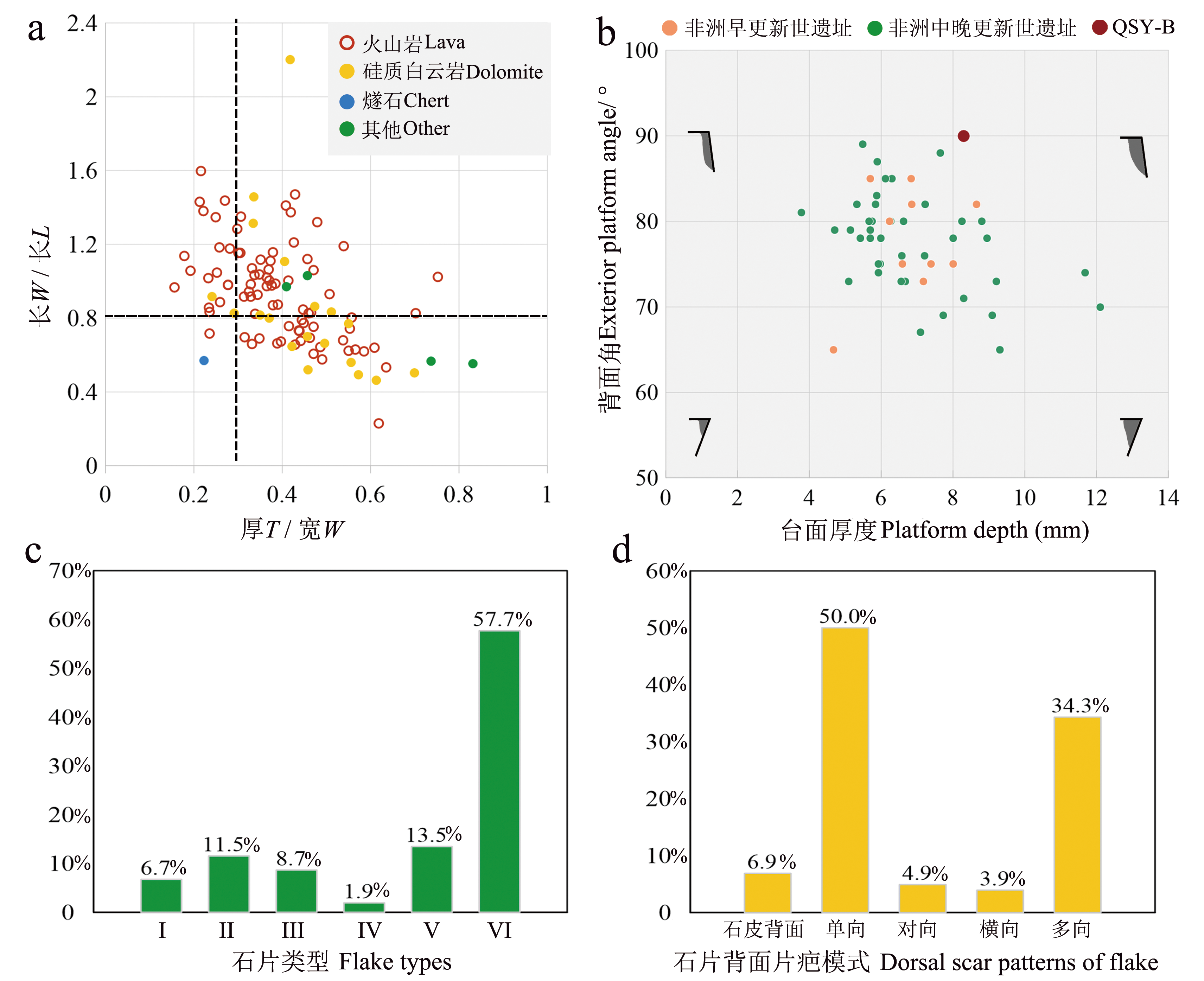
图5 前上营遗址B地点石片技术特征 a.石片外形特征Flake shape;b.石片台面厚度与背面角Flake platform depth and exterior platform angle;c.石片类型Flake types;d.石片背面片疤模式Dorsal scar patterns of flakes
Fig.5 Flake technological attributes at QSY-B
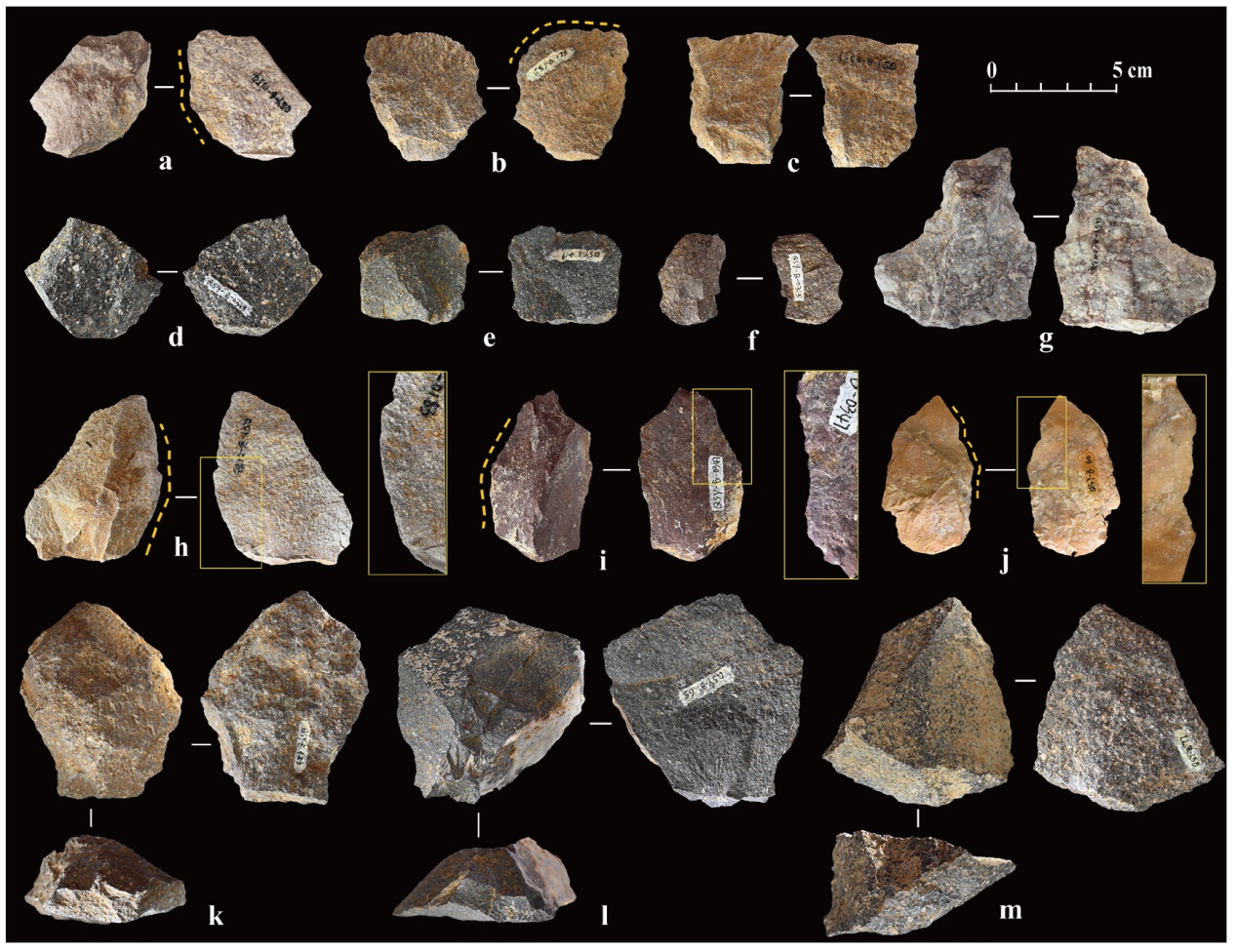
图6 前上营遗址B地点的完整石片 a, b, c, e, g, j, m. QSY-A-154, QSY-B-178, QSY-B-339, QSY-B-419, QSY-B-347, QSY-B-088, QSY-B-077, VI型/ Type VI;d, f. QSY-B-384, QSY-B-313, III型/ Type III;h, k, l. QSY-B-183, QSY-B-423, QSY-B-065, V型/ Type V;i. QSY-B-301, IV型/ Type IV黄色虚线为可能的使用边缘,黄色方框为使用边缘的局部放大Yellow dashed lines indicate possible use edges, and yellow boxes show magnified views of the used flake edges
Fig.6 Whole flakes at QSY-B
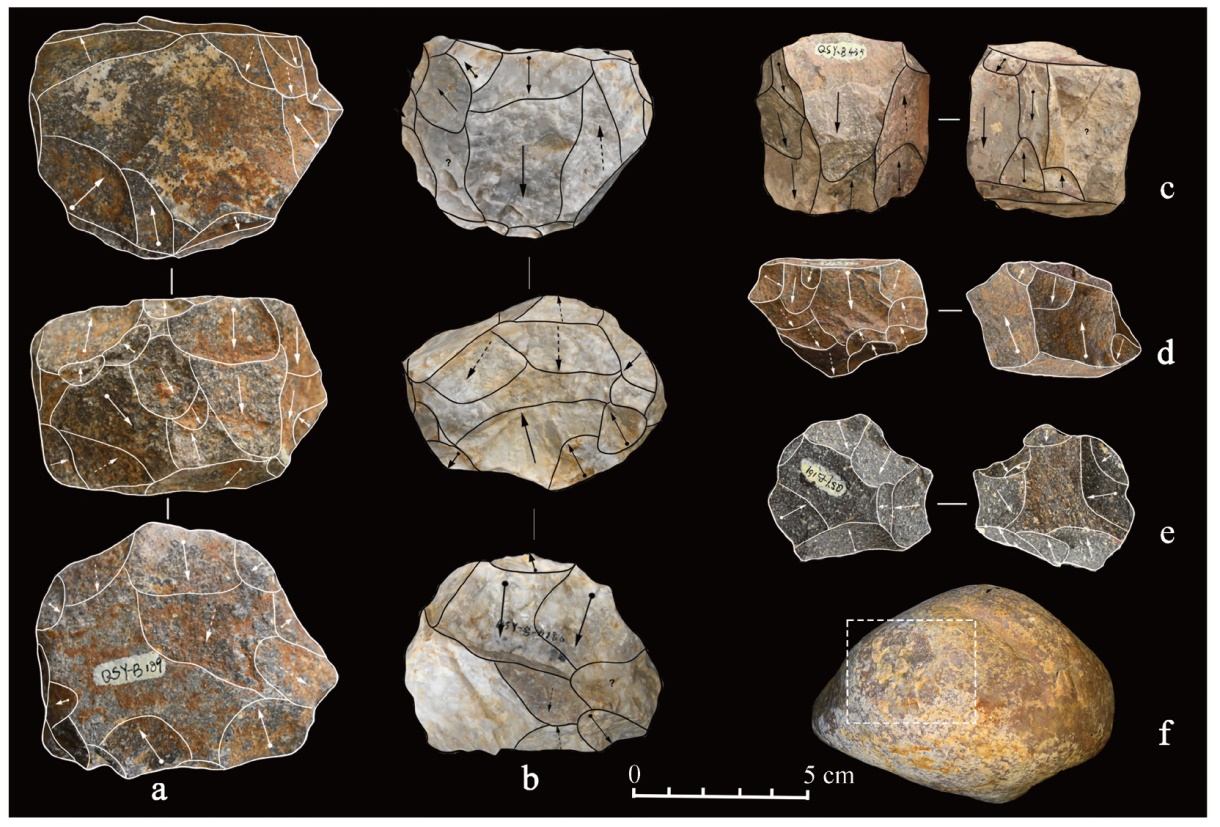
图7 前上营遗址B地点的石核与石锤 a. QSY-B-189, 准石球Subspheroid;b-d. QSY-B-186, QSY-B-435, QSY-B-136, 多向剥片石核Cores with multidirectional exploitation;e. QSY-B-161, 盘状石核Discoid;f. QSY-B-191, 石锤Hammerstone
Fig.7 Selected cores and hammerstone from QSY-B
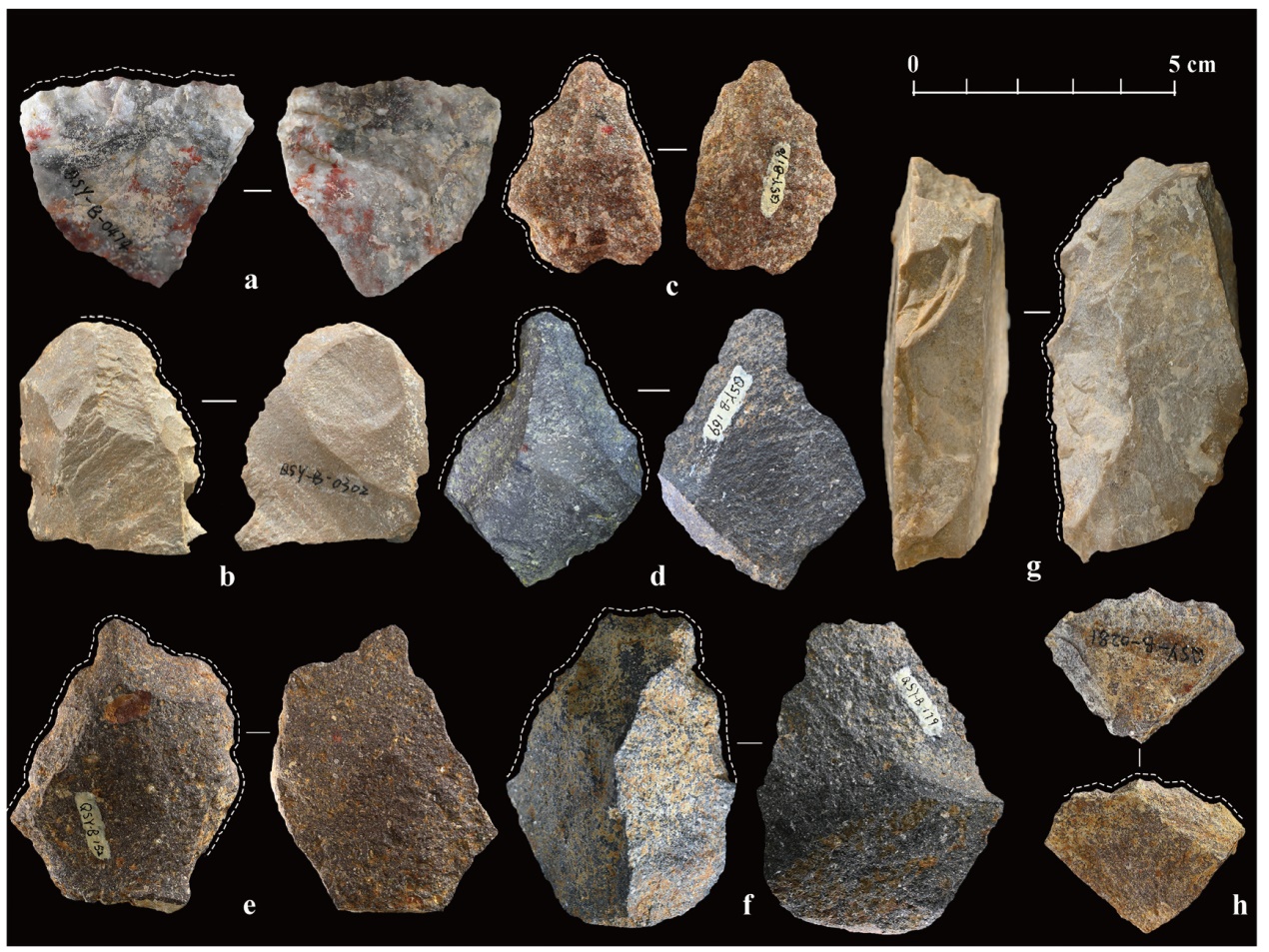
图8 前上营遗址B地点出土修理石器 a, b. QSY-B-474, QSY-B-302, 刮削器Scraper;c-f. QSY-B-190, QSY-B-169, QSY-B-152, QSY-B-179, 汇聚形石器Convergent tool;g, h. QSY-B-084, QSY-B-281, 锯齿刃器Denticulate
Fig.8 Retouched tools excavated from QSY-B
| [1] | 袁宝印, 夏正楷, 牛平山. 泥河湾裂谷与古人类[M]. 北京: 地质出版社, 2011, 1-257 |
| [2] |
Zhu RX, Hoffman KA, Potts R, et al. Earliest presence of humans in northeast Asia[J]. Nature, 2001, 413: 413-417
doi: 10.1038/35096551 |
| [3] | Yang SX, Deng CL, Zhu RX, et al. The Paleolithic in the Nihewan Basin, China: Evolutionary history of an Early to Late Pleistocene record in Eastern Asia[J]. Evoluttionary Anthropology, 2020, 29: 125-142 |
| [4] | 杜雨薇, 张乐, 叶芷, 等. 蔚县盆地吉家庄旧石器遗址动物骨骼的埋藏学分析[J]. 人类学学报, 2023, 42(2):359-372 |
| [5] | 马东东, 牛东伟, 裴树文, 等. 蔚县盆地2017-2018年旧石器考古调查[J]. 人类学学报, 2021, 40(1): 128-136 |
| [6] | 牛东伟, 闫晓蒙, 马东东, 等. 蔚县盆地2019-2020年旧石器考古调查简报[J]. 人类学学报, 2022, 41(5): 936-944 |
| [7] | 裴树文. 泥河湾盆地南部(蔚县盆地)发现一处重要古人类活动遗址群[J]. 人类学学报, 2017, 36(1): 26 |
| [8] | 叶芷, 杜雨薇, 裴树文, 等. 蔚县盆地吉家庄旧石器遗址的形成过程[J]. 人类学学报, 2023, 42(1): 46-60 |
| [9] | 王法岗, 刘连强, 谢飞. 蔚县盆地前上营遗址发现的旧石器[A].见:董为(主编).第十三届中国古脊椎动物学学术年会论文集[C].北京: 海洋出版社, 2012, 165-170 |
| [10] | 裴树文, 马东东, 贾真秀, 等. 蔚县盆地吉家庄旧石器遗址发掘报告[J]. 人类学学报, 2018, 37(4): 510-528 |
| [11] | 夏正楷, 刘锡清. 泥河湾层古地理环境的初步认识[J]. 海洋地质与第四纪地质, 1984, 4(3): 101-110 |
| [12] | 白振平. 对蔚县盆地发育过程的初步认识[A]. 见:卫奇,谢飞(主编). 泥河湾研究论文选编[M]. 北京: 文物出版社, 1989, 466-474 |
| [13] |
Alperson-Afil N, Sharon G, Kislev M, et al. Spatial organization of hominin activities at Gesher Benot Ya’aqov, Israel[J]. Science, 2009, 326(5960): 1677-1680
doi: 10.1126/science.1180695 pmid: 20019284 |
| [14] | Schick KD. Stone Age sites in the making: experiments in the formation and transformation of archaeological occurrences[M]. Oxford: British Archaeological Reports Limited, 1986 |
| [15] |
Ma DD, Pei SW, Xie F, et al. Site formation processes at Cenjiawan (Nihewan Basin, North China): a case study on the structure of the Early Pleistocene archaeological record in lakeshore environments[J]. Journal of Quaternary Science, 2023, 38(4): 488-504
doi: 10.1002/jqs.v38.4 URL |
| [16] |
Ding X, Pei SW, Ma DD, et al. Deciphering site formation processes in lakeshore environments: a case study of early pleistocene site of Feiliang (Nihewan Basin, China)[J]. Archaeological and Anthropological Sciences, 2024, 16: 92
doi: 10.1007/s12520-024-02003-7 |
| [17] | Pei SW, Xie F, Deng CL, et al. Early Pleistocene archaeological occurrences at the Feiliang site, and the archaeology of human origins in the Nihewan Basin, North China[J]. PLoS One, 2017, 12(11): e0187251 |
| [18] | 裴树文. 旧石器时代旷野遗址形成过程研究综述[J]. 人类学学报, 2019, 38(1): 1-18 |
| [19] | 任进成. 泥河湾盆地板井子旧石器时代遗址形成过程与石器技术研究[D]. 博士学位论文, 北京: 中国科学院大学, 2019 |
| [20] |
Goren-Inbar N, Feibel CS, Verosub KL, et al. Pleistocene milestones on the out-of-Africa corridor at Gesher Benot Ya’aqov, Israel[J]. Science, 2000, 289(5481): 944-947
pmid: 10937996 |
| [21] |
de la Torre I, Wehr K. Site formation processes of the early Acheulean assemblage at EF-HR (Olduvai Gorge, Tanzania)[J]. Journal of Human Evolution, 2018, 120: 298-328
doi: S0047-2484(17)30304-4 pmid: 28802723 |
| [22] |
de la Torre I, Mora R. Oldowan technological behaviour at HWK EE (Olduvai Gorge, Tanzania)[J]. Journal of Human Evolution, 2018, 120: 236-273
doi: S0047-2484(18)30122-2 pmid: 29773229 |
| [23] | de la Torre I, Mora R, 裴树文, 等. 旧石器时代早期石制品分析方案[J]. 人类学学报, 2021, 40(4): 547-567 |
| [24] |
Pei SW, Deng CL, de la Torre I, et al. Magnetostratigraphic and archaeological records at the Early Pleistocene site complex of Madigou (Nihewan Basin): implications for human adaptations in North China[J]. Palaeogeography, Palaeoclimatology, Palaeoecology, 2019, 530: 176-189
doi: 10.1016/j.palaeo.2019.05.014 URL |
| [25] | 裴树文, 侯亚梅. 东谷坨遗址石制品原料利用浅析[J]. 人类学学报, 2001, 20(4): 271-281 |
| [26] |
Goldman-Neuman T, Hovers E. Raw material selectivity in late Pliocene Oldowan sites in the Makaamitalu Basin, Hadar, Ethiopia[J]. Journal of Human Evolution, 2012, 62(3): 353-366
doi: 10.1016/j.jhevol.2011.05.006 pmid: 21741072 |
| [27] | Geneste JM. Systèmes d’approvisionnement en matières premières au Paléolithique moyen et au Paléolithique supérieur en Aquitaine[J]. L’homme de Néandertal, 1988, 8: 61-70 |
| [28] | Goldman-Neuman T, Hovers E. Methodological considerations in the study of Oldowan raw material selectivity:insights from AL 894 (Hadar, Ethiopia)[A]. Interdisciplinary approaches to the Oldowan[M]. Dordrecht: Springer Netherlands, 2009, 71-84 |
| [29] | 贾真秀. 泥河湾盆地早更新世古人类遗址成因与石器技术比较研究:以东谷坨、麻地沟和飞梁遗址为例[D]. 博士学位论文, 北京: 中国科学院大学, 2018 |
| [30] |
Blumenschine RJ, Masao FT, Tactikos JC, et al. Effects of distance from stone source on landscape-scale variation in Oldowan artifact assemblages in the Paleo-Olduvai Basin, Tanzania[J]. Journal of Archaeological Science, 2008, 35(1): 76-86
doi: 10.1016/j.jas.2007.02.009 URL |
| [31] | Režek Ž, Dibble HL, McPherron SP, et al. Two million years of flaking stone and the evolutionary efficiency of stone tool technology[J]. Nature ecology & evolution, 2018, 2(4): 628-633 |
| [32] | Dogandžić T, Braun DR, McPherron SP. Edge length and surface area of a blank: experimental assessment of measures, size predictions and utility[J]. PLoS One, 2015, 10(9): e0133984 |
| [33] | Toth N. The stone technologies of early hominids at Koobi Fora, Kenya: an experimental approach[D]. MA thesis, Berkeley: University of California, 1982 |
| [34] |
Toth N. The Oldowan reassessed: a close look at early stone artifacts[J]. Journal of Archaeological Science, 1985, 12(2): 101-120
doi: 10.1016/0305-4403(85)90056-1 URL |
| [35] |
de la Torre I, Mora R, Domı́nguez-Rodrigo M, et al. The Oldowan industry of Peninj and its bearing on the reconstruction of the technological skills of LowerPleistocene hominids[J]. Journal of Human Evolution, 2003, 44(2): 203-224
doi: 10.1016/S0047-2484(02)00206-3 URL |
| [36] |
Delagnes A, Roche H. Late Pliocene hominid knapping skills: the case of Lokalalei 2C, West Turkana, Kenya[J]. Journal of Human Evolution, 2005, 48(5): 435-472
pmid: 15857650 |
| [37] |
Zaidner Y. Adaptive flexibility of Oldowan hominins: secondary use of flakes at Bizat Ruhama, Israel[J]. PLoS One, 2013, 8(6): e66851
doi: 10.1371/journal.pone.0066851 URL |
| [38] |
de la Torre I. The early stone age lithic assemblages of Gadeb (Ethiopia) and the developed Oldowan / early Acheulean in East Africa[J]. Journal of Human Evolution, 2011, 60(6): 768-812
doi: 10.1016/j.jhevol.2011.01.009 URL |
| [39] | Gallotti R, Mussi M. The unknown Oldowan: -1.7-million-year-old standardized obsidian small tools from Garba IV, Melka Kunture, Ethiopia[J]. PLoS One, 2015, 10(12): e0145101 |
| [40] | Yang SX, Petraglia MD, Hou YM, et al. The lithic assemblages of Donggutuo, Nihewan basin: Knapping skills of Early Pleistocene hominins in North China[J]. PLoS One, 2017, 12(9): e0185101 |
| [41] | Cabanès J, Borel A, Baena Preysler J, et al. Palaeolithic polyhedrons, spheroids and bolas over time and space[J]. PloS One, 2022, 17(7): e0272135 |
| [42] |
Sahnouni M, Schick K, Toth N. An experimental investigation into the nature of faceted limestone “spheroids” in the Early Palaeolithic[J]. Journal of Archaeological Science, 1997, 24(8): 701-713
doi: 10.1006/jasc.1996.0152 URL |
| [43] |
Wilkins J, Schoville BJ, Brown KS, et al. Evidence for early hafted hunting technology[J]. Science, 2012, 338(6109): 942-946
doi: 10.1126/science.1227608 pmid: 23161998 |
| [44] | Gallotti R, Mussi M. The emergence of the Acheulean in East Africa and beyond: contributions in honor of Jean Chavaillon[M]. Springer, 2018 |
| [45] | Van Kolfschoten T, Knul M, Buhrs E, et al. Butchered large bovids (Bos primigenius and Bison priscus) from the Palaeolithic throwing spear site Schöningen 13 II-4 (Germany)[J]. Groningen Archaeological Studies, 2012, 21: 32-45 |
| [46] |
Van Kolfschoten T, Buhrs E, Verheijen I. The larger mammal fauna from the Lower Paleolithic Schöningen Spear site and its contribution to hominin subsistence[J]. Journal of Human Evolution, 2015. 89:138-53
doi: 10.1016/j.jhevol.2015.09.014 pmid: 26607346 |
| [47] |
Ye Z, Pei S, Tu H, et al. 26Al/10Be burial dating and technological strategies of hominins at the Jijiazhuang Paleolithic site, Nihewan Basin, China: Implications for understanding Middle Pleistocene human adaptations in east Asia[J]. Quaternary Science Reviews, 2024, 339: 108837
doi: 10.1016/j.quascirev.2024.108837 URL |
| [1] | 裴树文, 牛东伟, 马东东. 泥河湾盆地蔚县中更新世古人类活动遗址的发现与科学价值[J]. 人类学学报, 2026, 45(03): 403-418. |
| [2] | 牛东伟, 刘尔凡, 薛峰, 谢飞. 河北怀来盆地古人类文化遗存的考古发现与研究[J]. 人类学学报, 2026, 45(03): 419-435. |
| [3] | 单佳璐, 李怡晓, 王法岗, 郭玉杰, 李锋. 泥河湾盆地新庙庄遗址2号地点2018年发现材料初步研究[J]. 人类学学报, 2026, 45(03): 447-461. |
| [4] | 沈柯, 李锋, 王晓敏, 王法岗, 郭北姮, 高星. 板井子遗址第2地点2023~2024年发掘报告[J]. 人类学学报, 2026, 45(03): 462-477. |
| [5] | 王心蕊, 张芷瑶, 黄冰柔, 王法岗, 郭玉杰. 泥河湾盆地武家梁旧石器遗址1号地点的光释光测年[J]. 人类学学报, 2026, 45(03): 489-499. |
| [6] | 耿帅杰, 裴树文, 杜雨薇, 徐静玥, 叶芷, 刘子仪. 泥河湾盆地蔚县蔡家沟遗址A地点发掘简报[J]. 人类学学报, 2026, 45(03): 500-514. |
| [7] | 刘子仪, 耿帅杰, 丁馨, 徐静玥, 叶芷, 牛东伟, 裴树文. 泥河湾盆地蔚县北官堡遗址B地点的埋藏过程[J]. 人类学学报, 2026, 45(03): 556-569. |
| [8] | 杜雨薇, 耿帅杰, 徐静玥, 叶芷, 张乐, 马东东, 裴树文. 泥河湾盆地蔡家沟遗址A和B地点动物骨骼的埋藏学观察[J]. 人类学学报, 2026, 45(03): 570-585. |
| [9] | 刘尔凡, 高佳璇, 牛东伟. 河北怀来盆地珠窝堡遗址出土的石制品[J]. 人类学学报, 2026, 45(03): 600-608. |
| [10] | 姚艳燕, 艾婉婷, 胡敏航, 付琼耀, 李国山, 钟洁美, 胡鹏程, 黄胜敏, 田淳, 梁华, 廖卫, 王伟, 易智星. 广西崇左岩利1号洞早-中更新世过渡期的巨猿化石[J]. 人类学学报, 2026, 45(02): 199-209. |
| [11] | 姚艳燕, 廖卫, 李炬平, 易智星, 田淳, 钟洁美, 高超, 王伟, 梁华. 广西崇左岩利2号洞发现中更新世早期的猩猩牙齿化石[J]. 人类学学报, 2026, 45(02): 210-223. |
| [12] | 王思元, 李金燕, 梁华, 谢耀樟, 廖卫, 王伟. 广西西部新发现的猩猩牙齿化石及其分类演化意义[J]. 人类学学报, 2026, 45(02): 224-235. |
| [13] | 赵海龙, 周天路, 马冲, 杨博灿, 贾倩. 河北泥河湾盆地东缘石器原料的开发与利用[J]. 人类学学报, 2026, 45(01): 34-45. |
| [14] | 董哲, 战世佳. 安徽地区发现的阿舍利大型工具[J]. 人类学学报, 2025, 44(06): 998-1008. |
| [15] | 刘武, 吴秀杰. 华龙洞古人类化石及其在人类演化上的意义[J]. 人类学学报, 2025, 44(05): 727-741. |
| 阅读次数 | ||||||
|
全文 |
|
|||||
|
摘要 |
|
|||||
 京ICP证05002819号-3