

主管:中国科学院
主办:中国科学院古脊椎动物与古人类研究所
出版:科学出版社
主办:中国科学院古脊椎动物与古人类研究所
出版:科学出版社
人类学学报 ›› 2026, Vol. 45 ›› Issue (05): 948-964.doi: 10.16359/j.1000-3193/AAS.2026.0059cstr: 32091.14.j.1000-3193/AAS.2026.0059
任进成1( ), 鹿瑶1, 陈福友2(), 王法岗3, 李锋4,5,6
收稿日期:2026-02-24
修回日期:2026-06-29
出版日期:2026-10-15
发布日期:2026-10-16
通讯作者:
陈福友,副研究员,主要从事旧石器考古研究。E-mail: chenfuyou@ivpp.ac.cn
作者简介:任进成,副教授,主要从事旧石器考古研究。E-mail: renjincheng@jlu.edu.cn
基金资助:
REN Jincheng1(), LU Yao1, CHEN Fuyou2(), WANG Fagang3, LI Feng4,5,6
Received:2026-02-24
Revised:2026-06-29
Online:2026-10-15
Published:2026-10-16
摘要:
板井子是泥河湾盆地晚更新世早期的重要遗址,本文针对该遗址第1地点1990年发掘的2535件石制品开展了较系统的类型学与技术学研究。研究显示,周家山燧石原料在石制品生产中占据主导。石核剥片以简单石核石片技术为主,有少量盘状石核技术;21%的普通石核在台面局部纵向打击大疤来修整台面,22件石片暗示石核台面剥片缘存在悬突处理行为。92.8%的石片为长度小于40 mm的宽薄型,有10件长石片。石器以各类刮削器为主,凹缺器、锥钻器和锯齿刃器等次之,显示出类型的多样性。13.5%的石器表现出陡刃厚边的修理特征,可能与区域性特殊功能需求相关。35件再修理石片显示存在少量石器刃缘再修理与维护的现象。部分标本有刃缘修形、修理持握部位及折断的情况。板井子遗址第1地点出土的石制品展现出一定的技术创新,佐证传统上所认为的中国北方小型石片石器组合的复杂性和多样性,为深入理解中更新世晚期至晚更新世早期中国北方早期人类的技术行为与人类演化提供了重要材料。
中图分类号:
任进成, 鹿瑶, 陈福友, 王法岗, 李锋. 板井子遗址第1地点1990年出土的石制品[J]. 人类学学报, 2026, 45(05): 948-964.
REN Jincheng, LU Yao, CHEN Fuyou, WANG Fagang, LI Feng. Stone artifacts unearthed in 1990 from the Banjingzi site locality 1[J]. Acta Anthropologica Sinica, 2026, 45(05): 948-964.
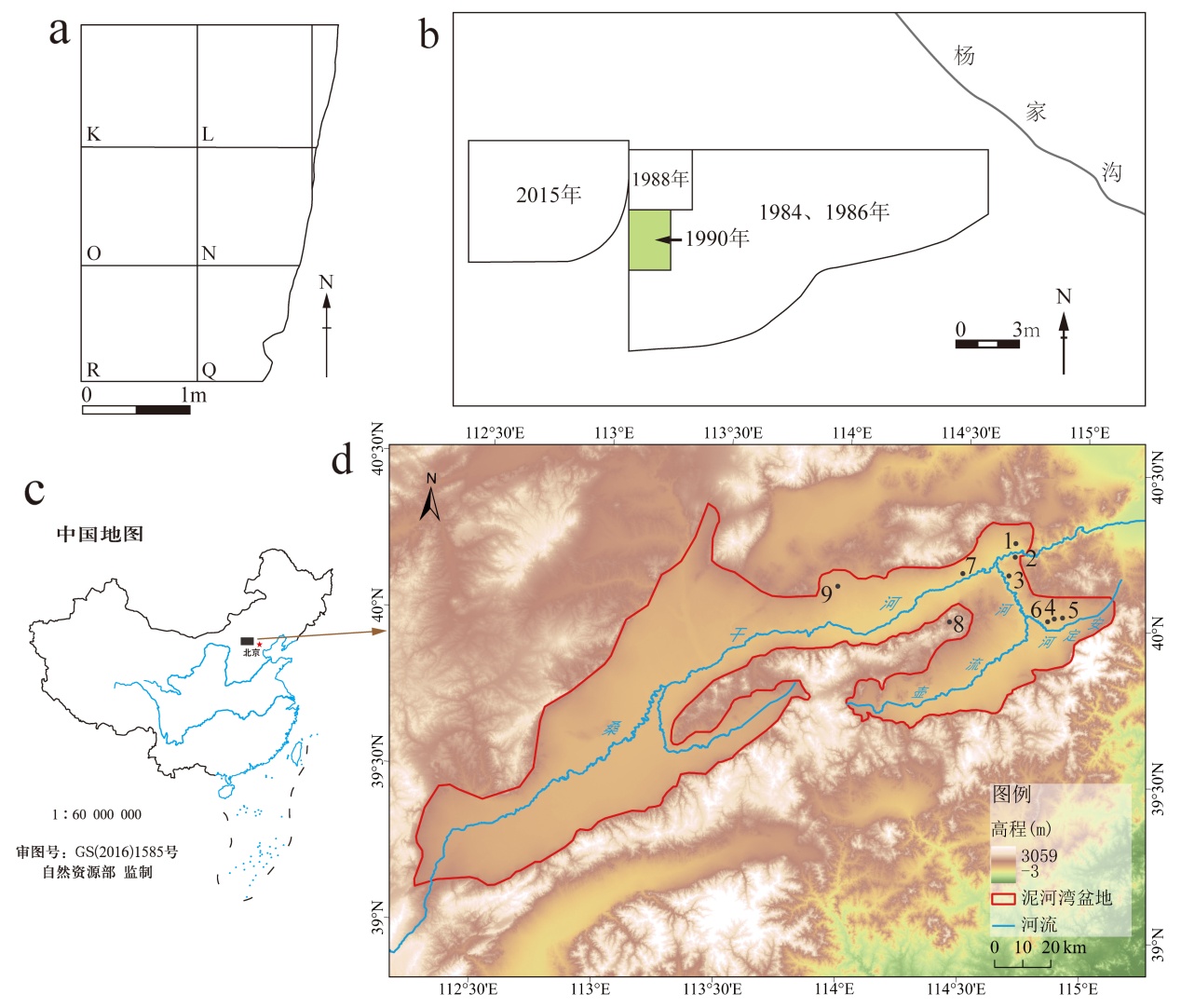
图1 板井子遗址第1地点地理位置与历年探方分布示意图 a.第1地点1990年探方布方示意图/Trench of Banjingzi locality 1 in 1990;b.第1地点历年探方分布Excavation trench of Banjingzi locality 1;c.泥河湾盆地地理位置Location of Nihewan basin。d.板井子遗址与泥河湾盆地主要中更新世晚期至晚更新世早期遗址分布 Location of Banjingzi site and some important sites from late middle Pleistocene to early late Pleistocene in the Nihewan basin:1.板井子 Banjingzi;2.油房北 Youfangbei;3.摩天岭 Motianling;4.吉家庄 Jijiazhuang;5.前上营 Qianshangying;6.东沟 Donggou;7.雀儿沟 Queergou;8.新庙庄 Xinmiaozhuang;9.许家窑-侯家窑Xujiayao-houjiayao
Fig.1 Location and excavation trench of Banjingzi site locality 1
| 类型types | 燧石chert | 石英quartz | 砂岩sandstone | 石英岩quartzite | 白云岩dolomite | 各类火成岩igneous | 合计total | |
|---|---|---|---|---|---|---|---|---|
| 石核core | 试打片石核test core | 25 | 1 | 1 | 27 | |||
| 普通石核casual core | 96 | 8 | 2 | 106 | ||||
| 局部两面partial bifacial core | 8 | 8 | ||||||
| 盘状石核discoid core | 9 | 9 | ||||||
| 石片flake | 普通石片ordinary flake | 300 | 2 | 3 | 1 | 3 | 4 | 313 |
| 边角石片lateral flake | 38 | 1 | 39 | |||||
| 长石片elongated flake | 10 | 10 | ||||||
| 剥片缘石片core edge flake | 3 | 3 | ||||||
| 悬突处理石片overhang flake | 22 | 22 | ||||||
| 再修理石片resharpening flake | 35 | 35 | ||||||
| 断片broken flake | 63 | 1 | 64 | |||||
| 裂片siret flake | 125 | 2 | 1 | 128 | ||||
| 石器tool | 边刮器side scraper | 211 | 19 | 1 | 3 | 4 | 238 | |
| 双刃刮削器double scraper | 9 | 9 | ||||||
| 聚刃刮削器convergent scraper | 10 | 1 | 1 | 1 | 13 | |||
| 横刃刮削器transversal scraper | 9 | 1 | 10 | |||||
| 端刃刮削器end scraper-like | 7 | 1 | 8 | |||||
| 锯齿刃器denticulate | 17 | 2 | 19 | |||||
| 凹缺器notch | 66 | 2 | 68 | |||||
| 锥钻器borer | 45 | 2 | 1 | 2 | 50 | |||
| 砍砸器chopper | 1 | 1 | ||||||
| 多刃器multiple-edge tool | 12 | 12 | ||||||
| 未定型undetermined | 42 | 4 | 1 | 47 | ||||
| 石器残段tool fragment | 6 | 2 | 8 | |||||
| 断块chunk | 497 | 10 | 10 | 7 | 524 | |||
| 碎片debris | 731 | 9 | 9 | 13 | 762 | |||
| 石锤hammerstone | 1 | 1 | 2 | |||||
| 总计total | 2400 | 64 | 4 | 2 | 31 | 34 | 2535 | |
表1 石制品类型与原料统计表
Tab.1 Types and raw materials of stone artifacts (n)
| 类型types | 燧石chert | 石英quartz | 砂岩sandstone | 石英岩quartzite | 白云岩dolomite | 各类火成岩igneous | 合计total | |
|---|---|---|---|---|---|---|---|---|
| 石核core | 试打片石核test core | 25 | 1 | 1 | 27 | |||
| 普通石核casual core | 96 | 8 | 2 | 106 | ||||
| 局部两面partial bifacial core | 8 | 8 | ||||||
| 盘状石核discoid core | 9 | 9 | ||||||
| 石片flake | 普通石片ordinary flake | 300 | 2 | 3 | 1 | 3 | 4 | 313 |
| 边角石片lateral flake | 38 | 1 | 39 | |||||
| 长石片elongated flake | 10 | 10 | ||||||
| 剥片缘石片core edge flake | 3 | 3 | ||||||
| 悬突处理石片overhang flake | 22 | 22 | ||||||
| 再修理石片resharpening flake | 35 | 35 | ||||||
| 断片broken flake | 63 | 1 | 64 | |||||
| 裂片siret flake | 125 | 2 | 1 | 128 | ||||
| 石器tool | 边刮器side scraper | 211 | 19 | 1 | 3 | 4 | 238 | |
| 双刃刮削器double scraper | 9 | 9 | ||||||
| 聚刃刮削器convergent scraper | 10 | 1 | 1 | 1 | 13 | |||
| 横刃刮削器transversal scraper | 9 | 1 | 10 | |||||
| 端刃刮削器end scraper-like | 7 | 1 | 8 | |||||
| 锯齿刃器denticulate | 17 | 2 | 19 | |||||
| 凹缺器notch | 66 | 2 | 68 | |||||
| 锥钻器borer | 45 | 2 | 1 | 2 | 50 | |||
| 砍砸器chopper | 1 | 1 | ||||||
| 多刃器multiple-edge tool | 12 | 12 | ||||||
| 未定型undetermined | 42 | 4 | 1 | 47 | ||||
| 石器残段tool fragment | 6 | 2 | 8 | |||||
| 断块chunk | 497 | 10 | 10 | 7 | 524 | |||
| 碎片debris | 731 | 9 | 9 | 13 | 762 | |||
| 石锤hammerstone | 1 | 1 | 2 | |||||
| 总计total | 2400 | 64 | 4 | 2 | 31 | 34 | 2535 | |
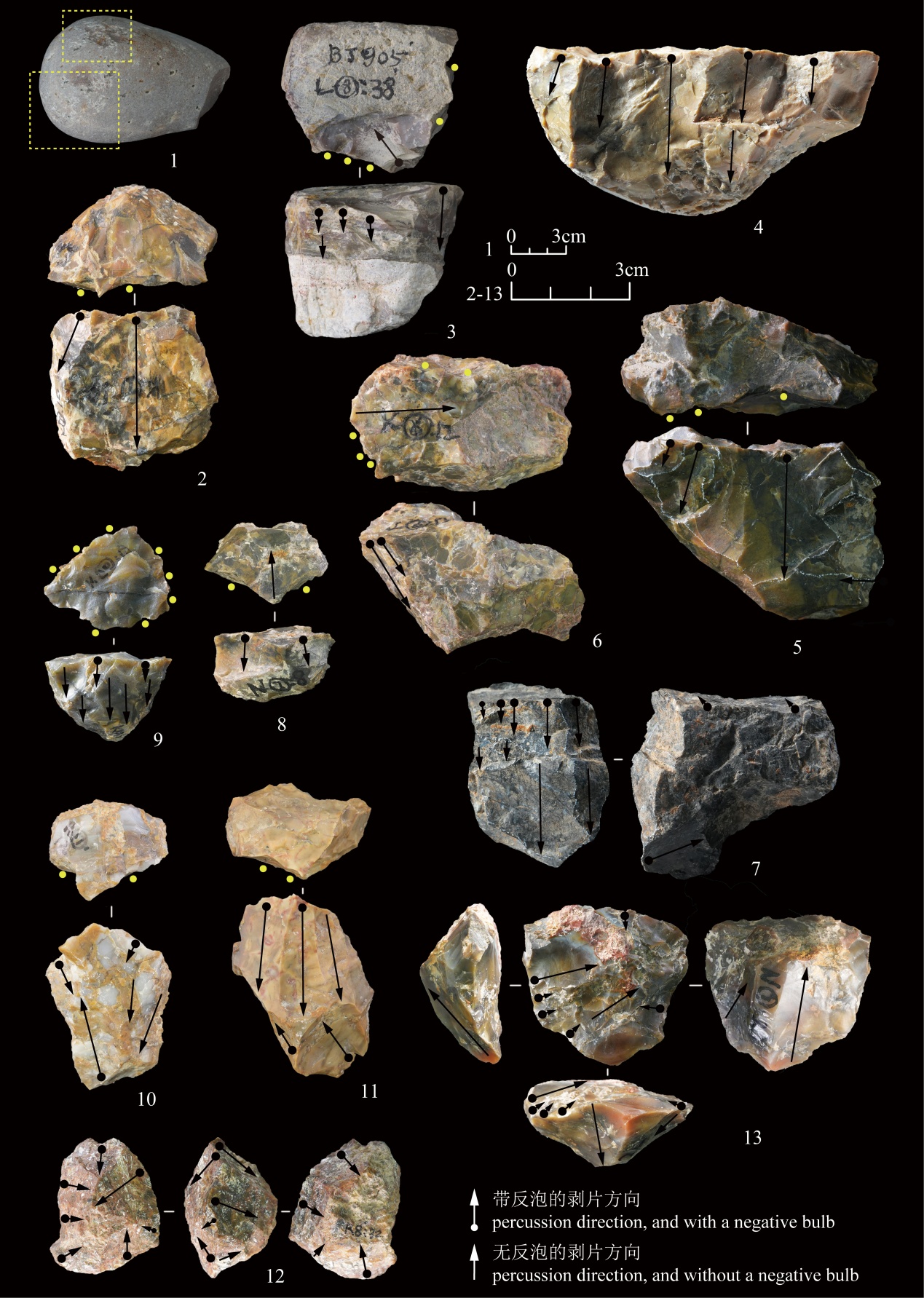
图2 板井子遗址第1地点1990年出土部分石锤、石核 1. 90BJL13-12,石锤hammerstone;2, 4, 7. 90BJK7-10, 90BJR18-1, 90BJL12-49,单台面石核single platform cores;3, 6, 8. 90BJL8-38, 90BJK6-12, 90BJN7-8,单台面石核(台面修理)single platform cores with platform treatments;5, 10. 90BJR8-23, 90BJR17-12,双台面石核double platform cores;9. 90BJK10-6,漏斗状石核funnel-shaped core;11. 90BJR10-20,多台面石核multiple platform core;12-13. 90BJR8-32, 90BJN7-21,盘状石核discoid cores
Fig.2 Hammerstone and cores excavated from Banjingzi site locality 1 in 1990
| 属性attributes | 试打片石核 test-core | 普通石核casual core | 局部两面石核 partial bifacial core | 盘状石核discoid core | |
|---|---|---|---|---|---|
| 核体长度core length (mm) | 区间range | 25.86~82.67 | 24~113 | 29.86~68.24 | 30~70.65 |
| 平均值mean | 45.33 | 45 | 46.08 | 48.2 | |
| 核体厚度core thickness (mm) | 区间range | 13.17~47.99 | 13.56~59.72 | 15.57~33.38 | 17.8~54.54 |
| 平均值mean | 24.33 | 25.53 | 22.9 | 30.8 | |
| 石核原型core blank (n) | 岩块/断块block | 27 | 100 | 8 | 8 |
| 石片flake | 4 | 1 | |||
| 砾石pebble | 2 | ||||
| 台面处理方式platform treatment (n) | 自然natural | 24 | 107 | ||
| 打击plain | 3 | 44 | |||
| 修理scarred | 26 | ||||
| 台面角platform angle | 54°~104° | 42°~113° | 52°~86° | 56°~87° | |
| 工作面数量debitage surface (n) | 1 | 27 | 28 | ||
| 2 | 50 | 8 | 9 | ||
| 3 | 19 | ||||
| ≥4 | 9 | ||||
| 剥片方向removal direction (n) | 同向single | 27 | 210 | 8 | |
| 对向opposite | 2 | ||||
| 侧向orthogonal | 10 | ||||
| 多向radial | 1 | 9 | |||
| 片疤数量total scar (n) | 1 | 27 | |||
| 2-3 | 34 | 3 | |||
| 4-5 | 39 | 2 | |||
| 6-7 | 22 | 1 | 4 | ||
| ≥8 | 11 | 2 | 5 |
表2 石核剥片属性统计表
Tab.2 Attributes of cores
| 属性attributes | 试打片石核 test-core | 普通石核casual core | 局部两面石核 partial bifacial core | 盘状石核discoid core | |
|---|---|---|---|---|---|
| 核体长度core length (mm) | 区间range | 25.86~82.67 | 24~113 | 29.86~68.24 | 30~70.65 |
| 平均值mean | 45.33 | 45 | 46.08 | 48.2 | |
| 核体厚度core thickness (mm) | 区间range | 13.17~47.99 | 13.56~59.72 | 15.57~33.38 | 17.8~54.54 |
| 平均值mean | 24.33 | 25.53 | 22.9 | 30.8 | |
| 石核原型core blank (n) | 岩块/断块block | 27 | 100 | 8 | 8 |
| 石片flake | 4 | 1 | |||
| 砾石pebble | 2 | ||||
| 台面处理方式platform treatment (n) | 自然natural | 24 | 107 | ||
| 打击plain | 3 | 44 | |||
| 修理scarred | 26 | ||||
| 台面角platform angle | 54°~104° | 42°~113° | 52°~86° | 56°~87° | |
| 工作面数量debitage surface (n) | 1 | 27 | 28 | ||
| 2 | 50 | 8 | 9 | ||
| 3 | 19 | ||||
| ≥4 | 9 | ||||
| 剥片方向removal direction (n) | 同向single | 27 | 210 | 8 | |
| 对向opposite | 2 | ||||
| 侧向orthogonal | 10 | ||||
| 多向radial | 1 | 9 | |||
| 片疤数量total scar (n) | 1 | 27 | |||
| 2-3 | 34 | 3 | |||
| 4-5 | 39 | 2 | |||
| 6-7 | 22 | 1 | 4 | ||
| ≥8 | 11 | 2 | 5 |
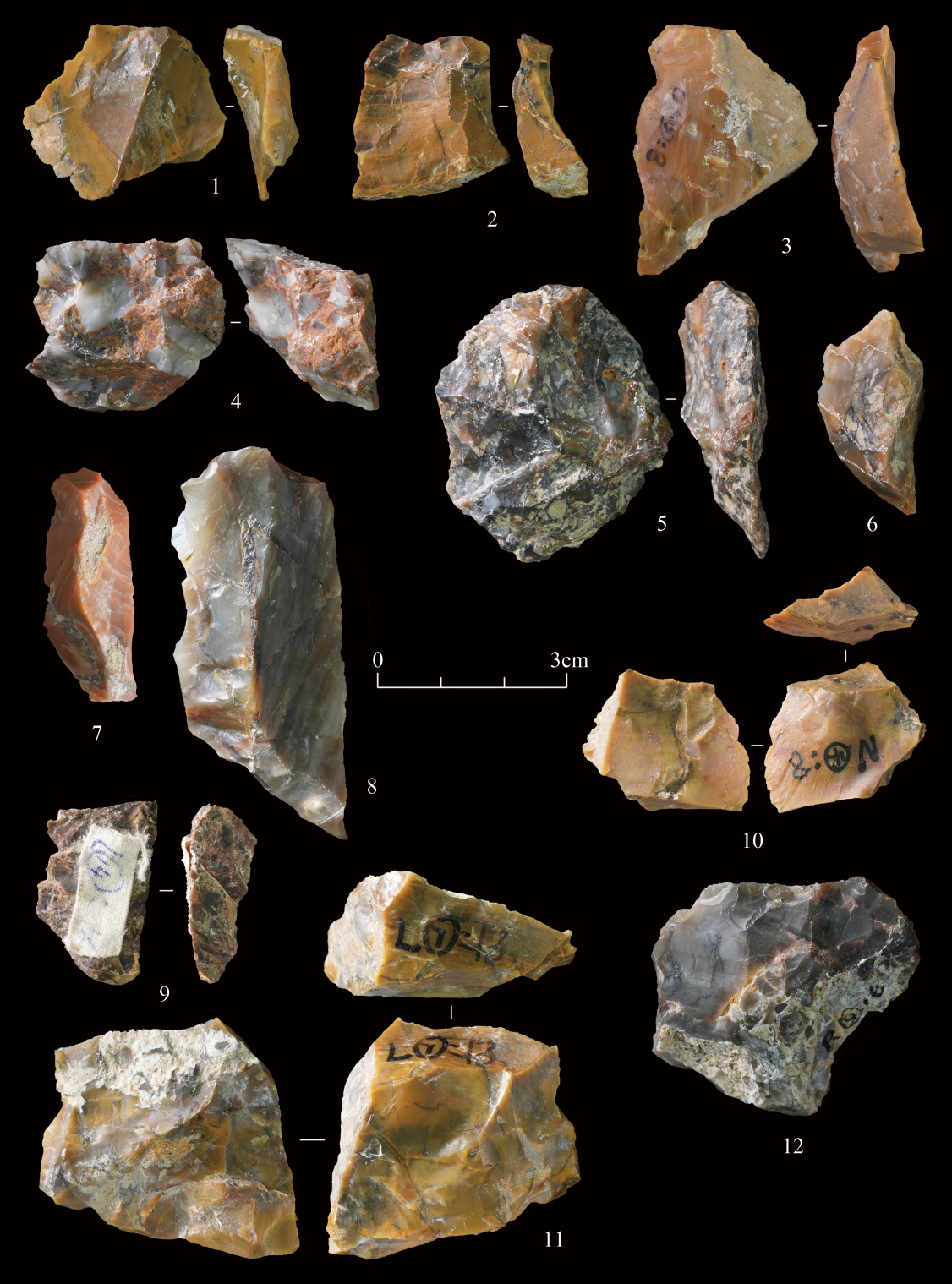
图3 板井子遗址第1地点1990年出土部分石片 1-2. 90BJR9-10, 90BJK14-17,完整石片(同向背疤)whole flakes with dorsal scars from proximal end;3-4. 90BJO15-8, 90BJO11-12,完整石片(侧向背疤)whole flakes with lateral dorsal scars;5. 90BJO18-2,完整石片(多向背疤)whole flake with radial dorsal scars;6. 90BJO7-28,盘状石核剥片缘石片core edge flake of discoid core;7-8. 90BJN9-11, 90BJN8-16,长石片elongated flakes;9. 90BJL14-16,裂片splinter;10-11. 90BJN4-8, 90BJL7-13,边角石片lateral flakes;12. 90BJR9-6,悬突处理石片flake of chipped overhang
Fig.3 Flakes excavated from Banjingzi site locality 1 in 1990
| 类型types | 普通石片whole flake | 边角石片lateral flake | 长石片elongated flake | 剥片缘石片 core edge flake | 悬突处理石片overhang flake | 再修理石片resharpening flake | |
|---|---|---|---|---|---|---|---|
| 台面性质platform type | 自然natural | 19 | |||||
| 素plain | 289 | 39 | 10 | 3 | 21 | 35 | |
| 脊状dihedral | 2 | 1 | |||||
| 修理faceted | 1 | ||||||
| 零台面null | 2 | ||||||
| 背疤数量 dorsal scar | 0 | 15 | |||||
| 1~2 | 210 | 30 | 5 | 1 | 3 | ||
| 3~4 | 81 | 8 | 5 | 2 | 14 | 29 | |
| ≧5 | 7 | 1 | 5 | 6 | |||
| 背疤方向dorsal scar direction | 同向single | 235 | 23 | 6 | 1 | 35 | |
| 侧向orthogonal | 49 | 15 | 4 | 2 | |||
| 对向opposite | 10 | 1 | |||||
| 多向radial | 4 | ||||||
| 背脊数量 dorsal ridge | 纵脊longitudinal | 152 | 26 | 10 | 3 | 10 | 4 |
| Y形/Y shape | 5 | ||||||
| 其他other | 21 | 2 | 3 | ||||
| 无none | 135 | 11 | 9 | 31 | |||
表3 完整石片非测量属性统计表
Tab.3 Non-metrical attributes of whole flakes (n)
| 类型types | 普通石片whole flake | 边角石片lateral flake | 长石片elongated flake | 剥片缘石片 core edge flake | 悬突处理石片overhang flake | 再修理石片resharpening flake | |
|---|---|---|---|---|---|---|---|
| 台面性质platform type | 自然natural | 19 | |||||
| 素plain | 289 | 39 | 10 | 3 | 21 | 35 | |
| 脊状dihedral | 2 | 1 | |||||
| 修理faceted | 1 | ||||||
| 零台面null | 2 | ||||||
| 背疤数量 dorsal scar | 0 | 15 | |||||
| 1~2 | 210 | 30 | 5 | 1 | 3 | ||
| 3~4 | 81 | 8 | 5 | 2 | 14 | 29 | |
| ≧5 | 7 | 1 | 5 | 6 | |||
| 背疤方向dorsal scar direction | 同向single | 235 | 23 | 6 | 1 | 35 | |
| 侧向orthogonal | 49 | 15 | 4 | 2 | |||
| 对向opposite | 10 | 1 | |||||
| 多向radial | 4 | ||||||
| 背脊数量 dorsal ridge | 纵脊longitudinal | 152 | 26 | 10 | 3 | 10 | 4 |
| Y形/Y shape | 5 | ||||||
| 其他other | 21 | 2 | 3 | ||||
| 无none | 135 | 11 | 9 | 31 | |||
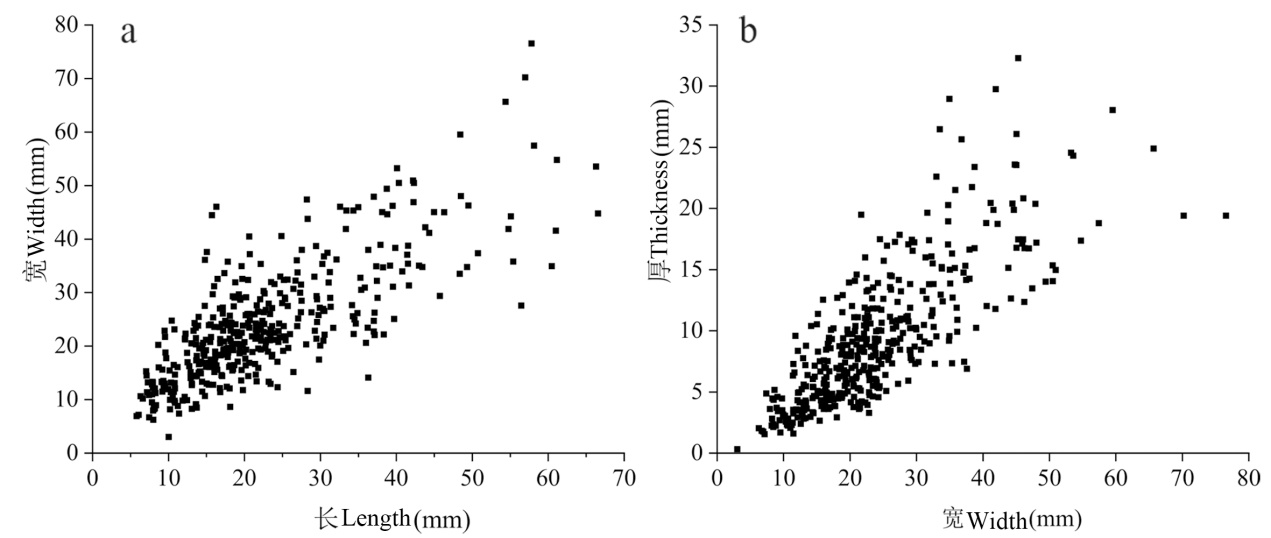
图4 板井子遗址第1地点1990年完整石片尺寸分布 a.完整石片的长与宽length and width of whole flakes; b.完整石片的宽与厚width and thickness of whole flakes
Fig.4 Size distribution of whole flakes excavated from Banjingzi site locality 1 in 1990
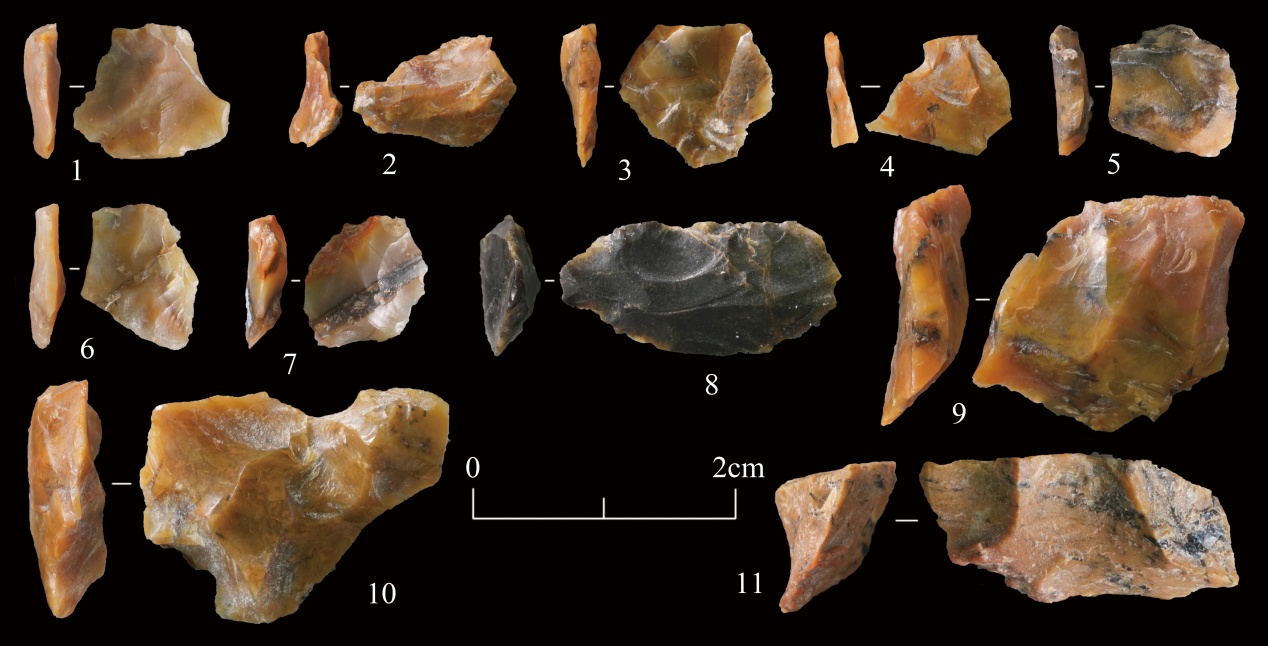
图5 板井子遗址第1地点1990年出土部分再修理石片
Fig.5 Resharpening flakes excavated from Banjingzi site locality 1 in 1990
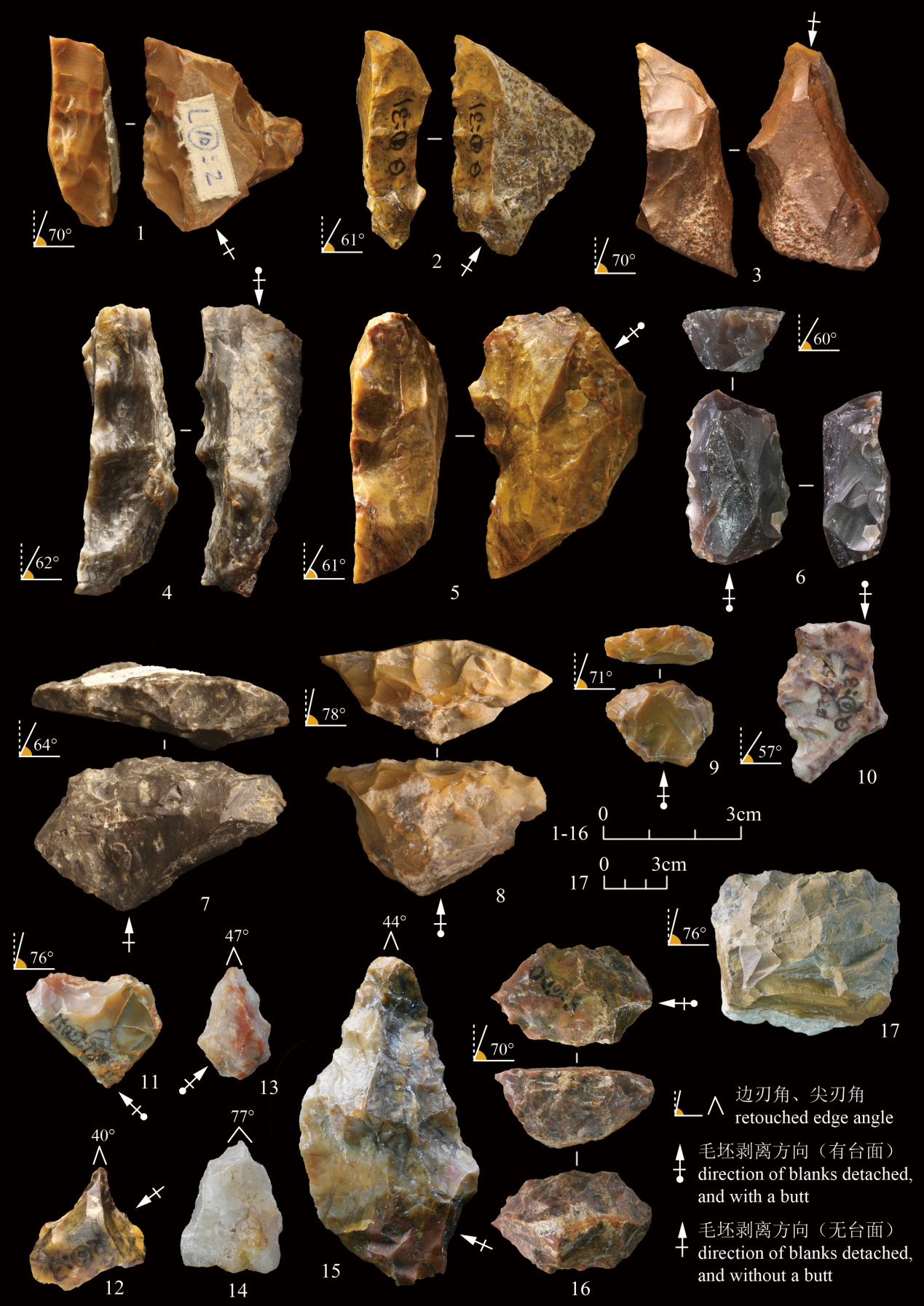
图6 板井子遗址第1地点1990年出土部分石器 1-5. 90BJL10-2, 90BJQ8-31, 90BJN16-21, 90BJO8-16, 90BJK21-1,边刮器side scrapers;6. 90BJK5-36,双刃刮削器double scraper;7, 8. 90BJK6-9, 90BJL8-8,横刃刮削器transversal scraper;9. 90BJL12-39,端刃刮削器end scraper-like tool;10. 90BJQ6-37,锯齿刃器denticulate;11. 90BJK16-18,凹缺器notch;12-15. 90BJR6-3, 90BJN15-7, 90BJN8-52, 90BJN19-7,锥钻器borer;16. 90BJQ10-13,高背石器undetermined tool;17. 90BJO16-24,砍砸器chopper
Fig.6 Retouched tools excavated from Banjingzi site locality 1 in 1990
| 类型types | 石核core | 完整石片whole flake | 边角石片lateral flake | 长石片 elongated flake | 断片 broken flake | 裂片splinter | 断块chunk | 砾石pebble |
|---|---|---|---|---|---|---|---|---|
| 边刮器side scraper | 7 | 96 | 4 | 4 | 10 | 40 | 76 | 1 |
| 双刃刮削器double scraper | 2 | 1 | 5 | 1 | ||||
| 聚刃刮削器convergent scraper | 8 | 1 | 4 | |||||
| 横刃刮削器transversal scraper | 10 | |||||||
| 端刃刮削器endscraper-like | 6 | 2 | ||||||
| 锯齿刃器denticulate | 5 | 1 | 2 | 6 | 5 | |||
| 凹缺器notch | 29 | 2 | 7 | 29 | 1 | |||
| 锥钻器borer | 27 | 9 | 14 | |||||
| 砍砸器chopper | 1 | |||||||
| 多刃器multiple-edge tool | 6 | 1 | 5 | |||||
| 未定型undetermined | 16 | 1 | 4 | 26 | ||||
| 石器残段tool fragment | 1 | 7 | ||||||
| 合计total | 7 | 206 | 8 | 9 | 13 | 70 | 168 | 2 |
表4 石器毛坯统计表
Tab.4 Blanks of retouched tools (n)
| 类型types | 石核core | 完整石片whole flake | 边角石片lateral flake | 长石片 elongated flake | 断片 broken flake | 裂片splinter | 断块chunk | 砾石pebble |
|---|---|---|---|---|---|---|---|---|
| 边刮器side scraper | 7 | 96 | 4 | 4 | 10 | 40 | 76 | 1 |
| 双刃刮削器double scraper | 2 | 1 | 5 | 1 | ||||
| 聚刃刮削器convergent scraper | 8 | 1 | 4 | |||||
| 横刃刮削器transversal scraper | 10 | |||||||
| 端刃刮削器endscraper-like | 6 | 2 | ||||||
| 锯齿刃器denticulate | 5 | 1 | 2 | 6 | 5 | |||
| 凹缺器notch | 29 | 2 | 7 | 29 | 1 | |||
| 锥钻器borer | 27 | 9 | 14 | |||||
| 砍砸器chopper | 1 | |||||||
| 多刃器multiple-edge tool | 6 | 1 | 5 | |||||
| 未定型undetermined | 16 | 1 | 4 | 26 | ||||
| 石器残段tool fragment | 1 | 7 | ||||||
| 合计total | 7 | 206 | 8 | 9 | 13 | 70 | 168 | 2 |
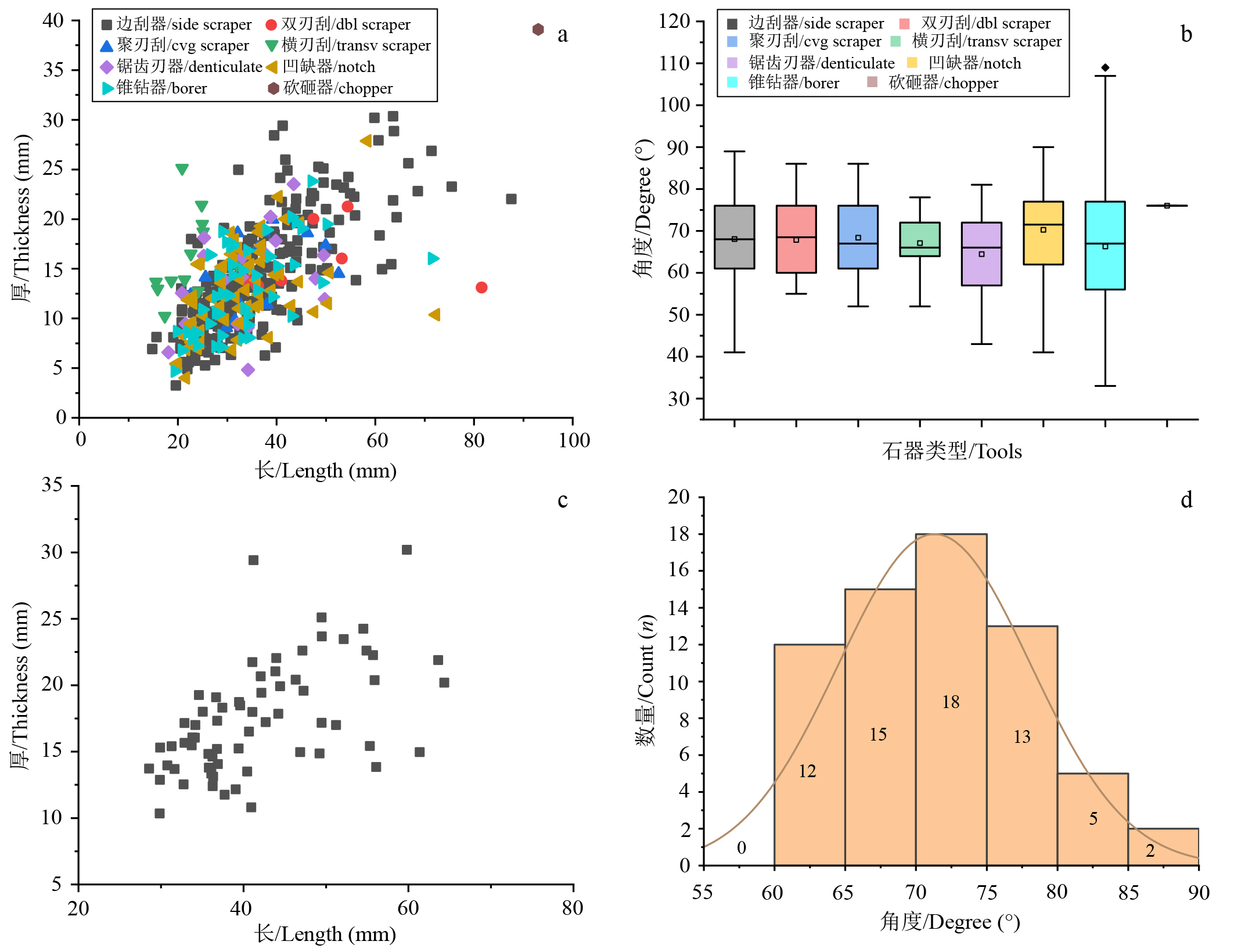
图7 板井子遗址第1地点1990年主要石器类型尺寸与角度统计 a.石器的长与厚length and width of tools;b.石器的边刃角与尖刃角retouched edge angle of tools; c.陡刃厚边刮削器的长与厚length and thickness of steep retouched scrapers; d.陡刃厚边刮削器的边刃角retouched edge angle of steep retouched scrapers
Fig.7 Size and retouched edge angle of tools excavated from Banjingzi site locality 1 in 1990
| [1] |
Ren JC, Li F, Chen FY, et al. Lithic technology at Banjingzi Locality 1: Implications for the Middle Paleolithic in northern China[J]. Journal of Archaeological Science: Reports, 2025, 65: 105193
doi: 10.1016/j.jasrep.2025.105193 URL |
| [2] | 李炎贤, 谢飞, 石金鸣. 河北阳原板井子石制品的初步研究[A].见:中国科学院古脊椎动物与古人类研究所参加第四纪大会论文选[C]. 北京: 科学出版社, 1991, 74-99 |
| [3] | 石金鸣. 板井子石工业探折[J]. 山西大学学报(哲学社会科学版), 1992, 4: 15-18 |
| [4] | 谢飞, 李珺, 刘连强. 泥河湾旧石器文化[M]. 石家庄: 花山文艺出版社, 2006 |
| [5] | 山西博物院, 河北省文物研究所. 河北阳原板井子旧石器时代遗址1988年发掘报告[A].见:河北省文物研究所(编). 河北省考古文集(五)[C]. 北京: 科学出版社, 2014, 1-28 |
| [6] | 任进成, 李锋, 王晓敏, 等. 河北阳原县板井子旧石器时代遗址2015年发掘简报[J]. 考古, 2018, 11: 3-14+2 |
| [7] |
Guo YJ, Li B, Zhang JF, et al. Luminescence ages for three ‘Middle Palaeolithic’ sites in the Nihewan Basin, northern China, and their archaeological and palaeoenvironmental implications[J]. Quaternary Research, 2016, 85(3): 456-470
doi: 10.1016/j.yqres.2016.03.002 URL |
| [8] | 卫奇. 石制品观察格式探讨[A].见:邓涛,王原(主编).第八届古脊椎动物学术年会文集[C]. 北京: 海洋出版社, 2001, 209-218 |
| [9] | Boëda E. Le débitage discoïde et le débitage Levallois récurrent centripède[J]. Bulletin de la Société Préhistorique Fran-çaise, 1993, 90(6): 392-404 |
| [10] | Vaquero M, Carbonell E. A temporal perspective on the variability of the discoid method in the Iberian Peninsula[A]. In: Peresani M (Ed.). Discoid Lithic Technology: advances and implications[C]. BAR International Series 1120, Oxford: Archaeopress, 2003, 67-82 |
| [11] |
Picin A, Vaquero M, Weniger G, et al. Flake morphologies and patterns of core configuration at the Abric Romaní rock-shelter: A geometric morphometric approach[J]. Quaternary International, 2014, 350: 84-93
doi: 10.1016/j.quaint.2014.05.004 URL |
| [12] |
Yee MK. The Middle Palaeolithic in China: a review of current interpretations[J]. Antiquity, 2012, 86: 619-626
doi: 10.1017/S0003598X00047803 URL |
| [13] |
Li F. Fact or fiction: the Middle Palaeolithic in China[J]. Antiquity, 2014, 88: 1303-1309
doi: 10.1017/S0003598X00115479 URL |
| [14] |
Li H, Li ZY, Gao X, et al. Technological behavior of the early Late Pleistocene archaic humans at Lingjing (Xuchang, China)[J]. Archaeological and Anthropological Sciences, 2019, 11(7): 3477-3490
doi: 10.1007/s12520-018-0759-7 |
| [15] |
Sherratt A. Climatic cycles and behavioural revolutions: the emergence of modern humans and the beginning of farming[J]. Antiquity, 1997, 71(272): 271-287
doi: 10.1017/S0003598X00084908 URL |
| [16] |
Bar-Yosef O, Kuhn SL. The big deal about blades: laminar technologies and human evolution[J]. American Anthropologist, 1999, 101: 322-338
doi: 10.1525/aa.1999.101.2.322 URL |
| [17] |
Johnson CR, McBrearty S. 500000 year old blades from the Kapthurin Formation, Kenya[J]. Journal of Human Evolution, 2010, 58(2): 193-200
doi: 10.1016/j.jhevol.2009.10.001 pmid: 20042224 |
| [18] |
Fontana F, Moncel MH, Nenzioni G, et al. Widespread diffusion of technical innovations around 300,000 years ago in Europe as a reflection of anthropological and social transformations? New comparative data from the western Mediterranean sites of Orgnac (France) and Cave dall’Olio (Italy)[J]. Journal of Anthropological Archaeology, 2013, 32(4): 478-498
doi: 10.1016/j.jaa.2013.08.003 URL |
| [19] |
Li F, Kuhn SL, Olsen JW, et al. Disparate stone age technological evolution in North China: Lithic technological variability and relations between populations during MIS 3[J]. Journal of Anthropological Research, 2014, 70(1): 35-67
doi: 10.3998/jar.0521004.0070.103 URL |
| [20] | 李锋, 陈福友, 汪英华, 等. 晚更新世晚期中国北方石叶技术所反映的技术扩散与人群迁移[J]. 中国科学:地球科学, 2016, 46(7): 891-905 |
| [21] | 加藤真二. 中国的石叶技术[J]. 人类学学报, 2006, 25(4): 343-351 |
| [22] | 王法岗. 侯家窑遗址综合研究[D].博士学位论文, 石家庄: 河北师范大学, 2016 |
| [23] | Turq A. Raw material and technological studies of the Quina Mousterian[A]. In: Dibble HL, Mellars P(Eds.). The Middle Palaeolithic: Adaptation, Behavior, and Variability[C]. Philadelphia: University of Pennsylvania, 1992, 75-85 |
| [24] |
Delpiano D, Zupancich A, Bertola S, et al. Flexibility within Quina lithic production systems and tool-use in Northern Italy: implications on Neanderthal behavior and ecology during early MIS 4[J]. Archaeological and Anthropological Sciences, 2022, 14(12): 219
doi: 10.1007/s12520-022-01684-2 |
| [25] | Hiscock P, Turq A, Faivre JP. et al. Quina procurement and tool production[A]. In: Adams B, Blades BS(Eds.). Lithic Materials and Paleolithic Societies[C]. Chichester: Wiley-Blackwell, 2009, 232-246 |
| [26] |
Agam A, Zupancich A. Interpreting the Quina and demi-Quina scrapers from Acheulo-Yabrudian Qesem Cave, Israel: Results of raw materials and functional analyses[J]. Journal of Human Evolution, 2020, 144: 102798
doi: 10.1016/j.jhevol.2020.102798 URL |
| [27] | Ruan QJ, Li H, Xiao PY, et al. Quina lithic technology indicates diverse Late Pleistocene human dynamics in East Asia[J]. Proceedings of the National Academy of Sciences, 2025, 122(14): e2418029122 |
| [28] | Bourguignon L, Soriano S, Claud E, et al. The presence of Quina lithic technology in China 50 to 60 ka ago remains a hypothesis[J]. Proceedings of the National Academy of Sciences, 2025, 122(40): e2518182122 |
| [29] | 刘武. 二十一世纪中国人类演化研究的发现、认识与理论探索[J]. 人类学学报, 2024, 43(6): 881-899 |
| [30] |
Fu QM, Bai F, Rao HY, et al. The proteome of the late Middle Pleistocene Harbin individual[J]. Science, 2025, 389(6761): 704-707
doi: 10.1126/science.adu9677 pmid: 40531192 |
| [1] | 马超, 铁卫冬, 裘文雁, 薛峰, 牛东伟, 侯佳岐, 王法岗. 泥河湾盆地武家梁1号旧石器地点发掘简报[J]. 人类学学报, 2026, 45(05): 939-947. |
| [2] | 裴树文, 牛东伟, 马东东. 泥河湾盆地蔚县中更新世古人类活动遗址的发现与科学价值[J]. 人类学学报, 2026, 45(03): 403-418. |
| [3] | 牛东伟, 刘尔凡, 薛峰, 谢飞. 河北怀来盆地古人类文化遗存的考古发现与研究[J]. 人类学学报, 2026, 45(03): 419-435. |
| [4] | 单佳璐, 李怡晓, 王法岗, 郭玉杰, 李锋. 泥河湾盆地新庙庄遗址2号地点2018年发现材料初步研究[J]. 人类学学报, 2026, 45(03): 447-461. |
| [5] | 沈柯, 李锋, 王晓敏, 王法岗, 郭北姮, 高星. 板井子遗址第2地点2023~2024年发掘报告[J]. 人类学学报, 2026, 45(03): 462-477. |
| [6] | 王心蕊, 张芷瑶, 黄冰柔, 王法岗, 郭玉杰. 泥河湾盆地武家梁旧石器遗址1号地点的光释光测年[J]. 人类学学报, 2026, 45(03): 489-499. |
| [7] | 耿帅杰, 裴树文, 杜雨薇, 徐静玥, 叶芷, 刘子仪. 泥河湾盆地蔚县蔡家沟遗址A地点发掘简报[J]. 人类学学报, 2026, 45(03): 500-514. |
| [8] | 叶芷, 裴树文, 马东东, 贾真秀, 王法岗, 杨海勇. 泥河湾盆地蔚县前上营遗址B地点发掘报告[J]. 人类学学报, 2026, 45(03): 515-531. |
| [9] | 刘子仪, 耿帅杰, 丁馨, 徐静玥, 叶芷, 牛东伟, 裴树文. 泥河湾盆地蔚县北官堡遗址B地点的埋藏过程[J]. 人类学学报, 2026, 45(03): 556-569. |
| [10] | 杜雨薇, 耿帅杰, 徐静玥, 叶芷, 张乐, 马东东, 裴树文. 泥河湾盆地蔡家沟遗址A和B地点动物骨骼的埋藏学观察[J]. 人类学学报, 2026, 45(03): 570-585. |
| [11] | 赵海龙, 周天路, 马冲, 杨博灿, 贾倩. 河北泥河湾盆地东缘石器原料的开发与利用[J]. 人类学学报, 2026, 45(01): 34-45. |
| [12] | 徐建炜, 刘连强, 成小雨, 赵永胜, 侯佳岐, 王法岗. 泥河湾盆地奶奶庙沟遗址2015年出土的石制品[J]. 人类学学报, 2025, 44(04): 556-567. |
| [13] | 李燊, 任雪岩, 刘连强, 杨石霞, 岳健平, 王法岗. 泥河湾盆地半山遗址2003年出土的石制品[J]. 人类学学报, 2025, 44(02): 193-200. |
| [14] | 徐静玥, 何湘栋, 牛东伟, 李潇丽. 泥河湾盆地蔚县东沟旧石器遗址的埋藏过程[J]. 人类学学报, 2024, 43(06): 1075-1090. |
| [15] | 裴树文, 王法岗, 牛东伟. 二十一世纪以来泥河湾盆地古人类活动的发现与研究进展[J]. 人类学学报, 2024, 43(06): 913-933. |
| 阅读次数 | ||||||
|
全文 |
|
|||||
|
摘要 |
|
|||||
 京ICP证05002819号-3
